seamus dubhghaill

Promoting Irish Culture and History from Little Rock, Arkansas, USA


Leave a comment

Death of Edmund Mortimer, 3rd Earl of March

Edmund Mortimer, 3rd Earl of March and jure uxoris Earl of Ulster, is killed at Cork on December 27, 1381. His sudden death leaves the colony without effective leadership and prompts a military crisis.

Mortimer, the son of Roger Mortimer, 2nd Earl of March, by his wife Philippa, daughter of William Montagu, 1st Earl of Salisbury and Catherine Grandison, is born on February 1, 1352. An infant at the death of his father, as a ward of the crown he is placed by Edward III of England under the care of William of Wykeham and Richard FitzAlan, 3rd Earl of Arundel. The position of the young earl, powerful on account of his possessions and hereditary influence in the Welsh marches, is rendered still more important by his marriage on August 24, 1369 at the age of 17 to the 14-year-old Philippa, the only child of the late Lionel of Antwerp, 1st Duke of Clarence, the second son of Edward III.

Lionel’s late wife, Elizabeth, had been daughter and heiress of William Donn de Burgh, 3rd Earl of Ulster, and Lionel had himself been created Earl of Ulster before his marriage. Mortimer inherits the title Earl of Ulster on Lionel’s death. Therefore, the Earl of March not only represents one of the chief Anglo-Norman lordships in Ireland in right of his wife Philippa, but Philippa’s line is also the second most senior line of descent in the succession to the crown, after Edward the Black Prince and his son, King Richard II of England. John of Gaunt, younger brother of Prince Edward, had become the 1st Duke of Lancaster and thus the source of the House of Lancaster‘s claim to the throne.

This marriage has, therefore, far-reaching consequences in English history, ultimately giving rise to the claim of the House of York to the crown of England contested in the Wars of the Roses between the Yorks and the Lancasters; Edward IV being descended from the second adult son of Edward III as great-great-grandson of Philippa, countess of March, and in the male line from Edmund of Langley, 1st Duke of York and the fourth adult son of Edward III. Mortimer’s son, Roger Mortimer, 4th Earl of March, becomes heir presumptive to the English crown during the reign of Richard II.

Mortimer, now styled Earl of March and Ulster, becomes Earl Marshal of England in 1369, and is employed in various diplomatic missions during the following years. He is a member of the committee appointed by the Peers to confer with the Commons in 1373, the first instance of such a joint conference since the institution of representative parliaments on the question of granting supplies for John of Gaunt’s war in France.

Mortimer participates in the opposition to Edward III and the court party, which grows in strength towards the end of the reign, taking the popular side and being prominent in the Good Parliament of 1376 among the lords who support the Prince of Wales and oppose the Court Party and John of Gaunt. The Speaker of the House of Commons in this parliament is Mortimer’s steward, Peter de la Mare, who firmly withstands John of Gaunt in stating the grievances of the Commons, in supporting the impeachment of several high court officials, and in procuring the banishment of the king’s mistress, Alice Perrers. Mortimer is a member of the administrative council appointed by the same parliament after the death of Edward, the Black Prince, to attend the king and advise him in all public affairs.

Following the end of the Good Parliament its acts are reversed by John of Gaunt, Mortimer’s steward is jailed, and he himself is ordered to inspect Calais and other remote royal castles as part of his duty as Marshal of England. He instead chooses to resign the post.

On the accession of Richard II in 1377, Mortimer becomes a member of the standing council of government; though as husband of the heir-presumptive to the crown he wisely refrains from claiming any actual administrative office. The richest and most powerful person in the realm is, however, the king’s uncle John of Gaunt, whose jealousy leads Mortimer to accept the office of Lord Lieutenant of Ireland in 1379. He succeeds in asserting his authority in eastern Ulster, but fails to subdue the O’Neill dynasty farther west. Proceeding to Munster to put down the turbulent southern chieftains, he is killed at Cork on December 27, 1381. He is buried in Wigmore Abbey, of which he had been a benefactor, and where his wife Philippa is also interred.

(Pictured: Coat of Arms of the House of Mortimer)


Leave a comment

Death of Thomas Dongan, Governor of the Province of New York

Thomas Dongan, 2nd Earl of Limerick, a member of the Irish Parliament, Royalist military officer during the English Civil War, and Governor of the Province of New York, dies in London on December 14, 1715. He is noted for having called the first representative legislature in New York and for granting the province’s Charter of Liberties.

Dongan is born in 1634 into an old Gaelic Norman (Irish Catholic) family in Castletown Kildrought (now Celbridge), County Kildare. He is the seventh and youngest son of Sir John Dongan, Baronet, Member of the Irish Parliament, and his wife Mary Talbot, daughter of Sir William Talbot, 1st Baronet and Alison Netterville. As Stuart supporters, following the overthrow of King Charles I, the family goes to King Louis XIV‘s France, although they manage to hold onto at least part of their Irish estates. His family gives their name to the Dongan Dragoons, a premier military regiment.

While in France, Dongan serves in an Irish regiment with Henri de La Tour d’Auvergne, Viscount of Turenne. He stays in France after the Restoration and achieves the rank of colonel in 1674.

After the Treaty of Nijmegen ends the Franco-Dutch War in 1678, Dongan returns to England in obedience to the order that recalls all English subjects fighting in service to France. Fellow officer James, Duke of York, arranges to have him granted a high-ranking commission in the army designated for service in Flanders and a pension. That same year, he is appointed Lieutenant-Governor of English Tangier, which had been granted to England as part of the dowry of Catherine of Braganza. He serves as part of the Tangier Garrison which defends the settlement.

In September 1682, James, Lord Proprietor of the Province of New York, appoints Dongan as Vice-admiral in the Navy and provincial governor (1683–1688) to replace Edmund Andros. James also grants him an estate on Staten Island. The estate eventually becomes the town of Castleton. Later, another section of the island is named Dongan Hills in honour of Dongan.

Dongan lands in Boston on August 10, 1683, crosses Long Island Sound, and passes through the small settlements in the eastern part of the island as he makes his way to Fort James, arriving on August 25.

At the time of Dongan’s appointment, the province is bankrupt and in a state of rebellion. He is able to restore order and stability. On October 14, 1683, he convenes the first-ever representative assembly in New York history at Fort James. The New York General Assembly, under the wise supervision of Dongan, passes an act entitled “A Charter of Liberties.” It decrees that the supreme legislative power under the Duke of York shall reside in a governor, council, and the people convened in general assembly; confers upon the members of the assembly rights and privileges making them a body coequal to and independent of the British Parliament; establishes town, county, and general courts of justice; solemnly proclaims the right of religious liberty; and passes acts enunciating certain constitutional liberties; right of suffrage; and no martial law or quartering of the soldiers without the consent of the inhabitants.

Dongan soon incurs the ill will of William Penn who is negotiating with the Iroquois for the purchase of the upper Susquehanna Valley. Dongan goes to Albany and declares that the sale would be “prejudicial to His Highness’s interests.” The Cayugas sell the property to New York with the consent of the Mohawk. Years later, when back in England and in favor at the Court of James, Penn uses his influence to prejudice the king against Dongan.

On July 22, 1686, Governor Dongan grants Albany a municipal charter. Almost identical in form to the charter awarded to New York City just three months earlier, the Albany charter is the result of negotiations conducted between royal officials and Robert Livingston and Pieter Schuyler. The charter incorporates the city of Albany, establishing a separate municipal entity in the midst of the Van Rensselaer Manor.

Dongan establishes the boundary lines of the province by settling disputes with Connecticut on the east, with the French Governor of Canada on the north, and with Pennsylvania on the south, thus marking out the present limits of New York State.

James later consolidates the colonial governments of New York, New Jersey and the United Colonies of New England into the Dominion of New England and appoints Edmund Andros, the former Governor-General of New York, as Governor-General. Dongan transfers his governorship back to Andros on August 11, 1688.

Dongan executes land grants establishing several towns throughout New York State including the eastern Long Island communities of East Hampton and Southampton. These grants, called the Dongan Patents, set up Town Trustees as the governing bodies with a mission of managing common land for common good. The Dongan Patents still hold force of law and have been upheld by the Supreme Court of the United States with the Trustees—rather than town boards, city councils or even the State Legislature—still managing much of the common land in the state.

Dongan lives in London for the last years of his life and dies on December 14, 1715. He is buried in the St. Pancras Old Church churchyard, London.

(Pictured: Portrait of Thomas Dongan, 2nd Earl of Limerick, from Castleton Manor, Staten Island licensed under the Creative Commons Attribution-Share Alike 4.0 International license)


Leave a comment

Death of Marie-Louise O’Murphy, Mistress of Louis XV

Marie-Louise O’Murphy, one of the lesser mistresses of King Louis XV of France and possibly the model for the famous painting by François Boucher, dies in Paris on December 11, 1814.

O’Murphy is born in Rouen, France on October 21, 1737 as the youngest of twelve children of Daniel Morfi and Marguerite Iquy, a family of Irish origin. Her parents have well-known criminal histories. Her father was involved in a case of espionage and blackmail while her mother was accused of prostitution and theft. She and her sisters are also known for being involved in prostitution.

Contemporary and modern historiography believe O’Murphy is the very young model who posed for the Jeune Fille allongée (Reclining Girl), of François Boucher, a painting famous for its undisguised eroticism, dating from 1752. Two versions of this painting have survived, both conserved in Germany, one in the Alte Pinakothek at Munich and the other in the Wallraf-Richartz Museum at Cologne.

The term petite maîtresse (little mistress) is given to Louis XV’s mistresses that are not formally presented at court, and unlike the official mistress (maîtresse-en-titre) do not have an apartment in Palace of Versailles. Generally recruited by the King’s valets in Paris surroundings, if their affair lasts more than a single night, they are placed in a group of houses in the district of Parc-aux-Cerfs in Versailles, or close to other royal residences. O’Murphy resides there for two years, from 1753 to 1755.

After a miscarriage in mid-1753 which almost kills her, O’Murphy gives birth to Louis XV’s illegitimate daughter, Agathe-Louise de Saint-Antoine de Saint-André, born in Paris on June 20, 1754. The King, who does not want to recognize the offspring born from petites maîtresses and brief affairs, orders that the newborn must be immediately placed in care of a wet nurse. Subsequently, Agathe-Louise is sent to the Couvent de la Présentation, where she is raised.

After serving as a mistress to the King for almost two years, O’Murphy makes a mistake that is common for many courtesans, that of trying to replace the official mistress. She unwisely tries to unseat the longtime royal favorite, Madame de Pompadour. This ill-judged move quickly results in her downfall at court. In November 1755 she is expelled at night from her home at Parc-aux-Cerfs, repudiated by the King, and sent far away from Versailles.

O’Murphy hastily marries Jacques Pelet de Beaufranchet, Seigneur d’Ayat on November 25, 1755. Soon after she becomes pregnant. Her first child, a daughter named Louise Charlotte Antoinette Françoise Pelet de Beaufranchet, is born on October 30, 1756 (she dies at the age of two). Thirteen months later, on November 5, 1757, her husband is killed in action at the Battle of Rossbach. Seventeen days after his death she gives birth a second child, a son, Louis Charles Antoine de Beaufranchet, the later Comte de Beaufranchet and General under the Republic.

On February 19, 1759, O’Murphy marries François Nicolas Le Normant, Comte de Flaghac and Receiver General of Finance in Riom, a divorcee with three children. From this marriage, she gives birth to a daughter, Marguerite Victoire Le Normant de Flaghac on January 5, 1768, who, according to one theory, could be another illegitimate daughter of Louis XV. François Le Normant dies on April 24, 1783.

During the Reign of Terror O’Murphy is imprisoned as a “suspect,” under the name of O’Murphy, at Sainte-Pélagie Prison and later at the English Benedictine convent in Paris. After her release she marries Louis Philippe Dumont, a moderate MP for Calvados in the National Convention and twenty-eight years her junior, on June 19, 1795. This union quickly fails, and after almost three years, they divorce on March 16, 1798. She never marries again.

Marie-Louise O’Murphy dies in Paris on December 11, 1814 aged 77, at the home of her daughter Marguerite Le Normant.


Leave a comment

First Issue of “The Irish People” Printed in Dublin

The Irish People, a nationalist weekly newspaper supportive of the Fenian movement, is first printed in Dublin on November 28, 1863. It is suppressed by the British Government in 1865.

Other republican newspapers namely, the United Irishman, The Irish Tribune, The Irish Felon, and then the Repeal Association-supporting paper, The Nation, are suppressed in 1848 after their writers, Young Irelanders and members of the Irish Confederation, are accused of promoting sedition. James Stephens is a Young Irelander and part of the Young Ireland rebellion of 1848 that follows the closures of these newspapers. He flees to France after the rebellion’s failure. In 1856, he returns to Ireland and makes connections with former rebels. Two years later, he founds the Irish Republican Brotherhood (IRB).

In 1863, Stephens tells friends he is to start a newspaper. With funds through John O’Mahony, founder of the Fenian Brotherhood in the United States, he sets up an office at 12 Parliament Street. John O’Leary becomes the editor, with Thomas Luby, Charles Kickham, and Denis Mulcahy as editorial staff and Luby as a proprietor. Jeremiah O’Donovan Rossa is the business manager and James O’Connor his assistant and bookkeeper. The newspaper is printed by John Haltigan. Most of the articles are written by O’Leary and Kickham. The first issue comes out on Saturday, November 28, 1863. Its sympathies are clear. A front-page advertisement offers to ship old copies of the United Irishman and The Irish Felon to any address in the UK and editorial content is critical of the political status quo. Superintendent Daniel Ryan of G Division of the Dublin Metropolitan Police, which is largely concerned with Fenianism, notes the new publication’s birth and comments on its low circulation.

Plans for a rising in Ireland, hatched in the United States, are found at Kingstown station in July 1865 in an envelope containing a £500 New York bankers’ draft payable to Stephens’ brother-in-law. This is handed over to Dublin Castle and the link proves to be decisive for what follows. Later, a letter to the Tipperary IRB calling for a nationalist uprising is found by Pierce Nagle, a police informer working for The Irish People. Nagle had visited British officials while in New York in 1864 and offers his services after being upset by Stephens’ manner. After Nagle provides the information, the offices of The Irish People are raided on September 15. The last issue comes out the following day.

The paper is suppressed by the Lord Lieutenant of Ireland, John Wodehouse. Luby, O’Leary, O’Donovan Rossa and O’Connor are arrested and held at Richmond Bridewell prison. Stephens and Kickham join them a month later. Stephens escapes from prison on November 24. A Special Commission is opened on November 27 and forty-one people are charged are ultimately charged. Luby, O’Leary, O’Connor, O’Donovan Rossa and Kickham are charged with the most serious crime of treason felony, first used against the republicans of 1848. Evidence used for the prosecution includes the letter found by Nagel and his testimony about Fenian connections, articles from The Irish People as far back as the first issue, in which Irish Catholic judges including one of the presiding judges, the current Attorney-General for Ireland and Privy Councillor William Keogh, had been strongly criticised, and a devastating secret document from 1864 written by Stephens and entrusted to Luby granting Luby, O’Leary and Kickham executive powers over the IRB. Kickham is unaware of the document. The conflicts of interest, also with the other judge, John David FitzGerald, who is involved in the defendants’ arrest, are highlighted by the defending counsel, former Tory MP Isaac Butt. Also noted is the striking, if not unusual, jury packing, an act where in a mostly Catholic land, some of the juries involved are entirely Protestant.

Luby, O’Leary and O’Connor receive sentences of twenty years. O’Donovan Rossa is sentenced to life imprisonment because of his previous convictions. The frail Kickham, lifelong near blind and deaf, gets twelve years. Judge Keogh praises his intellect and expresses sympathy with his plight, despite having refused his request for a writ of corpus to bring Luby and Charles Underwood O’Connell to his trial concerning his ignorance of the “executive document,” as Luby had already begun his sentence in Pentonville Prison.

(Pictured: The masthead of the first issue of The Irish People | This file is licensed under the Creative Commons Attribution 4.0 International license)


Leave a comment

Death of John Dunlap, Printer of the Declaration of Independence

John Dunlap, Irish printer who printed the first copies of the United States Declaration of Independence and one of the most successful Irish American printers of his era, dies in Philadelphia, Pennsylvania on November 27, 1812.

Dunlap is born in 1747 in Strabane, County Tyrone, in what is now Northern Ireland. When he is ten years old, he goes to work as an apprentice to his uncle, William Dunlap, a printer and bookseller in Philadelphia. In 1766, William Dunlap leaves the business in the care of his nephew, who eventually purchases the business. Initially he makes a living by printing sermons, broadsides and handbills. In November 1771, he begins the publication of the Pennsylvania Packet, or General Advertiser, a weekly newspaper. In 1773 he marries Elizabeth Hayes Ellison.

During the American Revolutionary War, Dunlap becomes an officer in the First Troop Philadelphia City Cavalry and sees action with George Washington at the battles of Trenton and Princeton. He continues in the First City Troop after the war, rising to the rank of major, and leading Pennsylvania’s cavalry militia to help suppress the Whiskey Rebellion in 1794.

In 1776, Dunlap secures a lucrative printing contract for the Continental Congress. In July 1776, fighting between the American colonists and the British forces had been going on for over a year. On July 2, the Second Continental Congress votes on the Lee Resolution to secede. Two days later, they approve the final wording of a public declaration regarding their decision, which ultimately comes to be known as the Declaration of Independence. President of Congress John Hancock signs the fair copy with Secretary of Congress Charles Thomson attesting it. That evening Hancock orders Dunlap to print broadside copies of the declaration. He prints perhaps 200 broadsides, since known as the Dunlap broadsides, which are the first published versions of the Declaration.

Dunlap also prints items for Pennsylvania’s revolutionary government. In 1777 he takes over the printing of the Journals of the Continental Congress from Robert Aitken, but loses the contract in 1779 after printing in his newspaper a letter from Thomas Paine that leaks news of the secret French aid to the Americans.

In 1784, Dunlap’s paper becomes a daily with a new title: the North American and United States Gazette. It is not the first daily in the United States as the Pennsylvania Evening Post is the first in 1783, but it becomes the first successful daily.

Continuing to serve the changing needs of the government, Dunlap and his partner David Claypoole print the Constitution of the United States on September 19, 1787 for use by the Constitutional Convention, and later publish it for the first time in the Pennsylvania Packet.

Dunlap’s major financial success comes from real estate speculation. During the American Revolutionary War, he purchases property confiscated from Loyalists who refuse to take Pennsylvania’s new loyalty oath. After the war, he purchases land in Kentucky. By 1795, when he is forty-eight, he is able to retire with a sizable estate. Retirement does not agree with him, however. According to his friend, Dr. Benjamin Rush, he becomes a drunkard in his final years. He dies in Philadelphia on November 27, 1812.


Leave a comment

Remembrance Sunday Ceremonies 2016

Taoiseach Enda Kenny and Tánaiste Frances Fitzgerald attend Remembrance Sunday ceremonies in Northern Ireland on November 13, 2016, while a cross commemorating Irish soldiers in World War I is dedicated at Dublin‘s Glasnevin Cemetery.

Kenny, who has taken part in the ceremony every year since 2012, lays a wreath of green laurels alongside the many red poppies at the war memorial in Enniskillen, County Fermanagh. Northern Ireland’s First Minister Arlene Foster, a Member of the Legislative Assembly (MLA) for Fermanagh and South Tyrone, also attends the event.

Although there are no discussions between the pair, Kenny confirms he will meet with Foster in Dublin on Tuesday, November 15. The pair are also due to meet in Armagh on Friday, November 18 for a North/South ministerial meeting, where Brexit-related issues are expected to dominate the agenda.

Tánaiste Frances Fitzgerald travels to Belfast, where she lays a laurel wreath at the Cenotaph at city hall. Fitzgerald is joined at the ceremony by Secretary of State for Northern Ireland James Brokenshire.

Speaking afterwards, Fitzgerald, whose grandfather served as a soldier in the British army and whose father was a colonel in the Irish Army, says it has been an important engagement. “So many people across the island lost their lives; 50,000 families affected by loss of a loved one during the First World War. We have had a government minister here since 2012 and I think it is really important to come together, to remember together and to look at our shared histories.”

In England, British Prime Minister Theresa May is among those who gather at the Cenotaph in London for a commemoration ceremony.

Meanwhile, Heather Humphreys, the Minister for Arts, Heritage, Regional, Rural and Gaeltacht Affairs, dedicates the France-Ireland Memorial at Glasnevin Cemetery. Humphreys is joined by the French Minister of State for Veterans and Remembrance at the Ministry of Defence Jean-Marc Todeschini for the ceremony. The memorial is a gift to Ireland from France in recognition of Irish sacrifices made “in the defence and freedom of France, particularly in the First World War.”

(From: “Taoiseach, Tánaiste attend Remembrance Sunday ceremonies,” Raidió Teilifís Éireann (RTÉ), http://www.rte.ie, November 13, 2016 | Pictured: Taoiseach Enda Kenny lays a wreath of green laurels in Enniskillen)


Leave a comment

First Meeting of the Dublin United Irishmen

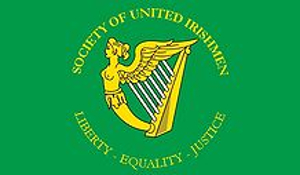
James Napper Tandy convenes the first meeting of the Society of United Irishmen in Dublin on November 9, 1791. The group had met the previous month in Belfast.

Spurred on by Theobold Wolfe Tone’s pamphlet titled An Argument on Behalf of the Catholics of Ireland, these young radicals propose three resolutions, which are to guide the new movement forward and which leave a lasting impression on generations of Irish men and women.

Firstly, that there exists the need for “a cordial union among all the people of Ireland.” Secondly, that a complete and radical reform of the representation of the people in Parliament is needed and, thirdly, that this reform should include “Irishmen of every religious persuasion.” The new organisation immediately tries to bring about change and Wolfe Tone, through his work as secretary of the Catholic Committee, organises a Catholic Convention in Dublin in 1792.

Although a Catholic Relief Act is passed in 1793, which rescinds some of the harsh Penal Laws, the United Irishmen soon turn their attention to France where they are heavily influenced by the French revolutionary ideals of “Liberty, Equality, Fraternity.”

When the United Irishmen are proclaimed a secret society and members arrested, Wolfe Tone travels to the United States and then France, making known his objectives for Irish Independence and that he wishes:

“To unite the whole people of Ireland, to abolish the memory of all past dissensions, and to substitute the common name of Irishman in place of the denominations of Protestant, Catholic and Dissenter – these were my means.”

The Irish Rebellion of 1798 soon follows and, although achieving initial success is brutally suppressed, thereby ending the ideals of the United Irishmen in uniting the people of Ireland.

(From: “Society of United Irishmen formed in Dublin 09 November 1791” posted on November 9, 2019, Irish News Archives, http://www.irishnewsarchives.com)


Leave a comment

Birth of John MacKenna, Chilean Military Officer

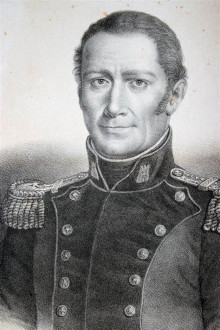
Brigadier John (Juan) Mackenna, Chilean military officer and hero of the Chilean War of Independence, is born in Monaghan, County Monaghan on October 26, 1771. He is considered to be the creator of the Corps of Military Engineers of the Chilean Army.

He is born John MacKenna, the son of William MacKenna of Willville House near Monaghan and Eleanora O’Reilly and, on his mother’s side, a nephew to Count Alejandro O’Reilly. Count O’Reilly takes an interest in the young Mackenna and takes him to Spain where he studies at the Royal School of Mathematics in Barcelona. He also trains in the Royal Military Academy as a Military Engineer between 1785 and 1791.

In 1787 Mackenna is accepted into the Irish Brigade of the Spanish Army, and joins the army fighting in Ceuta in northern Africa, under Lieutenant Colonel Luis Urbina, and is promoted to Second Lieutenant. In 1791 he resumes his studies in Barcelona and acts as liaison with mercenaries recruited in Europe. The following year he is promoted to Lieutenant in the Royal Regiment of Engineers. In the War of the Pyrenees against the French, he fights in Rosselló under General Ricardos and there meets the future liberator of Argentina, José de San Martín. For his exploits in defence of the Plaza de Rozas, he is promoted to captain in 1795.

For the purpose of a new assignment, in October 1796, Mackenna leaves Spain for South America. He arrives in Buenos Aires and then travels to Mendoza and to Chile across the Andes and then to Peru. Once in Lima, he contacts Ambrosio O’Higgins, another Irishman, at that time Viceroy of Perú, who names him Governor of Osorno and puts him in charge of the reconstruction works for the southern Chilean town.

In this capacity, Mackenna convinces the families of Castro, on Chiloé Island, to move to Osorno to found a colony there. He builds the storehouse and two mills, as well as the road between Osorno and present-day Puerto Montt. His successful administration provokes jealousy from Chile’s captain-general Gabriel de Avilés, who fears that Mackenna and Ambrosio O’Higgins will create an Irish colony in Osorno. Both Irishmen are loyal to the Spanish crown, though Mackenna has good relations with O’Higgins’ son Bernardo, the future emancipator of Chile, and is also connected with the Venezuelan Francisco de Miranda and his group of supporters of South American independence. When Ambrosio O’Higgins dies in 1801, Avilés is appointed viceroy of Peru. It takes him eight years to remove Mackenna, O’Higgins’s protégé, from Osorno.

In 1809 Mackenna marries Josefina Vicuña y Larraín, an eighteen-year-old Chilean woman from a family with revolutionary connections, with whom he has three children. After the Declaration of Chilean Independence in 1810, he adheres to the Patriot side and is commissioned by the first Chilean government to prepare a plan for the defense of the country and oversees the equipment of the new Chilean Army. At this juncture he trains the first military engineers for the new army.

The following year Mackenna is called to the defence committee of the new Republic of Chile, and in 1811 is appointed governor of Valparaíso. Owing to political feuds with José Miguel Carrera and his brothers, he is dismissed from the post and taken prisoner. He is a firm ally of Bernardo O’Higgins, who appoints him as one of the key officers to fight the Spanish army of General José Antonio Pareja. His major military honour is attained in 1814 at the Battle of Membrillar, in which the general assures a temporary collapse of the royal forces.

As a reward for his victory, Mackenna is appointed commandant-general by Bernardo O’Higgins, but after a coup d’état led by Luis Carrera he is exiled to Argentina in 1814, when Carrera comes to power. Mackenna dies in Buenos Aires on November 21, 1814, following a duel with Carrera.

A bust of General Mackenna is publicly presented to Monaghan County Museum on August 5, 2004 by his direct descendant, Luis Valentín Ferrada. At the presentation ceremony, MacKenna, the man “unreservedly regarded as the greatest of County Monaghan’s exiles” is commemorated in speeches by Most Rev. Dr. Joseph Duffy, Bishop of Clogher and by his descendant Senor Ferrada who declares, “In this city of Monaghan, very near to Willville House, the tombs of my ancestors are in the old cemetery. There, my own blood is interred in the sacred earth.”


Leave a comment

Death of Terence MacSwiney, Playwright & Politician

Terence James MacSwiney, Irish playwright, author, politician and Sinn Féin Lord Mayor of Cork during the Irish War of Independence, dies in London‘s Brixton Prison on October 25, 1920, after 73 days on hunger strike. His death brings him and the Irish Republican campaign to international attention.

MacSwiney is born at 23 North Main Street, Cork, County Cork, one of eight children of John and Mary MacSwiney. Following the failure of this business, John MacSwiney emigrates to Australia in 1885 leaving the children in the care of their mother and his eldest daughter.

MacSwiney is educated by the Christian Brothers at the North Monastery school in Cork but leaves at fifteen to help support the family. He becomes an accountancy clerk but continues his studies and matriculates successfully. He continues in full-time employment while he studies at the Royal University (now University College Cork), graduating with a degree in Mental and Moral Science in 1907.

In 1901 MacSwiney helps to found the Celtic Literary Society, and in 1908 he founds the Cork Dramatic Society with Daniel Corkery and writes a number of plays for them. His first play, The Last Warriors of Coole, is produced in 1910. His fifth play, The Revolutionist (1915), takes the political stand made by a single man as its theme.

Described as a sensitive poet-intellectual, MacSwiney’s writings in the newspaper Irish Freedom bring him to the attention of the Irish Republican Brotherhood. He is one of the founders of the Cork Brigade of the Irish Volunteers in 1913 and is President of the Cork branch of Sinn Féin. He founds a newspaper, Fianna Fáil, in 1914, but it is suppressed after only 11 issues. In April 1916, he is intended to be second in command of the Easter Rising in Cork and Kerry but stands down his forces on the order of Eoin MacNeill.

Following the rising, MacSwiney is imprisoned by the British Government under the Defence of the Realm Act 1914 in Reading and Wakefield Gaols until December 1916. In February 1917 he is deported from Ireland and imprisoned in Shrewsbury and Bromyard internment camps until his release in June 1917. It is during his exile in Bromyard that he marries Muriel Murphy of the Cork distillery-owning family. In November 1917, he is arrested in Cork for wearing an Irish Republican Army (IRA) uniform, and inspired by the example of Thomas Ashe, goes on a hunger strike for three days prior to his release.

In the 1918 Irish general election, MacSwiney is returned unopposed to the first Dáil Éireann as Sinn Féin representative for Mid Cork, succeeding the Nationalist MP D. D. Sheehan. After the murder of his friend Tomás Mac Curtain, the Lord Mayor of Cork on March 20, 1920, he is elected as Lord Mayor. On August 12, 1920, he is arrested in Cork for possession of “seditous articles and documents,” and also possession of a cipher key. He is summarily tried by a court on August 16 and sentenced to two years’ imprisonment at Brixton Prison in England.

In prison MacSwiney immediately starts a hunger strike in protest of his internment and the fact that he was tried by a military court. Eleven other Irish Republican prisoners in Cork Jail go on hunger strike at the same time. On August 26, the British Government states that “the release of the Lord Mayor would have disastrous results in Ireland and would probably lead to a mutiny of both military and police in south of Ireland.”

MacSwiney’s hunger strike gains world attention. The British Government is threatened with a boycott of British goods by Americans, while four countries in South America appeal to Pope Benedict XV to intervene. Protests are held in Germany and France as well. An Australian member of Parliament, Hugh Mahon, is expelled from the Parliament of Australia for “seditious and disloyal utterances at a public meeting,” after protesting against the actions of the British Government. Two weeks later, the Spanish Catalan organization Autonomous Center of Employees of Commerce and Industry (CADCI) sends a petition to British Prime Minister David Lloyd George calling for his release and the newspaper of the organization, Acció (Acción in Spanish), begins a campaign for MacSwiney.

Food is often placed near MacSwiney to persuade him to give up the hunger strike. Attempts at force-feeding are undertaken in the final days of his strike. On October 20, 1920, he slips into a coma and dies five days later after 73 days on hunger strike. His body lay in St. George’s Cathedral, Southwark in London where 30,000 people file past it. Fearing large-scale demonstrations in Dublin, the authorities divert his coffin directly to Cork, and his funeral in the Cathedral of St. Mary and St. Anne on October 31 attracts huge crowds. He is buried in the Republican plot in St. Finbarr’s Cemetery in Cork. Arthur Griffith delivers the graveside oration.


Leave a comment

Birth of James Butler, 1st Duke of Ormond

James Butler, 12th Earl and 1st Duke of Ormond, is born at Clerkenwell, London on October 19, 1610. An Anglo-Irish Protestant, he is the leading agent of English royal authority in Ireland during much of the period from the beginning of the English Civil War (1642–1651) to the Glorious Revolution (1688–1689).

Butler is born into the prominent Butler family, the eldest child of Thomas Butler and his wife Elizabeth Poyntz. He grows up in England and succeeds to the earldom of Ormonde in 1633. That same year he begins his active career in Ireland by offering his services to Lord Deputy of Ireland Thomas Wentworth, later Earl of Strafford. Upon the outbreak of the Irish Rebellion of 1641 in Ireland, he is appointed a lieutenant general in the English army. He defeats the rebels of the Catholic confederacy at Kilrush, Munster on April 15, 1642, and at New Ross, Leinster on March 18, 1643. Those triumphs, however, do not prevent the confederates from overrunning most of the country.

Butlers’s attempts to conclude a peace are blocked by a Catholic faction that advocates complete independence for Ireland. The situation deteriorates further, and, in July 1647, he departs from Ireland, leaving the Protestant cause in the hands of the parliamentarians, who had defeated King Charles I in the first English Civil War (1642–1646).

Returning to Ireland in September 1648, Butler concludes a peace with the confederacy in January 1649. He then rallies Protestant royalists and Catholic confederates in support of Charles II, son and successor of Charles I. For several months most of Ireland is under his control. But the parliamentarian general Oliver Cromwell lands at Dublin in August 1649 and swiftly conquers the country for Parliament. Butler flees to France and becomes one of Charles II’s closest advisers at his court-in-exile in Paris.

When Charles II returns to England in the Restoration of 1660, Butler, who had urged constitutional rather than military rule, is made commissioner for the treasury and the navy. Appointed Lord Lieutenant of Ireland in 1662, he makes vigorous attempts to encourage Irish commerce and industry. Nevertheless, his enemies at court persuade Charles to dismiss him in 1669. He is restored to royal favour in 1677 and is again appointed Lord Lieutenant of Ireland. Although he is created a duke in the English peerage in 1682, he is recalled from Ireland in 1684 as a result of new intrigues at Charles’s court and because of the determination of James, Duke of York, to strengthen his supporters in Ireland.

Butler dies on July 21, 1688, at Kingston Lacy estate, Dorset. He is buried in Westminster Abbey on August 4, 1688. His eldest son, Thomas, 6th Earl of Ossory, predeceases him, but Ossory’s eldest son James succeeds as 2nd Duke of Ormonde (1665–1745).

(Pictured: “James Butler, 1st Duke of Ormond,” oil on canvas by William Wissing, National Portrait Gallery)