seamus dubhghaill

Promoting Irish Culture and History from Little Rock, Arkansas, USA


Leave a comment

Birth of George Sigerson, Physician & Writer

george-sigerson

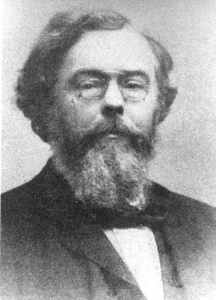
George Sigerson, Irish physician, scientist, writer, politician, and poet, is born at Holy Hill, near Strabane in County Tyrone on January 11, 1836. He is a leading light in the Irish Literary Revival of the late 19th century in Ireland.

Sigerson is the son of William and Nancy (née Neilson) Sigerson and has three brothers, James, John and William, and three sisters, Ellen, Jane, and Mary Ann. He attends Letterkenny Academy but is sent by his father, who developed the spade mill and who played an active role in the development of Artigarvan, to complete his education in France.

He studies medicine at the Queen’s College, Galway, and Queen’s College, Cork, and takes his degree in 1859. He then goes to Paris where he spends some time studying under Jean-Martin Charcot and Duchenne de Boulogne. Sigmund Freud is one of his fellow students.

Sigerson returns to Ireland and opens a practice in Dublin, specializing in neurology. He continues to visit France annually to study under Charcot. His patients included Maud Gonne, Austin Clarke, and Nora Barnacle. He lectures on medicine at the Catholic University of Ireland and is professor of zoology and later botany at the University College Dublin.

His first book, The Poets and Poetry of Munster, appears in 1860. He is actively involved in political journalism for many years, writing for The Nation. Sigerson and his wife Hester are by now among the dominant figures of the Gaelic Revival. They frequently hold Sunday evening salons at their Dublin home to which artists, intellectuals, and rebels alike attend, including John O’Leary, W.B. Yeats, Patrick Pearse, Roger Casement, and 1916 signatory Thomas MacDonagh. Sigerson is a co-founder of the Feis Ceoil and President of the National Literary Society from 1893 until his death. His daughter, Dora, is a poet who is also involved in the Irish literary revival.

Nominated to the first Seanad Éireann of the Irish Free State, Sigerson briefly serves as the first chairman on December 11-12, 1922, before the election of James Campbell, 1st Baron Glenavy. Sigerson dies at his home at 3 Clare Street, Dublin, on February 17, 1925, at the age of 89, after a short illness. On February 18, 1925, the day after his death, the Seanad Éireann pays tribute to him.

The Sigerson Cup, the top division of third level Gaelic football competition in Ireland is named in his honour. Sigerson donates the salary from his post at UCD so that a trophy can be purchased for the competition. In 2009, he is named in the Sunday Tribune‘s list of the “125 Most Influential People In GAA History.” The cup is first presented in 1911, with the inaugural winners being UCD GAA.


Leave a comment

Birth of Lucien Bull, Pioneer in Chronophotography

lucien-bullLucien Bull, a pioneer in chronophotography, is born in Dublin on January 5, 1876. Chronophotography is defined as “a set of photographs of a moving object, taken for the purpose of recording and exhibiting successive phases of motion.”

Born in Dublin to British father, Cornelius Bull, and French mother, Gabrielle Joune, Bull lives his younger years in Dublin where he attends school and lives at home with his parents. In 1894, Bull moves to France to visit his aunts. After several months, Bull eventually settles in the area and becomes an assistant to Étienne-Jules Marey in 1895. At the time, Marey is working on the cinematographic, which is a camera that is shaped like a rifle and takes pictures of moving objects from a rotating plate. This eventually becomes known as the “gun camera.”

This camera is designed to investigate the study of motion. Basically, the “gun camera” is designed to take an object in motion and snap still shots. By taking these still shots, each movement made by the object is captured and then studied to analyze movement patterns that were unable to be studied before. The first successful film is taken in 1904 when Bull is able to film the flight of a fly at 1,200 frames per second.

As a result of Marey’s death in May 1904, Bull becomes head of the Marey Institute, which forms part of the Collège de France. While remaining with the Marey Institute, Bull is naturalized as a French citizen in 1931. After a few years, Bull eventually introduces a few papers on a wide variety of subjects ranging from spark illuminations, high-speed motion-picture photography, original studies of insect and bird flight, and electrocardiography and muscle and heart functions.

In 1933, Bull is put in charge of research, National Office of Research and Invention in France. In 1948 he becomes President of the Institute of Scientific Cinematography in Paris. His work is eventually listed by Dr. W. Hinsch in Research Film for December 1953.

Lucien Bull dies in Paris on August 25, 1972.


Leave a comment

Birth of Irish Revolutionary Maud Gonne

maud-gonne

Maud Gonne, Irish revolutionary, romantic muse for William Butler Yeats, and mother to Nobel Peace Prize-winner Seán MacBride, is born at Tongham, England on December 21, 1866.

Gonne is born into a distinguished and wealthy family, and her father serves as an army captain. Her mother dies of tuberculosis when she is a child, and she and her sister are raised and educated by a French nanny. This cosmopolitan upbringing is furthered by travels throughout Europe with her father, then a military attaché.

In 1884, Gonne’s father dies of typhoid fever, and she receives a considerable inheritance. After moving to France to be with her aunt, she meets and falls in love with right wing politician Lucien Millevoye. Though he is already married, he instills Gonne with his political passions. She begins a nearly lifelong fight for Irish freedom from England and the release of political prisoners. She and Millevoye have two children, one of whom survives, before their relationship ends.

Moved by the plight of those evicted in the Land Wars, Gonne continues to campaign for the Irish nationalist cause. While living in Paris, she is introduced to Fenianism by John O’Leary, a veteran of the Young Ireland Rebellion of 1848. In 1889, O’Leary introduces her to a man whose infatuation with her would last most of his life, poet William Butler Yeats. She begins a relationship with Yeats, though she refuses his many marriage proposals. She is the inspiration for many of Yeats’s poems. In 1900, she founds the Daughters of Ireland, which provides a home for Irish nationalist women.

In 1918, Gonne is arrested for being a political agitator. She becomes severely ill in prison and after her release, she begins a crusade for improved conditions for Ireland’s political prisoners. In 1903, she marries Major John MacBride, who had led the Irish Transvaal Brigade against the British in the Second Boer War, in Paris in 1903. After the birth of their son, Seán, Gonne and her husband agree to end their marriage. She demands sole custody of their son but MacBride refuses, and a divorce case begins in Paris on February 28, 1905. The only charge against MacBride substantiated in court is that he was drunk on one occasion during the marriage. A divorce is not granted, and MacBride is given the right to visit his son twice weekly.

The couple’s son, Seán MacBride, is active in politics in Ireland and in the United Nations. He is a founding member and Chairman of Amnesty International and is awarded the Nobel Peace Prize in 1974.

Gonne dies in Clonskeagh on April 27, 1953, at the age of 86 and is buried in Glasnevin Cemetery, Dublin. Maud Gonne’s autobiography, A Servant of the Queen, is published in 1938.


Leave a comment

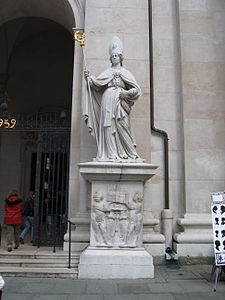
Death of Vergilius of Salzburg, Churchman & Astronomer

virgilius-of-salzburg

Vergilius of Salzburg, also known as Virgilius, Feirgil or Fergal, Irish churchman and early astronomer, dies on November 27, 784, in Salzburg, Austria. He serves as abbot of Aghaboe, bishop of Ossory and bishop of Salzburg. He is called “the Apostle of Carinthia” and “the geometer.”

He originates from a noble family of Ireland, where his name is Feirgil, and is said to have been a descendant of Niall of the Nine Hostages. Feirgil is likely educated at the Iona monastery.

In the Annals of the Four Masters and the Annals of Ulster he is mentioned as Abbot of Aghaboe, in County Laois, where he is known as “the Geometer” because of his knowledge of mathematics.

Around 745 Vergilius leaves Ireland, intending to visit the Holy land but, like many of his countrymen who seem to have adopted this practice as a work of piety, he settles down in France, where he is received with great favour by Pepin the Short, who is then Mayor of the Palace under Childeric III of Franconia. He serves as an adviser to Pepin. He probably uses a copy of the Collectio canonum Hibernensis, an Irish collection of canon law, to advise him to receive royal unction in 751, to assist his recognition as king Pippin III after the deposition of Childeric. After spending two years at Cressy, near Compiègne, he goes to Bavaria, at the invitation of Duke Odilo, where he founds the monastery of Chiemsee, and within a year or two is made Abbot of St. Peter’s at Salzburg. Among his notable accomplishments is the conversion of the Alpine Slavs and the dispatching of missionaries to Hungary.

While Abbot of St. Peter’s, Vergilius comes into collision with Saint Boniface. A priest, through ignorance, confers the Sacrament of Baptism using, in place of the correct formula, the words “Baptizo te in nomine patria et filia et spiritu sancta.” Vergilius holds that the sacrament has been validly conferred, but Boniface complains to Pope Zachary. The latter, however, decides in favour of Vergilius. Later on, Boniface accuses Vergilius of spreading discord between himself and Duke Odilo of Bavaria and of teaching a doctrine in regard to the rotundity of the earth, which is “contrary to the Scriptures.” Pope Zachary’s decision in this case is that “if it shall be clearly established that he professes belief in another world and other people existing beneath the earth, or in another sun and moon there, thou art to hold a council, and deprive him of his sacerdotal rank, and expel him from the church.”

Unfortunately, we no longer possess the treatise in which Vergilius expounds his doctrine. Two things, however, are certain: first, that there is involved the problem of original sin and the universality of redemption; secondly, that Vergilius succeeds in freeing himself from the charge of teaching a doctrine contrary to Scripture. It is likely that Boniface, already biased against Vergilius because of the preceding case, misunderstands him, taking it for granted, perhaps, that if there are antipodes, the “other race of men” are not descendants of Adam and are not redeemed by Christ.

After the martyrdom of Boniface, Vergilius is made Bishop of Salzburg in 766 or 767. Until his death in 784, he labours successfully for the upbuilding of his diocese as well as for the spread of Christianity in neighbouring heathen countries, especially in Carinthia.

Vergilius is venerated as a saint in the Orthodox Church and the Roman Catholic Church. In 1233 he is formally canonized by Pope Gregory IX. Aside from being personally associated with Abbey of Aghaboe and Salzburg Cathedral, a number of parishes around the world are dedicated to him, mostly being founded by small populations of far-flung Irish Catholics, like himself. There is a church still bearing his name dedicated to him in Broad Channel, Queens, New York. A parish in Morris Plains, New Jersey is also dedicated to him.


3 Comments

Birth of Flying Ace Thomas Falcon Hazell

thomas-falcon-hazell

Thomas Falcon Hazell, fighter pilot with the Royal Flying Corps and later the Royal Air Force during World War I, is born in Roundstone, County Galway, on August 7, 1892. Hazell scores 43 victories in 1917–1918 making him the fifth most successful British “flying ace” of the war, the third most successful Irish-born pilot behind Edward Mannock and George McElroy, and the only pilot to survive the war from both groups.

Upon the outbreak of the war in August 1914, Hazell volunteers for service as a private with the South Irish Horse. On October 10 he is commissioned as second lieutenant in the 7th Battalion, Royal Inniskilling Fusiliers. As part of the 49th Brigade in the 16th (Irish) Division, the 7th Inniskillings are initially based at Tipperary, where Hazell is promoted to lieutenant on June 4, 1915. The regiment lands in France in February 1916.

Soon afterwards Hazell transfers to the Royal Flying Corps. In April and May he is assigned to No. 5 Reserve Squadron, based at Castle Bromwich. He is appointed a flying officer on June 5 and survives a severe crash before completing his training. He eventually joins No. 1 Squadron on the Western Front. Flying Nieuport 17 Scouts, he shoots down 20 enemy aircraft between March and August 1917, being appointed a flight commander with the acting rank of captain on May 25, and is awarded the Military Cross on July 26.

After serving as an instructor at the Central Flying School in 1918, he takes command of “A” Flight, No. 24 Squadron, flying the S.E.5a. On August 22, 1918, Hazell shoots down an observation balloon despite its escort of seven Fokker D.VIIs. The escort is led by German ace Ernst Udet, who attacks and riddles Hazell’s petrol tank, propeller, and two longerons with bullets. In spite of this Hazell fights his way back, eyes full of petrol, and lands safely. Udet thinks he has forced the British pilot to crash and actually claims him as his 60th victory. Hazell finishes the war with 43 confirmed kills, the top British surviving ace of the war (excluding Dominion airmen). Hazell is twice awarded the Distinguished Flying Cross. On June 11, 1927, he returns to the RAF Depot at Uxbridge and is placed on the retired list on July 20, 1927, at his own request.

In 1944, at the age of 52, Hazell becomes the commander of “D” Company, 24th (Tettenhall) Battalion, South Staffordshire Home Guard during the later part of World War II.

Hazell dies in Newport, County Mayo, on September 4, 1946, and is buried at the Burrishoole Church of Ireland Cemetery there. In 2014 his grave, which had been largely forgotten and neglected, is restored, repaired, and re-dedicated in a ceremony on August 4, 2014, the 100th anniversary of the declaration of World War I.


Leave a comment

Birth of the Liberator, Daniel O’Connell

daniel-oconnell

Daniel O’Connell, Irish political leader often referred to as The Liberator or The Emancipator, is born on August 6, 1775, at Carhan near Cahersiveen, County Kerry, to the O’Connells of Derrynane, a once-wealthy Roman Catholic family, that has been dispossessed of its lands.

Raised by his uncle, Daniel learns the Irish language and Irish lore in Kerry. O’Connell does part of his schooling in France during the revolution. On May 19, 1798, O’Connell is called to the Irish Bar and becomes a barrister. Four days later, the United Irishmen stage their rebellion which is put down by the British with great bloodshed. O’Connell does not support the rebellion. He believes that the Irish need to assert themselves politically rather than by force. The violent excesses he witnesses in France, the slaughter of the 1798 Rising, and finally his own killing of a man in a duel in 1815 leads him to renounce violence forever.

Moving into politics, O’Connell founds the Catholic Association in 1823, creating one of the first massive political movements in Europe or the Americas. The Catholic Association embraces other aims to better Irish Catholics, such as electoral reform, reform of the Church of Ireland, tenants’ rights, and economic development.

When he is elected to Parliament in 1828, he is unable to take his seat as members of parliament have to take the Oath of Supremacy, which is incompatible with Catholicism.  Fear of the reaction of his millions of followers leads to the passage of the Roman Catholic Relief Act 1829. O’Connell works for Home Rule for Ireland for the rest of his days but never achieves it. The British ban his mass Repeal of the Union rallies in 1843 and jail him for a time. The movement loses momentum at that point and the long years of hard work wear “The Liberator” down.

O’Connell dies at the age of 71 of cerebral softening on May15, 1847, in Genoa, Italy, while on a pilgrimage to Rome. His time in prison seriously weakens him and the appallingly cold weather he has to endure on his journey is likely the final blow. According to his dying wish, his heart is buried in Rome at Sant’Agata dei Goti, then the chapel of the Irish College, and the remainder of his body in Glasnevin Cemetery in Dublin, beneath a round tower.


Leave a comment

Birth of “Jem” Finer, Founding Member of The Pogues

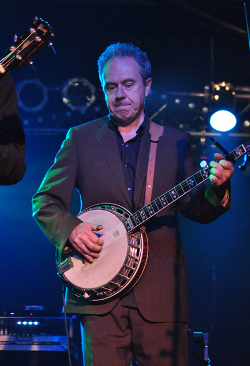
jem-finerJeremy Max “Jem” Finer, English musician, artist, composer, and one of the founding members of The Pogues, is born in Stoke-on-Trent, England on July 20, 1955.

After college at Keele University, Finer travels around Europe and spends some time working on a barge in France. He settles in London and becomes the bass player in a group called The Petals and lives in 32 Burton Street, a house which he sometimes shares with Spider Stacey and Shane MacGowan. Together with James Fearnley they found The Pogues. Primarily a banjoist, he also plays other instruments, including mandola, saxophone, hurdy-gurdy, and the guitar. Apart from Shane MacGowan, Finer is the most prolific composer for the band.

Finer appears on all the band’s albums until their breakup in 1996. He continues working as a musician and composer after leaving The Pogues.

On January 1, 2000, the Finer-composed Longplayer piece of music is started and is designed to last 1,000 years without ever repeating itself. It currently exists in both computer-generated and live versions. Longplayer represents a convergence of many of his concerns, particularly those relating to systems, long-durational processes, and extremes of scale in both time and space.

Finer serves as “Artist in Residence” at the Astrophysics Sub-department of the University of Oxford between October 2003 and June 2005. Finer and Hamburg-based swamp pop legend DM Bob begin recording and performing together in 2005, releasing their album Bum Steer in August of that year and co-producing the debut album by experimental pop band Marseille Figs. In July 2005, Finer wins the PRS Foundation New Music Award on the basis of his proposal to build a device that will automatically “compose” a song of indeterminate length by harnessing the creative force of the weather.

In March 2012, Mobile Sinfonia, a global composition for ringtones is launched, developed during a year Finer spends as a non-resident artist at the University of Bath. This piece concerns mutual invasion of soundscape via ringtones.

Finer is currently working on a number of new projects continuing his interest in long-term sustainability and the reconfiguring of older technologies, including Spiegelei, a spherical camera obscura featuring Finer’s innovative 360-degree projection system and the Supercomputer in Cambridge, a 5-bit mechanical sculpture which will compute minimal musical scores.


6 Comments

The Battle of Moira

battle-of-moira

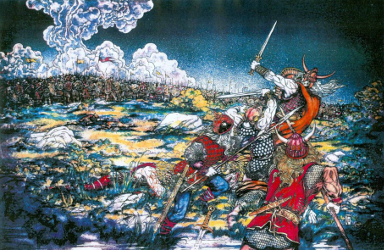
The Battle of Moira, known archaically as the Battle of Magh Rath, is fought on June 24, 637, near the Woods of Killultagh, just outside the village of Moira in what becomes County Down. The battle pits the Gaelic High King of Ireland Domnall II against his foster son King Congal of Ulster, supported by his ally Domnall the Freckled (Domnall Brecc) of Dál Riata.

The battle is allegedly the largest battle ever fought on the island of Ireland, and results in the death of Congal and the retreat of Domnall Brecc. The battle is caused as a result of the invading Gaels spreading out from Galway Bay. The Gaels have fled France and Spain to escape the Roman invasion of those areas. The Gaels are later to be known as Irish but are not native to the island. The native people of Ulster have been pushed into an area the size of two counties in what is now Antrim and Down.

Congal first establishes his power base in Dál nAraidi, where he becomes King before being recognised as King of Ulster in 627. His ambitions soon come into conflict with Domnall II, who becomes High King of Ireland in 628. Ironically, Domnall II rises to such a position because Congal has defeated and killed the previous High King, Suibne Menn, in a previous battle.

Domnall continues to press the rivalry with Congal very quickly. In 629 the two kings engage each other at the Battle of Dún Ceithirn in what is now County Londonderry. On that occasion Congal is defeated and Domnall is left unchallenged as the High King.

Throughout the 630s, Domnall continues to wage war on his rivals in the Uí Néill clan. In 637, however, Congal once again rises to challenge the Ard Rí, and enlists the help of Dál Riata to do so. The two forces meet just east of Lough Neagh.

Little is known about the actual battle itself. The armies of both Domnall II and Congal are primarily made up of warriors native to Ireland. However, Domnall I of Dál Riata brings a more varied force to the fight. His army included Scots, Picts, Anglo-Saxons, and Britons (Welshmen). At least one side has a substantial cavalry force.

There is reason to believe that the battle might have lasted a week, at the end of which the defeated force flees towards the woods of Killultagh. The forces of Ulster and Dál Riata are defeated, with Domnall of Dál Riata forced to flee north to his kingdom’s holdings. Congall is killed in the course of the battle.

The scale of the battle is confirmed in the 19th century when the railway line in Moira is being constructed. Thousands of bodies of men and horses are excavated. When one considers that the survivors probably numbered quite considerably more, then the reputation of the scale of the battle becomes obvious.


Leave a comment

Hugh de Lacy Appointed 1st Earl of Ulster

1st-earl-of-ulster-coat-of-arms

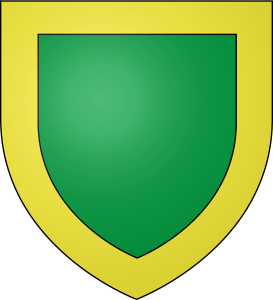
King John of England appoints Hugh de Lacy, a leading figure in the Norman invasion of Ireland in the 12th century, as the 1st Earl of Ulster on May 29, 1205.

Circa 1189 de Lacy is appointed Viceroy of Ireland, a position previously held by his father, Hugh de Lacy, Lord of Meath. He is replaced in 1190 by Guillaume le Petil. He is later reappointed to serve as viceroy from 1205 to 1210.

In 1199, King John authorises de Lacy to wage war on John de Courcy, who has conquered much of Ulster without help or permission from the King. Hugh captures de Courcy in 1204. An account of the capture appears in the Book of Howth.

After King John creates him Earl of Ulster in 1205, he makes what was de Courcy’s territory in Ulster the Earldom of Ulster. He grants Drogheda its charter and continues the conquest of the northeastern over-kingdom of Ulaid, building on de Courcy’s success, with the earldom spanning across the modern counties of Antrim and Down and parts of Londonderry.

In 1207, war breaks out between the Earl of Ulster and the justiciar. This brings King John to Ireland, where he expels the earl’s brother, Walter de Lacy, from Meath, and compels the earl himself to flee to Scotland.

For several years Ulster takes part in the wars in France, and de Lacy does not return to Ireland until 1221, when he allies himself with the O’Neills against the English. In 1226, his lands in Ulster are handed over to his brother Walter, but they are restored to him in the following year, after which date, he appears to loyally serve the king, being more than once summoned to England to give advice about Irish affairs.

De Lacy purportedly separates from his first wife and lives in adultery. He has legitimate and natural children. In 1226, his daughter by his first wife marries Alan, Lord of Galloway. He marries his second wife, Emmeline de Riddlesford, the daughter of Walter de Riddlesford around 1242. Hugh de Lacy dies shortly thereafter in 1242 or 1243. Emmeline’s second marriage takes place around 1243 with Stephen Longespee, grandson of Henry II of England, by whom she has two daughters, Ela Longespee, Lady of Ashby, and Emmeline Longespee, Lady of Offaly.

Left with no surviving legitimate children, the earldom of Ulster reverts to the crown upon de Lacy’s death.


Leave a comment

Death of Brendan the Navigator

brendan-the-navigator

Saint Brendan of Clonfert, called “the Navigator” and one of the early Irish monastic saints, dies on May 16, 577, in Annaghdown, County Galway.

In 484, Brendan is born in Tralee, County Kerry, in the province of Munster. He is born among the Altraige, a tribe originally centred around Tralee Bay, to parents called Finnlug and Cara. He is baptised at Tubrid, near Ardfert by Saint Erc, and is originally to be called “Mobhí” but signs and portents attending his birth and baptism lead to him being christened “Broen-finn” or “fair-drop.” For five years he is educated under Saint Ita, “the Brigid of Munster.” When he is six, he is sent to Saint Jarlath‘s monastery school at Tuam to further his education. Brendan is one of the “Twelve Apostles of Ireland,” one of those said to have been tutored by the great teacher, Finnian of Clonard.

At the age of twenty-six, Brendan is ordained a priest by Saint Erc. Afterwards, he founds a number of monasteries. Brendan’s first voyage takes him to the Aran Islands, where he founds a monastery. He also visits Hinba, an island off Scotland where he is said to meet Columcille. On the same voyage he travels to Wales, and finally to Brittany, on the northern coast of France. Between the years 512 and 530 Brendan builds monastic cells at Ardfert and, at the foot of Mount Brandon, Shanakeel— Seana Cill, usually translated as “the old church.” From here he supposedly sets out on his famous seven-year voyage for Paradise.

St. Brendan is chiefly renowned for his legendary journey to the Isle of the Blessed as described in the ninth century Voyage of St. Brendan the Navigator. Many versions exist that tell of how he sets out onto the Atlantic Ocean with sixteen pilgrims searching for the Garden of Eden. One of these companions is said to be Saint Malo, the namesake of Saint-Malo. This occurs sometime between 512 and 530 AD, before his travel to the island of Great Britain. On the trip, Brendan supposedly sees Saint Brendan’s Island, a blessed island covered with vegetation. He also encounters a sea monster, an adventure he shares with his contemporary, Saint Columba. The most commonly illustrated adventure is his landing on an island which turns out to be a giant sea monster called Jasconius or Jascon. This too, has its parallels in other stories, not only in Irish mythology but in other traditions, from Sinbad the Sailor to Pinocchio.

Brendan travels to Wales and the holy island of Iona, off the west coast of Scotland. Returning to Ireland, he founds a monastery at Annaghdown, where he spends the rest of his days. He also founds a convent at Annaghdown for his sister Briga. Having established the bishopric of Ardfert, St. Brendan proceeds to Thomond and founds a monastery at Inis-da-druim, in the present parish of Killadysert, County Clare, about the year 550. He then journeys to Wales and studies under Saint Gildas at Llancarfan, and then to Iona, for it is said that he leaves traces of his apostolic zeal at Kil-brandon and Kil-brennan Sound. After a three years’ mission in Britain, he returns to Ireland, and does more proselytising in various parts of Leinster, especially at Dysart, Killiney, and Brandon Hill. He establishes churches at Inchiquin, County Clare and at Inishglora, County Mayo, and founds Clonfert in County Galway around 557 AD.

Brendan dies on May 16, 577 at Annaghdown, while visiting his sister Briga. Fearing that after his death his devotees might take his remains as relics, Brendan arranges before his death to have his body secretly carried back to the monastery he founded at Clonfert concealed in a luggage cart. He is buried in Clonfert Cathedral.