seamus dubhghaill

Promoting Irish Culture and History from Little Rock, Arkansas, USA


Leave a comment

The Tunnel Trench Assault at the Battle of Cambrai

At dawn on the morning of November 20, 1917, the 16th (Irish) Division of the British Army assaults an area of the German lines known as “Tunnel Trench,” named for an elaborate tunnel system that runs along it. The attack is meant as a diversion for the main attack, about eight miles to the southeast at Cambrai, France, where six infantry and two cavalry divisions of the British Expeditionary Force, with additional support from fourteen squadrons of the Royal Flying Corps, join the British Tank Corps in a surprise attack on the German lines.

By autumn 1917, three years into World War I, continuous shelling and lack of drainage has transformed the Ypres Salient, on the Western Front, into a waterlogged quagmire. In Ireland, meanwhile, a month earlier, Eamon de Valera becomes president of Sinn Féin and decides to push for an independent Irish republic. Despite the growing political turmoil at home, in France, on firm ground near the town of Cambrai, the British Army’s 16th (Irish) Division again proves to be formidable adversaries for the Germans.

According to the divisional historian, at Cambrai, the “swift and successful operation by 16th Division was a model of attack with a limited objective.” In addition to securing 3,000 yards of trench, 635 prisoners are captured from the German army’s 470th and 471st Regiments and 330 German bodies are counted in the trenches. More importantly, though, the mayhem caused by the diversionary assault contributes greatly to the initial success of the Cambrai offensive, though the offensive eventually sputters, dragging the war into 1918.

Cambrai becomes the field of operations when the British Commander-in-Chief, Field Marshal Douglas Haig, recognising that it is impossible to launch further military operations in the Ypres sector, seeks a new battlefield where he hopes success can be achieved before year’s end. Lieutenant Colonel John Fuller of the Tank Corps and General Julian Byng, commander of the Third Army, recommend that a massed assault by 400 tanks should be mounted across the firm, chalky ground to the southwest of Cambrai. Haig adopts this proposal, confident that the tanks can punch a hole through the mighty Hindenburg Line and allow his underused Cavalry Divisions to break through to the enemy rear.

In order to create maximum confusion among the Germans, Sir Aylmer Haldane, commander of VI Corps, is ordered to stage a diversionary attack. The area selected for the assault is about eight miles to the northwest of Cambrai, where the British line passes through the villages of Bullecourt and Fontaine-lès-Croisilles. The units select to make this subsidiary attack are 3rd Army and 16th (Irish) Division.

The defences of the Hindenburg Line opposite VI Corps positions consists of Tunnel Trench, a heavily defended front-line trench, with a second, or support trench, some 300 yards behind. The whole area is scattered with concrete machine gun forts, or Mebus, similar to those that had decimated the 16th (Irish) Division at the Battle of Langemarck three months earlier.

Tunnel Trench is so called because it has a tunnel 30 or 40 feet below ground along its entire length, with staircase access from the upper level every 25 yards. The entire tunnel has electric lighting, and side chambers provide storage space for bunks, food, and ammunition. Demolition charges are set that can be triggered from the German rear in order to prevent the defences from falling into British hands.

The 16th (Irish) Division, attacking on a three-brigade front, is assigned the task of capturing a 2,000-yard section of the trench network. On the right flank of the Irishmen, 3rd Division’s 9th Brigade is detailed to capture an additional 800 yards. One unusual feature of the attack is that there is to be no preliminary bombardment as surprise is the key to the success of the operation. Once the assault begins, however, 16th (Irish) Division’s artillery, reinforced with guns from the 34th Division, is to open a creeping barrage upon the German positions.

The morning of the advance, November 20, is overcast, with low visibility. At 6:20 a.m., the Divisional 18 pounder-field guns open fire, and the leading assault companies spring from their jump-off positions. At the same time, Stokes mortars begin to lay a smoke barrage upon the German trenches in imitation of a gas attack. This deception proves successful, as many German troops don cumbersome gas masks and retreat to the underground safety of the tunnel, thus leaving the exposed portion of the trench undefended.

On the left flank, the attack of the 49th Brigade is launched by 2nd Royal Irish Regiment and 7/8th Royal Irish Fusiliers. They quickly cross the 200 yards of no-man’s-land and reach the enemy frontline just as the barrage lifts. Resistance above ground is minimal, and storming parties began the task of flushing the Germans from the tunnel with Mills bombs and bayonets.

Once the tunnel is secure, sappers, acting on information obtained by 7th Leinster Regiment’s intelligence officer, cut the leads connecting the demolition charges. Supporting companies then press on to capture Tunnel Support Trench, while Divisional support units rapidly wire and made secure the new defensive front in anticipation of German counterattacks.

Only on the extreme left flank does 49th Brigade encounter any serious opposition. In this sector, Company “B” of the 7/8th Royal Irish Fusiliers suffers heavy losses inflicted by concentrated machine gun fire from Mebus Flora. Nearly one-hour elapses before resistance from this strong point can be overcome.

In the centre, 10th and 2nd Royal Dublin Fusiliers head the attack of the 48th Brigade. The advance here is so rapid that the Irish find many Germans still wearing gas masks and unable to fight. Two more Mebus, Juno and Minerva, are stormed and many more prisoners taken, particularly by 10th Royal Dublin Fusiliers which captures 170 Germans.

Leading the attack on the right flank is 6th Connaught Rangers and 1st Royal Munster Fusiliers, both of which belong to the 47th “Irish Brigade.”

After capturing their assigned section of Tunnel Trench, two companies of Rangers press forward to assault the strong points known as Mars and Jove. The Division had learned from the disastrous frontal attack made at Langemarck, and so the Rangers work around to the rear before pressing home with the bayonet.

Unfortunately, 3rd Division fails in its attempt to capture the trench network immediately to the right of 16th (Irish) Division, and the flank of the Connaught Rangers is thus exposed to a savage counterattack. The Rangers ferociously engage the Germans and use captured “potato masher” grenades brought up from the tunnel to great effect. Eventually, overwhelming numbers begin to tell, and “A” Company is forced to yield Jove and fall back upon “B” Company, which is holding Mars.

These two isolated companies doggedly hold their ground for several hours. The situation only improves when the Divisional pioneer battalion, the 11th Hampshire Regiment, digs a communication trench across the fire-swept no-man’s-land, thereby allowing the support companies of the Rangers to come to the aid of their comrades. The front is finally stabilised three days later when 7th Leinster Regiment recaptures and consolidates Jove and successfully assaults the untaken section of Tunnel Trench.

On the first day of the Battle of Cambrai, General Byng’s eight attacking Divisions achieve complete surprise and pierce the Hindenburg Line, driving the Germans back four miles toward Cambrai itself. Having captured 8,000 prisoners and 100 guns for the loss of only 5,000 British casualties, it is small wonder that church bells are sounded in celebration in Britain for the first time during the war.

Unfortunately, Byng lacks sufficient reserves to exploit, or consolidate his success, and German counterattacks, launched by some 20 Divisions, recover most of the lost ground. Although the battle ultimately ends in failure for the British, the willingness to employ new weaponry and tactics at Cambrai and during the diversionary assault upon Tunnel Trench, points the way to the final victory in 1918.

Although the capture of Tunnel Trench contributes greatly to the early success at Cambrai, it proves costly as VI Corps suffers 805 casualties. Most of these occur close to Jove Mebus, where the Connaught Rangers had engaged the enemy in hand-to-hand combat.

Perhaps an idea of the ferocious nature of this form of trench warfare can be gleaned from Father William Doyle, chaplain of the 8th Royal Irish Fusiliers, who once remarks, “We should have had more prisoners, only a hot-blooded Irishman is a dangerous customer when he gets behind a bayonet and wants to let daylight through everybody.”

(From: “Tunnel Trench: 16th (Irish) Division Clears the Way at Cambrai,” by Kieron Punch, posted by The Wild Geese, http://www.thewildgeese.irish, January 18, 2013 | Pictured: Troops from the Royal Irish Regiment about to go into action at Cambrai)

Leave a comment

Death of Philip Twysden, Lord Bishop of Raphoe

Philip Twysden, Anglican clergyman who serves in the Church of Ireland as Lord Bishop of Raphoe from 1747 to 1752, dies bankrupt on November 2, 1752, after having been shot while allegedly masquerading as a highwayman. The circumstances of his death later become the subject of scandalous rumour.

Twysden is born in Kent, in the South East England region, on September 7, 1713, the third son of Sir William Twysden, 5th Baronet of Roydon Hall, East Peckham, Kent, by his wife (and distant cousin) Jane Twisden.

Twysden studies at University College, Oxford, from 1732. He is awarded a Master of Arts degree, and the honorary degree of Doctor of Civil Law in 1745.

Twysden marries twice: firstly, to Mary Purcell, who dies in 1743, and secondly to Frances Carter, daughter of The Rt Hon. Thomas Carter, Master of the Rolls in Ireland. After Twysden’s death, she marries her cousin, General James Johnston.

By his second wife, Twysden has two children: Mary, who dies in infancy, and a posthumous daughter named Frances (1753–1821). Frances, later Countess of Jersey, is one of the many mistresses of King George IV when he is Prince of Wales.

Twysden is ordained a priest in the Church of England. He is instituted in 1738 as rector of Eard and in 1745, for a short time, serves as the rector of Eastling in Kent. He accompanies Philip Stanhope, 4th Earl of Chesterfield, to Dublin as his chaplain, upon the Earl’s appointment as Lord Lieutenant of Ireland.

Twysden is nominated to the Bishopric of Raphoe in Ulster on March 3, 1746, and is consecrated by the Archbishop of Dublin, assisted by the bishops of Derry and Clonfert, at St. Michan’s Church, Dublin, on March 29, 1747.

Twysden dies on November 2, 1752, at home in Jermyn Street, St. James’s, London. However, according to ecclesiastical historian and author Henry Cotton, he dies at Roydon Hall, East Peckham, his father’s country house. He is buried in the south chancel of St. Michael’s Church, East Peckham, under a plain stone with no inscription.

A story grows up that, having been made bankrupt, Twysden is shot while attempting to rob a stagecoach. The location of his alleged attempted career as a highwayman is either Hounslow Heath (west of London) or Wrotham Heath in Kent.

(Pictured: The Cathedral of St Eunan, Raphoe, the episcopal seat of the pre-Reformation and Church of Ireland bishops of Raphoe)


Leave a comment

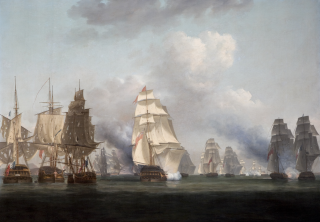
The Battle of Tory Island

The Battle of Tory Island, sometimes called the Battle of Donegal, Battle of Lough Swilly or Warren’s Action, is a naval action of the French Revolutionary Wars, fought on October 12, 1798, between French and British squadrons off the northwest coast of County Donegal, then in the Kingdom of Ireland. The last action of the Irish Rebellion of 1798, the Battle of Tory Island ends the final attempt by the French Navy to land substantial numbers of soldiers in Ireland during the war.

Britain’s enemies in Continental Europe have long recognised Ireland as a weak point in Britain’s defences. Landing troops there is a popular strategic goal, not only because an invader can expect the support of a large proportion of the native population, but also because at least initially they will face fewer and less reliable troops than elsewhere in the British Isles. Additionally, embroiling the British Army in a protracted Irish campaign will reduce its availability for other theatres of war. Finally, French planners consider that a successful invasion of Ireland might act as the ideal platform for a subsequent invasion of Great Britain.

The Society of United Irishmen, led by Theobald Wolfe Tone, launches an uprising against British rule in Ireland in May 1798. At the request of the rebels, a small French force under General Jean Joseph Amable Humbert is landed at Killala, County Mayo, but by early September both this expedition and the rebellion has been defeated.

Unaware of Humbert’s surrender, the French despatch reinforcements under the command of Commodore Jean-Baptiste-François Bompart on September 16. Having missed one invasion force, the Royal Navy is more watchful. Roving frigate patrols cruise off the principal French ports and in the approaches to Ireland, while squadrons of battleships from the Channel Fleet sail nearby, ready to move against any new invasion force. In command of the squadron on the Irish station is Commodore Sir John Borlase Warren, a highly experienced officer (and politician) who has made a name for himself raiding the French coast early in the war.

The squadron carrying the reinforcements is soon spotted after leaving Brest. After a long chase, the French are brought to battle in a bay off the rugged County Donegal coast in the west of Ulster, very close to Tory Island. During the action the outnumbered French attempt to escape, but are run down and defeated piecemeal, with the British capturing four ships and scattering the survivors. Over the next fortnight, British frigate patrols scour the passage back to Brest, capturing three more ships. Of the ten ships in the original French squadron, only two frigates and a schooner reach safety. British losses in the campaign are minimal.

The battle marks the last attempt by the French Navy to launch an invasion of any part of the British Isles. It also ends the last hopes the United Irishmen have of obtaining outside support in their struggle against the British. After the action, Wolfe Tone is recognised aboard the captured French flagship and arrested. He is brought ashore by the British at Buncrana, on the Inishowen peninsula. He is later tried for treason, convicted, and commits suicide while in prison in Dublin, hours before he is to be hanged.

(Pictured: Attack of the French Squadron under Monsr. Bompart Chef d’Escadre, upon the Coast of Ireland, by a Detachment of His Majesty’s Ships under the Command of Sir J. B. Warren, October 12, 1798, by Nicholas Pocock, 1799)


Leave a comment

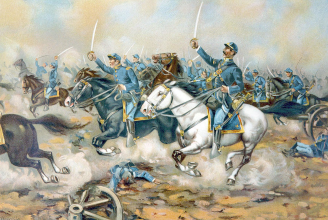
Patrick Cleburne Commands Brigade at the Battle of Perryville

On October 8, 1862, Irish-born Confederate Brigadier General Patrick Cleburne commands a brigade at the Battle of Perryville, (Kentucky) in the American Civil War. His brigade is part of the army of General Braxton Bragg. Encouraged by Jefferson Davis, Bragg invades Kentucky in August. On August 30, at the Battle of Richmond, Cleburne receives a very painful injury when a ball passes through his open mouth and out his left cheek, taking several teeth with it. However, less than a month later, he is back with his command in time for the crucial battle at Perryville.

The largest and last major battle of the Confederate Heartland Offensive (Kentucky Campaign), the Battle of Perryville, pits Bragg’s Confederate army against General Don Carlos Buell‘s Union army. While Bragg wins the battle tactically, Confederate forces retreat from the battlefield and end the campaign, leaving Kentucky under Union control for the rest of the war.

In conjunction with General Edmund Kirby Smith, Bragg invades the Commonwealth of Kentucky in August 1862. While the Confederate forces see early success in the Battles of Richmond and Munfordville, they ultimately are unable to achieve their larger goal of taking control of the state. By late October, Bragg and Smith’s armies retreat into Tennessee.

On October 7, 1862, the 55,000-man Union Army of the Ohio under the command of General Buell converges on the small crossroads town of Perryville, Kentucky, in three columns. Union forces first skirmish with Confederate cavalry on the Springfield Pike before the fighting continues on Peters Hill as the gray-clad infantry arrive. Based on the intelligence Bragg receives from his cavalry, he believes that he faces only a small portion of General Buell’s army, not the main body. Both sides settle in for the coming battle that would decide the fate of Kentucky.

In the early morning hours of October 8, 1862, fighting begins around Peters Hill as a Union division advances up the pike searching for water, halting just before the Confederate line. General Bragg orders his army to attack the supposedly isolated Union force, but it is noon before the assault gets underway. By that point, a new Union Corps, numbering about 13,000, arrives on the field further to the Union left, led by General Alexander M. McCook. The Confederates shift their focus on this isolated corps, believing it to be the force they faced earlier in the morning.

In the afternoon, the Confederate attacks open up. Bragg plans to commit three divisions. Due to the surprise of the Confederates, the plan works. Many of the Union soldiers in McCook’s corps are inexperienced and have been in the service for less than three months. For over five hours, McCook’s corps struggle to survive.

Cleburne’s brigade enters the battle at about 3:40 p.m. Cleburne’s horse, Dixie, is killed by an artillery shell, which also wounds Cleburne in the ankle, but he keeps his troops moving forward. As they advance up the slope, they are subjected to Confederate artillery fire. Cleburne later surmises that the friendly fire is caused by his men wearing blue uniform trousers, which had been captured from Union soldiers at Richmond. On Cleburne’s left, Brigadier General Daniel W. Adams‘s brigade joins the attack against the 15th Kentucky, which had been reinforced by three companies of the 3rd Ohio. The Union troops retreat to the west toward the Russell House, McCook’s headquarters.

Meanwhile, the majority of the veteran Union forces are under orders not to engage because General Buell, only two miles from the main fight, cannot hear the battle raging. The acoustic shadow dissipates in the area’s rolling hills. In the fighting, the Confederates see much success all across the battlefield at places like Open Knob, where they capture seven Union cannons, Loomis’s Heights, and the H. P. Bottoms Farm. They manage to push back the Union corps over a mile from their positions. Eventually, the Union troops are reinforced by two brigades that stabilize their line, bringing the Confederate attack to a halt. Later, a Confederate brigade assaults the Union force on the Springfield Pike but is repulsed and falls back into Perryville. The Union forces pursue, and skirmishing occurs in the streets in the evening before dark.

After five hours of brutal fighting, on October 8, 1862, night falls upon the battlefield at Perryville. During the night, word finally reaches General Bragg of the true nature of what lay before him. Rather than facing a small Union force, he faces Gen. Buell’s entire army, the majority of which do not see combat. Weighing his options, Bragg, short of men and supplies, withdraws during the night and, after pausing at Harrodsburg, continues the Confederate retreat by way of the Cumberland Gap into East Tennessee.

Cleburne performs a final valuable service to the Confederate cause during Bragg’s retreat. He saves thousands of rifles, cartridges, and other supplies by using stragglers to drag the supply-wagon train to safety.

The Confederate offensive is over and the Union controls Kentucky.


1 Comment

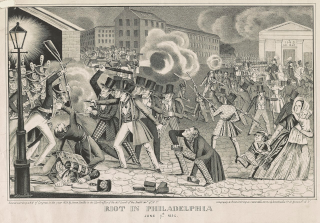
The Philadelphia Nativist Riots

The Philadelphia nativist riots (also known as the Philadelphia Prayer Riots, the Bible Riots and the Native American Riots) are a series of riots that take place on May 6—8 and July 6—7, 1844, in Philadelphia, Pennsylvania, and the adjacent districts of Kensington and Southwark. The riots are a result of rising anti-Catholic sentiment at the growing population of Irish Catholic immigrants.

On July 3, Father John Patrick Dunn of the Church of St. Philip Neri in the Southwark District is warned that the church might be attacked during an upcoming parade held by the Native American Party. The Native American Party, a nativist political party, plans to hold a large parade the next day on Independence Day.

To prepare for violence, the church applies for an arsenal that a volunteer company could use in case the church is attacked. Pennsylvania Governor David R. Porter authorizes the formation of a company and the procurement of twenty-five muskets from the Frankford Arsenal. Major General Robert Patterson, commander of the Pennsylvania militia, puts the troops on alert in case of violence.

Five of the muskets placed in St. Philip Neri’s Church are discovered to be defective and are sent back to the Frankford Arsenal to be repaired. No violence occurs before or during the parade, but on July 5, a nativist mob numbering in the thousands gathers at the church after some observe five defective muskets being returned to the church. They then demand that the sheriff remove the weapons, while Father Dunn and volunteers rally to protect the church. Sheriff Morton McMichael and two aldermen search the church and remove twelve muskets. After leaving the church, the sheriff urges the crowd to disperse and leaves a volunteer posse to guard the church. The mob remains, and a man injured in the May riots makes a speech to the crowd, calling for a second search of the church. The sheriff, an alderman, and seventeen nativists enter the church and find three armed men, fifty-three muskets, ten pistols, a keg of gunpowder and ammunition. To avoid inciting the mob, the sheriff decides not to remove the armaments, and the search party stays in the church. Just after midnight, July 6, Major General Patterson orders a company of city guards to clear the streets. After the crowd disperses, the arms found within the church are removed.

By midday, the crowds return around St. Philip Neri’s Church. General George Cadwalader orders the crowds to disperse, but they do not. By the evening, the sheriff arrives with a 150-strong posse. Throughout the evening, the military presence grows, and three cannons are stationed on the streets. The soldiers clear the streets near the church, despite being pelted with rocks by the mob. Responding to the rock throwers, General Cadwalader orders a cannon to be fired at the crowd on Third Street. Former U.S. Congressman Charles Naylor begs the general not to fire. He and several others are arrested and held within the church. By the morning of July 7, most of the soldiers have left, but the crowds, led by an alderman and the sheriff, return and demand that the remaining guard release Naylor. Everyone except Naylor is released. The crowds grow, and a cannon is brought from a nearby wharf and used to threaten the church. After further negotiations, Naylor is released and carried home to cheers on people’s shoulders.

After Naylor is brought home, the mob attacks the church, damaging a wall with the cannon. A second cannon is brought from the wharfs and fired at the church, after which the mob pelts the building with rocks and break in through a side door. The soldiers fire on the men breaking into the church, who promptly retreat. After retreating, the nativists negotiate with the guard, who agrees to withdraw, allowing the nativists to guard the church. The crowd pelts the soldiers with rocks and some soldiers fire back, which only incites the mob further. The mob forces its way into the church, causing extensive damage to the interior. After about an hour, a group of twenty men organizes themselves to guard St. Philip Neri’s, and the mob leaves the church.

By the evening, a large number of soldiers arrive with orders to clear the streets, only to be stoned in the process. After a captain is attacked, the order is given to fire on the mob, which results in seven fatalities and nine injuries. Not long after, people with muskets and cannons arrive and fierce fighting breaks out between the soldiers and the mob. The fighting lasts for several hours, with the soldiers being fired upon from alleyways and the windows of nearby buildings. The soldiers bring in two cannons of their own and fire on the mob. The mob returns fire using their own cannons, armed with items such as nails, chains, knives and broken bottles. In an attempt to capture the mob’s cannons, soldiers charge one cannon’s position, only to be knocked off their horses by a rope tied across the street. The cannons are all eventually captured, and by early morning on July 8, the fighting has ended.

At least fifteen people, including rioters and soldiers, are killed in the riot, and at least fifty people are injured. Under Governor Porter’s orders, state troops continue to arrive in the city in the days afterward, but no further violence takes place. An estimated 5,000 militia are used to stop violence. Troops begin to withdraw from the city on July 10, and the church takes over responsibility from the district of Southwark of protecting the church on July 11. As with the May riots, a grand jury blames the Irish Catholics for the riots but supports the military’s response to the violence.

The riots gain national attention and condemnation. The riots are used as an issue in the 1844 U.S. Presidential election, the Democratic Party condemning the growing Native American Party and the Whig Party, which the Democrats accuse of involvement in the nativist movement. In Philadelphia, the Native American Party ends up making a strong showing in the city’s October election.

On July 11, 1844, Philadelphia passes an ordinance that gives the city a battalion of artillery, a regiment of infantry, and at least one full troop of cavalry to preserve peace within the city when necessary. The difficulty of quelling the riots and other crime leads the Pennsylvania General Assembly to pass an 1845 act that requires Philadelphia, the township of Moyamensing and the unincorporated districts of Spring Garden, Northern Liberties, and Penn to maintain a police force of one man per 150 taxable inhabitants. In 1850, another act is passed that establishes that the Philadelphia police force will police the city and seven surrounding districts. The inability to maintain order effectively in Philadelphia’s suburbs is an important argument for the consolidation of the city in 1854.

After the riots, Bishop Kenrick ends his efforts to influence the public education system and begins encouraging the creation of Catholic schools, with 17 being founded by 1860. The friars of the Church of St. Augustine sue the city of Philadelphia for not providing the church with adequate protection, claiming $80,000 in damages. The city argues that the friars cannot claim their civil rights were violated, as the Order of Saint Augustine is a foreign organization under the Pope. Furthermore, the city argues that the friars took a vow of poverty and cannot be property owners. The Augustinians end up proving the Order is incorporated in 1804 and is awarded $45,000. The church is rebuilt in 1848.

(Pictured: “Riot in Philadelphia,” lithograph by H. Bucholzer, 1844, Library of Congress)


Leave a comment

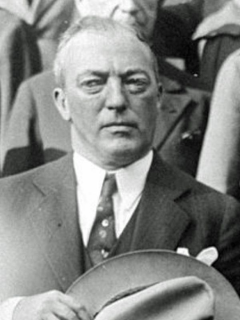
Death of William Francis Deegan, Architect & American Legion Organizer

William Francis Deegan, architect, organizer of the American Legion, major in the United States Army Corps of Engineers (USACE), and Democratic political leader in New York City, dies in Manhattan, New York County, New York, on April 3, 1932.

Deegan is born in the Bronx, Bronx County, New York, on December 28, 1882, to Irish immigrants. He studies architecture at Cooper Union. He marries Violet Secor (1889-1969) and has one son, William Secor Deegan (1909-85). At the age of 35 he serves in World War I as a staff officer in the 105th Field Artillery, rising to the rank of major.

Deegan later joins the United States Army Corps of Engineers as a major, where he supervises the construction of military bases in the New York area under the command of General George Washington Goethals. After the war he helps organize the American Legion in 1919, advancing to State Commander in 1921. In 1922 he is considered a strong candidate to become national commander of the Legion at their convention in New Orleans but is defeated due to his strong advocacy for admitting Black veterans into the organization. Advocacy for the rights of Black people is a strong theme throughout Deegan’s career, including during his position as Tenement House Commissioner.

Deegan works as an architect at a number of distinguished firms, including McKim, Mead & White, Post, Magnicke and Franke, and Starrett and van Vleck. Later in life he holds a number of political positions, most of them in the Bronx. He is President of the Bronx Chamber of Commerce until the chamber grows critical of Mayor Jimmy Walker, at which point he resigns. In 1928, Mayor Walker appoints him Tenement House Commissioner of New York City, a post he holds for the rest of his life, and in 1930, chairman of the Mayor’s Committee on Receptions to Distinguished Guests, or “official greeter,” a job in which he is preceded by his friend Rodman Wanamaker and eventually succeeded by Grover Whalen.

Deegan dies of complications following an appendectomy on April 3, 1932. He is buried at Gate of Heaven Cemetery, Hawthorne, Westchester County, New York. After his death, his widow, Violet, marries Albert W. Crouch (1882-1954).

At the time of his death, a new road is being built from the Triborough Bridge (now the Robert F. Kennedy Bridge) to the Grand Concourse. This is renamed and expanded in 1956 into the Major Deegan Expressway section of Interstate 87 in the Bronx, which retains his name.


Leave a comment

General Patrick Cleburne Commands Division in the Battle of Stones River

Irish-born Confederate States Army General Patrick Cleburne commands a division in the Battle of Stones River, also known as the Second Battle of Murfreesboro, one of the fiercest battles of the Western theater of the American Civil War. The battle takes place in Middle Tennessee from December 31, 1862, to January 2, 1863.

In early December 1862, the transfer of Confederate General Simon Bolivar Buckner creates a vacancy for a division command in General Braxton Bragg‘s Army of Tennessee. There is no man in that Army who can breathe a word against the promotion of Patrick Ronayne Cleburne to that post, nor the promotion to major general that goes with it. Usually, the months of December and January are quiet times, with soldiers in winter camps, but Union Major General William S. Rosecrans intends to drive Bragg’s army from Tennessee, winter or not.

Rosecrans’s Army of the Cumberland marches from Nashville, Tennessee, on December 26, 1862, to challenge Bragg’s Army of Tennessee at Murfreesboro. Bragg awaits his advance along Stones River, just west of Murfreesboro.

On December 31, each army commander plans to attack his opponent’s right flank, but Bragg has a shorter distance to go and thus strikes first. Cleburne’s division is on the Confederate left. A massive assault by the corps of Major General William J. Hardee, followed by that of Leonidas Polk, overruns the wing commanded by Major General Alexander M. McCook and drives the corps from the field. Union General Thomas Crittenden, observing from a distance, says it is the first time the Army of the Cumberland has ever seen such panic.

A stout defense by the division of Brigadier General Philip Sheridan in the right center of the line prevents a total collapse, and the Union assumes a tight defensive position backing up to the Nashville Turnpike. Repeated Confederate attacks are repulsed from this concentrated line, most notably in the cedar “Round Forest” salient against the brigade of Colonel William B. Hazen. Bragg attempts to continue the assault with the division of Major General John C. Breckinridge, but the troops are slow in arriving and their multiple piecemeal attacks fail.

Later, Confederate Corps commander William Hardee expresses his belief that had a fresh division followed up Cleburne’s, Rosecrans entire army would have been routed. Night falls, however, and the two armies bring in the New Year sleeping on their arms. Rosecran’s army is badly whipped, but it stays put on January 1st.

Bragg is cautious and only probes to discover if the Union army is still there. The Union army has fortified their position to the west of the river, in front of Cleburne. Bragg decides to attack them east of the river. Fighting resumes on January 2, 1863, when Bragg orders Breckinridge to assault a lightly defended Union position on a hill to the east of the Stones River. Chasing the retreating Union forces, this attack is successful at first, but they are led into a deadly trap. Faced with overwhelming artillery, the Confederates are repulsed with heavy losses. Bragg chooses to withdraw his army on January 3 to Tullahoma, Tennessee. Though his army has abandoned the field, Cleburne’s performance in his first battle as a major general has been outstanding. His eventual rise to corps command seems certain, but factors away from the battlefield prevent that.

The battle ends in a victory for the Union army following the Confederate army’s withdrawal on January 3, largely due to a series of tactical miscalculations by Confederate General Braxton Bragg, but the victory is costly for the Union army. Nevertheless, it is an important victory for the Union because it provides a much-needed boost in morale after the Union’s recent defeat at the Battle of Fredericksburg and also reinforces President Abraham Lincoln‘s foundation for issuing the Emancipation Proclamation, which ultimately discourages European powers from intervening on the Confederacy’s behalf.


Leave a comment

The Warrenpoint Ambush

The Warrenpoint ambush, also known as the Narrow Water ambush, the Warrenpoint massacre or the Narrow Water massacre, is a guerrilla attack by the Provisional Irish Republican Army (IRA) on August 27, 1979. The IRA’s South Armagh Brigade ambushes a British Army convoy with two large roadside bombs on the A2 road at Narrow Water Castle, just outside Warrenpoint, County Down, Northern Ireland.

The road and castle are on the northern bank of the Newry River, which marks the border between Northern Ireland and the Republic of Ireland. The Republic’s side of the river, the Cooley Peninsula in County Louth, is an ideal spot from which to launch an ambush. It is thickly wooded, which gives cover to the ambushers, and the river border prevents British forces from giving chase.

On the afternoon of August 27, a British Army convoy of one Land Rover and two four-ton lorries carrying soldiers of the 2nd Battalion, Parachute Regiment is driving from Ballykinlar Barracks to Newry. The British Army is aware of the dangers of using the stretch of road along the Newry River and often declares it out of bounds. However, they sometimes use it to avoid setting a pattern. At 4:40 p.m., as the convoy is driving past Narrow Water Castle, an 800-pound fertiliser bomb, hidden among bales of straw on a parked flatbed trailer, is detonated by remote control by IRA members watching from across the border in County Louth. The explosion catches the last lorry in the convoy, hurling it onto its side and instantly killing six paratroopers, whose bodies are scattered across the road. There are only two survivors amongst the soldiers traveling in the lorry, both of whom receive serious injuries. The lorry’s driver, Anthony Wood (19), is one of those killed. All that remains of his body is his pelvis, welded to the seat by the fierce heat of the blast.

According to the soldiers, immediately after the blast they are targeted by rifle fire from the woods on the Cooley Peninsula on the other side of the border, with this view supported by two part-time firefighters assisting the wounded. Shortly afterwards, the two IRA members arrested by the Garda Síochána and suspected of being behind the ambush, are found to have traces of gunsmoke residue on their hands and on the motorbike they are riding. The IRA’s first statement on the incident, however, denies that any shots had been fired at the troops, and according to Royal Ulster Constabulary (RUC) researchers, the soldiers might have mistaken the sound of ammunition cooking off for enemy gunfire. Nevertheless, at the official inquiry the soldiers declare on oath that they had been fired on.

The surviving paratroopers radio for urgent assistance, and reinforcements are dispatched to the scene by road. A rapid reaction unit is sent by Gazelle helicopter, consisting of Lieutenant Colonel David Blair, commanding officer of the Queen’s Own Highlanders, his signaler Lance Corporal Victor MacLeod, and army medics. Another helicopter, a Wessex, lands to pick up the wounded. Colonel Blair assumes command once at the site.

William Hudson, a 29-year-old from London, is killed by the British Army and his cousin Barry Hudson, a 25-year-old native of Dingle, is wounded when shots are fired across the Newry River into the Republic of Ireland about 3 km from the village of Omeath, County Louth.

The pair are partners in ‘Hudson Amusements’ and had been operating their amusements in Omeath for the duration of the Omeath Gala. When the first explosion is heard across the Lough, the pair go down to the shore to see what is unfolding. The pair makes their way to Narrow Water on the southern side of the border to get a better view of what is happening on the northern side. Barry Hudson is shot in the arm and as he falls to the ground he sees his cousin, who is the son of a coachman at Buckingham Palace, fall to the ground, shot in the head. He dies almost immediately.

The IRA had been studying how the British Army behaves after a bombing and correctly predicts that they would set up an incident command point (ICP) at the stone gateway on the other side of the road. At 5:12 p.m., thirty-two minutes after the first explosion, another 800-pound bomb hidden in milk pails explodes at the gateway, destroying it and hurling lumps of granite through the air. It detonates as the Wessex helicopter is taking off carrying wounded soldiers. The helicopter is damaged by the blast but does not crash.

The second explosion kills twelve soldiers, ten from the Parachute Regiment and the two from the Queen’s Own Highlanders. Lieutenant Colonel Blair is the second Lieutenant Colonel to be killed in the Troubles up until then, following Lieutenant Colonel Corden-Lloyd of the 2nd Battalion Royal Green Jackets in 1978. Only one of Colonel Blair’s epaulettes remains to identify him as his body had been vaporised in the blast. The epaulette is taken from the scene by Brigadier David Thorne to a security briefing with Prime Minister Margaret Thatcher to “illustrate the human factor” of the attack. Mike Jackson, then a major in the Parachute Regiment, is at the scene soon after the second explosion and later describes seeing human remains scattered over the road, in the water and hanging from the trees. He is asked to identify the face of his friend, Major Peter Fursman, still recognisable after it had been ripped from his head by the explosion and recovered from the water by divers from the Royal Engineers.

Press photographer Peter Molloy, who arrives at the scene after the first explosion, comes close to being shot by an angry paratrooper who sees him taking photographs of the dead and dying instead of offering to help the wounded. The soldier is tackled by his comrades. Molloy says, “I was shouted at and called all sorts of things, but I understood why. I had trespassed on the worst day of these fellas’ lives and taken pictures of it.”

The Warrenpoint ambush is a victory for the IRA. It is the deadliest attack on the British Army during the Troubles and the Parachute Regiment’s biggest loss since World War II, with sixteen paratroopers killed. General Sir James Glover, Commander of British forces in Northern Ireland, later says it was “arguably the most successful and certainly one of the best planned IRA attacks of the whole campaign.” The ambush happens on the same day that Lord Mountbatten, a prominent member of the British royal family, is killed by an IRA bomb aboard his boat at Mullaghmore, County Sligo, along with three others.

Republicans portray the attack as retaliation for Bloody Sunday in 1972 when the Parachute Regiment shot dead 13 unarmed civilians during a protest march in Derry. Graffiti appears in republican areas declaring “13 gone and not forgotten, we got 18 and Mountbatten.” The day after the Mountbatten and Warrenpoint attacks, the Ulster Volunteer Force (UVF) retaliates by shooting dead a Catholic man, John Patrick Hardy (43), at his home in Belfast‘s New Lodge estate. Hardy is targeted in the mistaken belief that he is an IRA member.

Very shortly after the ambush, IRA volunteers Brendan Burns and Joe Brennan are arrested by the Gardaí. They are stopped while riding a motorbike on a road opposite Narrow Water Castle. They are later released on bail due to lack of evidence. Burns dies in 1988 when a bomb he is handling explodes prematurely. In 1998, former IRA member Eamon Collins claims that Burns had been one of those who carried out the Warrenpoint ambush. No one has ever been criminally charged.

According to Toby Harnden, the attack “drove a wedge” between the Army and the RUC. Lieutenant General Sir Timothy Creasey, General Officer Commanding Northern Ireland, suggests to Margaret Thatcher that internment should be brought back and that liaison with the Gardaí should be left in the hands of the military. Sir Kenneth Newman, the RUC Chief Constable, claims instead that the British Army practice since 1975 of supplying their garrisons in south County Armagh by helicopter gives too much freedom of movement to the IRA. One result is the appointment of Sir Maurice Oldfield to a new position of Co-ordinator of Security Intelligence in Northern Ireland. His role is to co-ordinate intelligence between the military, MI5 and the RUC. Another is the expansion of the RUC by 1,000 members. Tim Pat Coogan asserts that the deaths of the 18 soldiers hastens the move to Ulsterisation.

Lieutenant Colonel Blair is remembered on a memorial at Radley College, Oxfordshire.


Leave a comment

The Irish 9th Massachusetts at the Battle of Gaines’ Mill

The Irish 9th Regiment Massachusetts Volunteer Infantry regiment, part of the Army of the Potomac of the Union Army, is heavily engaged at the Battle of Gaines’ Mill, sometimes known as the Battle of Chickahominy River, in Hanover County, Virginia, on June 27, 1862. It is the third of the Seven Days Battles (Peninsula campaign) of the American Civil War.

Following the inconclusive Battle of Beaver Dam Creek (Mechanicsville) the previous day, Confederate General Robert E. Lee renews his attacks against the right flank of the Union Army, relatively isolated on the northern side of the Chickahominy River. There, Brigadier General Fitz John Porter‘s V Corps establishes a strong defensive line behind Boatswain’s Swamp. Lee’s force is destined to launch the largest Confederate attack of the war, about 57,000 men in six divisions.

Porter’s reinforced V Corps holds fast for the afternoon as the Confederates attack in a disjointed manner, first with the division of Major General A. P. Hill, then Major General Richard S. Ewell, suffering heavy casualties. Put into an exposed, forward position near the bridge over Powhite Creek, the 9th Massachusetts sustains heavy casualties while delaying the advance of A.P. Hill’s division, allowing other Federal forces to improve their defenses. Among the Confederates attacking the 9th’s position are the Irishmen of Company K, 1st South Carolina Rifle Regiment.

After pulling back to the main Federal line, the 9th Massachusetts regiment is hotly engaged again later in the day. Numerous attacks by Hill’s Confederates are repulsed through the day, and the 9th also helps cover the retreat of their brigade. The 9th Massachusetts is one of the last regiments of the V Corps remaining on the field as General Thomas Francis Meagher and his Irish Brigade rush into line to relieve the beleaguered remnant of the brave Massachusetts regiment. The arrival of Major General Stonewall Jackson‘s command is delayed, preventing the full concentration of Confederate force before Porter receives some reinforcements from the VI Corps.

Seeing the green flags of the Irish Brigade coming to the aid of the 9th Massachusetts, Lieutenant Colonel Patrick Guiney, who had been watching his regiment shrink in number all day, shakes the hand of Meagher and exclaims, “Thank God, we are saved.”

At dusk, the Confederates finally mount a coordinated assault that breaks Porter’s line and drives his men back toward the Chickahominy River. The Federals retreat across the river during the night. The Confederates are too disorganized to pursue the main Union force. Gaines’ Mill saves Richmond for the Confederacy in 1862. The tactical defeat there convinces Army of the Potomac commander Major General George B. McClellan to abandon his advance on Richmond and begin a retreat to the James River. The 9th Massachusetts’ loses for the day are 82 killed and 167 wounded.

The battle occurs in almost the same location as the Battle of Cold Harbor nearly two years later.


Leave a comment

The Second Battle of Fredericksburg

The 6th Louisiana Infantry, a largely Irish Confederate regiment, fights at the Second Battle of Fredericksburg, also known as the Second Battle of Marye’s Heights, on May 3, 1863, in Fredericksburg, Virginia, as part of the Chancellorsville Campaign of the American Civil War. With its ranks filled with Irishmen from New Orleans and roundabouts, the 6th fights in nearly every major battle of the Eastern Theater, from First Battle of Bull Run to the Battle of Appomattox Court House.

Confederate General Robert E. Lee leaves Major General Jubal Anderson Early to hold Fredericksburg on May 1, while he marches west with the rest of the Army of Northern Virginia to deal with Union Army Major General Joseph Hooker‘s main thrust at Chancellorsville with four corps of the Army of the Potomac. Early has his own division, along with William Barksdale‘s brigade from McLaws’ division and cannons from the artillery reserve. Early is assisted by Brigadier General William Pendleton of the artillery reserve. Cadmus Wilcox‘s brigade arrives on May 3, increasing Early’s strength to 12,000 men and 45 cannons. Most of the Confederate force is deployed south of Fredericksburg.

Early is ordered by Lee to watch the remaining Union force near Fredericksburg. If he is attacked and defeated, he is to retreat southward to protect the Confederate supply lines. If the Union force moves to reinforce Hooker, then Early is to leave a covering force and rejoin Lee with the remainder of his troops. On May 2, misunderstanding his orders, Early leaves one brigade at Fredericksburg and starts the rest of his force towards Chancellorsville. Lee corrects the misunderstanding and Early then returns to his positions that night before Major General John Sedgwick of the Union Army discovers the Confederate retreat.

Sedgwick is left near Fredericksburg with the VI Corps, the I Corps, and the II Corps division of Brigadier General John Gibbon. Hooker’s plan calls for Sedgwick to demonstrate near the city in order to deceive Lee about the Union plan. The VI and II Corps seize control of several crossings on April 29, laying down pontoon bridges in the early morning hours, and the divisions of William T. H. Brooks and James S. Wadsworth cross the river. The I Corps is ordered to reinforce the main army at Chancellorsville during the night of May 1. During the evening of May 2, Sedgwick receives orders to attack Early with his remaining forces.

Sedgwick moves his forces into Fredericksburg during dawn on May 3, uniting with Gibbon’s division which had crossed the river just before dawn. Sedgwick originally plans to attack the ends of Marye’s Heights, but a canal and a stream block the Union forces. He then decides to launch an attack on the Confederate center on the heights, which is manned by Barksdale’s brigade, with John Newton’s division. This attack is defeated. Colonel Thomas M. Griffin of the 18th Mississippi Infantry grants the Union forces a truce in order to gather in their wounded. During this truce, the Union commanders notice that the flank of Barksdale’s left regiment is unprotected.

Sedgwick launches another attack against this flank and Barksdale’s front using elements from all three VI Corps divisions, which pushes the Confederate forces off the ridge, capturing some artillery. The first men to mount the stone wall are from the 5th Wisconsin and the 6th Maine Infantry regiments. Barksdale retreats to Lee’s Hill, where he attempts to make another stand but is again forced to retreat southward.

Confederate casualties total 700 men and four cannons. Early withdraws with his division two miles to the south, while Wilcox withdraws westward, slowing Sedgwick’s advance. When he learns of the Confederate defeat, Lee starts moving two divisions east to stop Sedgwick. Following the campaign, Early becomes embroiled in an argument with Barksdale over what Barksdale considered a slight to his brigade in a newspaper letter that Early had written. The exchange continues until Lee orders the two generals to cease.

Sedgwick loses 1,100 men during the engagement. At first, he starts to pursue Early’s division but then follows the orders he received the previous day and starts west along the Plank Road towards Hooker’s army at Chancellorsville. Gibbon’s division is left in Fredericksburg to guard the city.

(Pictured: Three men in a tree on Stafford Heights watching distant fighting on Marye’s Heights during the Second Battle of Fredericksburg, 1863. Smoke from the battle is possibly visible in the distance which would make it one of the earliest combat photographs of a land battle. The destroyed railroad bridge over the Rappahannock River is in the middle ground of the photo. Source: National Park Service via the Western Reserve Historical Society)