seamus dubhghaill

Promoting Irish Culture and History from Little Rock, Arkansas, USA


Leave a comment

Death of Louise Gavan Duffy, Educator & Irish Language Enthusiast

Louise Gavan Duffy, educator, Irish language enthusiast and a Gaelic revivalist, dies in Dublin on October 12, 1969. She sets up the first Gaelscoil in Ireland. She is also a suffragist and Irish nationalist who is present in the General Post Office, the main headquarters during the 1916 Easter Rising.

Duffy is born in Nice, France, on July 17, 1884, the daughter of the Irish nationalist Sir Charles Gavan Duffy, one of the founders of The Nation and his third wife, Louise (née Hall) from Cheshire, England. Her mother dies when she is four. She is then raised in Nice by her Australian half-sisters from her father’s second marriage. It is a well-to-do and culturally vibrant home where she is exposed to political figures and ideas.

Duffy’s brother George Gavan Duffy, one of the signatories to the Anglo-Irish Treaty in 1921, is an Irish politician, barrister and judge. Her half-brother Sir Frank Gavan Duffy is the fourth Chief Justice of the High Court of Australia, sitting on the bench from 1913 to 1935. Another brother works most of his life as a missionary in the French colony of Pondicherry.

Duffy’s first visit to Ireland is in 1903, at the age of 18, when her father dies and is buried in Glasnevin Cemetery. This is when she first hears Irish spoken. She finds a grammar book in a bookshop and becomes curious. Her father was not an Irish speaker, though her grandmother in the early 1800s was likely fluent.

Duffy spends the years between 1903 and 1907 between France and England. She takes courses through Cusack’s College in London so that she can matriculate.

Duffy decides to continue her studies in Dublin but cannot afford to move until she receives a small inheritance from her grandmother on the Hall side of the family. Once in Ireland in 1907, at the age of 23, she begins her university studies, taking arts. She lives in the Women’s College, Dominican Convent, as women are not allowed to attend lectures in the Royal University of Ireland. She goes occasionally to the Gaeltacht to learn Irish. Graduating in 1911 with a Bachelor of Arts from University College Dublin (UCD), she is one of the first women to do so.

Given the lack of teachers, even without a full qualification, Duffy then teaches in Patrick Pearse‘s St. Ita’s school for girls in Ranelagh. She studies with the Dominicans again in Eccles Street, gaining a Teaching Diploma from Cambridge University.

A supporter of women’s suffrage, Duffy speaks at a mass meeting in Dublin in 1912 in favour of having the Home Rule bill include a section to grant women the vote. She also joins the Irish republican women’s paramilitary organisation Cumann na mBan, as a founding member in April 1914, serving on the provisional committee with Mary Colum, as a co-secretary.

Duffy is aware that being a suffragist and a nationalist are not necessarily the same thing, realising her involvement in Cumann na mBan is in support of nationalism. When St. Ita’s closes due to funding problems in 1912, she takes the opportunity to complete her qualifications. After receiving her Cambridge teacher’s diploma in 1913, she returns to UCD to study for a Master of Arts degree.

Duffy is in fact working on her master’s thesis during the Easter break in 1916 when the rumour comes to her that the Rising has begun in Dublin city centre. She walks to the Rebel headquarters in the GPO where she tells Pearse, one of the leaders, that she does not agree with the violent uprising.

Duffy spends all of Easter week working in the GPO kitchens with other volunteers like Desmond FitzGerald and a couple of captured British soldiers, ensuring the volunteers are cared for. The women in the GPO are given the opportunity to leave under the protection of the Red Cross on the Thursday as the shelling of the building has caused fires, but almost all of them refuse. In the end, she is among the second group of the people to leave the GPO on the Friday, tunnelling through the walls of the buildings to avoid coming under fire.

Duffy’s group makes it to Jervis Street Hospital where they spend the night. The next day, Saturday, Pearse formally surrenders. She heads for Jacob’s Biscuit Factory, another volunteer position, on the morning after the surrender, to see what is happening. There she finds a holdout of volunteers who are unaware of the surrender or that the fighting is over.

After 1916 Duffy is elected to the Cumann na mBan’s executive and in 1918 is one of the signatories to a petition for self-determination for Ireland which is presented to President Woodrow Wilson by Hanna Sheehy-Skeffington. During her time in the GPO, she had collected names of the volunteers and promised to take messages to their families. This possibly influences her in being involved in the National Aid Association and Volunteers Dependants Fund. In the aftermath of the rebellion there are 64 known dead among the volunteers, while 3,430 men and 79 women are arrested. Families need support. These organisations are able to arrange funding from the United States.

In 1917, Duffy co-founds and runs Scoil Bhríde, as a secondary school for girls in Dublin through the medium of Gaelic. It is still in operation as a primary school. Her co-founder is Annie McHugh, who later marries Ernest Blythe. The end of the Rising leads to the Irish War of Independence (1919-21). During this time, she is mostly focused on the school. However, it is raided by the military and Duffy later admits it is in fact used for rebel meetings and to safeguard documents. In October 1920, the Irish leader Michael Collins meets Archbishop Patrick Clune there in secret. In an effort to support the nationwide boycott of the police, the Royal Irish Constabulary (RIC), in 1920, she has a leaflet sent to all branches of Cumann na mBan which states in part that the RIC are the “eyes and ears of the enemy. Let those eyes and ears know no friendship.”

The war ends with the Anglo-Irish Treaty in 1921. The result is the Irish Civil War which lasts until 1923. Duffy is a supporter of the Treaty, which her brother had signed, and as such she leaves Cumann na mBan and joins Cumann na Saoirse, in which she is instrumental in founding as an Irish republican women’s organisation which supports the Pro-Treaty side.

Once the civil war is over, Duffy leaves the political arena and returns to education. She especially needs to focus on funding in the early years of the school. She works with UCD’s Department of Education from 1926, once Scoil Bhríde is recognised as a teacher training school. She publishes educational documents like School Studies in The Appreciation of Art with Elizabeth Aughney and published by UCD in 1932.

Until her retirement, Duffy also lectures on the teaching of French. She retires as principal in 1944.

Once retired, Duffy gives much of her time to the Legion of Mary and to an association which works with French au pairs in Dublin. In 1948 she is awarded an honorary Doctor of Laws by the National University of Ireland.

Recognising the importance of her first-hand experience and with a good political understanding, Duffy records her memories of the events in which she has taken part. In 1949, she gives an account of her life in relation to nationalist activities to the Bureau of Military History. She is involved in a Radio Éireann broadcast in 1956 about the women in the Rising. In 1962, she takes part in the RTÉ TV program Self Portrait broadcast on March 20, 1962. In March 1966 she gives a lecture in UCD to mark the 50th anniversary of the Rising which is published in The Easter rising, 1916, and University College Dublin (1966).

Duffy dies, unmarried, on October 12, 1969, aged 85, and is interred in the family plot in Glasnevin Cemetery.

In 2014, An Post issues a stamp to commemorate the centenary of the founding of Cumann na mBan. In 2016, for the centenary, a documentary is produced, discussing seven of the women, including Duffy, who were involved in the Easter Rising.

Leave a comment

The Convening of the Second Dáil

The Second Dáil (Irish: An Dara Dáil) is Dáil Éireann as it convenes on August 16, 1921, following the dissolution of the First Dáil. The Second Dáil runs until June 8, 1922.

From 1919 to 1922, Dáil Éireann is the revolutionary parliament of the self-proclaimed Irish Republic. The Second Dáil consists of members elected at the 1921 Irish elections, but with only members of Sinn Féin taking their seats. On January 7, 1922, it ratifies the Anglo-Irish Treaty by 64 votes to 57 which ends the Irish War of Independence and leads to the establishment of the Irish Free State on December 6, 1922.

Since 1919, those elected for Sinn Féin at the 1918 Irish general election had abstained from the House of Commons and established Dáil Éireann as a parliament of a self-declared Irish Republic, with members calling themselves Teachtaí Dála or TDs. In December 1920, in the middle of the Irish War of Independence, the British Government passes the Government of Ireland Act 1920, which enacts partition by establishing two home rule parliaments in separate parts of Ireland. These provisions arise out of discussions held at the Irish Convention held in 1917, from which Sinn Féin abstains. In May 1921 the first elections to the House of Commons of Northern Ireland and the House of Commons of Southern Ireland are held, by means of the single transferable vote. On May 10, 1921, the Dáil passes a resolution that the elections scheduled to take place later in the month in both parts of the country will be “regarded as elections to Dáil Éireann.”

In the elections for Southern Ireland, all seats are uncontested, with Sinn Féin winning 124 of the 128 seats, and Independent Unionists winning the four seats representing the Dublin University. In the 1921 Northern Ireland general election, the Ulster Unionist Party (UUP) wins 40 of the 52 seats, with Sinn Féin and the Nationalist Party winning 6 seats each. Of the six seats won by Sinn Féin in Northern Ireland, five are held by people who had also won seats in Southern Ireland.

The Second Dáil responds favourably to the proposal from King George V on June 22, 1921, for a truce, which becomes effective from noon on July 11, 1921. This is upheld by nearly all of the combatants while the months-long process of arranging a treaty gets under way. The Truce allows the Dáil to meet openly without fear of arrest for the first time since September 1919, when it had been banned and driven underground.

During the Second Dáil the Irish Republic and the British Government of David Lloyd George agree to hold peace negotiations. As President of Dáil Éireann, Éamon de Valera is the highest official in the Republic at this time but is notionally only the head of government. In August 1921, to strengthen his status in the negotiations, the Dáil amends the Dáil Constitution to grant him the title President of the Republic, and he thereby becomes head of state.

On September 14, 1921, the Dáil ratifies the appointment of Arthur Griffith, Michael Collins, Robert Barton, Eamonn Duggan and George Gavan Duffy as envoys plenipotentiary for the peace conference in England. These envoys eventually sign the Anglo-Irish Treaty on December 6. The debate on the Treaty starts on December 14 and continues until January 7, 1922. On that date, the Dáil approves the treaty by 64 in favour to 57 against. As the leader of the anti-Treaty minority, de Valera resigns as President. He allows himself to be nominated again but is defeated on a vote of 60–58. He is succeeded as president by Arthur Griffith. The anti-Treaty deputies continue to attend the Dáil, with de Valera becoming the first Leader of the Opposition in the Dáil.

The ratification specified by the Treaty is by “a meeting summoned for the purpose of the members elected to sit in the House of Commons of Southern Ireland.” The Dáil vote does not fulfil this because four unionists are absent and one Northern Ireland member is present. The requisite approval comes at a separate meeting on January 14, 1922, attended by the unionists and boycotted by anti-Treaty TDs. The meeting also approves a Provisional Government led by Collins, which runs in parallel to Griffith’s Dáil government and with overlapping membership. The Government of Ireland Act 1920 requires the Commons to be summoned by the Lord Lieutenant and its members to take an oath of allegiance to the king, whereas the meeting on January 14 is summoned by Griffith and the members present do not take an oath.

Under the terms of the Treaty, a Constituent Assembly is to be elected to draft a Constitution for the Irish Free State to take effect by December 6, 1922. The assembly is also to serve as a “Provisional Parliament” to hold the Provisional Government responsible. This election is held on June 16, 1922, pursuant to both a resolution by the Second Dáil on May 20 and a proclamation by the Provisional Government on 27 May 27.

The Third Dáil is elected at the general election held on June 16, 1922. This election is required to be held under the Anglo-Irish Treaty signed on December 6, 1921.

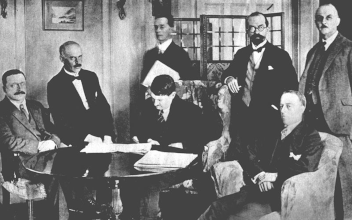
(Pictured: Some members of the Second Dáil at the Grosvenor Hotel in London, seated (L to R) Éamon de Valera and Arthur Griffith, National Library of Ireland, NPA-RPH-10)


Leave a comment

British Ultimatum to the Irish Delegation at the Anglo-Irish Treaty Talks

The Irish delegation at the Anglo-Irish Treaty talks in London are given an ultimatum by British Prime Minister David Lloyd George on December 5, 1921. Sign the treaty or face “immediate and terrible war.”

In 1920, during the Irish War of Independence, the Government of Ireland Act not only establishes the new state of Northern Ireland but gives that state the right to opt-out of a future self-governing Irish Free State within the British Commonwealth of Nations.

The Northern state consists of the six northeastern counties of Ulster with a unionist majority. They are Antrim, Down, Armagh, Derry, Tyrone, and Fermanagh. Belfast is to be the seat of a government and hold limited devolved powers. The counties of Donegal, Cavan, and Monaghan are to be absorbed within the Irish Free State controlled from parliament in Dublin.

Irish nationalists are dismayed with the plan. Protestant Unionists, particularly those living within the boundaries of the new state, accept and start to implement the Act. Sectarian attacks are launched upon Catholic homes in Belfast, Derry, Banbridge, Lisburn, and Dromore. Catholics are driven from Belfast shipyards and from various engineering works in the city. Supposedly these attacks are in revenge for Irish Republican Army (IRA) assassinations.

The IRA continues the campaign to establish a republic with the Irish War of Independence. By the middle of 1921, both sides are exhausted, and a truce is called on June 9.

In July 1921, Éamon DeValera, the president of Dáil Éireann, goes to London to meet with Prime Minister Lloyd George. They agree an Irish delegation will come to London to discuss terms in the autumn.

The delegation appointed by the Dáil to travel to London consists of Arthur Griffith (Minister for Foreign Affairs and chairman of the delegation); Michael Collins (Minister for Finance and deputy chairman of the delegation); Robert Barton (Minister for Economic Affairs); George Gavan Duffy and Éamonn Duggan, with Erskine Childers, Fionán Lynch, Diarmuid O’Hegarty, and John Chartres providing secretarial assistance. DeValera himself does not attend. Future historians wonder if he knew they would not be able to negotiate a 32 county Irish Republic.

During the debate, Lloyd George insists Ireland remain part of the Commonwealth and Dáil Éireann members take the oath of allegiance to the British throne. After a delay of two months, Lloyd George delivers the ultimatum on December 5, sign a treaty within three days or there will be war.

The Anglo-Irish Treaty is to give Ireland a 26 county Free State with Dominion status. The right to raise taxes, regulate foreign trade, independence in internal affairs, own an army, and the oath of allegiance is changed to one of fidelity.

The British are to retain three naval bases within the jurisdiction of the Free State, at Cobh, Lough Swilly, and Berehaven. The Northern Ireland boundary is to be determined by a commission. This gives false hope to large tracts of Tyrone, Fermanagh, Down, Armagh, and Derry City would be given to the Free State as they have Catholic majorities.

Just after 2:00 AM on December 6, 1921, the Irish delegation, without consulting the Dáil, finally sign a treaty with the British. Collins writes, prophetically, later on the day of the signing, “early this morning I signed my death warrant.”

The Treaty displeases the Catholics in the north and the unionists in the south. Meanwhile, many of those involved in the conflict are abhorred at the fact that not all of Ireland is to leave the United Kingdom.

(From: “The Anglo-Irish Treaty (1921)” by Brian O’Neill, Your Irish Culture, http://www.yourirish.com, May 20, 2020)


1 Comment

Birth of Barrister Alexander Martin Sullivan

alexander-martin-sullivan

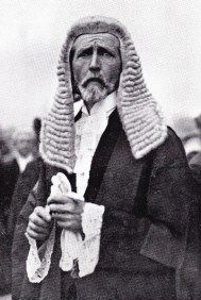
Alexander Martin Sullivan, Irish lawyer best known as the leading counsel for the defence in the 1916 treason trial of Roger Casement, is born in Dublin on January 14, 1871. He is the last barrister in either Ireland or England to hold the rank of Serjeant-at-Law, hence his nickname The Last Serjeant.

A younger son of A.M. Sullivan and Frances Donovan, Sullivan is educated at Ushaw College, Belvedere College, Trinity College, Dublin and King’s Inns. He is called to the Irish Bar in 1892 and practises on the Munster Circuit.

Sullivan is appointed an Irish KC in 1908 and King’s Third Serjeant-at-law (Ireland) in 1912 advancing to Second Serjeant in 1913 and First Serjeant in 1919, the last holder of that position.

A moderate constitutional nationalist and supporter of the Irish Parliamentary Party, Sullivan is a prominent campaigner for the recruitment of Irishmen into the British Army during World War I. His opposition to Sinn Féin republicanism and his prominent role in conducting prosecutions on behalf of the Crown during the Irish War of Independence lead to at least one attempt on his life. As a result, he relocates to England in 1921 and establishes a career at the English Bar, having previously been called to the Middle Temple in 1899. He subsequently becomes a Bencher and Treasurer of Middle Temple. By courtesy, he is always referred to as Serjeant Sullivan, even though that rank no longer exists in England.

Sullivan remains a member of the Irish Bar and returns at least once to appear in the celebrated case of Croker v Croker, where the children of the former leader of Tammany Hall, Richard “Boss” Croker attempt to overturn his will, which leaves his entire estate to their stepmother.

Sullivan is noted as a fearless advocate, who brings to his English practice the robust manners he had learned in the Irish county courts. He does not hesitate to interrupt the judge, and if he feels that he is not receiving a fair hearing, he is quite capable of walking out of Court.

In 1916 Sullivan is retained as lead counsel in the trial of Sir Roger Casement for treason. No English barrister will defend Casement, and Sullivan is persuaded to take the case by George Gavan Duffy, whose wife Margaret is Sullivan’s sister. Despite his rank of Serjeant at law and King’s Counsel at the Irish bar he is only ranked as a junior barrister in England. As the facts relied on by the prosecution are largely undisputed, Sullivan is limited to arguing a technical defence that the Treason Act 1351 only applies to acts committed “within the realm” and not outside it. The Act’s terms had however been expanded by case law over the previous 560 years, and the defence is rejected by the trial judges and by the Court of Criminal Appeal.

Sullivan writes two books: Old Ireland in 1927 and The Last Serjeant in 1952. He retires from legal practice in 1949. He dies on January 9, 1959.


Leave a comment

Dáil Éireann Approves the Anglo-Irish Treaty

second-all-ireland-dail

Dáil Éireann votes to approve the Anglo-Irish Treaty on January 7, 1922, following a debate through late December 1921 and into January 1922. The vote is 64 in favour, 57 against, with the Ceann Comhairle and three others not voting. The Sinn Féin party splits into opposing sides in the aftermath of the Treaty vote, which leads to the Irish Civil War from June 1922 until May 1923. The treaty is signed in London on December 6, 1921.

Two elections take place in Ireland in 1921, as a result of the Government of Ireland Act 1920 to establish the House of Commons of Northern Ireland and the House of Commons of Southern Ireland. The election is used by the Irish Republic as the basis of membership of the Second Dáil. The general election to the Northern Ireland House of Commons occurs on May 24, 1921. Of 52 seats, forty are won by unionists, six by moderate Irish nationalists, and six by Sinn Féin. No actual polling takes place in the Southern Ireland constituencies, as all 128 candidates are returned unopposed. Given the backdrop of the increasingly violent War of Independence, any candidates opposed to Sinn Féin, and their supporters can expect to be harassed by the Irish Republican Army (IRA). Supporters of the Irish Labour Party stand aside to allow the constitutional situation to run its course. Of these 128, 124 are won by Sinn Féin, and four by independent unionists representing the University of Dublin constituency. Only the Sinn Féin candidates recognise the Second Dáil and five of these have been elected in two constituencies, one in each part of Ireland, so the total number of members who assemble in the Second Dáil is 125.

During the Second Dáil, the government of the Irish Republic and the British government of David Lloyd George agree to hold peace negotiations. On September 14, 1921, the Dáil ratifies the appointment of Arthur Griffith, Michael Collins, Robert Barton, Eamonn Duggan, and George Gavan Duffy as envoys plenipotentiary for the peace conference in England. These envoys eventually sign the Anglo-Irish Treaty on December 6. After almost a month of acrimonious debate the treaty is formally ratified by Dáil Éireann on January 7, 1922.

To satisfy the requirements of the British constitution, the treaty also has to be ratified by the House of Commons of Southern Ireland. Thus, Irish nationalists end their boycott of the home rule parliament to attend the southern House of Commons as MPs. This they do alongside the four Unionist MPs who had refused to recognise the Dáil. In this way the treaty is ratified a second time in Dublin, this time unanimously as the anti-Treaty TDs refuse to attend.

Under the terms of the Anglo-Irish Treaty a provisional parliament, considered by nationalists to be the Third Dáil, is elected in the 1922 general election on June 16. Collins and Éamon de Valera agree a pact between the pro- and anti-Treaty wings of Sinn Féin, and this pact and the elections are endorsed by the Second Dáil. The new assembly is recognised both by nationalists and the British Government and so replaces both the Parliament of Southern Ireland and the Second Dáil with a single body. The anti-Treaty groups of IRA members, TDs, and their supporters are still bitterly opposed the settlement, despite the election result, and this leads to the Irish Civil War.

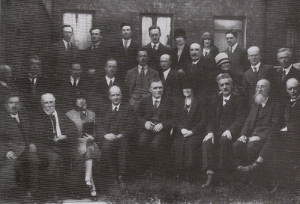
(Pictured: Second All-Ireland Dáil Éireann, elected in 1921)