King’s support of the Glorious Revolution in 1688 serves to advance his position. He becomes Bishop of Derry in 1691. His years as a bishop are marked by reform and the building of churches and glebe houses, and by the dispensing of charity. His political influence is considerable. He is always consulted on judicial appointments and at times seems to have an effective veto over candidates he considers unsuitable.
He is advanced to the position of Archbishop of Dublin in 1703, a post he holds until his death. He gives £1,000 for the founding of “Archbishop King’s Professorship of Divinity” at Trinity College in 1718. His influence declines after the appointment of Hugh Boulter as Archbishop of Armagh in 1724.
William King dies in May 1729. Much of his correspondence survives and provides a historic resource for the study of the Ireland of his time.
The Glorious Revolution of 1688 is a relatively bloodless revolution in which James II, King of England, Ireland and Scotland and a Roman Catholic convert, is ousted from power by the Parliament of England. The English throne is then offered to his Protestant daughter Mary and her husband William III of England, also known as William of Orange. In Scotland, the privy council asks William III to assume responsibility for the government in January 1689, and he and Mary are formally offered the Scottish throne in March. The situation is different in Ireland where most of the population are Catholics. Irish Catholics are hoping that James will re-grant them lands, which had been seized from them after the Cromwellian conquest of Ireland (1649–53). James thus looks to Ireland to muster support in regaining his kingdoms just as his father, Charles I, had done in the English Civil War of the 1640s.
On December 10, James flees London. He is caught but flees a second time on December 23 and makes his way to France. On March 12, James I lands in Kinsale with 6,000 French soldiers. He takes Dublin and marches north with an army of Irish and French Catholics.
In April 1689 reinforcements from England arrive under the command of Colonel John Cunningham, who is a native of the city. He is under instructions to take his orders from the Derry City Governor, Lieutenant Colonel Robert Lundy. Lundy advises Colonel Cunningham to leave as arrangements have been made for the city to be surrendered. Lundy calls a meeting with several of his most loyal supporters to discuss surrender. News of the meeting spread, angering many of the citizens. That night, Lundy and many others leave the city aboard a ship to Scotland. The city’s defence is overseen by Major Henry Baker, Colonel Adam Murray, and Major George Walker, also an Anglican priest. Their slogan is “No Surrender.”
As the Jacobite army nears, all the buildings outside the city walls are set alight by the defenders to prevent them being used as cover by the besiegers.
The Jacobite army reaches Derry on April 18. James and his retinue ride to within 300 yards of Bishop’s Gate and demand the surrender of the city. He is rebuffed with shouts of “No surrender!” and some of the city’s defenders fire at him. James asks for surrender three more times but is refused each time. This marks the beginning of the siege. Cannon and mortar fire are exchanged, and disease takes hold within the city. James returns to Dublin and leaves his forces under the command of Richard Hamilton.
Royal Navy warships under Admiral George Rooke arrive in Lough Foyle on June 11 but initially decline to ram through the heavily defended defensive boom across the River Foyle at Culmore.
On July 28, two armed merchant ships, Mountjoy and Phoenix, sail toward the boom, protected by the frigate HMS Dartmouth under Captain John Leake. Mountjoy rams and breaches the boom, and the ships move in, unloading many tons of food to relieve the siege. The city had endured 105 days of siege during which some 4,000 Protestants of a population of 8,000 are said to have died.
The siege is commemorated yearly by the Protestant Apprentice Boys of Derry who stage the week-long Maiden City Festival culminating in a parade around the walls of the city by local members, followed by a parade of the city by the full Association. Although violence has attended these parades in the past, those in recent years have been largely peaceful.
The song “Derry’s Walls” is written to commemorate the siege.
Brodrick is the second son of Sir St. John Brodrick of Ballyannan, near Midleton in County Cork, by his wife Alice, daughter of Laurence Clayton of Mallow, County Cork. His father receives large land grants during The Protectorate, and thus the family has much to lose if the land issue in Ireland is settled to the satisfaction of dispossessed Roman Catholics. He is educated at Magdalen College, Oxford and the Middle Temple, being called to the English bar in 1678. He and his relatives flee Ireland during the Glorious Revolution. They are attainted under the rule of King James II in Ireland. In exile in England, Brodrick argues for a speedy reconquest.
In 1690 Brodrick returns to Dublin and is given the legal office of Third Serjeant. He also becomes Recorder of Cork. He is dismissed as Serjeant in 1692, apparently on the ground that there is no work for him to do. While complaining bitterly about his dismissal, he admits privately that his post has been a superfluous one.
As a prominent Whig supporter of the outcome of the Glorious Revolution he is not always in agreement with court policies in Ireland, which he considers too lenient on the Jacobites. The dismissal of the First Serjeant, John Osborne, at the same time as Brodrick is due to his even stronger opposition to Court policy. Despite this he often holds Irish government offices and aspires to manage the Irish Parliament for English ministers. He represents Cork City in the Irish Parliament, which meets in 1692 and holds this seat until 1710. He is a vocal opponent of court policies, until the new Whig Lord Deputy of Ireland, Lord Henry Capell, decides to appoint him Solicitor-General for Ireland in 1695. He promotes penal laws against Catholics, whilst also supporting greater powers for the Irish Parliament.
Brodrick is Speaker of the Irish House of Commons from September 21, 1703. After promoting resolutions critical of the Lord Lieutenant of Ireland he loses his post as Solicitor-General in 1704. From 1707 until 1709 he is Attorney-General for Ireland. He becomes Chief Justice of Ireland in 1710 and is replaced as Speaker on May 19, 1710, but again holds the office in the next Parliament (November 25, 1713 – August 1, 1714), where he also represents County Cork. He is appointed Lord Chancellor of Ireland in 1714 and is ennobled in the Peerage of Ireland in 1715, as the 1st Baron Brodrick. He is advanced to the rank of 1st Viscount Midleton in 1717.
Brodrick feuds with his successor as Speaker William Conolly, as they are rivals to be the leading figure in Irish politics. Despite intrigues in England, he loses out and resigns as Lord Chancellor in 1725. He leaves behind him a legacy of bitterness and ill-will for which he is not really responsible as the Irish peers choose to blame him for the loss of their powers under the Sixth of George I, rather than their own misjudgment in imprisoning the Barons of the Exchequer.
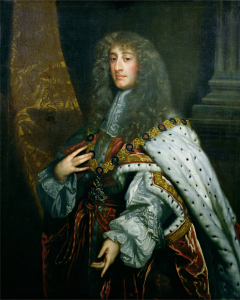
The second surviving son of Charles I, James ascends the throne upon the death of his brother, Charles II. There is little initial opposition to his accession, and there are widespread reports of public rejoicing at the orderly succession. The new Parliament that assembles in May 1685, which gains the name of “Loyal Parliament,” is initially favourable to James, and the new King sends word that even most of the former exclusionists will be forgiven if they acquiesce to his rule.
Members of Britain’s Protestant political elite increasingly suspect him of being pro-French and pro-Catholic and of having designs on becoming an absolute monarch. When he produces a Catholic heir, leading nobles call on his Protestant son-in-law and nephew William of Orange to land an invasion army from the Dutch Republic, which he does in the Glorious Revolution of 1688. James flees England and thus is held to have abdicated. He is replaced by his eldest, Protestant daughter Mary and her husband William of Orange.
James is best known for his struggles with the English Parliament and his attempts to create religious liberty for English Roman Catholics and Protestant nonconformists, against the wishes of the Anglican establishment. This tension makes James’s four-year reign a struggle for supremacy between the English Parliament and the Crown, resulting in his deposition, the passage of the Bill of Rights, and the accession of his daughter and her husband as king and queen.
On and around the Twelfth, large parades are held by the Orange Order and Ulster loyalist marching bands, streets are bedecked with British flags and bunting, and large, towering bonfires are lit. Today the Twelfth is mainly celebrated in Northern Ireland, where it is a public holiday, but smaller celebrations are held in other parts of the world where Orange lodges have been set up, including the Canadian province of Newfoundland where it is a provincial holiday. The Twelfth involves thousands of participants and spectators, although not all Protestants celebrate it.
In Northern Ireland, where almost half the population is from an Irish Catholic background, The Twelfth is a tense time. Orange marches through Irish Catholic and Irish nationalist neighbourhoods are usually met with opposition from residents, sometimes leading to violence. Public disorder during The Twelfth parades of the early 19th century led to them being banned in the 1830s and 1840s.
Many Catholics and Irish nationalists see the Orange Order and its marches as sectarian, triumphalist, and supremacist. The Order is also politically a unionist/loyalist organization. Violence related to the Twelfth in Northern Ireland worsens during the 30-year ethno-political conflict known as The Troubles. The Drumcree conflict is the most well-known dispute involving Orange marches.
Attempts have recently been made to downplay the political aspects of the marches and present the Twelfth as a cultural, family-friendly event at which tourists are welcome. Although most events pass off peacefully, some continue to result in violence.
It takes its name in memory of King William of Orange of the house of Orange who fights at the Battle of the Boyne, brings about the Glorious Revolution and the Bill of Rights giving the Westminster parliament ultimate power of the country rather than the Monarch. The Independent Order is small compared to the main organisation with 1,500 to 2,000 members. It is largely based around north County Antrim in Northern Ireland but has lodges around the world, including England, Scotland, and Australia. Its annual main Twelfth of July demonstration is held in a north Antrim town or village.
The first notable effect after the formation of the Independent Order is a more liberal interpretation of the rules of the “Old Order.” In the early years of the Institution, many suffer the full wrath of the “powers that be,” who are opposed to any splitting of the Orange Order. Jobs are lost, homes are burned, and their headquarters in Belfast is bombed.
Independent Orangeism today maintains that it is essential for the Orange Institution to be kept free from politics and to guard the principles of Reformation Protestantism. They often express alarm when they believe these principles are endangered by conciliatory politicians. They are opposed to ecumenism and, while being opposed to Orangeism being linked to the Ulster Unionist Party, they are not apolitical and tend to work alongside unionist politicians and parties.
The Institution also promotes Ulster Protestant history and proclaims the principle of “Liberty of Conscience.” They declare their right to think and act independently without direction from political or clerical masters, they seek to strengthen the position of Orangeism, and they often warn of the danger of the development of a social and cultural Orangeism devoid of Protestant principle.
The cause of the war is the deposition of James II as King of the Three Kingdoms in the “Glorious Revolution” of 1688. James is supported by the mostly Catholic Jacobites in Ireland and hopes to use the country as a base to regain his Three Kingdoms. He is given military support by France. For this reason, the war becomes part of a wider European conflict known as the Nine Years’ War, or War of the Grand Alliance. Some Protestants of the established Church in Ireland also fight on the side of King James.
James is opposed in Ireland by the mostly Protestant Williamites, who are concentrated in the north of the country. William lands a multi-national force in Ireland, composed of English, Scottish, Dutch, Danish, and other troops, to put down Jacobite resistance. James leaves Ireland after a reverse at the Battle of the Boyne in 1690 and the Irish Jacobites are finally defeated after the Battle of Aughrim in 1691.
The Treaty of Limerick, signed on October 3, 1691, offers favourable terms to Jacobites willing to stay in Ireland and give an oath of loyalty to William III. Peace is concluded on these terms between Patrick Sarsfield and Godert de Ginkell, giving toleration to Catholicism and full legal rights to Catholics that swear an oath of loyalty to William and Mary. Part of the treaty agreed to Sarsfield’s demand that the Jacobite army be allowed to leave Ireland as a body and go to France. This event is popularly known in Ireland as the “Flight of the Wild Geese.” Around 14,000 men with around 10,000 women and children leave Ireland with Patrick Sarsfield in 1691.
The Williamite victory in the war in Ireland has two main long-term results. The first is that it ensures James II will not regain his thrones in England, Ireland, and Scotland by military means. The second is that it ensures closer British and Protestant dominance over Ireland. Until the 19th century, Ireland is ruled by what becomes known as the “Protestant Ascendancy,” the mostly Protestant ruling class. The majority of the Irish Catholic community and the Ulster-Scots Presbyterian community are systematically excluded from power, which is based on land ownership.
For over a century after the war, Irish Catholics maintain a sentimental attachment to the Jacobite cause, portraying James and the Stuarts as the rightful monarchs who would have given a just settlement to Ireland, including self-government, restoration of confiscated lands and tolerance for Catholicism. Thousands of Irish soldiers leave the country to serve the Stuart monarchs in the Irish Brigade (Spanish) and Irish Brigade of the French Army. Until 1766, France and the Papacy remain committed to restoring the Stuarts to their British Kingdoms. At least one composite Irish battalion drawn from Irish soldiers in the French service fight on the Jacobite side in the Scottish Jacobite uprisings leading up to the Battle of Culloden in 1746.
Protestants, on the other hand, portray the Williamite victory as a triumph for religious and civil liberty where triumphant murals of King William still controversially adorn the gable walls in Ulster. The defeat of the Catholics in the Williamite war is still commemorated by Protestant Unionists in Ulster on the Twelfth of July by the Orange Order.



 The
The 
 seamus dubhghaill