O’Connor releases four solo albums and his third one, titled No Place Like Home, is named by The Irish Times as Number 1 Traditional/Folk album of the year in 2004. After the sudden death of banjo player Barney McKenna on April 5, 2012, he joins The Dubliners to complete their planned tour, until the final shows at Vicar Street in Dublin, on December 28-30. McKenna himself says about Gerry O’Connor: “He’s my best pupil ever.” Together with Eamonn Campbell, Patsy Watchorn and Seán Cannon, O’Connor keeps touring in 2013 as The Dublin Legends.
O’Connor is one of four musicians brought together by blues rock singer/guitar player Joe Bonamassa to perform on a variety of instruments in an acoustic concert at the Vienna State Opera on July 3, 2012. None of the five had ever worked together nor even met until they arrive in Vienna, where three days later they put on a live performance. The event is released on March 12, 2013, on CD and DVD/Blu-Ray, titled An Acoustic Evening At The Vienna Opera House, and in 2014 is broadcast as a PBS special.
O’Connor mainly plays CGDA tuned tenor banjo, instead of the usual Irish tuning GDAE. He plays a David Boyle banjo on almost every tour since 1996, but usually records with an Epiphone Recording A banjo.
Paul Joseph Brady, Irish singer-songwriter and musician, is born in Belfast, Northern Ireland, on May 19, 1947. Interested in a wide variety of music from an early age, his work straddles folk and pop.
Brady begins learning piano around age six and by the age of eleven he has begun to play guitar, spending hours of his school holidays learning every song that the Shadows had recorded. He is also influenced by Chuck Berry.
In 1963, Brady begins performing as a piano player in a hotel in Bundoran, County Donegal. In October 1964, he attends University College Dublin and performs with a number of R&B groups, covering songs by the likes of Ray Charles and James Brown. The first of these is the Inmates (late 1964–about April 1965), which evolves into the Kult (about April–December 1965), featuring Brady, Jackie McAuley (ex-Them, and future Belfast Gypsies and Trader Horne), Brendan Bonass, and Dave Pennefather. He can be seen in the documentary film Charlie Is My Darling waiting outside Dublin‘s Adelphi Cinema for the Rolling Stones‘ concert of September 3, 1965. He next joins Rootzgroup (late 1965–May 1966) and Rockhouse (about May–December 1966).
During Brady’s time at college in Dublin, the country sees a huge rise in interest in traditional Irish music. He joins the popular Irish band The Johnstons when Michael Johnston leaves in May 1967. They move to London in 1969 and subsequently to New York City in 1972 to expand their audience. Despite some success, he returns to Ireland in 1974 to join the Irish group Planxty, the band that subsequently launches the solo careers of Andy Irvine, Liam O’Flynn, Dónal Lunny, and Christy Moore.
When Planxty disbands in late 1975, Brady forms a duo with Irvine from 1976 to 1978, a partnership that produces the successful album, Andy Irvine/Paul Brady. The next few years see him establish his popularity and reputation as one of Ireland’s best interpreters of traditional songs. His versions of ballads like “Arthur McBride” and “The Lakes of Pontchartrain” are considered definitive and are still popular at concerts today. In 1975 in New York, he records three albums for Shanachie Records as guitar accompanist to resident Irish fiddlers Andy McGann, Paddy Reynolds and John Vesey. He also records a 1976 album, The High Part of the Road, for the same label with Irish fiddler Tommy Peoples.
In 1978, Brady releases his first solo album, Welcome Here Kind Stranger, which wins him critical acclaim and is voted the “Folk Album of the Year” by Melody Maker magazine. However, it proves to be his last album covering traditional material. He decides to delve into pop and rock music and releases his first album of this genre in 1981, Hard Station.
Brady releases a number of successful solo albums throughout the 1980s: True for You (1983), Back to the Centre (1985), and Primitive Dance (1987). By the end of the decade, he is recognised and accepted as a respected performer and songwriter. His songs are being covered by a number of other artists, including Santana and Dave Edmunds.
Dylan is sufficiently impressed by Brady’s work to name-check him in the booklet of his 1985 box set, Biograph. The actual quote is “(…) people get too famous too fast these days and it destroys them. Some guys got it down – Leonard Cohen, Paul Brady, Lou Reed, secret heroes, John Prine, David Allen Coe, Tom Waits. I listen more to that kind of stuff than whatever is popular at the moment. They’re not just witchdoctoring up the planet, they don’t set up barriers (…)”.
In 1991, Brady reaches number 5 in the Irish Singles Chart with Nobody Knows.
Since his Hard Station album (1981), Brady is on various major labels until he creates his own label, PeeBee Music, in the late 1990s. He releases three albums in the 1990s: Trick or Treat, Songs & Crazy Dreams (a remixed compilation of earlier songs) and Spirits Colliding, which are met with critical acclaim. Trick or Treat is on Fontana/Mercury Records and receives a lot of promotion. As a result, some critics consider it his debut album and note that the record benefits from the expertise of experienced studio musicians, as well as producer Gary Katz, who works with the rock group Steely Dan. Rolling Stone, after praising his earlier but less-known solo records, calls Trick or Treat Brady’s “most compelling collection.”
Brady goes on to record several other albums, fifteen in total since going solo in 1978, and collaborates with a number of other established musicians including Bonnie Raitt and Richard Thompson. In 2006, he collaborates with Cara Dillon on the track “The Streets of Derry” from her album After the Morning. He also works with Fiachra Trench.
Brady’s fifteenth studio album, Hooba Dooba, is released in March 2010.
In 2017, a friendship is struck with Theo Katzman (Vulfpeck) and Brady tours Ireland in 2019 as half of this duo with Joe Dart, also of vulfpeck, Louis Cato and Lee Pardini. He continues to tour, record and collaborate with other artists. In 2019, Jimmy Buffett begins performing a cover of Brady’s hit, “The World is What you Make It.” In September 2019, Brady joins Buffett on his tour stops in both Dublin and London.
Brady releases the album Unfinished Business on his own label, PeeBee Music, licensed to Proper Music UK, in 2017.
While Brady and Andy Irvine’s planned tour of their 1976 album Andy Irvine/Paul Brady is impacted by the COVID-19 pandemic, they finish the tour in 2022. Musicians to join them on the tour include fiddle player Kevin Burke and multi-instrumentalist Dónal Lunny, both of whom had played on the original album.
In 2009, Brady receives an honorary degree of Doctor of Letters from the University of Ulster, in recognition of his services to traditional Irish music and songwriting.
Kian John Francis Egan, Irish pop singer, songwriter and musician, best known as a member of pop group Westlife, is born on April 29, 1980, in Sligo, County Sligo. Westlife has released twelve albums, embarked on thirteen world tours, and won numerous awards, becoming one of the most successful musical groups of all time.
Egan is born to Kevin Egan and Patricia Egan (née Moore). He is the fifth of their seven children. He attends Summerhill College secondary school in Sligo, where he meets fellow band members Mark Feehily and Shane Filan. He is the cousin of Filan’s wife, Gillian Walsh. Before Westlife, he works at a jeans store.
In his early musical years, Egan is part of a rock band named Skrod. He can play at least five musical instruments, including guitar, piano, and drums. He is a grade 8 pianist and was taught piano by his brother Gavin Egan, a university music graduate and full-time teacher of music in the UK. Before he is in Westlife, he is part of a pop group called Six as One, which later changes its name to IOYOU, with fellow Westlife members Mark Feehily and Shane Filan, alongside Graham Keighron, Michael “Miggles” Garrett and Derrick Lacey.
After IOUYOU is signed by Louis Walsh, its lineup changes to include Egan, Mark Feehily, Shane Filan and two new members – Nicky Byrne and Brian McFadden. The band’s name changes to Westside and later to Westlife. Westlife splits up in 2012 after a Greatest Hits Tour.
During a year long hiatus from Westlife in 2008, Egan launches a new venture with Louis Walsh to put together and co-manage girlband, Wonderland, which includes Jodi Albert, who on May 8, 2009, becomes Egan’s wife. Wonderland’s debut album reaches number 6 on the Irish Albums Chart and number 8 on the UK Albums Chart, however, just four months later, they are dropped by Mercury Records and eventually split up.
In June 2012, Egan announces in an interview with the Sunday Life that he is “looking at doing a TV show with Sky on surfing.” Later reports suggest that the show would be eight episodes long and would broadcast on Sky One later in the year.
In July 2012, Egan presents the British programme This Morning’s Hub on a regular basis, standing in for the regular hosts. Later that year, every Friday morning in October, he begins giving reports on another British programme, This Morning, about the remaining contestants in the ninth series of The X Factor, before the competition’s live shows that weekend.
On October 21, 2012, Egan co-presents the revamped version of Surprise Surprise, but does not return the following year.
In 2013, Egan appears on the thirteenth series of I’m A Celebrity…Get Me Out Of Here! He is ultimately crowned King Of The Jungle, which contributes to an invitation to being signed by Rhino Records to create his Home album.
In January 2014, Egan signs with Rhino Records of Warner Music Group and his debut album Home is released on March 14 of that year in Ireland and March 17 in the UK. His debut single “Home“, a cover of a song by the band Daughtry, has its first exclusive play on BBC Radio 2 on lunch time with Terry Wogan‘s show. The album peaks at number 2 on the Irish Albums Chart and number 9 on the UK Albums Chart. In May 2014, he releases the second single from the album, “I’ll Be,” a cover of the track by Edwin McCain.
In October 2018, Westlife announces the group’s reunion as a four-piece. In 2019, the group headlines “The Twenty Tour,” named in honour of Westlife’s 20th anniversary since its formation and the release of its first single, “Swear It Again,” in 1999. In addition to touring, Westlife also releases new music. “Hello My Love,” the first single from the group’s upcoming album, debuts on The Graham Norton Show in January 2019.
Egan is one of four coaches on The Voice of Ireland. However, his dreams of winning the show go to tatters as he throws his lot in with Jim Devine from Northern Ireland. This immediately puts him at a disadvantage to the other contestants as, ahead of the final, viewers in Northern Ireland cannot download his single, the tally of which contributes to his vote. He is left fuming and in need of support from Sharon Corr as he expresses his opinion on the unfairness of it all and has “huge rows” about it but to no avail.
Egan and his wife and three sons live in Strandhill, County Sligo. He is ranked number five on Ireland’s Sexiest Man of 2014. As of 2017, his net worth is 18 million euros.
Ní Mhaonaigh’s father, Proinsias Ó Maonaigh, is a noted fiddler, song writer and school teacher and is her first main influence. Her mother, Kitty Rua is also raised in a musical house that holds frequent house dances. It is no surprise that she and her siblings, Gearóid and Anna, all play music together.
In the early 1980s, Ní Mhaonaigh qualifies as a Primary school teacher and teaches in Saint Oliver Plunkett National School in Malahide, County Dublin. She and her husband, Frankie Kennedy, record Ceol Aduaidh (Music from the North) for Irish label Gael Linn in 1983. This timeless recording is the genesis of what later becomes Altan. The recording features her brother Gearóid Ó Maonaigh on guitar, Fintan Mc Manus on bouzouki, Ciaran Curran on bouzouki and Eithne Ní Bhraonáin (now known as Enya) on keyboards. The album quietly gains praise among enthusiasts of traditional Irish music worldwide, which leads the way for a career in music.
Ní Mhaonigh’s teaching career comes to a halt after she and her husband take a career break in 1987 and formed Altan. The band goes on to become one of the most acclaimed Irish traditional bands touring the world. They record for Green Linnet Records in the United States and tour North America extensively.
In 1994, Frankie Kennedy passes away to cancer, which is a tremendous loss to Ní Mhaonigh. She continues with the band at her late husband’s request and signs to multinational record label Virgin Records London in late 1994. This marks the first traditional Irish band to be signed to a major record label and propels Altan and Ní Mhaonigh into a wider audience of followers.
Ní Mhaonaigh, along with fronting Altan, remains close her roots between touring and returns to her native County Donegal to play, sing and teach her music to a new generation. She helps set up Cairdeas na bhFidléirí (The Fellowship / Friendship of Fiddlers) in the early 1980s to promote and preserve the fiddle music of County Donegal.
In 2009, Ní Mhaonaigh releases her first solo album, Imeall (Edge/Theshold), as a limited edition. After many years of playing with the band and numerous requests for a solo recording she finally gets time to record the album after parting with her second husband Dermot Byrne, with whom she has her daughter Nia. She tours the album between Altan commitments with her co-producer and recording engineer Manus Lunny.
The album prompts one reviewer, Paul O’Connor, to remark, “Her identified success as the leader of Altan has dominated our sense of her to the point that we aren’t cognisant of how good she is as an artist, musician, composer in her own right.”
This new focus on Ní Mhaonaigh as an artist in her own right, prompts The Donegal Association in Dublin to grant her “Donegal Person of the Year 2009” at a gala dinner in Dublin’s prestigious Burlington Hotel.
Ní Mhaonaigh is awarded the top recognition in traditional Irish music by her fellow peers in 2018, when she is awarded TG4Gradam Ceoil’s Traditional Musician of the Year. The following year, she is honoured in her own county at the now world famous “Cup o’Tae Festival” which is held annually in Ardara, County Donegal.
Ní Mhaonaigh is also a member of String Sisters, which is a Grammy listed folk supergroup of six of the world’s leading female fiddlers. Together they have released two albums – the Grammy-longlisted Live and Between Wind and Water. She is a member of T with the Maggies, which is a vocal supergroup of Donegal singers comprised of Maighread and Tríona Ní Dhomhnaill and Moya Brennan of Clannad fame.
Recently Ní Mhaonaigh has recorded with a group of thirteen County Donegal-based female fiddlers which is called ‘SíFiddlers.’
McShane learns at a young age to play bass and guitar. As a teenager, he is allegedly shunned by his family after they learn of his homosexuality. Later as a young man in the late 1970s, he leaves Northern Ireland to study at a stage school in London, where he learns to dance, sing and recite.
Hired as a stage dancer and backing singer, McShane soon goes around Europe with Dee D. Jackson and her band. During a visit to Italy with the band, he is attracted to the country’s underground dance scene, which leads to him settling in Milan in 1984. He tells Dick Clark on American Bandstand in 1986 that he fell in love with Italy from that moment. He also learns the Italian language.
McShane makes his debut playing in small clubs in his hometown and is presented to various audiences, without success. In view of his low artistic success, he decides to work as an Emergency Medical Technician (EMT) for the Red Cross until he meets Italian record producer and keyboardistMaurizio Bassi, with whom he creates Baltimora. The act finds success with its most popular single, “Tarzan Boy”, released in 1985.
In the United States, McShane is overwhelmed with the success of “Tarzan Boy”. Some sources state lead vocals are performed by Maurizio Bassi, the group’s keyboardist, with McShane actually providing the backing vocals. This still remains uncertain, and McShane lip synchs while appearing in the “Tarzan Boy” music video, and not Bassi. Both the music and the lyrics of Baltimora are written mostly by Bassi and Naimy Hackett, though McShane writes the lyrics to some of their songs, such as the single “Survivor in Love.”
After the release of “Survivor in Love,” with no label support for a follow-up album and due to its poor success, Bassi decides it is time to move on to other projects and Baltimora disbands.
McShane is diagnosed with AIDS in Milan in 1994. A few months later he returns to Northern Ireland to spend his final year, and dies in his native Derry on March 29, 1995 at the age of 37. A family spokesman issues the following statement after his death: “He faced his illness with courage and died with great dignity.” In the centre of Derry, a commemorative plaque is bestowed upon the grave of McShane and his father, who had died three years prior.
Known as “Van the Man,” Morrison starts his professional career when, as a teenager in the late 1950s, he plays a variety of instruments including guitar, harmonica, keyboards and saxophone for various Irish showbands, covering the popular hits of the time. He rises to prominence in the mid-1960s as the lead vocalist of the Northern Irish R&B band Them, with whom he records the garage band classic “Gloria.” His solo career begins under the pop-hit oriented guidance of Bert Berns with the release of the hit single “Brown Eyed Girl” in 1967. After Berns’ death, Warner Bros. Records buys out his contract and allows him three sessions to record Astral Weeks (1968). Though this album gradually garners high praise, it is initially a poor seller.
Moondance (1970) establishes Morrison as a major artist, and he builds on his reputation throughout the 1970s with a series of acclaimed albums and live performances. He continues to record and tour, producing albums and live performances that sell well and are generally warmly received, sometimes collaborating with other artists, such as Georgie Fame and The Chieftains.
Van Morrison has received six Grammy Awards, the 1994 Brit Award for Outstanding Contribution to Music, and has been inducted into both the Rock and Roll Hall of Fame and the Songwriters Hall of Fame. In 2016, he is knighted for his musical achievements and his services to tourism and charitable causes in Northern Ireland.
(Pictured: Van Morrison performing at Glasgow Royal Concert Hall on January 26, 2015 | Image: Getty)
After college at Keele University, Finer travels around Europe and spends some time working on a barge in France. He settles in London and becomes the bass player in a group called The Petals and lives in 32 Burton Street, a house which he sometimes shares with Spider Stacey and Shane MacGowan. Together with James Fearnley they found The Pogues. Primarily a banjoist, he also plays other instruments, including mandola, saxophone, hurdy-gurdy, and the guitar. Apart from Shane MacGowan, Finer is the most prolific composer for the band.
Finer appears on all the band’s albums until their breakup in 1996. He continues working as a musician and composer after leaving The Pogues.
On January 1, 2000, the Finer-composed Longplayer piece of music is started and is designed to last 1,000 years without ever repeating itself. It currently exists in both computer-generated and live versions. Longplayer represents a convergence of many of his concerns, particularly those relating to systems, long-durational processes, and extremes of scale in both time and space.
Finer serves as “Artist in Residence” at the Astrophysics Sub-department of the University of Oxford between October 2003 and June 2005. Finer and Hamburg-based swamp pop legend DM Bob begin recording and performing together in 2005, releasing their album Bum Steer in August of that year and co-producing the debut album by experimental pop band Marseille Figs. In July 2005, Finer wins the PRS Foundation New Music Award on the basis of his proposal to build a device that will automatically “compose” a song of indeterminate length by harnessing the creative force of the weather.
In March 2012, Mobile Sinfonia, a global composition for ringtones is launched, developed during a year Finer spends as a non-resident artist at the University of Bath. This piece concerns mutual invasion of soundscape via ringtones.
Finer is currently working on a number of new projects continuing his interest in long-term sustainability and the reconfiguring of older technologies, including Spiegelei, a spherical camera obscura featuring Finer’s innovative 360-degree projection system and the Supercomputer in Cambridge, a 5-bit mechanical sculpture which will compute minimal musical scores.


 Sir George Ivan Morrison, best known as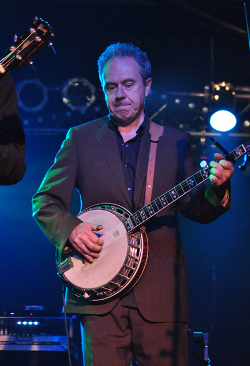
 seamus dubhghaill