seamus dubhghaill

Promoting Irish Culture and History from Little Rock, Arkansas, USA


Leave a comment

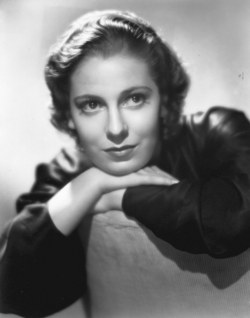
Birth of Actress Valerie Hobson

valerie-hobson

Valerie Hobson, Irish-born actress who appears in a number of films during the 1930s, 1940s and 1950s, is born Babette Valerie Louise Hobson in Larne, County Antrim, Northern Ireland on April 14, 1917. Her second husband is John Profumo, 5th Baron Profumo, a government minister who becomes the subject of a sensational sex scandal in 1963.

In 1935, still in her teens, Hobson appears as Baroness Frankenstein in Bride of Frankenstein with Boris Karloff and Colin Clive. She plays opposite Henry Hull that same year in Werewolf of London, the first Hollywood werewolf film. The latter half of the 1940s sees Hobson in perhaps her two most memorable roles: as the adult Estella in David Lean‘s adaptation of Great Expectations (1946), and as the refined and virtuous Edith D’Ascoyne in the black comedy Kind Hearts and Coronets (1949).

In 1952 she divorces her first husband, film producer Sir Anthony Havelock-Allan. In 1954, she marries Brigadier John, 5th Baron Profumo, an MP, giving up acting shortly afterwards. Baron Profumo is a prominent politician of Italian descent. Hobson’s last starring role is in the original London production of Rodgers and Hammerstein‘s musical play The King and I, which opens at the Theatre Royal, Drury Lane, on October 8, 1953. She plays Mrs. Anna Leonowens opposite Herbert Lom‘s King. The show runs for 926 performances.

After Profumo’s ministerial career ends in disgrace in 1963, following revelations he had lied to the House of Commons about his affair with Christine Keeler, Hobson stands by him. They worked together for charity for the remainder of her life, though she does miss their more public personas.

Hobson’s eldest son, Simon Anthony Clerveaux Havelock-Allan, is born in May 1944 with Down syndrome. Her middle child, Mark Havelock-Allan, is born on April 4, 1951, and becomes a judge. Her youngest child is the author David Profumo, who writes Bringing the House Down: A Family Memoir (2006) about the scandal. In it, he writes his parents told him nothing of the scandal and that he learned of it from another boy at school.

Valerie Hobson dies on November 13, 1998, at the age of 81 at a Westminster, London Hospital following a heart attack. After her death, her body is cremated in accordance with her wishes. Half her ashes are interred in the family vault in Hersham. The rest are scattered on January 1, 1999, by her sons David Profumo and Mark Havelock-Allan, near the family’s farm in Scotland.

Hobson is portrayed by Deborah Grant in the film Scandal (1989), and by Joanna Riding in Andrew Lloyd Webber‘s stage musical Stephen Ward, which opens at the Aldwych Theatre on December 19, 2013.


2 Comments

Birth of Actor Edward Mulhare

edward-mulhare

Edward Mulhare, Irish actor whose career spans five decades, is born in Cork, County Cork on April 8, 1923. He is best known for his starring roles in two television series, The Ghost & Mrs. Muir and Knight Rider.

Mulhare, one of three brothers, is born at 22 Quaker Road, Cork, County Cork, in what is then known as the Irish Free State, to John and Catherine Mulhare. As a child, he receives his education at St. Nessan’s Christian Brothers School, and later North Monastery. As a young adult, he begins schooling at the National University of Ireland in medicine, but eventually decides upon a career in theatre. After acting in various Irish venues including the Gate Theatre in Dublin, he moves to London, where he works with Orson Welles and John Gielgud.

His best-known stage role is as Professor Higgins in the original Broadway production of My Fair Lady, having taken over the role from Rex Harrison in 1957.

Mulhare’s first television appearance is in 1956 in a production of The Adventures of Robin Hood. He is a guest panelist in 1958 on the CBS television game show What’s My Line? By 1965, he is back in Hollywood appearing in films and television shows. He earns a role in the films Von Ryan’s Express in 1965, Our Man Flint in 1966, and Caprice in 1967. He guest-stars in television programs, including the Twelve O’Clock High episode “Siren Voices” as Luftwaffe Colonel Kurt Halland. He also guest-stars in “Experiment In Terra,” an episode of the original Battlestar Galactica series. In The Ghost & Mrs. Muir, a supernatural sitcom that runs from 1968 to 1970, he stars as Captain Daniel Gregg, and again is something of a successor to Rex Harrison, who had originated the role of “The Ghost” in the original 1947 film. In the mid-1980s, Mulhare hosts the television series Secrets & Mysteries, also called Secrets of the Unknown, a magazine show that examines historical mysteries and the paranormal. His most famous role is probably as Devon Miles in the Knight Rider series.

Mulhare stars in a number of films in his career including Megaforce and Out to Sea. His final role is on Baywatch Nights alongside former Knight Rider co-star David Hasselhoff in 1997.

Edward Mulhare dies of lung cancer on May 24, 1997, age 74, at his home in Van Nuys, California. He had been battling the cancer for five months prior to his death. He is buried in St. Joseph’s Cemetery, Tory Top Road, Cork. Team Knight Rider dedicates an episode titled “K.R.O.” to Mulhare’s memory which is broadcast on October 27, 1997.


2 Comments

Birth of Actor Spencer Tracy

spencer-tracy

Spencer Bonaventure Tracy, American actor noted for his natural style and versatility, is born in Milwaukee, Wisconsin on April 5, 1900. One of the major stars of Hollywood’s Golden Age, Tracy wins two Academy Awards for Best Actor, from nine nominations, sharing the record for nominations in that category with Laurence Olivier.

Tracy is the second son of Caroline and John Edward Tracy, a truck salesman. His mother is a Presbyterian from a wealthy Midwestern family and his father is of Irish Catholic background.

Tracy first discovers his talent for acting while attending Ripon College, and he later receives a scholarship for the American Academy of Dramatic Arts. He spends seven years in the theatre, working in a succession of repertory theatres and intermittently on Broadway. His breakthrough comes in 1930, when his lead performance in The Last Mile catches the attention of Hollywood. After a successful film debut in Up the River, he is signed to a contract with Fox Film Corporation. His five years with Fox are unremarkable and he remains largely unknown to audiences after 25 films, most of them starring Tracy as the leading man. None of them are hits although The Power and the Glory (1933) features one of his most acclaimed performances.

In 1935, Tracy joins Metro-Goldwyn-Mayer, at the time Hollywood’s most prestigious studio. His career flourishes with a series of hit films, and in 1937 and 1938 he wins consecutive Oscars for Captains Courageous and Boys Town. By the 1940s, Tracy is one of the studio’s top stars. In 1942, he appears with Katharine Hepburn in Woman of the Year, beginning a popular partnership that produces nine movies over 25 years.

Tracy leaves MGM in 1955 and continues to work regularly as a freelance star, despite an increasing weariness as he ages. His personal life is troubled, with a lifelong struggle against alcoholism and guilt over his son’s deafness. He becomes estranged from his wife in the 1930s but never divorces, conducting a long-term relationship with Katharine Hepburn in private. Towards the end of his life, he works almost exclusively for director Stanley Kramer. It is for Kramer that he makes his last film, Guess Who’s Coming to Dinner in 1967, completed just 17 days before his death.

On June 10, 1967, Tracy awakens at 3:00 AM to make himself a cup of tea in his apartment in Beverly Hills, California that he shares with Hepburn. She hears a loud thump and finds Tracy lying dead on the kitchen floor from a heart attack.

A Requiem Mass is held for Tracy on June 12, 1967, at the Immaculate Heart of Mary Catholic Church in East Hollywood. Pallbearers included George Cukor, Stanley Kramer, Frank Sinatra, James Stewart, and John Ford. Out of consideration for Tracy’s family, Hepburn does not attend the funeral. Tracy is interred at Glendale‘s Forest Lawn Memorial Park, near his wife, Louise, and son John.

During his career, Tracy appears in 75 films and develops a reputation among his peers as one of the screen’s greatest actors. In 1999 the American Film Institute ranks Tracy as the 9th greatest male star of Classical Hollywood Cinema.


4 Comments

Birth of Cairbre, the Original MGM Lion

Cairbre, the original Leo the Lion mascot for the Hollywood film studio Metro-Goldwyn-Mayer (MGM), is born at the Dublin Zoo on March 20, 1919.

Cairbre is renamed Slats and is trained by Volney Phifer. Slats is used on all black-and-white MGM films between 1924 and 1928. The original logo is designed by Howard Dietz and used by the Goldwyn Pictures Corporation studio from 1916 to 1924. Goldwyn Pictures is ultimately absorbed into the partnership that forms MGM, and the first MGM film that uses the logo is He Who Gets Slapped (1924). Dietz states that he decided to use a lion as the company’s mascot as a tribute to his alma mater Columbia University, whose athletic teams’ nickname is The Lions. He further adds that Columbia’s fight song, “Roar, Lion, Roar“, inspired him to make the lion roar.

Ironically, unlike his successors, Slats does nothing but look around in the logo making him the only MGM lion not to roar, although it is rumored that Volney Phifer trains the lion to growl on cue, despite the fact that synchronized sound is not officially used in motion pictures until 1927.

Slats dies in 1936.


Leave a comment

Birth of George Brent, Irish-Born Actor

george-brent

George Brent, Irish-born American stage, film, and television actor in American cinema, is born on March 15, 1904 in Ballinasloe, County Galway.

Brent was born George Patrick Nolan to John J. and Mary (née McGuinness) Nolan. His mother is a native of Clonfad, Moore, County Roscommon. During the Irish War of Independence, Brent is part of the Irish Republican Army (IRA). He flees Ireland with a bounty set on his head by the British government, although he later claims only to have been a courier for guerrilla leader and tactician Michael Collins.

Brent arrives in the United States in 1921. Some time later he tours with a production of Abie’s Irish Rose. During the next five years, he acts in stock companies in Colorado, Rhode Island, Florida, and Massachusetts. In 1930, he appears on Broadway in Love, Honor, and Betray, alongside Clark Gable.

He eventually moves to Hollywood, and makes his first film, Under Suspicion, in 1930. Over the next two years, he appears in a number of minor films produced by Universal Studios and 20th Century Fox, before being signed to contract by Warner Bros. in 1932. He remains at Warner Bros. for the next 20 years, carving out a successful career as a top-flight leading man during the late 1930s and 1940s.

Highly regarded by Bette Davis, Brent becomes her most frequent male co-star, appearing with her in 13 films, including Front Page Woman (1935), Special Agent (1935), The Golden Arrow (1936), Jezebel (1938), The Old Maid (1939), Dark Victory (1939), and The Great Lie (1941). Brent also plays opposite Ruby Keeler in 42nd Street (1933), Greta Garbo in The Painted Veil (1934), Ginger Rogers in In Person (1935), Madeleine Carroll in The Case Against Mrs. Ames (1936), Jean Arthur in More Than a Secretary (1936), Myrna Loy in Stamboul Quest (1934) and The Rains Came (1939), Merle Oberon in ‘Til We Meet Again (1940), Ann Sheridan in Honeymoon for Three (1941), Joan Fontaine in The Affairs of Susan (1945), Barbara Stanwyck in So Big! (1932), The Purchase Price (1932), Baby Face (1933), The Gay Sisters (1942), and My Reputation (1946), Claudette Colbert in Tomorrow Is Forever (1946), Dorothy McGuire in The Spiral Staircase (1946), Lucille Ball in Lover Come Back (1946), and Yvonne De Carlo in Slave Girl (1947).

Brent drifts into “B” pictures from the late 1940s and retires from film in 1953. He continues to appear on television until 1960, having appeared on the religion anthology series, Crossroads. He is cast in the lead in the 1956 television series, Wire Service. In 1978, he makes one last film, the made-for-television production Born Again.

George Brent receives two stars on the Hollywood Walk of Fame, the first, at 1709 Vine St., for his film contributions, the second star, at 1614 Vine St., for his work in television.

Brent is married five times: Helen Louise Campbell (1925–1927), Ruth Chatterton (1932–1934), Constance Worth (1937), Ann Sheridan (1942–1943), and Janet Michaels (1947-1974). His final marriage to Janet Michaels, a former model and dress designer, lasts 27 years until her death in 1974. They have a son and a daughter.

Brent also carries on a lengthy relationship with his frequent Warner Bros. co-star, actress Bette Davis, who describes her last meeting with Brent after many years of estrangement. He is suffering from advanced emphysema, and she expresses great sadness at his ill health and deterioration. George Brent dies on May 26, 1979 in Solana Beach, California.


Leave a comment

Birth of Neil Patrick Jordan, Screenwriter & Director

neil-patrick-jordan

Neil Patrick Jordan, film director, screenwriter, novelist, and short-story writer, is born in County Sligo on February 25, 1950. His first book, Night in Tunisia, wins a Somerset Maugham Award and the Guardian Fiction Prize in 1979. He wins an Academy Award for Best Original Screenplay for The Crying Game (1992). He also wins the Silver Bear for Best Director at the Berlin International Film Festival for The Butcher Boy (1997).

Jordan is educated at St. Paul’s College, Raheny. Later, Jordan attends University College Dublin, where he studies Irish history and English literature. He is raised a Catholic and is quite religious during the early stages of his life. Regarding his current beliefs, he states that “God is the greatest imaginary being of all time. Along with Einstein‘s General Theory of Relativity, the invention of God is probably the greatest creation of human thought.”

When John Boorman is filming Excalibur in Ireland, he recruits Jordan as a “creative associate.” A year later Boorman is executive producer on Jordan’s first feature, Angel, a tale of a musician caught up in the Troubles, starring Stephen Rea who subsequently appears in almost all of Jordan’s films to date. During the 1980s, he directs films that win him acclaim, including The Company of Wolves and Mona Lisa, both made in England. The Company of Wolves becomes a cult favorite.

As a writer/director, Jordan has a highly idiosyncratic body of work, ranging from mainstream hits like Interview with the Vampire to commercial failures like We’re No Angels to a variety of more personal, low-budget arthouse pictures. He is also the driving force behind the cable TV series The Borgias.

Unconventional sexual relationships are a recurring theme in Jordan’s work, and he often finds a sympathetic side to characters that audiences would traditionally consider deviant or downright horrifying. His film The Miracle, for instance, follows two characters who struggle to resist a strong, incestuous attraction, while The Crying Game makes complicated, likable characters out of an IRA volunteer and a transgender woman. Interview with the Vampire, like the Anne Rice book it is based on, focuses on the intense, intimate interpersonal relationship of two undead men who murder humans nightly, accompanied by an equally lusty vampire woman who is eternally trapped in the body of a little girl. While Lestat (Tom Cruise) is depicted in an attractive but villainous manner, his partner Louis (Brad Pitt) and the child vampire Claudia (Kirsten Dunst) are meant to capture the audience’s sympathy despite their predatory nature.

In addition to the unusual sexuality of Jordan’s films, he frequently returns to the Troubles of Northern Ireland. The Crying Game and Breakfast on Pluto both concern a transgender character, both concern the Troubles, and both feature frequent Jordan leading man Stephen Rea. The two films, however, are very different, with The Crying Game being a realistic thriller/romance and Breakfast on Pluto a much more episodic, stylized, darkly comic biography. Jordan also frequently tells stories about children or young people, such as The Miracle and The Butcher Boy. While his pictures are most often grounded in reality, he occasionally directs more fantastic or dreamlike films, such as The Company of Wolves, High Spirits, Interview with the Vampire, and In Dreams.

The critical success of Jordan’s early pictures leads him to Hollywood, where he directs High Spirits and We’re No Angels. Both are critical and financial disasters. He later returns home to make the more personal The Crying Game, which is nominated for six Academy Awards. Jordan wins the Academy Award for Best Original Screenplay for the film. Its unexpected success leads him back to American studio filmmaking, where he directs Interview with the Vampire. He also directs the crime drama The Brave One starring Jodie Foster.

Jordan also writes and directs the Irish-made film Ondine (2009), starring Colin Farrell and Alicja Bachleda-Curuś. He also directs Byzantium, an adaptation of the vampire play of the same name starring Saoirse Ronan, Gemma Arterton, and Jonny Lee Miller.

Jordan lives in Dalkey, which is a part of the larger town of Dún Laoghaire.


Leave a comment

Birth of Novelist Liam O’Flaherty

liam-oflaherty

Liam O’Flaherty, novelist, short story writer, and a major figure in the Irish literary renaissance, is born on August 28, 1896, in the remote village of Gort na gCapall on Inis Mór, one of the Aran Islands of County Galway. He is involved for a time in left-wing politics, as is his brother Tom Maidhc O’Flaherty (also a writer), and their father, Maidhc Ó Flaithearta, before them.

At the age of twelve, O’Flaherty goes to Rockwell College and later University College Dublin and the Dublin Diocesan teacher training college Holy Cross College. It is intended he enter the priesthood, but he joins the Irish Guards in 1917 under the name Bill Ganly. Serving on the Western Front, he finds trench life devastatingly monotonous and is badly injured in September 1917 during the Battle of Langemarck. It is speculated that shell shock is responsible for the mental illness which becomes apparent in 1933.

He returns from the front a socialist. Having become interested in Marxism as a schoolboy, atheistic and communistic beliefs evolve in his 20s and he is a founding member of the Communist Party of Ireland. Two days after the establishment of the Irish Free State, O’Flaherty and other unemployed Dublin workers seize the Rotunda Concert Hall in Dublin and hold it for four days in protest at “the apathy of the authorities.” Free State troops force their surrender.

O’Flaherty then leaves Ireland and moves first to England where, destitute and jobless, he takes to writing. In 1925 he scores immediate success with his best-selling novel The Informer about a rebel with confused ideals in the Irish War of Independence, which wins him the 1925 James Tait Black Memorial Prize for fiction. Four years later his next short novel Return of the Brute, set in the World War I trenches, proves another success. He then travels to the United States, where he lives in Hollywood for a short time. The well-known director John Ford, a cousin, later makes a film of O’Flaherty’ first novel. The novel is also the source of a 1929 film of the same name directed by Arthur Robison.

Many of his works have the common theme of nature and Ireland. He is a distinguished short story writer, and some of his best work in that genre is in Irish. The collection Dúil, published towards the end of his life, contains Irish language versions of a number of stories published elsewhere in English. This collection, now widely admired, has a poor reception at the time, and this seems to discourage him from proceeding with an Irish language novel he has in hand.

In a letter written to The Sunday Times in later years he confesses to a certain ambivalence regarding his work in Irish and speaks of other Irish writers who receive little praise for their work in the language. This gives rise to some controversy. His First Flight, a short story which symbolizes the nervousness one experiences before doing something new, is regarded as one of his most famous works. In 1923, O’Flaherty publishes his first novel, Thy Neighbour’s Wife, thought to be one of his best. Over the next couple of years, he publishes other novels and short stories. In 1933 he suffers the first of two mental breakdowns.

He travels in the United States and Europe, and the letters he writes while travelling have now been published. He has a love of French and Russian culture. Before his death he leaves the Communist Party and returns to the Roman Catholic faith. O’Flaherty dies in Dublin on September 7, 1984, and many of his works are subsequently republished. He is remembered today as a powerful writer and a strong voice in Irish culture.


Leave a comment

Birth of Actress Maureen O’Hara

maureen-ohara

Maureen O’Hara, Irish actress and singer, is born Maureen FitzSimons on August 17, 1920, in Ranelagh, County Dublin. The famously red-headed O’Hara is known for her beauty and playing fiercely passionate but sensible heroines, often in westerns and adventure films. She works on numerous occasions with director John Ford and longtime friend John Wayne and is one of the last surviving stars from the Golden Age of Hollywood.

O’Hara grows up in the Dublin suburb of Ranelagh to an “eccentric” devout Catholic family and aspires to become an actress from a very young age. She trains with the Rathmines Theatre Company from the age of 10 and at the Abbey Theatre from the age of 14. She is given a screen test, which is deemed unsatisfactory, but Charles Laughton sees potential and arranges for her to co-star with him in Alfred Hitchcock‘s Jamaica Inn in 1939. She moves to Hollywood the same year to appear with him in the production of The Hunchback of Notre Dame and is given a contract by RKO Pictures. From there, she goes on to enjoy a long and highly successful career, and acquires the nickname “The Queen of Technicolor,” which she detests, believing that people see her only for her beauty rather than talent.

O’Hara gains a reputation in Hollywood for bossiness and prudishness, avoiding the partying lifestyle. She appears in films such as How Green Was My Valley (1941), her first collaboration with John Ford, The Black Swan (1942) with Tyrone Power, The Spanish Main (1945), Sinbad the Sailor (1947), the Christmas classic Miracle on 34th Street (1947) with John Payne and Natalie Wood and Comanche Territory (1950).

O’Hara appears in her first film with John Wayne, the actor with whom she is most closely associated, with Rio Grande (1950). This is followed by The Quiet Man (1952), her best-known film, and The Wings of Eagles (1957), by which time her relationship with Ford has deteriorated. Such is her strong chemistry with Wayne that many assume they are married or in a relationship. In the 1960s O’Hara increasingly turns to more motherly roles as she ages, appearing in films such as The Deadly Companions (1961), The Parent Trap (1961), and The Rare Breed (1966).

O’Hara retires from the industry in 1971 after starring with Wayne one final time in Big Jake but returns 20 years later to appear with John Candy in Only the Lonely (1991). In the late 1970s, O’Hara helps run her third husband’s flying business in St. Croix in the American Virgin Islands, and edits a magazine, but later sells them to spend more time in Glengariff in Ireland. She is married three times and has one daughter, Bronwyn, born in 1944 to her second husband.

Her autobiography, ‘Tis Herself, is published in 2004 and becomes a New York Times Bestseller. In November 2014, she is presented with an Honorary Academy Award with the inscription “To Maureen O’Hara, one of Hollywood’s brightest stars, whose inspiring performances glowed with passion, warmth and strength.”

Maureen O’Hara dies of natural causes in her sleep at the age of 95 on October 24, 2015, at her home in Boise, Idaho. O’Hara is buried at Arlington National Cemetery in Virginia next to her late husband Charles Blair.


Leave a comment

Birth of Actress Maureen O’Sullivan

maureen-osullivan

Maureen Paula O’Sullivan, Irish American actress best known for playing Jane in the Tarzan series of films starring Johnny Weissmuller, is born in Boyle, County Roscommon on May 17, 1911.

O’Sullivan is the daughter of Evangeline “Mary Eva” Lovatt and Charles Joseph O’Sullivan, an officer in the Connaught Rangers who serves in World War I. She attends a convent school in Dublin, then the Convent of the Sacred Heart at Roehampton, England. One of her classmates there is Vivian Mary Hartley, future Academy Award-winning actress Vivien Leigh. After attending finishing school in France, O’Sullivan returns to Dublin to work with the poor.

O’Sullivan’s film career begins when she meets motion picture director Frank Borzage, who is doing location filming on Song o’ My Heart for 20th Century Fox. He suggests she take a screen test, which she does, and wins a part in the movie, which stars Irish tenor John McCormack. She travels to the United States to complete the movie in Hollywood. O’Sullivan appears in six movies at Fox, then makes three more at other movie studios.

In 1932, she signs a contract with Metro-Goldwyn-Mayer. After several roles there and at other movie studios, she is chosen by Irving Thalberg to appear as Jane Parker in Tarzan the Ape Man, opposite co-star Johnny Weissmuller. She is one of the more popular ingenues at MGM throughout the 1930s and appears in a number of other productions with various stars. In all, O’Sullivan plays Jane in six features between 1932 and 1942.

She stars with William Powell and Myrna Loy in The Thin Man (1934) and plays Kitty in Anna Karenina (1935) with Greta Garbo and Basil Rathbone. After co-starring with the Marx Bros. in A Day At The Races (1937), she appears as Molly Beaumont in A Yank at Oxford (1938), which is written partly by F. Scott Fitzgerald. At her request, he rewrites her part to give it substance and novelty.

She plays another Jane in Pride and Prejudice (1940) with Laurence Olivier and Greer Garson and supports Ann Sothern in Maisie Was a Lady (1941). After appearing in Tarzan’s New York Adventure (1942), O’Sullivan asks MGM to release her from her contract so she can care for her husband who has just left the Navy with typhoid. She retreats from show business, devoting her time to her family. In 1948, she re-appears on the screen in The Big Clock, directed by her husband for Paramount Pictures. She continues to appear occasionally in her husband’s movies and on television. However, by 1960 she believes she has permanently retired. In 1958, Farrow’s and O’Sullivan’s eldest son, Michael, dies in a plane crash in California.

Actor Pat O’Brien encourages her to take a part in summer stock, and the play A Roomful of Roses opens in 1961. That leads to another play, Never Too Late, in which she co-stars with Paul Ford in what is her Broadway debut. Shortly after it opens on Broadway, John Farrow dies of a heart attack. O’Sullivan sticks with acting after Farrow’s death. She is also an executive director of a bridal consulting service, Wediquette International. In June and July 1972, O’Sullivan is in Denver, Colorado, to star in the Elitch Theatre production of Butterflies are Free with Karen Grassle and Brandon deWilde. The show ends on July 1, 1972. Five days later, while still in Denver, deWilde is killed in a motor vehicle accident.

When her daughter, actress Mia Farrow, becomes involved with Woody Allen both professionally and romantically, she appears in Hannah and Her Sisters, playing Farrow’s mother. She has roles in Peggy Sue Got Married (1986) and the science fiction oddity Stranded (1987). Mia Farrow names one of her own sons Ronan O’Sullivan Farrow for her mother. In 1994, she appears with Robert Wagner and Stefanie Powers in Hart to Hart: Home Is Where the Hart Is, a feature-length made-for-TV movie with the wealthy husband-and-wife team from the popular weekly detective series Hart to Hart.

Maureen O’Sullivan dies in Scottsdale, Arizona, of complications from heart surgery on June 23, 1998, at the age of 87. O’Sullivan is buried at Most Holy Redeemer Cemetery, Niskayuna, New York. She is survived by six of her children, 32 grandchildren, and 13 great-grandchildren. Michael, her oldest son, is killed at age 19 in a plane crash in 1958.


Leave a comment

Birth of Maurice Walsh, Author of “The Quiet Man”

maurice-walsh

Maurice Walsh, Irish novelist best known for the short story The Quiet Man which is later made into an Oscar-winning movie, is born on April 21, 1879, in Ballydonoghue near Listowel, County Kerry.

Walsh is the third child of ten and the first son born to John Walsh, a local farmer, and his wife Elizabeth Buckley who live in a three-room thatched farmhouse. John Walsh’s main interests are books and horses and he himself does little work about the farm, preferring to have a hired man. The most famous of these hired men is Paddy Bawn Enright, whose name is immortalised by Walsh in his story The Quiet Man, although the name is not used in the later motion picture. John Walsh passes on to his son not only a love of books but also legends and folk tales that are later featured of many of Walsh’s books.

Walsh goes to school in Lisselton, a mile or so up the road from Ballydonoghue, and later goes to St. Michael’s College in Listowel to prepare for the Civil Service examination. He enters the service on July 2, 1901, as an Assistant Revenue Officer in the Customs and Excise Service. He is posted to Scotland before the year is out and, although he subsequently has a number of postings outside Scotland, he spends most of his time there while in the British service.

Walsh has a life-long interest in writing and, during his early years in Scotland, this interest starts to bear fruit. He submits some of his stories and has two published in the Irish Emerald in 1908. Later that year, on August 8, 1908, Walsh marries Caroline Begg in Dufftown, Banffshire, Scotland.

When the Irish Free State is formed in 1922, Walsh transfers to its excise service and moves to Dublin. Fighting is still going on there at the time, and he leaves his family in Scotland until it is safe for them to join him in 1923. The story The Key Above the Door is written during the months of separation although it is not published until some years later, appearing first in Chambers Journal as a serial between December 1925 and May 1926 and then in book form, published by W & R Chambers Ltd., in July 1926.

Sales of Walsh’s books grow steadily, especially in the wake of an unsolicited and generous letter from J. M. Barrie, the creator of Peter Pan, praising The Key Above the Door, which Chambers is subsequently able to use on dust covers of Walsh’s books.

Walsh retires from government service in 1933 but his success as a writer continues. In that same year he sells a story to The Saturday Evening Post, then a well-known weekly magazine published in the United States. That story, later to be incorporated in the collection of stories published under the title Green Rushes, is The Quiet Man.

Director John Ford reads the story in 1933 and soon purchases the rights to it for $10. Walsh is paid another $2,500 when Republic Pictures buys the idea and receives a final payment of $3,750 when the film is actually made. Filming commences on June 7, 1951, with John Wayne and Maureen O’Hara in the leading roles. All of the outdoor scenes are shot on location in County Mayo and County Galway. The inside scenes are filmed in late July at the Republic Studios in Hollywood. The Quiet Man wins the Academy Award for Best Director for John Ford, his fourth, and for Best Cinematography.

Walsh becomes President of the Irish branch of PEN International in 1938 and visits the United States for an international meeting that year as the Irish delegate. His wife Caroline is able to accompany him although she has been in failing health for some years and ultimately dies in January 1941. Walsh himself dies on February 18, 1964, in Blackrock, a suburb of Dublin, and is buried in the Esker cemetery at Lucan, County Dublin. President Éamon de Valera attended Walsh’s funeral Mass.

In 2013, The Quiet Man is selected for preservation in the United States National Film Registry by the Library of Congress as being “culturally, historically, or aesthetically significant.”