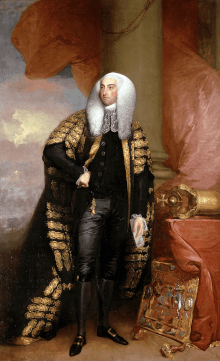
Staples is born on July 31, 1775, the son of John Staples (1736-1820) and Henrietta Molesworth (1745-1813), a daughter of Richard Molesworth, 3rd Viscount Molesworth. His siblings are Rev. John Molesworth Staples (1776-1858), Grace “Marchioness of Ormonde” Louisa Staples Butler (1779-1860) and Hon. Frances Staples Ponsonby (1782-1858).
Staples lives at Lissan House, near the market town of Cookstown, County Tyrone. He marries Catherine Hawkins (1796-1872), daughter and heiress of Reverend John Hawkins and Anne Montgomery, on October 27, 1813. They have no children.
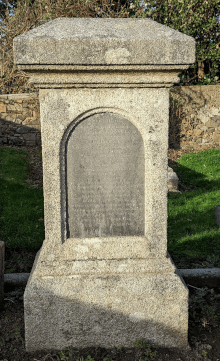
Staples dies in Dublin on May 14, 1865, and is buried in the Lissan Church of Ireland Churchyard in Cookstown. His title is inherited by his nephew.
Lady Isabella Anne Beresford (1776–1850), marries Sir John William Head Brydges, MP, of Wootton Court, second son of Edward Brydges), in 1812.
Lady Catharine Beresford (1777–1843)
Lady Anne Beresford (1779–1842)
Lady Elizabeth Louisa Beresford (1783–1856), who marries Maj. Gen. Sir Denis Pack in 1816. After his death in 1823, she marries Sir Thomas Reynell, 6th Baronet, in 1831.
Beresford is educated at Trinity College, Dublin. From 1783, he serves as a storekeeper for the port of Dublin. He is subsequently appointed to a wealthy sinecure post of Inspector-General of Exports and Imports. He is returned by his father, Hon. John Beresford, for the family borough of Swords to the Irish House of Commons in 1790. In 1798 he is returned for Dublin City, helped by his position in the port, and as a partner in a leading Dublin bank and a member of Dublin Corporation.
During the Irish Rebellion of 1798, Beresford leads a yeoman battalion which fights against the rebels with a particular ferocity. He keeps a riding school in Dublin, which acquires an evil reputation as the chief scene of the floggings by which evidence is extorted from the United Irishmen. As such, he becomes identified as one of the leading opponents of the rebellion, and the rebels deliberately burn the banknotes issued by his bank. His reputation for persecuting political opponents survives throughout his political career.
Beresford takes a prominent part in the Irish House of Commons, where he unsuccessfully moves the reduction of the proposed Irish contribution to the imperial exchequer in the debates on the Act of Union. He is to the last an ardent opponent of the union, taking the opposite position to his father. He resigns his post at the port on January 25, 1799, so as not to be tainted by it or by the suggestion that his actions are motivated by a desire to retain it.
Under a provision of the Act of Union 1800 Beresford retains his seat in the 1st Parliament of the United Kingdom (1801–02) without a fresh election, and in the Union Parliament he is a supporter of William Pitt the Younger and later Henry Addington. He has to give up his Irish business interests to play a full part in Parliamentary business. He is re-elected at the 1802 United Kingdom general election, being top of the poll.
On June 3, 1803, Beresford is the only previous supporter of the government to desert them and support a censure motion moved by Peter Patten, making a speech in support which is regarded as “absurd” by the Chief Secretary to the Lord Lieutenant for Ireland. In March 1804, he is appointed to the Irish currency committee, and therefore resigns his seat by accepting the Escheatorship of Ulster, a sinecure office of profit under the Crown.
After the death of his father on November 5, 1805, Beresford returns to Parliament by winning the by-election to replace him as MP for County Waterford. Politically, he allies to a family faction of the Marquess of Waterford, under the leadership of Henry de La Poer Beresford. The faction aims at trying to stop the government from giving power in Ireland to the Ponsonby family. Beresford is the chief spokesman for his group in their meetings with Ministers.
Although expected to go into opposition in 1806, Beresford in fact supports the government, because a run on funds at his bank leaves him in need of government support for credit. His support leads to his re-election at the 1806 United Kingdom general election in a contested election. This is a controversial decision within the government, with the Duke of Bedford admitting that Beresford had been guilty of persecution but believing he is now loyal, while Lord Howick believes it unlikely that he can be relied upon.
Howick turns out to be correct. In 1807 Beresford does not support the government and becomes a supporter of the Duke of Portland before his accession to the premiership later that year. He is unopposed in the 1807 United Kingdom general election. However, he is erratic, and some of his speeches are reckoned as doing more harm than good to the government’s cause. He strongly supports government against the proposal that peace negotiations with France begin in 1809.
In January 1811, Beresford suffers a further severe financial crisis which prevents his attendance at Parliament for some months. In June he resigns his seat through appointment as Escheator of Munster, being succeeded by his kinsman, Major General Sir William Carr Beresford. The next year, he attempts to get a government appointment but is refused as he already has a good pension. He serves as Lord Mayor of Dublin in 1814–15, where he is known for his “princely hospitality,” but thereafter withdraws from public life.
Beresford dies on July 20, 1846, at his house at Glenmoyle, County Londonderry.
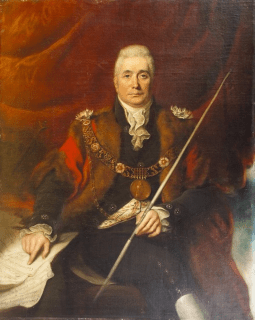
(Pictured: Portrait of John Claudius Beresford, seated and wearing the chain of office of the Lord Mayor of Dublin, by William Cuming, August 1814)
Hill vigorously exerts himself against the Union of Great Britain and Ireland in 1800 and is punished by the Government for his opposition by being dismissed from the Governorship of Down and the colonelcy of the Downshire Militia and struck off the roll of the Privy Council on February 12, 1800.
On June 29, 1786, Hill marries Mary Sandys, by whom he has seven children:
Hill’s last son, Lord George Hill, is born posthumously, as he dies by suicide on September 7, 1801. His widow, Mary, feels his early death is in part due to his humiliation by the Government, and thereafter is a bitter enemy to Robert Stewart, Viscount Castlereagh. She is the heiress of her uncle, Edwin Sandys, 2nd Baron Sandys, and to the estates of her grandfather, William Trumbull, including Easthampstead Park. In 1802, after Hill’s death, she is created Baroness Sandys, with a special remainder to her younger sons and their male heirs in succession and then to her eldest son and his male heirs.
Hill also has a son, William Arthur Dore-Hill, born in 1778, with his mistress Sarah Dore (who later marries William Garrow).
A trained barrister, Pery becomes a member of the Irish House of Commons for the Wicklow constituency in 1751. On the dissolution of the house following the death of George II, he is elected for the constituency of Limerick City and serves from 1761 until 1785, becoming Speaker of the House in 1771. In 1783, he stands also for Dungannon, however chooses to sit for Limerick City. He is considered one of the most powerful politicians in Ireland in his time, leading a faction which includes his nephew, the future Earl of Limerick, and his relatives by marriage, the Hartstonges. Following his resignation, he is created Viscount Pery, of Newtown Pery, near the City of Limerick, in the Peerage of Ireland, entitling him to a seat in the Irish House of Lords. As he has no male heirs, his title becomes extinct on his death on February 24, 1806.
Pery is also noted for his part in the history of the architecture of Limerick. In 1765, he commissions the engineer Davis Ducart to design a town plan for land that he owns on the southern edge of the existing city. This leads to the construction of the Georgian area of the city later known as Newtown Pery. He is also commemorated in the naming of Pery Square.
Ryan attributes to Pearse the saying “[G]ive me a hundred men and I will free Ireland!” He becomes part of a group of former students lodging in St. Enda’s while they go to university who join the Irish Republican Brotherhood (IRB). They meet in a safe house at Rathfarnham in 1911. The men take the tram from Rathfarnham to Nelson’s Pillar in central Dublin. Pearse once told his friend, “Let them talk! I am the most dangerous revolutionary of the whole lot of them!” In 1911, the Dungannon Clubs revive the Volunteers Militia movement. These clubs are not initially successful in Dublin but are more so in Belfast amongst nationalists. One of the northern members is the Dubliner Oscar Traynor, in his youth a professional footballer with Belfast Celtic F.C., later a war hero and later again a politician and Minister for Posts and Telegraphs.
Eoin MacNeill is appointed leader of the Irish Volunteers. Ryan writes that Pearse, a risk-taker and idealist, tells him MacNeill is “too tactful.” MacNeill is prepared to entertain the Irish Parliamentary Party with negotiations. Ryan quotes Pearse as saying, “[MacNeill] has the reputation of being tactful, but his tact consists in bowing to the will of the Redmondites every time. He never makes a fight except when they assail his personal honour, when he bridles up at once… very delicate position… he is weak, hopelessly weak.”
Pearse tells Ryan that MacNeill is “a Grattan come to life again.” Henry Grattan is a constitutional orator and MP in the Protestant-only 18th-century Irish House of Commons, but one of those who fiercely opposes the notorious Acts of Union 1800, secured by massive bribery (which is then repaid out of Irish taxes), making Ireland part of the United Kingdom. Moreover, MacNeill is an “inconclusive ditherer.” He wants the Irish Volunteers to be apolitical.
The Easter Rising is preceded by the revelation of the “Castle Document,” a plan by the British government to arrest the leaders of the Irish Volunteers and Irish Citizen Army and other radicals. Ryan claims that this document, presented to MacNeill on the Wednesday before the Rising and said to have been stolen from high-ranking British staff in Dublin Castle, is a forgery. Some claim that it is concocted by Joseph Plunkett with the implicit approval of Catholic Archbishop Cullen of Dublin, a sympathiser with Dublin Castle and Redmond’s war stratagem. “Forgery is a strong word,” Ryan says, “but that in its final form the document was a forgery no doubt can exist whatever.” Modern interpretation from Charles Townshend has judged the document to be genuine, and the opinion attributed to the Archbishop’s Palace as circumstantial. Grace Gifford, Plunkett’s widow, says that she was with Plunkett when he deciphered it at Larkfield House. Prior to his execution, Seán Mac Diarmada is met by a priest, and makes the assumptive response that it is a fraudulent document.
Ryan fights through the Easter Rising from April 24, 1916, in the General Post Office (GPO) under murderous artillery fire and describes the battle vividly in his witness statement to the Bureau of Military History. He describes the garrison retreating to Moore Street and quotes Pearse’s sculptor brother Willie Pearse, who is executed a few days later, as saying “Connolly has been asked out to negotiate. They have decided to go to save the men from slaughter, for slaughter it is.”
Ryan fights in the Irish War of Independence and afterwards writes about his experiences. However, the Irish Civil War which follows from June 1922 to April 1923 repels him. He cannot accept that Irishmen would fight Irishmen.
Ryan marries Sarah Hartley in 1933. In 1939 they return to Ireland, where he edits the Torch, a Labour paper. Finding his views at odds with the Labour Party‘s official line, publication ceases in 1944. He and his wife then move to Swords in north County Dublin, where they operate a poultry farm.
Father and son, both accounted “notorious womanizers,” have a bitter relationship. His father once challenges him to a duel, but he declines, observing that his father is not a gentleman.
With the support of the Grafton ministry and of the Court, in 1769 Luttrell stands in Middlesex against John Wilkes, the radical and popular figure who had already been the constituency’s three-time democratic choice. He loses the poll (1,143 votes to 269) but is seated in Parliament, Wilkes having once again been barred as an adjudged felon. As a result of the affair, for some months, Luttrell dares not appear in the street and is “the most unpopular man in the House of Commons.”
The government rewards Luttrell by appointing him Adjutant General for Ireland in 1770. He continues to sit in the Commons, where he describes the Whigs in their opposition to the conduct of the American War, as “the abetters of treason and rebellion combined purposely for the ruin of their country.”
In 1788, Luttrell is publicly accused in Dublin of the rape of a 12-year-old girl. Having been paid to deliver a message, Mary Neal claims she is bundled into a brothel and there assaulted throughout the night by Luttrell. The keeper of the house, Maria Llewellyn, is charged in a case marked by accusations of witness tampering, the death in prison of Mary’s mother and newborn baby sister and by the insinuation that Mary was already working as a prostitute. The affair becomes a cause célèbre with the public intervention of Archibald Hamilton Rowan, later a founding member of the Dublin Society of United Irishmen. To clear Mary’s name he brings her to Dublin Castle to see the Lord Lieutenant, John Fane, 10th Earl of Westmorland. Westmorland, unmoved, pardons Llewellyn and sets her at liberty. Luttrell is never asked to answer for raping Mary Neal. In 1790 he re-enters the British Parliament as Member for Plympton Erle.
In 1791 and 1792, Luttrell helps vote down bills to abolish the slave trade. Negroes, he proposes, only want “to murder their masters, ravish their women, and drink all their rum.” At the same time, he opposes lifting civil disabilities on Roman Catholics by abolishing the Test Act in Scotland and speaks scathingly of parliamentary reform.
In October 1793, a younger brother, Temple Simon Luttrell, is arrested in Boulogne and, until February 1795, is held in Paris where, on the strength of their sister Anne Luttrell being married to Prince Henry, Duke of Cumberland, he is publicly exhibited as the brother of the king of England.
In 1795, Luttrell is entrusted with the breakup and disarming of Defenders, the agrarian semi-insurgency, in Connacht. His proceedings and impressment of some 1,300 “rebels” into the British navy elicits criticism in otherwise loyal circles.
In 1796, with the leaders of the democratic party, the United Irishmen, preparing for a French-assisted insurrection, Luttrell is given overall command of the Crown forces in Ireland. He demonstrates still greater ruthlessness in attempting to “pacify” the country and suppress the eventual rising in the summer of 1798. His command has the unusual distinction of being upbraided by his successor as Commander in Chief, Sir Ralph Abercromby, for an army “in a state of licentiousness, which must render it formidable to everyone but the enemy.”
Luttrell is seen by his critics as having “fanned the flame of disaffection into open rebellion” by “the picketings, the free quarters, half hangings, flogging and pitch-cappings” he directs.
In July 1799, Luttrell sells his Irish property and by his own later account, he takes no part in the Acts of Union. He claims to be “disgusted at the scene that was passing before me”, and to abandon Ireland because, under a “cowardly” government, he sees “the country likely to become Catholic.” When the Dublin Post of May 2, 1811, erroneously reports his death, he demands a retraction which they print under the headline Public Disappointment.
Luttrell purchases an estate at Painshill Park in Surrey and lives for several years in relative obscurity. From 1813 he harries the government of Robert Jenkinson, 2nd Earl of Liverpool, with the claim that George III had promised him a secure seat in the Commons. In June 1817, five weeks short of his eightieth birthday, he finds his own way back to Parliament as Member for Ludgershall and revenges himself, in the four years remaining to him, by voting with the opposition. This, however, does not extend to joining in the attacks on the domestic spy system in 1818 nor to voting for parliamentary reform in 1819. Moreover, in the wake of the Peterloo Massacre, he supports the government, lauding the use of deadly force against “the Radicals and their system.”
Stewart is born in 28 Henry Street, in Dublin’s Northside. He is the second and only surviving child of Robert Stewart (the elder) and his wife Sarah Frances Seymour-Conway. His parents marry in 1766. He has recurring health problems throughout his childhood, and is sent to The Royal School, Armagh, rather than to England for his secondary education. At the encouragement of Charles Pratt, 1st Earl Camden, who takes a great interest in him and treats him as if he is a grandson by blood, he later attends St. John’s College, Cambridge (1786–87), where he applies himself with greater diligence than expected from an aristocrat and excels in his first-year examinations. But he then withdraws, pleading an illness that he admits to Camden is something “which cannot be directly acknowledged before women,” i.e. something sexually transmitted.
Stewart organises and finances the alliance that defeats Napoleon, bringing the powers together at the Treaty of Chaumont in 1814. After Napoleon’s second abdication in 1815, he works with the European courts represented at the Congress of Vienna to frame the territorial, and broadly conservative, continental order that holds until mid-century. He blocks harsh terms against France believing that a treaty based on vengeance and retaliation will upset a necessary balance of powers. France is restored to the frontiers of 1791, and her British-occupied colonies are returned. In 1820 Stewart enunciates a policy of non-intervention, proposing that Britain hold herself aloof from continental affairs.
After 1815, at home, Stewart supports repressive measures that link him in public opinion to the Peterloo Massacre of 1819. Widely reviled in both Ireland and Great Britain, overworked, and personally distressed, he commits suicide on August 12, 1822. He is found in a dressing room seconds after he has cut his own throat using a small knife. He collapses and dies almost instantly.
(Pictured: “Robert Stewart, 2nd Marquess of Londonderry,” oil on canvas by Thomas Lawrence, National Portrait Gallery)
At the Athyby-election on June 12, 1741, following the death of Sir Walter Dixon Borrowes, James FitzGerald, styled Lord Ophaly and later 1st Duke of Leinster, is returned. In the course of the election there is a duel between William Paul Warren and Jack Hardy, which leads to Hardy’s right hand and arm being shattered. It is thought that it might have to be amputated.
In 1761 FitzGerald is created Earl of Offaly and Marquess of Kildare in the Peerage of Ireland and in 1766 he is further honoured when he is made Duke of Leinster, becoming by this time the Premier Duke, Marquess and Earl in the Peerage of Ireland.
FitzGerald dies at Leinster House, Dublin, on November 19, 1773, aged 51, and is buried in the city’s Christ Church Cathedral. He is succeeded by his second (but eldest surviving) son, William, Marquess of Kildare. The Duchess of Leinster causes a minor sensation by marrying her lover William Ogilvie in 1774 but continues to be known as The Dowager Duchess of Leinster. She has a further three children by him. She dies in London on March 27, 1814, aged 82.
In 1999, Irish Screen, BBC America and WGBH produce Aristocrats, a six-part limited television series based on the lives of Emily Lennox and her sisters. FitzGerald is portrayed by Ben Daniels.
Levinge is the second son of Richard Levinge of Parwich Hall, Derbyshire, Recorder of Chester, and Anne Parker, daughter of George Parker of Staffordshire and his wife Grace Bateman. The Levinges (sometimes spelled “Levin”) are a long-established Derbyshire family with a tradition of public service. Through his mother he is a first cousin of Thomas Parker, 1st Earl of Macclesfield, Lord High Chancellor of Great Britain.
Levinge is one of the first to declare for William III of England at the Glorious Revolution and is sent by the new Government to Ireland as Solicitor-General in 1689. In 1692 he is elected as a member of the Irish House of Commons for Belfast and for Blessington, but chooses to sit for Blessington, a seat he holds until 1695. During this time, he serves as Speaker of the Irish House of Commons. In politics he is a moderate Tory, noted throughout his career for his desire to conciliate. In an age of bitter political faction this earns him the uncharitable nickname “Tom Double.” Although he supports the Penal Laws, as no Irish officeholder then could do otherwise, he is very tolerant in religious matters and has several Roman Catholic friends, including his predecessor as Solicitor-General, Sir Theobald Butler.
Levinge later represents Longford Borough from 1698 to September 1713 and Kilkenny City from 1713 to November 1715 in the Irish Parliament. In 1713 he is also returned for Gowran but chooses to sit for Kilkenny. He is created a Baronet of High Park in the County of Westmeath, in the Baronetage of Ireland on October 26, 1704.
Levinge had expressed his interest in being appointed to the English Bench but meets with no success in his efforts to achieve office in England. Under George I of Great Britain, despite being of the “wrong” political persuasion, and his growing age, his famous moderation, and his 30 years’ experience of Irish public life make him acceptable as an Irish judge to the Government, in which he has a powerful supporter in his cousin Lord Macclesfield. In 1721 he becomes Chief Justice of the Irish Common Pleas for Ireland and a member of the Privy Council of Ireland. He complains bitterly of the poor quality of his junior judges, and asks for suitable replacements, although he complains equally about some of those whose names are put forward as possible replacements. Despite being in great pain from gout in his last years, he remains on the Bench until his death on July 13, 1724.
Levinge divides his time between his ancestral home, Parwich Hall, which he purchases from his childless elder brother, and his newly acquired property Knockdrin Castle, County Westmeath. Most of his estates passes to his eldest son, who extensively rebuilds Parwich.
(Pictured: Knockdrin Castle, County Westmeath, the main Levinge residence in Ireland)