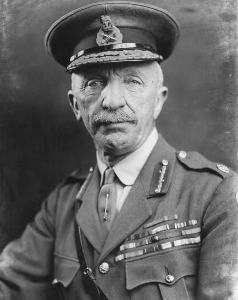
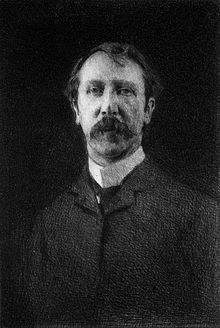
Wilson attends Marlborough public school between September 1877 and Easter 1880, before leaving for a crammer to prepare for the Army.
Wilson serves as Commandant of the Staff College, Camberley, and then as Director of Military Operations at the War Office, in which post he plays a vital role in drawing up plans to deploy an Expeditionary Force to France in the event of war. During these years he acquires a reputation as a political intriguer for his role in agitating for the introduction of conscription and in the Curragh incident of 1914, when he encourages senior officers to resign rather than move against the Ulster Volunteers.
As Sub Chief of Staff to the British Expeditionary Force (BEF), Wilson is John French‘s most important adviser during the 1914 campaign, but his poor relations with Douglas Haig and William Robertson see him sidelined from top decision-making in the middle years of the war. He plays an important role in Anglo-French military relations in 1915 and, after his only experience of field command as a corps commander in 1916, again as an ally of the controversial French General Robert Nivelle in early 1917. Later in 1917 he is informal military advisor to British Prime MinisterDavid Lloyd George, and then British Permanent Military Representative at the Supreme War Council at Versailles.
In 1918 Wilson serves as Chief of the Imperial General Staff, the professional head of the British Army. He continues to hold this position after the war, a time when the Army is being sharply reduced in size whilst attempting to contain industrial unrest in the UK and nationalist unrest in Mesopotamia, Iraq and Egypt. He also plays an important role in the Irish War of Independence.
The Dunmanway killings, also known as the Dunmanway murders or the Dunmanway massacre, takes place in and around Dunmanway, County Cork between April 26-28, 1922. The event refers to the killing (and in some cases, disappearances) of thirteen Protestant men and boys.
The killings happen in a period of truce after the July 1921 end of the Irish War of Independence and before the outbreak of the Irish Civil War in June 1922. All the dead and missing are Protestants, which has led to the killings being described as sectarian. Six are killed as purported British informants and loyalists, while four others are relatives killed in the absence of the target. Three other men are kidnapped and executed in Bandon as revenge for the killing of an Irish Republican Army (IRA) officer Michael O’Neill during an armed raid. One man is shot and survives his injuries.
On April 26, 1922, a group of anti-Treaty IRA men, led by Michael O’Neill, arrive at the house of Thomas Hornibrook, a former magistrate, at Ballygroman, East Muskerry, Desertmore, Bandon (near Ballincollig on the outskirts of Cork City), seeking to seize his car. Hornibrook is in the house at the time along with his son, Samuel, and his nephew, Herbert Woods, a former Captain in the British Army. O’Neill demands a part of the engine mechanism that had been removed by Hornibrook to prevent such theft. Hornibrook refuses to give them the part, and after further efforts, some of the IRA party enter through a window. Herbert Woods then shoots O’Neill, wounding him fatally. O’Neill’s companion, Charlie O’Donoghue, takes him to a local priest who pronounces him dead. The next morning O’Donoghue leaves for Bandon to report the incident to his superiors, returning with “four military men,” meeting with the Hornibrooks and Woods, who admit to shooting O’Neill.
It is not clear who orders the attacks or carries them out. However, in 2014 The Irish Times releases a confidential memo from the then-Director of Intelligence Colonel Michael Joe Costello (later managing director of the Irish Sugar Company) in September 1925 in relation to a pension claim by former IRA volunteer Daniel O’Neill of Enniskeane, County Cork, stating: “O’Neill is stated to be a very unscrupulous individual and to have taken part in such operations as lotting [looting] of Post Offices, robbing of Postmen and the murder of several Protestants in West Cork in May 1922. A brother of his was shot dead by two of the latter named, Woods and Hornbrooke [sic], who were subsequently murdered.”
Sinn Féin and IRA representatives, from both the pro-Treaty side, which controls the Provisional Government in Dublin and the anti-Treaty side, which controls the area the killings take place in, immediately condemn the killings.
The motivation of the killers remains unclear. It is generally agreed that they were provoked by the fatal shooting of O’Neill by Woods, whose house was being raided on April 26. Some historians have claimed there were sectarian motives; others claim that those killed were targeted only because they were suspected of having been informers during the Irish War of Independence and argue that the dead were associated with the so-called “Murragh Loyalist Action Group,” and that their names may have appeared in captured British military intelligence files which listed “helpful citizens” during the war.
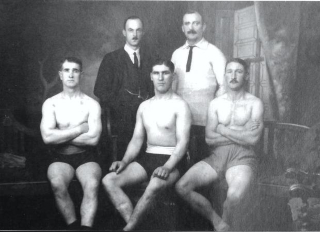
(Pictured: Herbert Woods, centre, whose decision to shoot sparks the massacre)
At the start of the twentieth century, the people of Ireland are divided into two mutually hostile factions. Nationalists, the much larger group, are mostly Roman Catholic, identify primarily as Irish, and want some form of Irish home rule or independence from Britain. Unionists, the smaller group, concentrates primarily in the province of Ulster, are mostly Protestant, identify primarily as British (although many see themselves as Irish and British), and are committed to remaining within the United Kingdom.
Partition is formally established with the Government of Ireland Act 1920. This also establishes the Parliament of Northern Ireland, which comes into being the following year. Partition is followed by high levels of inter-communal violence, especially in Belfast. The Irish Republican Army (IRA), although it spends most of these years fighting in the Irish Civil War, aims to use armed force to end partition and compel the United Kingdom to withdraw sovereignty from Northern Ireland.
The Act is presented as being necessary to re-establish peace and law and order in Northern Ireland and enables the government to “take all such steps and issue all such orders as may be necessary for preserving the peace and maintaining order,” although it is specified that the ordinary course of law should be interfered with as little as possible. Because it is presented as emergency legislation, the Act is initially current only for one year and has to be renewed annually. In 1928, however, it is renewed for five years and when this period expires in 1933 the Act is made permanent.
Despite rhetoric accompanying the Act which asserts that it is for the purpose of restoring public order, its provisions continue to be used for the entire period of the Northern Irish parliament’s existence. Because the Ulster Unionist Party is the only party ever to form a government in this parliament, the Act is used “almost exclusively on the minority population.” Initially, regulations under the Act are used mostly to curb immediate violence and disorder. One of the most controversial of these is internment without trial.
After the troubles of the early 1920s dies down, the provision for internment is not used until the IRA’s Border Campaign of the 1950s, in which several hundred republicans are interned. Following the outbreak of The Troubles in 1968, many within the Protestant community call for the reintroduction of internment. This occurs in 1971 and authorises internment of those suspected to be involved in terrorism. Although there are loyalist as well as republican terrorists at this time, of the 1,981 men interned, only 107 are loyalists. Due to inadequate intelligence-gathering, many of the interned republicans are members of the Official Irish Republican Army rather than the recently formed Provisional Irish Republican Army (PIRA), which is much more heavily involved in terrorist activity at the time.
Internment ends in 1975 but is credited with increasing support and sympathy for the PIRA amongst the Catholic community and outside of Northern Ireland. It helps to create political tensions which culminate in the 1981 Irish Hunger Strike and the death of MPBobby Sands. Imprisonment under anti-terrorism laws specific to Northern Ireland continue until the 1998 Good Friday Agreement, but these laws require the right to a fair trial be respected.
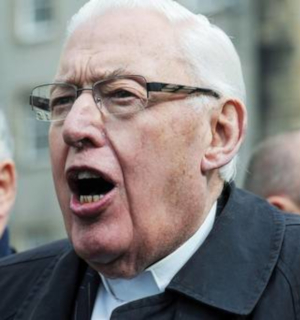
On March 23, 2011, Ian Paisley calls for a new era of sharing and reconciliation in an emotional farewell at his final sitting of the power-sharing Assembly he helped to create at Stormont. Dr. Paisley continues his political career in the House of Lords.
Protestant and Catholic leaders in Northern Ireland‘s unity government celebrate their first full four-year term in power and lauded Paisley, the unlikely peacemaker who made it possible, on his effective retirement day.
Paisley, a stern anti-Catholic evangelist who spent decades rallying pro-British Protestants against compromise, stuns the world in 2007 by agreeing to forge a coalition alongside senior Irish Republican Army (IRA) veterans. Their polar-opposite combination governs Northern Ireland with surprising harmony for the four years leading up to his retirement.
The Northern Ireland Assembly that elects the administration is dissolved on March 14, 2011, in preparation for a May 5 election in the British territory. The 84-year-old Paisley makes his last debate in an elected chamber on March 6, 2011, noting that this local government is not ending in chaos and acrimony, as 1999-2002 attempts at power-sharing repeatedly had done.
At this point, Paisley has already stepped down as a member of the British and European parliaments and as leader of the Democratic Unionists, a party of hard-line Protestant protesters that he founded in 1970 and watched grow over the previous decade into the most popular in Northern Ireland.
Those lauding him include Peter Robinson, who succeeded him in 2008 as leader of both the government and the Democratic Unionists and Sinn Féin‘s Martin McGuinness, the senior Catholic politician who spends decades as a commander of Paisley’s archenemy, the IRA.
The IRA kills nearly 1,800 people in a failed 1970-1997 effort to force Northern Ireland out of the United Kingdom. Northern Ireland remains part of the United Kingdom when the overwhelmingly Catholic rest of Ireland gains its independence in 1922. The outlawed IRA formally renounces violence and disarms in 2005, clearing the way for its allied Sinn Féin party to recognize the legal authority of Northern Ireland and its police.
Still, few observers expected Paisley to agree to a pact so quickly after the IRA-Sinn Féin peace moves or to get along so warmly with McGuinness during their year in partnership.
McGuinness, whose organization once considered Paisley a prime target for assassination, addressing his remarks to the stooped, silver-haired Paisley across the chamber, notes that Ulster wits had christened the two of them “the Chuckle Brothers.” He adds, “And I would like to think that we showed leadership. I think my relationship with him will undoubtedly go down in the history books.”
(From: “Northern Ireland power-sharing marks 1st full term,” the Associated Press and CTV News, March 23, 2011)
When the convoy enters the ambush position, IRA volunteers open fire from elevated positions on both sides of the road. The three lorries and touring car are disabled, and the armoured car becomes stuck in the roadside ditch, although those inside continue to fire its machine guns. As Cumming jumps from his car, he is shot in the head and dies instantly. He is one of the highest ranked British officers to die in the Irish War of Independence.
The battle lasts slightly over an hour. As the IRA forces withdraw from one side of the road, a British officer and six soldiers attempted to flank the IRA on the other side. After a brief exchange of fire, they retreat.
The IRA are not believed to have sustained any casualties.
(Pictured: Two British officers surnamed Lawson and Adams with Brigadier General H. R. Cumming in Kenmare County Kerry shortly before their deaths at the hands of the IRA in 1921)
As EU delegates discuss the Union’s budget and Europe‘s farming subsidies, the two prime ministers vow to battle on with the peace deal’s outstanding problems.
“We’re very clear on what we have to do in the Good Friday agreement … we have just got to keep pushing the thing forward as well as we possibly can,” says Blair.
Both Ahern and Blair say the way forward on the outstanding deadlocked issue of paramilitary disarmament is through the official decommissioning commission. Chaired by former Canadian General John de Chastelain, the international commission is working to take arms out of the province’s political arena.
The republican party Sinn Féin insists it is fully cooperating with the commission, which is implementing the final deadline for the handover of arms in May 2000. But some Ulster Unionists oppose further peace moves because of the Irish Republican Army‘s (IRA) failure to begin disarming.
According to Ahern and Blair, the following few weeks will be a key time to try and finalise disarmament issues.
“During the month of March … we can conclude the central aspects,” says Blair.
However, in a separate development on February 26, the chairman of the IRA’s political wing, Sinn Féin’s Mitchel McLaughlin, warns that pressure on disarmament could cause irreparable damage to the fragile peace process. He adds that disarmament should not become a litmus test for progress.
“Those who are now demanding prior decommissioning before we move to setting up the executive are reneging on the Good Friday Agreement,” says McLaughlin in an interview with BBC Radio.
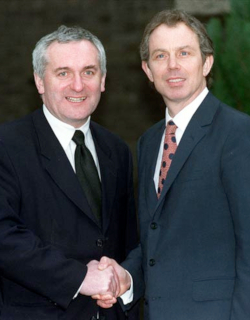
(From BBC News Online Network, Friday, February 26, 1999 | Pictured: Bertie Ahern with Tony Blair at the signing of the Good Friday Agreement in April 1998)
Moore comes from a distinguished Catholic family of Irish landholders. When he is 21, he leaves Ireland for Paris to become a painter. His Reminiscences of the Impressionist Painters (1906) vividly describes the Café Nouvelle-Athènes and the circle of Impressionist painters who frequent it. He is particularly friendly with Édouard Manet, who sketches three portraits of him. Another account of the years in Paris, in which he introduces the younger generation in England to his version of fin de siècle decadence, is his first autobiography, Confessions of a Young Man (1888).
Deciding that he has no talent for painting, Moore returns to London in 1882 to write. His first novels, A Modern Lover (1883) and A Mummer’s Wife (1885), introduce a new note of French Naturalism into the English scene, and he later adopts the realistic techniques of Gustave Flaubert and Honoré de Balzac. Esther Waters (1894), his best novel, deals with the plight of a servant girl who has a baby out of wedlock. It is a story of hardship and humiliation illumined by the novelist’s compassion. It is an immediate success, and he follows it with works in a similar vein: Evelyn Innes (1898) and Sister Teresa (1901).
In 1901 Moore moves to Dublin, partly because of his loathing for the South African War and partly because of the Irish Literary Revival spearheaded by his friend, the poet William Butler Yeats. In Dublin he contributes notably to the planning of the Abbey Theatre. He also produces The Untilled Field (1903), a volume of fine short stories reminiscent of Ivan Turgenev’s writing that focuses on the drudgery of Irish rural life, and a short poetic novel, The Lake (1905). The real fruits of his life in Ireland, however, come with the trilogy Hail and Farewell (Ave, 1911; Salve, 1912; Vale, 1914). Discursive, affectionate, and satirical by turns, it reads like a sustained monologue that is both a carefully studied piece of self-revelation and an acute, though not always reliable, portrait gallery of his Irish acquaintance, which included Yeats, George William Russell, and Lady Gregory. Above all it is a perfectly modulated display of the comic spirit.
The increasing narrowness of the Irish mind, politics, and clericalism sends Moore back to England in 1911. After Hail and Farewell, he makes another literary departure. Aiming at epic effect he produces The Brook Kerith (1916), an elaborate and stylish retelling of the Gospel story that is surprisingly effective despite some dull patches. He continues his attempts to find a prose style worthy of epic theme in Héloïse and Abélard (1921). His other works include A Story-Teller’s Holiday (1918), a blend of autobiography, anecdote, Irish legend, and satire, Conversations in Ebury Street (1924), autobiography, The Pastoral Loves of Daphnis and Chloe (1924) and Ulick and Soracha (1926), an Irish legendary romance.
George Moore dies at his home at Ebury Street in the London district of Belgravia on January 21, 1933, leaving a fortune of £70,000. He is cremated in London at a service attended by Ramsay MacDonald among others. An urn containing his ashes is interred on Castle Island in Lough Carra in view of the ruins of Moore Hall, which had been burned by anti-treaty forces in 1923, during the final months of the Irish Civil War.
Jordan is educated at St. Paul’s College, Raheny. Later, Jordan attends University College Dublin, where he studies Irish history and English literature. He is raised a Catholic and is quite religious during the early stages of his life. Regarding his current beliefs, he states that “God is the greatest imaginary being of all time. Along with Einstein‘s General Theory of Relativity, the invention of God is probably the greatest creation of human thought.”
When John Boorman is filming Excalibur in Ireland, he recruits Jordan as a “creative associate.” A year later Boorman is executive producer on Jordan’s first feature, Angel, a tale of a musician caught up in the Troubles, starring Stephen Rea who subsequently appears in almost all of Jordan’s films to date. During the 1980s, he directs films that win him acclaim, including The Company of Wolves and Mona Lisa, both made in England. The Company of Wolves becomes a cult favorite.
As a writer/director, Jordan has a highly idiosyncratic body of work, ranging from mainstream hits like Interview with the Vampire to commercial failures like We’re No Angels to a variety of more personal, low-budget arthouse pictures. He is also the driving force behind the cable TV series The Borgias.
Unconventional sexual relationships are a recurring theme in Jordan’s work, and he often finds a sympathetic side to characters that audiences would traditionally consider deviant or downright horrifying. His film The Miracle, for instance, follows two characters who struggle to resist a strong, incestuous attraction, while The Crying Game makes complicated, likable characters out of an IRA volunteer and a transgender woman. Interview with the Vampire, like the Anne Rice book it is based on, focuses on the intense, intimate interpersonal relationship of two undead men who murder humans nightly, accompanied by an equally lusty vampire woman who is eternally trapped in the body of a little girl. While Lestat (Tom Cruise) is depicted in an attractive but villainous manner, his partner Louis (Brad Pitt) and the child vampire Claudia (Kirsten Dunst) are meant to capture the audience’s sympathy despite their predatory nature.
In addition to the unusual sexuality of Jordan’s films, he frequently returns to the Troubles of Northern Ireland. The Crying Game and Breakfast on Pluto both concern a transgender character, both concern the Troubles, and both feature frequent Jordan leading man Stephen Rea. The two films, however, are very different, with The Crying Game being a realistic thriller/romance and Breakfast on Pluto a much more episodic, stylized, darkly comic biography. Jordan also frequently tells stories about children or young people, such as The Miracle and The Butcher Boy. While his pictures are most often grounded in reality, he occasionally directs more fantastic or dreamlike films, such as The Company of Wolves, High Spirits, Interview with the Vampire, and In Dreams.
The critical success of Jordan’s early pictures leads him to Hollywood, where he directs High Spirits and We’re No Angels. Both are critical and financial disasters. He later returns home to make the more personal The Crying Game, which is nominated for six Academy Awards. Jordan wins the Academy Award for Best Original Screenplay for the film. Its unexpected success leads him back to American studio filmmaking, where he directs Interview with the Vampire. He also directs the crime drama The Brave One starring Jodie Foster.
Finucane is born into a Roman Catholic family on the Falls Road, Belfast on March 21, 1949. At the start of the Troubles, his family is forced out of their home. He graduates from Trinity College, Dublin in 1973. He comes to prominence due to successfully challenging the British government in several important human rights cases during the 1980s.
Finucane is shot fourteen times and killed at his home in Fortwilliam Drive, north Belfast, by Ken Barrett and another masked man using a Browning Hi-Power 9mm pistol and a .38 revolver respectively. The two gunmen knock down the front door with a sledgehammer and enter the kitchen where Finucane has been having a Sunday meal with his family. They immediately open fire and shoot him twice, knocking him to the floor. Then while standing over him, the leading gunman fires twelve bullets into his face at close range. Finucane’s wife Geraldine is slightly wounded in the shooting attack which their three children witness as they hide underneath the table.
The Royal Ulster Constabulary (RUC) immediately launches an investigation into the killing. The investigation, led by Detective Superintendent Alan Simpson, runs for six weeks and he later states that from the beginning, there had been a noticeable lack of intelligence coming from the other agencies regarding the killing. Finucane’s killing is widely suspected by human rights groups to have been perpetrated in collusion with officers of the RUC and, in 2003, the British GovernmentStevens Report states that the killing is indeed carried out with the collusion of police in Northern Ireland.
In September 2004, an Ulster Defence Association (UDA) member, and at the time of the murder a paid informant for the Royal Ulster Constabulary, Ken Barrett, pleads guilty to Finucane’s murder.
The Ulster Defence Association/Ulster Freedom Fighters (UDA/UFF) claim they killed Finucane because he was a high-ranking officer in the Irish Republican Army (IRA). Police at his inquest say they have no evidence to support this claim. Finucane had represented republicans in many high-profile cases, but he had also represented loyalists. Several members of his family have republican links, but the family strongly denies Finucane is a member of the IRA. Informer Sean O’Callaghan claims that he attended an IRA finance meeting alongside Finucane and Gerry Adams in Letterkenny in 1980. However, both Finucane and Adams have consistently denied being IRA members.
In Finucane’s case, both the RUC and the Stevens Report find that he is not a member of the IRA. Republicans strongly criticise the claims made by O’Callaghan in his book The Informer and subsequent newspaper articles. One Republican source says O’Callaghan “…has been forced to overstate his former importance in the IRA and to make increasingly outlandish accusations against individual republicans.”
In 2011 British Prime MinisterDavid Cameron meets with Finucane’s family and admits the collusion, although no member of the British security services has yet been prosecuted.
On February 11, 1922, Irish Republican Army (IRA) volunteers stop a group of Ulster Special Constabulary (USC) constables on a train at Clones, County Monaghan, a short distance into Southern territory in an event recorded in history as the “Clones Ambush.” A gunfight begins in which one IRA officer and four USC constables are killed. The remaining USC constables are captured.
On January 22, the UlsterGaelic Football Final is played in Derry. The previous evening six cars leave Monaghan to bring the Monaghan players to Derry, many of the members of the team being members of the IRA. They are stopped by a B Specials (Ulster Special Constabulary) check point at Dromore station. After a search the Specials discover weapons in the cars and arrest ten of the men. The IRA men are led by Dan Hogan O/C of the Fifth Northern Division. The men are taken to Omagh and interned.
The IRA waits impatiently for a chance at reprisal and on February 11, a group of Irish Republican Army volunteers attempt to ambush a party of Ulster Special Constabulary policemen travelling on a train through Clones. The volunteers enter a carriage of a train and order the Specials to put their hands up. IRA Commandant Matthew Fitzpatrick is shot and killed in the ensuing fight and five members of the Specials, Doherty, McMahon, McCullough, Lewis and McFarland are shot and killed. Several members of the Specials run down the track and cross the border into Fermanagh. The few remaining B Specials on the train decide to surrender and are arrested.
The IRA lifts the body of the Commandant Fitzpatrick and it is attended to by Monsignor E.C. Ward who gives him his Last Rites.
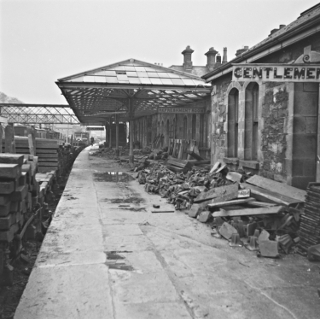
The Clones railway station is on the Dundalk and Enniskillen Railway. The Dundalk and Enniskillen Railway opens the station on June 26, 1858. The station closes on October 1, 1957.
(Photo: Clones Train Station, Co Monaghan, caught in mid-demolition by photographer James O’Dea on November 22, 1960)





 seamus dubhghaill