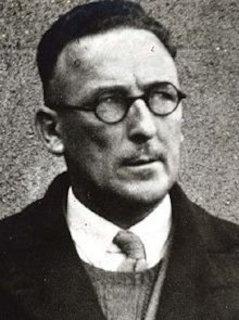
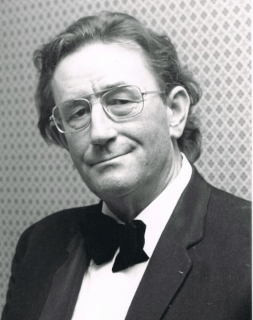
O’Donovan is an explosives expert and reputedly invents the “Irish War Flour” (named after the flour sacks in which it was smuggled into Dublin aboard ships) and “Irish Cheddar” devices. He subsequently becomes IRA Director of Chemicals in 1921. During the Irish War of Independence, he is imprisoned in Mountjoy Prison and Kilmainham Gaol and later interned in Newbridge, County Kildare.
In addition to fighting in the Irish War of Independence, O’Donovan fights on the Anti-Treaty side during the Irish Civil War. In 1930 he becomes manager at Electricity Supply Board (ESB) headquarters in Dublin.
In August 1938, at the request of IRA Chief of StaffSeán Russell, O’Donovan writes the S-Plan, a bombing campaign targeting the United Kingdom. In his unpublished memoirs he writes that he “conducted the entire training of cadre units, was responsible for all but locally derived intelligence, carried out small pieces of research and, in general, controlled the whole explosives and munitions end” of S-Plan. During this time, he and Russell are the only GHQ members of the old IRA still in the organisation.
As “Agent V-Held”, O’Donovan visits Germany three times in 1939 on behalf of the IRA. On February 28 he negotiates an arms and radio equipment delivery at the Abwehrstelle in Hamburg. On April 26 he concludes a new arms deal with the Abwehrstelle and establishes, with the help of a Breton, a secret courier connection to Ireland via France. On August 23, he receives the last instructions for the event of war.
On February 9, 1940, Abwehr II agent Ernst Weber-Drohl lands at Killala Bay, County Sligo aboard U-37. He is equipped with an ‘Ufa’ transmitter, cash, and instructions for O’Donovan, who by this time is the chief IRA contact for Abwehr I/II. The transmitter is lost upon landing, but when Weber-Drohl reaches O’Donovan at Shankill, Killiney, County Dublin, he is able to deliver new transmission codes, $14,450 in cash, and a message from “Pfalzgraf Section” asking that the IRA concentrate its S-Plan attacks on military rather than civilian targets.
O’Donovan becomes increasingly enamoured of Nazi ideology during this time, and visits Germany three times. In 1942 he writes an article arguing that Ireland’s future lay in an alliance with a victorious Germany and attacks Britain and the United States for being “centres of Freemasonry, international financial control and Jewry.” Even long after the pact with the Germans falls apart, he continues to express his sympathy for the Nazi regime. His son, Gerard O’Donovan, recalls that every Saturday night a visitor would come to the family home and send messages to Germany.
Barry’s execution inflames nationalist public opinion in Ireland, largely because of his age. The timing of the execution, only seven days after the death by hunger strike of Terence MacSwiney, the republicanLord Mayor of Cork, brings public opinion to a fever-pitch. His pending death sentence attracts international attention, and attempts are made by United States and Vatican officials to secure a reprieve. His execution and MacSwiney’s death precipitate an escalation in violence as the Irish War of Independence enters its bloodiest phase, and Barry becomes an Irish republican martyr.
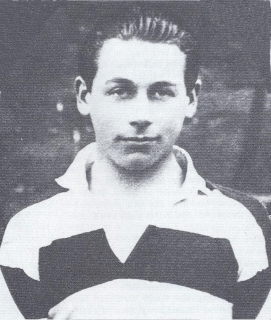
Barry is born on January 20, 1902, at 8 Fleet Street, Dublin, to Thomas and Mary (née Dowling) Barry. The fourth of seven children, two boys and five sisters, he is baptised in St. Andrew’s Church, Westland Row. As a child he attends the National School in Rathvilly, County Carlow, and the O’Connell Schools in Dublin, before enrolling in the Preparatory Grade at St. Mary’s College, Dublin, in September 1915. He remains at that school until May 31, 1916, when it is closed by its clerical sponsors. With the closure of St. Mary’s College, he transfers to Belvedere College, a Jesuit school in Dublin.
In October 1917, during his second year at Belvedere, Barry joins Company C, 1st Battalion of the Dublin Brigade of the Irish Volunteers. When Company C is later reorganized, he is reassigned to the newly formed Company H, under the command of Captain Seamus Kavanagh. The following year he is introduced by Seán O’Neill and Bob O’Flanagan to the Clarke Luby Club of the Irish Republican Brotherhood (IRB), and at some point in time he is sworn as a member of this secret society which is led by Michael Collins.
Two Dublin Volunteers notice that a British army lorry guarded by an armed party of soldiers makes twice weekly trips to Monk’s Bakery on Church Street to obtain bread. Based on these observations, John Joe Carroll of Company H conducts a reconnaissance of the bakery. In addition to its main entrance on Church Street, he observes that the bakery yard is also accessible by a corridor leading from a shop on North King Street. He concludes that this makes the bakery an attractive site for an ambush.
On the morning of September 20, 1920, Barry goes to Mass, then joins a party of IRA volunteers on Bolton Street in Dublin. Their orders are to ambush a British army lorry as it picks up a delivery of bread from the bakery and capture their weapons. The ambush is scheduled for 11:00 AM, which gives him enough time to take part in the operation and return to class in time for an examination he has at 2:00 PM. The truck arrives late and is under the command of Sergeant Banks.
Armed with a .38 MauserParabellum, Barry and members of C Company are to surround the lorry, disarm the soldiers, take the weapons and escape. He covers the back of the vehicle and, when challenged, the five soldiers comply with the order to lay down their weapons. A shot is then fired, possibly a warning shot from an uncovered soldier in the front. Barry and the rest of the ambush party then open fire. His gun jams twice and he dives for cover under the vehicle. His comrades flee and he is left behind. He is then spotted and arrested by the soldiers. One soldier is killed and two other later die of their wounds.
The War Office orders that Barry be tried by court-martial under the Restoration of Order in Ireland Act 1920, which received royal assent on August 9, 1920. Barry is charged on three counts of the murder of Private Marshall Whitehead. In accordance with military procedure the verdict is not announced in court. He is returned to Mountjoy Prison. Later that night the district court-martial officer enters his cell and reads out the sentence: death by hanging. The public learns on October 28 that the date of execution has been fixed for November 1.
Barry is hanged on November 1, 1920, after hearing two Masses in his cell. Canon Waters, who walks with him to the scaffold, writes to Barry’s mother later, “You are the mother, my dear Mrs. Barry, of one of the bravest and best boys I have ever known. His death was one of the most holy, and your dear boy is waiting for you now, beyond the reach of sorrow or trial.”
Barry’s body is buried at 1:30 PM, in a plot near the women’s prison. His comrade and fellow-student Frank Flood is buried alongside him four months later. A plain cross marks their graves and those of Patrick Moran, Thomas Whelan, Thomas Traynor, Patrick Doyle, Thomas Bryan, Bernard Ryan, Edmond Foley and Patrick Maher who are hanged in the same prison before the Anglo-Irish Treaty of July 1921 which ends hostilities between Irish republicans and the British. The men are buried in unconsecrated ground on the jail property and their graves are unidentified until 1934. They become known as the Forgotten Ten by republicans campaigning for the bodies to be reburied with honour and proper rites. On October 14, 2001, the remains of these ten men are given a state funeral and moved from Mountjoy Prison to be re-interred at Glasnevin Cemetery in Dublin.
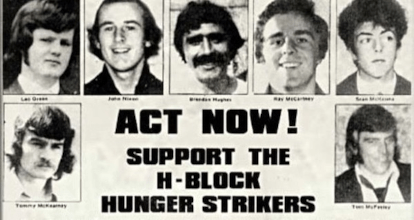
Irish political prisoners confined in the infamous H-Blocks of Long Kesh Detention Centre commence a hunger strike on October 27, 1980. The hunger strike is to continue until their demands for political status and for an end to British torture are met, or until death.
On December 1, three female prisoners, Mary Doyle, Mairéad Farrell and Mairéad Nugent, join the strike in Armagh Prison. Thirty more republican prisoners join later.
Despite being deceived into ending prematurely after 53 days, it sets the scene for a second hunger strike the following March, led by Bobby Sands. The first hunger strike announcement is made in a statement which is reprinted in full below.
“We the Republican POWs in the H-Blocks, Long Kesh, demand the right of political recognition and that we be accorded the status of political prisoners. We claim this right as captured combatants in the continuing struggle for national liberation and self-determination. We refute most strongly the tag of criminal with which the British have attempted to label us and our struggle, and we point to the devisive, partitionist institution of the six-county state as the sole criminal aspect of the present conflict.
“All of us were arrested under repressive laws, interrogated and often tortured in RUC barracks, and processed through special non-jury courts, where we were sentenced to lengthy terms of imprisonment. After this we were put in the H-Blocks and were expected to bow the knee before the British administration and wear their criminal uniform. Attempts to criminalise us were designed to depoliticise the Irish national struggle.
“We don’t have to recite again the widespread, almost total forms of punishment, degradations and deprivations we have been subjected to. All have failed to break our resistance.
“For the past four years we have endured this brutality in deplorable conditions. We have been stripped naked and robbed of our individuality, yet we refuse to be broken. Further repression only serves to strengthen our resolve and that of our gallant female comrades’ enduring the same hardships in Armagh jail.
“During this period many individuals, religious figures and political organisations and sections of the media have condemned the way we have been treated. Yet despite appeals for a resolution of the H-Block protest, the British government has remained intransigent and has displayed vindictive arrogance in dealing with the problem. They refuse to treat this issue in a realistic manner which is just another reflection of their attitude to the entire Irish question.
“Bearing in mind the serious implications of our final step, not only for us but for our people, we wish to make it clear that every channel has now been exhausted, and not wishing to break faith with those from whom we have inherited our principles, we now commit ourselves to a hunger strike.
“We call on the Irish people to lend us their support for our just demands and we are confident that this support will be very much in evidence in the coming days.
“We call on all solidarity and support groups to intensify their efforts and we also look forward with full confidence to the support of our exiled countrymen in America and Australia.
“We declare that political status is ours of right and we declare that from Monday, October 27th, 1980, a hunger strike by a number of men representing H- Blocks 3, 4, and 5 will commence.
“Our widely recognised resistance has carried us through four years of immense suffering, and it shall carry us through to the bitter climax of death, if necessary.”
The UDA’s Shankill headquarters is above Frizzell’s fish shop on the Shankill Road. The UDA’s Inner Council and West Belfast brigade regularly meets there on Saturdays. Peter Taylor says it is also the office of the Loyalist Prisoners’ Association (LPA), and on Saturday mornings is normally crowded, as that is when money is given to prisoners’ families. According to Henry McDonald and Jim Cusack, the IRA have had the building under surveillance for some time. They say that the IRA decides to strike when one of their scouts spots Adair entering the building on the morning of Saturday, October 23, 1993. Later, in a secretly-recorded conversation with police, Adair confirms that he had been in the building that morning.
The IRA’s Belfast Brigade launches an operation to assassinate the UDA’s top commanders, whom it believes are at the meeting. The plan allegedly is for two IRA members to enter the shop with a time bomb, force out the customers at gunpoint and flee before it explodes, killing those at the meeting. As they believe the meeting is being held in the room above the shop, the bomb is designed to send the blast upwards. IRA members maintain that they would have warned the customers as the bomb was primed. It has an eleven-second fuse, and the IRA state that this would allowed just enough time to clear the downstairs shop but not enough for those upstairs to escape.
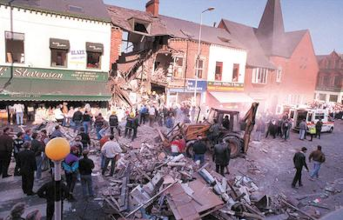
The operation is carried out by Thomas Begley and Seán Kelly, two IRA members in their early twenties from Ardoyne. They drive from Ardoyne to the Shankill in a hijacked blue Ford Escort, which they park on Berlin Street, around the corner from Frizzell’s. Dressed as deliverymen, they enter the shop with the five-pound bomb in a holdall. It is shortly after 1:00 PM on a Saturday afternoon and the area is crowded with mostly women and children. While Kelly waits at the door, Begley makes his way through the customers towards the counter, where the bomb detonates prematurely. Forensic evidence shows that Begley had been holding the bomb over the refrigerated serving counter when it exploded. Begley is killed along with nine other people, two of them children. They are the owner John Frizzell (63), his daughter Sharon McBride (29), Leanne Murray (13), UDA member Michael Morrison (27), his partner Evelyn Baird (27) and their daughter Michelle (7), George Williamson (63) and his wife Gillian (49), and Wilma McKee (38). The force of the blast causes the old building to collapse into a pile of rubble. The upper floor comes down upon those inside the shop, crushing many of the survivors under the rubble, where they remain until rescued some hours later by volunteers and emergency services. About 57 people are injured. At the scene during the rescue operation are several senior loyalists, including Adair and Billy McQuiston. The latter had been in a pub on the nearest corner when the bomb went off. Among those rescued from the rubble is the badly-wounded Seán Kelly.
Unknown to the IRA, if a UDA meeting had taken place, it had ended early and those attending it had left the building before the bomb exploded. McDonald and Cusack state that Adair and his men had stopped using the room for important meetings, allegedly because a sympathiser within the Royal Ulster Constabulary (RUC) told Adair that the police had it bugged.
There was great anger and outrage in the Shankill in the wake of the bombing. Billy McQuiston tells journalist Peter Taylor that “anybody on the Shankill Road that day, from a Boy Scout to a granny, if you’d given them a gun they would have gone out and retaliated.” Many Protestants see the bombing as an indiscriminate attack on them. Adair believes that the bomb was meant for him. Two days after the bombing, as Adair is driving away from his house, he stops and tells a police officer, “I’m away to plan a mass murder.”
In the week following the bombing, the UDA and UVF launch a wave of “revenge attacks,” killing 14 civilians. The UDA shoots a Catholic delivery driver in Belfast after luring him to a bogus call just a few hours after the bombing. He dies on October 25. On 26 October, the UDA shoots dead another two Catholic civilians and wounds five in an indiscriminate attack at a Council Depot on Kennedy Way, Belfast. On October 30, UDA members enter a pub in Greysteel frequented by Catholics and again open fire indiscriminately. Eight civilians, six Catholics and two Protestants, are killed and 13 are wounded. This becomes known as the Greysteel massacre. The UDA states it is a direct retaliation for the Shankill Road bombing.
Seán Kelly, the surviving IRA member, is badly wounded in the blast, having lost his left eye and is unable to move his left arm. Upon his release from hospital, however, he is arrested and convicted of nine counts of murder, each with a corresponding life sentence. In July 2000, he is released under the terms of the Good Friday Agreement. In an interview shortly after his release, he says he had never intended to kill innocent people and regrets what happened.
On the same day, the prisoners in Kilmainham Gaol go on hunger strike, and Ernie O’Malley writes eloquently of it in his book on the Civil War, The Singing Flame. He notes that “practically all volunteered; some were exempted, including myself, but I refused this concession.”
Previously, the Irish Free State government had passed a motion outlawing the release of prisoners on hunger strike. Dan Downey had died in the Curragh on June 10, and Joseph Witty, only 19 years old, also died in the Curragh on September 2. However, because of the large numbers of Republicans on strike, at the end of October the Government sends a delegation to Newbridge Camp to speak with IRA leaders there.
It soon becomes apparent that they are not there to negotiate the strikers’ demands, but rather to give the prisoners the Government’s message: “we are not going to force-feed you, but if you die we won’t waste coffins on you; you will be put in orange boxes and you will be buried in unconsecrated ground.”
O’Malley writes, “Any action was good, it seemed, and everyone was more cheerful when the hunger strike began. We listened to the tales of men who had undergone previous strikes and we, who were novices, wondered what it would be like. We laughed and talked, but in the privacy of our cells, some, like myself, must have thought what fools we were, and have doubted our tenacity and strength of will. I looked into the future of hunger and I quailed.”
All negotiations to curtail the strike are abandoned and the strike goes forward. Poorly planned, within weeks many are going off strike, but by the end of October, there are still 5,000 on strike. O’Malley does not know what effect the strike will have, but he feels he cannot ‘let the side down.’ “Hunger striking was an unknown quantity for me. I did not approve of it. I was frankly afraid, but I could not see boys of sixteen and eighteen take their chance whilst I could eat and be excused. Now, even though one thought one’s death could be of use, there was no passive acceptance. It was a challenge, a fight, and again resistance was built up……The mind would suffer more than the body. The struggle in the end would be between body and spirit.”
On November 20, Denis “Denny” Barry dies in the Newbridge Camp, and Andrew Sullivan dies in Mountjoy on November 22.
When Barry dies, the Bishop of Cork, Daniel Cohalan, refuses to let his body lie in a Cork church. When Terence MacSwiney died on hunger strike in 1921, Bishop Cohalan had written in The Cork Examiner, “I ask the favour of a little space to welcome home to the city he laboured for so zealously the hallowed remains of Lord Mayor Terence MacSwiney. For the moment, it might appear that he has died in defeat. Was Robert Emmet’s death in vain? Did Pearse and the other martyrs for the cause of Irish freedom die in vain? We bow in respect before his heroic sacrifice. We pray the Lord may have mercy on his soul.”
At the death of Denis Barry two years later, the very same Bishop Cohalan writes, “Republicanism in Ireland for the last twelve months has been a wicked and insidious attack on the Church and on the souls of the faithful committed to the Church by the law of the Catholic Church.” Denis Barry is not afforded a Catholic burial.
With the deaths of Barry and Sullivan drawing no positive response or concessions from the Free State government, the IRA command orders the strikes ended on November 23.
O’Malley writes that the strike ended with no promises of release, “we had been defeated again.” While the strike itself fails to win releases, it does begin a slow start of a programme of release of prisoners, the State being worried about the political impact of more deaths, though some prisoners remain in jail until as late as 1932.
O’Malley, writing of Tom Derrig who is in Mountjoy, relates that one of the strikers there, on the last day of the strike, had asked a doctor, “What day of the strike is this?” The doctor replies, “The forty-first.” The striker says, “Be cripes! We bate Christ by a day!”
Stagg is the seventh child in a family of thirteen children. His father, Henry, and his uncle had both fought in the Irish War of Independence and Irish Civil War. His brother, Emmet Stagg, becomes a Labour Party politician and a Teachta Dála (TD) for Kildare North. He is educated to primary level at Newbrook Primary School and at CBS Ballinrobe to secondary level. After finishing his schooling, he works as an assistant gamekeeper with his uncle prior to emigrating to England in search of work. Once in England, he gains employment as a bus conductor in North London and later becomes a bus driver. While in England he meets and marries fellow Mayo native, Bridie Armstrong from Carnacon in 1970.
In 1972, Stagg joins the Lutoncumann of Sinn Féin and soon after becomes a volunteer in the Provisional Irish Republican Army (IRA).
In April 1973, Stagg is arrested with six others alleged to comprise an IRA unit planning bombing attacks in Coventry. He is tried at BirminghamCrown Court. The jury finds three of the seven not guilty. The remaining four are all found guilty of criminal damage and conspiracy to commit arson. Stagg and English-born priest, Father Patrick Fell, are found to be the unit’s commanding officers. Stagg is given a ten-year sentence and Fell is given twelve years. Thomas Gerald Rush is given seven years and Anthony Roland Lynch, who is also found guilty of possessing articles with intent to destroy property, namely nitric acid, balloons, wax and sodium chlorate, is given ten years.
Following the hunger strike that results in the death of Michael Gaughan, the Price sisters, Feeney and Kelly are granted repatriation to Ireland. Stagg is denied repatriation and is transferred to Long Lartin Prison. During his time there he is subject to solitary confinement for refusing to do prison work and is also subjected, along with his wife and sisters during visits, to humiliating body searches. In protest against this, he begins a second hunger strike that lasts for thirty-four days. This ends when the prison governor agrees to an end of the strip-searches on Stagg and his visitors. He is bed-ridden for the rest of his incarceration in Long Lartin, due to a kidney complaint.
In 1975 Stagg is transferred to Wakefield Prison, where it is demanded that he again do prison work. He refuses and is placed in solitary confinement. On December 14, 1975, he embarks on a hunger strike in Wakefield, along with a number of other republican prisoners, after being refused repatriation to Ireland during the IRA/British truce. His demands are an end to solitary confinement, no prison work and repatriation to prison in Ireland. The British government refuses to meet any of these demands and Stagg dies on February 12, 1976, after 62 days on hunger strike.
Stagg’s burial causes considerable controversy. Republicans and two of his brothers seek to have him buried in the republican plot in Ballina beside the grave of Michael Gaughan, in accordance with his wishes. His widow, his brother Emmet Stagg and the Irish government wish to have him buried in the family plot in the same cemetery and to avoid republican involvement in the funeral.
In order to prevent the body from being disinterred and reburied by republicans, the grave is covered with concrete. Local Gardaí keep an armed guard by the grave for six months. However, unknown to them, the plot beside the grave is available for purchase. Stagg’s brother George purchases the plot and places a headstone over it, with it declaring that the “pro-British Irish government” had stolen Frank’s body. In November 1977, a group of republicans dig down into the plot that George had purchased, then dig sideways and recover Stagg’s coffin from the adjacent plot under cover of darkness, before reburying it in the republican plot beside the body of Michael Gaughan. The Republicans hold their own version of a funeral ceremony before disappearing back into the night.
The IRA swears revenge over Stagg’s death, warning the British public it is going to attack indiscriminately. They explode about 13 bombs throughout England within a month after his death.
The Free State’s Provisional Government puts the “Public Safety Bill” before Dáil Éireann on September 27, 1922, which passes by 41 votes to 18. This is emergency legislation which allows for the execution of those captured bearing arms against the State. The legislation passes to the National Army powers of punishment for anyone “taking part in or aiding and abetting attacks on the National Forces,” having possession of arms or explosives “without the proper authority” or disobeying an Army General Order.
The legislation gives the Military Courts the right to impose the sentence of death, imprisonment or penal servitude on those found to be guilty of such offences, the sentence only requiring the signatures of two officers. By time the bill is a year old, 81 men are executed under its terms and over 12,000 men and women imprisoned.
The reason for such punitive legislation is the dragging on of the Irish Civil War caused by the Anglo-Irish Treaty. A pro-Treaty offensive against the anti-Treaty Irish Republican Army (IRA) in the summer of 1922 appears to have won the war for the government but the anti-Treatyites or republicans subsequently fall back on guerrilla tactics which the newly formed Free State or National Army have great difficulty in suppressing. Ernest Blythe, the Minister for Finance in the Provisional Government, later recalls, “there was for some time a feeling that the Civil War would speedily end as major resistance was broken, but actually it began to assume a chronic character.”
In the week preceding the Dáil’s motion, on September 21, six National Army soldiers are killed in a prolonged engagement with Republican fighters near Ballina, County Mayo. On the same day, the Free State barracks in Drumshambo, County Leitrim, is attacked and taken and one soldier is killed. On September 22, a National Army soldier is killed and several soldiers and three civilians injured in a gun and grenade attack by Republicans on Free State troops on Eden Quay in central Dublin. And on the day of the Bill itself coming before the Dáil, in County Kerry several hundred anti-Treaty IRA guerrillas attack the town of Killorglin and are only repulsed after 24 hours of fighting, when Free State troops arrive from Tralee.
At the time and since, the legislation passed in 1922 is known as the Public Safety Bill. However, no such Bill or Act can be found in the records of the Irish state. The Provisional Government have no legal right under the Treaty to enact new legislation without royal assent, the King being represented in the person of the Governor-General. And in theory the Provisional Government’s powers do not apply after the Treaty formally passes into law on December 6, 1922.
So technically speaking the Public Safety Bill is not a law but simply a resolution passed in the Dáil. However, since there was, as yet no Governor-General who could give his assent and as the government felt the situation was too grave for legal niceties, the legislation setting up military courts was passed anyway. It is not until August 1923, when the Free State passes an Act of Indemnity for all actions committed during the Irish Civil War and also pass new, formal special powers legislation – The Emergency Powers Act – that retrospectively legalises what it had enacted in the autumn of 1922.
After an amnesty of two weeks, in which anti-Treaty fighters could surrender without consequences, the legislation comes into force in mid-October. Republicans at first do not believe that the government is serious about enforcing what its foes term “the Murder Bill.” It is in practice nearly two months before it is used in earnest.
On November 17, 1922, four IRA men who had been captured in Dublin are shot by firing squad. By the end of the week, Erskine Childers, who had served as secretary to the delegation which signed the Treaty but later organized Republican propaganda against it, is also dead. He had been captured at his home in County Wicklow on November 11 in possession of a small pistol Michael Collins had given him before he departed for Treaty negotiations in London. He is sentenced and shot on November 24. On November 30 another three Republican prisoners are executed in Dublin.
Liam Lynch, IRA Chief of Staff, issues a general order that Teachtaí Dála (TDs) who had voted for the Bill be shot on sight. On December 6, in retaliation for the executions, IRA members assassinate the TD Sean Hales in Dublin. In reprisal for that four senior republicans, Rory O’Connor, Liam Mellows, Richard Barrett and Joe McKelvey, who had been captured long before the Public Safety legislation is passed are summarily shot.
The legislation passed on September 27, 1922, may well have helped, as its supporters claimed, to break anti-Treaty resistance and to bring the Irish Civil War to an end. However, it also helped to convert the conflict into a feud as bitter and as personal as a vendetta.
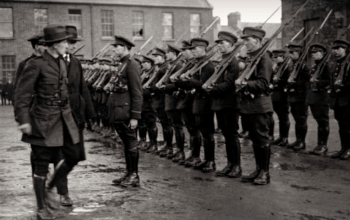
(From: “The passing of legislation allowing for executions during the Irish Civil War” by John Dorney, The Irish Story (www.theirishstory.com), September 27, 2013 | Photo: Richard Mulcahy, shown inspecting soldiers in Dublin, argued that permitting official executions would prevent National Army troops from carrying out unofficial killings)
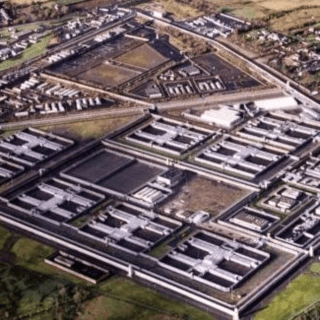
The Maze Prison escape, known to Irish republicans as the Great Escape, takes place on September 25, 1983, in County Antrim, Northern Ireland. HM Prison Maze, also known as Long Kesh, is a maximum-security prison considered to be one of the most escape-proof prisons in Europe, and holds prisoners suspected of taking part in armed paramilitary campaigns during the Troubles. In the biggest prison escape in UK history, 38 Provisional Irish Republican Army (IRA) prisoners escaped from H-Block 7 (H7) of the prison. One prison officer dies of a heart attack during the escape and twenty others are injured, including two who are shot with guns that had been smuggled into the prison. The escape is a propaganda coup for the IRA, and a British government minister faces calls to resign. The official inquiry into the escape places most of the blame onto prison staff, who in turn blame the escape on political interference in the running of the prison.
IRA volunteers regard themselves as prisoners of war with a duty to escape. During the Troubles, Irish republican prisoners escape from custody en masse on several occasions between 1971 and 1981.
Prisoners had been planning the 1983 escape for several months. Bobby Storey and Gerry Kelly start working as orderlies in H7, which allows them to identify weaknesses in the security systems. Six handguns are also smuggled into the prison. Shortly after 2:30 PM on September 25, prisoners seize control of H7 by simultaneously taking the prison officers hostage at gunpoint in order to prevent them from triggering an alarm. One officer is stabbed with a craft knife, and another is knocked down by a blow to the back of the head. One officer who attempts to prevent the escape is shot in the head by Gerry Kelly but survives. By 2:50 PM the prisoners are in control of H7 without an alarm being raised. A dozen prisoners also take uniforms from the officers, and the officers are forced to hand over their car keys and details of where their cars are, for possible later use during the escape. A rearguard is left behind to watch over hostages and keep the alarm from being raised until they believe the escapees are clear of the prison, at which time they return to their cells. At 3:25 PM, a lorry delivering food supplies arrives at the entrance to H7, whereupon Brendan McFarlane and other prisoners take the occupants hostage at gunpoint and move them inside H7. The lorry driver is told the lorry is being used in the escape, and he is instructed what route to take and how to react if challenged.
At 3:50 PM the prisoners leave H7, and the driver and a prison orderly are taken back to the lorry. Thirty-seven prisoners climb into the back of the lorry, while Gerry Kelly lay on the floor of the cab with a gun pointed at the driver, who is also told the cab has been booby trapped with a hand grenade. At nearly 4:00 PM the lorry drives toward the main gate of the prison, where the prisoners intend to take over the gatehouse. Ten prisoners dressed in guards’ uniforms and armed with guns and chisels dismount from the lorry and enter the gatehouse, where they take the officers hostage.
At 4:05 PM the officers begin to resist, and an officer presses an alarm button. When other staff respond via an intercom, a senior officer says while being held at gunpoint that the alarm had been triggered accidentally. By this time the prisoners are struggling to maintain control in the gatehouse due to the number of hostages. Officers arriving for work are entering the gatehouse from outside the prison, and each is ordered at gunpoint to join the other hostages. Officer James Ferris runs from the gatehouse toward the pedestrian gate attempting to raise the alarm, pursued by Dermot Finucane. Ferris had already been stabbed three times in the chest, and before he can raise the alarm he collapses.
Finucane continues to the pedestrian gate where he stabs the officer controlling the gate, and two officers who had just entered the prison. This incident is seen by a soldier on duty in a watchtower, who reports to the British Army operations room that he has seen prison officers fighting. The operations room telephones the prison’s Emergency Control Room (ECR), which replies that everything is all right and that an alarm had been accidentally triggered earlier.
At 4:12 PM the alarm is raised when an officer in the gatehouse pushes the prisoner holding him hostage out of the room and telephones the ECR. However, this is not done soon enough to prevent the escape. After several attempts the prisoners open the main gate and are waiting for the prisoners still in the gatehouse to rejoin them in the lorry. At this time two prison officers block the exit with their cars, forcing the prisoners to abandon the lorry and make their way to the outer fence which is 25 yards away.
Four prisoners attack one of the officers and hijack his car, which they drive toward the external gate. They crash into another car near the gate and abandon the car. Two escape through the gate, one is captured exiting the car, and another is captured after being chased by a soldier. At the main gate, a prison officer is shot in the leg while chasing the only two prisoners who have not yet reached the outer fence. The prisoner who fires the shot is captured after being shot and wounded by a soldier in a watch tower, and the other prisoner is captured after falling. The other prisoners escape over the fence, and by 4:18 PM the main gate is closed and the prison secured, after 35 prisoners had breached the prison perimeter. The escape is the biggest in British history, and the biggest in Europe since World War II.
Outside the prison the IRA has planned a logistical support operation involving 100 armed members, but due to a miscalculation of five minutes, the prisoners find no transport waiting for them and are forced to flee across fields or hijack vehicles. The British Army and Royal Ulster Constabulary immediately activate a contingency plan and by 4:25 PM a cordon of vehicle checkpoints are in place around the prison, and others are later in place in strategic positions across Northern Ireland, resulting in the recapture of one prisoner at 11:00 PM. Twenty prison officers are injured during the escape, thirteen are kicked and beaten, four stabbed, and two shot. One prison officer, James Ferris, who had been stabbed, dies after suffering a heart attack during the escape.
The escape is a propaganda coup and morale boost for the IRA, with Irish republicans dubbing it the “Great Escape.” Leading unionist politician Ian Paisley calls on Nicholas Scott, the Parliamentary Under-Secretary of State for Northern Ireland, to resign. The British Prime MinisterMargaret Thatcher makes a statement in Ottawa during a visit to Canada, saying “It is the gravest [breakout] in our present history, and there must be a very deep inquiry.” The day after the escape, Secretary of State for Northern IrelandJames Prior announces an inquiry to be headed by Her Majesty’s Chief Inspector of Prisons, James Hennessy. The Hennessy Report is published on January 26, 1984, placing most of the blame for the escape on prison staff, and making a series of recommendations to improve security at the prison. The report also places blame with the designers of the prison, the Northern Ireland Office and successive prison governors who had failed to improve security. Prior announces that the prison’s governor has resigned, and that there will be no ministerial resignations as a result of the report’s findings. Four days after the Hennessy Report is published, the Minister for Prisons Nicholas Scott dismisses allegations from the Prison Governors Association and the Prison Officers Association that the escape is due to political interference in the running of the prison.
Fifteen escapees are captured on the day, including four who are discovered hiding underwater in a river near the prison using reeds to breathe. Four more escapees are captured over the next two days, including Hugh Corey and Patrick McIntyre who are captured following a two-hour siege at an isolated farmhouse. Out of the remaining 19 escapees, 18 end up in the republican stronghold of South Armagh where two members of the IRA’s South Armagh Brigade are in charge of transporting them to safehouses and given the option of either returning to active service in the IRA’s armed campaign or a job and new identity in the United States.
On October 25, 1984, nineteen prisoners appear in court on charges relating to the death of prison officer James Ferris, sixteen charged with his murder. A pathologist determines that the stab wounds Ferris suffered would not have killed a healthy man. The judge acquits all sixteen as he cannot correlate the stabbing to the heart attack.
Boland is born in Dublin on October 15, 1917. He attends St. Joseph’s, Fairview, leaving in 1933. He is the son of Gerald Boland, a founder-member of Fianna Fáil, and the nephew of Harry Boland. Despite this, he fails to get elected to Dáil Éireann on his first two attempts, standing in the Dublin County constituency at the 1951 Irish general election and again at the 1954 Irish general election. Double success follows at the 1957 Irish general election, when he is not only elected to the 16th Dáil but is appointed to the cabinet as Minister for Defence on his very first day in the Dáil. This is due to the retirement of his father who had served in every Fianna Fáil government since 1932.
The Defence portfolio is largely considered a safe and uncontroversial position, so Boland makes only a small impact. As a Minister, he proudly displays a fáinne (gold ring) on the lapel of his jacket, which indicates that he is able and willing to speak the Irish language. He frequently conducts his governmental business in Irish. In 1961, he is moved from Defence to become the Minister for Social Welfare. He remains there until the retirement in 1966 of the Taoiseach, Seán Lemass, when Fianna Fáil faces the first leadership contest in its history. He is then appointed Minister for Local Government which post he holds until he leaves government in 1970.
The leadership race immediately erupts as a two-horse battle between Charles Haughey and George Colley. Both of these men epitomise the new kind of professional politician of the 1960s. Things change when Neil Blaney indicates his interest in running. Boland supports him in his campaign, as both men hail from the republican and left wing of the party. There is talk at one point of Boland himself entering the leadership race. In the end Jack Lynch is chosen as a compromise, and he becomes the new Taoiseach. Boland is made Minister for Local Government in the new cabinet.
In 1969, events in Northern Ireland cause political chaos over the border in Ireland. It is the start of The Troubles in Northern Ireland and Fianna Fáil’s policy with regard to the North is coming into question. One crisis meeting is held after another, in which the possibility of decisive action is discussed. The “hawks” in the cabinet urge a symbolic invasion of Northern Ireland to protect nationalists near the border, and to draw international attention, while the “doves”, who ultimately prevail, urged caution. These cabinet meetings are heated events. On one occasion Boland is alleged to have been so angry that he resigns not only his cabinet position but also his Dáil seat and goes home to his farm in County Dublin to make hay. The resignations are rejected by Taoiseach Jack Lynch after a calming-down period. In what becomes known as the Arms Crisis, two ministers, Charles Haughey and Neil Blaney, are sacked from the government in May 1970, for allegedly being involved in a plot to import arms for Republicans in the North. Boland resigns in solidarity with them and in protest about the government’s position on the North. Later that year his criticism of the Taoiseach (whom Boland and many others within the Party maintain had authorized the arms importation) leads to his expulsion from the Fianna Fáil party.
One of Boland’s most famous incidents takes place at the Fianna Fáil Ardfheis in 1971. Just before Jack Lynch’s speech Boland storms a nearby podium, interrupting Patrick Hillery in the middle of his speech. He openly defies the party leadership and his opponents, holding his arms wide open and shouting to the crowd, “Come on up and put me down.” While there is a lot of booing and clapping in an effort to drown him out, many of his supporters start cheering and chanting “We want Boland.” An enraged Patrick Hillery grabs his microphone and famously replies, “If you want a fight, you can have it…You can have Boland, but you can’t have Fianna Fáil.” At this point the government supporters are ecstatic with cheering and Boland is carried out of the hall.
After this episode Boland founds his own political party, Aontacht Éireann (Irish Unity). It wins very little support, and he fails to be elected to the Dáil in 1973, which effectively ends his political career. He and his colleagues resign from the party in 1976 after it is taken over by a number of far-right individuals. He remains an outspoken critic of the Republic’s Northern Ireland policy, particularly the Sunningdale Agreement. He makes one last attempt to reclaim a Dáil seat, standing unsuccessfully in the Dublin South-West constituency at the 1981 Irish general election. He then retires from public life completely.
In 1996, Boland sues the Irish Independent for libel after a January 20, 1993, article incorrectly states that he had appeared before the court in the Arms Trial in 1970 and had been dismissed as a Minister by Taoiseach Jack Lynch. He is awarded £75,000 in damages.
Kevin Boland dies at the age of 83 in Dublin on September 23, 2001, following a short illness.
Potter is born to a Presbyterian family who, oddly, lives on the Falls Road, a republican (Catholic) stronghold. His father is a church organist and piano tuner who has been blind since childhood. His mother is, in Potter’s own words, “a raging alcoholic.” He escapes a rather grim childhood when he goes to live with an aunt in Kent, England.
Potter had already started composing chamber and vocal music before the war. Now, established in Dublin, he chooses the orchestra as his principal means of expression. His early pieces, such as Rhapsody under a High Sky and Overture to a Kitchen Comedy, show that he has absorbed Vaughan Williams’ pastoral style and his love of folk music. In 1952, both pieces are awarded Radio Éireann‘s “Carolan Prize” for orchestral composition by the adjudicatorArnold Bax. A year later Potter repeats this success when his Concerto da Chiesa, a concerto for piano and orchestra, also wins the Carolan Prize.
In 1955 Potter is appointed Professor of Composition at the Royal Irish Academy of Music, where he becomes an effective administrator and inspiring teacher.
In the 1960s, Potter turns to ballet, writing four orchestral scores for the Cork Ballet company. The first of these, Careless Love, becomes the composer’s own favourite of all his compositions. Several years later, following a successful battle with alcoholism, he writes what some regard as his magnum opus, Sinfonia “de Profundis” (1969). The première is given at the Gaiety Theatre, Dublin on March 23, 1969 in a performance by the RTÉ Symphony Orchestra under the baton of Albert Rosen. The Irish Times refers to the concert as a “major national event.” In December 1969, he receives a Jacob’s Award for the composition.
Potter’s last substantial work, an opera entitled The Wedding, receives its first public performance in Dublin in 1981, almost a year after his death.
Potter dies suddenly at his home in Greystones, County Wicklow on July 5, 1980, at the age of 61. He is buried in the nearby Redford cemetery.