Pearse is born on August 24, 1878, at 27 Great Brunswick Street (now Pearse Street) in Dublin, the eldest child of James Pearse and Margaret Pearse (née Brady), who serves as a Teachta Dála (TD) in the 1920s. She is educated at the Holy Faith Convent in Glasnevin. After leaving school, she trains as a teacher. She helps to found St. Enda’s School with her brothers Patrick and Willie. Following the executions of her brothers in the aftermath of the Easter Rising, she continues to run St. Enda’s, along with Fergus De Búrca, until 1933.
Illness forces Pearse into the Linden Convalescent Home in Blackrock, County Dublin when she is in her 80s. In 1967, when she is 89 years old, her condition is described to be deteriorating. However, in 1968 during the months leading up to her 90th birthday, she leaves the Linden Convalescent Home for a short while in order to spend her birthday at St. Endas in Rathfarnham. The president of Ireland at the time, Éamon de Valera, visits her at St. Endas to congratulate her on her upcoming 90th birthday.
Margaret Pearse dies, unmarried, at the Linden Convalescent Home in Blackrock, County Dublin, on November 7, 1968, and is given a state funeral. President de Valera, the church and the state all pay tribute to her at the funeral. She is buried beside her parents and sister at Glasnevin Cemetery. The Taoiseach, Jack Lynch, says that Margaret Mary Pearse is the last remaining member of the noble Pearse family. He says her life, like her patriotic brothers, was dedicated to Ireland.
As per her mother’s wishes, Pearse bequeaths St. Enda’s to the people of Ireland as a memorial to her brother’s sacrifice. The school is now home to the Pearse Museum.
Lynch is born on August 15, 1917, in Blackpool, on the north side of Cork, County Cork. He is educated at St. Vincent’s Convent on Peacock Lane, and later at the North MonasteryChristian Brothers School. He sits his Leaving Certificate in 1936, after which he moves to Dublin and works with the Dublin District Milk Board, before returning to Cork to take up a position in the Circuit Court Office.
Lemass’s retirement in 1966 causes an internal party conflict over the succession that leads to Lynch’s selection as a compromise candidate, a position he reluctantly accepts. In November of that year, he becomes leader of Fianna Fáil and Taoiseach. In June 1969 he becomes the only Fianna Fáil leader other than de Valera to win an overall majority in a general election. In 1969–1973 Lynch plays an important role when civil unrest leads to the collapse of the government of Northern Ireland and poses a threat to the stability of the Irish state. He fires two cabinet ministers who are suspected of involvement in smuggling arms to the Provisional Irish Republican Army (IRA). He also creates a consensus in Irish party politics on a policy of conciliation and cooperation with the British government in seeking a solution to the Northern Ireland problem based on establishing power-sharing between the unionist majority and the Roman Catholic minority.
In 1972 Lynch wins an 83 percent majority in a referendum on Ireland’s entry into the European Economic Community. On January 1, 1973, Ireland becomes a member. Although he is defeated in the 1973 elections, he again demonstrates his remarkable popularity at the polls in 1977 when Fianna Fáil wins their largest and their last overall majority. In December 1979, however, discouraged by challenges to his authority from party colleagues, he resigns his leadership and soon after retires from politics. He serves on a number of corporate boards after his retirement.
In 1992 Lynch suffers a severe health setback, and in 1993 suffers a stroke in which he nearly loses his sight. Following this he withdraws from public life, preferring to remain at his home with his wife Máirín where he continues to be dogged by ill-health.
Lynch dies in the Royal Hospital, Donnybrook, Dublin on October 20, 1999, at the age of 82. He is honoured with a state funeral which is attended by the President of IrelandMary McAleese, Taoiseach Bertie Ahern, former Taoisigh John Bruton, Albert Reynolds and Charles Haughey, and various political persons from all parties. The coffin is then flown from Dublin to Cork where a procession through the streets of the city draws some of the biggest crowds in the city’s history. After the Requiem Mass celebrated in his home parish of the Cathedral of St. Mary and St. Anne, Lynch’s friend and political ally, Desmond O’Malley, delivers the graveside oration, paying tribute to Lynch’s sense of decency. He is buried in St. Finbarr’s Cemetery in Cork.
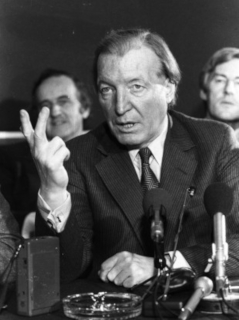
In 1970 Haughey is twice tried for conspiracy to use government funds to procure arms for the outlawed IRA. The first trial is aborted, and he wins acquittal in the second. Dismissed from the government, he remains in the Dáil and gains strong support among his party’s grass roots. When Fianna Fáil is returned to office in 1977, he is made Minister for Health and Minister for Social Welfare. On the resignation of party leader Jack Lynch in 1979, he is elected party leader and becomes Taoiseach. In June 1981 his government falls, but he returns to power briefly in 1982. He becomes Taoiseach again after elections in February 1987, though his government lacks a majority in the Dáil. When Fianna Fáil forms a government with the Progressive Democrats in July 1989, thereby eschewing the party’s traditional rejection of coalition rule, he is made Taoiseach for a fourth time.
Haughey’s first two terms in office are marked by deteriorating relations with Great Britain, a declining economy, and deep divisions within Fianna Fáil. Despite the controversies that plague his government, the charismatic Haughey remains party leader after losing office for a second time in late 1982. During his later terms, he successfully mounts a fiscal austerity program to address Ireland’s financial crisis. In 1992 he resigns and retires after being implicated in a phone tapping scandal of two journalists. He denies the allegations. He remains out of public life until 1997, when an official tribunal of inquiry determines that he had received large sums of money from a prominent businessman while Taoiseach. The Dáil then establishes another tribunal to investigate his financial affairs, and many other irregularities are uncovered. He eventually agrees to pay €6.5 million in back taxes and penalties.
Haughey dies at the age of 80 from prostate cancer, from which he had suffered for a decade, on June 13, 2006, at his home in Kinsealy, County Dublin. He receives a state funeral on June 16. He is buried in St. Fintan’s Cemetery, Sutton, Dublin, following mass at Donnycarney. The then Taoiseach Bertie Ahern delivers the graveside oration. The funeral rites are screened live on RTÉ One and watched by a quarter of a million people. The funeral is attended by PresidentMary McAleese, the Taoiseach, Bertie Ahern, members of the Oireachtas, many from the world of politics, industry and business. The chief celebrant is Haughey’s brother, Father Eoghan Haughey.
After losing to Joe Frazier in March 1971, Ali goes on something of a world tour, fighting 13 times in six countries before defeating Frazier in a rematch in January 1974.
The promotion is the brainchild of a character from County Kerry named Butty Sugrue, known throughout Ireland as a circus strongman, whose alleged claim to fame is pulling double-decker buses by a rope in his teeth. Dublin journalists laugh at him when he first announces his intentions.
But despite the scepticism, the fight is arranged for July 19, 1972. As soon as he steps off the plane at Dublin Airport, Ali, ever the showman, immediately captures the heart of a nation by announcing that he has Irish roots. In the 1860s, Abe Grady left his native Ennis in County Clare and emigrated to the United States. In Kentucky, he met and married an emancipated slave. A century later Abe Grady’s great grandson Muhammad Ali touches down in Dublin.
In the week leading up to the fight Ali meets people from all walks of life in Dublin. He spends time with celebrities, including actor Peter O’Toole, and playfully spars with director John Huston, whose boxing movie, Fat City, is screened with both Ali and Lewis in attendance.
Ali also meets politicians, including TaoiseachJack Lynch in Leinster House and political activist Bernadette Devlin. The Cork Examiner comments on how popular Ali has proven with politicians in Ireland. “Not since the late President John F. Kennedy was in Dublin in 1963 has a visitor from abroad been given as big a welcome at Leinster House as that accorded to Muhammad Ali.”
Ali is always about so much more than boxing, and that week in Dublin is another case in point, as the fight itself is not a classic. He has a cold and is wary of Lewis, who is a dangerous fighter and a man who had previously served time in prison for manslaughter. Ali who, prior to the bout predicts that his opponent’s chances of victory lay somewhere between “slim and none,” eventually wins with a TKO in the eleventh round.
In 2009, Ali returns to Ireland to visit Ennis in County Clare, the hometown of his ancestor Abe Grady, where he is granted the freedom of the town. The huge crowds who come out to meet him are testament to his enduring appeal. But the magic of Muhammad Ali leaves an indelible impact on Ireland after his 1972 visit as the late Budd Schulberg, a legendary boxing writer, said, “Ali was like the Pied Piper. It was really kind of magical. He had enormous influence over there. He was a fellow Irishman.”
(From: “When Ali thrilled Ireland: How ‘the Greatest’ shook up Dublin” by Peter Crutchley, BBC NI Digital & Learning, June 6, 2016)
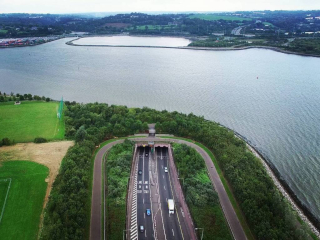
The Jack Lynch Tunnel, described as the most challenging civil engineering project in the history of the state, is unveiled on May 21, 1999 by TaoiseachBertie Ahern at the entrance of the tunnel in Mahon, County Cork.
The Jack Lynch Tunnel is an immersed tube tunnel and an integral part of the N40 southern ring road of Cork. It is named after former Taoiseach Jack Lynch, a native of Cork. Construction involves the excavation of a large casting basin where the tunnel elements or pieces are constructed. After construction of elements is complete, the casting basin is filled with water and joined to the adjacent River Lee, each element is floated out and sunk into position into a carefully dredged river bed.
The tunnel takes the road under the River Lee. North of the tunnel, the ring-road joins the M8 motorway to Dublin and N8 road to the city centre, with the N25 road commencing east to Waterford. The tunnel is completed in May 1999, and carries nearly 40,000 vehicles per day as of 2005. This number rises further as the N40 ring-road’s upgrades progress, with the opening of the Kinsale Road Roundabout flyover in 2006 and subsequent upgrades to the Sarsfield Road and Bandon Road Roundabouts. Traffic in 2015 is 63,000 vehicles a day up from 59,000 in 2013.
The tunnel has two cells, each with two traffic lanes and two footpaths, and a central bore for use in an emergency only. Pedestrians and cyclists are expressly forbidden from using the tunnel. The exclusion of cyclists has been somewhat controversial as the feeder road is a dual-carriageway and so is open to cyclists, but the by-law is applied because of space limitations and the obvious danger of cyclists in an enclosed tunnel.
MacSharry is educated at the local national school before later briefly attending Summerhill College. After leaving school he works as a livestock dealer throughout Sligo and Mayo before becoming involved in the Meat Exporters Factory in his native town. MacSharry also owns his own haulage firm.
Although MacSharry comes from a non-political family, he himself becomes an active member of Fianna Fáil in Sligo. In 1967 he makes his first move into politics when he secures election to both Sligo Borough Council and Sligo County Council. It was from this local base that he launches his national election campaign.
Following the 1977 general election, Fianna Fáil returns to government with a massive twenty-seat Dáil majority. With the introduction of the new Minister of State positions in 1978, MacSharry finally secures a junior ministerial post, as Minister of State at the Department of the Public Service.
Charles Haughey succeeds in becoming party leader after Jack Lynch’s resignation in 1979, albeit by a narrow margin of just six votes, and is later elected Taoiseach by the Dáil. MacSharry’s loyalty is subsequently rewarded when he is appointed Minister for Agriculture in the new government.
Fianna Fáil falls out of power in 1981 but returns to power following the February 1982 general election. MacSharry is promoted to the positions of Tánaiste and Minister for Finance, however, the government falls after just nine months in office and a new coalition government of Fine Gael, and the Labour Party take office.
In 1983 MacSharry resigns from the Fianna Fáil front bench due to a telephone tapping controversy, when it is revealed that as Tánaiste and Minister for Finance, he had borrowed police tape recorders to secretly record conversations with a cabinet colleague. He spends a number of years in the political wilderness following the phone-tapping scandal. He is elected to the European Parliament as a Member of the European Parliament (MEP) for Connacht–Ulster in 1984.
Following the 1987 general election MacSharry is returned to the Dáil once again. He resigns his European Parliament seat when he is appointed Minister for Finance in Haughey’s new government. In 1988 his loyalty to Haughey is rewarded when he is appointed European Commissioner. As a result of this he resigns his Dáil seat and ends his domestic political career.
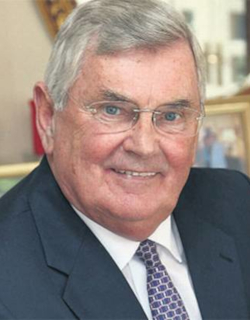
Following the completion of his term as Commissioner, MacSharry retires from politics to pursue business interests. He is currently a director on the boards of a variety of companies including Bank of Ireland and Ryanair Holdings. In 1999 he is appointed chairman of Eircom plc. He is also a member of the Comite d’Honneur of the Institute of International and European Affairs.
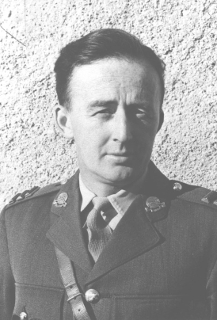
Kelly is a central figure in the Arms Crisis, having traveled to Hamburg to arrange the purchase of arms. It emerges later that Neil Blaney had ordered him to do so outside normal legal channels, but before the weapons arrive the Gards Special Detective Unit hears of the plan and informs the Taoiseach, Jack Lynch, aborting the importation and resulting in criminal charges for the plotters. Although in his summation the judge says it is no defence for Kelly to say that he believes that the government authorised the importation of arms, Kelly is acquitted.
Despite his acquittal, Kelly suffers financially because he had felt compelled to resign from the Army even before the prosecution was brought. He prints and publishes a personal memoir in paperback format called Orders for the Captain? in 1971.
Kelly never denies his involvement in extra-legal arms purchase talks, but contends that he had been ordered to do so by some ministers. A typical version of the events is found in a 1993 hostile biography of Charles Haughey, claiming: “As early as October 1969, to the certain knowledge of Charles Haughey, James Gibbons, the Department of Justice, the Special Branch and Army Intelligence, there were meetings with leading members of the IRA, when they were promised money and arms. The critical encounter took place in Bailieborough, County Cavan, on Saturday, 4 October 1969. It had been arranged by Captain James Kelly, an army intelligence officer, and Cathal Goulding. Kelly, at that stage, was already the subject of several security reports to the Secretary of the Department of Justice, Peter Berry, from the Special Branch, implicating Kelly with subversives and with promises of money and of arms.” Kelly never objected to such versions of the events of 1969.
Kelly is elected vice-chairman of Aontacht Éireann. Aontacht Éireann meets with little success at the polls and by 1980 he has joined Fianna Fáil, becoming a member of its national executive. Following the first applications of the 1987 Extradition (European Convention on the Suppression of Terrorism) Act, he resigns from the party in 1989 in opposition to the extradition of Provisional IRA prisoners to the United Kingdom. He also serves twice as President of the 1916-1921 Club. He launches a successful defamation case against Garret FitzGerald over an article in The Irish Times.
James Kelly dies on July 16, 2003 and is buried in Glasnevin Cemetery in Dublin. The epitaph on his grave is “Put not your trust in princes,” a quote from Psalm 146.
In 1990 Wilson challenges Brian Lenihan for the Fianna Fáil nomination for the 1990 presidential election. Lenihan wins the nomination but fails to be elected President and is also sacked from the government. Wilson is then appointed Tánaiste. He remains in the cabinet until retirement in 1993. Although the 26th Dáil Éireann is dissolved in December 1992, he serves in Government until the new government takes office.
John Wilson dies at St. James Hospital, Dublin on July 9, 2007, one day after his 84th birthday. His funeral takes place at the Good Shepherd Church at Churchtown, Dublin. President Mary McAleese is one of a number of prominent figures among the mourners, while Taoiseach Bertie Ahern is represented by his Aide-de-Camp.
After finishing his education, Childers works for a period in a tourism board in Paris. In 1931, Éamon de Valera invites him to work for his recently founded newspaper, The Irish Press, where Childers becomes advertising manager. He becomes a naturalised Irish citizen in 1938. That same year, he is first elected as a Fianna Fáil Teachta Dála (TD) for Athlone–Longford. He remains in the Dáil Éireann until 1973, when he resigns to become President.
Childers joins the cabinet in 1951 as Minister for Posts and Telegraphs in the de Valera government. He then serves as Minister for Lands in de Valera’s 1957–59 cabinet, as Minister for Transport and Power under Seán Lemass, and, successively, as Transport Minister, Posts and Telegraphs Minister, and Health Minister under Jack Lynch. He becomes Tánaiste in 1969.
Fine Gael TD Tom O’Higgins, who had almost won the 1966 presidential election, is widely expected to win the 1973 election when he is again the Fine Gael nominee. Childers is nominated by Fianna Fáil at the behest of de Valera, who pressures Jack Lynch in the selection of the presidential candidate. He is a controversial nominee, owing not only to his British birth and upbringing but to his Protestantism. However, on the campaign trail his personal popularity proves enormous, and in a political upset, Childers is elected the fourth President of Ireland on May 30, 1973, defeating O’Higgins by 635,867 votes to 578,771.
Childers quickly gains a reputation as a vibrant, extremely hard-working president, and becomes highly popular and respected. However, he has a strained relationship with the incumbent government, led by TaoiseachLiam Cosgrave of Fine Gael. Childers had campaigned on a platform of making the presidency more open and hands-on, which Cosgrave views as a threat to his own agenda as head of government. Childers considers resigning from the presidency but is convinced to remain by Cosgrave’s Minister for Foreign Affairs and Trade, Garret FitzGerald.
The Garda Special Branch informs the Minister for JusticeMicheál Ó Móráin and TaoiseachJack Lynch that a plot to import arms exists and includes government members, however Lynch takes no action until the Special Branch makes opposition leader Liam Cosgrave aware of the plot. Cosgrave tells Lynch he is aware of the plot and will announce it in the Dáil the next day if he does not act. Lynch subsequently requests that Haughey and Blaney resign from the Cabinet. Both men refuse, saying they had done nothing illegal. Lynch then asks PresidentÉamon de Valera to terminate their appointments as members of the government, a request that de Valera is required to grant by convention. Haughey and Blaney are subsequently tried in court along with Captain James Kelly, a former intelligence captain in the Irish Army, and Albert Luykx, a former Flemish Nationalist and businessman, who allegedly used his contacts to buy the arms.
The verdict, reached by jury after two hours and 10 minutes of deliberation, leads to political repercussions for the Government of Taoiseach Jack Lynch. Lynch had dismissed the Haughey from his Cabinet post the previous May on the allegation of illegal gunrunning.
Witnesses declare during the 14‐day trial that the arms, imported from the Continental Europe, were ultimately destined for the Roman Catholic minority in Northern Ireland. However, the defense contends that the arms had been brought in with the knowledge and approval of the current Minister for Agriculture, Jim Gibbons, who was serving as Minister for Defence at the time.
The jury rules that the prosecution had failed to prove its case. Haughey is carried from the High Court after the acquittal, as are the three other defendants.
Although cleared of wrongdoing, it appears as if Haughey’s political career is finished. Blaney eventually resigns from Fianna Fáil but Haughey remains. He spends his years on the backbenches building support within the grassroots of the party. During this time, he remains loyal to the party and serves the leader but after the debacle of the Arms Crisis neither man trusts the other.
(Pictured: Charles Haughey with Neil Blaney at the 1970 at the Arms Trial)





 seamus dubhghaill