Johnson is born on May 17, 1872, in Liverpool, England. He works on the docks for an Irish fish merchant, spending much of his time in Dunmore East and Kinsale. It is this way that he picks up ideas about socialism and Irish nationalism, joining a Liverpool branch of the Independent Labour Party in 1893. In 1900 he starts work as a commercial traveller, then moves in 1903 with his family to Belfast where he becomes involved in trade union and labour politics.
In 1907, Johnson helps James Larkin organise a strike in the port, but has to watch in dismay as the strike, which begins with remarkable solidarity between labour, Orange, and nationalist supporters, collapses in sectarian rioting. At various times he is the president, treasurer and secretary of the Irish Trades Union Congress (ITUC) which is, at the time, also the Labour Party in Ireland, until officially founded in 1912 by James Connolly and James Larkin. Johnson becomes Vice-President of the ITUC in 1913, and President in 1915.
Johnson sympathizes with the Irish Volunteers, many of whom are sacked from their jobs, for illegal activities. During the Easter Rising, he notes in his diary that people in Ireland paid little heed to the fate of the defeated revolutionaries. He succeeds as leader of the Labour Party from 1917, when the party does not contest the 1918 Irish general election. When the British government tries to enforce conscription in Ireland in 1918, he leads a successful strike in conjunction with other members of the Irish anti-conscription movement.
Johnson is later elected a TD for Dublin County to the Third Dáil at the 1922 Irish general election and remains leader of the Labour Party until 1927. As such, he is Leader of the Opposition in the Dáil of the Irish Free State, as the anti-treaty faction of Sinn Féin refuses to recognise the Dáil as constituted. He issues a statement of support for the Government of the 4th Dáil when the Irish Army Mutiny threatens civilian control in March 1924.
Johnson is the only Leader of the Labour Party who serves as Leader of the Opposition in the Dáil. He loses his Dáil seat at the September 1927 Irish general election, and the following year he is elected to Seanad Éireann, where he serves until the Seanad’s abolition in 1936.
In 1896 he meets Marie Tregay, then a teacher in St. Multose’s National school, outside Kinsale. A native of Cornwall, she has advanced political views. They marry in 1898 in Liverpool. Their only son, Frederick Johnson, is born in 1899, and becomes a well-known actor. Johnson dies on January 17, 1963, at 49 Mount Prospect Avenue, Clontarf, Dublin.
Each summer, Labour Youth holds the “Tom Johnson Summer School” to host panel discussions, debates and workshops.
Born at 35 William Street in Wexford on September 17, 1886, Corish is the eldest child of carpenter Peter Corish and Mary Murphy. He is educated by the Christian Brothers in the town on George’s Street and leaves school at fourteen years old, which is not unusual at this time.
On September 29, 1913, at 27 years of age, he marries Catherine Bergin, daughter of labourer Daniel Bergin. They have six children, including Brendan.
Corish works as a fitter in the Wexford Engineering foundry the Star Iron Works. It is in this job that he witnesses the poor working conditions that industrial workers have to face all over the country. Many people of Ireland feel that this needs to change and so, in 1909, James Larkin forms the Irish Transport and General Workers’ Union (ITGWU). Many important figures join the union including P. T. Daly, James Connolly and eventually Corish himself, who becomes a voice for the Wexford workers.
The Wexford lockout from 1911 to 1912 that ensues because of this union is the event that first brings public attention to Corish in his hometown. Wexford employers counter the ITGWU by locking out their employees. On a conciliation committee, Corish represents the workers of the town and becomes a leader of this local union. During the lockout, he is arrested, spending a night in jail, for expressing his anger to a recently employed non-union foundry worker.
When visiting Wexford to support the workers, ITGWU leader James Larkin and trusted members James Connolly and P. T. Daly are put up in the Corish household on William Street.
In February 1912, the dispute is resolved with the introduction of the Irish Foundry Workers’ Union of which Corish is secretary until 1915. His career as a tradesman however is over as he is blacklisted by all employers. This new union is absorbed by the ITGWU two years later. He remains a respected figure in the town, especially by the foundry workers, and continues as secretary in the ITGWU until 1921.
Corish first takes his seat in the Wexford Borough Council in January 1913, where he is given the title of “Alderman.”
In May 1916, Corish is arrested after being suspected of having involvement in the Easter Rising and is imprisoned in Stafford, England until June. He is often targeted because of his republican activism, receiving a life-threatening letter in 1920 regarding the killing of Royal Irish Constabulary (RIC) officers.
Corish is first elected to Wexford County Council in 1920 and later that year is appointed mayor of the town.
Corish is an Irish Labour Party representative. However, as the Labour Party in the southern 26 counties, later the Irish Free State, choose not to contest the 1921 Irish elections, Corish runs as a Sinn Féin candidate and is elected to Dáil Éireann for the Wexford constituency.
Corish supports the Anglo-Irish Treaty and votes in favour of it. He also runs as a member of the Labour Party at the 1922 Irish general election. His involvement in the trade union movement and his clear speech-giving skills displayed during a visit from Michael Collins to Wexford that same year are what give him a fighting chance in the election. He is elected and serves in Dáil Éireann until his death in 1945.
He is a public supporter of the Garda Síochána, expressing his disagreement with the reductions in Garda pay and allowances in 1924 and 1929.
Corish is a recipient of the Honorary Freedom of the Borough of Wexford in early 1945 and dies later that year, on July 19, 1945, after serving as mayor and council member for 25 years. During exploratory surgery for stomach pain, the doctors of Wexford County Hospital realise that his condition is much worse than imagined and he dies at the age of 58 shortly thereafter. After appearing in the Dáil only a few days prior, his death is unexpected.
His death causes a by-election to the Dáil which is won by his son, Brendan Corish, who is later a leader of the Labour Party and Tánaiste. He serves as mayor up until his retirement in 1982. Another son, Des Corish, later also becomes mayor of the town. Corish’s granddaughter, Helen Corish, is mayor in 1990.
Corish Park is built in his honour in the early 1950s.
When Oisín Kelly completes his statue of the union leader James Larkin in 1978, he does not know that it is to be among his final works. He is at the height of his power, the go-to sculptor for public commissions in Ireland.
That Larkin would be commemorated by a monument in Dublin is proposed in 1959 by the Workers’ Union of Ireland (WUI), which Larkin had set up in 1924, after his expulsion from the Irish Transport and General Workers’ Union (ITGWU), which he had also established. But it is 1974, the centenary of Larkin’s birth, before the commemoration gets under way. Larkin had claimed to be two years younger than he was, which results in his centenary celebrations taking place in 1976 and the date of his birth inscribed on the monument having to be corrected to read 1874.
The memorial committee, comprising the great and the good of the union, includes Donal Nevin, who is instrumental in choosing the sculptor. Kelly is an inspired choice, as the resulting statue is one of the most dynamic public works in the centre of Dublin. Only John Henry Foley’s representation of Henry Grattan, from 1876, on College Green, exudes a similar energy. In these two works, emphatic gesture and naturalistic treatment of the men’s clothing create a liveliness in the figures. Foley’s 19th-century concern is to create a contrast with his statues of Oliver Goldsmith and Edmund Burke, positioned opposite, in the grounds of Trinity College Dublin (TCD). Kelly’s 20th-century aspiration is to please both his patron and the public.
Kelly, who had not known Larkin, chooses to use a familiar image of the man. Joseph Cashman had photographed Larkin addressing a crowd in Dublin in 1923. He looked so vital and passionate that the photograph has become iconic.
Once his maquette is approved, Kelly begins work on the plaster model in the backyard of his family home, in Firhouse, outside Dublin. His neighbour Eddie Golden, the actor, poses for the statue. When the full-size model is completed, it is transferred to Dublin Art Foundry, where it is cast in bronze by Leo Higgins and John Behan.
Although ready for unveiling in 1978, a delay ensues while attempts are made to quarry a colossal stone for the pedestal. Larkin’s son Denis is keen that it be carved from a single piece of granite, which proves impossible. Also, PresidentPatrick Hillery’s decision to perform the unveiling necessitates careful consideration of his speech. The writing of several drafts ensures that his language is neither controversial nor ambiguous. The word “comrades,” present in early drafts, does not appear in the final text. The statue is unveiled on June 15, 1979.
The sculpture has a commanding presence on O’Connell Street, where it has become one of the most popular monuments in Dublin. It regularly serves as a site of celebration and demonstration and is often a central motif in photographs of union members and politicians of the left gathering for anniversaries, or of crowds of the aggrieved and dissatisfied marching past.
The quotation on the pedestal, in French, Irish and English, dates back to the French Revolution: “The great appear great because we are on our knees. Let us rise.”
(From: “Modern Ireland in 100 Artworks: 1978 – James Larkin statue, by Oisín Kelly” by Paula Murphy, The Irish Times, http://www.irishtimes.com, January 30, 2016)
Hackett is born into a working-class family in Dublin on July 25, 1893, the daughter of John Hackett, a hairdresser, and Roseanna Dunne. According to the 1901 census, she is living with her widowed mother and five other family members in a tenement building on Bolton Street in Dublin. The available documents suggest that her father dies when she is still very young. She joins the Irish Transport and General Workers’ Union (ITGWU) when it is established in 1909 by James Larkin, which marks the beginning of her lifelong activity in trade unionism. By 1911 she is living with her family in a cottage on Old Abbey Street, and her mother has remarried to Patrick Gray.
Hackett fights for many decades for the rights of workers. Through her affiliation and work with the ITGWU, the IWWU and the Irish Citizen Army, she helps carve out and secure modern-day working conditions. Her career begins as a packer in a paper store, then becoming a messenger for Jacob’s biscuits. At that time the working conditions in the factory are poor.
On August 22, 1911, Hackett helps organise the withdrawal of women’s labour in Jacob’s factory to support their male colleagues who are already on strike. With the women’s help, the men secure better working conditions and a pay rise. Two weeks later, at the age of eighteen, she co-founds the IWWU with Delia Larkin. During the 1913 lock-out she helps mobilise the Jacob’s workers to come out in solidarity with other workers. They, in turn, are locked out by their own employers. This does not stop her work to help others, and she, along with several of her IWWU colleagues, set up soup kitchens in Liberty Hall to help feed the strikers. However, in 1914 her Jacob’s employers sack her over her role in the lock-out.
Hackett begins work as a clerk in the printshop in Liberty Hall, and it is here she becomes involved with the Irish Citizen Army. She is involved in preparations for the 1916 Rising, working in a union shop, helping with printers, and making first-aid kits and knap-sacks.
If other members of the ITGWU were looking for James Connolly, Hackett aids in bringing them to him. She “worked as canvasser and traveler and was called on to carry out many confidential jobs.”
Hackett takes up first aid training provided by Dr. Kathleen Lynn for six months before the Rising and attends night marches organised by the Irish Citizen Army. According to her own account, she says, “A week before Easter, I took part in the ceremony of hoisting the challenge flag over Hall.” Like other girls and women who are involved in the Rising, she carries messages and guns and prepares uniforms and food for Irish Republican Army (IRA) members “and sometimes risky work.”
Three weeks before the Easter Rising, the Royal Irish Constabulary (RIC) raid a shop where Hackett is working. She is alone when they come, and they are looking for a copy of “Gael.” She says to them, “wait until I get the head” and she calls for Connolly. The police are stopped by Connolly and Helena Molony who are armed, and Hackett immediately hides everything, so that when the police come back, they cannot get anything.
Through her experience of working in the printshop, Hackett helps to print the Proclamation of the Irish Republic. She is in the printing room in Liberty Hall as a trusted messenger in 1916 when the Proclamation is printed, and it is the first time she is allowed in. Three men are there when she enters the room and one comes over to her, shakes her hand and congratulates her. It makes her very proud, especially since no one else is allowed to get in. She subsequently tells family members of handing it still wet to James Connolly before it is read by Patrick Pearse outside the entrance to the General Post Office (GPO).
Hackett is an active member of the Irish Citizen Army. On Easter Tuesday, under the command of Constance Markievicz, she takes part in the 1916 Rising and is located in the area of St. Stephen’s Green and the Royal College of Surgeons in Ireland. This position is heavily attacked with guns, short of first aid and “looked like a death trap.” However, after moving from an initially overlooked position in St. Stephen’s Green, it is one of the last positions to surrender. In the Royal College, as a first-aid practitioner, she is allowed entry to the lecture room sanctioned to the Red Cross only. Another first-aider, Aider Nora O’Daily, later reports that during those days, “I have a very kind remembrance of Little Rosie Hackett of the Citizen Army, always cheerful and always willing; to see her face about the place was a tonic itself.”
After surrendering, the rebels are taken to Dublin Castle. Hackett is imprisoned in Kilmainham Gaol for ten days.
In 1917, on the anniversary of Connolly’s death, Hackett, together with Helena Molony, Jennie Shanahan and Brigid Davis, print and hang a poster detailing the anniversary. After the first poster displayed by the ITGWU members is taken down by the police, they work to ensure that their poster will stay on Liberty Hall much longer by staying on top of the roof to defend it. They barricade the door using a ton of coal and nails on the windows. The poster is hanging there until 6:00 p.m. and thousands of people can see it.
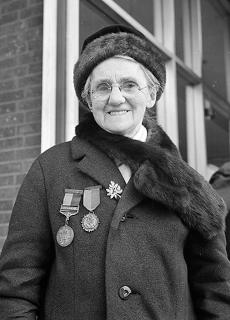
After the Rising, Hackett returns to the IWWU which, at its strongest, organises over 70,000 women. After the 1945 laundry strike, they win an extra week of paid holidays for the workers. She attends many important labour union events such as the opening of the new Liberty Hall on May 2, 1965, and Arbour Hill memorial services. Until her retirement, she runs the trade union shops resulting in over five decades of active participation in the Irish trades union movement work to improve conditions for Irish workers. In 1970 she is awarded a gold medal for fifty years of ITGWU membership.
In the 1970s, Walter McFarlane, then branch secretary of the ITGWU, awards an honorary badge for Hackett’s fifty years contribution to the union.
Hackett never marries and lives in Fairview, Dublin, with her brother Tommy until her death on May 4, 1976. She is buried at St. Paul’s plot in Glasnevin Cemetery next to her mother and stepfather. At her burial, she is honoured with a military salute and her coffin is covered with the Irish flag. After her passing, her legacy is remembered in the union’s newspaper, a tale of the strife of Hackett together with the rest of Dublin’s working class, for which she fought to change.
In May 2014, the Rosie Hackett Bridge is officially opened by the Lord Mayor of Dublin. The Hackett Bridge Campaign began in October 2012, led by three women Angelina Cox, an active member of Labour Youth, Jeni Gartland and Lisa Connell. The final shortlist of contending names for the new bridge were Rosie Hackett, Kathleen Mills, Willie Bermingham, Bram Stoker and Frank Duff.
In April 2015, a plaque is unveiled on Foley Street by the North Inner City Folklore Project to commemorate the women of the Irish Citizen Army. The plaque lists Hackett as a member of the St. Stephen’s Green/College of Surgeons garrison during the 1916 Easter Rising.
O’Grady’s father is the Reverend Thomas O’Grady, the scholarly Church of Ireland minister of Castletown Berehaven, County Cork, and his mother Susanna Doe (or Dowe). The Glebe, his childhood home, lies a mile west of Castletownbere near a famine mass grave and ruined Roman Catholic chapel. He is a cousin of Standish Hayes O’Grady, another noted figure in Celtic literature, and of Standish O’Grady, 1st Viscount Guillamore. After a rather severe education at Tipperary Grammar School, he follows his father to Trinity College, Dublin, where he wins several prize medals and distinguishes himself in several sports.
O’Grady is a paradox for his times, proud of his Gaelic heritage, he is also a member of the Church of Ireland, a champion of aristocratic virtues (particularly decrying bourgeois values and the uprooting cosmopolitanism of modernity) and at one point advocates a revitalised Irish people taking over the British Empire and renaming it the Anglo-Irish Empire.
O’Grady proves too unconventional of mind to settle into a career in the church, and takes a job as a schoolmaster at Midleton College, then in a period of expansion. He also qualifies as a barrister, while earning much of his living by writing for the Irish newspapers. Reading Sylvester O’Halloran’s A general history of Ireland (1778) sparks an interest in early Irish history. After an initial lukewarm response to his writing on the legendary past in History of Ireland: The Heroic Period (1878) and Early Bardic Literature of Ireland (1879), he realises that the public wants romance, and so follows the example of James Macpherson in recasting Irish legends in literary form, producing historical novels including Finn and his Companions (1891), The Coming of Cuculain (1894), The Chain of Gold (1895), Ulrick the Ready (1896) and The Flight of the Eagle (1897), and The Departure of Dermot (1913).
O’Grady also studies Irish history of the Elizabethan period, presenting in his edition of Sir Thomas Stafford‘s Pacata Hibernia (1896) the view that the Irish people had made the Tudors into kings of Ireland to overthrow their unpopular landlords, the Irish chieftains. His The Story of Ireland (1894) is not well received, as it sheds too positive a light on the rule of Oliver Cromwell for the taste of many Irish readers. He is also active in social and political campaigns in connection with such issues as unemployment and taxation.
Until 1898, O’Grady works as a journalist for the Daily Express of Dublin, but in that year, finding Dublin journalism in decline, he moves to Kilkenny to become editor of the Kilkenny Moderator, which is printed at 28 High Street. It is here he becomes involved with Ellen Cuffe, Countess of Desart, and Captain Otway Cuffe. He engages in the revival of the local woolen and woodworking industries. In 1900 he founds the All-Ireland Review and returns to Dublin to manage it until it ceases publication in 1908. He also contributes to James Larkins‘ The Irish Worker paper.
O’Grady’s influence crosses the divide of the Anglo-Irish and Irish-Ireland traditions in literature. His influence is explicitly stated by the Abbey Theatre set with Lady Gregory, W. B. Yeats and George William Russell attributing their interest in the Fenian Cycle of Gaelic tradition in part to him. This leads to him being known as the “Father of the Celtic Revival.” Some of the figures associated with the political party Sinn Féin, including its founder Arthur Griffith, have positive things to say about his efforts in helping to retrieve from the past the Gaelic heroic outlook.
O’Grady marries Margaret Allen Fisher, daughter of William Allen Fisher, and they have three sons. Advised to move away from Ireland for the sake of his health, they leave Ireland in 1918. After living in the north of France and Northamptonshire, they move to the Isle of Wight. He is working on a final exposition of his ideas when he dies suddenly on May 18, 1928.
Rosanna “Rosie” Hackett, Irish insurgent and trade union leader, is born into a working-class family in Dublin on July 25, 1893. She is a founder-member of the Irish Women Workers’ Union (IWWU) and supports strikers during the 1913 Dublin lock-out. She later becomes a member of the Irish Citizen Army and is involved in the 1916 Easter Rising. In the 1970s, the labour movement awards her a gold medal for decades of service, and in 2014 a Dublin city bridge is named in her memory.
Hackett is the daughter of John Hackett, a hairdresser, and Roseanna Dunne. According to the 1901 census, she is living with her widowed mother and five other family members in a tenement building on Bolton Street in Dublin. The available documents suggest that her father dies when she is still very young. She joins the Irish Transport and General Workers’ Union (ITGWU) when it is established in 1909 by James Larkin, which marks the beginning of her lifelong activity in trade unionism. By 1911 she is living with her family in a cottage on Old Abbey Street, and her mother has remarried to Patrick Gray.
Hackett fights for many decades for the rights of workers. Through her affiliation and work with the ITGWU, the IWWU and the Irish Citizen Army, she helps carve out and secure modern-day working conditions. Her career begins as a packer in a paper store, then becoming a messenger for Jacob’s biscuits. At that time the working conditions in the factory are poor.
On August 22, 1911, Hackett helps organise the withdrawal of women’s labour in Jacob’s factory to support their male colleagues who are already on strike. With the women’s help, the men secure better working conditions and a pay rise. Two weeks later, at the age of eighteen, she co-founds the IWWU with Delia Larkin. During the 1913 lock-out she helps mobilise the Jacob’s workers to come out in solidarity with other workers. They, in turn, are locked out by their own employers. This does not stop her work to help others, and she, along with several of her IWWU colleagues, set up soup kitchens in Liberty Hall to help feed the strikers. However, in 1914 her Jacob’s employers sack her over her role in the lock-out.
Hackett begins work as a clerk in the printshop in Liberty Hall, and it is here she becomes involved with the Irish Citizen Army. She is involved in preparations for the 1916 Rising, working in a union shop, helping with printers, and making first-aid kits and knap-sacks.
If other members of the ITGWU were looking for James Connolly, Hackett aids in bringing them to him. She “worked as canvasser and traveller and was called on to carry out many confidential jobs.”
Hackett takes up first aid training provided by Dr. Kathleen Lynn for six months before the Rising and attends night marches organised by the Irish Citizen Army. According to her own account, she says, “A week before Easter, I took part in the ceremony of hoisting the challenge flag over Hall.” Like other girls and women who are involved in the Rising, she carries messages and guns and prepares uniforms and food for Irish Republican Army (IRA) members “and sometimes risky work.”
Three weeks before the Easter Rising, the Royal Irish Constabulary (RIC) raid a shop where Hackett is working. She is alone when they come, and they are looking for a copy of “Gael.” She says to them, “wait until I get the head” and she calls for Connolly. The police are stopped by Connolly and Helena Molony who are armed, and Hackett immediately hides everything, so that when the police come back, they cannot get anything.
Through her experience of working in the printshop, Hackett helps to print the Proclamation of the Irish Republic. She is in the printing room in Liberty Hall as a trusted messenger in 1916 when the Proclamation is printed, and it is the first time she is allowed in. Three men are there when she enters the room and one comes over to her, shakes her hand and congratulates her. It makes her very proud, especially since no one else is allowed to get in. She subsequently tells family members of handing it still wet to James Connolly before it is read by Patrick Pearse outside the entrance to the General Post Office (GPO).
Hackett is an active member of the Irish Citizen Army. On Easter Tuesday, under the command of Constance Markievicz, she takes part in the 1916 Rising and is located in the area of St. Stephen’s Green and the Royal College of Surgeons in Ireland. This position is heavily attacked with guns, short of first aid and “looked like a death trap.” However, after moving from an initially overlooked position in St. Stephen’s Green, it is one of the last positions to surrender. In the Royal College, as a first-aid practitioner, she is allowed entry to the lecture room sanctioned to the Red Cross only. Another first-aider, Aider Nora O’Daily, later reports that during those days, “I have a very kind remembrance of Little Rosie Hackett of the Citizen Army, always cheerful and always willing; to see her face about the place was a tonic itself.”
After surrendering, the rebels are taken to Dublin Castle. Hackett is imprisoned in Kilmainham Gaol for ten days.
In 1917, on the anniversary of Connolly’s death, Hackett, together with Helena Molony, Jennie Shanahan and Brigid Davis, print and hang a poster detailing the anniversary. After the first poster displayed by the ITGWU members is taken down by the police, they work to ensure that their poster will stay on Liberty Hall much longer by staying on top of the roof to defend it. They barricade the door using a ton of coal and nails on the windows. The poster is hanging there until 6:00 p.m. and thousands of people can see it.
After the Rising, Hackett returns to the IWWU which, at its strongest, organises over 70,000 women. After the 1945 laundry strike, they win an extra week of paid holidays for the workers. She attends many important labour union events such as the opening of the new Liberty Hall on May 2, 1965, and Arbour Hill memorial services. Until her retirement, she runs the trade union shops resulting in over five decades of active participation in the Irish trades union movement work to improve conditions for Irish workers. In 1970 she is awarded a gold medal for fifty years of ITGWU membership.
In the 1970s, Walter McFarlane, then branch secretary of the ITGWU, awards an honorary badge for Hackett’s fifty years contribution to the union.
Hackett never marries and lives in Fairview, Dublin, with her brother Tommy until her death on July 4, 1976. She is buried at St. Paul’s plot in Glasnevin Cemetery next to her mother and stepfather. At her burial, she is honoured with a military salute and her coffin is covered with the Irish flag. After her passing, her legacy is remembered in the union’s newspaper, a tale of the strife of Hackett together with the rest of Dublin’s working class, for which she fought to change.
In May 2014, the Rosie Hackett Bridge is officially opened by the Lord Mayor of Dublin. The Hackett Bridge Campaign began in October 2012, led by three women Angelina Cox, an active member of Labour Youth, Jeni Gartland and Lisa Connell. The final shortlist of contending names for the new bridge were Rosie Hackett, Kathleen Mills, Willie Bermingham, Bram Stoker and Frank Duff.
In April 2015, a plaque is unveiled on Foley Street by the North Inner City Folklore Project to commemorate the women of the Irish Citizen Army. The plaque lists Hackett as a member of the St. Stephens Green/College of Surgeons garrison during the 1916 Easter Rising.
Johnson works on the docks for an Irish fish merchant, spending much of his time in Dunmore East and Kinsale. It is this way that he picks up ideas about socialism and Irish nationalism, joining a Liverpool branch of the Independent Labour Party in 1893. In 1900 he starts work as a commercial traveller, then moves in 1903 with his family to Belfast where he becomes involved in trade union and labour politics.
In 1907 Johnson helps James Larkin organise a strike in the port, but has to watch in dismay as the strike, which begins with remarkable solidarity between labour, Orange, and nationalist supporters, collapses in sectarian rioting. At various times he is the president, treasurer and secretary of the Irish Trades Union Congress (ITUC) which is, at the time, also the Labour Party in Ireland, until officially founded in 1912 by James Connolly and James Larkin. Johnson becomes Vice-president of the ITUC in 1913, and President in 1915.
Johnson sympathizes with the Irish Volunteers, many of whom are sacked from their jobs, for illegal activities. During the Easter Rising, he notes in his diary that people in Ireland paid little heed to the fate of the defeated revolutionaries. He succeeds as leader of the Labour Party from 1917, when the party does not contest the 1918 Irish general election. When the British government tries to enforce conscription in Ireland in 1918, he leads a successful strike in conjunction with other members of the Irish anti-conscription movement.
Johnson is later elected a TD for Dublin County to the Third Dáil at the 1922 Irish general election and remains leader of the Labour Party until 1927. As such, he is Leader of the Opposition in the Dáil of the Irish Free State, as the anti-treaty faction of Sinn Féin refuses to recognise the Dáil as constituted. He issues a statement of support for the Government of the 4th Dáil when the Irish Army Mutiny threatens civilian control in March 1924.
Johnson is the only Leader of the Labour Party who serves as Leader of the Opposition in the Dáil. He loses his Dáil seat at the September 1927 Irish general election, and the following year he is elected to Seanad Éireann, where he serves until the Seanad’s abolition in 1936.
In 1896 he meets Marie Tregay, then a teacher in St. Multose’s National school, outside Kinsale. A native of Cornwall, she has advanced political views. They marry in 1898 in Liverpool. Their only son, Frederick Johnson, is born in 1899, and becomes a well-known actor. Johnson dies on January 17, 1963, at 49 Mount Prospect Avenue, Clontarf, Dublin.
Each summer, Labour Youth holds the “Tom Johnson Summer School” to host panel discussions, debates and workshops.
Larkin is born to Irish parents in Liverpool, England, on January 21, 1876. He and his family later move to a small cottage in Burren, County Down. Growing up in poverty, he receives little formal education and begins working in a variety of jobs while still a child.
In 1905, Larkin is one of the few foremen to take part in a strike on the Liverpool docks. He is elected to the strike committee, and although he loses his foreman’s job as a result, his performance so impresses the National Union of Dock Labourers (NUDL) that he is appointed a temporary organiser.
Larkin moves to Belfast in 1907 to organise the city’s dock workers for the NUDL. He succeeds in unionising the workforce, and as employers refuse to meet the wage demands, he calls the dockers out on strike in June. Carters and coal men soon join in, the latter settling their dispute after a month.
In 1908, Larkin moves south and organises workers in Dublin, Cork, and Waterford, with considerable success. His involvement, against union instructions, in a dispute in Dublin results in his expulsion from the NUDL. The union later prosecutes him for diverting union funds to give strike pay to Cork workers engaged in an unofficial dispute. After trial and conviction for embezzlement in 1910, he is sentenced to prison for a year. This is widely regarded as unjust, and the Lord Lieutenant of Ireland, Lord Aberdeen, pardons him after he has served three months in prison.
After his expulsion from the NUDL, Larkin founds the Irish Transport and General Workers’ Union (ITGWU) at the end of December 1908. The organisation exists today as the Services Industrial Professional & Technical Union (SIPTU). In early 1909, Larkin moves to Dublin, which becomes the main base of the ITGWU and the focus of all his future union activity in Ireland.
In June 1911, Larkin establishes a newspaper, The Irish Worker and People’s Advocate, as a pro-labour alternative to the capitalist-owned press. In 1912, in partnership with James Connolly, Larkin helps form the Irish Labour Party.
In early 1913, Larkin achieves some successes in industrial disputes in Dublin. Two major employers, Guinness and the Dublin United Tramway Company, are the main targets of Larkin’s organising ambitions. The chairman of the Dublin United Tramway Company, industrialist and newspaper proprietor William Martin Murphy, is determined not to allow the ITGWU to unionise his workforce. On August 15, he dismisses 40 workers he suspects of ITGWU membership, followed by another 300 over the next week. On August 26, 1913, the tramway workers officially go on strike.
The resulting industrial dispute is the most severe in Ireland’s history. Employers in Dublin engage in a sympathetic lockout of their workers when the latter refuses to sign the pledge, employing blackleg labour from Britain and from elsewhere in Ireland. Guinness, the largest employer in Dublin, refuses the employers’ call to lock out its workers but it sacks 15 workers who struck in sympathy.
For seven months the lockout affects tens of thousands of Dublin workers and employers, with Larkin portrayed as the villain by Murphy’s three main newspapers, the Irish Independent, the Sunday Independent, and the Evening Herald, and by other bourgeois publications in Ireland. The lockout eventually concludes in early 1914 when calls by James Connolly and Larkin for a sympathetic strike in Britain are rejected by the British Trades Union Congress (TUC). Larkin’s attacks on the TUC leadership for this stance also lead to the cessation of financial aid to the ITGWU.
Some months after the lockout ends, Larkin leaves for the United States. He intends to recuperate from the strain of the lockout and raise funds for the union. Once there he becomes a member of the Socialist Party of America and is involved in the Industrial Workers of the World union (the Wobblies). He becomes an enthusiastic supporter of the Soviet Union and is expelled from the Socialist Party of America in 1919 along with numerous other sympathisers of the Bolsheviks during the Red Scare of that year.
Upon his return to Ireland in April 1923, Larkin receives a hero’s welcome and immediately sets about touring the country meeting trade union members and appealing for an end to the Irish Civil War. In September 1923, Larkin forms the Irish Worker League (IWL), which is soon afterwards recognised by the Communist International as the Irish section of the world communist movement.
James Larkin dies in his sleep on January 30, 1947, in the Meath Hospital in Dublin. Fr. Aloysius Travers, OFM, who had administered last rites to James Connolly in 1916, also administers extreme unction to Larkin. His funeral mass is celebrated by the Catholic Archbishop of Dublin, John Charles McQuaid, who had visited him in hospital before he died, and thousands line the streets of the city as the hearse passes through on the way to Glasnevin Cemetery.
Today a statue of “Big Jim” stands on O’Connell Street in Dublin, completed by Oisín Kelly and unveiled in 1979.
James Plunkett Kelly, Irish writer who writes under the pseudonym of James Plunkett, is born in Dublin on May 21, 1920.
Plunkett is the son of a World War I veteran who was a member of James Larkin‘s Irish Transport and General Workers Union, which had a life-long impact on the young writer. He is educated at Synge Street CBS. He works as a clerk in the Dublin Gas Company and later joins the trade union movement, serving under Larkin between 1946 and 1947.
Plunkett grows up among the Dublin working class and they, along with the petite bourgeoisie and lower intelligentsia, make up the bulk of the dramatis personae of his oeuvre. His best-known works are the novel Strumpet City, set in Dublin in the years leading up to the lockout of 1913 and during the course of the strike, and the short stories in the collection The Trusting and the Maimed. His other works include a radio play on Larkin, who figures prominently in his work.
During the 1960s, Plunkett works as a producer at Telefís Éireann. He wins two Jacob’s Awards, in 1965 and 1969, for his TV productions. In 1971 he writes and presents “Inis Fail – Isle of Destiny,” his very personal appreciation of Ireland. It is the final episode of the BBC series Bird’s Eye View, shot entirely from a helicopter, and the first co-production between the BBC and RTÉ. He is a member of Aosdána.
Plunkett dies in a Dublin nursing home at the age of 83 on May 28, 2003. A second-year class, “2 Plunkett” at Synge Street CBS, is named in his honour.
O’Brien moves with his family to Dublin in 1897 and quickly becomes involved in the Irish Socialist Republican Party (ISRP). He is described as “a very significant figure in the ISRP” by ISRP historian David Lynch. He is a member of the Socialist Party of Ireland, serving on its executive.
An important figure in the Labour Party in Ireland in its formative days, O’Brien resists James Larkin‘s attempt to gain control of the Party on release from prison. Taking Larkin to court over his occupation of ITGWU headquarters, the Larkin-O’Brien feud results in a split within the labour and trade union movements, and the formation of the Irish Congress of Trade Unions.
In 1930, O’Brien seeks to have Leon Trotsky granted asylum in Ireland, but the head of the Free State government, W. T. Cosgrave, refuses to allow it.
Active in politics and the trade union movement into his 60s, O’Brien retires in 1946 and dies on October 31, 1968.





 seamus dubhghaill