Dinneen is a leading figure in the Irish Texts Society, publishing editions of Geoffrey Keating‘s Foras Feasa ar Éirinn, poems by Aogán Ó Rathaille, Piaras Feiritéar, Tadhg Gaelach Ó Súilleabháin, and other poets. He also writes a novel and a play in Irish, and translates such works as Charles Dickens‘s A Christmas Carol into Irish. His best known work, however, is his Irish–English dictionary, Foclóir Gaedhilge agus Béarla, which is first published in 1904. The stock and plates of the dictionary are destroyed during the Easter Rising of 1916, so Dinneen takes the opportunity to expand the dictionary. A much larger second edition, compiled with the assistance of Liam S. Gógan, is published in 1927. His request to the Irish Texts Society to include Gogan’s name on the title page is refused. Gogan continues to work on the collection of words up to his death in 1979. This complementary dictionary is published online in 2011.
De Bhaldraithe’s stance on standard forms and spellings is supported by Éamon de Valera despite opposition from traditionalists in the Department of Education, and the work is widely seen as an important benchmark in Irish scholarship.
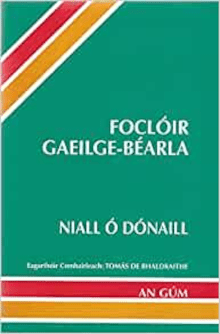
In 1942, de Bhaldraithe is appointed a professor at the Dublin Institute for Advanced Studies (DIAS) in the department of Celtic Studies. In 1960 he is appointed professor of modern Irish language and literature at University College Dublin (UCD), where he develops an impressive archive of material on Irish dialects. Much of the material in this archive is later used as the basis of Niall Ó Dónaill‘s Foclóir Gaeilge-Béarla, published in 1978, for which he is consulting editor. Also, during the 1970s, de Bhaldraithe translates the Irish language diary of Amhlaoibh Ó Súilleabháin, Cín Lae Amhlaoibh, into English. It is then published by Mercier Press as The Diary of an Irish Countryman.
The language laboratory which de Bhaldraithe sets up in UCD is the first of its kind in any university in Ireland. His interest in seanchas (folklore) leads to his publication of Seanchas Thomáis Laighléis in 1977, while his earlier work includes the ground-breaking study of the Cois Fharraige dialect (a variety of Connacht Irish), Gaeilge Chois Fharraige: Deilbhíocht. In later years he works extensively on the definitive Irish dictionary, Foclóir Stairiúil na Nua-Ghaeilge, which remains unfinished at the time of his death, but which is still in progress today.
De Bhaldraithe dies in Dublin on April 24, 1996, after launching a collection of a friend’s writings entitled The words we use. He marries Vivienne Ní Thoirdhealbhaigh in 1943 and they have nine children.
Abraham Colles, Professor of Anatomy, Surgery and Physiology at the Royal College of Surgeons in Ireland (RCSI) and the President of RCSI in 1802 and 1830, is born in Millmount, County Kilkenny, on July 23, 1773. A prestigious Colles Medal & Travelling Fellowship in Surgery is awarded competitively annually to an Irish surgical trainee embarking on higher specialist training abroad before returning to establish practice in Ireland.
Descended from a Worcestershire family, some of whom had sat in Parliament, Colles is born to William Colles and Mary Anne Bates of Woodbroak, County Wexford. The family lives near Millmount, a townland near Kilkenny, County Kilkenny, where his father owns and manages his inheritance which is the extensive Black Quarry that produces the famous Kilkenny black marble. His father dies when he is 6 years old, but his mother takes over the management of the quarry and manages to give her children a good education. While at Kilkenny College, a flood destroys a local physician’s house. He finds an anatomy book belonging to the doctor in a field and returns it to him. Sensing the young man’s interest in medicine, the physician lets him keep the book.
Following his return to Dublin, in 1799, Colles is elected to the staff at Dr. Steevens’ Hospital where he serves for the next 42 years. In October 1803, he is appointed Surgeon to Cork-street Fever Hospital, and subsequently becomes Consulting Surgeon to the Rotunda Hospital, City of Dublin Hospital, and Victoria Lying-in Hospital. He is a well-regarded surgeon and is elected as president of the Royal College of Surgeons in Ireland (RCSI) in 1802 at the age of 28 years, subsequently also serving as president in 1830. In 1804, he is appointed Professor of Anatomy, Physiology, and Surgery at RCSI.
In 1811, Colles writes an important treatise on surgical anatomy and some terms he introduces have survived in surgical nomenclature until today. He is remembered as a skillful surgeon and for his 1814 paper On the Fracture of the Carpal Extremity of the Radius. This injury continues to be known as Colles’ fracture. This paper, describing distal radial fractures, is far ahead of its time, being published decades before X-rays come into use. He also describes the membranous layer of subcutaneous tissue of the perineum, which comes to be known as Colles’ fascia. He also extensively studies the inguinal ligament, which is sometimes called Colles’ ligament. He is regarded as the first surgeon to successfully ligate the subclavian artery.
In 1837, Colles writes “Practical observations on the venereal disease, and on the use of mercury” in which he introduces the hypothesis of maternal immunity of a syphilitic infant when the mother has not shown signs of the disease. His principal textbook is the two-volume Lectures on the theory and practice of surgery. His writings are important, though not voluminous. Some of his papers are collected and edited by his son, William Colles, and published in the Dublin Journal of Medical Science. Selections from the works of Abraham Colles, chiefly relative to the venereal disease and the use of mercury, comprise Volume XOII. of the Library of the New Sydenham Society, published in 1881. They are edited and annotated by one of the most distinguished Fellows of the RCSI, Robert McDonnell. His Lectures on Surgery are edited by Simon M’Coy and published in 1850. In tribute to his distinguished career, he is awarded a baronetcy in 1839, which he refuses.
Upon Colles’s retirement as Professor of Surgery, the Members of RCSI pass a resolution which includes “We have also to assure you that it is the unanimous feeling of the College, that the exemplary and efficient manner in which you have filled this chair for thirty-two years, has been a principal cause of the success and consequent high character of the School of Surgery in this country.”
In 1807, Colles marries Sophia Cope. His son William follows in his footsteps, being elected to the Chair of Anatomy in the Royal College of Surgeons in Ireland in 1863. Another of his sons, Henry, marries Elizabeth Mayne, a niece of Robert James Graves. His grandson is the eminent music critic and lexicographerH. C. Colles. His granddaughter Frances marries the judge Lord Ashbourne, and her sister Anna marries his colleague Sir Edmund Thomas Bewley.
Knowles’s father is the lexicographer James Knowles, cousin of Richard Brinsley Sheridan. The family moves to London in 1793, and at the age of fourteen he publishes a ballad entitled The Welsh Harper, which, set to music, is very popular. His talents secure him the friendship of William Hazlitt, who introduces him to Charles Lamb and Samuel Taylor Coleridge. He serves for some time in the Wiltshire and afterwards in the Tower Hamlets militia, leaving the service to become a pupil of Dr. Robert Willan. He obtains the degree of M.D. and is appointed vaccinator to the Jennerian Society.
Although Dr. Willan offers him a share in his practice, Knowles decides to give up medicine for the stage, making his first appearance as an actor probably at Bath, and plays Hamlet at the Crow Street Theatre, Dublin. At Wexford he marries, in October 1809, Maria Charteris, an actress from the Edinburgh Theatre. In 1810, he writes Leo, a successful play in which Edmund Kean appears. Another play, Brian Boroihme, written for the Belfast Theatre in the next year, attracts crowds. Nevertheless, his earnings are so small that he is obliged to become assistant to his father at the Royal Belfast Academical Institution. In 1817 he moves from Belfast to Glasgow, where, besides keeping a flourishing school, he continues to write for the stage.
Knowles first important success is Caius Gracchus, produced at the Belfast Theatre in 1815. His Virginius, written for William Charles Macready, is first performed in 1820 at Covent Garden. In William Tell (1825), he writes for Macready one of his favourite parts. His best-known play, The Hunchback, is produced at Covent Garden in 1832, and he wins praise acting in the work as Master Walter. The Wife is brought out at the same theatre in 1833. The Daughter, better known as The Wrecker’s Daughter, in 1836, and The Love Chase in 1837. His 1839 play Love is praised by Mary Shelley for its “inspiring situations founded on sentiment and passion.” His second wife is the actress, Emma Knowles.
In his later years Knowles forsakes the stage for the pulpit and, as a Baptist preacher, attracts large audiences at Exeter Hall and elsewhere. He publishes two polemical works: the Rock of Rome and the Idol Demolished by Its Own Priests in both of which he combats the special doctrines of the Roman Catholic Church. He is for some years in the receipt of an annual pension of £200, bestowed by Sir Robert Peel in 1849. In old age he befriends the young Edmund Gosse, whom he introduces to Shakespeare. He makes a happy appearance in Gosse’s Father and Son.
Knowles dies at Torquay on November 30, 1862. He is buried under a huge tomb at the summit of the Glasgow Necropolis.
A full list of the works of Knowles and of the various notices of him can be found in The Life of James Sheridan Knowles (1872), privately printed by his son, Richard Brinsley Knowles (1820–1882), who is well known as a journalist. It is translated into German.
Abraham Colles, Professor of Anatomy, Surgery and Physiology at the Royal College of Surgeons in Ireland (RCSI) and the President of RCSI in 1802 and 1830, dies on November 16, 1843. A prestigious Colles Medal & Travelling Fellowship in Surgery is awarded competitively annually to an Irish surgical trainee embarking on higher specialist training abroad before returning to establish practice in Ireland.
Descended from a Worcestershire family, some of whom had sat in Parliament, Colles is born to William Colles and Mary Anne Bates of Woodbroak, County Wexford, on July 23, 1773. The family lives near Millmount, a townland near Kilkenny, County Kilkenny, where his father owns and manages his inheritance which is the extensive Black Quarry that produces the famous Kilkenny black marble. His father dies when he is 6 years old, but his mother takes over the management of the quarry and manages to give her children a good education. While at Kilkenny College, a flood destroys a local physician’s house. He finds an anatomy book belonging to the doctor in a field and returns it to him. Sensing the young man’s interest in medicine, the physician lets him keep the book.
Following his return to Dublin, in 1799, Colles is elected to the staff at Dr. Steevens’ Hospital where he serves for the next 42 years. In October 1803, he is appointed Surgeon to Cork-street Fever Hospital, and subsequently becomes Consulting Surgeon to the Rotunda Hospital, City of Dublin Hospital, and Victoria Lying-in Hospital. He is a well-regarded surgeon and is elected as president of the Royal College of Surgeons in Ireland (RCSI) in 1802 at the age of 28 years, subsequently also serving as president in 1830. In 1804, he is appointed Professor of Anatomy, Physiology, and Surgery at RCSI.
In 1811, Colles writes an important treatise on surgical anatomy and some terms he introduces have survived in surgical nomenclature until today. He is remembered as a skillful surgeon and for his 1814 paper On the Fracture of the Carpal Extremity of the Radius. This injury continues to be known as Colles’ fracture. This paper, describing distal radial fractures, is far ahead of its time, being published decades before X-rays come into use. He also describes the membranous layer of subcutaneous tissue of the perineum, which comes to be known as Colles’ fascia. He also extensively studies the inguinal ligament, which is sometimes called Colles’ ligament. He is regarded as the first surgeon to successfully ligate the subclavian artery.
In 1837, Colles writes “Practical observations on the venereal disease, and on the use of mercury” in which he introduces the hypothesis of maternal immunity of a syphilitic infant when the mother has not shown signs of the disease. His principal textbook is the two-volume Lectures on the theory and practice of surgery. His writings are important, though not voluminous. Some of his papers are collected and edited by his son, William Colles, and published in the Dublin Journal of Medical Science. Selections from the works of Abraham Colles, chiefly relative to the venereal disease and the use of mercury, comprise Volume XOII. of the Library of the New Sydenham Society, published in 1881. They are edited and annotated by one of the most distinguished Fellows of the RCSI, Robert McDonnell. His Lectures on Surgery are edited by Simon McCoy and published in 1850. In tribute to his distinguished career, he is awarded a baronetcy in 1839, which he refuses.
Upon Colles’s retirement as Professor of Surgery, the Members of RCSI pass a resolution which includes “We have also to assure you that it is the unanimous feeling of the College, that the exemplary and efficient manner in which you have filled this chair for thirty-two years, has been a principal cause of the success and consequent high character of the School of Surgery in this country.”
In 1807, Colles marries Sophia Cope. His son William follows in his footsteps, being elected to the Chair of Anatomy in the Royal College of Surgeons in Ireland in 1863. Another of his sons, Henry, marries Elizabeth Mayne, a niece of Robert James Graves. His grandson is the eminent music critic and lexicographerH. C. Colles. His granddaughter Frances marries the judge Lord Ashbourne, and her sister Anna marries his colleague Sir Edmund Thomas Bewley.
Ó Dónaill is the olderst of the six children of Tarlach Ó Dónaill and Éilis Nic Ruairí from Grial, Loughanure. They own a little land and a few cows. His father spends June to November working in Scotland and dies when he is 13 years old. He himself spends summers working in the tunnels in Scotland.
Ó Dónaill receives his education at Scoil Loch an Iúir in Loughanure before gaining a scholarship to St. Eunan’s College in Letterkenny. Another scholarship takes him to University College Dublin to study Irish, English and History. During his time in university Ó Dónaill spends his summers teaching at Coláiste Bhríde in Rann na Feirste, County Donegal.
Ó Dónaill writes the book Bruigheann Féile which is based on stories of pastimes in the Gaeltacht town Loughanure and its surrounding area. His book Na Glúnta Rosannacha is first published in 1952.
Ó Dónaill is most famous for his work as editor of the 1977 Irish-English dictionary Foclóir Gaeilge-Béarla, which is still widely used today.
Kuno Meyer, German scholar distinguished in the field of Celticphilology and literature, is born in Hamburg, Germany on December 20, 1858. He was considered first and foremost a lexicographer among Celtic scholars but is known by the general public in Ireland rather as the man who introduced them to Selections from Ancient Irish Poetry (1911). His brother was the distinguished classical scholar, Eduard Meyer.
Meyer then takes up the post of lecturer in Teutonic languages at the new University College, Liverpool, the precursor of the University of Liverpool, which is established three years earlier.
In 1903, Meyer founds the School of Irish Learning in Dublin, and the next year creates its journal Ériu of which he is the editor. Also in 1904, he becomes Todd Professor in the Celtic Languages at the Royal Irish Academy. In October 1911, he follows Heinrich Zimmer as Professor of Celtic Philology at Friedrich Wilhelm University in Berlin. The following year, a volume of Miscellany is presented to him by pupils and friends in honour of his election, and he is made a freeman of both Dublin and Cork.
At the outbreak of World War I, Meyer leaves Europe for the United States, where he lectures at Columbia University, University of Illinois at Urbana-Champaign, and elsewhere. A pro-German speech he gives in December 1914 to Clan na Gael on Long Island causes outrage in Britain and some factions among the Irish, and as a result, he is removed from the roll of freemen in Dublin and Cork and from his Honorary Professorship of Celtic at Liverpool. He also resigns as Director of the School of Irish Learning and editor of Ériu. Harvard University also had extended an invitation to Meyer to lecture on campus, but it subsequently cancels the invitation in the fall of 1914 on account of Meyer’s propagandist activity.
Meyer nevertheless accepts candidacy for the post of exchange professor at Harvard, at the recommendation of German professors there. However, when the April 1915 issue of The Harvard Advocate awards first prize to an anti-German satirical poem “Gott mit Uns” written by an undergraduate, Meyer sends the university and the press a letter of protest, rebuking the faculty members who served as judges for failure to exercise neutrality. Meyer also declines his candidacy from the exchange professorship in the letter. In a reply, President Abbott Lawrence Lowell says, in explaining Harvard’s policy, that freedom of speech includes pro-German and pro-Allied voices alike.
Meyer is injured in a railway collision in 1915 and meets 27-year-old Florence Lewis while he is recovering in a California hospital. They marry shortly afterwards. He returns to Germany in 1917 and dies in Leipzig on October 11, 1919.
Posthumously, in 1920, Meyer’s name is restored, both by Dublin and Cork, in their Rolls of Honorary Freemen. The restoration occurs on April 19, 1920, in Dublin, where Sinn Féin had won control of the City Council three months earlier, rescinding the decision taken in 1915 by the Irish Parliamentary Party. The restoration in Cork follows on May 14, 1920.


 seamus dubhghaill