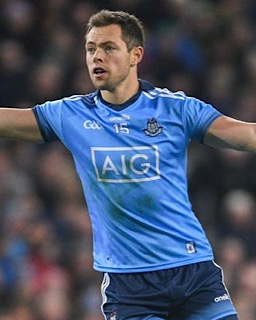
Rock attends the Catholic University School where he plays rugby union in the absence of a Gaelic football team. He simultaneously comes to prominence at juvenile and underage levels with the Ballymun Kickhams club before making his debut with the senior team in 2008. Since then he has won one Leinster medal and two county senior championship medals.
Rock makes his debut on the inter-county scene when he is selected for the Dublin minor team. After an unsuccessful tenure with the minor team, he later wins an All-Ireland medal as part of the Dublin under-21 team.
Rock represents Dublin at Junior level in the 2009 Leinster Junior Football Championship. Dublin is knocked out in the semi-final by Louth. He scores a total of 14 points for Dublin in his two appearances for Dublin Juniors.
Rock makes his senior debut during the 2012 league when he is introduced as a substitute against Donegal in March. He makes his championship debut the following year against Westmeath. Since then he wins six All-Ireland medals, beginning with his first title in 2013 and followed by five successive championships from 2015 to 2019. He also wins six Leinster Senior Football Championship medals and five National League medals. He is awarded two All Star awards for Dublin in 2017 and 2016, when he finishes the season as top scorer of the 2016 All-Ireland Senior Football Championship.
Rock starts his first league match for Dublin in 2015, after which he participates in 63 consecutive league and championship games.
Rock is noted for his taking Dublin’s frees, while attaining hitherto unimaginable levels of accuracy. Having spent to years as a substitute in 2013 and 2014, he studies placed-ball kicking and works with kicking expert Dave Alred, as he reveals in 2017.
Rock’s fifth point of the drawn 2019 All-Ireland Senior Football Championship Final (which gives Dublin a lead of 1–7 to 0–6) is his 411th point for his county in league and championship in his 88th game. Combined with his 14 Dublin goals, he passes Bernard Brogan Jnr. to become the second highest scorer ever in Dublin football. Unusually, he does this mostly through points; he has the lowest goal-scoring record among the top ten (with only Charlie Redmond‘s 15 goals within reach) and achieves the feat while making fewer appearances than those around him in the all-time list.
Rock holds the record for the fastest goal scored in the history of All-Ireland Senior Football Championship Finals, after sending the ball past David Clarke directly from the throw-in of the 2020 All-Ireland Senior Football Championship Final, breaking Kerryman Garry McMahon‘s record which had stood since the 1962 final. He debuts the “Dean Rock Free Taking Project” in mid-2020.
On January 16, 2024, Rock announces his retirement from inter-county football. After retiring, he contributes to the GAAGOpodcast.
In September 2025, it is announced that Rock is joining the backroom team of the recently appointed Dublin senior manager Ger Brennan.
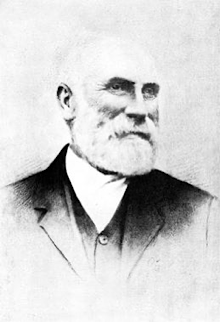
Kettle is one among six children of Thomas Kettle, a prosperous farmer, and his wife, Alice (née Kavanagh). His maternal grandmother, Mary O’Brien, had smuggled arms to United Irishmen in the district in 1798, while her future husband, Billy Kavanagh, had been a senior figure in the movement. He is educated at Ireland’s most prestigious Catholicboarding school, Clongowes Wood College. His education is cut short when he is called to help full-time on the farm. Though an autodidact and always a forceful writer, he is beset later by an exaggerated sense of his “defective education and want of talking powers.” Fascinated by politics, he enjoys the repeal excitement of 1841–44 and in his late teens speaks once or twice at Tenant Right League meetings in Swords. Through the 1850s and most of the 1860s he sets about expanding the family farm into a composite of fertile holdings in Swords, St. Margaret’s, Artane, and Malahide (c.150 acres). Getting on well with the Russell-Cruise family of Swords, his first landlords, he benefits from a favourable leasehold arrangement on their demesne in the early 1860s. The farm is mostly in tillage, though Kettle also raises some fat cattle and Clydesdale horses, which he eventually sells to Guinness’s.
Kettle first enters politics in 1867, when he disagrees with John Paul Byrne of Dublin Corporation in public and in print over the right of graziers to state aid during an outbreak of cattle distemper. In 1868, he joins an agricultural reform group initiated by Isaac Butt. He becomes friendly with Butt and later claims to have converted him to support tenant-right. His memoirs, which are somewhat egocentric, contain a number of such questionable claims. It is, however, the case that he habitually writes up, for his own use, cogent summaries of the direction of current political tendencies, which sometimes become useful confidential briefs for Butt and later Charles Stewart Parnell. He is among the published list of subscribers to the Home Rule League in July 1870.
In 1872, disappointed by the Landlord and Tenant (Ireland) Act 1870, Kettle organises a Tenants’ Defence Association (TDA) in north County Dublin, soon sensing the need for a central body to coordinate the grievances of similar groups around the country. The Dublin TDA effectively acts as this central body, under his guidance as honorary secretary. At the 1874 United Kingdom general election in Ireland, the Dublin TDA decides to challenge the electoral control of certain corporation interests in County Dublin. Kettle secures the cautious approval of CardinalPaul Cullen for any candidate supporting the principle of denominational education. He is also one of a deputation to ask Parnell to fight the constituency, which the latter loses. He becomes closely acquainted with Parnell, who frequently attends Dublin TDA meetings after his election for Meath in April 1875.
Taking a sombre view of the threat of famine in the west of Ireland after evidence of crop failure appears in early summer 1879, Kettle calls a conference of TDA delegates at the European Hotel in Bolton Street, Dublin, in late May. After a heated debate in which a proposal for a rent strike is greatly modified, Parnell comes to seek Kettle’s advice on whether to become involved in the evolving land agitation in County Mayo. Kettle urges him to go to the Westport meeting set for June 8, 1879, and claims later to have stressed in passing that “if you keep in the open you can scarcely go too far or be too extreme on the land question.” If the incident is correctly recounted, this is a most important statement, which virtually defines Parnell’s oratorical strategy throughout the land war. In October 1879, Kettle agrees to merge the TDA with a new Irish National Land League, set up at a meeting in the Imperial Hotel, Dublin, chaired by Kettle. As honorary secretary of the Land League, Kettle frankly admits that he is able to attend meetings without “the necessity of working.” His attendance is, however, among the most regular of all League officers, with him taking part in 73 of 107 meetings scheduled between December 1879 and October 1881.
In March 1880, Kettle disputes Michael Davitt‘s reluctance to use League funds in the general election. He canvasses vigorously together with Parnell in Kildare, Carlow, and Wicklow and is later pressed by his party leader into standing for election in County Cork, though aware that the local tenant movement has already prepared their own candidates. His association with Parnell antagonises the catholic hierarchy in Munster, who issues a condemnation of his candidacy. The hurly-burly of this election creates the persistent impression that Kettle is anti-clerical in politics, and he is defeated by 151 votes.
On a train journey to Ballinasloe in early April 1880, Kettle confides to Parnell his idea that land purchase can be facilitated by the recovery of tax allegedly charged in excess on Ireland by the British government since the act of union. At League meetings in June and July 1880, he advances his “catastrophist” plan: to cease attempts to prevent the development of an irresistible crisis among the Irish smallholding population, by diverting the application of League funds from general relief solely to the aid of evicted tenants, who might be temporarily housed “encamped like gypsies and the land lying idle,” in the belief that the British government will thereby be compelled to introduce radical remedial legislation. Smallholders do not have enough faith in either League or parliamentary politicians to listen.
At a meeting of the League executive in London and in Paris, before and after Davitt’s arrest on February 3, 1881, Kettle presents his plan that the parliamentary party should, if faced with coercive legislation, withdraw from Westminster, “concentrate” in Ireland, and call a general rent strike. Republicans on the League executive continually find themselves embarrassed by Kettle’s radical calls to action motivated solely by the project of agrarian reform. Parnell is later supposed to have lamented party failure to execute the plan at this juncture.
Kettle is arrested in June 1881 for calling for a collective refusal of rent. After two weeks in Naas jail he is transferred to Kilmainham Gaol, where in October he is, with some misgivings, one of the signatories to the No Rent Manifesto. Discharged from Kilmainham in late December 1881 owing to poor health, he returns principally to work on the family farm for most of the 1880s, though he claims to have formulated a draft solution for the plight of the agricultural labourer and “pushed it through” in correspondence with Parnell. He reemerges in 1890 to defend Parnell after the divorce scandal breaks. Attempting to establish a new ”centre” party independent of extreme Catholic and Protestant interests, he stands for election as a Parnellite at the 1891 County Carlow by-election, where he is comprehensively beaten, having endured weeks of insinuating harangues by Tim Healy, and raucous mob insults to the din of tin kettles bashed by women and children at meetings around the county. He is intermittently involved in County Dublin politics in the 1890s and 1900s and maintains a brusque correspondence on matters of the day in the national press.
Kettle dies on September 22, 1916, at his residence, St. Margaret’s, County Dublin, anguished by the death on September 9 of his brilliant son, Tom Kettle, near the village of Ginchy during the Battle of the Somme. He is buried at St. Colmcille’s cemetery, Swords.
Kettle marries Margaret McCourt, daughter of Laurence McCourt of Newtown, St. Margaret’s, County Dublin, farmer and agricultural commodity factor. They have five sons and six daughters.
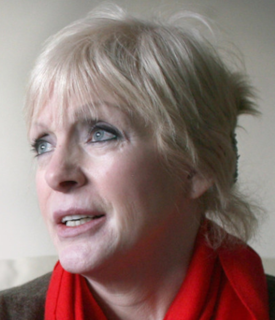
Owen is first elected to Dublin County Council in 1979 for the Malahide local electoral area. She is later elected as a Fine Gael TD for the first time in 1981, serving until the 1987 Irish general election when she loses her seat. That year she becomes a member of the executive of Trócaire, an International Non-Governmental Organisation (INGO) which is based in Ireland. She returns to Dáil Éireann following the 1989 Irish general election. In 1993, she becomes Deputy leader of Fine Gael. The following year she becomes Minister for Justice, remaining in that post until 1997. She undertakes a significant programme of criminal law reform. Among the major changes she implements is the referendum on bail in 1996, leading to the Bail Act of 1997, which allows a court to refuse bail to those charged with a serious offence where it is considered necessary to prevent them committing a serious offence. Journalist Veronica Guerin was murdered in 1996 and in its aftermath, Owen introduces the highly successful Criminal Assets Bureau to crack down on organised crime. In 2002, she becomes the first high-profile Fine Gael TD to lose her seat in Dublin North in the party’s disastrous general election result.
Owen is the patron of the Collins 22 Society, which works to keep the memory and legacy of Michael Collins in living memory. She occasionally works as an election pundit. In August 2011, it is announced she is to present the Irish version of Mastermind on TV3.
Ahern and her books have won numerous awards, including the Irish Book Award for Popular Fiction for The Year I Met You (2014). She publishes several novels and contributes a number of short stories to various anthologies.
Before starting her writing and producing career, Ahern obtains a degree in journalism and media communications from Griffith College Dublin, but withdraws from a master’s degree course to pursue her writing career.
In 2002, when Ahern is twenty-one, she writes her first novel, PS, I Love You. Published in 2004, it is the number 1 bestseller in Ireland (for 19 weeks), the United Kingdom, United States, Germany and the Netherlands. It is sold in over forty countries. The book is adapted as a motion picture directed by Richard LaGravenese and starring Hilary Swank and Gerard Butler. It is released in the United States on December 21, 2007.
Ahern’s second book, Where Rainbows End (known as Love, Rosie in the United States), also reaches number 1 in Ireland and the United Kingdom and wins the German Corine Literature Prize in 2005. It is adapted as a motion picture titled Love, Rosie which is released in 2014, directed by Christian Ditter and starring Lily Collins and Sam Claflin.
Ahern has contributed to charity books with the royalties from short stories such as Irish Girls are Back in Town and Ladies’ Night.
Ahern’s book The Gift is published just before Christmas 2008 in the United Kingdom. Her following book, The Book of Tomorrow, is published on October 1, 2009. In 2016, she releases Flawed, her first book for young adults, and Lyrebird.
Ahern is nominated for Best Newcomer 2004/5 at the British Book Awards for her debut novel PS, I Love You. She wins the 2005 Irish Post Award for Literature and a 2005 Corine Literature Prize for her second book Where Rainbows End, which is voted for by German readers. In 2006, she is long listed for the International IMPAC Dublin Literary Award for PS, I Love You. Cosmopolitan US honours her with a Fun Fearless Fiction Award 2007 for If You Could See Me Now. Irish Tatler awards her Writer of the Year at the Woman of the Year awards in 2009. Her fifth novel, Thanks for the Memories, is nominated for Most Popular Book in the British Book Awards 2008. She is voted Author of Year in the UK Glamour Awards in 2008.
Ahern marries David Keoghan in 2010. They have three children, two daughters and a son. As of 2015, they reside in Malahide in County Dublin. She had COVID-19 in early 2022, describing it as “kind of mild. I was lucky.”
Price and her sister, Marian, also an IRA member, are the daughters of Albert Price, a prominent Irish republican and former IRA member from Belfast. Their aunt, Bridie Dolan, is blinded and loses both hands in an accident while handling IRA explosives.
Price becomes involved in Irish republicanism in the late 1960s and she and Marian participate in the Belfast to Derrycivil rights march in January 1969 and are attacked in the Burntollet Bridge incident.
In 1971 Price and her sister join the Provisional Irish Republican Army (IRA). In 1972 she joins an elite group within the IRA called “The Unknowns” commanded by Pat McClure. The Unknowns are tasked with various secretive activities and transport several accused traitors across the border into the Republic of Ireland where they are “disappeared.” She personally states that she had driven Joe Lynskey across the border to face trial. In addition, she states that she, Pat McClure and a third Unknown were tasked with killing Jean McConville, with the third Unknown actually shooting her.
Price leads the car bombing attacks in London on March 8, 1973, which injure over 200 people and is believed to have contributed to the death of one person who suffers a fatal heart attack. The two sisters are arrested, along with Gerry Kelly, Hugh Feeney and six others, on the day of the bombing as they are boarding a flight to Ireland. They are tried and convicted at the Great Hall in Winchester Castle on November 14, 1973. Although originally sentenced to life imprisonment, which is to run concurrently for each criminal charge, their sentence is eventually reduced to 20 years. She serves seven years for her part in the bombing. She immediately goes on a hunger strike demanding to be moved to a prison in Northern Ireland. The hunger strike lasts for 208 days because the hunger strikers are force-fed by prison authorities to keep them alive.
On the back of the hunger-striking campaign, Price’s father contests Belfast West at the February 1974 United Kingdom general election, receiving 5,662 votes (11.9%). The Price sisters, Hugh Feeney, and Gerry Kelly are moved to Northern Ireland prisons in 1975 as a result of an IRA truce. In 1980 she receives the royal prerogative of mercy and is freed on humanitarian grounds in 1981, purportedly suffering from anorexia nervosa due to the invasive trauma of daily force feedings.
After her release in 1980, Price marries Irish actor Stephen Rea, with whom she has two sons, Danny and Oscar. They divorce in 2003.
The Price sisters remain active politically. In the late 1990s, Price and her sister claim that they have been threatened by their former colleagues in the IRA and Sinn Féin for publicly opposing the Good Friday Agreement (i.e. the cessation of the IRA’s military campaign). she is a contributor to The Blanket, an online journal, edited by former Provisional IRA member Anthony McIntyre, until it ceases publication in 2008.
In 2001, Price is arrested in Dublin and charged with possession of stolen prescription pads and forged prescriptions. She pleads guilty and is fined £200 and ordered to attend Alcoholics Anonymous meetings.
In February 2010, it is reported by The Irish News that Price had offered help to the Independent Commission for the Location of Victims’ Remains in locating graves of three men, Joe Lynskey, Seamus Wright, and Kevin McKee. The bodies of Wright and McKee are recovered from a singular grave in County Meath in August 2015. It is unclear if Price played a role in their recovery. The remains of Joe Lynskey have not been recovered as of April 2021.
Price is the subject of the 2018 feature-length documentary I, Dolours in which she gives an extensive filmed interview.
In 2010, Price claims Gerry Adams had been her officer commanding (OC) when she was active in the IRA. Adams, who has always denied being a member of the IRA, denies her allegation. She admits taking part in the murder of Jean McConville, as part of an IRA action in 1972. She claims the murder of McConville, a mother of ten, was ordered by Adams when he was an IRA leader in West Belfast. Adams subsequently publicly further denies Price’s allegations, stating that the reason for them is that she is opposed to the Provisional Irish Republican Army’s abandonment of paramilitary warfare in favour of politics in 1994, in the facilitation of which Adams has been a key figure.
Oral historians at Boston College interview both Price and her fellow IRA paramilitary Brendan Hughes between 2001 and 2006. The two give detailed interviews for the historical record of the activities in the IRA, which are recorded on condition that the content of the interviews is not to be released during their lifetimes. Prior to her death in May 2011, the Police Service of Northern Ireland (PSNI) subpoena the material, possibly as part of an investigation into the disappearance of a number of people in Northern Ireland during the 1970s. In June 2011, the college files a motion to quash the subpoena. A spokesman for the college states that “our position is that the premature release of the tapes could threaten the safety of the participants, the enterprise of oral history, and the ongoing peace and reconciliation process in Northern Ireland.” In June 2011, U.S. federal prosecutors ask a judge to require the college to release the tapes to comply with treaty obligations with the United Kingdom. On July 6, 2012, the United States Court of Appeals for the First Circuit agrees with the government’s position that the subpoena should stand. On October 17, 2012, the Supreme Court of the United States temporarily blocks the college from handing over the interview tapes. In April 2013, after Price’s death, the Supreme Court turns away an appeal that seeks to keep the interviews from being supplied to the PSNI. The order leaves in place a lower court ruling that orders Boston College to give the Justice Department portions of recorded interviews with Price. Federal officials want to forward the recordings to police investigating the murder of Jean McConville.
Price dies in her Malahide, County Dublin, home on January 23, 2013, from a toxic effect of mixing prescribed sedative and anti-depressant medication. Her body is found the following day. The inquest returns a verdict of death by misadventure. She is buried at Milltown Cemetery in West Belfast.
Price is born in Belfast on December 16, 1950. She and her sister, Marian, also an IRA member, are the daughters of Albert Price, a prominent Irish republican and former IRA member from Belfast. Their aunt, Bridie Dolan, is blinded and loses both hands in an accident handling IRA explosives.
Price becomes involved in Irish republicanism in the late 1960s and she and Marian participate in the Belfast to Derrycivil rights march in January 1969 and are attacked in the Burntollet Bridge incident.
In 1971 Price and her sister join the Provisional Irish Republican Army (IRA). In 1972 she joins an elite group within the IRA called “The Unknowns” commanded by Pat McClure. The Unknowns are tasked with various secretive activities and transport several accused traitors across the border into the Republic of Ireland where they are “disappeared.” She personally states that she had driven Joe Lynskey across the border to face trial. In addition she states that she, Pat McClure and a third Unknown were tasked with killing Jean McConville, with the third Unknown actually shooting her.
Price leads the car bombing attacks in London on March 8, 1973, which injure over 200 people and is believed to have contributed to the death of one person who suffers a fatal heart attack. The two sisters are arrested, along with Gerry Kelly, Hugh Feeney and six others, on the day of the bombing as they are boarding a flight to Ireland. They are tried and convicted at the Great Hall in Winchester Castle on November 14, 1973. Although originally sentenced to life imprisonment, which is to run concurrently for each criminal charge, their sentence is eventually reduced to 20 years. She serves seven years for her part in the bombing. She immediately goes on a hunger strike demanding to be moved to a prison in Northern Ireland. The hunger strike lasts for 208 days because the hunger strikers are force-fed by prison authorities to keep them alive.
On the back of the hunger-striking campaign, Price’s father contests Belfast West at the February 1974 United Kingdom general election, receiving 5,662 votes (11.9%). The Price sisters, Hugh Feeney, and Gerry Kelly are moved to Northern Ireland prisons in 1975 as a result of an IRA truce. In 1980 she receives the royal prerogative of mercy and is freed on humanitarian grounds in 1981, purportedly suffering from anorexia nervosa due to the invasive trauma of daily force feedings.
After her release in 1980, Price marries Irish actor Stephen Rea, with whom she has two sons, Danny and Oscar. They divorce in 2003.
The Price sisters remain active politically. In the late 1990s, Price and her sister claim that they have been threatened by their former colleagues in the IRA and Sinn Féin for publicly opposing the Good Friday Agreement (i.e. the cessation of the IRA’s military campaign). she is a contributor to The Blanket, an online journal, edited by former Provisional IRA member Anthony McIntyre, until it ceases publication in 2008.
In 2001, Price is arrested in Dublin and charged with possession of stolen prescription pads and forged prescriptions. She pleads guilty and is fined £200 and ordered to attend Alcoholics Anonymous meetings.
In February 2010, it is reported by The Irish News that Price had offered help to the Independent Commission for the Location of Victims’ Remains in locating graves of three men, Joe Lynskey, Seamus Wright, and Kevin McKee. The bodies of Wright and McKee are recovered from a singular grave in County Meath in August 2015. It is unclear if Price played a role in their recovery. The remains of Joe Lynskey have not been recovered as of April 2021.
Price is the subject of the 2018 feature-length documentary I, Dolours in which she gives an extensive filmed interview.
In 2010 Price claims Gerry Adams had been her officer commanding (OC) when she was active in the IRA. Adams, who has always denied being a member of the IRA, denies her allegation. She admits taking part in the murder of Jean McConville, as part of an IRA action in 1972. She claims the murder of McConville, a mother of ten, was ordered by Adams when he was an IRA leader in West Belfast. Adams subsequently publicly further denies Price’s allegations, stating that the reason for them is that she is opposed to the Provisional Irish Republican Army’s abandonment of paramilitary warfare in favour of politics in 1994, in the facilitation of which Adams has been a key figure.
Oral historians at Boston College interview both Price and her fellow IRA paramilitary Brendan Hughes between 2001 and 2006. The two give detailed interviews for the historical record of the activities in the IRA, which are recorded on condition that the content of the interviews is not to be released during their lifetimes. Prior to her death in May 2011, the Police Service of Northern Ireland (PSNI) subpoena the material, possibly as part of an investigation into the disappearance of a number of people in Northern Ireland during the 1970s. In June 2011, the college files a motion to quash the subpoena. A spokesman for the college states that “our position is that the premature release of the tapes could threaten the safety of the participants, the enterprise of oral history, and the ongoing peace and reconciliation process in Northern Ireland.” In June 2011, U.S. federal prosecutors ask a judge to require the college to release the tapes to comply with treaty obligations with the United Kingdom. On July 6, 2012, the United States Court of Appeals for the First Circuit agrees with the government’s position that the subpoena should stand. On October 17, 2012, the Supreme Court of the United States temporarily blocks the college from handing over the interview tapes. In April 2013, after Price’s death, the Supreme Court turns away an appeal that seeks to keep the interviews from being supplied to the PSNI. The order leaves in place a lower court ruling that orders Boston College to give the Justice Department portions of recorded interviews with Price. Federal officials want to forward the recordings to police investigating the murder of Jean McConville.
On January 24, 2013 Price is found dead at her Malahide, County Dublin home, from a toxic effect of mixing prescribed sedative and anti-depressant medication. The inquest returns a verdict of death by misadventure. Her body is buried at Milltown Cemetery in West Belfast.
Between 1932 and 1937, Dillon serves as a TD for the Donegal constituency for the National Centre Party and after its merger with Cumann na nGaedheal, for the new party of Fine Gael. He plays a key role in instigating the creation of Fine Gael and becomes a key member of the party in later years. He remains as TD for Monaghan from 1937 to 1969. He becomes deputy leader of Fine Gael under W. T. Cosgrave.
Dillon temporarily resigns from Fine Gael in 1942 over its stance on Irish neutrality during World War II. While Fine Gael supports the government’s decision to stay out of the war, he urges the government to side with the Allies. A passionate anti-Nazi, he describes the Nazi creed as “the devil himself with twentieth-century efficiency.” His zeal against Adolf Hitler draws him the ire of the German Minister to Ireland Eduard Hempel, who denounces him as a “Jew” and “German-hater.” Even Éamon de Valera, then Taoiseach, is not spared the fierceness of Dillon’s rhetoric. When the Taoiseach ridicules his stark support for the Allies, noting this means he has to adopt a Pro-British stance, Dillon defiantly retorts, “My ancestors fought for Ireland down the centuries on the continent of Europe while yours were banging banjos and bartering budgies in the backstreets of Barcelona.”
In 1942, while holidaying in Carna, County Galway, Dillon meets Maura Phelan of Clonmel on a Friday. By that Monday the two are engaged and six weeks after that the pair are married. He is 40 and Maura is 22 years of age.
Dillon is one of the independents who supports the first inter-party government (1948–1951) and is appointed Minister for Agriculture. As Minister, he is responsible for huge improvements in Irish agriculture. Money is spent on land reclamation projects in the areas of less fertile land while the overall quality of Irish agricultural produce increases.
Dillon rejoins Fine Gael in 1953. He becomes Minister for Agriculture again in the second inter-party government (1954–1957). In 1959, he becomes leader of Fine Gael, succeeding Richard Mulcahy. He becomes president of the party in 1960. In 1965, Fine Gael loses the general election to Seán Lemass and Fianna Fáil. The non-Fianna Fáil parties win 69 seats to Fianna Fáil’s 72. Had the other parties won four more seats between them, they would have been able to form a government. Having narrowly failed to become Taoiseach, Dillon stands down as Fine Gael leader after the election.
On Northern Ireland, while Dillon stands against Partition, he equally opposes any “armed solution” or militant nationalist policy, stating, “We have got to win, not only the barren acres of Ulster, but the hearts of the people who live in it.”
Dillon is a colourful contributor to Dáil proceedings and is noted for his high standard of oratory. He remains a TD until 1969, when he retires from politics. He dies in Malahide, Dublin on February 10, 1986, at the age of 83.
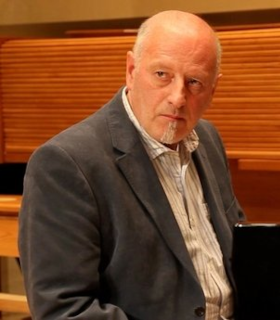
Doyle studies piano from the age of nine. After leaving school he attends the Royal Irish Academy of Music for three years, studying composing, during which time he is awarded two composition scholarships. He also studies at the Institute of Sonology at Utrecht University in the Netherlands and the Finnish Radio Experimental Music Studio on scholarships.
As a performer Doyle begins as a drummer with the groups Supply Demand and Curve and Jazz Therapy, playing free improvisatory and fusion music. He releases his first LP, Oizzo No, in 1975, and his second, Thalia, in 1978 on CBS Classics. Rapid Eye Movements (1981) is his third LP, and his attempt at a “masterpiece before the age of thirty.”
Doyle begins his magnum opus, Babel, in 1989, a 5-CD set that takes ten years to compose. Each track corresponds to a ‘room’ or place within an imagined giant tower city, a kind of aural virtual reality. It celebrates the multiplicity of musical language. One hundred three pieces of music are composed for it and he works with 48 collaborators. From 2002 to 2007 he works on the three-volume electronic work Passades. Twenty-seven albums of his music have been released. He has also composed scores for several films including Budawanny, Pigs and the documentary Atlantean by Bob Quinn.
In 2013 Doyle founds META Productions with opera director Eric Fraad, committed to exploring new forms of opera for the 21st century. Their first production is the electronic opera Heresy. Originally titled The Death by Fire of Giordano Bruno, a 40-minute ‘in development’ version is performed as part of a fully staged concert of his works at both the Kilkenny Arts Festival and in the Dublin Theatre Festival 2013. The two hour Heresy is presented as part of ‘Project 50’, a season of work celebrating 50 years of Project Arts Centre in November 2016. The opera is based on episodes from the life and works of Giordano Bruno. It is broadcast on RTÉ Lyric fm in September 2017 and released as a double album on Heresy records in 2018. Recent album releases are The Thousand Year Old Boy (2013), Time Machine (2015), Frail Things In Eternal Places (2016), and The Heresy Ostraca (2019).
Doyle founds the music theatre company Operating Theatre with Irish actress Olwen Fouéré. They produce many important site-specific productions, including Passades, Here Lies and Angel/Babel, all featuring his music as an equal partner in the theatrical environment. Operating Theatre performs in conventional and site-specific venues in Ireland, England, the Netherlands, France, Venezuela and the United States and releases several records. With Icontact Dance Company, he produces Tower of Babel – Delusional Architecture, featuring as much of Babel as he has composed by that point. This work is originally performed in a whole wing of the Irish Museum of Modern Art in 1992. Arguably his most famous theatre work is the music he wrote and performs on piano onstage for the Steven Berkoff version of the Oscar Wilde play Salome which plays in Dublin‘s Gate Theatre, in London‘s West End and on three world tours. The Irish Times notes that “his name is revered in the realm of theatre.”
Doyle’s works Four Sketches and All the Rage are awarded second and first prizes in the Dublin Symphony Orchestra composition competition in 1970 and 1974 respectively. He has won the Programme Music Prize (1997) and the Magisterium Award (2007) at the Bourges International Electro-Acoustic Music Competition in Bourges, France. He also receives the Irish Arts Council‘s Marten Toonder Award in 2000 in recognition of his innovative work as a composer. He is a member of Aosdána, and has recently been made Adjunct Professor of Music at Trinity College Dublin.
PresidentMichael D. Higgins confers the honour of Saoi on Doyle on August 16, 2019 by placing a gold torc around his neck. This is the highest honour of Aosdána that can be bestowed by fellow Aosdána members. No more than seven living members can be so honoured at one time. The Irish Times describes his album Chalant – Memento Mori as “a richly rewarding work that runs the full, glorious gamut of human emotion.” It is Album of the Week on March 30, 2012 in the same paper.
Kettle is born on February 9, 1880, in Malahide or Artane, Dublin, the seventh of twelve children of Andrew J. Kettle (1833–1916), a leading Irish nationalist politician, progressive farmer, agrarian agitator and founding member of the Irish National Land League, and his wife, Margaret (née McCourt). One of his brothers is the industrial pioneer, Laurence Kettle. He is influenced considerably through his father’s political activities.
Kettle is killed in action with ‘B’ Company of the 9th Battalion of the Royal Dublin Fusiliers in an attack on German lines on September 9, 1916, near the village of Ginchy during the Somme Offensive in France. During the advance he is felled when the Dublin Fusiliers are “struck with a tempest of fire,” and having risen from the initial blow, he is struck again and killed outright. His body is buried in a battlefield grave by the Welsh Guards, but the location of the grave is subsequently lost. His name is etched on the monumental arched gateway for the missing of the Somme at Thiepval.
Kettle is one of the leading figures of the generation who, at the turn of the twentieth century, give new intellectual life to Irish party politics, and to the constitutional movement towards All-Ireland Home Rule. A gifted speaker with an incisive mind and devastating wit, his death is regarded as a great loss to Ireland’s political and intellectual life.
As G. K. Chesterton surmises, “Thomas Michael Kettle was perhaps the greatest example of that greatness of spirit which was so ill rewarded on both sides of the channel […] He was a wit, a scholar, an orator, a man ambitious in all the arts of peace; and he fell fighting the barbarians because he was too good a European to use the barbarians against England, as England a hundred years before has used the barbarians against Ireland.”
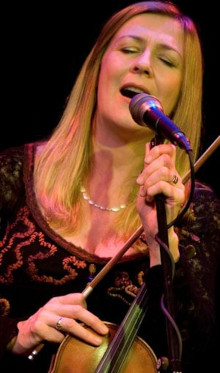
Ní Mhaonaigh’s father, Proinsias Ó Maonaigh, is a noted fiddler, song writer and school teacher and is her first main influence. Her mother, Kitty Rua is also raised in a musical house that holds frequent house dances. It is no surprise that she and her siblings, Gearóid and Anna, all play music together.
In the early 1980s, Ní Mhaonaigh qualifies as a Primary school teacher and teaches in Saint Oliver Plunkett National School in Malahide, County Dublin. She and her husband, Frankie Kennedy, record Ceol Aduaidh (Music from the North) for Irish label Gael Linn in 1983. This timeless recording is the genesis of what later becomes Altan. The recording features her brother Gearóid Ó Maonaigh on guitar, Fintan Mc Manus on bouzouki, Ciaran Curran on bouzouki and Eithne Ní Bhraonáin (now known as Enya) on keyboards. The album quietly gains praise among enthusiasts of traditional Irish music worldwide, which leads the way for a career in music.
Ní Mhaonigh’s teaching career comes to a halt after she and her husband take a career break in 1987 and formed Altan. The band goes on to become one of the most acclaimed Irish traditional bands touring the world. They record for Green Linnet Records in the United States and tour North America extensively.
In 1994, Frankie Kennedy passes away to cancer, which is a tremendous loss to Ní Mhaonigh. She continues with the band at her late husband’s request and signs to multinational record label Virgin Records London in late 1994. This marks the first traditional Irish band to be signed to a major record label and propels Altan and Ní Mhaonigh into a wider audience of followers.
Ní Mhaonaigh, along with fronting Altan, remains close her roots between touring and returns to her native County Donegal to play, sing and teach her music to a new generation. She helps set up Cairdeas na bhFidléirí (The Fellowship / Friendship of Fiddlers) in the early 1980s to promote and preserve the fiddle music of County Donegal.
In 2009, Ní Mhaonaigh releases her first solo album, Imeall (Edge/Theshold), as a limited edition. After many years of playing with the band and numerous requests for a solo recording she finally gets time to record the album after parting with her second husband Dermot Byrne, with whom she has her daughter Nia. She tours the album between Altan commitments with her co-producer and recording engineer Manus Lunny.
The album prompts one reviewer, Paul O’Connor, to remark, “Her identified success as the leader of Altan has dominated our sense of her to the point that we aren’t cognisant of how good she is as an artist, musician, composer in her own right.”
This new focus on Ní Mhaonaigh as an artist in her own right, prompts The Donegal Association in Dublin to grant her “Donegal Person of the Year 2009” at a gala dinner in Dublin’s prestigious Burlington Hotel.
Ní Mhaonaigh is awarded the top recognition in traditional Irish music by her fellow peers in 2018, when she is awarded TG4Gradam Ceoil’s Traditional Musician of the Year. The following year, she is honoured in her own county at the now world famous “Cup o’Tae Festival” which is held annually in Ardara, County Donegal.
Ní Mhaonaigh is also a member of String Sisters, which is a Grammy listed folk supergroup of six of the world’s leading female fiddlers. Together they have released two albums – the Grammy-longlisted Live and Between Wind and Water. She is a member of T with the Maggies, which is a vocal supergroup of Donegal singers comprised of Maighread and Tríona Ní Dhomhnaill and Moya Brennan of Clannad fame.
Recently Ní Mhaonaigh has recorded with a group of thirteen County Donegal-based female fiddlers which is called ‘SíFiddlers.’





 seamus dubhghaill