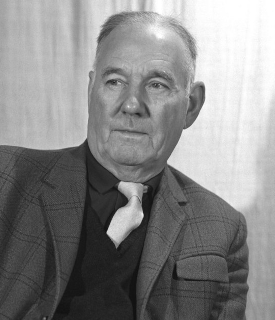
Gearóid O’Sullivan, soldier and politician, is born on January 28, 1891, at Coolnagrane, near Skibbereen, County Cork, fourth son among six sons and three daughters of Michael O’Sullivan, farmer, of Loughine, and Margaret Sullivan (née McCarthy) of Coolnagrane.
Christened Jeremiah but known in later life as Gearóid, O’Sullivan is an outstanding pupil at national school and secondary school in Skibbereen. Encouraged by his teachers, he acquires a love of the Irish language. Not yet ten, he joins the Gaelic League in Skibbereen in October 1900. He takes part in the Oireachtas debates of 1909. In 1911 he qualifies at St. Patrick’s College, Dublin, as a national schoolteacher and teaches at Kildorrery, County Cork, but returns to Dublin in 1912 to take up a post at St. Peter’s National School, Phibsborough. He takes an honours degree in Celtic studies at University College Dublin (UCD) (1913), an H.Dip.Ed. (1914), and an M.Ed. (1915). At the same time, he is an organiser and teacher with the Gaelic League, a member of its Keating branch at Parnell Square, Dublin, and a founder of the League’s “fáinne” proficiency badge.
O’Sullivan joins the F Company, 1st Battalion, Dublin Brigade of the Irish Volunteers at their foundation in November 1913, is aide-de-camp to Seán Mac Diarmada during the 1916 Easter Rising and is ordered by Patrick Pearse to raise the flag of rebellion over the General Post Office (GPO) stronghold in Dublin. Interned at Frongoch internment camp in Wales after the rising, he belongs to the Irish Republican Brotherhood (IRB) group of prisoners closely linked with Michael Collins, a proximity that continues throughout the crisis years to follow. Released in the amnesty of December 1916, he intensifies his Volunteer activity, playing a prominent role in Carlow Brigade, for which he is briefly detained while working as a teacher at St. Mary’s Knockbeg College, County Carlow. When the Irish Volunteers become the Irish Republican Army (IRA) in 1919, he is arrested again and goes on hunger strike at Mountjoy Prison, which leads to his release. Active throughout the Irish War of Independence (1919–21) and narrowly avoiding recapture during meetings with Collins, he joins the supreme council of the IRB in November 1921, remaining there for the remainder of his military career.
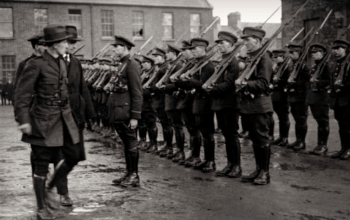
From February 1920, O’Sullivan replaces Collins as adjutant general of the IRA, a position he retains until the Anglo–Irish Treaty of December 1921 (which he supports), resuming it a month later as a lieutenant general of the new National Army, responsible for personnel and promotions. He is also elected to Dáil Éireann for Carlow–Kilkenny in 1921 and again in 1922, retiring in 1923. His intellectual and organisational abilities guarantee that his position within the army is safe after the death in August 1922 of Collins, to whom he owes much for his initial rise to prominence. On August 28 he is appointed to the newly created army council, whose most draconian prerogative becomes the military execution of republican prisoners.
After the Irish Civil War (1922–23), wholesale demobilisation of officers and other ranks takes place, but O’Sullivan and his council colleagues Richard Mulcahy, Seán Mac Mahon, and Seán Ó Murthuile survive the fiscal axe. Their privileged position angers some officers, led by Major General Liam Tobin, alarmed at the rate of demobilisation and the state’s apparent abandonment of Collins’s republican ideals. Through the Irish Republican Army Organisation, they deplore the devaluation of their pre-treaty IRA service and the retention of certain former British Army officers and instructors. O’Sullivan’s brief time as adjutant general places him in the role of personnel manager. As the Defence Forces (Temporary Provisions) Act, 1923, transforms the National Army into the defence forces of an Irish dominion, he is clearly in the sights of those who disagree with how these forces took shape.
As demobilisation continues and former British personnel become more evident, O’Sullivan and his colleagues become targets of suspicion that a hostile IRB clique had controlled the army council since its formation after the death of Collins. Exaggerated or not, such claims precipitate the army crisis of March 1924, in which O’Sullivan personally orders a raiding party under Colonel Hugo MacNeill to arrest its leaders. To defuse the crisis, he and his army council colleagues are forced to stand down, while the arrested dissidents are summarily retired. The subsequent army inquiry (April–June 1924) absolves him and his colleagues of any wrongdoing, but their active military careers are over. O’Sullivan, however, is for some time secretary of the military service pensions board.
Civilian life treats O’Sullivan well, as he enters a legal career and in 1926 is called to the bar. In 1927 he is appointed Judge Advocate General and remains so until 1932. After the assassination of Minister for Justice Kevin O’Higgins in July 1927, he fills the vacated Dublin County seat in a by-election in August, retaining it at subsequent elections until 1937. In August 1928 he is a Free State delegate to the Empire Parliamentary Association conference in Canada. Openly supporting Gen. Eoin O’Duffy and the short-lived ‘Blueshirts’ vanguard of the fledgling Fine Gael party during 1933–34, he pointedly refuses to surrender his legally held revolver when gardaí demand it as a precaution against a feared Blueshirt coup d’étât. In 1937 he becomes a barrister on the western circuit, and in 1940 commissioner for special purposes of the income tax acts, a post he holds for life.
O’Sullivan lives at St. Kevin’s Park, Dartry, Dublin, where he dies at the age of 57 on March 26, 1948. His military funeral to Glasnevin Cemetery, with his coffin draped in the same flag that had covered the coffin of Michael Collins, reflects his high national profile.
In 1922, O’Sullivan marries Maude Kiernan, sister of Kitty Kiernan and daughter of Peter and Bridget Kiernan, whose family is closely involved with the Irish political leadership, notably Michael Collins and Harry Boland. After Maude’s death he marries Mary Brennan of Belfast. They have three daughters and a son, all of whom survive him. O’Sullivan is commemorated in County Cork by a plaque at Skibbereen town hall.
(From: “O’Sullivan, Gearóid” contributed by Patrick Long, Dictionary of Irish Biography, http://www.dib.ie, shared in line with Creative Commons ‘Attribution’ (CC BY) licencing)