seamus dubhghaill

Promoting Irish Culture and History from Little Rock, Arkansas, USA


Leave a comment

Founding of the Ancient Order of Hibernians in America

The Ancient Order of Hibernians (AOH) is founded in the United States on May 4, 1836, at St. James’ Roman Catholic Church in New York City, near the old Five Points neighbourhood. A branch is formed the same year at Pottsville, Pennsylvania. The existence and activities of the Order are concealed for some years.

During the late 1860s and early 1870s many of the lodges of the order in Pennsylvania are infiltrated by the Molly Maguires. However, the Molly Maguires and their criminal activities are condemned at the 1876 national convention of the AOH, and the Order is reorganised in the Pennsylvania coal areas.

In 1884 there is a split in the organisation. The Order has previously been governed by the Board of Erin, which has governed the order in Ireland, Great Britain and the United States, but is composed of officers selected exclusively by the organisations in Ireland and Great Britain. The majority leave in 1884 and become the Ancient Order of Hibernians of America, while the small group calls itself Ancient Order of Hibernians, Board of Erin. In 1897 the Ancient Order of Hibernians, Board of Erin, has approximately 40,000 members concentrated in New YorkNew JerseyOhioIllinois, and Michigan, while the Ancient Order of Hibernians of America has nearly 125,000 members scattered throughout nearly every state in the union. The two groups reunite in 1898.

female auxiliary, the Daughters of Erin, is formed in 1894, and has 20,000 members in 1897. It is attached to the larger, “American” version of the order. The AOH has 181,000 members in 1965 and 171,000 in 736 local units of “Divisions” in 1979. John F. Kennedy joins the AOH in 1947.

The Ladies Ancient Order of Hibernians (LAOH) raises $50,000 to build the Nuns of the Battlefield sculpture in Washington, D.C., which the United States Congress authorises in 1918. The Irish American sculptor, Jerome Connor, ends up suing the Order for non-payment.

In 1982, in a revival of Hibernianism, the Thomas Francis Meagher Division No. 1 forms in Helena, Montana, dedicated to the principles of the Order and to restoring a historically accurate record of Brigadier General Meagher’s contributions to Montana. Soon after, six additional divisions form in Montana.

The Order organises the New York City St. Patrick’s Day Parade for 150 years, emphasising a conservative Catholic interpretation of the Irish holiday. In 1993 control is transferred to an independent committee amid controversy over the exclusion of Irish American gay and lesbian groups.

The Brothers of St. Patrick Division of the Ancient Order of Hibernians in America is established at Brother’s of St. Patrick in Midway City, California, in 1995.

In 2013, The Ancient Order of Hibernians raises and distributes over $200,000 to aid victims of Hurricane Sandy.

In 2014, the AOH calls for a boycott of Spencer’s Gifts, for selling products the AOH says promote anti-Irish stereotypes and irresponsible drinking.

On May 10, 2014, a memorial to Commodore John Barry, an immigrant from Wexford who is a naval hero of the American Revolution and who holds commission number one in the subsequent United States Navy, is dedicated on the grounds of the United States Naval Academy. The memorial and associated “Barry Gate” are presented to the Academy by the members of the Ancient Order of Hibernians.

Several buildings of the Ancient Order of Hibernians are listed on the U.S. National Register of Historic Places or are otherwise notable.


Leave a comment

Death of Marie Dolores Eliza Rosanna Gilbert, Dancer & Actress

lola-montez

Marie Dolores Eliza Rosanna Gilbert, Countess of Landsfeld, Irish dancer and actress better known by the stage name Lola Montez, dies in Brooklyn, New York, on January 17, 1861. She becomes famous as a “Spanish dancer,” courtesan, and mistress of King Ludwig I of Bavaria, who makes her Countess of Landsfeld. She uses her influence to institute liberal reforms. At the start of the German revolutions of 1848-1849, she is forced to flee. She proceeds to the United States via Switzerland, France, and London, returning to her work as an entertainer and lecturer.

Gilbert is born in Grange, County Sligo, on February 17, 1821. Her family makes their residence at King House in Boyle, County Roscommon, until early 1823, when they journey to Liverpool, thence departing for India on March 14. Gilbert spends much of her childhood in India but is educated in Scotland and England. At age 19 she elopes with Lieutenant Thomas James. The couple separates five years later, and, in 1843, Gilbert launches a career as a dancer. Her London debut in June 1843 as “Lola Montez, the Spanish dancer” is disrupted when she is recognized as Mrs. James. The fiasco would probably have ended the career of anyone less beautiful and determined, but Gilbert receives additional dancing engagements throughout Europe. During her travels she reputedly forms liaisons with Franz Liszt and Alexandre Dumas, among many others.

Late in 1846, Gilbert dances in Munich and Ludwig I of Bavaria is so struck by her beauty that he offers her a castle. She accepts, becomes Baroness Rosenthal and Countess of Lansfeld, and remains as his mistress. Under Gilbert’s influence, Louis inaugurates liberal and anti-Jesuit governmental policies, but his infatuation with her helps to bring about the collapse of his regime in the revolution of 1848. In March of that year Ludwig abdicates in favour of his son. Gilbert flees to London, where in 1849 she marries Lieutenant George Heald, although she has never been divorced from James. Heald later leaves her.

From 1851 to 1853 Gilbert performs in the United States. Her third marriage, to Patrick P. Hull of San Francisco in 1853, ends in divorce soon after she moves to Grass Valley, California. There, among other amusements, she coaches young Lotta Crabtree in singing and dancing. She settles in New York City after an unsuccessful tour of Australia in 1855–1856 and gathers a following as a lecturer on such topics as fashion, gallantry, and beautiful women. An apparently genuine religious conversion leads her to take up various personal philanthropies.

Gilbert publishes Anecdotes of Love; Being a True Account of the Most Remarkable Events Connected with the History of Love; in All Ages and among All Nations (1858), The Arts of Beauty, or, Secrets of a Lady’s Toilet with Hints to Gentlemen on the Art of Fascination (1858), and Lectures of Lola Montez, Including Her Autobiography (1858). The international notoriety of her heyday persists long after her death and inspires numerous literary and balletic allusions.

Gilbert spends her last days in rescue work among women. By November 1859 she is showing the tertiary effects of syphilis, and her body begins to waste away. She dies at the age of 39 on January 17, 1861. She is buried in Green-Wood Cemetery in Brooklyn, New York.


Leave a comment

Birth of Commodore Thomas Macdonough

thomas-macdonough

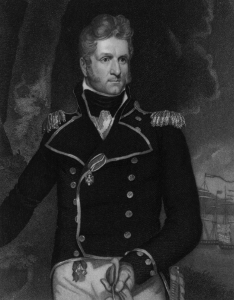
Commodore Thomas Macdonough, American naval officer noted for his roles in the first Barbary War and the War of 1812, whose family is from Dublin, is born on December 31, 1783, in the New Castle County, Delaware town then known as “The Trap,” but now renamed McDonough in his honor.

Before joining the U.S. Navy, Macdonough, for unknown reasons, changes the spelling of his last name from “McDonough” to “Macdonough.” He joins the Navy in 1800 as a midshipman and spends the first years of his naval career fighting pirates, including the famous Barbary pirates operating out of Tripoli. When the War of 1812 breaks out, Macdonough, then a lieutenant, is made the commander of all the Navy’s forces on Lake Champlain, an extremely important post due to the threat of British invasion from Canada. The opposing sides build their fleets on the Lake through most of 1813.

In August of that year, British General Sir George Prévost begins his invasion from Canada. Moving along the western edge of Lake Champlain, he hopes to use the guns of his fleet to help cover his advance. The British army outnumbers the Americans better than two to one, but Prévost needs to use the Lake to supply his army, thus the fleet of Thomas Macdonough becomes a prime target of the British fleet on Lake Champlain.

The two fleets are fairly evenly matched, but the guns of the British ships have an advantage in range. Macdonough comes up with a brilliant plan to negate this advantage. He anchors inside Plattsburgh Bay in such a manner that the British cannot fire at them from long range and have to come around Cumberland Head and approach them head on, presenting their bows to the American guns. From there it becomes a close-range slugging match, more to the liking of the Americans.

On board his flagship, the USS Saratoga, Macdonough fires the first shot, hitting the HMS Confiance, the flagship of Captain George Downie, commander of the British fleet. Macdonough continues to work the gun through the fierce 2 ½-hour battle. Twice his men are sure he has been killed as he is knocked out and lay on the deck. But twice he rises and returns to action. Finally, with Captain Downie dead, and their ships devastated, the largest ships of the British fleet strike their colors, and their gunboats run for home.

On land, General Prévost has engaged the American land forces as the British fleet attacks. When it becomes apparent the American fleet is victorious, Prévost knows that further movement south is futile. He breaks off the attack and retreats toward Canada. Thomas Macdonough’s fleet has ended the British invasion. It is one of the greatest victories in the history of the U.S. Navy.

For his enormous contribution to the momentous victory, the United States Congress has a medal struck in Macdonough’s honor, and New York and Vermont present him with huge tracks of land. He continues his Navy career after the war.

On November 10, 1825, Macdonough dies of consumption aboard ship while commanding the USS Constitution as it is passing Gibraltar. His body is returned to the United States and is buried in Middletown, Connecticut. He is laid to rest alongside his wife Ann Shaler, a lady of a prominent family in Middletown, she having died just a few months earlier.


2 Comments

Birth of Patrick Henry Jones, Postmaster of New York City

patrick-henry-jones

Patrick Henry Jones, American lawyer, public servant, and Postmaster of New York City during the mid-to late 19th century, is born on November 20, 1830, in County Westmeath.

Jones attends grammar school in Dublin for three years until emigrating with his family to the United States in 1840. They settle on a farm in Cattaraugus County, New York where Jones spends most of his childhood. Because of his poor background, he receives only a limited education at the Union School in Ellicottville. In 1850, the 20-year-old Jones becomes involved in journalism and travels as a correspondent throughout the Western States for a leading New York journal. He later becomes the local editor for the Buffalo Republic and one of the editors of the Buffalo Sentinel.

Eventually, Jones decides to pursue a career in law and later studies under the firm of Addison Rice. He is admitted to the bar in 1856 and afterwards practices law with Addison in Ellicottville as a full partner. By 1860, he has established himself as one of the most prominent lawyers in western New York. A lifelong Democrat, he becomes disillusioned by the party’s support of Southern succession from the Union and, in May 1861, decides to join the military in defense of the United States.

Upon the outbreak of the American Civil War, Jones readily joins the Union Army. On July 7, 1861, he enlisted with the 37th New York Volunteers, popularly known as the “Irish Rifles”, under Colonel John H. McCunn. Jones has a successful career serving in the Union Army, being involved in thirty major battles and countless skirmishes, and reaching the rank of brigadier general. He remains at that rank for the rest of the war and resigns on June 17, 1865. He is one of ten Irish Americans to become brigade commanders and one of four Irish-born officers to become a divisional commander.

After his resignation, Jones resumes his law practice in Ellicottville and in November 1865 is elected on the Republican ticket as Clerk of the New York Court of Appeals. On August 13, 1868, Jones is appointed by Gov. Reuben E. Fenton as Register of New York City to fill the vacancy resulting from the death of Charles G. Halpine. On April 1, 1869, Jones is appointed by President Ulysses S. Grant as Postmaster of New York City. From 1875 to 1877, Jones is again Register of New York City, elected in November 1874 on the Republican ticket. Afterwards he resumes his private practice.

In 1878, Jones is involved in the Alexander T. Stewart bodysnatching case when he is contacted by the kidnappers to act as an intermediary between themselves and the Stewart estate. When negotiations stall between the Stewart family’s lawyer Henry Hilton, he assists Stewart’s widow in negotiating for the return of her husband’s body.

Jones suffers serious medical problems in his old age, specifically deafness and chronic diarrhea, which his physician blames on his exposure to artillery fire and his time in the swamps along the Chickahominy River during his military service. He also suffered from constant pain in his right sciatic nerve, attributed to his old war wound suffered at Chancellorsville, as well as his wound in the gluteal region.

In early July 1900, Jones begins suffering from severe gastroenteritis. His condition does not respond to therapeutic treatments as he loses control of his bowels and is unable to keep down solid food, living on scalded milk and brandy. On July 18, 1900, Jones dies from cardiac failure, indirectly caused by his gastroenteritis, at his home in Port Richmond, New York. His funeral is held at St. Mary’s Church two days later and he is buried in St. Peter’s Cemetery.


Leave a comment

Death of Mary Mallon, Better Known as “Typhoid Mary”

typhoid-mary

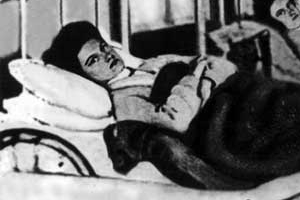
Mary Mallon, better known as Typhoid Mary, dies in North Brother Island, East River, New York, on November 11, 1938. She is the first person in the United States identified as an asymptomatic carrier of the pathogen associated with typhoid fever. She is presumed to have infected 51 people, three of whom die, over the course of her career as a cook. She is twice forcibly isolated by public health authorities and dies after a total of nearly three decades in isolation.

Mallon is born on September 23, 1869, in Cookstown, County Tyrone, Northern Ireland. She immigrates to the United States in 1883 at the age of fifteen and lives with her aunt and uncle.

From 1900 to 1907, Mallon works as a cook in the New York City area for seven families. In 1900, she works in Mamaroneck, New York, where, within two weeks of her employment, residents develop typhoid fever. In 1901, she moves to Manhattan, where members of the family for whom she works develop fevers and diarrhea, and the laundress dies. Mallon then goes to work for a lawyer but leaves after seven of the eight people in that household become ill.

In 1906, she takes a position in Oyster Bay, Long Island, and within two weeks ten of the eleven family members are hospitalized with typhoid. She changed jobs again and similar occurrences happen in three more households. She works as a cook for the family of a wealthy New York banker, Charles Henry Warren. When the Warrens rent a house in Oyster Bay for the summer of 1906, Mallon goes along as well. From August 27 to September 3, six of the eleven people in the family come down with typhoid fever. The disease at that time is “unusual” in Oyster Bay, according to three medical doctors who practice there. Mallon is subsequently hired by other families and outbreaks follow her.

In late 1906, one family hires a typhoid researcher named George Soper to investigate. Soper publishes the results on June 15, 1907, in the Journal of the American Medical Association. He believes Mallon might be the source of the outbreak, but she repeatedly turns him away.

The New York City Health Department sends physician Sara Josephine Baker to talk to Mallon. A few days later, Baker arrives at Mallon’s workplace with several police officers, who take her into custody.

Mallon attracts so much media attention that she is called “Typhoid Mary” in a 1908 issue of the Journal of the American Medical Association. Later, in a textbook that defines typhoid fever, she is again called “Typhoid Mary.”

The New York City Health Inspector determines her to be a carrier. Under sections 1169 and 1170 of the Greater New York Charter, Mallon is held in isolation for three years at a clinic located on North Brother Island.

Upon her release, Mallon is given a job as a laundress. In 1915, Mallon starts another major outbreak, this time at Sloane Hospital for Women in New York City. Twenty-five people are infected and two die. She again leaves, but the police are able to locate and arrest her when she brings food to a friend on Long Island. After arresting her, public health authorities return her to quarantine on North Brother Island on March 27, 1915.

Mallon spends the rest of her life in quarantine at the Riverside Hospital. Six years before her death, she is paralyzed by a stroke. On November 11, 1938, at the age of 69, she dies of pneumonia. An autopsy finds evidence of live typhoid bacteria in her gallbladder. Mallon’s body is cremated, and her ashes are buried at Saint Raymond’s Cemetery in the Bronx.


Leave a comment

Death of General Philip Henry Sheridan

philip-sheridan

Irish American General Philip Henry Sheridan, career United States Army officer and a Union general in the American Civil War, dies of heart disease in Dartmouth, Massachusetts, on August 5, 1888.

Sheridan is born in Albany, New York, the third child of six by John and Mary Meenagh Sheridan, immigrants from the parish of Killinkere, County Cavan. Fully grown, he reaches only 5 feet 5 inches in height, a stature that leads to the nickname “Little Phil.” Abraham Lincoln describes his appearance in a famous anecdote, “A brown, chunky little chap, with a long body, short legs, not enough neck to hang him, and such long arms that if his ankles itch, he can scratch them without stooping.”

Sheridan’s career is noted for his rapid rise to major general and his close association with General-in-chief Ulysses S. Grant, who transfers Sheridan from command of an infantry division in the Western Theater to lead the Cavalry Corps of the Army of the Potomac in the East. In 1864, he defeats Confederate forces in the Shenandoah Valley and his destruction of the economic infrastructure of the Valley, called “The Burning” by residents, is one of the first uses of scorched earth tactics in the war. In 1865, his cavalry pursues General Robert E. Lee and is instrumental in forcing his surrender at Appomattox Court House.

In later years, Sheridan fights in the Indian Wars of the Great Plains. Comanche Chief Tosahwi reputedly tells Sheridan in 1869, “Me, Tosahwi; me good Injun,” to which Sheridan supposedly replies, “The only good Indians I ever saw were dead.” Sheridan denies he had ever made the statement. Biographer Roy Morris Jr. states that, nevertheless, popular history credits Sheridan with saying “The only good Indian is a dead Indian.” This variation “has been used by friends and enemies ever since to characterize and castigate his Indian-fighting career.” In Bury My Heart at Wounded Knee, Dee Brown attributes the quote to Sheridan but does not provide documentation to support his contention, so the quote may be more apocryphal than real.

Both as a soldier and private citizen, Sheridan is instrumental in the development and protection of Yellowstone National Park. The protection of the Yellowstone area is Sheridan’s personal crusade. He authorizes Lieutenant Gustavus Doane to escort the Washburn Expedition in 1870 and for Captain John W. Barlow to escort the Hayden Expedition in 1871. Barlow names Mount Sheridan, a peak overlooking Heart Lake in Yellowstone, for the general in 1871. As early as 1875, Sheridan promotes military control of the area to prevent the destruction of natural formations and wildlife.

In 1883, Sheridan is appointed general-in-chief of the U.S. Army, and in 1888 he is promoted to the rank of General of the Army during the term of President Grover Cleveland. Sheridan serves as the ninth president of the National Rifle Association.

Sheridan suffers a series of massive heart attacks two months after sending his memoirs to the publisher. After his first heart attack, the U.S. Congress quickly passes legislation to promote him to general and he receives the news from a congressional delegation with joy, despite his pain. His family moves him from the heat of Washington, D.C. and he dies of heart failure in his summer cottage in the Nonquitt section of Dartmouth, Massachusetts.

His body is returned to Washington, and he is buried on a hillside facing the capital city near Arlington House in Arlington National Cemetery. The burial helps elevate Arlington to national prominence.


Leave a comment

Death of Jeremiah O’Donovan Rossa

jeremiah-odonovan-rossa

Jeremiah O’Donovan Rossa, Irish Fenian leader and prominent member of the Irish Republican Brotherhood, dies suddenly in Staten Island, New York, on June 29, 1915.

Jeremiah O’Donovan Rossa is born Jeremiah O’Donovan at Reenascreena, Rosscarbery, County Cork, on September 10, 1831. Rossa becomes a shopkeeper in Skibbereen where, in 1856, he establishes the Phoenix National and Literary Society, the aim of which is “the liberation of Ireland by force of arms.” This organisation later merges with the Irish Republican Brotherhood (IRB), founded two years later in Dublin.

In December 1858, Roosa is arrested and jailed without trial until July 1859. He is charged with plotting a Fenian rising in 1865, put on trial for high treason, and sentenced to penal servitude for life due to previous convictions. He serves his time in Pentonville, Portland, and Chatham prisons in England.

In an 1869 by-election, Roosa is returned to the British House of Commons for the Tipperary constituency, defeating the Liberal Catholic Denis Caulfield Heron by 1054 to 898 votes. The election is declared invalid because Rossa is an imprisoned felon.

After giving an understanding that he will not return to Ireland, Rossa is released as part of the Fenian Amnesty of 1870. Boarding the S.S. Cuba, he leaves for the United States with his friend John Devoy and three other exiles. Together they were dubbed “The Cuba Five.”

Rossa takes up residence in New York City, where he joins Clan na Gael and the Fenian Brotherhood. He organises the first ever bombings by Irish republicans of English cities in what is called the “dynamite campaign.” The campaign lasts through the 1880s and makes him infamous in Britain. The British government demands his extradition from America but without success.

In 1885, Rossa is shot outside his office near Broadway by an Englishwoman, Yseult Dudley, but his wounds are not life-threatening. He is allowed to visit Ireland in 1894, and again in 1904. On the latter visit, he is made a “Freeman of the City of Cork.”

Rossa is seriously ill in his later years and is finally confined to a hospital bed in St. Vincent’s Hospital, Staten Island, where he dies at the age of 83 on June 29, 1915. His body is returned to Ireland for burial and a hero’s welcome. The funeral at Glasnevin Cemetery on August 1, 1915, is a huge affair, garnering substantial publicity for the Irish Volunteers and the IRB at time when a rebellion, later to emerge as the Easter Rising, is being actively planned. The graveside oration given by Patrick Pearse remains one of the most famous speeches of the Irish independence movement stirring his audience to a call to arms.


Leave a comment

Birth of Actress Maureen O’Sullivan

maureen-osullivan

Maureen Paula O’Sullivan, Irish American actress best known for playing Jane in the Tarzan series of films starring Johnny Weissmuller, is born in Boyle, County Roscommon on May 17, 1911.

O’Sullivan is the daughter of Evangeline “Mary Eva” Lovatt and Charles Joseph O’Sullivan, an officer in the Connaught Rangers who serves in World War I. She attends a convent school in Dublin, then the Convent of the Sacred Heart at Roehampton, England. One of her classmates there is Vivian Mary Hartley, future Academy Award-winning actress Vivien Leigh. After attending finishing school in France, O’Sullivan returns to Dublin to work with the poor.

O’Sullivan’s film career begins when she meets motion picture director Frank Borzage, who is doing location filming on Song o’ My Heart for 20th Century Fox. He suggests she take a screen test, which she does, and wins a part in the movie, which stars Irish tenor John McCormack. She travels to the United States to complete the movie in Hollywood. O’Sullivan appears in six movies at Fox, then makes three more at other movie studios.

In 1932, she signs a contract with Metro-Goldwyn-Mayer. After several roles there and at other movie studios, she is chosen by Irving Thalberg to appear as Jane Parker in Tarzan the Ape Man, opposite co-star Johnny Weissmuller. She is one of the more popular ingenues at MGM throughout the 1930s and appears in a number of other productions with various stars. In all, O’Sullivan plays Jane in six features between 1932 and 1942.

She stars with William Powell and Myrna Loy in The Thin Man (1934) and plays Kitty in Anna Karenina (1935) with Greta Garbo and Basil Rathbone. After co-starring with the Marx Bros. in A Day At The Races (1937), she appears as Molly Beaumont in A Yank at Oxford (1938), which is written partly by F. Scott Fitzgerald. At her request, he rewrites her part to give it substance and novelty.

She plays another Jane in Pride and Prejudice (1940) with Laurence Olivier and Greer Garson and supports Ann Sothern in Maisie Was a Lady (1941). After appearing in Tarzan’s New York Adventure (1942), O’Sullivan asks MGM to release her from her contract so she can care for her husband who has just left the Navy with typhoid. She retreats from show business, devoting her time to her family. In 1948, she re-appears on the screen in The Big Clock, directed by her husband for Paramount Pictures. She continues to appear occasionally in her husband’s movies and on television. However, by 1960 she believes she has permanently retired. In 1958, Farrow’s and O’Sullivan’s eldest son, Michael, dies in a plane crash in California.

Actor Pat O’Brien encourages her to take a part in summer stock, and the play A Roomful of Roses opens in 1961. That leads to another play, Never Too Late, in which she co-stars with Paul Ford in what is her Broadway debut. Shortly after it opens on Broadway, John Farrow dies of a heart attack. O’Sullivan sticks with acting after Farrow’s death. She is also an executive director of a bridal consulting service, Wediquette International. In June and July 1972, O’Sullivan is in Denver, Colorado, to star in the Elitch Theatre production of Butterflies are Free with Karen Grassle and Brandon deWilde. The show ends on July 1, 1972. Five days later, while still in Denver, deWilde is killed in a motor vehicle accident.

When her daughter, actress Mia Farrow, becomes involved with Woody Allen both professionally and romantically, she appears in Hannah and Her Sisters, playing Farrow’s mother. She has roles in Peggy Sue Got Married (1986) and the science fiction oddity Stranded (1987). Mia Farrow names one of her own sons Ronan O’Sullivan Farrow for her mother. In 1994, she appears with Robert Wagner and Stefanie Powers in Hart to Hart: Home Is Where the Hart Is, a feature-length made-for-TV movie with the wealthy husband-and-wife team from the popular weekly detective series Hart to Hart.

Maureen O’Sullivan dies in Scottsdale, Arizona, of complications from heart surgery on June 23, 1998, at the age of 87. O’Sullivan is buried at Most Holy Redeemer Cemetery, Niskayuna, New York. She is survived by six of her children, 32 grandchildren, and 13 great-grandchildren. Michael, her oldest son, is killed at age 19 in a plane crash in 1958.


Leave a comment

Death of William Joseph “Wild Bill” Donovan

william-joseph-donovan

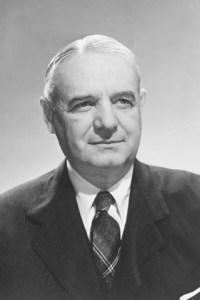
William Joseph “Wild Bill” Donovan, a United States soldier, lawyer, intelligence officer, and diplomat, dies on February 8, 1959. Donovan is best remembered as the wartime head of the Office of Strategic Services (OSS), a precursor to the Central Intelligence Agency, during World War II. He is also known as the “Father of American Intelligence” and the “Father of Central Intelligence.”

Of Irish descent, Donovan is born in Buffalo, New York, to first generation immigrants Anna Letitia “Tish” Donovan (née Lennon) of Ulster and Timothy P. Donovan of County Cork. His grandfather, Timothy O’Donovan, Sr., is from the town of Skibbereen, and marries Mary Mahoney, who belongs to a propertied family of substantial means who disapprove of him. They move first to Canada and then to New York, where their son Timothy, Jr., Donovan’s father, attempts to engage in a political career but with little success.

William attend St. Joseph’s Collegiate Institute and Niagara University before starring on the football team at Columbia University, where he earns the nickname “Wild Bill”, which remains with him for the rest of his life. He graduates from Columbia in 1905. He then attends and graduates from Columbia Law School, after which he becomes an influential Wall Street lawyer.

In 1912, Donovan forms and leads a troop of cavalry of the New York National Guard, which is mobilized in 1916 and serves on the U.S.-Mexico border during the American government’s campaign against Pancho Villa.

During World War I, Major Donovan organizes and leads the 1st battalion of the 165th Regiment of the 42nd Division. For his service near Landres-et-St. Georges, France, on October 14-15, 1918, he receives the Medal of Honor. By the end of the war, he receives a promotion to colonel, as well as the Distinguished Service Cross and Purple Heart.

Donovan serves as U.S. Attorney for the Western District of New York from 1922 to 1924. Due to his energetic enforcement of Prohibition in the United States, there are a number of threats to assassinate him and to dynamite his home, but he is not deterred. In 1924, President Calvin Coolidge names Donovan to the United States Department of Justice’s Antitrust Division as a deputy assistant to Attorney General Harry M. Daugherty. Donovan runs unsuccessfully for Lieutenant Governor of New York (1922) and for Governor of New York (1932) as a Republican.

During the years between the world wars, Donovan earns the attention and friendship of President Franklin D. Roosevelt. Although the two men were from opposing political parties, they were very similar in personality. In 1940 and 1941, Donovan traveled as an informal emissary to Britain, where he is urged by U.S. Secretary of the Navy Frank Knox and Roosevelt to gauge Britain’s ability to withstand Germany’s aggression. During these trips Donovan meets with key officials in the British war effort, including Winston Churchill and the directors of Britain’s intelligence services. Donovan returns to the U.S. confident of Britain’s chances and enamored of the possibility of founding an American intelligence service modeled on that of the British.

On July 11, 1941, Donovan is named Coordinator of Information (COI) where he is to oversee America’s foreign intelligence organizations which, at the time are fragmented and isolated from each other. He is plagued over the course of the next year with jurisdictional battles as few of the leaders in the intelligence community are willing to part with any of their power. Nevertheless, Donovan begins to lay the groundwork for a centralized intelligence program.

In 1942, the COI becomes the Office of Strategic Services (OSS) and Donovan is returned to active duty in the U.S. Army. He is promoted to brigadier general in March 1943 and to major general in November 1944. Under his leadership the OSS eventually conducts successful espionage and sabotage operations in Europe and parts of Asia. By 1943, relations with the British are becoming increasingly strained, partly due to British concerns that OSS operations are sometimes regarded as ill-disciplined and irresponsibly managed. MI6 chief Stewart Menzies is extremely hostile towards the idea of OSS operations anywhere in the British Empire and categorically forbids them to operate within the U.K.

After the end of World War II and the death of President Roosevelt in early April 1945, Donovan’s political position is substantially weakened as he finds himself opposed by President Harry S. Truman, J. Edgar Hoover, and others. Truman disbands the OSS in September 1945 and Donovan returns to civilian life. Several departments of the OSS survive the dissolution and, less than two years later, the Central Intelligence Agency is founded.

Donovan does not have an official role in the newly formed CIA, but he is instrumental in its formation. His opinions meet strong opposition from the State, War, and Navy Departments, as well as J. Edgar Hoover. President Truman is also unenthusiastic about some of Donovan’s arguments, but he prevails, and they are reflected in the National Security Act of 1947 and the Central Intelligence Agency Act of 1949.

After the end of the war ended, Donovan returns to his lifelong role as a lawyer and serves as special assistant to chief prosecutor Robert H. Jackson at the Nuremberg War Crimes Tribunal in Germany. On August 3, 1953, President Dwight Eisenhower appoints Donovan Ambassador to Thailand, and he serves in that capacity from September 4, 1953, until his resignation on August 21, 1954.

Donovan dies from complications of vascular dementia on February 8, 1959, at the age of 76, at Walter Reed Army Medical Center in Washington, D.C. He is buried in Section 2 of Arlington National Cemetery. President Eisenhower remarks, “What a man! We have lost the last hero.”


Leave a comment

Death of Shipbuilding Mogul John Roach

john-roach

John Roach, an American industrialist who rises from humble origins as an Irish immigrant laborer to found the largest and most productive shipbuilding empire in the postbellum United States, John Roach & Sons, dies in New York City on January 10, 1887.

Roach is born on December 25, 1815, at Mitchelstown, County Cork, Ireland, the first of seven children to Patrick Roche, a retail salesman, and his wife Abigail Meany. In 1832, at the age of sixteen, he emigrates together with his cousin to the United States. Arriving in New York City, he is at first unable to find regular work, but eventually gains secure employment at the Howell Works of James P. Allaire on the recommendation of a former employee of his father.

In 1852, after 20 years in the employment of Allaire, Roach and three partners purchase the Etna Iron Works, a small New York City ironworks which has fallen into receivership. Roach soon becomes sole proprietor, and during the American Civil War transforms the Etna Iron Works into a major manufacturer of marine engines. He continues to prosper after the war and in 1867 he purchases the Morgan Iron Works on New York’s East River and relocates his business there.

In 1871, Roach purchases the Reaney, Son & Archbold shipyard in Chester, Pennsylvania, which has fallen into receivership and renames it the Delaware River Iron Ship Building and Engine Works. This becomes his main facility. Over the next few years, he founds a network of new companies in Chester to support the shipyard’s operations. To give his sons a stake in the business, Roach founds the firm of John Roach & Sons, which becomes the overall parent and marketing company. He also attempts to create his own shipping line with the establishment of the United States and Brazil Mail Steamship Company, but this venture is a costly failure.

From 1871 until 1885, John Roach & Sons is easily the largest and most productive shipbuilding firm in the United States, building more tonnage of ships than its next two chief competitors combined. In the mid-1880s the firm runs into trouble when a series of U.S. Navy contracts become the subject of political controversy. Roach signed the contracts under a Republican administration, but when the Democratic administration of Grover Cleveland comes to power, it voids one of the contracts. Doubts over the validity of the remaining three contracts make it impossible for John Roach & Sons to obtain loans and, in 1885, the Roach shipbuilding empire is forced into receivership.

During the contract disputes, Roach falls ill with a chronic mouth infection which is diagnosed as cancer in 1886. Roach undergoes surgery in the spring of 1886, but it provides only temporary relief. He dies at the age of 71 on January 10, 1887, while his business is still in the hands of receivers. Roach’s eldest son, John Baker Roach, assumes control of the business which continues for another 20 years, although it never regains the pre-eminent position in American shipbuilding that it had enjoyed under Roach Sr.

During its existence between 1871 and 1907, the shipyard established by Roach builds 179 iron ships, 98 under Roach’s own management and an additional 81 under that of John Baker Roach.