seamus dubhghaill

Promoting Irish Culture and History from Little Rock, Arkansas, USA


Leave a comment

The Founding of Sinn Féin

Sinn Féin, a left-wing Irish republican political party active in both the Republic of Ireland and Northern Ireland, is founded on November 28, 1905, when, at the first annual Convention of the National Council, Arthur Griffith outlines the Sinn Féin policy, “to establish in Ireland’s capital a national legislature endowed with the moral authority of the Irish nation.”

The phrase “Sinn Féin” is Irish for “ourselves” or “we ourselves,” although it is frequently mistranslated as “ourselves alone.” The meaning of the name itself is an assertion of Irish national sovereignty and self-determination, i.e., the Irish people governing themselves, rather than being part of a political union with Great Britain under the Westminster Parliament.

Around the time of 1969–1970, owing to the split in the republican movement, there are two groups calling themselves Sinn Féin, one under Tomás Mac Giolla, the other under Ruairí Ó Brádaigh. The latter becomes known as Sinn Féin (Kevin Street) or Provisional Sinn Féin, and the former becomes known as Sinn Féin (Gardiner Place) or Official Sinn Féin. The “Officials” drop all mention of Sinn Féin from their name in 1982, instead calling itself the Workers’ Party of Ireland. The Provisionals are now generally known as Sinn Féin. Supporters of Republican Sinn Féin, which comes from a 1986 split, still use the term “Provisional Sinn Féin” to refer to the party led by Gerry Adams.

Sinn Féin is a major party in both Northern Ireland and the Republic of Ireland. It is the largest nationalist party in the Northern Ireland Assembly, and the second-largest overall. It has four ministerial posts in the most recent power sharing Northern Ireland Executive. It holds seven of Northern Ireland’s eighteen seats, the second largest bloc after the Democratic Unionist Party (DUP), at Westminster, where it follows a policy of abstentionism, refusing to attend parliament or vote on bills. It is the third-largest party in the Oireachtas, the parliament of the Republic of Ireland. As Ireland’s dominant parties of Fine Gael and Fianna Fáil are both centre-right, Sinn Féin is the largest left-wing party in Ireland.

Sinn Féin members have also been referred to as Shinners, a term intended as a pejorative.


Leave a comment

George Mitchell Submits Final Good Friday Agreement Report

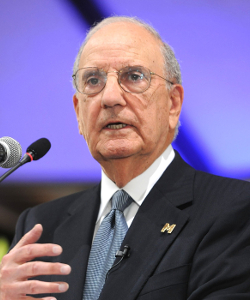
Former United States Senator George J. Mitchell submits his final report into the Good Friday Agreement in Belfast on November 18, 1999. He urges the Irish Republican Army (IRA) to appoint its representative to discuss disarmament on the same day the new power-sharing government is set up.

Since 1995, Mitchell has been active in the Northern Ireland peace process, having served as the United States Special Envoy for Northern Ireland under President Bill Clinton. He first leads a commission that establishes the principles on non-violence to which all parties in Northern Ireland have to adhere and subsequently chairs the all-party peace negotiations, which lead to the Belfast Peace Agreement signed on Good Friday 1998, known since as the “Good Friday Agreement.” Mitchell’s personal intervention with the parties is crucial to the success of the talks. He is succeeded as special envoy by Richard Haass.

For his involvement in the Northern Ireland peace negotiations, Mitchell is awarded the Presidential Medal of Freedom on March 17, 1999, and the Philadelphia Liberty Medal on July 4, 1998. In accepting the Liberty Medal, he states, “I believe there’s no such thing as a conflict that can’t be ended. They’re created and sustained by human beings. They can be ended by human beings. No matter how ancient the conflict, no matter how hateful, no matter how hurtful, peace can prevail.”


Leave a comment

Death of Frederick Hugh Crawford, Ulster Loyalist

Colonel Frederick Hugh Crawford, staunch Ulster loyalist and officer in the British Army, dies on November 5, 1952. He is most notable for organising the Larne gun-running which secures guns and ammunition for the Ulster Volunteers in 1914, making him a hero for Northern Ireland‘s unionists.

Crawford is born in Belfast on August 21, 1861, into a Methodist family of Ulster Scots roots. He attends Methodist College Belfast and University College London.

Crawford works as an engineer for White Star Line in the 1880s, before returning from Australia in 1892. In 1894 he enlists with the Mid Ulster Artillery regiment of the British Army, before being transferred to the Donegal Artillery, with which he serves during the Boer Wars, earning himself the rank of major.

In 1898, Crawford is appointed governor of Campbell College in Belfast. In 1911 he becomes a member of the Ulster Unionist Council. On September 28, 1912, he is in charge of the 2,500 well-dressed stewards and marshals that escort Edward Carson and the Ulster unionist leadership from the Ulster Hall in Belfast to the City Hall for the signing of the Ulster Covenant, which he is alleged to sign in his own blood. With the formation of the Ulster Volunteers in 1913, he is made their Director of Ordnance.

In World War I Crawford is officer commanding of the Royal Army Service Corps and is awarded the Royal Humane Society‘s Bronze Medal for saving life. He also becomes a Justice of the Peace for Belfast.

Crawford in regard to Irish Home Rule is strongly partisan and backs armed resistance in opposing it, being contemptuous of those who use political bluffing. In 1910 the Ulster Unionist Council plans for the creation of an army to oppose Home Rule, and approaches Crawford to act as their agent in securing weapons and ammunition. He tries several times to smuggle arms into Ulster, however vigilant customs officials seize many of them at the docks. Despite this, the meticulously planned and audacious Larne gun-running of April 1914, devised and carried out by Crawford, is successful in bringing in enough arms to equip the Ulster Volunteers.

By the 1920s Crawford remains as stoic in his belief’s remarking in a letter in 1920 that “I am ashamed to call myself an Irishman. Thank God I am not one. I am an Ulsterman, a very different breed.” In 1921 he attempts to create an organisation called the Ulster Brotherhood, the aims of which are to uphold the Protestant religion, political and religious freedom as well as use by all means to “destroy and wipe out the Sinn Féin conspiracy of murder, assassination and outrage.” However, this organisation only lasts completely unofficially for a few months after failing to gain acceptance with the political authorities. Also, in 1921 he is included in the Royal Honours List and granted a CBE. In 1934 he writes his memoirs, entitled Guns for Ulster.

Frederick Hugh Crawford dies November 5, 1952, and is buried in the City Cemetery, Falls Road, Belfast. Upon news of his death, he is described by the then Prime Minister of Northern Ireland, Sir Basil Brooke, as being “as a fearless fighter in the historic fight to keep Ulster British.”

(Pictured: Colonel Crawford is shown second from the left in this loyalist mural in East Belfast’s Ballymacarrett Road)


Leave a comment

Charles Haughey Acquitted of Conspiring in the Arms Crisis

Charles Haughey, former Minister for Finance, and three others including former Minister for Agriculture Neil Blaney, are acquitted on October 23, 1970, of charges that they had conspired to illegally import arms and ammunition into Ireland for the Irish Republican Army (IRA), an incident known as the Arms Crisis.

The Garda Special Branch informs the Minister for Justice Micheál Ó Móráin and Taoiseach Jack Lynch that a plot to import arms exists and includes government members, however Lynch takes no action until the Special Branch makes opposition leader Liam Cosgrave aware of the plot. Cosgrave tells Lynch he is aware of the plot and will announce it in the Dáil the next day if he does not act. Lynch subsequently requests that Haughey and Blaney resign from the Cabinet. Both men refuse, saying they had done nothing illegal. Lynch then asks President Éamon de Valera to terminate their appointments as members of the government, a request that de Valera is required to grant by convention. Haughey and Blaney are subsequently tried in court along with Captain James Kelly, a former intelligence captain in the Irish Army, and Albert Luykx, a former Flemish Nationalist and businessman, who allegedly used his contacts to buy the arms.

The verdict, reached by jury after two hours and 10 minutes of deliberation, leads to political repercussions for the Government of Taoiseach Jack Lynch. Lynch had dismissed the Haughey from his Cabinet post the previous May on the allegation of illegal gunrunning.

Witnesses declare during the 14‐day trial that the arms, imported from the Continental Europe, were ultimately destined for the Roman Catholic minority in Northern Ireland. However, the defense contends that the arms had been brought in with the knowledge and approval of the current Minister for Agriculture, Jim Gibbons, who was serving as Minister for Defence at the time.

The jury rules that the prosecution had failed to prove its case.  Haughey is carried from the High Court after the acquittal, as are the three other defendants.

Although cleared of wrongdoing, it appears as if Haughey’s political career is finished. Blaney eventually resigns from Fianna Fáil but Haughey remains. He spends his years on the backbenches building support within the grassroots of the party. During this time, he remains loyal to the party and serves the leader but after the debacle of the Arms Crisis neither man trusts the other.

(Pictured: Charles Haughey with Neil Blaney at the 1970 at the Arms Trial)


Leave a comment

Birth of Michael Collins, Revolutionary Leader & Politician

Michael Collins, soldier and politician who was a leading figure in the struggle for, and achievement of Irish independence in the early 20th century, is born near Clonakilty, County Cork, on October 16, 1890.

Michael Collins is born to a successful farmer, Michael John Collins, and Mary Anne O’Brien. When the couple marries, she is twenty-three years old, and he is sixty. The couple have eight children, with Michael being the youngest.

Raised in a beautiful but remote part of southwest Ireland, Collins is educated at local primary schools. At the Lisavair National School, Collins is inspired by his teacher, Denis Lyons, a member of a secret organization, the Irish Republican Brotherhood (IRB), whose aim is to gain Ireland’s independence from Great Britain. Collins is also influenced by the stories of local men who had taken part in the Irish Rebellion of 1798, a conflict that sparks a feud between the Irish Protestants and Catholics. From these stories Collins learns of Irish pride, rebellion, executions, and the general harsh treatment imposed on his country by the British.

In 1906 Collins goes to London to enter the civil service as a postal clerk. For ten years Collins lives in London, where he becomes active in various Irish organizations, including the Gaelic League, a society that promotes the use of the Irish language. Also, during this time, Collins is influenced by the writings of Arthur Griffith, an Irish nationalist who founded the Irish political party Sinn Féin. In 1909 Collins himself becomes a member of the IRB, and later becomes the IRB treasurer for the South of England.

Collins returns to Ireland in 1916 to take part in the Easter Rising, a rebellion against British rule. After the rebellion is crushed, Collins is interned in North Wales along with most of the other rebels from the IRB. When the internees are released in December 1916, he goes to Dublin, where his sharp intelligence and dynamic energy soon secure him a leadership position in the reviving revolutionary movement.

After their victory in the general election of December 1918, the revolutionaries establish an Irish parliament, Dáil Éireann, in January 1919. The Dáil officially announces an Irish Republic and sets up an executive to take over the government of the country. British attempts to crush the Republican movement are met with guerrilla warfare from the Irish Republican Army (IRA).

Collins plays the most important role in this struggle. As director of intelligence of the IRA, he cripples the British intelligence system in Ireland and replaces it with an effective Irish network. At the same time, he performs other important military functions, heads the IRB, and, as minister of finance in the Republican government, successfully raises and hands out large sums of money on behalf of the rebel cause. Despite constant efforts, the British are unable to capture Collins or stop his work. The “Big Fellow” becomes an idolized and near-legendary figure in Ireland, and he wins a reputation in Britain and abroad for ruthlessness, resourcefulness, and daring.

After the truce of July 1921, Collins reluctantly agrees to Irish president Éamon de Valera‘s request to serve on the peace-making talks headed by Arthur Griffith. During the autumn negotiations in London, the British government firmly rejects any settlement that involves recognition of the republic. Instead, its representatives offer Dominion status for Ireland with the right of exclusion for loyalist Northern Ireland. Collins decides to accept these terms, in the belief that rejection would mean renewal of the war and quick defeat for Ireland, and that the proposed treaty will soon lead to unity and complete freedom for his country. Using these arguments, he and Griffith persuade their side to sign the treaty on December 6, 1921, and Dáil Éireann to approve it on January 7, 1922.

De Valera and many Republicans refuse to accept the agreement, however, believing that it means a betrayal of the republic and a continued domination by Britain. As the British evacuate southern Ireland, Collins and Griffith do their best to maintain order and enforce the treaty signed with the British. They find their efforts frustrated by the opposition of an armed Republican minority. Collins seeks desperately to satisfy the forces that oppose the treaty without abandoning the treaty altogether, but he finds it impossible to make a workable compromise.

In late June 1922, after the population had supported the settlement in an election, Collins agrees to use force against the opposition. This action sparks a civil war, a bitter conflict in which the forces of the infant Irish Free State eventually overcome the extreme Republicans in May 1923. However, Collins does not live to see the end of the war. He is killed in an ambush in West Cork on August 22, 1922, just ten days after the death of Arthur Griffith.

Much of Collins’s success as a revolutionary leader is due mainly to his realism and extraordinary efficiency. He also possesses an amazing vision and humanity in his character, however, which appeals to friend and foe alike. The treaty that costs him his life does not end the argument, as he had hoped, but it does make possible the peaceful gaining of full political freedom for most of Ireland.


Leave a comment

Birth of Sinn Féin President Gerry Adams

Gerard “Gerry” Adams, Irish republican politician who is the president of the Sinn Féin political party and a Teachta Dála (TD) for Louth since the 2011 general election, is born in Belfast, Northern Ireland, on October 6, 1948.

Adams attends St. Finian’s Primary School on the Falls Road, where he is taught by La Salle brothers. Having passed the eleven-plus exam in 1960, he attends St. Mary’s Christian Brothers Grammar School. He leaves St. Mary’s with six O-levels and becomes a barman. He is increasingly involved in the Irish republican movement, joining Sinn Féin and Fianna Éireann in 1964, after being radicalised by the Divis Street riots during that year’s general election campaign.

In the late 1960s, a civil rights campaign develops in Northern Ireland. Adams is an active supporter and joins the Northern Ireland Civil Rights Association in 1967. However, the civil rights movement is met with violence from loyalist counterdemonstrations and the Royal Ulster Constabulary. In August 1969, Northern Ireland cities like Belfast and Derry erupt in major rioting.

During the 1981 hunger strike, which sees the emergence of Sinn Féin as a political force, Adams plays an important policy-making role. In 1983, he is elected president of Sinn Féin and becomes the first Sinn Féin MP elected to the British House of Commons since Philip Clarke and Tom Mitchell in the mid-1950s. From 1983 to 1992 and from 1997 to 2011, he is an abstentionist Member of Parliament (MP) of the British Parliament for the Belfast West constituency.

Adams has been the president of Sinn Féin since 1983. Since that time the party has become the third-largest party in the Republic of Ireland, the second-largest political party in Northern Ireland and the largest Irish nationalist party in that region. In 1984, Adams is seriously wounded in an assassination attempt by several gunmen from the Ulster Defence Association (UDA), including John Gregg. From the late 1980s onwards, Adams is an important figure in the Northern Ireland peace process, initially following contact by the then-Social Democratic and Labour Party (SDLP) leader John Hume and then subsequently with the Irish and British governments.

In 1986, Sinn Féin, under Adams, changes its traditional policy of abstentionism towards the Oireachtas, the parliament of the Republic of Ireland, and later takes seats in the power-sharing Northern Ireland Assembly. In 2005, the Provisional Irish Republican Army (IRA) states that its armed campaign is over and that it is exclusively committed to democratic politics.

In 2014, Adams is held for four days by the Police Service of Northern Ireland for questioning in connection with the abduction and murder of Jean McConville in 1972. He is freed without charge and a file is sent to the Public Prosecution Service for Northern Ireland, which later states there is insufficient evidence to charge him.

In September 2017, Adams says Sinn Féin will begin a “planned process of generational change” after its November ardfheis and will allow his name to go forward for a one-year term as Uachtaran Shinn Fein (President Sinn Fein).


Leave a comment

The Guildford Pub Bombings

The Guildford pub bombings occur on October 5, 1974, when the Provisional Irish Republican Army (IRA) detonate two 6-pound gelignite bombs at two pubs in Guildford, Surrey, southwest of London. The pubs are targeted because they are popular with British Army personnel stationed at the barracks in Pirbright. Four soldiers and one civilian are killed, while 65 others are wounded.

The bomb in the Horse and Groom pub detonates at 8:30 PM. It kills Paul Craig, a 22-year-old plasterer, two members of the Scots Guards and two members of the Women’s Royal Army Corps. The Seven Stars pub is evacuated after the first blast, and thus there are no serious injuries when the second bomb explodes at 9:00 PM.

These attacks are the first in a year-long campaign by an IRA Active Service Unit who are eventually captured after the Balcombe Street siege. A similar bomb to those used in Guildford, with the addition of shrapnel, is thrown into the Kings Arms pub in Woolwich on November 7, 1974. Gunner Richard Dunne and Alan Horsley, a salesclerk, die in that explosion. On August 27, 1975, the same IRA unit detonates a bomb in Surrey at the Caterham Arms pub which injures over 30 people. Surrey police say it is “a carbon copy of the Guildford bombs.”

The bombings occur at the height of the Troubles in Northern Ireland. The Metropolitan Police Service is under enormous pressure to apprehend the IRA bombers responsible for the attacks in England. The bombings contribute to the speedy and unchallenged passing of the Prevention of Terrorism Acts in November 1974.

In December 1974 the police arrest Gerry Conlon, Paul Hill, Patrick Armstrong and Carole Richardson, later known as the Guildford Four. The Guildford Four are falsely convicted of the bombings in October 1975 after the Metropolitan Police use the Prevention of Terrorism Acts to force false confessions. All four are sentenced to life in prison.

The Guildford Four are held in prison for fifteen years, although Gerry Conlon dies near the end of his third year of imprisonment. All the convictions are overturned years later in the appeal courts after it is proved the Guildford Four’s convictions had been based on confessions obtained by torture, while evidence specifically clearing the Four is not reported by the police.


Leave a comment

Death of Playwright Brian Friel

Brian Patrick Friel, Irish playwright, short story writer and founder of the Field Day Theatre Company, dies on October 2, 2015, in Greencastle, County Donegal. He has been considered one of the greatest living English-language dramatists. He has been likened to an “Irish Chekhov” and described as “the universally accented voice of Ireland.” His plays have been compared favourably to those of contemporaries such as Samuel Beckett, Arthur Miller, Harold Pinter and Tennessee Williams.

Friel is born in Knockmoyle, close to Omagh, County Tyrone, Northern Ireland. The family moves to Derry when Friel is ten years old. There, he attends St. Columb’s College, the same school attended by Seamus Heaney, John Hume, Seamus Deane, Phil Coulter, Eamonn McCann and Paul Brady. He receives his B.A. from St. Patrick’s College, Maynooth (1945–48).

Recognised for early works such as Philadelphia, Here I Come! and Faith Healer, Friel has 24 plays published in a career of more than a half-century. He is elected to the honorary position of Saoi of Aosdána. His plays are commonly produced on Broadway in New York City throughout this time, as well as in Ireland and the United Kingdom. In 1980 Friel co-founds Field Day Theatre Company, and his play Translations is the company’s first production. With Field Day, Friel collaborates with Seamus Heaney, 1995 recipient of the Nobel Prize in Literature. Heaney and Friel first become friends after Friel sends the young poet a letter following publication of his book Death of a Naturalist. Friel’s play Dancing at Lughnasa wins three Tony Awards in 1992.

Friel is a member of the American Academy of Arts and Letters, the British Royal Society of Literature and the Irish Academy of Letters. He is appointed to Seanad Éireann in 1987 and serves until 1989. In later years, Dancing at Lughnasa reinvigorates Friel’s oeuvre, bringing him Tony Awards, including Best Play, the Laurence Olivier Award for Best New Play and the New York Drama Critics Circle Award for Best Play. It is also adapted into a film, starring Meryl Streep, directed by Pat O’Connor, script by Frank McGuinness.

After a long illness Friel dies at the age of 86 in the early morning of Friday, October 2, 2015, in Greencastle, County Donegal. He is survived by his wife Anne and children Mary, Judy, Sally and David. A daughter, Patricia, predeceases him in 2012.


Leave a comment

Birth of Artist Thomas James Carr

Thomas James Carr, British artist who is associated with the Euston Road School in the 1930s and has a long career as a painter of domestic scenes and landscapes, is born in Belfast to a well-to-do family on September 21, 1909.

Carr attends Oundle School where his art masters include E.M.O’R. Dickey and Christopher Perkins. In 1927 Carr moves to London where he studies at the Slade School of Fine Art. After two years at the Slade, he moves to Italy and spends six months in Florence. Upon returning to London, he establishes himself as a well-regarded painter of domestic scenes.

Although essentially a realist painter, Carr is included in the 1934 Objective Abstractionists exhibition at Zwemmer’s Gallery. In 1937, he shares an exhibition with Victor Pasmore and Claude Rogers at the Storran Gallery and subsequently becomes associated with the representational style of the Euston Road School. Starting in 1940, at Georges Wildenstein‘s gallery, he holds a series of one-man exhibitions at various galleries including at the Leicester Galleries, The Redfern Gallery and also at Thomas Agnew & Sons.

In 1939, Carr returns to Northern Ireland and settles in Newcastle, County Down. During the World War II, he receives a small number of commissions from the War Artists’ Advisory Committee to depict parachute manufacture and the Short Sunderland flying boats being built at the Short Brothers factory in Belfast.

After the war, Carr teaches at the Belfast College of Art and moves to Belfast in 1955. After the death of his wife in 1995, he moves to Norfolk, England to be nearer one of his three daughters and her family. He continues to paint into old age and tends to concentrate on landscape painting.

Carr is a regular exhibitor at the Royal Academy of Arts and is a member of the Royal Ulster Academy, the New English Art Club, the Royal Watercolour Society and is an honorary member of the Royal Hibernian Academy. Queen’s University awards him an honorary doctorate in 1991. For his services to art in Northern Ireland, he is awarded the MBE in 1974 and receives an OBE in 1993.

Thomas Carr dies at the age of 89 in Norwich, England on February 17, 1999.

(Pictured: “Making Coloured Parachutes” by Thomas James Carr (http://www.iwm.org.uk/collections/item/object/4674) [Public domain], via Wikimedia Commons)


Leave a comment

Birth of Singer-Songwriter Van Morrison

Sir George Ivan Morrison, best known as Van Morrison, Northern Irish singer-songwriter, instrumentalist and producer, is born on August 31, 1945 in Bloomfield, Belfast, Northern Ireland. He is the only child of George Morrison, a shipyard electrician, and Violet Stitt Morrison, who had been a singer and tap dancer in her youth.

Known as “Van the Man,” Morrison starts his professional career when, as a teenager in the late 1950s, he plays a variety of instruments including guitar, harmonica, keyboards and saxophone for various Irish showbands, covering the popular hits of the time. He rises to prominence in the mid-1960s as the lead vocalist of the Northern Irish R&B band Them, with whom he records the garage band classic “Gloria.” His solo career begins under the pop-hit oriented guidance of Bert Berns with the release of the hit single “Brown Eyed Girl” in 1967. After Berns’ death, Warner Bros. Records buys out his contract and allows him three sessions to record Astral Weeks (1968). Though this album gradually garners high praise, it is initially a poor seller.

Moondance (1970) establishes Morrison as a major artist, and he builds on his reputation throughout the 1970s with a series of acclaimed albums and live performances. He continues to record and tour, producing albums and live performances that sell well and are generally warmly received, sometimes collaborating with other artists, such as Georgie Fame and The Chieftains.

Much of Morrison’s music is structured around the conventions of soul music and R&B, such as the popular singles “Brown Eyed Girl,” “Jackie Wilson Said (I’m in Heaven When You Smile),” “Domino” and “Wild Night.” An equal part of his catalogue consists of lengthy, loosely connected, spiritually-inspired musical journeys that show the influence of Celtic tradition, jazz and stream of consciousness narrative, such as the album Astral Weeks and the lesser-known Veedon Fleece and Common One. The two strains together are sometimes referred to as “Celtic soul.”

Van Morrison has received six Grammy Awards, the 1994 Brit Award for Outstanding Contribution to Music, and has been inducted into both the Rock and Roll Hall of Fame and the Songwriters Hall of Fame. In 2016, he is knighted for his musical achievements and his services to tourism and charitable causes in Northern Ireland.

(Pictured: Van Morrison performing at Glasgow Royal Concert Hall on January 26, 2015 | Image: Getty)