seamus dubhghaill

Promoting Irish Culture and History from Little Rock, Arkansas, USA


Leave a comment

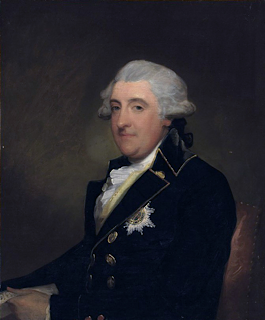
Death of William FitzGerald, 2nd Duke of Leinster

William Robert FitzGerald, 2nd Duke of LeinsterKPPC (Ire), an Irish liberal politician and landowner, dies at Carton House in Maynooth, County Kildare, on October 20, 1804.

FitzGerald is born on March 13, 1749, in Arlington Place, Piccadilly, London, the second son of nine sons and ten daughters of James Fitzgerald, 20th Earl of Kildare and later 1st Duke of Leinster, and his wife, Lady Emily Lennox. He is educated at Eton College (1758–63). He is the elder brother of the 1790s revolutionary Lord Edward FitzGerald, and is a first cousin of the English liberal politician Charles James Fox.

FitzGerald makes his Grand Tour between 1768 and 1769. During the same time, he is also a Member of Parliament (MP) for Kildare Borough. He then sits in the Irish House of Commons for Dublin City until 1773, when he inherits his father’s title and estates. He is appointed High Sheriff of Kildare for 1772. Politically he is a liberal supporter of Henry Grattan‘s Irish Patriot Party and he co-founds the Irish Whig Club in 1789. He controls about six Kildare members of the Irish House of Commons. In 1779, he is elected colonel of the Dublin Regiment of the Irish Volunteers.

In November 1775, FitzGerald marries Emilia Olivia Usher, daughter of the 1st Baron Saint George and Elizabeth Dominick and sole grand daughter of Sir Christopher Dominick. They have three sons and six daughters.

In 1770, FitzGerald is chosen Grandmaster of the masonic Grand Lodge of Ireland, a post he holds for two years. He is re-elected for another year in 1777. In 1783, he is among the first knights in the newly created Order of St. Patrick.

In 1788–89, FitzGerald is Master of the Rolls in Ireland. In theory a senior judicial office, it is then largely a sinecure, but so blatant a choice of a man who is wholly unqualified for it gives rise to unfavourable comment, and a few years later it becomes the rule that the Master must be a lawyer of repute.

FitzGerald is a supporter of Catholic emancipation and helps to found the Royal College of St. Patrick at Maynooth on land he donates, in 1795. Withdrawing from Parliament with Grattan in 1797, he moves to England to be with his sick wife and remains there during the Irish Rebellion of 1798.

FitzGerald’s homes are at Carton and Kilkea Castle in County Kildare, and at Leinster House in Dublin (now the home of the Oireachtas). He is a founder member of the Order of St. Patrick in 1783 and of the Royal Irish Academy in 1785, and is a large investor in the Royal Canal company launched in 1790. His family’s estates of 60,000 acres (25,000 Ha) in Kildare are in three main parts, around Maynooth, Rathangan and Athy. He rebuilds the main bridge in Athy over the River Barrow.

FitzGerald dies of strangury, a urinary tract disorder, at Carton House on October 20, 1804. He is buried in Kildare Abbey. His funeral is so well attended that the mourners reach across The Curragh. He is succeeded by his second, but eldest surviving, son, Augustus Frederick Fitzgerald, as 3rd Duke of Leinster.

Leave a comment

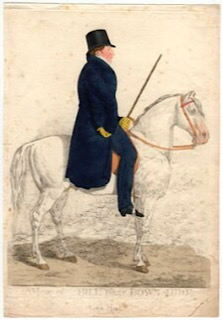
Death of Arthur Hill, 3rd Marquess of Downshire

Arthur Blundell Sandys Trumbull Hill, 3rd Marquess of Downshire KP, an Anglo-Irish peer, styled Viscount Fairford from 1789 until 1793 and Earl of Hillsborough from 1793 to 1801, dies on September 12, 1845, in Blessington, County Wicklow.

Hill is born in Hanover Square, on October 8, 1788, the eldest son of Arthur Hill, 2nd Marquess of Downshire, and his wife, Mary Sandys. He becomes Marquess of Downshire on the early death of his father in 1801. He is educated at Eton College and Christ Church, Oxford, gaining his MA in 1809 and a DCL in 1810.

During his early political career, Hill is identified with the Whigs and supports the reform of Parliament. After the Grey Ministry comes to power, he receives a succession of appointments, becoming Colonel of the South Down Militia on March 25, 1831, and carrying the second sword at the coronation of William IV on September 8. He is appointed a deputy lieutenant of Berkshire on September 20, Lord Lieutenant of Down on October 17 (a new office replacing the Governor of Down), and finally a Knight of the Order of St Patrick on November 24, 1831. He receives an honorary LL.D. from the University of Cambridge on July 6, 1835.

Hill is a very strong supporter of the Irish language, and is president of the Ulster Gaelic Society (est. 1830). In this capacity he plays an important role in helping preserve records of the language, poetry, folk and song collections and much else.

Hill is disliked by Elizabeth Smith, diarist at Baltyboys HouseCounty Wicklow, who feels snubbed by him when she and her husband first move into the area. Writing of him after his death she recalls “The late Lord never called upon me when I first came here although the Colonel waited upon him. The Colonel never went near him again.”

High-minded, if also at times high-handed in manner and self-important, Hill works hard himself and expects all his employees and tenants to be equally conscientious. Naturally, he is often disappointed. He is particularly concerned about his failure, despite all efforts and exhortations, to make his southern estates as efficient and well behaved as those in the north. Though an absentee owner in the south, he visits both Blessington and Edenderry regularly. It is during one of these periodic tours of inspection that he drops dead at Blessington on September 12, 1845. He is buried in St. Malachy Parish Churchyard at Royal Hillsborough, County Down. The funeral attracts an enormous crowd of mourners and is reported at some length in The Illustrated London News. His memory is perpetuated in an impressive pillar monument, with his statue on top, erected at Hillsborough in 1848.


Leave a comment

Birth of Lawrence Parsons, 4th Earl of Rosse

Lawrence Parsons, 4th Earl of Rosse, KP, FRS, a member of the Irish peerage and an amateur astronomer, is born at Birr Castle, Parsonstown, King’s County (now County Offaly), on November 17, 1840. His name is often given as Laurence Parsons.

Parsons is the son and heir of the astronomer William Parsons, 3rd Earl of Rosse, who built the “Leviathan of Parsonstownreflecting telescope, largest of its day, and his wife, the Countess of Rosse (née Mary Field), an amateur astronomer and pioneering photographer. He succeeds his father in 1867 and is educated first at home by tutors, like John Purser, and after at Trinity College Dublin (TCD) and the University of Oxford. He is the brother of Charles Algernon Parsons, inventor of the steam turbine.

Parsons serves as the eighteenth Chancellor of Trinity College Dublin between 1885 and 1908. His father serves as the sixteenth Chancellor. He is Lord Lieutenant of King’s County and Custos Rotulorum of King’s County from 1892 until his death. He is also a Justice of the Peace for the county and is appointed High Sheriff of King’s County for 1867–68. He is knighted KP in 1890.

Parsons also performs some preliminary work in association with the practices of the electrodeposition of copper sulfate upon silver films circa 1865 while in search of the design for a truly flat mirror to use in a telescope. However, he finds it impossible to properly electroplate copper upon these silver films, as the copper contracts and detaches from the underlying glass substrate. His note has been cited as one of the earliest confirmations in literature that thin films on glass substrates experience residual stresses. He revives discussion in his work Nature’s August 1908 edition after witnessing similar techniques used to present newly devised searchlights before the Royal Society.

Although overshadowed by his father (when astronomers speak of “Lord Rosse”, it is almost always the father that they refer to), Parsons nonetheless pursues some astronomical observations of his own, particularly of the Moon. Most notably, he discovers NGC 2, a spiral galaxy in the constellation Pegasus.

Parsons is elected a Fellow of the Royal Society in December 1867 and delivers the Bakerian lecture there in 1873. He is vice-president of the society in 1881 and 1887. From 1896 he is President of the Royal Irish Academy. In May 1902 he is at Caernarfon to receive the honorary degree LL.D. (Legum Doctor) from the University of Wales during the ceremony to install the Prince of Wales (later King George V) as Chancellor of that university.

After some years of ill-health, Parsons dies on August 30, 1908, at Birr Castle and is buried in the local churchyard. He leaves a bequest to the Royal Society to establish the “Rosse Fund,” and a further £1,000 to the science school fund at TCD.


Leave a comment

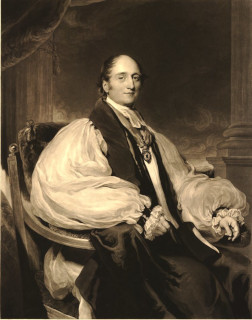
Death of Lord John Beresford, Anglican Archbishop of Armagh

Lord John George de la Poer Beresford, Anglican Archbishop of Armagh and Primate of all Ireland, dies on July 18, 1862, at Woburn, Bedfordshire, England.

Beresford is born at Tyrone House, Dublin, on November 22, 1773, the second surviving son of George de La Poer Beresford, 1st Marquess of Waterford, and his wife Elizabeth, only daughter of Henry Monck and maternal granddaughter of Henry Bentinck, 1st Duke of Portland. He attends Eton College and Christ Church, Oxford, where he graduates with a Bachelor of Arts in 1793 and a Master of Arts three years later.

Beresford is ordained a priest in 1797 and begins his ecclesiastical career with incumbencies at Clonegal and Newtownlennan. In 1799 he becomes Dean of Clogher and is raised to the episcopate as Bishop of Cork and Ross in 1805. He is translated becoming Bishop of Raphoe two years later and is appointed 90th Bishop of Clogher in 1819. He is again translated to become Archbishop of Dublin the following year and is sworn of the Privy Council of Ireland. In 1822, he goes on to be the 106th Archbishop of Armagh and therefore also Primate of All Ireland. He becomes Prelate of the Order of St. Patrick and Lord Almoner of Ireland. Having been vice-chancellor from 1829, he is appointed the 15th Chancellor of the University of Dublin in 1851, a post he holds until his death in 1862.

Beresford employs Lewis Nockalls Cottingham, one of the most skilled architects of the time, to restore St. Patrick’s Cathedral, Armagh. Cottingham removes the old, stunted spire and shores up the belfry stages while he rebuilds the piers and arches under it. The arcade walls which had fallen away as much as 21 inches from the perpendicular on the south side and 7 inches on the north side, are straightened by means of heated irons, and the clerestory windows which had long been concealed, are opened out and filled with tracery.

Beresford is unsympathetically represented by Charles Forbes René de Montalembert with whom he has breakfast at Castle Gurteen de la Poer during his tour of Ireland.

Beresford dies on July 18, 1862, at Woburn, Bedfordshire, England, the home of his niece, in the parish of Donaghadee and is buried in the cathedral. There is a memorial to him in the south aisle at St. Patrick’s Cathedral, Armagh.


1 Comment

Death of George Beresford, 1st Marquess of Waterford

George de la Poer Beresford, 1st Marquess of Waterford, KP, PC (Ire), an Irish politician, known as George Beresford, 2nd Earl of Tyrone from 1763 to 1789, dies on December 3, 1800.

Beresford is the eldest surviving son of Marcus Beresford, 1st Earl of Tyrone, and his wife, Lady Catherine Power, suo jure Baroness de la Poer. Among his siblings are John Beresford, who marries Countess Anne Constantin de Ligondes, and William Beresford, 1st Baron Decies, who marries Elizabeth FitzGibbon, sister of John FitzGibbon, 1st Earl of Clare.

Beresford’s mother is the only daughter of James Power, 3rd Earl of Tyrone (who is also the 8th Baron Power) and the former Anne Rickard, eldest daughter and co-heiress of Andrew Rickard, of Dangan-Spidoge. His father is the only son of Sir Tristram Beresford, 3rd Baronet, and his wife Nichola Sophia Hamilton, youngest daughter of Hugh Hamilton, 1st Viscount of Glenawly.

Beresford is educated at Kilkenny College and Trinity College Dublin.

From 1757 to 1760, Beresford is a Member of the Irish House of Commons for County Waterford from 1757 to 1760, and for Coleraine from 1761 until 1763, when he inherits his father’s earldom, enters the Irish House of Lords and is admitted to the Privy Council of Ireland.

Beresford is Governor of Waterford from 1766 and Custos Rotulorum of County Waterford from 1769 to 1800, during which time he is made a Knight of St. Patrick, created Baron Tyrone in the Peerage of Great Britain in 1786, and elevated as a marquess in 1789.

On April 19, 1769, Beresford marries Elizabeth Monck, the daughter of Henry Monck, of Charleville, and the former Lady Isabella Bentinck, second daughter of Henry Bentinck, 1st Duke of Portland. Elizabeth is also the cousin of Charles Monck, 1st Viscount Monck. Together, they are the parents of eight children:

Beresford also has two illegitimate sons, William Carr Beresford, 1st Viscount Beresford, and Sir John Beresford, 1st Baronet.

Beresford dies on December 3, 1800, and his titles pass to his eldest surviving legitimate son, Henry.

(Pictured: George Beresford, First Marquess of Waterford, oil on canvas by Gilbert Stuart (1755-1828))


Leave a comment

Death of James Hamilton, 3rd Duke of Abercorn

James Albert Edward Hamilton, 3rd Duke of Abercorn, dies on September 12, 1953 in London, England.

Hamilton is born in Hamilton Place, Piccadilly, London, on November 30, 1869. Styled Marquess of Hamilton between 1885 and 1913, he is a British peer and Unionist politician. He serves as the first Governor of Northern Ireland, a post he holds between 1922 and 1945. He is a great-grandfather of Diana, Princess of Wales.

Hamilton is the eldest son of James Hamilton, 2nd Duke of Abercorn, and godson of the Prince of Wales. His mother, Lady Mary Anna, is the fourth daughter of Richard Curzon-Howe, 1st Earl Howe. He is educated at Eton College and subsequently serves first in the Royal Inniskilling Fusiliers until 1892 when he joins the 1st Life Guards. He is later transferred as major to the North Irish Horse.

In early 1901 he accompanies his father on a special diplomatic mission to announce the accession of King Edward to the governments of Denmark, Sweden and Norway, Russia, Germany, and Saxony.

In the 1900 United Kingdom general election in Ireland, Hamilton stands successfully as Unionist candidate for Londonderry City, and three years later he becomes Treasurer of the Household, a post he holds until the fall of Arthur Balfour‘s Conservative administration in 1905. After serving for a time as an Opposition whip, Hamilton succeeds his father as third Duke of Abercorn in 1913. In 1922, he is appointed governor of the newly created Northern Ireland. He also serves as Lord Lieutenant of Tyrone from 1917 until his death, having previously been a Deputy Lieutenant for County Donegal. Hamilton proves a popular royal representative in Northern Ireland and is reappointed to the post in 1928 after completing his first term of office. In 1931, he declines the offer of the governor generalship of Canada, and three years later he is again reappointed governor for a third term. He remains in this capacity until his resignation in July 1945.

Hamilton is made the last non-royal Knight of the Most Illustrious Order of Saint Patrick in 1922. In 1928 he becomes a Knight of the Most Noble Order of the Garter and is also the recipient of an honorary degree from the Queen’s University Belfast. He receives the Royal Victorian Chain in 1945, the same year he is sworn of the Privy Council.

Hamilton marries Lady Rosalind Cecilia Caroline Bingham, only daughter of Charles George Bingham, 4th Earl of Lucan and his wife Lady Cecilia Catherine Gordon-Lennox at St. Paul’s Church, Knightsbridge, on November 1, 1894. They have three daughters and two sons.

Hamilton dies at his London home on September 12, 1953, and is buried at Baronscourt in County Tyrone.

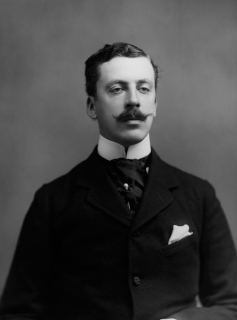
(Pictured: “James Albert Edward Hamilton, 3rd Duke of Abercorn” by Alexander Bassano, Collodion Negative, 1894, Photographs Collection, National Portrait Gallery, London)


Leave a comment

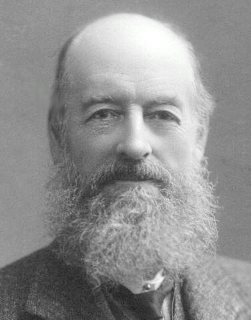
Death of Lawrence Parsons, 4th Earl of Rosse

Lawrence Parsons, 4th Earl of Rosse, KP, FRS, a member of the Irish peerage and an amateur astronomer, dies on August 29, 1908. His name is often given as Laurence Parsons.

Parsons is born at Birr Castle, Parsonstown, King’s County (now County Offaly), the son and heir of the astronomer William Parsons, 3rd Earl of Rosse, who built the “Leviathan of Parsonstownreflecting telescope, largest of its day, and his wife, the Countess of Rosse (née Mary Field), an amateur astronomer and pioneering photographer. He succeeds his father in 1867 and is educated first at home by tutors, like John Purser, and after at Trinity College, Dublin and the University of Oxford. He is the brother of Charles Algernon Parsons, inventor of the steam turbine.

Parsons serves as the eighteenth Chancellor of Trinity College, Dublin between 1885 and 1908. His father serves as the sixteenth Chancellor. He is Lord Lieutenant of King’s County and Custos Rotulorum of King’s County from 1892 until his death. He is also a Justice of the Peace for the county and is appointed High Sheriff of King’s County for 1867–68. He is knighted KP in 1890.

Parsons also performs some preliminary work in association with the practices of the electrodeposition of copper sulfate upon silver films circa 1865 while in search of the design for a truly flat mirror to use in a telescope. However, he finds it impossible to properly electroplate copper upon these silver films, as the copper contracts and detaches from the underlying glass substrate. His note has been cited as one of the earliest confirmations in literature that thin films on glass substrates experience residual stresses. He revives discussion in his work Nature’s August 1908 edition after witnessing similar techniques used to present newly devised searchlights before the Royal Society.

Although overshadowed by his father (when astronomers speak of “Lord Rosse”, it is almost always the father that they refer to), Parsons nonetheless pursues some astronomical observations of his own, particularly of the Moon. Most notably, he discovers NGC 2, a spiral galaxy in the constellation Pegasus.

Parsons is elected a Fellow of the Royal Society in December 1867 and delivers the Bakerian lecture there in 1873. He is vice-president of the society in 1881 and 1887. From 1896 he is President of the Royal Irish Academy. In May 1902 he is at Caernarfon to receive the honorary degree LL.D. (Legum Doctor) from the University of Wales during the ceremony to install the Prince of Wales (later King George V) as Chancellor of that university.


Leave a comment

Birth of Lord John Beresford, Archbishop of Armagh

Lord John George de la Poer Beresford, Anglican Archbishop of Armagh and Primate of all Ireland, is born at Tyrone House, Dublin on November 22, 1773.

Beresford is the second surviving son of George de La Poer Beresford, 1st Marquess of Waterford, and his wife Elizabeth, only daughter of Henry Monck and maternal granddaughter of Henry Bentinck, 1st Duke of Portland. He attends Eton College and Christ Church, Oxford, where he graduates with a Bachelor of Arts in 1793 and a Master of Arts three years later.

Beresford is ordained a priest in 1797 and begins his ecclesiastical career with incumbencies at Clonegal and Newtownlennan. In 1799 he becomes Dean of Clogher and is raised to the episcopate as Bishop of Cork and Ross in 1805. He is translated becoming Bishop of Raphoe two years later and is appointed 90th Bishop of Clogher in 1819. He is again translated to become Archbishop of Dublin the following year and is sworn of the Privy Council of Ireland. In 1822, he goes on to be the 106th Archbishop of Armagh and therefore also Primate of All Ireland. He becomes Prelate of the Order of St. Patrick and Lord Almoner of Ireland. Having been vice-chancellor from 1829, he is appointed the 15th Chancellor of the University of Dublin in 1851, a post he holds until his death in 1862.

Beresford employs Lewis Nockalls Cottingham, one of the most skilled architects at that time, to restore St. Patrick’s Cathedral, Armagh. Cottingham removes the old, stunted spire and shores up the belfry stages while he rebuilds the piers and arches under it. The arcade walls which had fallen away as much as 21 inches from the perpendicular on the south side and 7 inches on the north side, are straightened by means of heated irons, and the clerestory windows which had long been concealed, are opened out and filled with tracery.

Beresford is unsympathetically represented by Charles Forbes René de Montalembert with whom he has breakfast at Castle Gurteen de la Poer during his tour of Ireland.

Beresford dies on July 18, 1862, at Woburn, Bedfordshire, England, the home of his niece, in the parish of Donaghadee and is buried in the cathedral. There is a memorial to him in the south aisle at St. Patrick’s Cathedral, Armagh.


Leave a comment

Birth of Henry Loftus, 1st Earl of Ely

Henry Loftus, 1st Earl of Ely and 4th Viscount Loftus, Anglo-Irish peer and politician, is born on November 18, 1709.

Loftus is the younger son of Nicholas Loftus, 1st Viscount Loftus and Anne Ponsonby, daughter of William Ponsonby, 1st Viscount Duncannon. His elder brother is Nicholas Hume-Loftus, 1st Earl of Ely of the first creation.

Loftus serves as High Sheriff of Wexford in 1744 and between 1747 and 1768 represents Bannow in the Irish House of Commons. Subsequently he sits for Wexford County until 1769, when he succeeds his nephew Nicholas Hume-Loftus, 2nd Earl of Ely, as Viscount Loftus. He is created Earl of Ely (second creation) in 1771 and is appointed a Knight Founder of the Order of St. Patrick on March 11, 1783.

In 1745 Loftus marries Frances Monroe, daughter of Henry Monroe of Roe’s Hall, County Down. Frances is a leading figure in Dublin society who wields some political influence and is a much stronger character than her rather ineffectual husband, whom she seems to dominate completely. She dies in 1774.

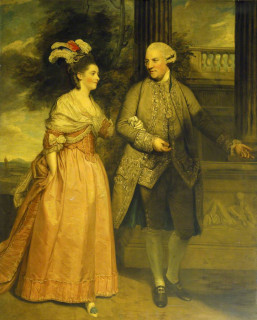
There is a portrait of the couple, with Lady Ely’s nieces, Dorothea (Dolly) and Frances Monroe, the daughters of her brother Henry Monroe of Roe’s Hall, by the celebrated Swiss painter Angelica Kauffman, who visits Ireland in 1771. Dolly Monroe is one of the greatest beauties of the age, whose admirers include Henry Grattan and Oliver Goldsmith. She marries the politician William Richardson and dies without issue in 1793. Her sister Frances marries Henry Read.

Loftus marries secondly Anne Bonfoy, daughter of Captain Henry Bonfoy and Anne Eliot, and sister of Edward Craggs-Eliot, 1st Baron Eliot. He has no issue by either marriage and at his death on May 8, 1783, his estates pass to his nephew Charles Loftus, 1st Marquess of Ely, the son of his sister Elizabeth and Sir John Tottenham, 1st Baronet. His widow dies in 1821, having outlived her mother, who lives to be 97, by only five years.

(Pictured: Henry Loftus (1709-1783), 1st Earl of Ely, and his wife Frances Monroe (d.1821), Countess of Ely, circa 1775, source National Trust, Upton House)


Leave a comment

Assassination of Sir Arthur Edward Vicars

arthur-vicars

Sir Arthur Edward Vicars, genealogist and heraldic expert, is assassinated in Kilmorna, County Kerry by the Irish Republican Army (IRA) on April 14, 1921.

Vicars is born on July 27, 1862 in Leamington Spa, Warwickshire, England, and is the youngest child of Colonel William Henry Vicars of the 61st Regiment of Foot and his wife Jane (nee Gun-Cunninghame). This is his mother’s second marriage, the first being to Pierce O’Mahony by whom she has two sons. He is very attached to his Irish half-brothers and spends much time at their residences. On completing his education at Magdalen College School, Oxford and Bromsgrove School he moves permanently to Ireland.

Vicars quickly develops an expertise in genealogical and heraldic matters and makes several attempts to be employed by the Irish heraldic administration of Ulster King of Arms, even offering to work for no pay. In 1891 he is one of the founder members of the County Kildare Archaeological Society and remains its honorary secretary until his death.

Vicars first attempts to find a post in the Office of Arms when in 1892 he applies unsuccessfully for the post of Athlone Pursuivant on the death of the incumbent, Bernard Louis Burke. In a letter dated October 2, 1892 his half-brother Pierce Mahony writes that Sir Bernard Burke, Ulster King of Arms, is dying and urges him to move at once. Burke dies in December 1892, and Vicars is appointed to the office by letters patent dated February 2, 1893. In 1896 he is knighted, in 1900 he is appointed Commander of the Royal Victorian Order (CVO) and in 1903 he is elevated to Knight Commander of the Order (KCVO). He is also a fellow of the Royal Society of Antiquaries of Ireland and a trustee of the National Library of Ireland.

In 1897 Vicars publishes An Index to the Prerogative Wills of Ireland 1536 -1810, a listing of all persons in wills proved in that period. This work becomes very valuable to genealogists after the destruction of the source material for the book in 1922 when the Public Record Office at the Four Courts is destroyed at the start of the Irish Civil War.

Vicars’ career is very distinguished until 1907 when it is hit by the scandal of the theft of the Irish Crown Jewels. As Registrar of the Order of St. Patrick, he has custody of the insignia of the order, also known as the “crown jewels.” They are found to be missing on July 6, and a Crown Jewel Commission is established in January 1908 to investigate the disappearance. Vicars and his barrister Tim Healy refuse to attend the commission’s hearings. The commission’s findings are published on January 25, 1908 and he is dismissed as Ulster five days later.

On November 23, 1912, the Daily Mail publishes serious false allegations against Vicars. The substance of the article is that Vicars had allowed a woman reported to be his mistress to obtain a copy of the key to the safe and that she had fled to Paris with the jewels. In July 1913 he successfully sues the paper for libel. The paper admits that the story is completely baseless and that the woman in question does not exist. He is awarded damages of £5,000.

Vicars leaves Dublin and moves to Kilmorna, near Listowel, County Kerry, the former seat of one of his half-brothers. He marries Gertrude Wright in Ballymore, County Westmeath on July 4, 1917. He continues to protest his innocence until his death, even including bitter references to the affair in his will.

In May 1920 up to a hundred armed men break into Kilmorna House and hold Vicars at gunpoint while they attempt to break into the house’s strongroom. On April 14, 1921, he is taken from Kilmorna House, which is set afire, and shot dead in front of his wife. According to the communiqué issued from Dublin Castle, thirty armed men took him from his bed and shot him, leaving a placard around his neck denouncing him as an informer. On April 27, as an official reprisal, four shops are destroyed by British Armed Forces in the town of Listowel. The proclamation given under Martial law and ordering their demolition states:

“For any outrage carried out in future against the lives or property of loyalist officials, reprisals will be taken against selected persons known to have rebel sympathies, although their implication has not been proved.”

Vicars is buried in Leckhampton, Gloucestershire on April 20, 1921. His wife dies in Somerset in 1946.