Sir John de Wogan, Cambro-Norman judge styled lord of Picton, ceases to be Justiciar of Ireland on August 6, 1312 although remaining nominally justiciar until April 1313. He serves as Justiciar of Ireland from 1295 to 1313.
In February 1308, under orders from the new king Edward II, Wogan suppresses the Knights Templar in Ireland. In June 1308 his forces are defeated by the O’Tooles and O’Byrnes, who are harrying The Pale from the Wicklow Mountains. From September 1308 to May 1309 Piers Gaveston, 1st Earl of Cornwall is in Ireland as “king’s lieutenant,” a new position outranking the justiciar, and he has more success against the Gaels. Wogan leaves Ireland in August 1312 although remaining nominally justiciar until April 1313.
McCarthy becomes a professional soldier and shows great skill in his profession, but poor eyesight hampers his career. He enters the French army in 1671 and then transfers to James Scott, 1st Duke of Monmouth‘s regiment, then in French pay, and serves against the Dutch.
McCarthy comes to England in 1678 and is befriended by the future James II, who generally chooses soldiers, especially Irish soldiers, as his boon companions. Charles II decides to use his services in Ireland and makes him a colonel in Sir Thomas Dongan‘s regiment. On the outbreak of the Popish Plot, however, the discovery of McCarthy’s presence at Whitehall causes uproar. He flees the country and the Secretary of State for the Northern Department, Sir Joseph Williamson, who had issued his commission, is sent to the Tower of London.
In 1689 McCarthy takes Castlemartyr and Bandon for James. At Bandon there is a massacre called “Black Monday,” but he persuades the King to issue a general pardon to his defeated opponents. He meets James at his landing at Kinsale and is commanded to raise seven regiments. He sits in the Irish House of Lords in the Parliament of Ireland of 1689.
With 3,000 men McCarthy advances from Dublin toward Enniskillen, which with Derry is the remaining resistance to James II. He is met by 2,000 Protestant “Inniskillingers” at the Battle of Newtownbutler on July 31, 1689. His forces are routed, he is wounded and then captured. Allowed out on parole he breaks parole and escapes to Dublin. Frederick Schomberg, 1st Duke of Schomberg, remarks that he had thought McCarthy was a man of honour, but on the other hand he expected no better from an Irishman.
McCarthy goes into exile in France and commands the first Irish Brigade of Louis XIV. His later career is hampered by his near blindness. He dies at Barèges on July 1, 1694, and is buried there.
Patrick Darcy, a prominent constitutional lawyer who wrote the constitution of Confederate Ireland, delivers his famous Argument during a conference on June 9, 1641.
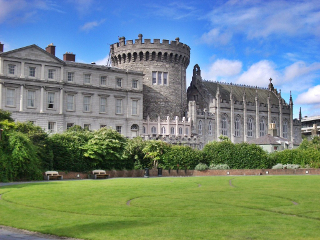
During a conference held in the dining room of Dublin Castle, Darcy delivers his Argument. Published in 1643 and reprinted in 1764, it is the first forceful and detailed statement of the rule of law in Ireland, articulating an effective constitutional position for her as England‘s colonial country. He is quoted arguing to William Molyneux that “no parliament but an Irish one can properly legislate for Ireland,” which is the central summation of his work.
In 1961, the American constitutional expert C.H. McIlwain says in compliment of Darcy’s Argument that it “constitute the first definite statement of the central point of the American opposition more than a century later. Patrick Darcy deserves a place in American constitutional history.”
The format of the 142-page Argument comprises a series of legal questions on the powers of the Parliament of Ireland in 1640–41. It refers to and suggests the extent by which the parliament’s general self-governing powers are superior to all ad-hoc (and possible illegal, unlawful or illicit) decisions by judges and royal officials in the Kingdom of Ireland. The relevant text nearest to the subject of Irish self-government is at page 130:
“Whither the Subjects of this kingdome bee a free people, and to be governed onely by the Common-lawes of England, and statutes of force in this kingdome. The subjects of this his Majesties kingdome of Ireland, are a free people, and to be governed onely according to the Common-law of England, and Statutes made & established by Parliament in this kingdome of Ireland, and according to the lawfull customes used in the same.”
The Bank of Ireland suspends gold payments on February 26, 1797. In the late 18th century, cash is king, whether it be gold or silver. If one has no gold or silver, one has no goods, unless one is a member of the 10,000 or so landed aristocratic families who are allowed to run up debts.
At the end of the 18th century Britain is at war with France. The British government requires gold above all to conduct its war with Napoleon. There is not enough to go around. There is not enough gold in the vaults of the Bank of England to adequately fund the war, much less for sending any of it to Ireland. Therefore, in 1797 the Bank of Ireland is obliged to stop issuing gold that it does not have and rather rely on well established banknotes to keep money in circulation. A few weeks later the stance taken by the Bank is approved of by Irish legislators in the Irish Parliament.
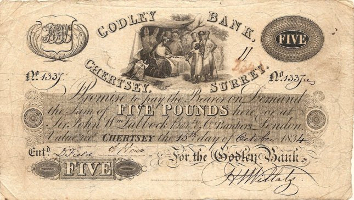
The withdrawal of gold and the increased issuing of notes leads to the establishment of a number of private banks in Ireland who are allowed to issue their own notes. In 1799 there are eleven private banks. By 1803, this number has increased to forty-one. Many of these banks subsequently fail and destroy the lives of their customers. The partners who run these financial institutions are identified on the banknotes they issue. Therefore their clients can see the names, but not the addresses, of the men who have financially destroyed them when they fall into liquidation.
By 1326 FitzGerald’s influence is such that there are rumours of a conspiracy to make him King of Ireland. Modern historians tend to dismiss the story, on the ground that the alleged conspirators were other magnates who were more interested in increasing their own power than aggrandising FitzGerald.
FitzGerald is created Earl of Desmond by Letters Patent dated at Gloucester, England, August 27, 1329, by which patent also the county palatine of Kerry is confirmed to him and his male heirs, to hold of the Crown by the service of one knight’s fee. This is part of a Crown policy of attempting to win the support of the magnates by conferring earldoms on them.
In January 1330 FitzGerald is summoned by Sir John Darcy, Lord Justice of Ireland, to fight armed Irish rebels, with a promise of the King’s pay. It is FitzGerald who introduces the practice of Coigne and Livery, the quartering of troops on the inhabitants of the district they are sent to protect.
Accepting the King’s proposal, in addition to dealing with Munster and Leinster, FitzGerald routs the O’Nolans and O’Murroughs and burns their lands in County Wicklow and forces them to give hostages. He recovers the castle of Ley from the O’Dempsies, and has a liberate of £100 sterling dated at Drogheda August 24, 1335, in return for the expense he has incurred in bringing his men-at-arms, hobelars, and foot-soldiers, from various parts of Munster to Drogheda, and there, with Lord Justice Darcy, disperses the King’s enemies.
In 1331 there are further rumours of an attempt to make him King. Although there seems to be no foundation for them, the Crown takes them seriously enough to imprison FitzGerald for several months. He is released when a number of fellow nobles stand surety for his good behaviour.
In 1339 FitzGerald is engaged against Irish rebels in County Kerry where it is said he slays 1,400 men, and takes Nicholas, Lord of Kerry, prisoner, keeping him confined until he dies as punishment for siding with the rebels against the Crown.
The same year FitzGerald is present in the parliament held in Dublin. He is summoned by Writ dated at Westminster July 10, 1344, with Maurice, Earl of Kildare, and others, to attend the King at Portsmouth “on the octaves of the nativity of the Virgin Mary,” with twenty men-at-arms and fifty hobelars, at his own expense, to assist in the war against Philip V of France.
FitzGerald, who has long been acting “with a certain disregard for the niceties of the law” now decides on open rebellion. In 1345 he presides at an assembly of Anglo-Irish magnates at Callan, County Kilkenny, ignores a summons to attend the Irish Parliament and attacks Nenagh. He is a formidable opponent, and for the next two years his defeat is the main preoccupation of the Crown. He surrenders on a promise that his life will be spared. He is imprisoned and his lands forfeited. He is allowed to go under guard to England to answer the charges against him.
By no means for the last time, the Crown evidently decides that it cannot govern Ireland without the magnates’ support. In 1348 FitzGerald is released and pardoned in 1349. His loyalty does not seem to have been in question during the last years of his life.
In July 1355 FitzGerald is appointed Lord Justice of Ireland for life, dying, however, the following January in Dublin Castle. He is interred in the Church of the Friars-Preachers in Tralee.
Brodrick is the second son of Sir St. John Brodrick of Ballyannan, near Midleton in County Cork, by his wife Alice, daughter of Laurence Clayton of Mallow, County Cork. His father receives large land grants during The Protectorate, and thus the family has much to lose if the land issue in Ireland is settled to the satisfaction of dispossessed Roman Catholics. He is educated at Magdalen College, Oxford and the Middle Temple, being called to the English bar in 1678. He and his relatives flee Ireland during the Glorious Revolution. They are attainted under the rule of King James II in Ireland. In exile in England, Brodrick argues for a speedy reconquest.
In 1690 Brodrick returns to Dublin and is given the legal office of Third Serjeant. He also becomes Recorder of Cork. He is dismissed as Serjeant in 1692, apparently on the ground that there is no work for him to do. While complaining bitterly about his dismissal, he admits privately that his post has been a superfluous one.
As a prominent Whig supporter of the outcome of the Glorious Revolution he is not always in agreement with court policies in Ireland, which he considers too lenient on the Jacobites. The dismissal of the First Serjeant, John Osborne, at the same time as Brodrick is due to his even stronger opposition to Court policy. Despite this he often holds Irish government offices and aspires to manage the Irish Parliament for English ministers. He represents Cork City in the Irish Parliament, which meets in 1692 and holds this seat until 1710. He is a vocal opponent of court policies, until the new Whig Lord Deputy of Ireland, Lord Henry Capell, decides to appoint him Solicitor-General for Ireland in 1695. He promotes penal laws against Catholics, whilst also supporting greater powers for the Irish Parliament.
Brodrick is Speaker of the Irish House of Commons from September 21, 1703. After promoting resolutions critical of the Lord Lieutenant of Ireland he loses his post as Solicitor-General in 1704. From 1707 until 1709 he is Attorney-General for Ireland. He becomes Chief Justice of Ireland in 1710 and is replaced as Speaker on May 19, 1710, but again holds the office in the next Parliament (November 25, 1713 – August 1, 1714), where he also represents County Cork. He is appointed Lord Chancellor of Ireland in 1714 and is ennobled in the Peerage of Ireland in 1715, as the 1st Baron Brodrick. He is advanced to the rank of 1st Viscount Midleton in 1717.
Brodrick feuds with his successor as Speaker William Conolly, as they are rivals to be the leading figure in Irish politics. Despite intrigues in England, he loses out and resigns as Lord Chancellor in 1725. He leaves behind him a legacy of bitterness and ill-will for which he is not really responsible as the Irish peers choose to blame him for the loss of their powers under the Sixth of George I, rather than their own misjudgment in imprisoning the Barons of the Exchequer.
Davis is the son of a Welsh father, a surgeon in the Royal Artillery, and an Irish mother. Through his mother he is descended from the Gaelic noble family of O’Sullivan Beare. His father dies one month after his birth and his mother moves to Warrington Place near Mount Street bridge in Dublin. In 1830, they move to 67 Lower Baggot Street. He attends school in Lower Mount Street before studying at Trinity College, Dublin. He graduates in Law and receives an arts degree in 1836, before being called to the Irish Bar in 1838.
Davis gives a voice to the 19th-century foundational culture of modern Irish nationalism. Formerly it is based on the republicans of the 1790s and on the Catholic emancipation movement of Daniel O’Connell in the 1820s-30s, which has little in common with each other except for independence from Britain. Davis aims to create a common and more inclusive base for the future. He establishes The Nation newspaper with Charles Gavan Duffy and John Blake Dillon.
He writes some stirring nationalistic ballads, originally contributed to The Nation and afterwards republished as Spirit of the Nation, as well as a memoir of Curran, the Irish lawyer and orator, prefixed to an edition of his speeches, and a history of King James II‘s parliament of 1689. He has formed many literary plans which are unfinished at the time of his early death.
Davis supports O’Connell’s Repeal Association from 1840, hoping to recreate the old Parliament of Ireland. They split during a debate on the proposed new Queen’s University of Ireland, when Davis is reduced to tears by O’Connell’s superior debating skill. Davis is in favour of a university that would inclusively educate all Irish students. O’Connell and the Catholic hierarchy prefer a separate system for Catholic students within Ireland that would remain under church control.
O’Connell generally refers to his inexperienced allies as “Young Ireland,” initially as a dismissive term, that from the 1870s becomes the accepted term for nationalists inspired by Davis. He also prefers a federal arrangement with Britain in the 1840s while Davis seeks a greater degree of autonomy. Both agree that a gradual and non-violent process is the best way forward. Despite their differences, O’Connell is distraught at Davis’s early death.
Davis is a Protestant but preaches unity between Catholics and Protestants. To him, it is not blood that makes a person Irish, but the willingness to be part of the Irish nation. He is to the fore of Irish nationalist thinking and it has been noted by later nationalist notables, such as Patrick Pearse, that while Theobald Wolfe Tone laid out the basic premise that Ireland as a nation must be free, Davis is the one who built this idea up promoting the Irish identity.
At the time Franklin is based in London attempting to negotiate on behalf of the American Colonies. Franklin details his views of Dublin and Ireland in a letter to Thomas Cushing, a lawyer and statesman from Boston, Massachusetts. Franklin has a keen interest in Irish affairs, writing in a letter two years prior to visiting the country that “all Ireland is strongly in favour of the American cause. They have reason to sympathise with us.”
As Franklin tours Ireland in 1771 and is astounded and moved by the level of poverty he sees there. Ireland is under the trade regulations and laws of England, which affect the Irish economy, and Franklin fears that America will suffer the same plight if Britain’s exploitation of the colonies continues. During his visit, Franklin also attends two sessions of Irish Parliament as an observer.
Franklin is struck by the contrast between the grandeur of Dublin city itself and the intense poverty of those beyond its core.
Franklin writes to a friend, “The people in that unhappy country, are in a most wretched situation. Ireland is itself a poor country, and Dublin a magnificent city; but the appearances of general extreme poverty among the lower people are amazing. They live in wretched hovels of mud and straw, are clothed in rags, and subsist chiefly on potatoes. Our New England farmers, of the poorest sort, in regard to the enjoyment of all the comforts of life, are princes when compared to them. Perhaps three-fourths of the Inhabitants are in this situation.”
In 1977, the United States Ambassador to IrelandWalter J.P. Curley presents a bust of Benjamin Franklin to the Bank of Ireland to commemorate the visit. Speaking at the unveiling of the bust, the Ambassador notes that Franklin’s friendship for Ireland was no fleeting whim. He had said “You have ever been friendly to the rights of mankind and we acknowledge with pleasure and gratitude that your nation has produced patriots who have nobly distinguished themselves in the cause of humanity and America.”
Boyle enters the army, and in 1709 is raised to the rank of major-general and sworn one of Her Majesty’s Privy Council. He is appointed to the Order of the Thistle and appointed queen’s envoy to the states of Brabant and Flanders. Having discharged this trust with ability, he is created an English peer, as Baron Boyle of Marston, in Somerset. He inherits the estate in 1714.
Boyle becomes a Fellow of the Royal Society in 1706. In 1713, under the patronage of Boyle, clockmaker George Graham creates the first mechanical solar system model that can demonstrate proportional motion of the planets around the Sun. The device is named the orrery in the Earl’s honour.
Boyle receives several additional honours in the reign of George I but, having had the misfortune to fall under the suspicion of the government for playing a part in the JacobiteAtterbury Plot, he is committed to the Tower of London in 1722, where he remains six months, and is then admitted to bail. On a subsequent inquiry he is discharged.
Boyle writes a comedy, As you find it, printed in 1703 and later publishes together with the plays of the first earl. In 1728, he is listed as one of the subscribers to the Cyclopaedia of Ephraim Chambers.
The college is established on June 5, 1795, as The Royal College of St. Patrick, by act of the Parliament of Ireland, to provide “for the better education of persons professing the popish or Roman Catholic religion.” The College in Maynooth is originally established to provide a university education for Catholic lay and ecclesiastical students and is based in Riverstown House on the south campus from 1802. With the opening of Clongowes Wood College in 1814, the lay college is closed and the college functions solely as a Catholic seminary for almost 150 years.
The college is particularly intended to provide for the education of Catholic priests in Ireland, who until this Act have to go to the continent for training. The added value in this is the reduction of the number of priests returning from training in revolutionary France, with whom Great Britain is at war, thus hindering potential revolution. The value to the government is proved by the condemnation by the Catholic Church hierarchy of the Irish Rebellion of 1798 and later support for the Act of Union.
In 1800, John Butler, 12th Baron Dunboyne, dies and leaves a substantial fortune to the College. Butler had been a Roman Catholic, and Bishop of Cork, who had embraced Protestantism in order to marry and guarantee the succession to his hereditary title. However, there are no children to his marriage, and it is alleged that he had been reconciled to the Catholic Church at his death. Were this the case, a Penal law demands that the will is invalid, and his wealth will pass to his family. Much litigation follows before a negotiated settlement in 1808 that leads to the establishment of a Dunboyne scholarship fund.
The land is donated by William FitzGerald, 2nd Duke of Leinster, who has argued in favour of Catholic emancipation in the Irish House of Lords. He lives nearby at Carton House and also at Leinster House. The building work is paid for by the British Government and parliament continues to give it an annual grant until the Irish Church Act 1869. When this law is passed the College receives a capital sum of £369,000. The trustees invest 75% of this in mortgages to Irish landowners at a yield of 4.25% or 4.75% per annum. This is considered a secure investment at the time but agitation for land reform and the depression of the 1870s erodes this security. The largest single mortgage is granted to the Earl of Granard. Accumulated losses on these transactions reached £35,000 by 1906.
The first building to go up on the site is designed by, and named after, John Stoyte. Stoyte House, which can still be seen from the entrance to the old campus, is a well-known building to Maynooth students and stands very close to the very historic Maynooth Castle. Over the next 15 years, the site at Maynooth undergoes rapid construction so as to cater to the influx of new students, and the buildings which now border St. Joseph’s Square are completed by 1824.
The Rev. Laurence F. Renehan (1797–1857), a noted antiquarian, church historian, and cleric, serves as president of St. Patrick’s from 1845 until 1857. Under Renehan, many of the college’s most important buildings are constructed by Augustus Pugin.
In 2015–16 there are approximately 80 men studying for the priesthood at Maynooth, 60 resident seminarians and approximately 20 non-residents.


 The
The 


 seamus dubhghaill