seamus dubhghaill

Promoting Irish Culture and History from Little Rock, Arkansas, USA


Leave a comment

Live Aid

live-aid-logo

Live Aid, a dual-venue benefit concert organised primarily by Dublin-born Bob Geldof, is held on July 13, 1985. The event is organised by Geldof and Midge Ure to raise funds for relief of the ongoing Ethiopian famine. Billed as the “global jukebox,” the event is held simultaneously at Wembley Stadium in London, England, (attended by 72,000 people) and John F. Kennedy Stadium in Philadelphia, Pennsylvania, (attended by about 100,000 people).

On the same day, concerts inspired by the initiative take place in other countries, such as the Soviet Union, Canada, Japan, Yugoslavia, Austria, Australia and West Germany. It was one of the largest-scale satellite link-ups and television broadcasts of all time. An estimated global audience of 1.9 billion, across 150 nations, watch the live broadcast. If accurate, this would be nearly 40% of the world population at the time.

In October 1984, images of millions of people starving to death in Ethiopia were shown in the UK in Michael Buerk‘s BBC News reports on the 1984 famine. The report shocks Britain, motivating its citizens to inundate relief agencies, such as Save the Children, with donations, and to bring the world’s attention to the crisis in Ethiopia. Bob Geldof also sees the report, and calls Midge Ure from Ultravox, and together they quickly co-write the song, “Do They Know It’s Christmas?” in the hope of raising money for famine relief. Geldof then contacts colleagues in the music industry and persuades them to record the single under the title “Band Aid” for free. On November 25, 1984, the song is recorded at SARM West Studios in Notting Hill, London and is released four days later. It stays at number-one on the UK Singles Chart for five weeks, is Christmas number one, and becomes the fastest-selling single ever in Britain and raises £8 million, rather than the £70,000 Geldof and Ure had initially expected.

The 1985 Live Aid concert is conceived as a follow-up to the successful charity single. The idea to stage a charity concert to raise more funds for Ethiopia originally comes from Boy George, the lead singer of Culture Club. On Saturday, December 22, 1984, an impromptu gathering of some of the other artists from Band Aid join Culture Club on stage at the end of their concert at Wembley Stadium for an encore of “Do They Know It’s Christmas?” George is so overcome by the occasion he tells Geldof that they should consider organising a benefit concert.

The concert begins at noon at Wembley Stadium in London. It continues at John F. Kennedy Stadium in the United States, starting at 8:51 EDT. The overall concert continues for just over 16 hours, but since many artists’ performances are conducted simultaneously in Wembley and JFK, the total concert’s length is much longer.

Throughout the concerts, viewers are urged to donate money to the Live Aid cause. Three hundred phone lines are manned by the BBC, so that members of the public can make donations using their credit cards. The phone number and an address that viewers can send cheques to are repeated every twenty minutes.

The following day, news reports state that between £40 and £50 million had been raised. It is now estimated that around £150m has been raised for famine relief as a direct result of the concerts. Geldof mentions during the concert that the Republic of Ireland had given the most donations per capita, despite being in the threat of a serious economic recession at the time. The single largest donation comes from the Al Maktoum, who is part of the ruling family of Dubai, who donates £1M during a phone conversation with Geldof.

Leave a comment

Birth of John Hughes, 1st Archbishop of New York

john-joseph-hughes

John Joseph Hughes, prelate of the Roman Catholic Church in the United States and the fourth Bishop and first Archbishop of the Archdiocese of New York, is born in the hamlet of Annaloghan, near Aughnacloy, County Tyrone in Northern Ireland on June 24, 1797.

Hughes is the third of seven children of Patrick and Margaret (née McKenna) Hughes. He and his family suffer religious persecution in their native land. He is sent with his elder brothers to a day school in the nearby village of Augher, and afterwards attends a grammar school in Aughnacloy. The family emigrates to the United States in 1816 and settles in Chambersburg, Pennsylvania. Hughes joins them there the following year.

After several unsuccessful applications to Mount St. Mary’s College in Emmitsburg, Maryland, he is eventually hired as a gardener at the college. During this time, he befriends Mother Elizabeth Ann Seton, who is impressed by Hughes and persuades the Rector to reconsider his admission. Hughes is subsequently admitted as a regular student of Mount St. Mary’s in September 1820.

On October 15, 1826, Hughes is ordained to the priesthood by Bishop Henry Conwell at St. Joseph’s Church in Philadelphia. His first assignment is as a curate at St. Augustine’s Church in Philadelphia, where he assists its pastor by celebrating Mass, hearing confessions, preaching sermons, and other duties in the parish.

Hughes is chosen by Pope Gregory XVI as the coadjutor bishop of the Diocese of New York on August 7, 1837. He is consecrated bishop at St. Patrick’s Old Cathedral on January 7, 1838, with the title of the titular see of Basilinopolis, by the Bishop of New York, John Dubois, his former Rector.

Hughes campaigns actively on behalf of Irish immigrants and attempts to secure state support for parochial schools. Although this attempt fails, he founds an independent Catholic school system which becomes an integral part of the Catholic Church’s structure at the Third Plenary Council of Baltimore (1884), which mandates that all parishes have a school and that all Catholic children be sent to those schools. In 1841, Hughes founds St. John’s College in New York City which is now Fordham University.

Hughes is appointed Apostolic Administrator of the diocese due to Bishop Dubois’ failing health. As coadjutor, he automatically succeeds Dubois upon the bishop’s death on December 20, 1842, taking over a diocese which covers the entire state of New York and northern New Jersey. He is a staunch opponent of Abolitionism and the Free-Soil movement, whose proponents often express anti-Catholic attitudes. Hughes also founds the Ultramontane newspaper New York Freeman to express his ideas.

Hughes becomes an archbishop on July 19, 1850, when the diocese is elevated to the status of archdiocese by Pope Pius IX. As archbishop, he becomes the metropolitan for the Catholic bishops serving all the dioceses established in the entire Northeastern United States. To the dismay of many in New York’s Protestant upper-class, Hughes foresees the uptown expansion of the city and begins construction of the current St. Patrick’s Cathedral on Fifth Avenue between 50th and 51st Street, laying its cornerstone on August 15, 1858. At the request of President Abraham Lincoln, Hughes serves as semiofficial envoy to the Vatican and to France in late 1861 and early 1862. Lincoln also seeks Hughes’ advice on the appointment of hospital chaplains.

Hughes serves as archbishop until his death. He is originally buried in St. Patrick’s Old Cathedral, but his remains are exhumed in 1882 and re-interred in the crypt under the altar of the new cathedral he had begun.


2 Comments

Deportation of Joe Doherty

joseph-doherty

Joe Doherty, a volunteer in the Belfast Brigade of the Provisional Irish Republican Army (IRA) who escapes during his 1981 trial for killing a member of the Special Air Service (SAS) in 1980, is arrested in the United States in 1983 and is deported to Northern Ireland by the U.S. government on February 19, 1992. A first season episode of Law & Order entitled “The Troubles” is based on his case.

The trial of Doherty and the other members of their four-man active service unit nicknamed the “M60 gang” begins in early May 1981, on charges including three counts of murder. On June 10, Doherty and seven other prisoners, including Angelo Fusco and the other members of the IRA unit, take a prison officer hostage at gunpoint in Crumlin Road Gaol and ultimately escape in waiting cars. Two days after the escape, Doherty is convicted in absentia and sentenced to life imprisonment with a minimum recommended term of thirty years.

Doherty escapes across the border into the Republic of Ireland, and then travels to the United States on a false passport. He lives with an American girlfriend in Brooklyn and New Jersey, working on construction sites and as a bartender at Clancy’s Bar in Manhattan, where he is arrested by the FBI on June 28, 1983. He is imprisoned in the Metropolitan Correctional Center in Manhattan, and a legal battle ensues with the British government seeking to extradite him back to Northern Ireland. Doherty claims he is immune from extradition as the killing of Royal Irish Constabulary Captain Herbert Westmacott was a political act. In 1985 federal judge John E. Sprizzo rules Doherty cannot be extradited as the killing is a “political offense.” Doherty’s legal battle continues as the United States Department of Justice then attempts to deport him for entering the country illegally.

Doherty remains in custody at the Metropolitan Correctional Center and attempts to claim political asylum, and on June 15, 1988, Attorney General Edwin Meese overturns an earlier ruling by the Federal Board of Immigration Appeals that Doherty can be deported to the Republic of Ireland and orders his deportation to Northern Ireland. In February 1989 new Attorney General Dick Thornburgh chooses not to support the decision made by his predecessor and asks lawyers for Doherty and the Immigration and Naturalization Service to submit arguments for a review of the decision and Doherty’s claim for asylum. By this time Doherty’s case is a cause célèbre with his sympathisers including over 130 Congressmen and a son of then President of the United States George H. W. Bush. In 1990 a street corner near the Metropolitan Correctional Center is named after him.

In August 1991, Doherty is transferred to a federal prison in Lewisburg, Pennsylvania, and on January 16, 1992, the Supreme Court of the United States overturns a 1990 Federal Appeals Court ruling by a 5-to-3 decision, paving the way for his deportation. On February 19, 1992, Doherty is deported to Northern Ireland, despite pleas to delay the deportation from members of Congress, Mayor of New York City David Dinkins, and the Cardinal Archbishop of New York, John Joseph O’Connor.

Doherty is returned to Crumlin Road Gaol before being transferred to HM Prison Maze. He is released from prison on November 6, 1998, under the terms of the Good Friday Agreement. After his release Doherty becomes a community worker specialising in helping disadvantaged young people. In 2006, he appears in the BBC television show Facing the Truth opposite the relatives of a soldier killed in the Warrenpoint ambush.


Leave a comment

Parnell Addresses U.S. House of Representatives

parnell-speaking-in-house-of-representatives

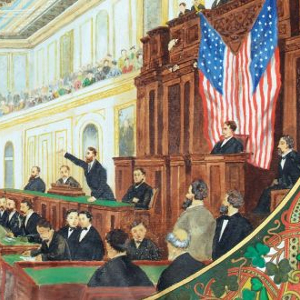
Irish Parliament member Charles Stewart Parnell addresses the United States House of Representatives during his North American tour on February 2, 1880 concerning the plight of Ireland, then in the midst of its second major potato famine of the century.

Despite the absence of a quorum, Speaker of the House Samuel J. Randall of Pennsylvania gavels the House into the evening session nearly 30 minutes late. The Chicago Daily Tribune reports that the House Floor is a mix of ladies and non-Members.

Only the fourth international leader to be invited to address the House, Parnell reports on the conditions of the Irish potato famine and its causes. “The present famine, as all other famines in Ireland, has been the direct result of the system of land tenure which is maintained there,” Parnell said, “And while we have been compelled by the frightful condition of our people . . . I feel it to be equally my duty to point out to you the cause which keeps Ireland in a condition of chronic poverty.”

After his 32-minute speech, the House adjourns for the evening. The Tribune judges Parnell’s address to be lackluster stating “the whole affair was tame and spiritless.” One Representative tells the Tribune reporter that the address failed because it lacked substance by “not going [even] skin deep into the subject of the Irish question.”

During Parnell’s highly successful tour, in addition to speaking before the House of Representatives, he has an audience with American President Rutherford B. Hayes and speaks in 62 cities in the United States and Canada, where he is so well received in Toronto that Timothy Healy dubs him “the uncrowned king of Ireland.”

House Receptions are not associated with other informal, social receptions and lunches provided for foreign leaders on behalf of congressional leadership or individual committees. In the post-World War II era, the practice of using one-chamber receptions is eventually discontinued. The last House Reception of a foreign leader is held for Mexican President José López Portillo in 1977.


Leave a comment

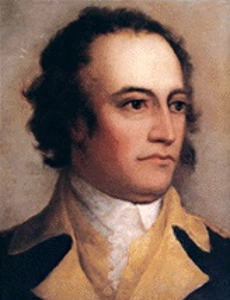
John Sullivan & The Battle of Trenton

john-sullivan

The Battle of Trenton is a small but pivotal battle during the American Revolutionary War which takes place on the morning of December 26, 1776, in Trenton, New Jersey.

The Continental Army has previously suffered several defeats in New York and has been forced to retreat through New Jersey to Pennsylvania. Morale in the army is low. To end the year on a positive note, George Washington, Commander-in-Chief of the Continental Army, devises a plan to cross the Delaware River on the night of December 25–26 and surround the Hessian garrison.

Because the river is icy and the weather severe, the crossing proves dangerous. Two detachments are unable to cross the river, leaving Washington with only 2,400 men under his command in the assault, 3,000 less than planned.

Washington’s army marches 9 miles south to Trenton. One division commanded by John Sullivan, the third son of Irish settlers from the Beara Peninsula in County Cork, secures the important bridge over the Assunpink Creek to the south of the town. This prevents escape and ensures the high number of Hessian prisoners captured.

The Hessians have lowered their guard, thinking they are safe from the American army, and have no long-distance outposts or patrols. Washington’s forces catch them off guard and, after a short but fierce resistance, most of the Hessians surrender, with negligible losses to the Americans. Almost two thirds of the 1,500-man garrison are captured, and only a few troops escaped across Assunpink Creek.

Despite the battle’s small numbers, the American victory inspires rebels in the colonies. With the success of the revolution in doubt a week earlier, the army had seemed on the verge of collapse. The dramatic victory inspires soldiers to serve longer and attracted new recruits to the ranks.

John Sullivan goes on to serve as a delegate in the Continental Congress, the third Governor of New Hampshire and a judge of the United States District Court for the District of New Hampshire. He dies on January 23, 1795, at the age of 54 in Durham, New Hampshire. He is buried in the Sullivan Family Burial Ground in Durham.


Leave a comment

Birth of Marcus O’Sullivan, Middle Distance Runner

marcus-osullivan

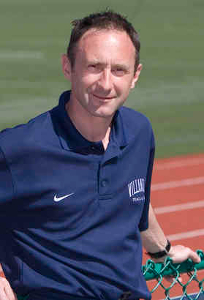
Marcus O’Sullivan, Irish middle distance runner, is born in Cork, County Cork, on December 22, 1961. Although he does not plan to enroll at any of Ireland’s universities, his running encourages him to go to Villanova University. After four years of education at Villanova, he graduates with a degree in accounting and later attains an MBA and a CPA.

O’Sullivan quickly becomes a world class runner and takes part in four summer Olympic Games. He wins three gold medals at the IAAF World Indoor Championships over 1500m in Indianapolis (1987), Budapest (1989), and Toronto (1993). In his victories in 1987 and 1989, he sets championship records. He is third all-time in total sub-4 minute miles with 101, trailing Steve Scott (137) and John Walker (127).

At the 1985 European Athletics Indoor Championships, O’Sullivan wins a silver medal in the 1500m. He finishes 4th in the 1991 IAAF World Indoor Championships in Seville, Spain. He qualifies for Ireland for Olympic Games in 1984, 1988, 1992, and 1996, at both 800 metres and 1500 metres. He reaches the 1500 metre finals at the 1988 Summer Olympics in Seoul, South Korea.

O’Sullivan sets an indoor 1500 metres world record of 3:35.4 on February 10, 1989, and is generally regarded as a better competitor running indoors. This is evidenced by the fact that he wins the prestigious Wanamaker Mile in Madison Square Garden‘s Millrose Games six times (1986, 1988, 1989, 1990, 1992, and 1996).

O’Sullivan’s personal best for the mile, which is set indoors in 1988, is 3:50.94. His personal best for the 1500 metres, which is set outdoors in 1996, is 3:33.61.

O’Sullivan, along with Irish runners Ray Flynn, Eamonn Coghlan, and Frank O’Mara (who ran collegiately at the University of Arkansas) establish the still standing world record in the 4 x 1 mile relay, when they combine in Dublin on August 17, 1985 to run 15:49.08.

O’Sullivan now runs the Running Works cross country summer camp in Canadensis, Pennsylvania, along with Cricket Batz, and is the head coach of Villanova cross country and track and field. He is coached by Tom Donnelly of Haverford College and advises Bob Kennedy in the later years before Kennedy’s retirement.

In addition to his ties to American record holder Bob Kennedy, O’Sullivan has coached elite professional runners such as Canadian indoor world silver medalist Carmen Douma-Hussar and New Zealander Adrian Blincoe.


Leave a comment

Birth of Irish Author Abraham “Bram” Stoker

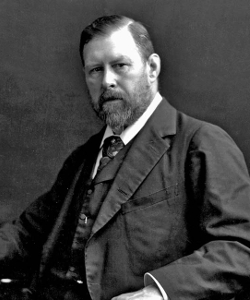
Abraham “Bram” Stoker, Irish author best known today for his 1897 Gothic fiction novel Dracula, is born on November 8, 1847 in Clontarf, Dublin. During his lifetime, he is better known as the personal assistant of actor Henry Irving and business manager of the Lyceum Theatre, London, which Irving owns.

Stoker’s father, Abraham Stoker, is a civil servant and his mother, Charlotte Mathilda Blake Thornley, is a charity worker and writer. Stoker is a sickly child and is bedridden with an unknown illness until he starts school at the age of seven, when he makes a complete recovery. Growing up his mother tells him a lot of horror stories which may have influence on his later writings.

In 1864 Stoker enters Trinity College, Dublin. While attending college he begins working as an Irish civil servant. He also works part time as a free lance journalist and drama critic. In 1876 he meets Henry Irving, a famous actor, and they soon become friends. Not long after that, Stoker meets and falls in love with an aspiring actress named Florence Balcombe whom he marries on December 4, 1878 at St. Anne’s Parish Church, Dublin. In 1878 he accepts a job working in London as Irving’s personal secretary.

On December 9, Stoker and his new wife move to England to join Irving. His first book The Duties of Clerks of Petty Sessions in Ireland though written while he is still in Dublin, is published in 1879. On December 30, 1879 Stoker and his wife have their only child, a son Noel. While in England Stoker also writes several novels and short stories. His first book of fiction, Under the Sunset, is published in 1881.

Stoker visits the English coastal town of Whitby in 1890, a visit that is said to be part of the inspiration for Dracula. Before writing Dracula, he meets Ármin Vámbéry, a Hungarian writer and traveller. Dracula likely emerges from Vámbéry’s dark stories of the Carpathian Mountains. Stoker then spends several years researching European folklore and mythological stories of vampires.

Dracula is an epistolary novel, written as a collection of realistic but completely fictional diary entries, telegrams, letters, ship’s logs, and newspaper clippings, all of which add a level of detailed realism to the story, a skill which Stoker develops as a newspaper writer. At the time of its publication, Dracula is considered a “straightforward horror novel” based on imaginary creations of supernatural life.

The original 541-page typescript of Dracula is believed to have been lost until it is found in a barn in northwestern Pennsylvania in the early 1980s. It consists of typed sheets with many emendations, plus handwritten on the title page is “THE UN-DEAD.” The author’s name is shown at the bottom as Bram Stoker. The typescript is purchased by Microsoft co-founder Paul Allen.

After suffering a number of strokes, Abraham “Bram” Stoker dies at No. 26 St. George’s Square, London on April 20, 1912. Some biographers attribute the cause of death to tertiary syphilis, others to overwork. He is cremated and his ashes are placed in a display urn at Golders Green Crematorium in north London.


Leave a comment

Laying of the Cornerstone for the White House

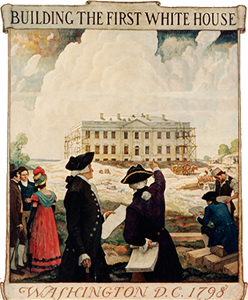
The cornerstone is laid for the White House in the newly designated capital city of Washington, D.C., on October 13, 1792. Earlier in the year, work begins on the neoclassical White House building at 1600 Pennsylvania Avenue under the guidance of Irish American architect James Hoban, whose design is influenced by Leinster House in Dublin and by a building sketch in James GibbsA Book of Architecture.

Hoban is an Irish Catholic raised on an estate belonging to the Earl of Desart in Cuffesgrange, near Callan, County Kilkenny. He works there as a wheelwright and carpenter until his early twenties, when he is given an “advanced student” place in the Dublin Society‘s Drawing School on Lower Grafton Street. He studies under Thomas Ivory. He excels in his studies and receives the prestigious Duke of Leinster‘s medal from the Dublin Society for drawings of “Brackets, Stairs, and Roofs” in 1780. Later, Hoban finds a position as an apprentice to Ivory, from 1779 to 1785.

Following the American Revolutionary War, Hoban emigrates to the United States, and establishes himself as an architect in Philadelphia, Pennsylvania in 1785.

Hoban is in South Carolina by April 1787, where he designs numerous buildings including the Charleston County Courthouse. President George Washington admires Hoban’s work on his Southern Tour and summons the architect to Philadelphia, the temporary national capital, in June 1792.

In July 1792, Hoban is named winner of the design competition for the White House. His initial design seems to have had a 3-story facade, nine bays across, much like the Charleston courthouse. Under Washington’s influence, Hoban amends this to a 2-story facade, eleven bays across, and, at Washington’s insistence, the whole presidential mansion is faced with stone. It is unclear whether any of Hoban’s surviving drawings are actually from the competition.

In 1800, President John Adams becomes the first president to reside in the executive mansion, which soon becomes known as the “White House” because its white-gray Virginia freestone contrasts strikingly with the red brick of nearby buildings.


Leave a comment

Death of John Barry, Father of the American Navy

John Barry, an officer in the Continental Navy during the American Revolutionary War and later in the United States Navy, dies on September 13, 1803 in present day Philadelphia, Pennsylvania. He comes to be widely credited as “The Father of the American Navy,” a moniker he shares with John Paul Jones and John Adams, and is appointed a captain in the Continental Navy on December 7, 1775. He is the first captain placed in command of a U.S. warship commissioned for service under the Continental flag.

After the war, Barry becomes the first commissioned U.S. naval officer, at the rank of commodore, receiving his commission from President George Washington in 1797.

Barry is born on March 25, 1745, in Tacumshane, County Wexford. When his family is evicted from their home by their British landlord, they move to Rosslare on the coast, where his uncle works a fishing skiff. As a young man, Barry determines upon a life as a seaman and he starts out as a ship’s cabin boy.

Barry receives his first captain’s commission in the Continental Navy on March 14, 1776, signed by John Hancock, president of the Continental Congress. Barry is a religious man and begins each day at sea with a reading from the Bible. He has great regard for his crew and their well being and always makes sure they are properly provisioned while at sea. During his naval career Barry commands the USS Delaware, USS Lexington, USS Raleigh, and USS Alliance.

On February 22, 1797, he is issued Commission Number 1 by President George Washington, backdated to June 4, 1794. His title is thereafter “commodore.” He is recognized as not only the first American commissioned naval officer but also as its first flag officer.

Appointed senior captain upon the establishment of the U.S. Navy, he commands the frigate USS United States in the Quasi-War with the French Republic. This ship transports commissioners William Richardson Davie and Oliver Ellsworth to France to negotiate a new Franco-American alliance.

Barry’s last day of active duty is March 6, 1801, when he brings USS United States into port, but he remains head of the Navy until his death.

Barry dies of asthma on September 13, 1803, at Strawberry Hill, in present-day Philadelphia, and is buried in the graveyard of Old St. Mary’s Roman Catholic Church in Center City, Philadelphia.

(Pictured: Portrait of Commodore John Barry, US Navy, by V. Zveg, 1972, from the 1801 portrait by Gilbert Stuart.)


Leave a comment

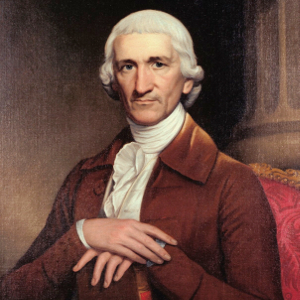
Death of Charles Thomson, Secretary of the Continental Congress

Charles Thomson, Irish-born Patriot leader in Philadelphia during the American Revolution and the secretary of the Continental Congress (1774–1789) throughout its existence, dies in Lower Merion Township, Pennsylvania, on August 16, 1824.

Thomson is born in Gorteade townland, Maghera parish, County Londonderry, to Scots Irish parents. After the death of his mother in 1739, his father emigrates to the British colonies in America with Charles and his brothers. His father dies at sea and the penniless boys are separated in America. Charles is cared for by a blacksmith in New Castle, Delaware, and is educated in New London Township, Pennsylvania. In 1750 he becomes a tutor in Latin at the Philadelphia Academy.

During the French and Indian War, Thomson is an opponent of the Pennsylvania proprietors’ American Indian policies. He serves as secretary at the Treaty of Easton (1758) and writes An Enquiry into the Causes of the Alienation of the Delaware and Shawanese Indians from the British Interest (1759), which blames the war on the proprietors. He is allied with Benjamin Franklin, the leader of the anti-proprietary party, but the two men part politically during the Stamp Act crisis in 1765. Thomson becomes a leader of Philadelphia’s Sons of Liberty. He is married to the sister of Benjamin Harrison V, another signer, as delegate, of the Declaration of Independence.

Thomson is a leader in the revolutionary crisis of the early 1770s. John Adams calls him the “Samuel Adams of Philadelphia.” Thomson serves as the secretary of the Continental Congress through its entirety. Through those 15 years, the Congress sees many delegates come and go, but Thomson’s dedication to recording the debates and decisions provides continuity. Along with John Hancock, president of the Congress, Thomson’s name (as secretary) appears on the first published version of the Declaration of Independence in July 1776.

Thomson’s role as secretary to Congress is not limited to clerical duties. Thomson is also noted for designing, with William Barton, the Great Seal of the United States. The Great Seal plays a prominent role in the January 14, 1784, ratification of the Treaty of Paris (1783). Britain’s representatives in Paris initially dispute the placement of the Great Seal and Congressional President Thomas Mifflin‘s signature, until mollified by Benjamin Franklin.

But Thomson’s service is not without its critics. James Searle, a close friend of John Adams, and a delegate, begins a cane fight on the floor of Congress against Thomson over a claim that he is misquoted in the “Minutes” that results in both men being slashed in the face. Such brawls on the floor are not uncommon, and many of them are promoted by argument over Thomson’s recordings. Political disagreements prevent Thomson from getting a position in the new government created by the United States Constitution. Thomson resigns as secretary of Congress in July 1789 and hands over the Great Seal, bringing an end to the Continental Congress.

Thomson spends his final years at Harriton House in Bryn Mawr, Pennsylvania working on a translation of the Bible. He also publishes a synopsis of the four evangelists in 1815. In retirement, Thomson also pursues his interests in agricultural science and beekeeping. According to Thomas Jefferson, writing to John Adams, Thomson becomes senile in his old age, unable to recognize members of his own household.