seamus dubhghaill

Promoting Irish Culture and History from Little Rock, Arkansas, USA


Leave a comment

Birth of Johnny Adair, Northern Irish Loyalist

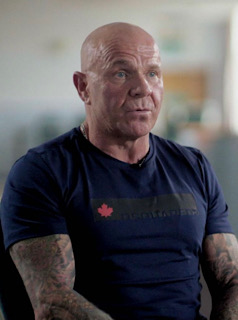
Johnny Adair, leader of “C Company” of the Ulster Loyalist paramilitary organisation Ulster Freedom Fighters (UFF), a cover name of the Ulster Defence Association, is born in Belfast, Northern Ireland, on October 27, 1963. He is known as Mad Dog. He is expelled from the organisation in 2002 following a violent power struggle. Since 2003, he, his family and a number of supporters have been forced to leave Northern Ireland by other loyalists.

Adair is born into a working class loyalist background and raised in Belfast. He grows up in the Lower Oldpark area, a site of many sectarian clashes during “The Troubles.” By all accounts, he has little parental supervision, and does not attend school regularly. He takes to the streets, forming a skinhead street gang with a group of young loyalist friends, who “got involved initially in petty, then increasingly violent crime.” Eventually, he starts a rock band called Offensive Weapon, which during performances espouses support for the British National Front.

While still in his teens, Adair joins the Ulster Young Militants (UYM), and later the Ulster Defence Association, a loyalist paramilitary organisation which also calls itself the Ulster Freedom Fighters.

By the early 1990s, Adair has established himself as head of the UDA/UFF’s “C Company” based on the Shankill Road. When he is charged with terrorist offences in 1995, he admits that he had been a UDA commander for three years up to 1994. During this time, he and his colleagues are involved in multiple and random murders of Catholic civilians. At his trial in 1995, the prosecuting lawyer says he is dedicated to his cause against those whom he “regarded as militant republicans – among whom he had lumped almost the entire Roman Catholic population.” Royal Ulster Constabulary (RUC) detectives believe his unit killed up to 40 people during this period.

Adair once remarks to a Catholic journalist from the Republic of Ireland upon the discovery of her being Catholic, that normally Catholics travel in the boot of his car. According to a press report in 2003, he is handed details of republican suspects by British Army intelligence, and is even invited for dinner in the early 1990s. In his autobiography, he claims he was frequently passed information by sympathetic British Army members, while his own whereabouts were passed to republican paramilitaries by the RUC Special Branch, who, he claims, hated him.

The Provisional Irish Republican Army (IRA) bombing of a fish shop on the Shankill Road in October 1993 is an attempt to assassinate Adair and the rest of the UDA’s Belfast leadership in reprisal for attacks on Catholics. The IRA claims that the office above the shop is regularly used by the UDA for meetings and one is due to take place shortly after the bomb is set to explode. The bomb goes off early, killing one IRA man, Thomas Begley, and nine Protestant civilians. The UFF retaliates with a random attack on the Rising Sun bar in Greysteel, County Londonderry, which kills eight civilians, two of whom are Protestants. Adair survives 13 assassination attempts, most of which are carried out by the IRA and Irish National Liberation Army (INLA).

During this time, undercover officers from the Royal Ulster Constabulary record months of discussions with Adair, in which he boasts of his activities, producing enough evidence to charge him with directing terrorism. He is convicted and sentenced to 16 years in HM Prison Maze. In prison, according to some reports, he sells drugs such as cannabis, ecstasy tablets and amphetamines to other loyalist prisoners, earning him an income of £5000 a week.

In January 1998, Adair is one of five loyalist prisoners visited in the prison by British Secretary of State for Northern Ireland, Mo Mowlam. She persuades them to drop their objection to their political representatives continuing the talks that leads to the Good Friday Agreement in April. In 1999, he is released early as part of a general amnesty for political prisoners after the Agreement.

Following his release, much of Adair’s activities are bound up with violent internecine feuds within the UDA and between the UDA and other loyalist paramilitary groupings. The motivation for such violence is sometimes difficult to piece together. It involves a combination of political differences over the loyalist ceasefires, rivalry between loyalists over control of territory and competition over the proceeds of organised crime.

In 1999, shortly after his release from prison, Adair is shot at and grazed in the head by a bullet at a UB40 concert in Belfast. He blames the shooting on republicans, but it is thought that rival loyalists are to blame.

In August 2000, Adair is again mildly injured by a pipe bomb he is transporting in a car. He again attempts to blame the incident on an attack by republicans, but this claim is widely discounted. A feud breaks out at the time between the UDA and the Ulster Volunteer Force (UVF) leaving several loyalists dead. As a result of Adair’s involvement in the violence, the then Secretary of State for Northern Ireland, Peter Mandelson, revokes his early release and returns him to prison.

In May 2002, Adair is released from prison again. Once free, he is a key part of an effort to forge stronger ties between the UDA/UFF and the Loyalist Volunteer Force (LVF), a small breakaway faction of the UVF loyalist paramilitary organization in Northern Ireland. The most open declaration of this is a joint mural depicting Adair’s UDA “C company” and the LVF. Other elements in the UDA/UFF strongly resist these movements, which they see as an attempt by Adair to win external support in a bid to take over the leadership of the UDA. Some UDA members dislike his overt association with the drugs trade, with which the LVF are even more heavily involved. A loyalist feud begins, and ends with several men dead and scores evicted from their homes.

On September 25, 2002, Adair is expelled from the UDA/UFF along with close associate John White, and the organisation almost splits as Adair tries to woo influential leaders such as Andre Shoukri, who are initially sympathetic to him. There are attempts on Adair’s and White’s lives.

Adair returns to prison in January 2003, when his early release licence is revoked by Secretary of State for Northern Ireland, Paul Murphy, on grounds of engaging in unlawful activity. On February 1, 2003, UDA divisional leader John Gregg is shot dead along with another UDA member, Rab Carson, on returning from a Rangers F.C. match in Glasgow. The killing is widely blamed on Adair’s C Company as Gregg is one of those who organised his expulsion from the UDA. Five days later, on February 6, about twenty Adair supporters, including White, flee their homes for Scotland, widely seen as a response to severe intimidation.

Adair is released from prison again on January 10, 2005. He immediately leaves Northern Ireland and joins his family in Bolton, Lancashire, where it is claimed he stays with supporters of Combat 18 and the Racial Volunteer Force.

The police in Bolton question Adair’s wife, Gina, about her involvement in the drugs trade, and his son, nicknamed both “Mad Pup” and “Daft Dog,” is charged with selling crack cocaine and heroin. Adair is arrested and fined for assault and threatening behaviour in September 2005. He had married Gina Crossan, his partner for many years and the mother of his four children, at HM Prison Maze on February 21, 1997. She is three years Adair’s junior and grew up in the same Lower Oldpark neighbourhood. 

After being released, Adair is almost immediately arrested again for violently assaulting Gina, who suffers from ovarian cancer. Since this episode he reportedly moves to Scotland, living in Troon in Ayrshire.

In May 2006, Adair reportedly receives £100,000 from John Blake publishers for a ghost-written autobiography.

In November 2006, the UK’s Five television channel transmits an observational documentary on Adair made by Dare Films.

Adair appears in a documentary made by Donal MacIntyre and screened in 2007. The focus of the film centers around Adair and another supposedly reformed character, a Neo-Nazi from Germany called Nick Greger, and their trip to Uganda to build an orphanage. Adair is seen to fire rifles, stating it is the first time he has done so without wearing gloves. He also admits to being “worried sick” and “pure sick with worry” after Greger disappears in Uganda for days on end. It turns out that he had gone off and married a Ugandan lady. Adair confesses via telephone that he “thought something might have happened to Nick.”

On July 20, 2015, three Irish republicans, Antoin Duffy, Martin Hughes and Paul Sands, are found guilty of planning to murder Adair and Sam McCrory. Charges against one of the accused in the trial are dropped on July 1.

On September 10, 2016, Adair’s son, Jonathan Jr., is found dead in Troon, aged 32. He dies from an accidental overdose while celebrating the day after his release from prison for motoring offences. He had been in and out of prison since the family fled Northern Ireland. He served a five-year sentence for dealing heroin and crack cocaine. The year before, he had been cleared of a gun raid at a party and in 2012 is the target of a failed bomb plot. He was also facing trial later that year on drugs charges.

In December 2023, while recording a podcast with far-right activist Tommy Robinson, Adair surprisingly expresses a grudging respect for the IRA hunger strikers, describing the manner of their deaths as “dedication at the highest level” for a political cause and admitting that he would not have volunteered to do the same if asked.

3 Comments

Birth of Paul “Dingus” Magee, Volunteer in the Provisional Irish Republican Army

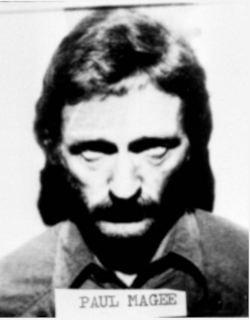
Paul “Dingus” Magee, a former volunteer in the Belfast Brigade of the Provisional Irish Republican Army (IRA), is born in the Ballymurphy area of Belfast, Northern Ireland, on January 30, 1948.

Magee joins the Belfast Brigade of the IRA and receives a five-year sentence in 1971 for possession of firearms. He is imprisoned in Long Kesh, where he holds the position of camp adjutant. In the late 1970s and early 1980s he is part of a four-man active service unit, along with Joe Doherty and Angelo Fusco, nicknamed the “M60 gang” due to their use of an M60 general-purpose machine gun. On April 9, 1980, the unit lures the Royal Ulster Constabulary (RUC) into an ambush on Stewartstown Road, killing Constable Stephen Magill and wounding two others. On May 2 the unit is planning another attack and has taken over a house on Antrim Road, when an eight-man patrol from the British Army‘s Special Air Service (SAS) arrives in plain clothes, after being alerted by the RUC. A car carrying three SAS members goes to the rear of the house, and another car carrying five SAS members arrives at the front of the house. As the SAS members at the front of the house exit the car the IRA unit opens fire with the M60 machine gun from an upstairs window, hitting Captain Herbert Westmacott in the head and shoulder. Westmacott is killed instantly and is the highest-ranking member of the SAS killed in Northern Ireland. The remaining SAS members at the front of the house, armed with Colt Commando automatic rifles, submachine guns and Browning pistols, return fire but are forced to withdraw. Magee is apprehended by the SAS members at the rear of the house while attempting to prepare the IRA unit’s escape in a transit van, while the other three IRA members remain inside the house. More members of the security forces are deployed to the scene, and after a brief siege the remaining members of the IRA unit surrender.

The trial of Magee and the other members of the M60 gang begins in early May 1981, with them facing charges including three counts of murder. On June 10 Magee and seven other prisoners, including Joe Doherty, Angelo Fusco and the other member of the IRA unit, take a prison officer hostage at gunpoint in Crumlin Road Jail. After locking the officer in a cell, the eight take other officers and visiting solicitors hostage, also locking them in cells after taking their clothing. Two of the eight wear officer’s uniforms while a third wears clothing taken from a solicitor, and the group moves toward the first of three gates separating them from the outside world. They take the officer on duty at the gate hostage at gunpoint and force him to open the inner gate. An officer at the second gate recognises one of the prisoners and runs into an office and presses an alarm button, and the prisoners run through the second gate towards the outer gate. An officer at the outer gate tries to prevent the escape but is attacked by the prisoners, who escape onto Crumlin Road. As the prisoners are moving toward the car park where two cars are waiting, an unmarked RUC car pulls up across the street outside Crumlin Road Courthouse. The RUC officers open fire, and the prisoners return fire before escaping in the waiting cars. Two days after the escape, Magee is convicted in absentia and sentenced to life imprisonment with a minimum recommended term of thirty years.

Magee escapes across the border into the Republic of Ireland. Eleven days after the escape he appears in public at the Wolfe Tone commemoration in Bodenstown Graveyard, County Kildare, where troops from the Irish Army and the Garda‘s Special Branch attempt to arrest him but fail after the crowd throws missiles and lay down in the road blocking access. He is arrested in January 1982 along with Angelo Fusco and sentenced to ten years imprisonment for the escape under extra-jurisdictional legislation. Shortly before his release from prison in 1989, he is served with an extradition warrant, and he starts a legal battle to avoid being returned to Northern Ireland. In October 1991, the Supreme Court of Ireland in Dublin orders his return to Northern Ireland to serve his sentence for the murder of Captain Westmacott, but Magee jumps bail, and a warrant is issued for his arrest.

Magee flees to England, where he is part of an IRA active service unit. On June 7, 1992, Magee and another IRA member, Michael O’Brien, are traveling in a car on the A64 road between York and Tadcaster, when they are stopped by the police. Magee and O’Brien are questioned by the unarmed police officers, who become suspicious and call for back-up. Magee shoots Special Constable Glenn Goodman, who dies later in hospital, and then shoots the other officer, PC Kelly, four times. Kelly escapes death when a fifth bullet ricochets off the radio he is holding to his ear, and the IRA members drive away. Another police car begins to follow the pair and comes under fire near Burton Salmon. The lives of the officers in the car are in danger, but Magee and O’Brien flee the scene after a member of the public arrives. A manhunt is launched, and hundreds of police officers, many of them armed, search woods and farmland. Magee and O’Brien evade capture for four days by hiding in a culvert, before they are both arrested in separate police operations in the town of Pontefract.

On March 31, 1993, Magee is found guilty of the murder of Special Constable Goodman and the attempted murder of three other police officers and sentenced to life imprisonment. O’Brien is found guilty of attempted murder and receives an eighteen-year sentence. On September 9, 1994, Magee and five other prisoners, including Danny McNamee, escape from HM Prison Whitemoor. The prisoners, in possession of two guns that had been smuggled into the prison, scale the prison walls using knotted sheets. A guard is shot and wounded during the escape, and the prisoners are captured after being chased across fields by guards and the police. In 1996 Magee stages a dirty protest in HM Prison Belmarsh, in protest at glass screens separating prisoners from their relatives during visits. He has refused to accept visits from his wife and five children for two years, prompting Sinn Féin to accuse the British government of maintaining “a worsening regime that is damaging physically and psychologically.”

In January 1997, Magee and the other five escapees from Whitemoor are on trial on charges relating to the escape for a second time, as four months earlier the first trial had been stopped because of prejudicial publicity. Lawyers for the defendants successfully argued that an article in the Evening Standard prejudiced the trial as it contained photographs of Magee and two other defendants and described them as “terrorists,” as an order had been made at the start of the trial preventing any reference to the background and previous convictions of the defendants. Despite the judge saying the evidence against the defendants was “very strong”, he dismisses the case stating, “What I have done is the only thing I can do in the circumstances. The law for these defendants is the same law for everyone else. They are entitled to that, whatever they have done.”

On May 5, 1998, Magee is repatriated to the Republic of Ireland to serve the remainder of his sentence in Portlaoise Prison, along with Liam Quinn and the members of the Balcombe Street Gang. He is released from prison in late 1999 under the terms of the Good Friday Agreement and returns to live with his family in Tralee, County Kerry. On March 8, 2000, he is arrested on the outstanding Supreme Court extradition warrant from 1991 and remanded to Mountjoy Prison. The following day he is granted bail at the High Court in Dublin, after launching a legal challenge to his extradition. In November 2000 the Irish government informs the High Court that it is no longer seeking to return him to Northern Ireland. This follows a statement from Secretary of State for Northern Ireland Peter Mandelson saying that “it is clearly anomalous to pursue the extradition of people who appear to qualify for early release under the Good Friday Agreement scheme, and who would, on making a successful application to the Sentence Review Commissioners, have little if any of their original prison sentence to serve.” In December 2000 Magee and three other IRA members, including two other members of the M60 gang, are granted a Royal Prerogative of Mercy which allows them to return to Northern Ireland without fear of prosecution.


Leave a comment

Birth of Angelo Fusco, Provisional Irish Republican Army Volunteer

Angelo Fusco, former volunteer in the Belfast Brigade of the Provisional Irish Republican Army (IRA) who escapes during his 1981 trial for killing a Special Air Service (SAS) officer in 1980, is born in West Belfast, Northern Ireland, on September 2, 1956.

Fusco is born to a family with an Italian background who owns a fish and chip shop. He joins the Belfast Brigade of the IRA and is part of a four-man active service unit (ASU), along with Joe Doherty and Paul Magee, which operates in the late 1970s and early 1980s nicknamed the “M60 gang” due to their use of an M60 heavy machine gun.

On April 9, 1980, the unit lures the Royal Ulster Constabulary (RUC) into an ambush on Stewartstown Road, killing one constable and wounding two others. On May 2 the unit is planning another attack and has taken over a house on Antrim Road, when an eight-man patrol from the SAS arrive in plain clothes, after being alerted by the RUC. A car carrying three SAS members goes to the rear of the house, and another car carrying five SAS members arrives at the front of the house. As the SAS members at the front of the house exit their car the IRA unit opens fire with the M60 machine gun from an upstairs window, hitting Captain Herbert Westmacott in the head and shoulder, killing him instantly. He is the highest-ranking member of the SAS killed in Northern Ireland. The remaining SAS members, armed with Colt Commando automatic rifles, submachine guns and Browning pistols, return fire but are forced to withdraw. Magee is apprehended by the SAS members at the rear of the house while attempting to prepare the IRA unit’s escape in a transit van, while the other three IRA members remain inside the house. More members of the security forces are deployed to the scene, and after a brief siege the remaining members of the IRA unit surrender.

The trial of Fusco and the other members of the M60 gang begins in early May 1981, with them facing charges including three counts of murder. On June 10 Fusco and seven other prisoners, including Joe Doherty and the other members of the IRA unit, take a prison officer hostage at gunpoint in Crumlin Road Jail. After locking the officer in a cell, the eight take other officers and visiting solicitors hostage, also locking them in cells after taking their clothing. Two of the eight are wearing officer’s uniforms while a third wears clothing taken from a solicitor, and the group moves towards the first of three gates separating them from the outside world. They take the officer on duty at the gate hostage at gunpoint and force him to open the inner gate. An officer at the second gate recognises one of the prisoners and runs into an office and presses an alarm button, and the prisoners run through the second gate towards the outer gate. An officer at the outer gate tries to prevent the escape but is attacked by the prisoners, who escape onto Crumlin Road. As the prisoners are moving towards the car park where two cars are waiting, an unmarked RUC car pulls up across the street outside Crumlin Road Courthouse. The RUC officers open fire, and the prisoners returned fire before escaping in the waiting cars. Two days after the escape, Fusco is convicted in absentia and sentenced to life imprisonment with a minimum recommended term of thirty years.

Fusco escapes across the border into the Republic of Ireland before being arrested in January 1982 and is sentenced to ten years imprisonment for the escape and firearms offences under extra-jurisdictional legislation. A further three years are added to his sentence in 1986 after he attempts to escape from Portlaoise Prison, and he is released in January 1992. Upon his release, he is immediately served with extradition papers from the British government for his return to the Maze Prison in Northern Ireland to serve his sentence for the murder conviction. The extradition is granted by a District Court but Fusco appeals, and in 1995 he wins a legal victory when a judge at the High Court in Dublin rules it would be “unjust, oppressive and invidious” to order his extradition due to the time lag involved. Fusco settles in Tralee with his wife and three children until February 1998, when the Supreme Court of Ireland brings an end to the six-year legal battle by ordering his extradition, but he has already fled on bail and a warrant is issued for his arrest.

Fusco is arrested at a Garda checkpoint in Castleisland, County Kerry, on January 3, 2000. The following day he is being escorted back to Northern Ireland to be handed over to the RUC, when his handover is halted by a successful court appeal by Sinn Féin. The arrest and abortive return of Fusco undermines the Northern Ireland peace process, with Unionist politicians including Ken Maginnis criticising the extradition being halted. Republicans are critical of Fusco’s arrest, with leading Sinn Féin member Martin Ferris stating, “The Irish government should immediately move to rescind the warrant against Angelo Fusco. The action will cause great anger and resentment within the nationalist community,” and graffiti in one republican area reads “Extradite Bloody Sunday war criminals, not Fusco.” On January 6 Fusco is refused bail and remanded to prison in Castlerea, County Roscommon, to await a legal review of his extradition, prompting scuffles outside the court between police and Sinn Féin supporters.

Fusco is freed on bail on March 21 pending the outcome of his legal challenge, and in November 2000 the Irish government informs the High Court that it is no longer seeking to return him to Northern Ireland. This follows a statement from Secretary of State for Northern Ireland Peter Mandelson saying that “it is clearly anomalous to pursue the extradition of people who appear to qualify for early release under the Good Friday Agreement scheme, and who would, on making a successful application to the Sentence Review Commissioners, have little if any of their original prison sentence to serve.” After the court hearing Fusco states, “I’m relieved it’s over,” and that he will continue to live in Tralee with his family and work for Sinn Féin.

In December 2000 Fusco and three other IRA members, including two other members of the M60 gang, are granted a royal prerogative of mercy which allows them to return to Northern Ireland without fear of prosecution.


Leave a comment

David Trimble Backs Power Sharing Deal with Sinn Féin

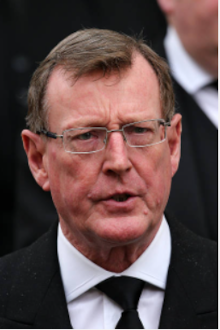
David Trimble, the leader of Northern Ireland‘s Protestant majority Ulster Unionist Party (UUP), announces on May 18, 2000 that he will back a power sharing deal with Catholic Sinn Féin when his party’s ruling council votes on it later in the month.

The 860-ruling Unionist Party council had been scheduled to meet on Saturday, May 13, but postponed the session for a week to allow Trimble to broaden his support among unionists still opposed to the deal. The council is expected to vote on resuming participation in a joint executive, which had been suspended on February 11 after the Irish Republican Army (IRA) failed to initiate disarmament.

The postponement of the unionist council meeting means a scheduled restart of devolution two days later will also be postponed. Great Britain and Ireland had offered to restore the Northern Ireland Assembly and a power-sharing executive composed of unionist, nationalist and republican members by May 22.

Great Britain and Ireland are co-sponsors of the 1998 Good Friday Agreement on reconciliation between the Catholic and Protestant communities. Trimble tells news media he is ready to support a return to sharing power with Sinn Féin, the IRA’s political wing, after receiving assurances on the arms issue.

Earlier in the month, the IRA broke the stalemate with an offer to put its arms arsenals beyond use under international supervision. The IRA offer fell short of a pledge to submit its weapons to destruction, as was understood from previous talks on the issue, but both Great Britain and Ireland back the compromise and press for its acceptance by unionists and nationalists as well.

Great Britain’s Northern Ireland Secretary Peter Mandelson describes the postponement as the “correct decision.” He says, “David Trimble has been clarifying some issues and driving a hard bargain over others. Now he needs time to present the outcome to his party.” He says he is confident that Trimble will be successful and the way will then be paved for the return to power-sharing.

However, hard-line Ulster Unionist leader Jeffrey Donaldson says he does not believe that weapons will be put beyond use. “What we actually need to know and hear from the IRA is are they going to decommission their weapons?” Donaldson, a member of the British parliament, says in a BBC interview. “We haven’t had any clarification from the IRA.”

British Prime Minister Tony Blair says in parliament on Wednesday, May 17, the IRA offer to put its weapons “beyond use” is “an important confidence-building measure” but only the start of a process of silencing the guns. “We need to make progress until the time when these weapons are indeed completely, verifiably, beyond use,” Blair says.

(From: “Unionist leader says he will back Ulster deal,” UPI Archives, http://www.upi.com/archives, May 18, 2000)


Leave a comment

Mo Mowlam Presented International Woman of the Year Award

mo-mowlan

Marjorie “Mo” Mowlam, English Labour Party politician, is presented with the International Woman of the Year Award at a ceremony in Dublin on October 23, 2001. United Nations High Commissioner for Human Rights Mary Robinson wins the Overall Award at the Irish Tatler Women of the Year Awards.

Mowlam is born on September 18, 1949 in Watford, Hertfordshire, England but grows up in Coventry. She starts her education at Chiswick Girls’ grammar school in West London, then moves to Coundon Court school in Coventry which, at the time, is one of the first comprehensive schools in the country. She then studies at Trevelyan College, Durham University, reading sociology and anthropology. She joins the Labour Party in her first year.

Mowlam becomes the Secretary of the Durham Union Society in 1969 and later goes on to become the Vice-President of the Durham Student’s Union. She works for then-MP Tony Benn in London and American writer Alvin Toffler in New York, moving to the United States with her then-boyfriend and studying for a PhD in political science at the University of Iowa.

Mowlam is a lecturer in the Political Science Department at the University of Wisconsin–Milwaukee in 1977 and at Florida State University in Tallahassee from 1977 to 1979. During her time in Tallahassee, someone breaks into her apartment. She suspects that it is Ted Bundy, the serial killer and rapist who is thought to have murdered at least 35 young women and attacked several others. She returns to England in 1979 to take up an appointment at the University of Newcastle upon Tyne.

Having failed to win selection for the 1983 general election, Mowlam is selected as Labour candidate for the safe seat of Redcar after James Tinn stands down. She takes the seat in the 1987 general election, becoming the Labour spokesperson on Northern Ireland later that year. Together with Shadow Chancellor John Smith, she is one of the architects of Labour’s “Prawn Cocktail Offensive” dedicated to reassuring the UK’s financial sector about Labour’s financial rectitude.

Mowlam joins the Shadow Cabinet when John Smith becomes leader of the Labour Party in 1992, holding the title of Shadow Secretary of State for National Heritage. During this time, she antagonises both monarchists and republicans by calling for Buckingham Palace to be demolished and replaced by a “modern” palace built at public expense. Later, her willingness to speak her mind, often without regard to the consequences, is seen as her greatest strength by her supporters.

Following Smith’s death in 1994, Mowlam, alongside Peter Kilfoyle, becomes a principal organiser of Tony Blair‘s campaign for the Labour leadership. After his victory, Blair makes her Shadow Secretary of State for Northern Ireland. She initially resists being appointed to the position, preferring an economic portfolio, but, after accepting it, she throws her weight into the job.

Mowlam oversees the negotiations which lead to the 1998 Good Friday Agreement. She is successful in helping to restore an Irish Republican Army (IRA) ceasefire and including Sinn Féin in multi-party talks about the future of Northern Ireland. In an attempt to persuade the Ulster loyalists to participate in the peace process, she pays an unprecedented and potentially dangerous visit to loyalist prisoners in HM Prison Maze, meeting convicted murderers face-to-face and unaccompanied.

Mowlam witnesses the Good Friday Agreement signing in 1998, which leads to the temporary establishment of a devolved power-sharing Northern Ireland Assembly. However, an increasingly difficult relationship with Unionist parties means her role in the talks is ultimately taken over by Tony Blair and his staff.

Mowlam’s deteriorating relationship with Unionists is the key reason she is replaced by Peter Mandelson as Northern Ireland Secretary in October 1999. Her move to the relatively lowly position of Minister for the Cabinet Office possibly involves other factors, notably her health and her popularity. On September 4, 2000, she announces her intention to retire from Parliament and relinquishes her seat at the 2001 general election.

Five months before the 1997 general election, Mowlam is diagnosed with a brain tumor, a fact that she tries to keep private. She appears to suffer from balance problems as a result of her radiotherapy. According to her husband, she falls on July 30, 2005, receiving head injuries and never regaining consciousness. Her living will, in which she asks not to be resuscitated, is honoured. On August 12, 2005, Mowlan is moved to Pilgrims Hospice in Canterbury, Kent, where she dies seven days later, on August 19, 2005, aged 55.

Mowlam is an atheist and is cremated in Sittingbourne on September 1, 2005 at a non-religious service conducted by Reverend Richard Coles, formerly of the 1980s band The Communards. Half of her ashes were scattered at Hillsborough Castle, the Secretary of State for Northern Ireland’s official residence, and the other half in her former parliamentary constituency of Redcar.


Leave a comment

The Good Friday Agreement Comes Into Operation

good-friday-agreement-signing

The Good Friday Agreement, a major political development in the Northern Ireland peace process, comes into operation on December 2, 1999, as the British and Irish governments formally notify each other that all the necessary arrangements are in place.

The notification ceremony takes place at Iveagh House, St. Stephen’s Green, headquarters of the Department of Foreign Affairs and Trade, at a joint signing by Minister for Foreign Affairs and Trade David Andrews and Secretary of State for Northern Ireland Peter Mandelson.

Northern Ireland‘s present devolved system of government is based on the agreement. The agreement also creates a number of institutions between Northern Ireland and the Republic of Ireland, and between the Republic of Ireland and the United Kingdom.

The agreement is made up of two inter-related documents, both agreed upon in Belfast on Good Friday, April 10, 1998. The first is a multi-party agreement by most of Northern Ireland’s political parties. The second is an international agreement between the British and Irish governments, known as the British-Irish Agreement.

The agreement sets out a complex series of provisions, or strands, relating to a number of areas:

Strand 1 addresses the status and system of government of Northern Ireland within the United Kingdom and establishes two major institutions – the Northern Ireland Assembly and the Northern Ireland Executive.

Strand 2 addresses the relationship between Northern Ireland and the Republic of Ireland and the institutions to be created between them – the North/South Ministerial Council, the North/South Inter-Parliamentary Association, and the North/South Consultative Forum.

Strand 3 addresses the relationship between the Republic of Ireland and the United Kingdom and institutions to be created between Ireland and Great Britain – the British/Irish Intergovernmental Conference, the British-Irish Council, and an expanded British-Irish Parliamentary Assembly.

Issues relating to sovereignty, civil and cultural rights, decommissioning of weapons, justice, and policing are central to the agreement.

The agreement is approved by voters across the island of Ireland in two referendums held on May 22, 1998. In Northern Ireland, voters are asked whether they support the multi-party agreement. In the Republic of Ireland, voters are asked whether they will allow the state to sign the agreement and allow necessary constitutional changes to facilitate it. The people of both jurisdictions need to approve the agreement in order to give effect to it.

The Good Friday Agreement comes into force on December 2, 1999. The Democratic Unionist Party (DUP) is the only major political group in Northern Ireland to oppose the Good Friday Agreement.

(Pictured: British Prime Minister Tony Blair and Irish Taoiseach Bertie Ahern sign the Good Friday Agreement)