seamus dubhghaill

Promoting Irish Culture and History from Little Rock, Arkansas, USA


Leave a comment

Birth of Sir Anthony Babington, Barrister, Judge & Politician

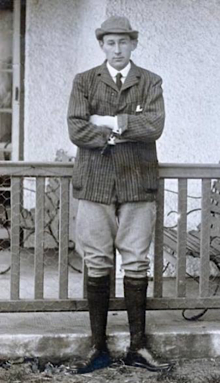
Sir Anthony Brutus Babington PC (NI)Anglo-Irish barristerjudge and politician, is born on November 24, 1877, at Creevagh House, County Londonderry, to Hume Babington JP, son of Rev. Hume Babington and a landowner of 1,540 acres, and Hester (née Watt), sister of Andrew Alexander Watt.

Babington is born into the Anglo-Irish Babington family that arrives in Ireland in 1610 when Brutus Babington is appointed Bishop of Derry. Notable relations include Robert BabingtonWilliam BabingtonBenjamin Guy Babington and James Melville Babington and author Anthony Babington.

Babington is educated at Glenalmond SchoolPerthshire, and Trinity College, Dublin, where he wins the Gold Medal for Oratory of the College Historical Society in 1899.

Babington is called to the Irish Bar in 1900. He briefly lectures in Equity at King’s Inns, and it is during this time, in 1910, that he re-arranges and re-writes R.E. Osborne’s Jurisdiction and Practice of County Courts in Ireland in Equity and Probate Matters. He takes silk in 1917.

Babington moves to the newly established Northern Ireland in 1921 and practises as a barrister until his election to the House of Commons of Northern Ireland as the Ulster Unionist Party member for Belfast South in the 1925 Northern Ireland general election and subsequent appointment as Attorney General for Northern Ireland the same year in the cabinet of James Craig, 1st Viscount Craigavon. His appointment to the Privy Council of Northern Ireland in 1926 entitles him to the style “The Right Honourable.” From 1929 he is the MP for Belfast Cromac, the Belfast South constituency having been abolished. He is made an honorary bencher of the Middle Temple in 1930.

Babington resigns from politics in 1937 upon his appointment as a Lord Justice of Appeal and is knighted in the 1937 Coronation Honours.

In 1947, Babington chairs the Babington Agricultural Enquiry Committee, named in his honour, which is established in 1943 to examine agriculture in Northern Ireland. The committee’s first recommendation under Babington’s leadership is that Northern Ireland should direct all its energies to the production of livestock and livestock products and to their efficient processing and marketing.

Babington retires from the judiciary in 1949, taking up the chairmanship of the Northern Ireland Transport Tribunal, which exists until 1967, established under the Ulster Transport Act – promoting a car-centred transport policy – and which is largely responsible for the closure of the Belfast and County Down Railway. He endorses the closure on financial grounds and is at cross purposes with his co-chair, Dr. James Beddy, who advises against the closure, citing the disruption of life in the border region between the north and the south as his primary reason in addition to financial grounds.

Babington also chairs a government inquiry into the licensing of clubs, the proceeds of which results in new regulatory legislation at Stormont. While Attorney General, he is a proponent of renaming Northern Ireland as “Ulster.”

Babington is critical of the newly proposed Irish constitution, in which the name of the Irish state is changed to “Ireland,” laying claim to jurisdiction over Northern Ireland.

Michael McDunphy, Secretary to the President of Ireland, then Douglas Hyde, recalls Ernest Alton‘s correspondence with Babington on the question of Irish unity, in which Alton and Babington are revealed to be at cross purposes. The discussion is used as an example by Brian Murphy, in Forgotten Patriot: Douglas Hyde and the Foundation of the Irish Presidency, as an example of the office of the Irish President becoming embroiled in an initiative involving Trinity College Dublin and a senior Northern Ireland legal figure, namely Babington. 

Babington writes to Alton, then Provost of Trinity College, Dublin, expressing his view that, as Murphy summarises, “… Severance between the two parts of Ireland could not continue, that it was the duty of all Irishmen to work for early unification and that in his opinion Trinity College was a very appropriate place in which the first move should be made.” When Alton arrives to meet with Hyde, it emerges, after conversing with Hyde’s secretary McDunphy, that he and Babington are at cross purposes. “It soon became clear that the united Ireland contemplated by Mr. [sic] Justice Babington of the Northern Ireland Judiciary was one within the framework of the British Commonwealth of Nations, involving recognition of the King of England as the Supreme Head, or as Dr. Alton put it, the symbol of unity of the whole system,” writes McDunphy.

On September 5, 1907, Babington marries Ethel Vaughan Hart, daughter of George Vaughan Hart of Howth, County Dublin (the son of Sir Andrew Searle Hart) and his wife Mary Elizabeth Hone, a scion of the Hone family. They have three children.

Babington is a member of the Apprentice Boys of Derry. From 1926 to 1952, he is a member of the board of governors of the Belfast Royal Academy. He serves as warden (chairman) of the board from 1941 to 1943. Through his efforts the school acquires the Castle Grounds from Anthony Ashley-Cooper, 9th Earl of Shaftesbury in 1934.

Babington is a keen golfer. He is an international golfer from 1903 to 1913, during which he is runner-up in the Irish Amateur Golf Championships in 1909 and one of the Irish representatives at an international match in 1913. The Babington Room in the Royal Portrush Golf Club is named after him, as is the 18th hole on the course as a result of the key role he plays in shaping its history.

Babington dies at the age of 94 on April 10, 1972 at his home, Creevagh, Portrush, County Antrim.

Leave a comment

Birth of Charles Lanyon, Civil Engineer & Architect

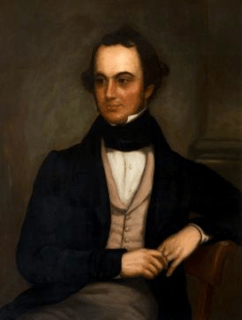
Sir Charles Lanyon, DL, JP, civil engineer and architect, is born on January 6, 1813, at Eastbourne, Sussex, England, third son of John Jenkinson Lanyon, purser in the Royal Navy, and Catherine Lanyon (née Mortimer). His work is most closely associated with Belfast, Northern Ireland.

Following his local education, Lanyon becomes an apprentice civil engineer with Jacob Owen in Portsmouth. When Owen is made senior Engineer and Architect of the Irish Board of Works and moves to Dublin, Lanyon follows. In 1835 he marries Owen’s daughter, Elizabeth Helen. They have ten children, including Sir William Owen Lanyon, an army officer and future administrator of the Transvaal in southern Africa.

Lanyon is county surveyor in County Kildare briefly, a post he exchanges for its equivalent in County Antrim, based in Belfast, when the incumbent, Thomas Jackson Woodhouse, resigns in 1836. By 1842, he has built the Antrim coast road between Larne and Portrush, through spectacular natural surroundings. He designs the lofty three-arched Glendun viaduct on this route near Cushendun, an early example of his versatile talent for monumental display as well as the Ormeau Bridge over the River Lagan. He remains county surveyor of Antrim until 1861 when he resigns from the post to concentrate on private work and other interests.

Lanyon is elected Mayor of Belfast in 1862, and Conservative MP for the city between 1865 and 1868. In 1868 he is also knighted and serves on the Select Committee on Scientific Instruction.

Lanyon loses his Belfast parliamentary seat in 1868 to William Johnston but continues to serve as a Belfast Town councillor until 1871. From 1862 to 1886 he is Belfast Harbour Commissioner. He serves as Deputy Lieutenant for County Antrim and is appointed High Sheriff of Antrim in 1876. He is also a Justice of the Peace for many years.

Lanyon’s other business interests include being director of the Blackstaff Flax Spinning Company and chairman of several railway companies. He is made director of the Northern Counties Railway in 1870 but resigns in 1887 because of ill-health. Alongside his business activities he is an active Freemason and serves as Provincial Deputy Grand Master of Belfast and North Down between 1863 and 1868, Provincial Deputy Grand Master of Antrim between 1868 and 1883 and Provincial Grand Master of Antrim between 1883 and 1889.

Lanyon lives at The Abbey, a grand house in Whiteabbey, County Antrim, which eventually becomes a sanitorium during World War I and is now part of Whiteabbey Hospital. His wife dies in 1858, and his son William dies from cancer at the age of 44 in 1887. He dies at The Abbey on May 31, 1889, and is buried in Knockbreda Cemetery, Belfast, in a tomb also of his design.


Leave a comment

Death of John McKeague, Northern Irish Loyalist

John Dunlop McKeague, a Northern Irish loyalist and one of the founding members of the paramilitary group the Red Hand Commando (RHC) in 1970, is killed by the Irish National Liberation Army (INLA) in Belfast, Northern Ireland, on January 29, 1982.

McKeague is born in 1930 at Messines Cottage, Bushmills, County Antrim, Northern Ireland, one of six children of Thomas McKeague and his wife, Isabella. The family operates a guesthouse in Portrush before moving to Belfast, where they open a stationer’s shop on Albertbridge Road. It is inherited by McKeague and in the late 1970s it becomes a confectioner’s shop and café.

In the late 1960s, McKeague is active in Ian Paisley‘s Free Presbyterian Church of Ulster and the Willowfield branch of the Ulster Protestant Volunteers (UPV). He is linked to William McGrath and the revived Ulster Volunteer Force (UVF) of the mid-1960s, and he publicises the claims of Gusty Spence that the police had framed him for the murder of a Catholic barman. On November 30, 1968, he participates in a banned demonstration by supporters of Ian Paisley against a civil rights march in Armagh city. Throughout the late 1960s and early 1970s he publishes a magazine, Loyalist News, full of anti-Catholic rhetoric and gossip, sectarian rhymes, Protestant religious material, and illustrated lessons in the use of firearms. He takes part in the bombing campaign of 1969 which leads to the downfall of Prime Minister of Northern Ireland Terence O’Neill and stands unsuccessfully for Belfast Corporation in 1969 as a Protestant Unionist Party (PUP) candidate. McKeague, who never marries, is a promiscuous homosexual. His paramilitary recruitment of young men has homoerotic overtones, and his violence contains elements of sexual perversion.

In 1969, McKeague and his associates take over the nascent Shankill Defence Association (SDA), which had been formed to oppose a destructive redevelopment scheme. He becomes its chairman and, despite his outsider status and eccentricities, is given to strutting around wearing a helmet and brandishing a stick, often seen as offering communal defence against a perceived Catholic threat. The organisation acquires 1,000 members. In August 1969, he orchestrates mob attacks on Catholic enclaves in Belfast, including Bombay Street. He boasts of these activities, becoming a figure of hate for Catholics. In October 1969, he is arrested and charged with conspiracy to cause an explosion but is cleared in February 1970. The sentence is reduced to three months on appeal. He testifies before Justice Leslie Scarman‘s tribunal, appointed to inquire into the unrest. In the course of his evidence, he exults over the August 1969 riots and the tribunal’s report condemns him by name. He later further enrages Catholics by calling the events of Bloody Sunday in January 1972 “Good Sunday” in a television interview.

McKeague seeks publicity and power, but his eccentricity and unwillingness to participate where he cannot command dooms his political ambitions. In the 1970 United Kingdom general election he wins only 441 votes in Belfast North. He is expelled from the UPV after being prosecuted in February–March 1970 over the loyalist bombing campaign of 1969, even though he is acquitted. He and Ian Paisley exchange bitter invective and he subsequently supports William Craig‘s Vanguard movement. In 1971, he and two associates are prosecuted under the new Incitement to Hatred Act for publishing a Loyalist song book, which includes verses, probably composed by McKeague, reveling in the murder of Catholics. The defendants plead that the book is purely a historical record, and their acquittal vitiates the act. After he quarrels with the newly formed Ulster Defence Association (UDA), which is created by a federation of the SDA with other local vigilante groups, his elderly mother is burned alive when the UDA petrol-bombs the family shop on May 9, 1971.

Early in 1972 McKeague is expelled from the SDA. He founds the Red Hand Commandos (RHC), centered on east Belfast and north Down, which perpetrates numerous sectarian murders. As RHC leader, he allegedly participates in murders involving torture and mutilation. He aligns the RHC with the UVF in 1972 and in February 1973 he is one of the first loyalist internees. He is subsequently imprisoned for three years for armed robbery, although he always asserts his innocence of this charge. During his imprisonment he assumes a leadership role among loyalist prisoners, undertaking two short hunger strikes in protest against the Special Powers Act and prison conditions. Later, in December 1981, he acts as an intermediary during a loyalist prison protest. On his release in 1975, the RHC splits and thereafter he denies any connection with the organisation, threatening to sue newspapers that link him with it. Until his death he is co-chair of the Ulster Loyalist Central Co-ordinating Committee (ULCCC), a paramilitary umbrella group established in 1974. On October 6, 1975, a Catholic customer is killed and McKeague’s sister severely injured when his shop is bombed by the Irish Republican Army (IRA).

From the mid-1970s McKeague advocates negotiated independence for Northern Ireland, arguing that this can accommodate republican anti-British feeling and unionist fears of a united Ireland. “The days of the Orange card are gone forever,” he says (Sunday World, January 31, 1982). He is a founder and deputy leader of the minuscule Ulster Independence Association and suggests that the “Londonderry Air” become Ulster‘s national anthem. In talks with nationalists and republicans, he tells the Catholic priest Des Wilson that a united Ireland would be acceptable to Protestants, provided “we enter as a free people, even if we’re only independent for five minutes.” However, his record is an insuperable barrier to these initiatives.

In his last years, McKeague is chairman of the Frank Street–Cluan Place–Stormont Street Housing Association. He lobbies for a security wall to shield this Protestant district of Belfast from the Catholic Short Strand on which it borders. Construction of the wall begins just before his death. He is shot dead by the INLA at his shop on Albertbridge Road on January 29, 1982. Shortly before his death, he is linked to the rape and prostitution of teenage boys at Kincora Boys’ Home in east Belfast. He had apparently been an informer to the security forces, and it is sometimes suggested that his murder is part of an official cover-up. He is buried in Bushmills, with Church of Ireland rites.

McKeague exemplifies the social deviant who can gain prominence during political instability, projecting and legitimising his hatreds and obsessions through extremist politics. In his last years, he accepts that he will die violently. He says that if loyalists kill him, “I want . . . to be left in the Republican area so that they’re blamed” (Sunday World, January 31, 1972).

(From: “McKeague, John Dunlop” by Patrick Maume, Dictionary of Irish Biography, http://www.dib.ie, October 2009)


Leave a comment

Birth of Peter Robinson, Northern Irish Politician

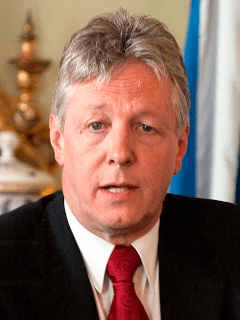
Peter David Robinson, retired Northern Irish politician, is born on December 29, 1948, in Belfast, Northern Ireland. He serves as First Minister of Northern Ireland from 2008 until 2016 and Leader of the Democratic Unionist Party (DUP) from 2008 until 2015. Until his retirement in 2016, he is involved in Northern Irish politics for over 40 years, being a founding member of the DUP along with Ian Paisley.

Robinson is the son of Sheila and David McCrea Robinson. He is educated at Annadale Grammar School and Castlereagh College, now part of the Belfast Metropolitan College. In 1966 he first hears Ian Paisley speak at a rally at Ulster Hall and shortly afterwards leaves school to devote himself to the Protestant fundamentalist cause. He considers joining the Royal Ulster Constabulary (RUC) but instead joins the Lagan Valley unit of the Ulster Protestant Volunteers (UPV), a paramilitary organisation tied to Ian Paisley’s Free Presbyterian Church of Ulster. He also joins the Ulster Constitution Defence Committee. As a young man he embraces a populist anti-Catholic fundamentalism. A former classmate alleges Robinson and a friend harassed a pair of Catholics nuns in the street in Portrush, County Antrim, yelling “Popehead, Popehead.” He initially gains employment as an estate agent for R.J. McConnell & Co. and later with Alex, Murdoch & Deane in Belfast.

Robinson serves in the role of General Secretary of the DUP from 1975, a position he holds until 1979 and which affords him the opportunity to exert unprecedented influence within the fledgeling party. In 1977, he is elected as a councillor for the Castlereagh Borough Council in Dundonald, County Down, and in 1979, he becomes one of the youngest Members of Parliament (MP) when he is narrowly elected for Belfast East. He holds this seat until his defeat by Naomi Long in 2010, making him the longest-serving Belfast MP since the Acts of Union 1800.

In 1980, Robinson is elected as the deputy leader of the DUP. Following the re-establishment of devolved government in Northern Ireland as a result of the Good Friday Agreement, he is elected in 1998 as the Member of the Legislative Assembly (MLA) for Belfast East. He subsequently serves as Minister for Regional Development and Minister of Finance and Personnel in the Northern Ireland Executive. He is elected unopposed to succeed Ian Paisley as leader of the DUP on April 15, 2008, and is subsequently confirmed as First Minister of Northern Ireland on June 5, 2008.

In January 2010, following a scandal involving his wife Iris (née Collins), Robinson temporarily hands over his duties as First Minister to Arlene Foster under the terms of the Northern Ireland Act 2006. Following a police investigation, which recommends that he should not be prosecuted following allegations made by the BBC in relation to the scandal, he resumes his duties as First Minister. The Official Assembly Commissioner’s Investigation and Report clears Robinson of any wrongdoing.

In September 2015, Robinson again stands aside to allow Arlene Foster to become acting First Minister after his bid to adjourn the assembly is rejected. His action is a response to a murder for which a member of Sinn Féin, a party in the Northern Ireland Executive, had been questioned. He resumes his duties on October 20, 2015. On November 19, 2015, he announces that he will be stepping down as First Minister and as leader of the DUP. He subsequently steps down as First Minister on January 11, 2016 and is now fully retired from frontline politics.

Robinson is the author of a number of books and pamphlets on local politics and history including: Capital Punishment for Capital Crime (1974), Savagery and Suffering (1975), Ulster the Facts (1981), Self-Inflicted (1981), A War to be Won (1983), It’s Londonderry (1984), Carson – Man of Action (1984), Ulster in Peril (1984), Their Cry was no Surrender (1986), Hands Off the UDR (1990), Sinn Féin – A Case for Proscription (1993), The Union Under Fire (1995), Give Me Liberty (no date), Ulster—the Prey (no date).


Leave a comment

Death of Open Champion Fred Daly

fred-daly

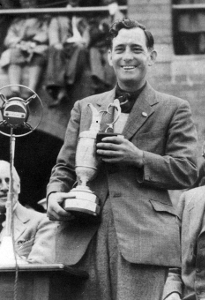
Frederick J. Daly, Northern Irish professional golfer best known for winning The Open Championship in 1947 at the Royal Liverpool Golf Club, Hoylake, dies on November 18, 1990.

Born in Portrush, County Antrim, Daly is the only Irishman from either side of the border to have won The Open until Pádraig Harrington wins it in 2007 and the only Northern Irish major winner until Graeme McDowell wins the U.S. Open in 2010. Daly wins the Open in 1947 while professional to the Balmoral Club in Belfast. He wins with a score of 293, a single stroke ahead of runners-up Reg Horne and amateur Frank Stranahan.

During his acceptance speech at Royal Liverpool, Daly says he is very honoured to receive the Claret Jug and take it back to Northern Ireland. He goes on to say that the trophy has never been to Ireland and that he is hoping that the change of air will help it. There is much applause and laughter at his humorous comments.

In addition, he adds the News of the World Match Play tournament, which is the main British Match Play Championship, becoming the first since James Braid (1905) to win both the Open and the Match Play title in the same year.

Daly is the only Ulsterman to win the Irish Open until 2016, when Rory McIlroy wins at The K Club. Daly wins in 1946 at Portmarnock, and plays on four Ryder Cup teams, in 1947, 1949, 1951, and 1953. Daly is awarded the MBE in the 1984 New Year Honours “for services to golf.”

Fred Daly, age 79, dies in Belfast on November 18, 1990, of a heart attack.