seamus dubhghaill

Promoting Irish Culture and History from Little Rock, Arkansas, USA


Leave a comment

Erskine Childers Elected Fourth President of Ireland

In a political upset, Erskine Hamilton Childers defeats Tom O’Higgins by a very narrow margin and is elected as the fourth President of Ireland on May 30, 1973.

Incumbent president Éamon de Valera is 90 years old and constitutionally barred from seeking a third term. His party, Fianna Fáil, seeks to get former Tánaiste Frank Aiken to run for the presidency, but he declines. Under pressure, former Tánaiste Erskine H. Childers agrees to run. The odds-on favourite is Fine Gael deputy leader, Tom O’Higgins, who had come within 1% of defeating Éamon de Valera in the 1966 presidential election.

Childers is a controversial nominee, owing not only to his British birth and upbringing but to his Protestantism. However, on the campaign trail his personal popularity proves enormous. In a political upset, Erskine H. Childers wins the presidency by 635,867 votes to 578,771.

Childers, though 67, quickly gains a reputation as a vibrant, extremely hard-working president, and becomes highly popular and respected. However, he has a strained relationship with the incumbent government, led by Taoiseach Liam Cosgrave of Fine Gael. Childers has campaigned on a platform of making the presidency more open and hands-on, which Cosgrave views as a threat to his own agenda as head of government. He refuses to co-operate with Childers’ first priority upon taking office, the establishment of a think tank within Áras an Uachtaráin to plan the country’s future. Childers considers resigning from the presidency, but is convinced to remain by Cosgrave’s Foreign MinisterGarret FitzGerald. However, Childers remains detached from the government. Whereas previously, presidents had been briefed by taoisigh once a month, Cosgrave briefs President Childers and his successor, Cearbhall Ó Dálaigh, on average once every six months.

Though frustrated about the lack of power he has in the office, Childers plays an important behind-the-scenes role in easing the Northern Ireland conflict as former Northern Ireland Prime Minister Terence O’Neill meets secretly with Childers at Áras an Uachtaráin on at least one occasion.

Prevented from transforming the presidency as he desires, Childers instead throws his energy into a busy schedule of official visits and speeches, which is physically taxing. On November 17, 1974, just after making a speech to the Royal College of Physicians in Dublin, Childers suffers a heart attack. He dies the same day at Mater Misericordiae University Hospital.

Childers’s state funeral in St. Patrick’s Cathedral, Dublin, is attended by world leaders including the Earl Mountbatten of Burma (representing Queen Elizabeth II), the Prime Minister of the United Kingdom and leader of the Opposition, and presidents and crowned heads of state from Europe and beyond. He is buried in the grounds of the Church of Ireland Derralossary church in RoundwoodCounty Wicklow.


Leave a comment

Birth of Academy Award Winning Actor Daniel Day-Lewis

Sir Daniel Michael Blake Day-Lewis, English actor who holds both British and Irish citizenship, is born in KensingtonLondonEngland, on April 29, 1957.

Day-Lewis is the son of poet Cecil Day-Lewis and English actress Jill Balcon. His father, who was born in Ballintubbert, County Laois, was of Protestant Anglo-Irish and English background, lived in England from the age of two, and later became the Poet Laureate of the United Kingdom. Day-Lewis’s mother was Jewish, and his maternal great-grandparents’ Jewish families emigrated to England from Latvia and Poland. His maternal grandfather, Sir Michael Balcon, was the head of Ealing Studios.

Growing up in London, he excels on stage at the National Youth Theatre, before being accepted at the Bristol Old Vic Theatre School, which he attends for three years. Despite his traditional actor training at the Bristol Old Vic, he is considered to be a method actor, known for his constant devotion to and research of his roles. He often remains completely in character for the duration of the shooting schedules of his films, even to the point of adversely affecting his health. He is one of the most selective actors in the film industry, having starred in only five films since 1998, with as many as five years between roles. Protective of his private life, he rarely gives interviews and makes very few public appearances.

Day-Lewis shifts between theatre and film for most of the early 1980s, joining the Royal Shakespeare Company and playing Romeo in Romeo and Juliet and Flute in A Midsummer Night’s Dream, before appearing in the 1984 film The Bounty. He stars in My Beautiful Laundrette (1985), his first critically acclaimed role, and gains further public notice with A Room with a View (1985). He then assumes leading man status with The Unbearable Lightness of Being (1988).

One of the most acclaimed actors of his generation, Day-Lewis has earned numerous awards, including three Academy Awards for Best Actor for his performances in My Left Foot (1989), There Will Be Blood (2007), and Lincoln (2012), making him the only male actor in history to have three wins in the lead actor category and one of only three male actors to win three Oscars. He is also nominated in this category for In the Name of the Father (1993) and Gangs of New York (2002). He has also won four BAFTA Awards for Best Actor in a Leading Role, three Screen Actors Guild Awards, and two Golden Globe Awards. In November 2012, Time names Day-Lewis the “World’s Greatest Actor.”

In 2008, while receiving the Academy Award for Best Actor for There Will Be Blood from Helen Mirren, who presented the award, Day-Lewis kneels before her and she taps him on each shoulder with the Oscar statuette, to which he quips, “That’s the closest I’ll come to ever getting a knighthood.” In November 2014, Day-Lewis is formally knighted by Prince William, Duke of Cambridge at Buckingham Palace for services to drama.

Day-Lewis and his wife, Rebecca Miller, have lived in Annamoe, County Wicklow since 1997.


Leave a comment

Founding of the Royal University of Ireland

The Royal University of Ireland is founded by Royal Charter on April 27, 1880, in accordance with the University Education (Ireland) Act 1879 as an examining and degree-awarding university based on the model of the University of London. The first chancellor is the Irish chemist, Robert Kane.

The university becomes the first university in Ireland that can grant degrees to women on a par with those granted to men, granting its first degree to a woman on October 22, 1882. In 1888 Letitia Alice Walkington has the distinction of becoming the first woman in Great Britain or Ireland to receive a degree of Bachelor of Laws. Among the honorary degree recipients of the university is Douglas Hyde, founder of the Gaelic League and later President of Ireland, who is awarded a DLitt in 1906.

The Royal University of Ireland is the successor to the Queen’s University of Ireland, dissolved in 1882, and the graduates, professors, students and colleges of that predecessor are transferred to the new university. In addition to the Queen’s Colleges, Magee CollegeUniversity College Dublin, Cecillia St. Medical School, St. Patrick’s College, Maynooth and Blackrock College present students for examinations as well, and no special status is accorded to the colleges of the former Queen’s University. After the 1880 reforms Catholic Colleges such as St. Patrick’s, Carlow CollegeHoly Cross College and Blackrock College come under the Catholic University, and with a number of other seminaries present students for examination by the RUI.

External students not of approved colleges can sit examinations of the Royal University although they are seen as being at a disadvantage to those of designated colleges whose professors are part of the university. In fact, many schools, including convent schools prepare students for the examinations of the Royal University.

Like the Queen’s University, the Royal University is entitled to grant any degree, similar to that of any other university in the United Kingdom of Great Britain and Ireland, except in theology. The colleges themselves award degrees in theology and divinity.

The professorships and Senate of the Royal University are shared equally between Roman Catholics and Protestants. However, colleges of the university maintain full independence except in the awarding of degrees, and the compilation and enforcement of academic regulations and standards.

The members of the senate of the Royal University included Gerald MolloyWilliam Joseph WalshJohn Healy, the Marquess of Dufferin and AvaGeorge Arthur Hastings Forbes, 7th Earl of GranardDaniel MannixGeorge Johnston Allman.

(Pictured: Coat of Arms of the Royal University of Ireland)


Leave a comment

Birth of Actor Arthur Shields

arthur-shields

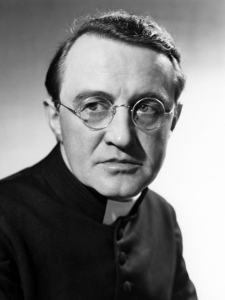
Arthur Shields, Irish actor on television, stage, and film, is born on February 15, 1896, into an Irish Protestant family in Portobello, Dublin. Shields starts acting in the Abbey Theatre when he is 17 years old. He is the younger brother of Oscar-winning actor Barry Fitzgerald. They are the sons of Adolphus Shields, who is well-known in Dublin as a labor organizer although the 1901 census lists his occupation as “press reader,” and Fanny Sophia Sheilds.

An Irish nationalist, Shields fights in the Easter Rising of 1916. He is captured and held for six months in the Frongoch internment camp in Frongoch, Wales. His obituary in the San Mateo County Times of San Mateo, California, reports, “upon his release he was decorated by the Republic of Eire.”

Shields returns to the Abbey Theatre and has a varied career there from 1914-1939 as actor, assistant director, director, and stage manager. He appears in more than 300 roles in 350 plays while he is at the Abbey. Three of the productions he appears in are by Irish playwright Teresa DeevyThe Reapers, Temporal Powers, and Katie Roche. Three times he brings the Abbey Company to the United States.

In 1936, John Ford brings him to the United States to act in a film version of The Plough and the Stars in the role of Patrick Pearse. Some of his memorable roles are in Ford films. Shields portrays the Reverend Playfair in Ford’s The Quiet Man, opposite John Wayne, Maureen O’Hara, and his brother, Barry Fitzgerald. He plays Dr. Laughlin in She Wore a Yellow Ribbon with Wayne and Joanne Dru and appears yet again with Wayne and Barry Fitzgerald in Ford’s The Long Voyage Home. His other films include Little Nellie Kelly, The Keys of the Kingdom, The Fabulous Dorseys, Gallant Journey, The Shocking Miss Pilgrim, Drums Along the Mohawk, Lady Godiva, National Velvet, and The River. He also makes television appearances including a 1958 role on Perry Mason as Dr. George Barnes in “The Case of the Screaming Woman.”

Shields dies of complications related to emphysema on April 27, 1970, in Santa Barbara, California. He is survived by his wife, actress Laurie Bailey, a daughter, a son, and four great-grandchildren. His body is cremated, with the ashes taken to Dublin, where a burial with full military honors takes place.


Leave a comment

Birth of Edmund Burke, Political Writer & Orator

edmund-burke

Edmund Burke, one of the greatest political writers and orators in history, is born in Arran Quay, Dublin, on January 12, 1729. British statesman, parliamentary orator, and political thinker, he plays a prominent part in all major political issues for about thirty years after 1765 and remains an important figure in the history of political theory.

Burke is the son of a mixed marriage – his father, a solicitor, is Protestant, his mother is Roman Catholic. He enters Trinity College, Dublin in 1744, and studies law at Middle Temple in London in 1750. He fails to secure a call to the bar and instead begins a literary career. He writes several books and is editor of the The Annual Register before entering politics. Burke’s A Vindication of Natural Society is published in 1756 and in 1757 A Philosophical Inquiry into the Origin of Our Ideas of the Sublime and Beautiful appears. Also on March 12, 1757, Burke marries Jane Nugent, the daughter of Christopher Nugent, an Irish Catholic doctor.

His political career begins in 1765 when he becomes the private secretary of one of the Whig leaders in the Parliament of Great Britain, Charles Watson-Wentworth, 2nd Marquess of Rockingham. Burke soon proves to be one of the main characters in the constitutional controversy in Britain under George III, who at the time is trying to establish more actual power for the crown. Although the crown has lost some influence under the first two Georges, one of the major political problems in 18th century Britain is the fact that both the king and Parliament have considerable control over the executive. Burke responds to these affairs in his pamphlet Thoughts on the Cause of the Present Discontents (1770), in which he argues that although George’s actions are legal in the sense that they are not against the letter of the constitution, they are all the more against it in spirit. In the pamphlet Burke elaborates on his famous and new justification of a party, defined as “a body of men united on public principle, which could act as a constitutional link between king and parliament, providing consistency and strength in administration, or principled criticism in opposition.”

Concerning the imperial controversy at the time, Burke argues that the British government has acted in a both unwise and inconsistent manner. Again, Burke claims that Britain’s way of dealing with the colony question is strictly legal and he urges that also “claims of circumstance, utility, and moral principle should be considered, as well as precedent.” In other words, if the British, persistently clinging to their narrow legalism, are not to clash with the ideas and opinions of the colonists on these matters, they will have to offer more respect and regard for the colonies’ cause. Burke calls for “legislative reason” in two of his parliamentary speeches on the subject, On American Taxation (1774) and On Moving His Resolutions for Conciliation with America (1775). However, British imperial policy in the controversy continues to ignore these questions.

Burke’s view of the revolution in France is a much different story. He publishes Reflections on the Revolution in France in 1790, attacking the revolution’s motives and principles. Many writers oppose his views, the most famous being Thomas Paine in his Rights of Man. Burke is a consistent advocate of Catholic emancipation, which politically damages him, but he is never an advocate of self-rule for the Irish.

Edmund Burke dies in London on July 9, 1797. Many quotes from his writings and orations have come down through the years, perhaps one is most applicable to the situation in Ireland today: “All government, indeed every human benefit and enjoyment, every virtue, and every prudent act, is founded on compromise and barter.”


1 Comment

Death of Grace Evelyn Gifford Plunkett

grace-gifford-plunkett

Grace Evelyn Gifford Plunkett, Irish artist and cartoonist who is active in the Republican movement, dies suddenly in her apartment in South Richmond Street, Portobello, Dublin, on December 13, 1955.

Gifford is the second youngest of twelve children born to Frederick Gifford, a solicitor and Roman Catholic, and Isabella Julia Burton Gifford, a Protestant. She grows up in the fashionable suburb of Rathmines in Dublin. The boys are baptised as Catholics and the girls as Protestant, but effectively the children are all raised as Protestants. The girls attend Alexandra College in Earlsfort Terrace, and the boys attend the The High School in Harcourt St.

At the age of 16, Gifford enters the Dublin Metropolitan School of Art, where she studies under the Irish artist William Orpen. Orpen regards Gifford as one of his most talented pupils. He often sketches her and eventually paints her as one of his subjects for a series on “Young Ireland.” Around this time, Gifford’s talent for caricature is discovered and developed. In 1907 she attends a course in Fine Art at the Slade School of Fine Art, London.

Gifford returns to Dublin in 1908 and, with great difficulty, attempts to earn a living as a caricaturist, publishing her cartoons in The Shanachie, Irish Life, Meadowstreet, and The Irish Review, which is edited from 1913 by Joseph Plunkett. She considers emigrating but gives up the idea. Later that year, she meets Plunkett for the first time at the opening of St. Edna’s School, a new bilingual school in Ranelagh, Dublin. Plunkett is a friend of her brother-in-law, another of the future leaders of the 1916 Easter Rising, Thomas MacDonagh, who is married to Gifford’s sister Muriel.

Her growing interest in the Roman Catholic religion leads to the deepening of Gifford and Plunkett’s relationship. Plunkett proposes to her in 1915. She accepts and takes formal instruction in Catholic doctrine. She is received into the Catholic Church in April 1916. The couple plan to marry on Easter Sunday that year, in a double wedding with his sister and her fiancé.

After the Rising, her brother-in-law Thomas MacDonagh is executed by firing squad along with Patrick Pearse and Thomas Clarke on May 3. That same day, Gifford learns that Plunkett is to be shot at dawn. She purchases a ring in a jeweler’s shop in Dublin city centre and, with the help of a priest, persuades the military authorities to allow them to marry. She and Plunkett are married on the night of May 3, 1916, in the chapel of Kilmainham Gaol, a few short hours before he is executed.

Grace Plunkett decides to devote herself through her art to the promotion of Sinn Féin policies and resumes her commercial work to earn a living. She is elected to the Sinn Féin executive in 1917.

During the Irish Civil War, Plunkett is arrested with many others in February 1923 and interned at Kilmainham Gaol for three months. She is released in May 1923.

When the Civil War ends, Plunkett has no home of her own and little money. Like many Anti-Treaty Republicans, she is the target of social ostracism and has difficulty finding work. She moves from one rented apartment to another and eats in the city-centre restaurants. She befriends many people and has many admirers but has no wish to remarry. Her material circumstances improve in 1932 when she receives a Civil List pension from Éamon de Valera‘s Fianna Fáil government. She lives for many years in a flat in Nassau St. with a balcony overlooking the sports ground of Trinity College.

Plunkett’s in-laws refuse to honour her husband’s will, which leaves everything to his widow. Legally, the will is invalid because there is only one of the required two witnesses and also the marriage takes place after the will is made, automatically revoking it. She begins legal proceedings against her in-laws in 1934. The Count and Countess Plunkett settle out of court and Plunkett is paid £700, plus costs.

From the late 1940s onwards, Plunkett’s health declines. In 1950 she is brought to St. Vincent’s Hospital, then in the city centre. She convalesces in a nursing home, which she does not like because it restricts her freedom.

After her sudden death on December 13, 1955, Grace Gifford Plunkett’s body is removed to St. Kevin’s Church, Harrington Street, and among the attendees at her funeral is President Seán T. O’Kelly. She is buried with full military honours near the republican plot in Glasnevin Cemetery.

Grace Gifford Plunkett is the subject of “Grace,” a song written in 1985 by Frank and Seán O’Meara, which becomes popular in Ireland and elsewhere and has been recorded by many musicians.


Leave a comment

Birth of Gerald Griffin, Novelist & Playwright

gerald-griffin

Gerald Griffin, Irish novelist, poet, and playwright, born in Limerick on December 12, 1803.

Griffin is the twelfth of the fifteen surviving children in his family. His father, Patrick Griffin, is a brewery farmer, and his mother, Ellen Griffin, of the ancient Gaelic family of the O’Briens, is very cultivated and much interested in literature.

Griffin goes to London in 1823 and becomes a reporter for one of the daily papers. He later turns to writing fiction. One of his most famous works is The Collegians, a novel based on a trial he has reported on, that of John Scanlan, a Protestant Anglo-Irish man who murdered Ellen Hanley, a young Irish Catholic girl. The novel is adapted to the stage as The Colleen Bawn, by Dion Boucicault.

In September 1838, Griffin informs his family of his intention of joining the Congregation of Christian Brothers. He enters the novitiate at North Richmond Street, Dublin, on September 8. He embarks on his new career with intense dedication, abandoning his literary work entirely. He is then admitted to the religious habit on the feast of St. Theresa and embarks on a two-year novitiate. His distaste for his earlier vocation is allayed to the extent that he is willing to undertake the composition of a few tales of a pious nature, but he is also desperately determined to avoid as much as possible the renewal of old contacts and the reopening of painful associations. Griffin burns most all of his unpublished manuscripts, preserving only a few poems and the tragedy, Gisippus.

Griffin dies at the North Monastery, Cork, from typhus fever on June 12, 1840. He is buried in the community’s graveyard on June 15.

Gerald Griffin has a street named after him in Limerick City and another in Cork City. Loughill/Ballyhahill GAA club in west Limerick plays under the name of Gerald Griffins.


Leave a comment

Birth of Irish Nationalist Joseph Mary Plunkett

joseph-mary-plunkett

Joseph Mary Plunkett, Irish nationalist, poet, journalist, and a leader of the 1916 Easter Rising, is born at 26 Upper Fitzwilliam Street in Dublin on November 21, 1887.

Both his parents come from wealthy backgrounds, and his father, George Noble Plunkett, has been made a papal count. Despite being born into a life of privilege, young Joe Plunkett does not have an easy childhood.

Plunkett contracts tuberculosis at a young age. This is to be a lifelong burden. His mother is unwilling to believe his health is as bad as it is. He spends part of his youth in the warmer climates of the Mediterranean and North Africa. He spends time in Algiers where he studies Arabic literature and language and composes poetry in Arabic. He is educated at the Catholic University School and by the Jesuits at Belvedere College in Dublin and later at Stonyhurst College, in Lancashire, England, where he acquires some military knowledge from the Officers’ Training Corps. Throughout his life, Plunkett takes an active interest in Irish heritage and the Irish language and also studies Esperanto. He is one of the founders of the Irish Esperanto League. He joins the Gaelic League and begins studying with Thomas MacDonagh, with whom he forms a lifelong friendship. The two are both poets with an interest in theatre, and both are early members of the Irish Volunteers, joining their provisional committee. Plunkett’s interest in Irish nationalism spreads throughout his family, notably to his younger brothers George and John, as well as his father, who allows his property in Kimmage, south Dublin, to be used as a training camp for young men who wish to escape conscription in Britain during the First World War. Men there are instead trained to fight for Ireland.

Sometime in 1915 Plunkett joins the Irish Republican Brotherhood (IRB) and soon after is sent to Germany to meet with Roger Casement, who is negotiating with the German government on behalf of Ireland. Casement’s role as emissary is self-appointed, and, as he is not a member of the IRB, the organisation’s leadership wishes to have one of their own contact Germany to negotiate German aid for an uprising the following year. Plunkett is seeking, but not limiting himself to, a shipment of arms. Casement, on the other hand, spends most of his energies recruiting Irish prisoners of war in Germany to form a brigade to fight instead for Ireland. Some nationalists in Ireland see this as a fruitless endeavour, and prefer to seek weapons. Plunkett successfully gets a promise of a German arms shipment to coincide with the rising.

Plunkett is one of the original members of the IRB Military Committee that is responsible for planning the Easter Rising, and it is largely his plan that is followed. Shortly before the rising is to begin, Plunkett is hospitalised following a turn for the worse in his health. He has an operation on his neck glands days before Easter and has to struggle out of bed to take part in what is to follow. Still bandaged, he takes his place in the General Post Office with several other of the rising’s leaders, including Patrick Pearse and Tom Clarke, though his health prevents him from being terribly active. His energetic aide-de-camp is Michael Collins.

Following the surrender Plunkett is held in Kilmainham Gaol, and faces a court-martial. Seven hours before his execution by firing squad at the age of 28, he is married in the prison chapel to his sweetheart Grace Gifford, a Protestant convert to Catholicism, whose sister, Muriel, had years before also converted and married his best friend Thomas MacDonagh, who is also executed for his role in the Easter Rising. Plunkett is executed by firing squad on May 4, 1916, and is the fourth and youngest signatory of the Proclamation of the Irish Republic to be executed.

Plunkett’s brothers, George Oliver Plunkett and Jack Plunkett, join him in the Easter Rising and later become important Irish Republican Army (IRA) men. His father’s cousin, Horace Plunkett, is a Protestant and unionist who seeks to reconcile unionists and nationalists. Horace Plunkett’s home is burned down by the Anti-Treaty IRA during the Irish Civil War.

The main railway station in Waterford City is named after Plunkett as is Joseph Plunkett Tower in Ballymun. Plunkett barracks in the Curragh Camp, County Kildare is also named after him.


Leave a comment

Birth of Margaret Dobbs, Irish Scholar & Playwright

feis-na-ngleann

Margaret Emmeline Dobbs, Irish scholar and playwright best known for her work to preserve the Irish Language, is born in Dublin on November 19, 1871.

Dobbs’ father, Conway Edward Dobbs, is Justice of the Peace for County Antrim, High Sheriff for Carrickfergus in 1875, and High Sheriff for County Louth in 1882. The family spends time living in Dublin which is where Dobbs is born. She attempts to learn Irish. However, when her father dies in 1898 her mother, Sarah Mulholland, daughter of St. Clair Kelvin Mulholland Eglantine, moves the family back to Glenariff.

Dobbs’ interest in learning Irish continues and she finds it easier to learn in Donegal where the language is still spoken. Her first teacher is Hugh Flaitile. She attends the Irish College at Cloughaneely in the Donegal Gaeltacht. She brings the idea of promoting the language to the Glens of Antrim and her circle of friends. Dobbs is one of the small numbers of Protestant women interested in the Gaelic revival.

The “Great Feis” takes place in Antrim in 1904. Dobbs is a founding member of the Feis na nGleann committee and later a tireless literary secretary. In 1946, the Feis committee decides to honour her by presenting her with an illuminated address. It can be seen today at Portnagolan House with its stained-glass windows commemorating a great Irishwoman. During her speech she says, “Ireland is a closed book to those who do not know her language. No one can know Ireland properly until one knows the language. Her treasures are hidden as a book unopened. Open the book and learn to love your language.”

Dobbs writes seven plays, published by Dundalgan Press in 1920, though only three are ever performed. The Doctor and Mrs. McAuley wins the Warden trophy for one-act plays at the Belfast festival in 1913. However, her plays are generally not a success and after 1920 she never writes another. She continues to work on historical and archaeological studies and her articles are published in the Ulster Journal of Archaeology, in a German magazine for Celtic studies, in the French Revue Celtique, and in the Irish magazine Eriu.

Roger Casement is a good friend and, although Dobbs never makes her political opinions known, she contributes to his defence costs when he is accused of treason. She also is a member of the Gaelic League and in the executive of Cumann na mBan.

She dies in Portnagalon, County Antrim, on January 2, 1962.


Leave a comment

The Remembrance Day Bombing

remembrance-day-bombing

The Remembrance Day bombing, also known as the Enniskillen bombing or Poppy Day massacre, takes place on November 8, 1987, in Enniskillen, County Fermanagh, Northern Ireland. A Provisional Irish Republican Army (IRA) bomb explodes near the town’s war memorial during a Remembrance Sunday ceremony, which is being held to commemorate British military war dead. Eleven people, many of them old age pensioners, are killed and 63 are injured.

The bomb explodes as a parade of Ulster Defence Regiment (UDR) soldiers is making its way to the memorial and as people wait for the ceremony to begin. It blows out the wall of the Reading Rooms, where many of the victims are standing, burying them under rubble and hurling masonry towards the gathered crowd. Bystanders rush to free those trapped in the rubble.

Eleven people, all Protestant, are killed by the Provisional IRA that day, including three married couples. The dead are Wesley and Bertha Armstrong, Kitchener and Jessie Johnston, William and Agnes Mullan, John Megaw, Georgina Quinton, Marie Wilson, Samuel Gault, and Edward Armstrong. Armstrong is a serving Royal Ulster Constabulary (RUC) officer and Gault has recently left the force. Gordon Wilson, whose daughter Marie dies in the blast and who is himself injured, goes on to become a peace campaigner and member of Seanad Éireann. The twelfth fatality, Ronnie Hill, dies after spending 13 years in a coma. Sixty-three people are injured, including thirteen children. Ulster Unionist politicians Sam Foster and Jim Dixon are among the crowd. Dixon receives extensive head injuries but recovers. A local businessman captures the immediate aftermath of the bombing on video camera. His footage, showing the effects of the bombing, is broadcast on international television.

A few hours after the blast, the IRA calls a radio station and says it has abandoned a 150-pound bomb in Tullyhommon, twenty miles away, after it failed to detonate. That morning, a Remembrance Sunday parade, which includes many members of the Boys’ and Girls’ Brigades, has unwittingly gathered near the Tullyhommon bomb. Soldiers and RUC officers were also there, and the IRA says it attempted to trigger the bomb when soldiers were standing beside it. The bomb is defused by security forces and is found to have a command wire leading to a “firing point” across the border.

The IRA apologises, saying it had made a mistake and that the target had been the UDR soldiers who were parading to the memorial. The bombing leads to an outcry among politicians in the Republic of Ireland and the United Kingdom. British Prime Minister Margaret Thatcher says, “It’s really desecrating the dead and a blot on mankind.” The Secretary of State for Northern Ireland, Tom King, denounces the “outrage” in the House of Commons, as does the Irish Minister for Foreign Affairs, Brian Lenihan, in Dáil Éireann. Seanad Éireann Senator Maurice Manning speaks of people’s “total revulsion.” It also facilitates the passing of the Extradition Act, which makes it easier to extradite IRA suspects from the Republic of Ireland to the United Kingdom.

The bombing is seen by many Northern Irish Protestants as an attack on them, and loyalist paramilitaries ″retaliate″ with attacks on Catholic civilians. The day after the bombing, five Catholic teenagers are wounded in a shooting in Belfast, and a Protestant teenager is killed by the Ulster Defence Association after being mistaken for a Catholic. In the week after the bombing, there are fourteen gun and bomb attacks on Catholics in Belfast.

The Remembrance Day bombing has been described as a turning point in the Troubles and an incident that shook the IRA “to its core.”