seamus dubhghaill

Promoting Irish Culture and History from Little Rock, Arkansas, USA


Leave a comment

Death of Charles Frederick Williams, Writer & Journalist

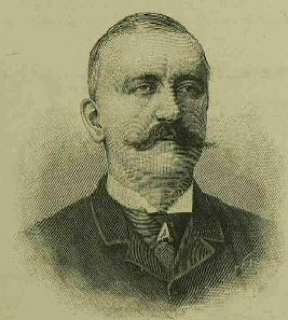
Charles Frederick Williams, a Scottish-Irish writer, journalist, and war correspondent, dies in Brixton, London, England, on February 9, 1904.

Williams is born on May 4, 1838, in Coleraine, County Londonderry. He claims to be descended on his father’s side from Worcestershire yeomen living in the parishes of Tenbury and Mamble. On his mother’s side he descends from Scottish settlers who planted Ulster in 1610. He is educated at Belfast Academy in Belfast under Dr. Reuben John Bryce and at a Greenwich private school under Dr. Goodwin. Later on, he goes to the southern United States for his health and takes part in a filibustering expedition to Nicaragua, where he sees some hard fighting and reportedly wins the reputation of a blockade runner. He is separated from his party and is lost in the forest for six days. Fevered, he discovers a small boat and manages to return to the nearest British settlement. He serves in the London Irish Rifles and has the rank of sergeant.

Williams returns to England in 1859, where he becomes a volunteer, and a leader writer for the London Evening Herald. In October 1859, he begins a connection with The Standard which lasts until 1884. From 1860 until 1863, he works as a first editor for the London Evening Standard and from 1882 until 1884, as editor of The Evening News.

Williams is best known for being a war correspondent. He is described as an admirable war correspondent, a daring rider as well as writer. For The Standard, he is at the headquarters of the Armée de la Loire, a French army, during the Franco-Prussian War in 1870. He is also one of the first correspondents in Strasbourg, where the French forces are defeated. In the summer and autumn of 1877, he is a correspondent to Ahmed Muhtar Pasha who commands the Turkish forces in Armenia during the Russo-Turkish War of 1877 and 1878. He remains constantly at the Turkish front, and his letters are the only continuous series that reaches England. In 1878, he publishes this series in a revised and extended form as The Armenian Campaign: A Diary of the Campaign on 1877, in Armenia and Koordistan, which is a large accurate record of the war, even though it is pro-Turkish. From Armenia, he follows Muhtar Pasha to European Turkey and describes his defence of the lines of Constantinople against the Imperial Russian Army. He is with General Mikhail Skobelev at the headquarters of the Imperial Russian Army when the Treaty of San Stefano is signed in March 1878. He reports this at the Berlin Congress.

At the end of 1878, Williams is in Afghanistan reporting the war, and in 1879 publishes the Notes on the Operations in Lower Afghanistan, 1878–9, with Special Reference to Transport.

In the autumn of 1884, representing the Central News Agency of London, Williams also joins the Gordon Relief Expedition, a British mission to relieve in Major-General Charles George Gordon in Khartoum, Sudan. His is the first dispatch to tell of the loss of Gordon. While in Sudan, he quarrels with Henry H. S. Pearse of The Daily News, who later unsuccessfully sues him. After leaving The Standard in 1884, he works with the Morning Advertiser, but later works with the Daily Chronicle as a war correspondent. He is the only British correspondent to be with the Bulgarian Army under Prince Alexander Joseph of Battenberg during the Serbo-Bulgarian War in November 1885. In the Greco-Turkish War of 1897, he is attached to the Greek forces in Thessaly. His last war reporting is on Herbert Kitchener‘s Sudanese campaign of 1898. His health does not permit his advance to South Africa, but he is still able to compile a diary of the South African War for The Morning Leader.

In 1887, Williams meets with then General of the United States Army, Philip Sheridan, in Washington, D.C. to update the general on European affairs and the prospects of upcoming conflicts.

Williams once tries to bid as a Conservative Party candidate for the House of Commons representative of Leeds West, a borough in Leeds, West Yorkshire, during the 1885 United Kingdom general election. He fails to win the seat against Liberal Party candidate Herbert Gladstone. He once serves as the Chairman of the London district of the Chartered Institute of Journalists from 1893 to 1894. He founds the London Press Club where he also serves as its President from 1896 to 1897.

Williams is wounded three times in action. He is shot in the leg in Egypt in 1885 during General Buller’s retreat from Gubat to Korti.

Williams is a member of the 1st Surrey Rifles, a volunteer unit of the British Army, a member of the London Irish Volunteers, and is a known marksman.

Williams is said to possess a voice of thunder and expresses with terrific energy. He conducts a lecture tour of the United States where he describes the six campaigns, illustrated by limelight photographs. His audience in Brooklyn, New York, is described by The New York Times as highly delighted by his lecture about the hardships and adventures. His presentation is “a feast for the eyes and ears and was highly appreciated by the large audience assembled.” He later tours England, Scotland, and Ireland speaking about his then seven campaigns.

A friend of explorer Henry Morton Stanley, Williams gives him a compass that has been on a number of his expeditions. Stanley takes it with him to Africa and it is now on display at the Royal Museum for Central Africa in Belgium.

Williams also writes fiction, including his book John Thaddeus Mackay, a tale about religious tolerance and understanding. With the sanction of Commander in Chief, Field Marshal Garnet Wolseley, he edits a book Songs for Soldiers for the March The Camp and the Barracks to improve morale and relieve boredom. Included in the book are a number of songs that he composed. He also writes about ecclesiastical questions, and contributes articles and stories to different periodicals.

Williams is a strong adherent to Wolseley’s military views and policy, and has considerable military knowledge. He also publishes military subjects in several publications such as the United Service Magazine, the National Review, and other periodicals. In 1892, he publishes Life of Sir H. Evelyn Wood, which is controversial as he defends the actions of Wood after the Battle of Majuba Hill in 1881. In 1902, he publishes a pamphlet, entitled Hush Up, in which he protests against the proposed limited official inquiry into the South African War and calls for an investigation.

Early in his career, Williams shares an office with friend and colleague Robert Gascoyne-Cecil, who later becomes Prime Minister of the United Kingdom. They have a standing tradition of always sending out for two beers with payment alternating between each man. Many years later, Williams is in the lobby of the House of Lords and Gascoyne-Cecil approaches him with an outstretched hand and asks, “By the way, Mr. Williams, whose turn is it to stand the beer?”

In 1884, the steamer carrying Williams and colleague Frederic Villiers of The Graphic overturns in the Nile River. Their rescue leads Williams to later commission a unique ivory and gold mitre for the Bishop of London as a thank-offering to God for his safe return from Khartoum.

In Rudyard Kipling‘s play, The Light That Failed, the character of Mr. Nilghai, the war correspondent, is based on Williams.

Williams receives a personal invitation from King Edward VII to attend the funeral of his mother, Queen Victoria.

Both of Williams‘a sons became journalists. Frederick is a noted parliamentary reporter, writer, and historian in Canada. Francis Austin Ward Williams practices journalism in Sydney, Australia.

In the Nile Campaign of 1884-85, application is made to the War Office with the support of the Commander in Chief Lord Wolseley for medals for Willams and correspondent Bennet Burleigh. Williams has been twice requested to take command of some of the men by senior officers on the spot. The Secretary of War is unable to grant the recognition under the rules of the day but writes a letter saying that he regrets that this must be his decision.

Williams is a recipient of the Queen’s Sudan Medal, an award given to British and Egyptian forces which took part in the Sudan campaign between 1896 and 1898.

Field Marshall Garnet Wolseley recognizes the contributions of Williams on the battlefield. He says in a speech that from “Charles Williams, he had at various times received the greatest possible help in the field.”

Williams dies in Brixton, London, on February 9, 1904. He is buried in Nunhead Cemetery in London. His son, journalist Fred Williams, first learns of his father’s death on the wire service he is monitoring at his newspaper in Toronto, Ontario, Canada.

Williams’s funeral is well attended by the press as well as members of the military including Field Marshal Sir Evelyn Wood. Colleague Henry Nevison writes a long reflection on Williams. It includes, “On the field he possessed a kind of instinctive sense of what was going to happen. When I went to big field-days with him he was already an elderly man, and much broken down with the hardships of a war correspondent’s life; but he invariably appeared at the critical place exactly at the right moment, and I once heard the Duke of Connaught, who was commanding, say, ‘When I see Charlie Williams shut up his telescope, I know it’s all over.’ And now he is gone, with his rage, his generosity, his innocent pride, his faithful championship of every friend, and his memories of so many a strange event. His greatest joy was to encourage youth to follow in his steps, and the world is sadder and duller for his going.”
Leave a comment

Lord Randolph Churchill’s Speech at Ulster Hall

Generated by IIPImage

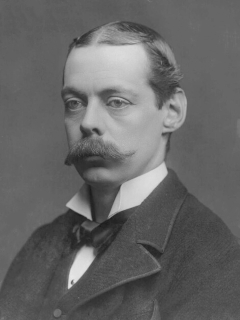
Conservative Party politician Lord Randolph Churchill, father of Winston Churchill, gives what many consider one of the single most destructive speeches in Irish history, inciting militant loyalists at Ulster Hall in Belfast on February 22, 1886.

The Conservative Party in Ulster launches an anti-Home Rule campaign in February 1886. It joins with the Orange Order to organise a huge political rally which is addressed by Lord Churchill.

Protestants in Ulster are very concerned about the prospect of Irish Home Rule. They fear that an Irish parliament will put rural agricultural interests before the needs of the industrial North-East. They believe a Dublin parliament will introduce tariffs which will damage industries in the north. They also fear that they will be discriminated against because of their religion, outnumbered in a Dublin parliament by Catholic representatives.

Churchill has shown disdain for Ulster Unionists up until this time, in private at least, telling Lord Salisbury, “these foul Ulster Tories have always ruined our party,” but as 1886 begins he sees an opportunity to exploit their fears for political gain. He decides that should Prime Minister William Gladstone “went for Home Rule (for Ireland), the Orange Card would be the one to play. Please God may it turn out the ace of trumps and not the two.” This quote leads one to believe he has few real convictions regarding the issue.

“Ulster will fight, and Ulster will be right,” Lord Churchill proclaims to a crowd before he even arrives at Ulster Hall.

Lord Churchill gives a rousing speech at the rally. During his speech, he plays on Protestant fears of Dublin “Catholic” rule and encourages Ulster Protestants to organize against Home Rule, so it does not come upon them “as a thief in the night.” As a result, the Ulster Protestants begin to form paramilitary drilling units.

Churchill achieves a short-term political gain by his playing of the Orange Card, but his most lasting legacy is the unfounded fear of Irish Catholics that he helps to implant in the minds of Ulster Protestants, a tragedy for both traditions on the island. Those fears remain evident over a century later.


Leave a comment

Death of Charles Stewart Parnell

charles-stewart-parnell

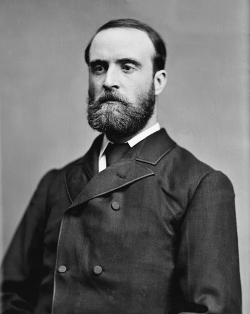
Charles Stewart Parnell, Irish nationalist politician and one of the most powerful figures in the British House of Commons in the 1880s, dies of pneumonia at age 45 in Hove, East Sussex, England on October 6, 1891.

Born into a wealthy and powerful Anglo-Irish Protestant landowning family in County Wicklow on June 27, 1846, Parnell enters the House of Commons in 1875. He is a land reform agitator and becomes leader of the Home Rule League in 1880, insisting on operating independently of the Liberals, and winning great influence by his balancing of constitutional, radical, and economic issues, and by his skillful use of parliamentary procedure. He is imprisoned in Kilmainham Gaol in 1882 but, being a very capable negotiator, is released when he renounces violent extra-Parliamentary action in an informal agreement, the Kilmainham Treaty, with British Prime Minister William Ewart Gladstone. That same year he reforms the Home Rule League as the Irish Parliamentary Party, which he controls minutely as Britain’s first disciplined democratic party.

The hung Parliament of 1885 sees him hold the balance of power between Gladstone’s Liberals and Robert Gascoyne-Cecil, 3rd Marquess of Salisbury‘s Conservatives. His power is one factor in Gladstone’s adoption of Home Rule as the central tenet of the Liberal Party. His reputation peaks in 1889-1890 when letters published in The Times linking him to the Phoenix Park murders of 1882 are shown to have been forged by Richard Pigott. However, the Irish Parliamentary Party splits in 1890 after the revelation of Parnell’s long adulterous love affair, causing many English Liberals, many of them nonconformists, to refuse to work with him, and strong opposition from Catholic bishops. He heads a small minority faction until his death in 1891.

parnell-marker

In describing Parnell, Gladstone says, “I do not say the ablest man; I say the most remarkable and the most interesting. He was an intellectual phenomenon.” Liberal leader H. H. Asquith calls him as one of the three or four greatest men of the 19th century, while Richard Haldane, 1st Viscount Haldane describes him as the strongest man the House of Commons has seen in 150 years. Historian A.J.P. Taylor says, “More than any other man he gave Ireland the sense of being an independent nation.”

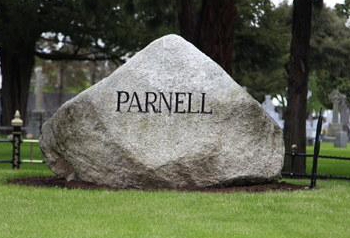
Charles Stewart Parnell dies of pneumonia at age 45 in his home at 10 Walsingham Terrace, Hove, England on October 6, 1891, in the arms of his wife Katharine. Though an Anglican, his funeral on October 11 is at the Irish National nondenominational Glasnevin Cemetery in Dublin and is attended by more than 200,000 people. His notability is such that his gravestone of unhewn Wicklow granite, erected in 1940, reads only “Parnell.”


Leave a comment

Bloody Sunday 1887 in London

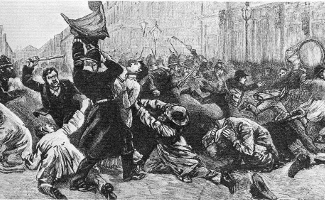
Bloody Sunday takes place in London on November 13, 1887, when a march against unemployment and coercion in Ireland, as well as demanding the release of Member of Parliament (MP) William O’Brien, is attacked by the Metropolitan Police Service and the British Army. The demonstration is organised by the Social Democratic Federation (SDF) and the Irish National League. Violent clashes take place between the police and demonstrators, many “armed with iron bars, knives, pokers and gas pipes.” A contemporary report notes that 400 are arrested and 75 persons are badly injured, including many police, two policemen being stabbed, and one protester bayonetted.

William Ewart Gladstone‘s espousal of the cause of Irish home rule has split the Liberal Party and makes it easy for the Conservatives to gain a majority in the House of Commons of the United Kingdom. The period from 1885 to 1906 is one of Tory dominance, with short intermissions. Coercion Acts are the answer of British governments perturbed by rural unrest in Ireland, and they involve various degrees of suspension of civil rights. Although one purpose of the November 13 demonstration is to protest about the handling of the Irish situation by the Conservative government of Robert Arthur Talbot Gascoyne-Cecil, 3rd Marquess of Salisbury, it has a much wider context.

The Long Depression, starting in 1873 and lasting almost to the end of the century, creates difficult social conditions in Britain, similar to the economic problems that drive rural agitation in Ireland. Falling food prices create rural unemployment, which results in both emigration and internal migration. Workers move to the towns and cities in thousands, eroding employment, wages and working conditions. By November 1887, unemployed workers’ demonstrations from the East End of London have been building up for more than two years. There have already been clashes with the police and with the members of upper-class clubs. Trafalgar Square is seen symbolically as the point at which the working-class East End meets the upper-class West End of London, a focus of class conflict and an obvious flashpoint.

This attracts the attention of the small but growing socialist movement – the Marxists of both the Social Democratic Federation and Socialist League, and the reformist socialists of the Fabian Society. Police and government attempt to suppress or divert the demonstrations also bring in the radical wing of the Liberal Party and free speech activists from the National Secular Society.

Some 30,000 persons encircle Trafalgar Square as at least 10,000 protesters march in from several different directions, led by Elizabeth Reynolds, John Burns, William Morris, Annie Besant and Robert Bontine Cunninghame Graham, who are primarily leaders of the Social Democratic Federation. Also marching are the Fabian playwright George Bernard Shaw and Charlotte Wilson. Two thousand police and 400 troops are deployed to halt the demonstration. Burns and Cunninghame Graham are arrested and imprisoned for six weeks. Annie Besant, who is a Marxist, Fabian and secularist, speaks at the rally and offers herself for arrest, but the police decline to do so. Of the 400 arrested, 50 are detained in custody.

In the fighting, many rioters are injured by police truncheons and under the hooves of police horses. There are both infantry and cavalry present. Although the infantry is marched into position with bayonets fixed, they are not ordered to open fire and the cavalry are not ordered to draw their swords.

The following Sunday, November 20, sees another demonstration and more casualties. According to a report in the partisan Socialist Review, among them is a young clerk named Alfred Linnell, who is run down by a police horse, dying in hospital a fortnight later from complications of a shattered thigh.

The funeral of Linnell on December 18 provides another focus for the unemployed and Irish movements. William Morris, leader of the Socialist League, gives the main speech and advocates a holy war to prevent London from being turned into a huge prison. A smaller but similar event marks the burial of another of those killed, W. B. Curner, which takes place in January. The release of those imprisoned is celebrated on February 20, 1888, with a large public meeting. Henry Hyndman, leader of the SDF, violently denounces the Liberal Party and the Radicals who are present.

(Pictured: Bloody Sunday, 1887. This engraving from The Illustrated London News depicts a policeman being clubbed by a demonstrator as he wrests a banner from a female protester.)