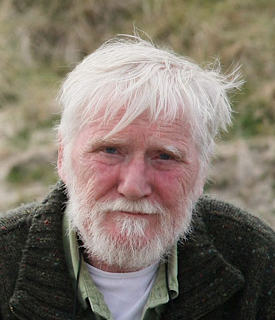
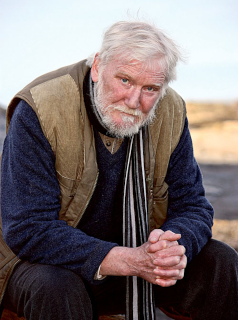
Dermot Healy, Irish novelist, playwright, poet and short story writer, dies at his home in Ballyconnell, Sligo, County Sligo, on June 29, 2014. A member of Aosdána, he is also part of its governing body, the Toscaireacht. He is described variously as a “master,” a “Celtic Hemingway” and as “Ireland’s finest living novelist.”
Healy is born in Finnea, County Westmeath, on November 9, 1947, the son of a Guard. As a child the family moves to Cavan, County Cavan, where he attends the local secondary school. In his late teens he moves to London and works in a succession of jobs, including barman, security man and as a labourer. He later returns to Ireland, settling in Ballyconnell, County Sligo, a small settlement on the Atlantic coast.
Often overlooked due to his relatively low public profile, Healy’s work is admired by his Irish literary predecessors, peers and successors alike, many of whom idolise him. Among the writers to have spoken highly of him are Seamus Heaney, Eugene McCabe, Roddy Doyle, Patrick McCabe and Anne Enright.
Healy dies at his home in Ballyconnell on June 29, 2014, while awaiting an ambulance after suddenly being taken ill. He is laid to rest at Carrigans Cemetery following funeral mass by Fr. Michael Donnelly at St. Patrick’s Church in Maugherow, County Sligo.
Reid is born on April 4, 1818, in Ballyroney, a hamlet near Katesbridge, County Down, in present day Northern Ireland, the son of the Rev. Thomas Mayne Reid, a Presbyterian minister and later a senior clerk of the General Assembly of the Presbyterian Church in Ireland, and his wife, a daughter of the Rev. Samuel Rutherford. He is educated at the Royal Belfast Academical Institution. He rebels against his father’s plans for him and decides not to pursue a career in the church. He briefly runs a school at Ballyroney before emigrating to the United States in 1839. Arriving in New Orleans, Louisiana, he finds a job as a corn factor’s clerk in the corn market. After six months he leaves because he refuses to whip slaves. Travelling across America, he works as a teacher, a clerk and an Indian-fighter, and anonymously publishes his first poem in August 1843. Later that year he meets Edgar Allan Poe in Philadelphia and the two become close friends. Poe later admits that Reid was “a colossal but most picturesque liar,” but was impressed by his brilliant story-telling abilities.
With the outbreak of the Mexican-American War in 1846 Reid enlists in the 1st New York Infantry Regiment and is commissioned second lieutenant. Contributing a series of reports from the front under the pseudonym ‘Ecolier,’ he performs with great bravery in the Battle of Chapultepac on September 13, 1847. Wounded during the battle, he is promoted to first lieutenant three days later. Following his discharge from the army in 1848 he claims to have reached the rank of captain, but this is another of his inventions.
Reid’s first play, Love’s Martyr, is staged at the Walnut Street Theatre, Philadelphia, for five nights in October 1848, and the following year he publishes an embellished account of his experiences in Mexico entitled War Life. All of his works are published under the name ‘Captain Mayne Reid.’ In July 1849 he sails to England with a group of Hungarian radicals but decides against accompanying them to the Continent. Returning briefly to Ireland, he settles in London in 1850 and writes a novel, The Rifle Rangers. It is an immediate success and is followed quickly by The Scalp Hunters (1851), The Desert Home (1852), and The Boy Hunters (1853). While in England in 1851 he meets and falls in love with a 13-year-old girl, Elizabeth Hyde, daughter of his publisher, G. W. Hyde, an English aristocrat. When he discovers her age, he tells her that she is “getting old enough to have a lover, and you must have me.” Two years later he continues with his suit, and this time is successful as they marry in 1853. He is immensely proud of his young bride and later writes a semi-autobiographical novel The Child Wife (1868), based on their relationship.
Establishing a reputation as one of the most popular novelists of his generation, Reid does much to enhance the romantic image of the American West. His internationally successful books include The White Chief (1855), Bush Boys (1856), Oceola (1859), and The Headless Horseman (1865), and his novel about miscegenation, The Quadroon (1856), is later plagiarised by Dion Boucicault for The Octoroon (1859). A champion croquet player, he writes a treatise on the subject in 1863.
Disaster strikes in November 1866 when Reid is declared bankrupt. He had squandered all his money on the construction of “The Ranche,” a Mexican-style hacienda in England. To raise money, he returns to the United States and embarks on a successful lecturing tour. Settling at Newport, Rhode Island, he writes another novel, The Helpless Hand (1868), which is a huge success and alleviates some of his difficulties. His wife hates America, however, and after he is briefly hospitalised in 1870, they decide to return to England.
Ill health, artistic doubts, and financial insecurity plagued Reid’s final years. Diagnosed with acute depression, he is unable to recapture his earlier audience and, despite a pension from the U.S. government, he struggles for money. He dies at Ross-on-Wye in Herefordshire on October 22, 1883, and is buried at Kensal Green Cemetery in London.
Although not regarded as an important novelist, Reid none the less has a significant influence on subsequent writers. The young Vladimir Nabokov is deeply impressed by his adventure stories, and one of his own first works is a poetic recreation of The Headless Horseman in French alexandrine. Both Robert Louis Stevenson and Arthur Conan Doyle are admirers, and politicians as diverse as Theodore Roosevelt and Leon Trotsky also make reference to his varied output. In total, Reid publishes over sixty novels, which are printed in ten languages.
Hayes-McCoy is born to Thomas Hayes-McCoy and Mary Kathleen Hayes-McCoy (née Wallace). His grandfather, Thomas Hayes-McCoy, is a Dubliner who as a child came to Galway in 1834 and is later a well-known Parnellite. His maternal grandfather, Thomas Burke, is a Galway artist. He grows up on Eyre Square where his father runs a gentleman’s hairdressing business. His two older siblings are Ignatius and Marguerite. The latter receives a PhD-degree in History at University College Galway (UCG), and later teaches at the Galway Technical School.
Hayes-McCoy receives his early education from the Patrician Brothers, Galway. His earliest notebook of 1927 and a manuscript history of Poland of the same year, now at the National Library of Ireland (NLI), testify to an early interest in history and heritage. From 1928 to 1932 he is a student scholarship holder at University College Galway, graduating in 1932 with a Bachelor of Commerce, and a Bachelor of Arts, with first-class honours in both, and a specialisation in “History, Ethics, Politics” for the latter. Mary Donovan O’Sullivan is one of his professors of history, and Liam Ó Briain, professor of Romance languages, is a stimulating influence. At this time, Hayes-McCoy is a member of the Republican Club, a committee member of the Literary and Debating Society, and in 1931 he is one of the founding members of a new Irish Students’ Association.
Hayes-McCoy pursues his PhD at the University of Edinburgh, and then spends two years at the Institute of Historical Research, London, in the Tudor seminar of J. E. Neale, rewriting his PhD and eventually publishing it as Scots mercenary forces in Ireland, 1565–1603 (Dublin and London, 1937), with a foreword by Eoin MacNeill. This is characterised by meticulous archival research, and it anticipates by sixty years the much-vaunted New British History of the late twentieth century by tracing the interconnections between events in England, Ireland, and Scotland.
In the absence of an academic post, Hayes-McCoy becomes an assistant keeper in the Art and Industrial Division at the National Museum of Ireland (1939–1959), with a responsibility for the Military History, and the Irish War of Independence collections. One of his first tasks is to prepare a standing exhibition on Irish history before 1916. His research, long-standing personal interest in the military, and his curatorial experience, helps form an expert knowledge of historical Irish warfare. This leads to his role in co-founding The Military History Society of Ireland in 1949 whose journal, The Irish Sword, he edits. He describes the vagaries of setting up such a body, its reception, and the historiographical considerations attendant on it, in a paper published posthumously in The Irish Sword.
On August 19, 1941, Hayes-McCoy marries Mary Margaret “May” O’Connor, daughter of C.J. and M.B. O’Connor of New Ross/Enniscorthy. They have three daughters and two sons: Mary, Ann, Ian, Robert, Felicity. The family home is in Dublin.
Earning high reputation by continued research and by publishing leads to Hayes-McCoy’s receipt of the D.Litt. degree from the National University, and to his membership in the Royal Irish Academy in 1950. In his professional career, apart from the broad spectrum of press publications, he publishes prolifically. The works that are judged most influential, are his Scots mercenary forces in Ireland 1565–1603 (1937), the papers “The early history of guns in Ireland” (1938–1939), “Strategy and tactics in Irish warfare, 1593–1601” (1941), “The army of Ulster, 1593–1601” (1951), the controversial “Gaelic society in Ireland in the late sixteenth century” (1963), and the monographs “Irish battles” (London 1969), and “A history of Irish flags from earliest times” (Dublin 1979). A member of the Irish Manuscripts Commission, his most notable contribution is the publication “Ulster and other Irish maps, c.1600” (Dublin 1964).
In 1946, Hayes-McCoy is appointed to a committee of eight historians to advise on setting up the Bureau of Military History, a body established for the creation and compilation of material on the history of the Irish movements for independence, 1913–1921, specifically from witness statements. The committee is also to further offer guidance and oversee progress of the Bureau in coordination with the Ministry of Defence. It subsequently expresses concerns about the state’s role and methods in the collection of statements.
Having begun writing for the press at an early stage, Hayes-McCoy’s public position at the Museum encourages him to go further. He has broad involvement with local history groups to whom he presents papers, and also works for newspapers and for radio and television. To the national and Galway press he usually contributes articles on military aspects of Irish history, as well as book reviews, but he also uses them as a platform to engage with what he sees are flaws in the education of history in Ireland which during his lifetime is constrained by a certain degree of political and cultural state control.
During the 1940s and 1950s, Hayes-McCoy becomes involved in a number of paratheatrical events of national significance one of which – the “Pageant of St.Patrick” for which he writes the script (An Tóstal 1954) – is realised on an immense scale. He scripts these works to begin with and is later principally engaged as historical consultant. In that capacity, he collaborates in 1955 and 1956 with Micheál Mac Liammóir and Denis Johnston on their scripts for pageants on St. Patrick and on the Táin Bó Cuailgne, at times finding it difficult to square the historical liberties taken by these artists with his own role.
On Irish radio and television Hayes-McCoy is most active in the mid-1960s, editing and contributing to Thomas Davis lectures series, writing scripts for a series of thirty children’s programmes on all aspects of Irish history, and preparing/contributing on air to the television series “Irish battles” and “The long winter.” As well as writing for RTÉ, Ireland’s national broadcaster, he contributes scripts to BBC Northern Ireland‘s schools radio programmes.
In 1959, Hayes-McCoy succeeds to the chair of his former history professor at UCG with the full remit of lecturing, administering examinations to undergraduates, and supervising postgraduate theses. Among his students who continue in the field of history are Nicholas Canny, Martin Coen, Patrick Melvin, Peter Toner, Tony Claffey, and Breandán Ó Bric. After his appointment to UCG, the family home remains in Dublin, and he commutes to Galway weekly during term time.
In the early 1960s, Hayes-McCoy becomes a spokesperson for the movement rekindled by the Old Galway Society to preserve the landmark “Lion’s Tower” in the city. The ultimate failure of the campaign informs his regret, expressed a year later, that Ireland is forgetful about its past and that “we don’t bother to find out about it or to maintain our ancient heritage,” and, on a perceived spirit of conformity, “take my own city of Galway, it is now more prosperous than it was, but it is no longer distinctive. I do not believe that it is essential for progress that we should lose our heritage.”
While at one time member and secretary of the London Sinn Féin office and informed by a pride of country and place, Hayes-McCoy’s professional and private outlook are marked by a distrust of nationalism or of any antagonising national agendas compromising genuine scholarship. In a paper drafted on tendencies in modern historical studies, he criticises the two historiographical extremes, each to be avoided, each unfortunately characteristic of the moment – extreme de-bunking and extreme “adding for effect.” “A history is a record of fact; to add pseudo-facts is as grave a sin as to leave out real facts that may change the colour of the whole.”
Hayes-McCoy’s abiding pastime is drawing. Among his papers in the James Hardiman Library, NUI Galway are approximately 40 items with predominantly maritime subjects, and he has a special regard for the history of ships, and a romantic liking of the sea. He also has a lifelong interest in Robert Louis Stevenson, Sir Walter Scott, and their works, and in the Pre-Raphaelite movement.
Hayes-McCoy’s middle age is marked by intermittent ill health. He dies on November 27, 1975, in his room at the Great Southern Hotel, Eyre Square, Galway.
Hayes-McCoy’s papers are held at the James Hardiman Library, National University of Ireland, Galway.
Reid is the son of the Rev. Thomas Mayne Reid, a Presbyterian minister and later a senior clerk of the General Assembly of the Presbyterian Church in Ireland, and his wife, a daughter of the Rev. Samuel Rutherford. Educated at the Royal Belfast Academical Institution, he rebels against his father’s plans for him and decides not to pursue a career in the church. He briefly runs a school at Ballyroney before emigrating to the United States in 1839. Arriving in New Orleans, Louisiana, he finds a job as a corn factor’s clerk in the corn market. After six months he leaves because he refuses to whip slaves. Travelling across America, he works as a teacher, a clerk and an Indian-fighter, and anonymously publishes his first poem in August 1843. Later that year he meets Edgar Allan Poe in Philadelphia and the two become close friends. Poe later admits that Reid was ‘a colossal but most picturesque liar,’ but was impressed by his brilliant story-telling abilities.
With the outbreak of the Mexican-American War in 1846 Reid enlists in the 1st New York Infantry Regiment and is commissioned second lieutenant. Contributing a series of reports from the front under the pseudonym ‘Ecolier,’ he performs with great bravery in the Battle of Chapultepac on September 13, 1847. Wounded during the battle, he is promoted to first lieutenant three days later. Following his discharge from the army in 1848 he claims to have reached the rank of captain, but this is another of his inventions.
Reid’s first play, Love’s Martyr, is staged at the Walnut Street Theatre, Philadelphia, for five nights in October 1848, and the following year he publishes an embellished account of his experiences in Mexico entitled War Life. All of his works are published under the name ‘Captain Mayne Reid.’ In July 1849 he sails to England with a group of Hungarian radicals but decides against accompanying them to the Continent. Returning briefly to Ireland, he settles in London in 1850 and writes a novel, The Rifle Rangers. It is an immediate success and is followed quickly by The Scalp Hunters (1851), The Desert Home (1852), and The Boy Hunters (1853). While in England in 1851 he meets and falls in love with a 13-year-old girl, Elizabeth Hyde, daughter of his publisher, G. W. Hyde, an English aristocrat. When he discovers her age, he tells her that she is ‘getting old enough to have a lover, and you must have me.’ Two years later he continues with his suit, and this time is successful as they marry in 1853. He is immensely proud of his young bride, and later writes a semi-autobiographical novel The Child Wife (1868), based on their relationship.
Establishing a reputation as one of the most popular novelists of his generation, Reid does much to enhance the romantic image of the American West. His internationally successful books include The White Chief (1855), Bush Boys (1856), Oceola (1859), and The Headless Horseman (1865), and his novel about miscegenation, The Quadroon (1856), is later plagiarised by Dion Boucicault for The Octoroon (1859). A champion croquet player, he writes a treatise on the subject in 1863.
Disaster strikes in November 1866 when Reid is declared bankrupt. He had squandered all his money on the construction of ‘The Ranche,’ a Mexican-style hacienda in England. To raise money, he returns to the United States and embarks on a successful lecturing tour. Settling at Newport, Rhode Island, he writes another novel, The Helpless Hand (1868), which is a huge success and alleviates some of his difficulties. His wife hates America, however, and after he is briefly hospitalised in 1870, they decide to return to England.
Ill health, artistic doubts, and financial insecurity plagued Reid’s final years. Diagnosed with acute depression, he is unable to recapture his earlier audience and, despite a pension from the U.S. government, he struggles for money. He dies at Ross in Herefordshire on October 22, 1883, and is buried at Kensal Green Cemetery in London.
Although not regarded as an important novelist, Reid none the less has a significant influence on subsequent writers. The young Vladimir Nabokov is deeply impressed by his adventure stories, and one of his own first works is a poetic recreation of The Headless Horseman in French alexandrine. Both Robert Louis Stevenson and Arthur Conan Doyle are admirers, and politicians as diverse as Theodore Roosevelt and Leon Trotsky also make reference to his varied output. In total, Reid publishes over sixty novels, which are printed in ten languages.
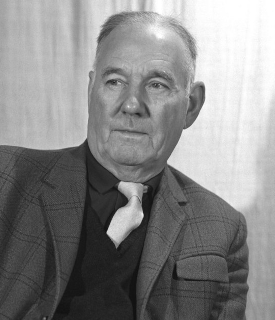
León Ó Broin, senior civil servant, historian, and author, is born Leo Byrne on November 10, 1902, at 21 Aungier Street, Dublin, the second of four sons of James P. Byrne, a potato factor’s bookkeeper, and Mary Byrne (née Killeen), daughter of a seaman who abandoned his family.
After early education in convent school, Ó Broin attends Synge Street CBS, where he is especially adept at languages. After working in several minor clerical employments, he becomes a clerk in the Kingsbridge headquarters of the Great Southern Railway. Joining a local Sinn Féin club, he canvasses for the party in the College Green ward during the 1918 Irish general election. Sent from an early age to Irish language classes by his father, he attends the Irish summer college in Spiddal, County Galway, and joins the Gaelic League, becoming by early 1921 secretary of central branch. He writes articles for the league’s successive weekly organs, each in its turn suppressed by the authorities. Despite regarding such writing as practice work within a language he is yet learning, he is selected best writer of Irish at the 1920 Dublin feis.
Arrested with his father and two brothers just before Christmas 1920 when Black and Tans discover a letter in Irish on his person during a house raid, Ó Broin is imprisoned for several weeks in Wellington Barracks. Leaving his railway job, he works as a clerk in the clandestine office of the Dáil ÉireannDepartment of Agriculture (1921–22). During the Irish Civil War, with departmental work at a standstill, he joins the National Army as a commissioned officer assigned to general headquarters staff at Portobello Barracks. Having recently commenced legal studies at the King’s Inns and University College Dublin (UCD), he handles army legal matters, such as compensation claims for damage to property.
Called to the bar in 1924, Ó Broin enters the civil service. Assigned to the Department of Education (1925–27), he was involved in launching the Irish language publishing imprint An Gúm, intended to redress the paucity of reading material, apart from school texts, in the language. Transferred to the Department of Finance (1927), he serves as estimates officer and parliamentary clerk and is assistant secretary of the economy committee established by the Cumann na nGaedheal government to make recommendations on reductions in current expenditure. Appointed private secretary to the Minister for Finance (1931–32), he serves both Ernest Blythe and the first Fianna Fáil minister, Seán MacEntee. Promoted to assistant principal (1932), and to principal officer (1939), he represents the department on the Irish Folklore Commission, and serves on the interdepartmental committee that, after the disastrous Kirkintilloch bothy fire in 1937, investigates seasonal migration to Scotland. During the emergency he is regional commissioner for Galway and Mayo (1940–45), one of eight such officers charged with organising contingency preparations for dealing with the likely collapse of central administration in the event of invasion by any of the wartime belligerents.
Transferred out of Finance, Ó Broin becomes assistant secretary (1945–48) and secretary (1948–67) of the Department of Posts and Telegraphs, administering both the postal service and telecommunications. He works closely with Fianna Fáil minister Patrick Little to improve the range and quality of music offered by the broadcasting service, playing a large part in the decision to form and adequately staff a full Radio Éireann symphony orchestra. He represents Ireland in several post-war conferences in Europe and America that reorganise the international regulation of broadcasting activities. He is elected to the European Broadcasting Union‘s administrative council (1953). He establishes and serves on a departmental committee in 1953 that studies all facets of launching a television service.
A devout but liberal Catholic, Ó Broin is prominent for many years in the Legion of Mary, founded by his close friend and civil-service colleague Frank Duff. President of a legion presidium of writers, actors, and artists, he is first editor (1937–47) of the quarterly organ Maria Legionis. Sharing Duff’s ecumenism, he belongs to the Mercier Society, the Pillar of Fire Society, and Common Ground, groups organised by Duff in the early 1940s to facilitate discussion between Catholics and, respectively, protestants, Jews, and secular intellectuals. The first two are suspended amid disapproval by the Catholic Archbishop of Dublin, John Charles McQuaid.
On retirement from the civil service in 1967, Ó Broin concentrates on the parallel career of research and writing that he had cultivated over many years. Having begun writing articles and short stories in Irish from his earliest years in the Gaelic League, he publishes his first collection of short stories, Árus na ngábhad, in 1923. With the establishment of An Gúm, he publishes three more collections of original short stories and translations of such masters of the genre as Alexander Pushkin, Prosper Mérimée, Guy de Maupassant, and Jerome K. Jerome. He translates several popular modern novels, including Robert Louis Stevenson‘s Kidnapped and H. G. Wells‘s The War of the Worlds. Active as secretary, actor, and writer with the state-subsidised Gaelic Drama League (An Comhar Drámaíochta), which produces Irish language plays, he publishes many plays in Irish, both original and translated. His best-selling book in Irish is Miss Crookshank agus coirp eile (1951), about the mummified corpses in the vaults of St. Michan’s Church, Dublin.
Ó Broin writes prolifically on modern Irish history and biography. His Irish language biography of Charles Stewart Parnell (1937), the first full-scale study of its kind in Irish since the commencement of the language revival, is a landmark publication, praised for the quality of its prose by such critics as Frank O’Connor and Seán Ó Faoláin. His biography of Robert Emmet, published in Irish in 1954, and awarded the Douglas Hyde prize, pioneers the scholarly subversion of the romantic myth surrounding its subject, and includes consideration of the political and social context. The subjects of subsequent biographies include Richard Robert Madden, Charles Gavan Duffy, Joseph Brenan, Michael Collins, and Frank Duff.
Ó Broin takes a largely biographical approach to historical writing, researching neglected aspects of pivotal historical events, and basing his studies on previously unexploited primary sources, often the papers of a single individual, whose career serves as the linchpin of his narrative, filtering events through the perspective of that person. Another vein of his scholarship is his primary research into the history of Irish separatism, especially with sources in the Irish State Paper Office.
Ó Broin receives an honorary LL. D from the National University of Ireland (NUI) in 1967. Elected a member of the Royal Irish Academy (RIA) in 1971, he is a council member (1974–76) and senior vice-president (1976–77) and chairs the group whose recommendations results in the academy’s establishment of the National Committee on International Affairs. He is president of the Irish Historical Society (1973–74), and a member of the Irish Manuscripts Commission.
In 1925 Ó Broin marries Cait Ní Raghallaigh, an office assistant reared in Baltinglass, County Wicklow, whom he met in the Gaelic League. They have two sons and three daughters. After residing in the south city suburbs, they move to Booterstown, County Dublin in the 1930s, and from there to the Stillorgan Road in the 1950s.
Ó Broin dies February 26, 1990, in Dublin, and is buried in Deans Grange Cemetery. His papers are in the National Library of Ireland (NLI). His eldest son, Eimear Ó Broin, is an accomplished musicologist and assistant conductor of the several Radio Éireann orchestras (1953–89).
(From: “Ó Broin, León” by Lawrence William White, Dictionary of Irish Biography, http://www.dib.ie)
Healy is the son of a Guard. As a child the family moves to Cavan, where he attends the local secondary school. In his late teens he moves to London and works in a succession of jobs, including barman, security man and as a labourer. He later returns to Ireland, settling in Ballyconnell, County Sligo, a small settlement on the Atlantic coast.
Often overlooked due to his relatively low public profile, Healy’s work is admired by his Irish literary predecessors, peers and successors alike, many of whom idolise him. Among the writers to have spoken highly of him are Seamus Heaney, Eugene McCabe, Roddy Doyle, Patrick McCabe and Anne Enright.
Healy dies at his home in Ballyconnell on June 29, 2014, while awaiting an ambulance after suddenly being taken ill. He is laid to rest at Carrigans Cemetery following funeral mass by Fr. Michael Donnelly at St. Patrick’s Church in Maugherow.
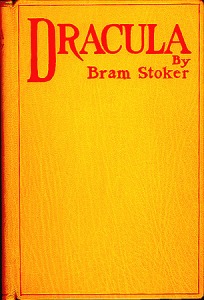
The Gothic horror novel Dracula, written by Bram Stoker of Dublin, is first published on May 26, 1897. The novel tells the story of Dracula’s attempt to move from Transylvania to England so that he may find new blood and spread the undead curse, and of the battle between Dracula and a small group of men and women led by Professor Abraham Van Helsing.
Between 1879 and 1898, Stoker is a business manager for the world-famous Lyceum Theatre in London, where he supplements his income by writing a large number of sensational novels, including the vampire tale Dracula. Parts of the novel are set around the town of Whitby, where he spends summer holidays.
Throughout the 1880s and 1890s, authors such as H. Rider Haggard, Rudyard Kipling, Robert Louis Stevenson, Arthur Conan Doyle, and H. G. Wells write many tales in which fantastic creatures threaten the British Empire. Invasion literature is at a peak, and Stoker’s formula of an invasion of England by continental European influences is very familiar by 1897 to readers of fantastic adventure stories. Victorian readers enjoy Dracula as a good adventure story like many others, but it does not reach its iconic legendary status until later in the 20th century when film versions begin to appear.
Before writing Dracula, Stoker spends seven years researching European folklore and stories of vampires, being most influenced by Emily Gerard‘s 1885 essay Transylvania Superstitions. Later he also claims that he has a nightmare, caused by eating too much crab meat covered with mayonnaise sauce, about a “vampire king” rising from his grave.
Despite being the most widely known vampire novel, Dracula is not the first. It is preceded and partly inspired by Sheridan Le Fanu‘s 1871 Carmilla, about a lesbian vampire who preys on a lonely young woman, and by Varney the Vampire, a lengthy penny dreadful serial from the mid-Victorian period by James Malcolm Rymer. John Polidori creates the image of a vampire portrayed as an aristocratic man, like the character of Dracula, in his tale The Vampyre in 1819.
The Lyceum Theatre where Stoker works between 1878 and 1898 is headed by actor-manager Henry Irving, who is Stoker’s real-life inspiration for Dracula’s mannerisms and who Stoker hopes would play Dracula in a stage version. Irving never does agree to do a stage version, but Dracula’s dramatic sweeping gestures and gentlemanly mannerisms draw their living embodiment from Irving.
The Dead Un-Dead is one of Stoker’s original titles for Dracula, and the manuscript is entitled simply The Un-Dead up until a few weeks before publication. Stoker’s notes for Dracula show that the name of the count is originally “Count Wampyr”, but Stoker becomes intrigued by the name “Dracula” while doing research, after reading William Wilkinson‘s book An Account of the Principalities of Wallachia and Moldavia with Political Observations Relative to Them (London 1820), which he finds in the Whitby Library and consults a number of times during visits to Whitby in the 1890s. The name Dracula is the patronym of the descendants of Vlad II of Wallachia, who takes the name “Dracul” after being invested in the Order of the Dragon in 1431. In the Romanian language, the word dracul can mean either “the dragon” or, especially in the present day, “the devil.”
Dracula is copyrighted in the United States in 1899 with the publication by Doubleday & McClure of New York. However, when Universal Studios purchases the rights, it comes to light that Bram Stoker has not complied with a portion of U.S. copyright law, placing the novel into the public domain. In the United Kingdom and other countries following the Berne Convention on copyrights, the novel is under copyright until April 1962, fifty years after Stoker’s death.
F. W. Murnau‘s unauthorized film adaptation Nosferatu is released in 1922, and the popularity of the novel increases considerably, owing to the controversy caused when Stoker’s widow tries to have the film removed from public circulation. Florence Stoker sues the film company and wins; however, the company is bankrupt, and Stoker only recovers her legal fees and an order by the court for all copies of the film to be destroyed. Some copies survive and find their way into theatres. Eventually, Florence Stoker simply gives up the fight against public displays of the film.
Dracula has been assigned to many literary genres including vampire literature, horror fiction, gothic fiction, and invasion literature. Stoker does not invent the vampire, but he defines its modern form, and the novel has spawned numerous theatrical, film, and television interpretations.



 seamus dubhghaill