seamus dubhghaill

Promoting Irish Culture and History from Little Rock, Arkansas, USA


Leave a comment

The Soloheadbeg Ambush

The Soloheadbeg ambush takes place on January 21, 1919, when members of the Irish Volunteers, which becomes the Irish Republican Army (IRA) later that year, ambush Royal Irish Constabulary (RIC) officers who are escorting a consignment of gelignite explosives at Soloheadbeg, County Tipperary. Two RIC officers are killed, and their weapons and the explosives are seized. As it happens on the same day that the revolutionary Irish parliament first meets and declares Ireland’s independence, it is often seen as the first engagement of the Irish War of Independence.

In April 1916, during World War I, Irish republicans launch an uprising against British rule in Ireland, called the Easter Rising. They proclaim an Irish Republic. After a week of heavy fighting, mostly in Dublin, the rising is put down by British forces. About 3,500 people are taken prisoner by the British, many of whom had played no part in the Rising. Most of the Rising’s leaders are executed. The rising, the British response, and the British attempt to introduce conscription in Ireland, leads to an even greater public support for Irish republicanism.

In the 1918 Irish general election, the Irish republican party Sinn Féin wins a landslide victory in Ireland, gaining 73 out of 105 seats in the British Parliament. However, in its election manifesto, the party has vowed to set up a separate government in Ireland rather than sit in the British Parliament. At a meeting in Dublin on January 21, 1919, Sinn Féin establishes an independent parliament called Dáil Éireann and declares independence from the United Kingdom.

That same day, an ambush is carried out by Irish Volunteers from the 3rd Tipperary Brigade. It involves Seán Treacy, Dan Breen, Seán Hogan, Séumas Robinson, Tadhg Crowe, Patrick McCormack, Patrick O’Dwyer and Michael Ryan. Robinson is the commander of the group that carries out the attack and Treacy coordinates the planning of the attack. The unit involved acts on its own initiative as had they had to wait for a response, even if it is affirmative, it might come too late.

In December 1918, they receive information that there are plans to move a consignment of gelignite from Tipperary British Army barracks to the Soloheadbeg quarry. They begin plans to intercept the consignment and Dan Breen’s brother Lars, who works at the quarry, receives information that the consignment is to be moved around January 16, 1919. They anticipate that there would be between two and six armed escorts, and they discuss different plans. If the escort is small, they believe they can overpower the RIC officers without firing a shot. Gags and ropes are hidden in the quarry, so that should officers surrender they can be bound and gagged. The planning for the ambush takes place in the ‘Tin Hut,’ a deserted semi-derelict house at Greenane.

Each day from January 16 to 21, the men chosen for the ambush take up their positions from early in the morning to late afternoon and then spend the night at the deserted house. Seven of the Volunteers are armed with revolvers while Treacy is armed with a small automatic rifle. On a rainy January 21, around noon, Patrick O’Dwyer sees the transport leaving the barracks. The consignment of 160 lbs. of gelignite is on a horse-drawn cart, led by two council men and guarded by two RIC officers armed with carbine rifles. O’Dwyer cycles quickly to where the ambush party is waiting and informs them. Robinson and O’Dwyer hide about 20 yards in front of the main ambush party of six, in case they rush through the main ambush position.

When the transport reaches the position where the main ambush party is hiding, masked Volunteers step out in front of them with their guns drawn and call on the RIC to surrender. The officers can see at least three of the ambushers. One officer gets down behind the cart and the other apparently fumbles with his rifle. According to the Volunteers, the officers raise their rifles to fire at them, but the rifles do not fire. The Volunteers immediately fire at the officers, and it is believed that Treacy fires the first shot. Both officers, James McDonnell and Patrick O’Connell, native Roman Catholics, are killed. MacDonnell (50) of Belmullet, County Mayo, is a widower with five children. O’Connell is unmarried and a native of Coachford, County Cork.

As planned, Hogan, Breen and Treacy take the horse and cart with the explosives and speed off. Tadhg Crowe and Patrick O’Dwyer take the guns and ammunition from the dead officers, while Robinson, McCormack and Ryan guard the two council workers, Ned Godfrey and Patrick Flynn, before releasing them once the gelignite is far enough away. Initially the explosives are hidden in a field in Greenane. They are moved several times and are later divided up between the battalions of the brigade.

The ambush is later seen as the beginning of the Irish War of Independence. The British government declares South Tipperary a Special Military Area under the Defence of the Realm Act two days later. There is strong condemnation from the Catholic Church in Ireland. The parish priest of Tipperary calls the dead officers “martyrs to duty.”

A meeting of the Executive of the Irish Volunteers takes place shortly thereafter. On January 31, An t-Óglach, the official publication of the Irish Volunteers, states that the formation of Dáil Éireann “justifies Irish Volunteers in treating the armed forces of the enemy – whether soldiers or policemen – exactly as a National Army would treat the members of an invading army.”

In February 1919 at a Brigade meeting in Nodstown, Tipperary, Brigade officers draft a proclamation, signed by Séumas Robinson as OC, ordering all British military and police forces out of South Tipperary and, should they stay, they will be held to have “forfeited their lives.” GHQ refuses to sanction the proclamation and demands it not be publicly displayed. Despite this it is still posted in several places in Tipperary.

In order to avoid capture, Breen, Treacy, Hogan and the other participants are forced to stay on the move for the following months, often hiding in the barns and attics of sympathisers.

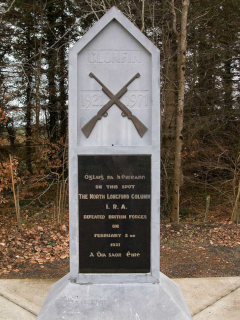
A monument (pictured) has been erected at the site of the ambush, and each year a ceremony of remembrance is held there.


4 Comments

The Pickardstown Ambush

The Pickardstown Ambush, an action by a combined Waterford force against a British Army patrol at Pickardstown, takes place near the town of Tramore, County Waterford on the night of January 7, 1921, during the Irish War of Independence. The ambush follows a feint attack on the Tramore Royal Irish Constabulary (RIC) barracks.

The ambush is conceived by Irish Republican Army (IRA) East Waterford Officer Commanding (OC) Paddy Paul, who gathers volunteers from the local Dunhill and Waterford City units of his command, as well as West Waterford OC Pax Whelan and West Waterford flying column OC George Lennon. This makes for a total of fifty men although several are armed only with shotguns.

An attack is made on the RIC barracks in the town, and the British military garrison in Waterford quickly dispatches forty troops in four Crossley tenders. However the ambush has been badly planned with the result that the British troops are able to make a determined counterattack. Two IRA volunteers, Thomas O’Brien and Michael McGrath, are reportedly taken away and shot by members of the Devon Regiment. Two other volunteers are wounded. One British soldier and one Black and Tan are wounded.

A memorial is later erected on the ambush site. In later years, local Gaelic Athletic Association (GAA) fields are named after the two dead IRA men.

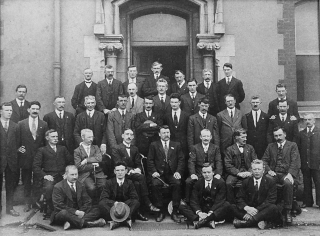
(Pictured: Members of the Irish Republican Army East Waterford Brigade)


Leave a comment

Birth of George Plant, Member of the Irish Republican Army

George Plant, Irish Republican Army (IRA) member who is executed by the Irish Government in 1942, is born into a Church of Ireland farming family in Fethard, County Tipperary, on January 5, 1904.

Plant is the second eldest child and son in a family of six children. His parents are John William Albert Plant, a farmer, and Catherine Hayden.

One Sunday in 1916 George and his older brother Jimmy are arrested by the Royal Irish Constabulary (RIC) after being seen speaking to two well-known republicans, Seán Hayes and Dan Breen. In custody the two brothers are beaten and mistreated resulting in a hatred of the RIC. He serves with the Irish Republican Army during the Irish War of Independence and with the Anti-Treaty IRA in the Irish Civil War.

In 1923 George and Jimmy leave Ireland for Canada and the United States but continue as active IRA members. In 1929 they return to Ireland and carry out a bank raid in Tipperary on behalf of the IRA. They are arrested two days later at the family farm and subsequently sentenced to 7 years in prison. They are released in a general amnesty after the Fianna Fáil and Éamon de Valera election victory in 1932. He is a strong supporter of Seán Russell. In 1939 following the outbreak of World War II, known in Ireland as The Emergency, de Valera is determined to maintain Irish neutrality and is not going to allow the IRA to jeopardize this. The IRA links with Germany and campaign in Britain are severely straining Anglo-Irish relations so emergency legislation is introduced.

Russell, the IRA Chief of Staff, dies in August 1940 after taking ill on board a U-boat and Stephen Hayes from County Wexford becomes IRA Chief of Staff. In late August 1940 an address on Lansdowne Road Dublin is raided by the Garda Síochána. Among the men arrested is Michael Devereux, a 24-year-old married truck driver from County Wexford who is also Quartermaster of the IRAs Wexford Brigade. He is released after three days without charge. Shortly afterwards Gardaí in County Wexford find an IRA arms dump. Many in the IRA suspect that Devereux had turned informer, so Stephen Hayes orders Devereux’s execution. George Plant and another man, Michael Walsh from County Kilkenny, are ordered to carry out the order. Devereux meets Plant and Walsh who tell Devereux that Tom Cullimore, the Wexford Brigade’s OC is blamed for the arms dump and that they have shot him. They order Devereux to drive them to an IRA safe house at Grangemockler in south County Tipperary. Devereux, believing he is the prime suspect in a murder, stays willingly at the safe house. A week later, on September 27, 1940, Devereux is invited to go for a walk with Plant and Paddy Davern, the owner of the safe house. Somewhere along the walk Plant accuses Devereux of being an informer and shoots him dead. Plant is arrested nine weeks later on suspicion of IRA membership and brought before the Special Criminal Court in Dublin. On February 10, 1941, Radio Éireann broadcasts a radio appeal for Michael Devereux on behalf of his wife.

In September 1941 Stephen Hayes is accused of being an informer by a group of Northern IRA members led by Seán McCaughey. He manages to escape to a garda station. Shortly afterwards a large force of Garda Síochána and Irish Army descend on the area around the Davern farmhouse where they find Devereux’s car buried under an onion bed and eventually discover Devereux’s body, a year to the day after his death. Two weeks later, Plant, already in prison on IRA membership charges, is charged with Devereux’s murder. A trial is held with a senior IRA officer, Joseph o’Connor, also charged with Devereux’s murder. The first trial collapses after two days when Paddy Davern and Micheal Walsh, two of the prosecution witnesses, refuse to give evidence. This result leads to the court issuing a nolle prosequi order which should have meant the end of the affair, however both men are rearrested and recharged with the same offence, under Emergency Order 41f. Minister for Justice Gerald Boland transfers the case to a Special Military Court with army officers acting as judges. In addition to Plant, Paddy Davern and Michael Walsh are also now charged with Devereux’s murder. The second trial begins at Collins Barracks, Dublin in February 1942 with Seán MacBride, a former IRA Chief of Staff and future government minister as the defendant’s barrister. Davern states his original statement was given at gunpoint but under the new order even statements given under duress are admissible. The court only has two sentencing options – death or acquittal. Joseph O’Connor is acquitted and despite MacBride’s best efforts the other three are sentenced to death. Davern and Walsh have their sentences commuted to life imprisonment and are both released in 1946.

Just one week after sentence is passed, Plant is executed in Portlaoise Prison by a six-man firing squad drawn from the Irish Army. Much bitterness is caused by the treatment of Plant’s relatives. Neither his wife or mother or infant son are allowed to visit him in the week before his execution. Censorship ensures there is little mention in the newspapers, so his family only learns of his execution from a brief radio broadcast shortly before they receive a telegram. He is buried in the grounds of Portlaoise Prison, but is reinterred in 1948, when he is buried with full IRA military honours in his local church St. Johnstown in County Tipperary, and a Celtic cross is erected over his grave.

Plant’s wife moves to the United States where she remarries. His brother Jimmy dies in London in 1978. The Plant’s family farm is now part of the Coolmore Estate.


Leave a comment

The Kilcommon Ambush

On the morning of the December 16, 1920 during the Irish War of Independence, an eight man Royal Irish Constabulary (RIC) foot patrol under the command of Sergeant Thomas Bray, leaves the barracks at Kilcommon Cross, County Tipperary, to retrieve mail from the Post Office in Kilcommon village, a mile away.

As they approach the crest of a hill on the narrow road between the Cross and the village, approximately twenty men of the Irish Republican Army (IRA) 1st Tipperary Brigade open fire on them. The object of the attack is apparently quite simple – to kill members of the police, and in particular Sergeant Bray.

The ambush, although triggered early, is successful, with the deaths of four of the constables and the serious wounding of one other. The remaining three policemen are able to take cover and return to the barracks, including the Sergeant. Two RIC rifles are lost and there are no casualties on the IRA side.

The dead constables are Patrick Joseph Halford (27) of Meath, Ernest Frederick Harden (21) of Essex, Albert Holman Palmer (24) of Surrey, and Arthur Smith (22) of London. Constable Alfred Edwin Bundy of Gloucestershire is seriously wounded and requires hospital care. He is pensioned out early, in June 1921, as a result of his injuries.

There is some suggestion that the local IRA units are not at all keen on an ambush in their area, for fear of retribution. The brigade commanders push ahead with it however, and the inevitable ‘unofficial reprisals’ are carried out, with the killing of some livestock and the burning of some dwellings, including the home of one of the IRA volunteers.

The total strength in Kilcommon RIC Barracks at this time was around 16 police. Most of them are British recruits – Black and Tans – and under the control of only one Sergeant. Immediately after the ambush a further six men are drafted in as replacements.

Two of the eight police involved in the incident that day remain to be identified. But present in Kilcommon barracks during the period are two constables who are later to have careers in the Palestine Gendarmerie, Arthur Charles Howard and Arthur Fisher. Fisher becomes an officer in the Arab Section of the Palestine Gendarmerie and later the Transjordan Frontier Force (TJFF).

(From: “The Kilcommon Ambush, 16 December 1920” by Peter Mc, The Royal Irish Constabulary Forum, irishconstabulary.com | Pictured: The vicinity of the ambush site)


Leave a comment

Fermanagh County Council Pledges Allegiance to Dáil Éireann

Fermanagh County Council pledges allegiance to Dáil Éireann on December 15, 1921. After the meeting the Royal Irish Constabulary (RIC) takes over the council chamber.

Fermanagh County Council is the authority responsible for local government in County Fermanagh, Northern Ireland, between 1899 and 1973. It is originally based at the Enniskillen Courthouse, but moves to County Buildings in East Bridge Street, Enniskillen, in 1960.

Fermanagh County Council is formed under orders issued in accordance with the Local Government (Ireland) Act 1898 which comes into effect on April 18, 1899. Elections are held using proportional representation until 1922 when it is abolished in favour of first-past-the-post voting. On December 15, 1921, shortly before the partition of Ireland and transfer of power from the Dublin Castle administration, Fermanagh County Council passes a resolution on a 13–10 majority not to recognise the newly formed Parliament of Northern Ireland and pledges their allegiance to the unrecognised republican Second Dáil of the self-proclaimed Irish Republic in Southern Ireland before the ratification of the Anglo-Irish Treaty. The resolution states, “We, the County Council of Fermanagh, in view of the expressed desire of a large majority of people in this county, do not recognise the partition parliament in Belfast and do hereby direct our Secretary to hold no further communications with either Belfast or British Local Government Departments, and we pledge our allegiance to Dáil Éireann.” In response, the Royal Irish Constabulary evict them from their council offices and confiscate official documents. As a result, the council is temporarily dissolved. The council are replaced by Commissioners appointed by Sir Dawson Bates.

The council is reformed by the time of the 1924 Northern Ireland local elections. As a protest against the abolition of proportional representation nationalist parties boycott the election, allowing unionist parties to take control of the council uncontested. Due to the abolition of proportional representation and gerrymandering, the council always has a unionist majority of councillors elected up until abolition. In 1967, the Government of Northern Ireland passes the County Fermanagh (Transfer of Functions) Order 1967. This makes Fermanagh County Council amalgamate with the smaller Enniskillen Borough Council and the rural district councils in Enniskillen, Irvinestown and Lisnaskea to turn Fermanagh County Council into a unitary authority.

In 1969, the Fermanagh Civil Rights Association publishes a booklet criticising the council and accusing them of favouring the Protestant community over the Catholic community. Some of the accusations include that the council deliberately hires Protestants for skilled local government and school jobs and that they propose to build a new village for Catholics in a gerrymandered district that already has a Catholic majority. The council is abolished in accordance with the Local Government Act (Northern Ireland) 1972 on October 1, 1973 and replaced by Fermanagh District Council.

(Pictured: Coat of arms of Fermanagh County Council, Northern Ireland)


2 Comments

IRA Volunteer Mick Fitzgerald Dies on Hunger Strike

Michael Fitzgerald also known as Mick Fitzgerald, dies on hunger strike in Cork County Gaol on October 17, 1920. He is among the first members of the Irish Republican Army and plays an important role in organizing it. His death is credited with bringing world-wide attention to the Irish cause for independence.

Born in December 1881 in Ballyoran, Fermoy, County Cork, Fitzgerald is educated at the Christian Brothers School in the town and subsequently finds work as a mill worker in the locality. He joins the Irish Volunteers in 1914 and plays an important role in building the local organisation which is soon to become the Irish Republican Army (IRA). He soon rises to the rank of Battalion Commandant, 1st Battalion, Cork No.2 Brigade.

On Easter Sunday, April 20, 1919, Fitzgerald leads a small group of IRA volunteers who capture Araglin, Cork Royal Irish Constabulary Barracks located on the border with County Tipperary. He is subsequently arrested and sentenced to three months imprisonment at Cork County Gaol. He is released from prison in August 1919 and immediately returns to active IRA duty. He is involved in the holding up of a party of British Army troops at the Wesleyan Church in Fermoy. The troops are disarmed although one of them is killed. Arrested and held on remand, Fitzgerald feels that the only chance he has for release is via a hunger strike.

Fitzgerald, along with Terence MacSwiney and nine other IRA volunteers, are arrested on August 8, 1920. On August 11, MacSwiney begins a hunger strike in Brixton Gaol. Fitzgerald and the other nine volunteers at Cork County Gaol join in. At the age of 24, he is the first to die on October 17, 1920 as a result of his sixty-seven day fast. His death is followed by the deaths of Joe Murphy and Terence MacSwiney. Their deaths are credited with bringing world-wide attention to the Irish cause for independence.

Fitzgerald is buried at Kilcrumper Cemetery, on the outskirts of Fermoy, County Cork. In addition, a road is named after him in Togher, Cork.

During a November 2008 visit to Fermoy, Sinn Féin Vice-President Pat Doherty lays a wreath at Fitzgerald’s grave. Doherty says Fitzgerald’s sacrifice was like that of the hunger strikers in 1981. He says it is a great honour for him to pay homage to a man “to whom we owe so much.” Also buried in the Republican Plot in Fermoy is General Liam Lynch, who was Chief of Staff of the IRA when he was shot dead by Irish Free State troops in the Knockmealdown Mountains on April 12, 1923. His last wish was to be buried with his great friend and comrade, Mick Fitzgerald.


1 Comment

Capture of Mallow Barracks

The Cork No. 2 Brigade, Irish Republican Army (IRA), attacks and captures a military barracks in Mallow, County Cork, on September 28, 1920, the only military barracks to be captured during the Irish War of Independence. British forces later burn and sack the town.

Mallow had been a garrison town for several hundred years. Eight miles to the north lay Buttevant where one of the largest military barracks in the country is located. Not far from Buttevant are the great military training camps of Ballyvonaire, while nineteen miles to the northeast is Fermoy with its large permanent military garrisons and huge barracks adjacent to the big training centres of Kilworth and Moorepark. Twenty miles to the southeast is the city of Cork with its many thousands of troops both in the posts within the city and at Ballincollig, about six miles west of it, on the Macroom road. Thirteen miles westward a detachment from a British machine gun corps holds Kanturk. Every town and village has its post of Royal Irish Constabulary (RIC) men armed to the teeth.

The idea of capturing the barracks comes from two members of the Mallow IRA Battalion, Dick Willis, a painter, and Jack Bolster, a carpenter, who are employed on the civilian maintenance staff of the barracks which is occupied by the 17th Lancers. Willis and Bolster are able to observe the daily routine of the garrison and form the opinion that the capture of the place would not be difficult. They are instructed by their local battalion officers to make a sketch map of the barracks. After that is prepared, Liam Lynch and Ernie O’Malley go with Willis and Tadhg Byrnes to Mallow to study the layout of the surrounding district. Among the details of the garrison’s routine that Willis and Bolster report to the Column leaders, is the information that each morning the officer in charge, accompanied by two-thirds of the men, take the horses for exercise outside the town. It is obvious to the two Mallow volunteers that this is the ideal time for the attack.

Situated at the end of a short, narrow street and on the western verge of the Town Park, Mallow barracks stand on an unusually low-lying location and is relatively small in size. Surrounded by a high stone wall, the barracks can be approached from the town park as well as from the main street. The various details are carefully studied by Lynch and O’Malley. While Willis and Bolster are allotted tasks within the walls of the barracks, Byrnes and Jack Cunningham are chosen to attack with the main body of the column which includes Commandant Denny Murphy of Kanturk.

On the morning of September 27, at their Burnfort headquarters, the men are ordered to prepare for action. Under cover of darkness they move into the town and enter the Town Hall by way of the park at the rear. The eighteen men of the column are strengthened by members of the Mallow battalion, a number of men posted in the upper storey of the Town Hall, from which they can command the approaches to the nearby RIC barracks. Initially it is planned that Willis and Bolster will enter the military barracks that morning in the normal manner, accompanied by an officer of the column who will pose as a contractor’s overseer. The officer is Paddy McCarthy of Newmarket, who would die a few months later in a gun battle with the Black and Tans at Millstreet.

McCarthy, Willis and Bolster enter the barracks without mishap. Members of the garrison follow their normal routine, with the main body of troops under the officer in charge leaving the barracks with the horses. In the barracks remain about fifteen men under the command of a senior N.C.O., Sergeant Gibbs.

Once the military has passed, the attackers, numbering about twenty men and led by Liam Lynch, advance toward the bottom of Barrack Street. All are armed with revolvers which are considered the most convenient and suitable weapons for the operation. Lynch has issued strict instructions that there is to be no shooting by the attackers, unless as a last resort. Inside the walls are McCarthy, Willis and Bolster, their revolvers concealed. Then Ernie O’Malley presents himself at the wicket gate with a bogus letter in his hand. Behind him and out of sight of the sentry are the other members of the main attacking party, led by Lynch, O’Brien and George Power. When the gate is opened sufficiently, O’Malley wedges his foot between it and the frame and the soldier is overpowered and the attackers rush in. McCarthy, Bolster and Willis immediately go to the guardroom where they hold up the guard. Realising what is happening, Sergeant Gibbs, rushes toward the guardroom in which rifles are kept. Although called upon to halt, he continues even though a warning shot is fired over his head. As he reaches the guardroom door, the IRA officer and one of the volunteers in the guardroom fire simultaneously. Mortally wounded, the sergeant falls at the guardroom door.

By this time the majority of the attacking party is inside the gate. Military personnel in different parts of the barracks are rounded up and arms are collected. Three waiting motor cars pull up to the gate and all the rifles, other arms and equipment found in the barracks are loaded into them. The prisoners are locked into one of the stables, with the exception of a man left to care for Sergeant Gibbs. The whole operation goes according to plan, except for the shooting of the sergeant. Twenty minutes after the sentry had been overpowered the pre-arranged signal of a whistle blast is sounded and the attackers withdraw safely to their headquarters at Burnfort, along the mountain road out of Mallow.

Expecting reprisals, the column moves to Lombardstown that night, and positions are taken up around the local co-operative creamery as it is the custom of the British to wreak their vengeance on isolated country creameries after incidents such as what had just occurred. The Mallow raid, however, has greater repercussions than the destruction of a creamery and co-operative stores. The following night, large detachments of troops from Buttevant and Fermoy enter Mallow. They rampage through the town, burning and looting at will. High over the town, the night sky is red with the flames of numerous burning buildings.

Townspeople run through the blazing streets, in search of refuge. A number of women and children are accorded asylum in the nearby convent schools. Another group of terrified women, some with children in arms, take refuge in the cemetery at the rear of St. Mary’s Church, where they kneel or lay above the graves. It is a night of terror such as which had never before been endured by the people of Mallow.

The extent of the wanton destruction outrages fair-minded people all over the world. Details of the havoc that had been wrought and pictures of the scenes of destruction are published worldwide.

(Pictured: Townspeople gather in front of one of the many buildings in Mallow which were reduced to ruins during British Army reprisals)


Leave a comment

The Templemore Miracles

In August and September 1920 the town of Templemore in County Tipperary is the sight of alleged Marian apparitions. Thousands of people come to the town daily to see the apparitions. The affair occurs during the Irish War of Independence and results in a short-lived local truce between the Irish Republican Army (IRA) and Crown forces. When the truce ends, pilgrims stop coming to the town and the sightings end. The affair is sometimes referred to as the Templemore miracles.

In January 1919 the Irish War of Independence begins and lasts until July 1921. On the night of August 16, 1920, British soldiers of the Northamptonshire Regiment attack Templemore in reprisal for the killing of an Royal Irish Constabulary (RIC) officer by IRA volunteers earlier that day. They fire volleys and burn homes and businesses. No civilians or IRA men are killed but two soldiers die by accident in the fires.

Shortly after the attack, a sixteen-year old farm labourer named James Walsh claims that he was visited by the Virgin Mary in his cottage in the nearby townland of Curraheen. She told him that she was troubled by what was happening in Ireland. At her request he digs a hole in the ground in his bedroom and this soon fills with spring water. Afterwards he claims that all three statues of the Virgin Mary in his home began to bleed. He takes these statues to Templemore, where the bleeding is witnessed. One man who had been crippled for most of his life claims he is dancing in the streets after visiting Walsh’s cottage. He is the first of many who claim to have been cured of their ailments in the presence of Walsh or the statues.

Locals believe that divine intervention had prevented any of them being killed or wounded during the attack by the British. Walsh gathers people around the statues to say the Rosary in Irish. According to Ann Wilson, the statues are seen “as asserting the Catholic Irish identity of the population in the face of the non-Catholic British opponent, a superior spiritual power which would win out against the much more substantial, but merely worldly, advantages of the enemy.”

The affair is soon reported in local and national newspapers, which causes more pilgrims to go to Tipperary, both to see the statues in Templemore and Walsh’s cottage in Curraheen. On August 31, 1920 an RIC inspector writes to the Dublin Castle administration, estimating that over 15,000 pilgrims per day are coming down. Many come seeking cures for various illnesses and report that they had received them. One RIC officer resigns from his job to join a religious order. One soldier is reported to convert to Catholicism. The influx results in a large economic windfall for the town.

The official position of the church is one of ‘extreme reserve.’ The parish priest Reverend Kiely refuses to see the statues. However, no effort is made to stop people making pilgrimages. Local IRA commander James Leahy notes a division between older and younger clergy in the local church, with older clergy generally being skeptical of Walsh while younger clergy are more enthusiastic about his claims.

Prior to the apparitions beginning, Wilson had given a Virgin Mary statue to a local RIC constable named Thomas Winsey, according to the Tipperary Star. Winsey placed the statue in the barracks. This too is said to be bleeding. One day a large crowd of pilgrims besiege the barracks and have to be physically restrained when they attempt to enter it. The statue is removed from the barracks. Police and military stop appearing on the street shortly after.

The IRA effectively takes over the area at this point. They keep order, organise traffic and help pilgrims. However, they do not appear in the streets in uniform and there is an informal truce in effect between them and Crown forces.

Local IRA commander James Leahy is concerned at the effect that tips given to IRA volunteers were having on discipline. He and other local commanders interrogate Walsh and stop believing him after this. He contacts IRA Director of Intelligence Michael Collins. Collins has Dan Breen interrogate Walsh. Breen reports that Walsh “was a fake.” Collins sarcastically replies, “One can’t take any notice of what you say, Breen, because you have no religion.”

Having failed to get the church to intervene and denounce Walsh, Leahy and other IRA members decide to restart the war anyway. On September 29, IRA volunteers attack a group of RIC men between Templemore and Curraheen. Two constables are killed. As anticipated, this brings police and army reinforcements to the area. Soldiers loot and desecrate sites outside Templemore associated with the pilgrimage. Rumours begin that the town itself would soon be attacked. Pilgrims flee the area. The statues apparently stop bleeding.

Interest in the statues and Walsh’s cottage largely end at this point, ending Templemore as a sight for pilgrimages. However, Michael Collins does receive a statue at his request. Upon receiving the statue, he smashes it. He discovers that inside is an alarm clock connected to fountain pen inserts containing sheep’s blood. When the clock strikes a certain time, it sends a spurt of blood out of the statue, giving the impression it is bleeding. It is not clear whether this statue performed in Templemore or was one of the ones owned by James Walsh. Collins had received complaints from a local priest that IRA volunteers had engineered statues that would bleed at intervals.

James Walsh is labelled as a possible spy by Dan Breen. At the request of Templemore clergy he is taken to Salesian College in Limerick and placed in the care of Father Aloysius Sutherland. He emigrates to Australia in 1923, settling in Sydney. Towards the end of his life he attempts to enter numerous religious orders but is unsuccessful due to a prior divorce. He dies in Sydney in 1977, having never returned to Ireland.

Historian John Reynolds states at a talk that the affair could have been a prank that got out of hand or was a money-making swindle. He speculates that Walsh may have been used by others, who really instigated it. He discounts the local IRA as having been the instigators.

The affair is not well-known despite gaining worldwide attention at the time. However, in November 2012 the Irish-language television broadcaster TG4 screens a documentary about it. In 2019 the book The Templemore Miracles, written by John Reynolds, is published.

(Pictured: Children pray beside statues that were reported to have started bleeding, Belfast Telegraph, http://www.belfasttelegraph.co.uk)


Leave a comment

The Conor Pass Ambush

Two Royal Irish Constabulary (RIC) men are killed on Conor Pass in Dingle, County Kerry, on July 13, 1920 during the Irish War of Independence.

District Inspector Michael Fallon, accompanied by three other police in a motor car, are ambushed on the Conor Pass between Cloghane and Dingle, County Kerry. The D.I. is returning from an inspection of the barracks at Cloghane when the party is ambushed by members of the Irish Republican Army (IRA) West Kerry No.1 Brigade who are billetted at Fibough, in the Slieve Mish Mountains. The IRA volunteers include J. Dowling, Paddy Paul Fitzgerald, Dan Jeffers and Mick McMahon among their number.

Constables George Roach 62449 and Michael Linehan 63592 are killed outright. D.I. Fallon and Constable Joseph Campbell 67905, the driver, are both wounded. The IRA removes the bodies from the car and takes away the rifles and revolvers of the police. They then take Constable Campbell prisoner, dropping him off about three miles down the road.

Constable Linehan is 34 years old and single, and is originally from Cork. He has twelve years police service. His funeral takes place at St. Mary’s Catholic Church, Limerick, with burial in Mount St. Lawrence Cemetery. A hearse cannot be obtained so the constabulary, in relays, carry the coffin from the church to the cemetery.

Constable Roach has thirteen years service and is from County Clare. He is also a single man.

Compensation awards for gunshot injuries are later made to D.I. Fallon of £850 and to Constable Campbell of £600.

(From: “Constables George Roach and Michael Linehan, killed on the Connor Pass 1920” by Peter Mc, The Royal Irish Constabulary Forum (www.irishconstabulary.com), March 7, 2011)


Leave a comment

Birth of Gilbert Potter, District Inspector of the Royal Irish Constabulary

Gilbert Norman Potter, a District Inspector of the Royal Irish Constabulary, is born in Dromahair, County Leitrim on July 10, 1887. He is executed by the Irish Republican Army (IRA) on April 27, 1921, in reprisal for the British execution of Irish republican Thomas Traynor.

Potter receives his commission as District Inspector on April 27, 1901, having completed his cadetship at the Depot, Phoenix Park, Dublin. His first assignment is to Castlepollard, County Westmeath. During the 1909 ITGWU strike in Cork, he is temporarily posted there from Dublin and is also involved in policing the August 14 marches in Portadown. Having had charge of No. 4 Company at the Depot, he is assigned to Cahir in 1912.

On April 23, 1921, District Inspector Potter is captured by the 3rd Tipperary Brigade, IRA, following the Hyland’s Cross Ambush. This occurs near Curraghcloney, close to the village of Ballylooby. The ambush party is initially made up of a combination of the 1st and 2nd Flying Columns 3rd Tipperary Brigade. This is the largest force assembled to date by the Tipperary IRA in anticipation of a major battle. However, the convoy of military lorries that is expected never materialises. Dan Breen and Con Moloney return to Battalion Headquarters, while Seán Hogan‘s Column withdraws northward in the direction of the Galtee Mountains.

As Dinny Lacey‘s No.1 Column prepares to leave towards the south, a small party of British soldiers accompanying two horse-drawn carts unexpectedly approaches from Clogheen and are immediately fired upon. Amid some confusion Lacey’s scattered men withdraw southwards towards the Knockmealdown Mountains. One British soldier, Frank Edward Conday, is fatally wounded and two others from the relieving party are wounded.

By chance, Potter, who is returning by car from police duties at Ballyporeen, drives into a section of the withdrawing No.1 Column. Although in civilian attire, he is recognised by one of the IRA Volunteers and taken prisoner. As part of a new strategy, he is held as a hostage for the safe release of Thomas Traynor, an IRA volunteer and father of ten young children, then under sentence of death at Mountjoy Gaol. The IRA offers to release Potter in exchange for Traynor’s release. Traynor is executed. Traynor has since been honoured by the Irish state as one of “The Forgotten Ten.”

The Column, under sporadic fire from soldiers, alerted at the nearby Clogheen barracks, follow the contours of the mountains to the village of Newcastle. Losing their pursuers, they stay for a period of time at the townland of Glasha. Here Potter is detained in an out-building of a farm which is regularly used by the IRA as a safe house. From there the party is guided into the Nire Valley by a contingent of local Waterford Volunteers and on to the Comeragh Mountains.

Accounts from Rathgormack, County Waterford suggest he is kept for at least one night at a nearby Ringfort before being taken down the hill to a field then owned by Powers of Munsboro, where he meets his ultimate fate. At 7:00 PM, on April 27, following news of Traynor’s execution by hanging, he is shot to death, and hastily buried in a shallow grave on the banks of the River Clodiagh. A diary he kept during his period of captivity and some personal effects and farewell letters, are returned anonymously to his wife. It is the first confirmation she has that he has been killed. The artifacts are later lost when his son’s ship is torpedoed in 1942, during World War II.

(Pictured: Photo of District Inspector Gilbert Potter R.I.C. that appeared in the Press during his time in captivity)