seamus dubhghaill

Promoting Irish Culture and History from Little Rock, Arkansas, USA


1 Comment

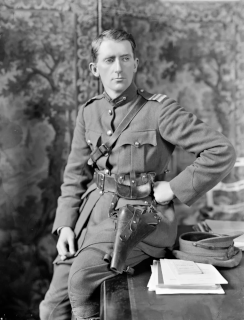
Death of Richard Mulcahy, Fine Gael Politician & Army General

Richard James Mulcahy, Irish Fine Gael politician and army general, dies from natural causes in Dublin on December 16, 1971.

Mulcahy is born in Manor Street, Waterford, County Waterford, on May 10, 1886, the son of post office clerk Patrick Mulcahy and Elizabeth Slattery. He is educated at Mount Sion Christian Brothers School and later in Thurles, County Tipperary, where his father is the postmaster.

Mulcahy joins the Royal Mail (Post Office Engineering Dept.) in 1902, and works in Thurles, Bantry, Wexford and Dublin. He is a member of the Gaelic League and joins the Irish Volunteers at the time of their formation in 1913. He is also a member of the Irish Republican Brotherhood.

Mulcahy is second-in-command to Thomas Ashe in an encounter with the armed Royal Irish Constabulary (RIC) at Ashbourne, County Meath, during the 1916 Easter Rising, one of the few stand-out victories won by republicans in that week and generally credited to Mulcahy’s grasp of tactics. In his book on the Rising, Charles Townshend principally credits Mulcahy with the defeat of the RIC at Ashbourne, for conceiving and leading a flanking movement on the RIC column that had engaged with the Irish Volunteers. Arrested after the Rising, he is interned at Knutsford and at the Frongoch internment camp in Wales until his release on December 24, 1916.

On his release, Mulcahy immediately rejoins the republican movement and becomes commandant of the Dublin Brigade of the Irish Volunteers. He is elected to the First Dáil in the 1918 Irish general election for Dublin Clontarf. He is then named Minister for Defence in the new government and later Assistant Minister for Defence. In March 1918, he becomes Irish Republican Army (IRA) chief of staff, a position he holds until January 1922.

Mulcahy and Michael Collins are largely responsible for directing the military campaign against the British during the Irish War of Independence. During this period of upheaval in 1919, he marries Mary Josephine (Min) Ryan, sister of Kate and Phyllis Ryan, the successive wives of Seán T. O’Kelly. Her brother is James Ryan. O’Kelly and Ryan both later serve in Fianna Fáil governments.

Mulcahy supports the Anglo-Irish Treaty of December 1921. Archive film shows that Mulcahy, as Minister of Defence, is the Irish officer who raises the Irish tricolour at the first hand-over of a British barracks to the National Army in January 1922. He is defence minister in the Provisional Government on its creation and succeeds Collins, after the latter’s assassination, as Commander-in-Chief of the Provisional Government’s forces during the subsequent Irish Civil War.

Mulcahy earns notoriety through his order that anti-Treaty activists captured carrying arms are liable for execution. A total of 77 anti-Treaty prisoners are executed by the Provisional Government. He serves as Minister for Defence in the new Free State government from January 1924 until March 1924, but resigns in protest because of the sacking of the Army Council after criticism by the Executive Council over the handling of the “Army Mutiny,” when some National Army War of Independence officers almost revolt after he demobilises many of them at the end of the Irish Civil War. He re-enters the cabinet as Minister for Local Government and Public Health in 1927.

During Mulcahy’s period on the backbenches of Dáil Éireann his electoral record fluctuates. He is elected as TD for Dublin North-West at the 1921 and 1922 Irish general elections. He moves to Dublin City North for the election the following year and is re-elected there in four further elections: June 1927, September 1927, 1932, and 1933.

Dublin City North is abolished for the 1937 Irish general election, at which Mulcahy is defeated in the new constituency of Dublin North-East. However, he secures election to Seanad Éireann as a Senator, the upper house of the Oireachtas, representing the Administrative Panel. The 2nd Seanad sits for less than two months, and at the 1938 Irish general election he is elected to the 10th Dáil as a TD for Dublin North-East. Defeated again in the 1943 Irish general election, he secures election to the 4th Seanad by the Labour Panel.

After the resignation of W. T. Cosgrave as Leader of Fine Gael in 1944, Mulcahy becomes party leader while still a member of the Seanad. Thomas F. O’Higgins is parliamentary leader of the party in the Dáil at the time and Leader of the Opposition. Facing his first general election as party leader, Mulcahy draws up a list of 13 young candidates to contest seats for Fine Gael. Of the eight who run, four are elected. He is returned again to the 12th Dáil as a TD for Tipperary at the 1944 Irish general election. While Fine Gael’s decline had been slowed, its future is still in doubt.

Following the 1948 Irish general election Mulcahy is elected for Tipperary South, but the dominant Fianna Fáil party finishes six seats short of a majority. However, it is 37 seats ahead of Fine Gael, and conventional wisdom suggests that Fianna Fáil is the only party that can possibly form a government. Just as negotiations get underway, however, Mulcahy realises that if Fine Gael, the Labour Party, the National Labour Party, Clann na Poblachta and Clann na Talmhan band together, they would have only one seat fewer than Fianna Fáil and, if they can get support from seven independents, they will be able to form a government. He plays a leading role in persuading the other parties to put aside their differences and join forces to consign the then Taoiseach and Fianna Fáil leader Éamon de Valera, to the opposition benches.

Mulcahy initially seems set to become Taoiseach in a coalition government. However, he is not acceptable to Clann na Poblachta’s leader, Seán MacBride. Many Irish republicans had never forgiven him for his role in the Irish Civil War executions carried out under the Cosgrave government in the 1920s. Consequently, MacBride lets it be known that he and his party will not serve under Mulcahy. Without Clann na Poblachta, the other parties would have 57 seats between them — 17 seats short of a majority in the 147-seat Dáil. According to Mulcahy, the suggestion that another person serve as Taoiseach comes from Labour leader William Norton. He steps aside and encourages his party colleague John A. Costello, a former Attorney General of Ireland, to become the parliamentary leader of Fine Gael and the coalition’s candidate for Taoiseach. For the next decade, Costello serves as the party’s parliamentary leader while Mulcahy remained the nominal leader of the party.

Mulcahy goes on to serve as Minister for Education under Costello from 1948 until 1951. Another coalition government comes to power at the 1954 Irish general election, with Mulcahy once again stepping aside to become Minister for Education in the Second Inter-Party Government. The government falls in 1957, but he remains as Fine Gael leader until October 1959. In October the following year, he tells his Tipperary constituents that he does not intend to contest the next election.

Mulcahy dies from natural causes at the age of 85 in Dublin on December 16, 1971. He is buried in Littleton, County Tipperary.


Leave a comment

Birth of Austin Stack, Irish Republican & Politician

Augustine Mary Moore Stack, Irish republican and politician who serves as Minister for Home Affairs from 1921 to 1922, is born on December 7, 1879, in Ballymullen, Tralee, County Kerry. He is a Teachta Dála (TD) from 1918 to 1927.

Stack is born to William Stack, an attorney’s clerk, and Nanette O’Neill. He is educated at the Christian Brothers School in Tralee. At the age of fourteen, he leaves school and becomes a clerk in a solicitor‘s office. A gifted Gaelic footballer, he captains the Kerry team to All-Ireland victory in 1904. He also serves as President of the Kerry Gaelic Athletic Association County Board.

Stack becomes politically active in 1908 when he joins the Irish Republican Brotherhood (IRB). In 1916, as commandant of the Kerry Brigade of the Irish Volunteers, he makes preparations for the landing of arms by Roger Casement. He is made aware that Casement was arrested on Easter Saturday and was being held in Tralee. He makes no attempt to rescue him from Ballymullen Barracks.

Stack is arrested and sentenced to death for his involvement in the Easter Rising, however, this is later commuted to penal servitude for life. He is released under general amnesty in June 1917 and is elected as an abstentionist Sinn Féin MP for West Kerry at the 1918 Irish general election, becoming a member of the First Dáil. He is elected unopposed as an abstentionist member of the House of Commons of Southern Ireland and a member of the Second Dáil as a Sinn Féin TD for Kerry–Limerick West at the 1921 Irish elections.

Stack, as part of his role as Minister for Home Affairs, is widely credited with the creation and administration of the Dáil Courts. These are courts run by the Irish Republican Army (IRA) in parallel and opposition to the judicial system being run by the British government. The IRA and Sinn Féin are highly successful in both getting the civilian population of Ireland to use the courts and accept their rulings. The success of this initiative gives Sinn Féin a large boost in legitimacy and supports their goals in creating a “counter-state” within Ireland as part of their overarching goals in the Irish War of Independence.

Stack opposes the Anglo-Irish Treaty of 1921 and takes part in the subsequent Irish Civil War. He is captured in 1923 and goes on hunger strike for forty-one days before being released in July 1924.

Stack is elected to the Third Dáil at the 1922 Irish general election and subsequent elections as an Anti-Treaty Sinn Féin TD for the Kerry constituency. When Éamon de Valera founds Fianna Fáil in 1926, Stack remains with Sinn Féin, being re-elected to the Dáil at the June 1927 Irish general election. He does not contest the September 1927 Irish general election.

In 1925, Stack marries Winifred (Una) Gordon, (née Cassidy), the widow of a Royal Irish Constabulary (RIC) district inspector, Patrick Gordon.

Stack’s health never recovers following his hunger strike and he dies at the age of 49 in a Dublin hospital on April 27, 1929.

Austin Stack Park in his hometown of Tralee, one of the Gaelic Athletic Association’s stadiums, is named in his honour, as is the Austin Stacks GAA hurling and Gaelic football club.


Leave a comment

Patrick Maher’s Remains Returned to County Limerick

The dying wish of Irish Republican Army (IRA) volunteer Patrick Maher is fulfilled on October 19, 2001, when his remains are brought from Dublin to his native County Limerick for burial the following day with full military honours. He is executed in Mountjoy Prison on June 7, 1921 following his alleged part in the rescue of IRA man Seán Hogan from a heavily guarded train in Knocklong, County Limerick, in May 1919, which results in the death of two Royal Irish Constabulary (RIC) officers. Maher always protests his innocence. He is 32 years old at the time of his death.

Maher, a native of County Limerick born around 1889, is hanged along with Edmond Foley for his alleged involvement in the rescue of Seán Hogan at Knocklong Railway Station on May 13, 1919 in which two RIC officers are killed.

Unlike Foley, Maher has no direct involvement in the rescue. He merely works at the station grading poultry and eggs and he is at a crossroads three miles away at the time of the ambush. He strongly protests his innocence. Two civilian juries fail to reach a verdict. He is finally convicted of involvement by a military court-martial and sentenced to death.

In a final message to other members of the IRA, Foley and Maher write:

“Fight on, struggle on, for the honour, glory and freedom of dear old Ireland. Our hearts go out to all our dear old friends. Our souls go to God at 7 o’clock in the morning and our bodies, when Ireland is free, shall go to Galbally. Our blood shall not be shed in vain for Ireland, and we have a strong presentiment, going to our God, that Ireland will soon be free and we gladly give our lives that a smile may brighten the face of ‘Dear Dark Rosaleen.’ Farewell! Farewell! Farewell!”

Maher is one of a group of men hanged and buried in Mountjoy in the period 1920–21, commonly referred to as the Forgotten Ten. In 2001 Maher and the other nine, including Kevin Barry, are exhumed and given a full State funeral. He is the only one of the Ten not to be buried in Glasnevin Cemetery, Dublin. In accordance with his wishes and those of his family, he is buried at Ladywell Graveyard in Ballylanders, County Limerick.


Leave a comment

Birth of Mary Devenport O’Neill, Poet & Dramatist

Mary Devenport O’Neill, Irish poet and dramatist and a friend and colleague of W. B. Yeats, George Russell, and Austin Clarke, is born in Barrack Street, Loughrea, County Galway, on August 3, 1879.

O’Neill is born Mary Devenport, the daughter of Royal Irish Constabulary (RIC) sub-constable, John Devenport, and his wife Bridget (née Burke). She attends the Dominican convent, Eccles Street, Dublin before enrolling in the Metropolitan School of Art from 1898 to 1903. In 1900 she wins the year’s prize in the School of Art. She apparently considers teaching as a career, as she is listed on the college register as a teacher in training from 1901 to 1903. It is while an art student that she starts to correspond with the writer she admires, Joseph O’Neill. Their relationship develops, and the couple marries on June 19, 1908, settling in Kenilworth Square, Dublin.

Many of O’Neill’s husband’s friends disapprove of her modern and unconventional ideas, but she is popular with “the Rathgar Group” who attends George Russell’s Sunday salons. After a few years, she establishes her own salon referred to as “Thursdays at home,” attended by Russell, Padraic Colum, W. B. Yeats, Richard Irvine Best, Frank O’Connor, Francis Stuart and Iseult Gonne. She becomes particularly close to Yeats, who she confides in. Yeats records their weekly consultations in his diary while working on A Vision (1925). In his Oxford anthology of English verse from 1936, he includes one of O’Neill’s poems. In 1917, she contributes lyrics to her husband’s play The Kingdom Maker. She publishes her only book in 1929, Prometheus and other poems. After this she occasionally contributes primarily modernist plays and poetry to The Dublin Magazine, The Irish Times and The Bell. She collaborates with Austin Clarke from the Lyric Theatre Company on her plays Bluebeard (1933) and Cain (1945).

O’Neill suffers with poor health, which sees her and her husband spending extended periods in the south of France and Switzerland. They sell their home in Dublin in August 1950 and move to Nice, with the intention of settling there. However, due to rapidly depleting finances they are forced to return to Ireland in April 1951. They rent a cottage in Wicklow from their friend Con Curran. When her husband dies in 1953, she goes to live with relatives in Dublin. She dies there in 1967.


Leave a comment

First Assassination by “The Squad”

On July 30, 1919, the first assassination authorised by Michael Collins is carried out by The Squad, also known as the Twelve Apostles, when Detective Sergeant “the Dog” Smith is shot near Drumcondra, Dublin.

The Squad is an Irish Republican Army (IRA) unit founded by Collins to counter British intelligence efforts during the Irish War of Independence, mainly by means of assassination.

On April 10, 1919, the First Dáil announces a policy of ostracism of Royal Irish Constabulary (RIC) men. At the time Sinn Féin official policy is against acts of violence. Boycotting, persuasion and mild intimidation succeed against many officers. However, others escalate their activities against republicans and in March 1920 Collins asks Dick McKee to select a small group to form an assassination unit.

When The Squad is formed, it comes directly under the control of the Director of Intelligence or his deputy and under no other authority. The Squad is commanded by Mick McDonnell.

The original “Twelve Apostles” are Mick McDonnell, Tom Keogh, Jimmy Slattery, Paddy Daly, Joe Leonard, Ben Barrett, Vincent Byrne, Sean Doyle, Paddy Griffin, Eddie Byrne, Mick Reilly and Jimmy Conroy. After some time, The Squad is strengthened with members Ben Byrne, Frank Bolster, Mick Keogh, Mick Kennedy, Bill Stapleton and Sam Robinson. Owen Cullen, a member of 2nd Battalion, is driver for a short time, and Paddy Kelly of County Clare for a short time. They are employed full-time and received a weekly wage.

Sometimes, as occasion demands, The Squad is strengthened by members of the IRA Intelligence Staff, the Active Service Unit, munition workers and members of the Dublin Brigade, Tipperary Flying Column men, Dan Breen, Séumas Robinson, Seán Treacy and Seán Hogan, and also Mick Brennan and Michael Prendergast of County Clare. The IRA Intelligence Staff consists of the Director of Intelligence Michael Collins, the Deputy Director of Intelligence Liam Tobin, the Second Deputy Director of Intelligence Tom Cullen, the Third Director of Intelligence Frank Thornton, and members Joe Dolan, Frank Saurin, Ned Kelleher, Joe Guilfoyle, Paddy Caldwell, Paddy Kennedy, Charlie Dalton, Dan McDonnell and Charlie Byrne. The munitions workers include Mat Furlong, Sean Sullivan, Gay McGrath, Martin O’ Kelly, Tom Younge and Chris Reilly.

Other members include Mick Love, Gearoid O’Sullivan, Patrick Caldwell, Charlie Dalton, Mick O’Reilly, Sean Healy, James Ronan, Paddy Lawson, John Dunne, Johnny Wilson and James Heery. Seán Lemass and Stephen Behan, the father of Irish writers Brendan and Dominic Behan, have also been listed as members of the Apostles. There is no hard evidence to support the inclusion of many of the names, but those who subsequently serve in the Irish Army have their active service recorded in their service records held in the Military Archives Department in Cathal Brugha Barracks, Rathmines. Andrew Cooney is also reported to have been associated with The Squad. Stephen Behan’s involvement is first made public in 1962, when the BBC broadcasts an episode of This Is Your Life dedicated to Behan. During the broadcast, remaining members of the squad joined Behan on the set of the show.

Following “The Dog” Smith’s assassination, The Squad continues to target plainclothes police, members of the G Division of the Dublin Metropolitan Police, and, occasionally, problematic civil servants. Organisationally it operates as a subsection of Collins’ Intelligence Headquarters. Two of the executions by The Squad are the killing on January 21, 1920, of RIC Inspector William Redmond of the DMP “G” Division and on March 2, 1920, a British double agent John Charles Byrnes.

One of the Apostles’ particular targets is the Cairo Gang, a deep-cover British intelligence group, so called since it has either been largely assembled from intelligence officers serving in Cairo or from the Dublin restaurant called The Cairo, which the gang frequents. Sir Henry Wilson brings in the Cairo Gang in the middle of 1920, explicitly to deal with Michael Collins and his organization. Given carte blanche in its operations by Wilson, the Cairo Gang adopts the strategy of assassinating members of Sinn Féin unconnected with the military struggle, assuming that this will cause the IRA to respond and bring its leaders into the open.

The most well-known operation executed by the Apostles occurs on what becomes known as Bloody Sunday, November 21, 1920, when British MI5 officers, linked to the Cairo Gang and significantly involved in spying, are shot at various locations in Dublin with fourteen killed and six wounded. In addition to the The Squad, a larger number of IRA personnel are involved in this operation. The only IRA man captured during the operation is Frank Teeling. In response to the killings, the Black and Tans retaliate by shooting up a Gaelic football match between Dublin and Tipperary at Croke Park, the proceeds from which are for the Irish Republican Prisoners Fund. Fourteen civilians are killed including one of the players, Michael Hogan, and 68 are wounded. The Hogan stand at Croke Park is named after Hogan.

The elimination of the Cairo Gang is seen in Dublin as an intelligence victory, but British Prime Minister David Lloyd George comments dismissively that his men “… got what they deserved, beaten by counterjumpers…”. Winston Churchill adds that they were “.. careless fellows … who ought to have taken precautions.”

Some members of The Squad are hanged in 1921 for the killings on Bloody Sunday, including Thomas Whelan and Patrick Moran. Moran had killed a vet, Patrick MacCormack, who seems to have been an innocent victim.

In May 1921, after the IRA’s Dublin Brigade takes heavy casualties during the burning of the Custom House, The Squad and the Brigade’s Active Service Unit are amalgamated into the Dublin Guard, under Paddy Daly. Under the influence of Daly and Michael Collins, most of the Guard take the Free State side and join the National Army in the Irish Civil War of 1922–23. During this conflict some of them are attached to the Criminal Investigation Department and are accused of multiple assassinations of Anti-Treaty fighters. They are also involved in several atrocities against Republican prisoners, particularly after the death of Collins, due to many of them having personal ties with him.

Bill Stapleton goes on to become a director in Bord na Móna, Charles Dalton and Frank Saurin become directors in the Irish Sweepstakes. In October 1923, Commandant James Conroy is implicated in the murder of two Jewish men, Bernard Goldberg and Emmanuel ‘Ernest’ Kahn. He avoids arrest by fleeing to Mexico, returning later to join the Blueshirts. A later application for an army pension is rejected. The killings are the subject of a 2010 investigative documentary by RTÉ, CSÍ: Murder in Little Jerusalem.


Leave a comment

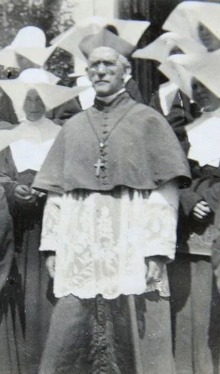
Birth of Daniel Cohalan, Bishop of Cork

Daniel Cohalan, Irish Roman Catholic clergyman who serves as the Bishop of Cork from 1916 to 1952, is born on July 14, 1858, in Kilmichael, County Cork.

After graduating at St. Patrick’s College, Maynooth, Cohalan is ordained a priest at the Cathedral of St. Mary and St. Anne, Cork on July 25, 1882. His first pastoral appointment is a curate at Kilbrittain, County Cork, from October 1883 to January 1884. He briefly resumes his post-graduate studies at St. Finbarr’s Seminary (now College), Cork, from January to November 1884. His second curacy is at Tracton, County Cork, from November 1884 to September 1896. He returns to St. Patrick’s College, Maynooth, as a professor of Theology from September 7, 1896, to June 7, 1914.

Cohalan is appointed Auxiliary Bishop of Cork and Titular Bishop of Vaga on May 25, 1914. He is consecrated bishop at the Cathedral of St. Mary and St. Anne on June 7, 1914, by John Harty, Archbishop of Cashel and Emly. Two years later, he is appointed Diocesan Bishop of Cork on August 29, 1916.

Cohalan is an outspoken critic during the Irish War of Independence, condemning acts of violence on both sides. In particular, he denounces the policy of reprisals. In July 1920, he pronounces an interdict on the killers of a Royal Irish Constabulary (RIC) sergeant, shot dead in the church porch in Bandon. He declares that anyone killing from ambush will be excommunicated. On December 12, 1920, Cohalan issues a decree saying that “anyone within the diocese of Cork who organises or takes part in ambushes or murder, or attempted murder, shall be excommunicated.” In turn, his life is threatened by the Irish Republican Army (IRA). In August 1928, he condemns the British government which had allowed Terence MacSwiney to die on hunger strike in 1920.

The Bessborough Home in Cork is run by the Sisters of the Sacred Hearts of Jesus and Mary and when the department “sought a change of superior in Bessborough because of the appallingly high death rate, he [Catholic Bishop of Cork Dr. Daniel Cohalan] denounced the request. The replacement of the Bessborough superior was delayed for four years after the department requested it, and many infants died during that time. It seems probable that the bishop’s intervention was elicited by the congregation.” In general, the report finds that the major causes of infant mortality in the homes were respiratory infections and gastroenteritis, while “public attention has focused on marasmus [malnutrition]” suggesting “willful neglect.” However, it says that “the term marasmus is best seen as indicating that a child was failing to thrive, but medical experts suggest that this was due to an underlying, undiagnosed medical condition.”

Cohalan dies in office at the age of 94 at Bon Secours Hospital, Cork, on August 24, 1952. A story, current at the time in Cork, refers to his antipathy towards bishops of the Church of Ireland who styled themselves “Bishop of Cork.” A month before his death, and on his deathbed, word is brought to him of the death of the Church of Ireland Bishop of Cork, Cloyne and Ross, Robert Hearn. The response of Cohalan, known “affectionately” as “Danny Boy”, is reputedly, “now he knows who’s Bishop of Cork.”

Originally buried at St. Finbarr’s College, Farranferris, Cohalan is reinterred in the grounds of St. Mary and St. Anne’s Cathedral, Cork, in 1996. His nephew of the same name, Daniel Cohalan, is Bishop of Waterford and Lismore from 1943 to 1965.


Leave a comment

Death of James Warren Doyle, Bishop of Kildare and Leighlin

James Warren Doyle, Roman Catholic Bishop of Kildare and Leighlin, who uses the signature “JKL”, an acronym from “James Kildare and Leighlin,” dies on June 15, 1834. He is active in the Anti-Tithe movement and a campaigner for Catholic emancipation until it is attained in 1829. He is also an educator, church organiser and the builder of the Cathedral of the Assumption in Carlow.

Doyle is born close to New Ross, County Wexford in 1786, the posthumous son of a respectable Catholic farmer. His mother, Anne Warren, of Quaker extraction, is living in poverty at the time of his birth. At the age of eleven he witnesses the horrors of the Battle of New Ross between the United Irishmen and British Crown forces supplemented by the militia and yeomanry.

Doyle receives his early education at Clonleigh, at Rathconrogue at the school of a Mr. Grace, and later at the Augustinian College, New Ross under the care of an Augustinian monk, Rev. John Crane.

Doyle joins the Augustinian friars in 1805 at Grantstown, County Wexford, and then studies for his doctorate at Coimbra in Portugal (1806–08). His studies are disturbed by the Peninsular War, during which he serves as a sentry in Coimbra. Later, he accompanies the British Army with Arthur Wellesley‘s forces to Lisbon as an interpreter.

Following Doyle’s return to Ireland, he is ordained to the priesthood on October 1, 1809, at Enniscorthy. He teaches logic at the Augustinian College, New Ross. In 1813, he is appointed to a professorship at St. Patrick’s, Carlow College, holding the Chair of Rhetoric and in 1814, the Professorship of Theology.

Michael Corcoran, Bishop of Kildare and Leighlin, dies on February 22, 1819. Doyle is a popular choice of the clergy and bishops of the Archdiocese of Dublin and is chosen by the Holy See as Corcoran’s successor. He is formally named in August 1819 and is duly consecrated in Carlow Parish Church on November 14. During his fifteen-year tenure as Bishop of Kildare and Leighlin, he earns respect nationwide for his polemics in furtherance of the Catholic position in both Irish and British society, and in supporting the work of the Catholic Association. His books on pastoral, political, educational and inter-denominational matters provide a rich source of material for social and religious historians. He is a close ally of Daniel O’Connell in the political campaign for Catholic emancipation which is finally passed in 1829 by the Wellington government.

In 1830, the new tithe-proctor of Graigue, a parish of 4,779 Catholics and 63 Protestants, decides to break with the tradition of Doyle’s predecessor and to enforce seizure orders for the collection of arrears of Tithes. Tithes provide financial support of the established Anglican Church of Ireland. Some of the recalcitrant Catholics habitually transfer ownership of their livestock to Doyle in order to avoid seizure at the town fair. The new proctor requests their priest’s cooperation in handing over the assets. Doyle refuses, and the proctor, aided by the Royal Irish Constabulary, seize some of the livestock. A mass riot breaks out at the fair and there is several casualties. A civil disobedience campaign follows, peppered with sporadic violence mostly at county fairs over the seizure of livestock. A period of instability that becomes known as the Tithe War follows.

Doyle is a leader of nonviolent resistance to the Tithe, devoting himself both to strengthening the nonviolent resistance and to discouraging like paramilitary secret societies who have taken to using violence to drive out tithe-collectors and to intimidate collaborators. He says, “I maintain the right which [Irish Catholics] have of withholding, in a manner consistent with the law and their duty as subjects, the payment of tithe in kind or in money until it is extorted from them by the operation of the law.”

Given Doyle’s prior experience in education, his major contribution is arguably in helping the establishment of National Schools across Ireland from 1831, the initiative of Edward Smith-Stanley, Chief Secretary for Ireland, which are initially started with a UK government grant of £30,000. The proposed system is ahead of state provision for education in England or Scotland at that time. This Model School prototype is, in some respects, experimental. His involvement is a sign of his practicality and foresight.

Doyle makes statements on other issues: the theological status of ‘non-Catholic’ Christians, freedom to convert to Protestantism, mixed marriages and, as already mentioned, on the union of Catholics and Anglicans. On this last issue he is asked to resign by Rome and is eventually allowed to continue after agreeing not to speak on the issue again.

The construction of Carlow Cathedral of the Assumption crowns Doyle’s career, being started in 1828 and finished at the end of November 1833. He falls ill for a number of months before dying on June 15, 1834. He is buried in his new cathedral. A sculpture, by John Hogan, in memorial to Doyle is finished in 1839.

Several biographies are written on Doyle before 1900 and his influence on the later Irish Catholic bishops in the period 1834-1900 is considerable. He had proved that negotiations with government could be beneficial to his church, his congregation, and its finances.


Leave a comment

Birth of Thomas Traynor, Member of “The Forgotten Ten”

Thomas Traynor, a member of the Irish Republican Army (IRA), is born in Tullow, County Carlow, on May 27, 1882.

Traynor is an experienced soldier having been a member of the Boland’s Mill garrison during the 1916 Easter Rising. After the Rising he is interned in Frongoch internment camp, Wakefield Prison and Mountjoy Prison where he shares a cell with Seán Mac Eoin.

Traynor works as a boot maker and is married with ten children. At the time of his death the eldest is 18 years and the youngest 5 months. The eldest son, Frank, represents Ireland at the 1928 Summer Olympics in Amsterdam, competing as a bantamweight boxer.

Traynor is captured during an ambush on Auxiliaries in Brunswick Street, Dublin, on March 14, 1921, and is tried on April 5 at City Hall. He is part of a party of IRA volunteers keeping watch outside a meeting at 144 Brunswick Street that includes Seán MacBride. During the fight an IRA volunteer, Leo Fitzgerald, is killed, as are Constable James O’Farrell and Cadet Bernard Beard of the Dublin Metropolitan Police. Traynor is reportedly badly beaten by members of the Igoe Gang.

Traynor is hanged in Mountjoy Prison in Dublin on April 25, 1921, one of a group of men, commonly referred to as the Forgotten Ten, hanged in Mountjoy Prison from 1920–21, during the Irish War of Independence. He is 38 years old at the time of his death.

Mark Sturgis, assistant to the Under-Secretary for Ireland, writes, “Traynor, captured red handed with an attacking party when Auxiliaries were killed in Brunswick Street, was executed this morning. I don’t think they will make much fuss as there is no sort of ‘alibi’ business this time – nor is he the usual ‘youth’, dear to ‘The Freeman‘, as he is over 40 and has a pack of children, the poor deluded idiot.”

On the day following Traynor’s death, Gilbert Potter, a Royal Irish Constabulary (RIC) District Inspector based in Cahir, County Tipperary, and being held for Traynor’s safe treatment is executed in reprisal by members of the 3rd Tipperary Brigade of the IRA. Another IRA volunteer, Jack Donnelly, captured with Traynor, is sentenced to death but is reprieved by the declaration of an impending truce in June 1921.

In 1965 a statue is erected to honor Traynor in his native town of Tullow. The Ballad of Thomas Traynor is written in his memory.

In 2001 Traynor and the other nine, including Kevin Barry, are exhumed from their graves in the prison and given a full state funeral. He is now buried in Glasnevin Cemetery in Dublin.


Leave a comment

The Knocklong Ambush

Dan Breen and Seán Treacy rescue their comrade Seán Hogan from a Dublin-Cork train at Knocklong, County Limerick, on May 13, 1919, in what becomes known as the Knocklong Ambush. Two policemen guarding Hogan are killed.

One of the most famous photographs (left) of the Irish War of Independence (1919-21) is taken at Breen’s wedding in June 1921. Breen is already burnishing his reputation as the romantic guerilla campaigner three years before the publication of his bestselling autobiography My Fight for Irish Freedom. On his lap there is a Luger pistol, an incongruity in a wedding photograph, but in keeping with his penchant for self-mythologising. In the background on the left is his best man Hogan who is dressed in the uniform of the Irish Volunteers. Unlike Breen, he looks shy and awkward, his body tilted as if to convey how ill at ease with himself he is.

Had Hogan shown the same diffidence in May 1919, he might have saved himself and his comrades a great deal of trouble. He is the youngest of those involved in the Soloheadbeg ambush on January 21, 1919, the event that is viewed in retrospect as the event that starts the Irish War of Independence.

Hogan is only 18, according to most reports, but to date no birth certificate has been found for him. His youth may explain his lack of caution in early May 1919 when he slips his minder after a dance in Kilshenane, County Tipperary, and ends up, not in the arms of his sweetheart Bridie O’Keeffe, but in the embrace of the Royal Irish Constabulary (RIC). He escorts O’Keeffe back to her relative’s farmhouse where she is spending the night. He sleeps on the sofa. When he wakes up, the house is surrounded. He flees, but is picked up by the RIC in a laneway near the house. He, along with the others involved in the Soloheadbeg ambush, are the most wanted men in Ireland. He faces interrogation and possible execution.

The Knocklong ambush, which occurs on May 13, 1919, saves Hogan from such a fate, but it comes at a terrible price for all those involved. He is put on the 6:00 p.m. train from Thurles to Cork where he is due to be interrogated in the military prison. Knocklong Station, just over the border in County Limerick, is chosen as the place for the escape attempt because of its distance from the nearest RIC barracks.

Four volunteers of the Irish Republican Army (IRA) East Limerick Brigade get on the train at Emly in order to signal to the men waiting at Knocklong Station the carriage in which Hogan is being detained. He is being escorted to Cork by four RIC men. They face five volunteers, three of whom are armed. A ferocious gun battle ensues, lasting 14 minutes. Constable Michael Enright (30), from Ballyneety, County Limerick, is shot dead immediately.

Sgt. Peter Wallace and Treacy, another of those involved at Soloheadbeg, wrestle over Treacy’s gun. Wallace, who is a huge man, shoots Treacy in the throat before the gun is turned on Wallace, who later dies from his wounds. Hogan smashes his mangled chains in the head of another of his armed guards who is then thrown out of the window of the train. The last remaining guard picks up a rifle and opens fire on the IRA party through the carriage window wounding three volunteers waiting on the platform, including Breen. Hogan is taken immediately to a butcher’s shop where his chains are smashed with a cleaver, setting him free.

Knocklong becomes an exalted event in the iconography of Irish republicanism. At Soloheadbeg, eight armed and ready volunteers faced two unwary policemen. It was not a fair fight. Hogan’s rescue from the train at Knocklong demands organisation, courage and daring of the highest order.

Hogan continues to serve in the Irish War of Independence and on the anti-Treaty side in the Irish Civil War (1922-23). By the time hostilities cease in 1923, he is only 23, but has spent the previous five years in armed combat. The toll on his mind and body are huge. In 1924, he is admitted to St. Bricin’s Military Hospital suffering from “attacks of restlessness and depression – inability to concentrate his mind on anything.” His wife at the time, Christina, runs a nursing home in Tipperary, where her patients include many shellshocked Irish veterans of World War I. The couple later separates.

Hogan’s fortunes change with the change of government in 1932 bringing to power Fianna Fáil, a party which Hogan supports. He is given a job in the Board of Works, but his mental health continues to deteriorate. He complains of the “nerves and all the ailments that go with them.” His circumstances are such that he spends two years living in the family home of Séumas Robinson, the officer commanding at Soloheadbeg.

In early 2019, Robinson’s daughter, Dimphne Brennan, tells The Irish Times, “He had nowhere else to go. He never got over what happened. His nerves were shattered. We were all just kids and we didn’t disturb him in his room. He didn’t talk to us.”

Hogan dies on Christmas Eve 1968 from a cerebral hemorrhage and chronic bronchitis. At the funeral reception, his estranged widow supposedly tells a niece of Hogan, “Well, but wasn’t that some waste of a life.”

Hogan and Christina are buried 50 paces from each other in St. Michael’s Cemetery in Tipperary, divided in death as they were in life. Seán Hogan: His Life: A Troubled Journey, by John Connors, is published by Tipp Revolution.

(From: “Knocklong ambush, on May 13th, 1919 involved a 14-minute gun battle” by Ronan McGreevy, The Irish Times, http://www.irishtimes.com, May 20, 2019)


Leave a comment

Death of Liam Tobin, Irish Army Officer & IRA Intelligence Officer

Liam Tobin, officer in the Irish Army and the instigator of the Irish Army Mutiny in March 1924, dies in Dublin on April 30, 1963. During the Irish War of Independence, he serves as an Irish Republican Army (IRA) intelligence officer for Michael CollinsSquad.

Tobin is born William Joseph Tobin at 13 Great Georges Street in Cork, County Cork, on November 15, 1895, the eldest son of Mary Agnes (nee Butler) and David Tobin, a hardware clerk. He has two younger siblings, Katherine and Nicholas Augustine Tobin, also born in Cork. His family moves to John Street in Kilkenny and then to Dublin. He goes to school in Kilkenny and is an apprentice in a hardware shop at the time of the 1916 Easter Rising. As a participant in the Rising he fights in the Four Courts garrison under Edward Daly. He is arrested, court martialed, and sentenced to death but his sentence is commuted to life imprisonment. He is a prisoner in Kilmainham, Mountjoy, Lewes, Dartmoor, Broadmoor and Pentonville prisons. He is released in June 1917.

In early 1919 Tobin becomes Collins’ chief executive in the Intelligence Directorate handling the many spies in Dublin Castle, including double agent David Neligan. Nancy O’Brien works for Under-Secretary for Ireland James Macmahon, decoding messages sent from London. Each day between 2:30 and 3:30 she passes any information acquired to either Tobin, Joseph McGrath, or Desmond FitzGerald. Tobin is involved in planning the assassinations of British soldiers, informants, members of the Royal Irish Constabulary, the Dublin Metropolitan Police, and operatives of MI5. He constructs detailed profiles of everyone remotely connected to the British government, often using Who’s Who, The Morning Post, and The Times, a newspaper that describes him as “one of the most formidable of [the] Twelve Apostles.”

In October 1921, Tobin travels with the Irish Treaty Delegation as part of Collins’ personal staff.

Tim Pat Coogan and James Mackay have examined Tobin’s involvement in the assassination of British Field Marshal Sir Henry Wilson. Wilson’s public tirades about Collins is evidence of mutual personal dislike between the two men. In May 1922 Collins tells Tobin “We’ll kill a member of that bunch” to the news of “bloody pogroms” in Belfast. Wilson is intimately involved with the Ulster loyalist cause, including the Curragh Mutiny and the establishment of the Ulster Special Constabulary. Just before the shooting, Coogan places Tobin in London. He meets courier Peig Ni Braonain at Euston Station collecting a document that has been sent from Dublin. Returning to Dublin before the incident, he is jubilant when he tells defence minister Richard Mulcahy about Wilson’s death. Mulcahy is appalled and threatens to resign.

Following the Anglo-Irish Treaty, Tobin is appointed deputy director of intelligence in the new state and assigned to the Criminal Investigation Department based at Oriel House. However Collins soon replaces him with Joseph McGrath. Tobin is placed on the Army Council and is Director of Intelligence from September 1922 until his appointment as Senior Aide-de-Camp to the new GovernorGeneral of the Irish Free State, Tim Healy, in November 1922. The position provides an apartment in Viceregal Lodge.

In October 1922, Tobin’s brother Nicholas, a Free State captain, is accidentally shot dead by his own troops during the raid and capture of a bomb making factory at number 8 Gardiner’s Place, Dublin.

Tobin believes in the stepping stone doctrine which sees the Treaty as a stage towards full independence. With the outbreak of the Irish Civil War he remains loyal to Collins and takes the Pro-Treaty side. He leads in the fight against the Anti-Treaty IRA in the south. Disillusioned with the continuing hostilities and in the aftermath of the death of Collins, he forms an association called the IRA Organisation (IRAO) or “Old Irish Republican Army” to distinguish themselves from the anti-treaty insurgents.

Richard Mulcahy, the new Irish defence minister, proposes to reduce the army from 55,000 to 18,000 men in the immediate post- Civil-War period. Tobin knows his own position is to be affected and shares the perception that the Irish Army treats former British officers better than former IRA officers. On March 7, 1924, Tobin, together with Colonel Charlie Dalton, sends an ultimatum to President of the Executive Council of the Irish Free State W. T. Cosgrave demanding an end to the army demobilisation. The immediate response is an order for the arrest of the two men on a charge of mutiny. The cabinet, already wary of the Irish Army, orders an inquiry and appoints Garda Commissioner Eoin O’Duffy to the army command.

On March 18, the mutineers assemble with hostile intent at a Dublin pub. An order is made to arrest the mutineers and the cabinet demands the resignation of the army council. The generals resign, affirming the subservience of the military to the civilian government of the new state.

In later years, Tobin rebuilds relations with his Civil War foes and joins Éamon de Valera‘s Anti-Treaty Fianna Fáil party. He joins up with Joseph McGrath to form the Irish Hospitals’ Sweepstake in the 1930s. Many other former army comrades find work in this lottery. He leaves the Sweep in 1938. After World War II, he becomes Superintendent of the Oireachtas for the Irish Dáil.

On October 14, 1929, Tobin marries Monica “Mona” Higgins at the Church of the Holy Family, Aughrim Street, Dublin. They have two daughters, Máire and Anne Tobin. Following the death of his father, David, in 1956, Tobin’s health declines, resulting in his death in Dublin on April 30, 1963.

Tobin is portrayed by actor Brendan Gleeson in Neil Jordan‘s biopic Michael Collins.