Byrne is born on March 17, 1882, the second of seven children born to Thomas Byrne, an engineer, and Fanny Dowman. His childhood home is at 36 Seville Place, a terraced house with five rooms just off the North Strand in Dublin. He drops out of school at the age of thirteen and is soon juggling jobs as a grocer’s assistant and a bicycle mechanic. Eventually he uses his savings to buy a pub on Talbot Street. He marries Elizabeth Heagney in 1910.
Byrne becomes an Alderman on Dublin Corporation in 1914. He is a member of the Dublin Port and Docks Board, a significant position for a politician from the Dublin Harbour constituency. In the records of the Oireachtas his occupation is given as company director. He is elected as MP for Dublin Harbour as a candidate of the Irish Parliamentary Party (IPP) in a by-election on October 1, 1915, following the death of William Abraham. The Easter Rising in 1916 is followed by the rapid decline of the Irish Parliamentary Party and the rise of Sinn Féin. At the 1918 Irish general election he is defeated by a Sinn Féin candidate, Philip Shanahan.
Byrne is elected as an Independent TD supporting the Anglo-Irish Treaty for the Dublin Mid constituency at the general election to the Third Dáil in 1922. From 1923 to 1928 he represents Dublin City North. In 1928 he is elected for a six-year term as a member of Seanad Éireann. He vacates his Dáil seat on December 4, 1928. He resigns from the Seanad on December 10, 1931, and returns to the Dáil in 1932. He remains a TD until his death in 1956, representing Dublin City North (1932–37) and Dublin North-East (1937–56). In several elections he secures more votes than any other politician in the country.
Byrne is elected as Lord Mayor of Dublin in 1930, serving in the post for nine consecutive years. When cycling or walking around the city he dispenses lollipops to children, who are often seen chasing him down the street. With a handshake and a few words for all, his eternal canvassing soon earns him the first of his nicknames: the Shaking Hand of Dublin. Married with eight children, he treats the people of Dublin as his second family. Every morning, he finds up to fifty people waiting for him in the Mansion House. None have appointments. All are met. He answers 15,000 letters in his first year as Lord Mayor. Many are from Dubliners looking for a job, a house, some advice or a reference. One morning in 1931 a journalist watches the Lord Mayor attend to his correspondence. Within an hour he accepts “seventeen invitations to public dinners, one invitation to a public entertainment and eight invitations to public functions.” Then he dictates forty-three sympathetic letters to men and women looking for employment.
In 1937, children between the ages of eight and eleven years old are being sentenced to spend up to five years in Industrial Schools. Their crime is stealing a few apples from an orchard. When Byrne says such sentences are “savage,” a judge responds with a defence of the Industrial School system, urging an end to “ridiculous Mansion House mummery.” He stands firm: “For the punishment of trifling offences the home of the children is better than any institution.” In 1938, he is favoured by the press for the presidency of Ireland, a ceremonial role created in the new Constitution, but he is outgunned by the political establishment.
When, in 1935, Byrne becomes the first Lord Mayor of Dublin to visit North America in 40 years, he is granted the freedom of Toronto, and The New York Times hails the arrival of a “champion showman.” He often extends a hand of friendship to Britain. He also improves relations between Dublin, until recently the centre of British authority, and the rest of the country. One night Dublin Fire Brigade gets an urgent call for assistance from Clones, County Monaghan. As Lord Mayor, he feels obliged to join the men on top of the fire engine as they set off on the 85-mile journey in the middle of the night.
In August 1936, Byrne addresses the inaugural meeting of the anti-communistIrish Christian Front, some of whose members later express anti-Semitic views. In 1938, as Lord Mayor, he presents a gift of a replica of the Ardagh Chalice to Italian naval cadets visiting Dublin on board two warships, who had been welcomed by the Irish government despite the protests of Dubliners. A photograph exists of Byrne giving a fascist salute along with Eoin O’Duffy, commander of the Blueshirts, around 1933.
In 1954, Byrne is elected as Lord Mayor for a record tenth time. This time he does not live in the Mansion House, but stays in Rathmines with his family, taking the bus to work each morning. He is just as devoted to the job. When flooding damages 20,000 houses in Fairview and North Strand, he rises from his sick bed to organise a relief fund. His final term as Lord Mayor comes to an end in 1955. Shortly afterwards, Trinity College Dublin awards him an honorary Doctor of Law, describing him as a “champion of the poor and needy, and a friend of all men.”
Byrne dies on March 13, 1956. His funeral is the largest seen in Dublin for many years. TheEvening Herald reports that “Traffic in O’Connell Street was held up for almost 20 minutes to allow the cortege of over 150 motor cars to pass, and at all the junctions along the route to Glasnevin people silently gathered to pay tribute to one of Dublin’s most famous sons.” The members of the Dáil stand and observe a short silence as a mark of respect. A telegram is sent to his widow from the Mayor of New York City, Robert F. Wagner Jr., expressing deepest sympathy, and stating “that Ald. Byrne had attained high office of Lord Mayor many times, but he never lost contact with the poor and the underprivileged, whose champion he was.”
The by-election caused by Byrne’s death, is won by his son, Patrick Byrne. Two other sons, A. P. Byrne and Thomas Byrne, are also TDs for various Dublin constituencies. Alfie Byrne Road in Clontarf is named after him. The Dublin Bay North branch of Young Fine Gael is renamed “Alfie Byrne YFG.”
Ben Briscoe, former Fianna Fáil politician, is born on March 11, 1934, in Dublin. He is a Teachta Dála (TD) for 37 years, representing constituencies in the south Dublin city area.
At the 1992 Irish general election Briscoe is involved in a marathon recount battle with Democratic Left‘s Eric Byrne to decide the fate of the final seat in Dublin South-Central. He is declared the victor after ten days of re-counting and re-checking ballot papers, leading to him describing the long count as being like “the agony and the ex-TD.”
Briscoe is sometimes critical of the leader of Fianna Fáil in the 1980s, once describing Charles Haughey‘s leadership as a “Fascist Dictatorship.” He fronts a quietly discontented anti-Haughey faction within the Parliamentary Party, which includes Charlie McCreevy, during Haughey’s time as Taoiseach.
In 1988–1989 Briscoe is Lord Mayor of Dublin, a post previously held by his father. His term covers the second half of Dublin’s Millennium Year 1988. After the Dublin City Council makes him Lord Mayor, he describes his selection for the honour as “one of the proudest moments of my life.”
The Molly Malone statue, previously at the bottom end of Grafton Street and now outside the Dublin Tourist Information Office around the corner, is unveiled by Briscoe during the Dublin Millennium celebrations in 1988, and he declares June 13 as Molly Malone Day in Dublin.
Briscoe is one of Ireland’s most famous Jewish politicians. The small Irish Jewish community have been enthusiastic and active participants in the country’s political and legal world. His father is one of several Jews involved in the Irish War of Independence and Sinn Féin movements. In his time, each of the three main political parties have a Jewish member in Ireland’s 166-member Dáil.
In a March 4, 2008, announcement, the Rev. Ian Paisley signals the end of an era by announcing he will retire as First Minister of Northern Ireland. He also confirms he is stepping down as leader of the Democratic Unionist Party (DUP), the party he founded in the early 1970s. The news represents a huge moment in the politics and recent history of Northern Ireland, removing from the scene as it does one of its most striking figures.
The 81-year-old announces he will quit both posts following an international investment conference in Belfast in May 2008 but will remain as an MP and Assembly member.
“I came to this decision a few weeks ago when I was thinking very much about the conference and what was going come after the conference,” Paisley tells Ulster Television. “I thought that it is a marker, a very big marker and it would be a very appropriate time for me to bow out.”
Paisley denies he is leaving in part over allegations that his son, Ian Paisley Jr., lobbied Downing Street on behalf of a wealthy party member. He says his son has been “wrongly accused.” He is also weakened over defeat in a recent by-election – an indication that a section of the DUP’s electorate is uneasy about his historic decision to share power with Sinn Féin.
Significantly, Paisley does not back any contender in the DUP leadership contest to succeed him. “This is not the Church of Rome. I have no right to say who will succeed me. I will not be like Putin in Russia saying to the president – ‘this is the way you have to go.’ When I make a break it will be [a] break.”
Paisley defends his decision to enter into government with Sinn Féin. “It was the right thing to do because it was the only thing to do to save us from a united Ireland. We were threatened that we would be more Irish in our rulership, that there would be more Dublin say in government. That was what the British government threatened. We managed to put that to a rest.”
“We have laid to rest that and republicans have come to see that they have to put up with Paisley and his clan. We took what was meant for our destruction and turned it into our salvation.”
Speaking from Dubai the previous night, the deputy First Minister, Martin McGuinness, says, “It wasn’t unexpected. It was the right decision to go into sharing power with Sinn Féin which changed the politics of Ireland forever.”
The Sinn Féin MP describes Paisley as “courageous” for agreeing to enter into the power-sharing government. “We have had a positive and constructive working relationship,” McGuinness said.
Paisley’s fiercest critic within unionism, the ex-DUP MEP, Jim Allister, claims opposition to his power-sharing with Sinn Féin and his relationship with McGuinness means that Paisley “jumped before he was pushed.”
Allister’s new party, Traditional Unionist Voice (TUV), split the DUP vote in a by-election in February 2008 and cost the party a council seat in County Down. It was Paisley’s first electoral test since he agreed to share power with Sinn Féin following the St. Andrews Agreement at the end of 2006.
In April 2008, Peter Robinson is chosen to succeed Paisley as leader of the Democratic Unionist Party. The 36 DUP members of the Northern Ireland Assembly unanimously select Robinson, who has been MP for Belfast East since 1979 and Paisley’s deputy since 1980. He is the Minister of Finance and Personnel in the Northern Ireland Executive – Northern Ireland’s power-sharing government – for the previous year.
(From: “Paisley to step down as Ulster’s first minister” by Henry McDonald, Ireland correspondent, The Guardian, March 4, 2008)
The Solomons come to Ireland from England in 1824. Solomons is the son of Maurice Solomons (1832–1922), an optician whose practice is mentioned in James Joyce‘s Ulysses. His grandmother, Rosa Jacobs Solomons (1833–1926), is born in Hull in England. His elder brother Edwin (1879–1964) is a stockbroker and prominent member of the Dublin Jewish community. His sister Estella Solomons (1882–1968) is a leading artist, and a member of Cumann na mBan during the 1916 Easter Rising. She marries poet and publisher Seumas O’Sullivan. His younger sister Sophie is a trained opera singer.
Solomons attends St. Andrew’s College, Dublin, where he is very interested in rugby. He earns ten international rugby caps for Ireland between 1908 and 1910. He studies medicine at Trinity College, Dublin, becomes a medical doctor, and is Master of the Rotunda Hospital in Dublin from 1926 to 1933, surprising those who felt that a Jew would never hold the post. When his term ends in 1933, his name is intimately linked with that of the hospital when James Joyce writes in Finnegans Wake, “in my bethel of Solyman’s I accouched my rotundaties.” He serves as president of the Royal College of Physicians of Ireland (RCPI) in the late 1940s and practices from No. 30 Lower Baggot Street.
In a biography of Solomons he is described as “World famous obstetrician & gynaecologist, Rugby international, horseman, leader of Liberal Jewry & of Irish literary & artistic renaissance.”
Following a brief courtship, Solomons marries Gertrude Levy, who had studied with his sister Sophie at the Royal Academy of Music, London, in the liberal synagogue in London in 1916. His second son, Dr. Michael Solomons (1919–2007), is a distinguished gynaecologist, a pioneer of family planning in Ireland, and a veteran of the bitter and divisive 1983 constitutional amendment campaign.
Solomons is a friend of the founder of Sinn Féin and TD, Arthur Griffith. He contributes to the purchase of a house for Griffith. He is a founding member and the first president of the Liberal Synagogue in Dublin. He establishes a dispensary for Jewish women with Ada Shillman. In retirement he is inspector of qualifying examinations and visitor of medical schools in midwifery for the general medical council. A volume of memoirs is published in 1956. He is an art collector, including the works of Jean Cooke.
Solomons dies on September 11, 1965, at his home, Laughton Beg, Rochestown Avenue, Dún Laoghaire. The Bethel Solomons medal is awarded annually to an outstanding student in midwifery at the hospital.
From 1985 onwards, the IRA in East Tyrone had been at the forefront of a campaign against British state police and army facilities and their personnel. In 1987, an East Tyrone IRA unit was ambushed with eight of its members being killed by the SAS while they were making an attack on a police station in Loughgall, County Armagh. This was the IRA’s greatest loss of life in a single incident during The Troubles. Despite these losses, the IRA’s campaign continued, with it attacking nearly 100 police and military facilities over the next five years, wrecking thirty-three and damaging the remainder to varying degrees. The SAS ambush has no noticeable long-term effect on the level of IRA activity in East Tyrone. In the two years before the Loughgall ambush, the IRA killed seven people in East Tyrone and North Armagh, and eleven in the two years following the ambush.
Three other IRA members – Gerard Harte, Martin Harte and Brian Mullin – had been ambushed and killed by the SAS as they tried to kill an off-duty Ulster Defence Regiment (UDR) soldier near Carrickmore, County Tyrone. British intelligence identified them as the perpetrators of the Ballygawley bus bombing, which killed eight British soldiers. After that bombing, all troops going on leave or returning from leave were ferried in and out of East Tyrone by helicopter. Another high-profile attack of the East Tyrone Brigade was carried out on January 11, 1990, near Augher, where a Gazelle helicopter was shot down.
On June 3, 1991, three IRA men, Lawrence McNally, Michael “Pete” Ryan and Tony Doris, were killed at the town of Coagh, when a stolen car they were driving in on their way to kill an off-duty Ulster Defence Regiment soldier was ambushed by the Special Air Service. Ryan was the same man who, according to Irish journalist and author Ed Moloney, had led an attack on Derryard checkpoint on the orders of IRA Army Council member Thomas “Slab” Murphy two years earlier.
The IRA’s East Tyrone Brigade lost 53 members killed by the British Forces during the Troubles – the highest of any “Brigade areas.” Of these, 28 were killed between 1987 and 1992.
At 10.30 p.m. on the night of February 16, 1992, a stolen car and lorry carrying multiple IRA attackers drives into the centre of the village of Coalisland and, pulling up at its fortified Royal Ulster Constabulary security base, fires 30 rounds of armour-piercing tracer ammunition into it at close range from a Soviet Union made DShK heavy machine-gun that they had mounted on the back of the lorry. The heavy machine gun is fired by IRA member Kevin O’Donnell, the rest of the unit being armed with Soviet-made AKMassault rifles. The IRA attackers then drive off at speed up Annagher hill, without any apparent pursuit from the security forces. While making their escape they drive past the home of Tony Doris, an IRA man who had been killed by the British Army the previous year, where they stop to fire into the air, shouting, “Up the ‘RA, that’s for Tony Doris!” Witnesses also report the IRA men waving Irish Tricolours from the back of the lorry. After this they drive on at speed to the car park of St. Patrick’s Roman Catholic Church in the village of Clonoe, two miles away from Coalisland police station, arriving at 10.45 p.m., where getaway cars are waiting.
Immediately on arrival, the IRA attackers are in the process of preparing to abandon the attack vehicles and dismounting the DShK to take with them when they are assailed by a British Army detachment that had been lying in wait for them in the car park’s perimeter, primarily composed of soldiers from the Special Air Service, who engage them with sustained automatic fire. Patrick Vincent, age 20, the driver of the stolen lorry, is shot dead with five bullets while still in its cab. Peter Clancy, age 19, and Kevin O’Donnell, age 21) are killed while dismounting the DShK on the back of the lorry. Sean O’Farrell, age 23, is pursued on foot across the church grounds over a distance of 100 yards before being shot dead with five bullets while trying to climb over a fence. Two other IRA men, one of them being Aidan McKeever, who are found sitting in a car in the car park with the intention of acting as getaway drivers, surrender after being wounded and are taken prisoner. The roof of the church is accidentally set on fire after a stray round hit a fuel storage tank. One British soldier is wounded during the confrontation. An IRA statement reports that another active service unit made up of at least four volunteers taking part in the operation at Coalisland “escaped unharmed” under heavy fire in other vehicles after splitting up into two teams.
Several witnesses to the ambush later claim that some of the IRA men tried to surrender to the British Army engaging unit during the ambush but were summarily executed. Justice Seamus Treacy of Northern Ireland’s High Court awards McKeever, the IRA getaway driver, £75,000 in damages in 2011. It is unclear whether or not this decision is appealed, or whether the damages are ever paid.
A local IRA source points out areas of incompetence in the attack by the IRA unit involved that leads to its destruction:
The use of a long-range weapon for a short-range shooting. The DShK can be used up to 2,000 metres from the target, and its armour-piercing capabilities at 1,500 metres are still considerable.
The use of tracer rounds is ill-judged as they easily reveal the firing location of the gun if it is not being fired from a well-hidden position.
The escape route is chosen at random, with the machine-gun in full sight and the support vehicle flashing its hazard lights.
The gathering of so many men at the same place after such an attack is another factor in the failure to escape for most of the attacking force.
During the funeral services for O’Donnell and O’Farrell in Coalisland, the parish priest criticises the security forces for what happened at Clonoe church, which had resulted in the deaths of the four IRA men. The priest, Fr. MacLarnon, then appeals to the IRA and Sinn Féin to replace “the politics of confrontation with the politics of cooperation.” While Francie Molloy, a local Sinn Féin councillor, walks out of the church in protest, leading Sinn Féin politicians Gerry Adams and Martin McGuinness remain in their seats. There are hundreds of Royal Ulster Constabulary police officers outside the church during the funeral, the RUC having changed its policy after the Milltown Cemetery attack. This show of force is criticised by Sinn Féin.
This is the last occasion that IRA members are killed in a series of ambushes by the British Army, spearheaded by the Special Air Service, in Northern Ireland. Growing tension between locals and the British military foot-patrols lead to street confrontations with soldiers from the Parachute Regiment three months later.
(Pictured: The ambush scene at Clonoe, County Tyrone, where four IRA men were shot dead by the British army in February 1992)
In his early years, Devlin is active in various local debating societies, where his associates include Cathal O’Byrne, who he retains a personal friendship despite later political differences. A committee member of the Belfast branch of the Irish National League (INL) in 1890, he joins the anti-Parnellite faction during the O’Shea divorce scandal (1891), becoming local secretary of the Irish National Federation (INF). His political model at this time is Thomas Sexton, MP for Belfast West, whose campaign he organises at the 1892 United Kingdom general election.
Although Healyism is strong in CatholicUlster, Devlin aligns himself with the faction led by John Dillon and, from 1899, with the United Irish League (UIL), founded by William O’Brien. From the late 1890s this brings Devlin into conflict with the Belfast Catholic Association of Dr. Henry Henry, bishop of Down and Connor (1895–1908). This organisation, though sometimes regarded as Healyite, is essentially based on the view that mass nationalist political mobilisation in Belfast can only bring trouble and ostracism, and that Catholic interests are best represented by allowing a small group of lay and clerical notables to broker concessions from the unionist majority. After a series of local election contests in Catholic wards and controversies between the pro-Devlin weekly Northern Star and the clerically controlled The Irish News, Devlin succeeds in marginalising the politically maladroit Henry by 1905. In the process, however, he takes on some of the qualities of his “Catholic establishment” opponents. At the same time, he moves onto the national political stage.
Returned unopposed for North Kilkenny (1902–06), Devlin is appointed secretary of the United Irish League of Great Britain in 1903, and of the parent body in Dublin in 1904. A speaking tour of the United States in 1902–03 convinces him of the organisational potential of Catholic fraternal organisations, and in 1905 he takes over the presidency of the Board of Erin faction of the Ancient Order of Hibernians (AOH), a specifically Catholic body which he proceeds to develop as an organisational arm of the Nationalist Party. Under his tutelage the AOH expands from 10,000 members in 1905 to 60,000 in 1909, despite opposition from some Catholic bishops who distrust it because of its close affiliation to Dillonism, its secrecy, and its habit of staging dances and other entertainments without paying what they regard as due deference to local priests. His AOH also faces opposition from a rival separatist body, the Irish-American Alliance AOH. Though far less numerous, this group is able to draw on the support of separatists within the American AOH and hinder Devlin’s attempts to mobilise the American organisation in his support. The AOH expands further after 1910 and is strengthened by becoming an approved society under the National Insurance Act 1911.
Belfast is where Devlin’s political career begins and where it ends. Organisational skill contributes substantially to his hold on the largely working-class seat of Belfast West, which he wins in 1906 on a platform that seeks to transcend religious boundaries by combining labour issues with the home rule demand. A lifelong bachelor, though short in stature, he is apparently highly attractive to women, and takes a special interest in their problems, no doubt mindful of the influence they might have on the political behaviour of their spouses. He founds a holiday home for working-class women. When the scholar Betty Messenger interviews former Belfast linen workers in the late 1960s and early 1970s, she is startled to discover the extent to which Devlin is remembered as a champion of the workers decades after his death. This image persists among Protestant workers as well as Catholics, and he is generally credited with various ameliorations of workplace conditions even when he had not been responsible for them.
Possessed of great oratorical skills and even greater organisational ability, Devlin effectively becomes the key organiser of the Nationalist Party from the early years of the twentieth century, relieving the party leader, John Redmond, of a great deal of the administrative burden of party affairs, and becoming well known abroad through fund-raising trips, especially in North America. His personal geniality makes him a great favourite at Westminster, and Irish socialists are dismayed at the willingness of British Labour Party MPs to accept him as an authentic Labour representative. Several MPs elected after 1906 can be identified as his protégés, and groups of Hibernian strong-arm men uphold the party leadership in such contests as the 1907 North Leitrimby-election and the 1909 “baton convention” which witnesses the final departure of William O’Brien and his supporters from the UIL. He is the only post-Parnellite MP to be admitted to the tight leadership group around Redmond. In 1913 he is a leading organiser of the National Volunteers.
When William O’Brien embarks on his personal initiative to deal with the Ulster problem through conciliation in the early Edwardian period, he finds a stern critic in Devlin and in turn demonises the “Molly Maguires” as sectarian corruptionists. Personally non-sectarian, Devlin, like other party leaders, endorses the shibboleth that home rule will prove a panacea for Ireland’s problems, including Ulster, and uses his credentials as a labour representative to dismiss popular unionism as a mere product of elite manipulation. In a period when the Vatican‘s Ne Temere decree on religiously mixed marriages is heightening Protestant fears about the “tyranny” of Rome, he seems to be oblivious to how his integration of Hibernianism and nationalism is exacerbating that problem. As the third home rule bill passes through Parliament and the Ulster Volunteer Force (UVF) mobilises, he encourages the Irish party leaders in the view that the Ulster unionist campaign is a gigantic bluff, dismissing contrary opinions even when held by other nationalist MPs. During these years the AOH clashes with the Irish Transport and General Workers’ Union (ITGWU) during the Dublin lock-out, and from late 1913 the AOH spearheads the Redmondite attempt to take over and dominate the Irish Volunteers.
Devlin endorses Redmond’s support for the British war effort and engages in extensive recruiting activity. He seems to be motivated, at least in part, by the belief that after the war nationalist ex-soldiers can be used to overawe the Ulster unionists by the threat of force. According to Stephen Gwynn, Devlin wishes to apply for an officer’s commission but is asked not to do so by Redmond on the grounds that the party needs his organisational skills.
Devlin’s career is decisively shaped by his decision to use his influence to persuade northern nationalists to accept temporary partition, in fulfilment of the flawed agreement arrived at between David Lloyd George, Sir Edward Carson, and Redmond in the aftermath of the 1916 Easter Rising. He later claims he has been decisively influenced by the prospect that under this agreement the excluded area would be governed directly from Westminster, rather than by a local, Orange-dominated parliament. He forces the agreement through a Belfast-based convention despite protests from west Ulster nationalists, but the proposal collapses after it transpires that Lloyd George has made incompatible commitments to nationalists and unionists. Northern nationalism immediately splits between west and south Ulster dissidents and Devlin’s loyalists predominant in Belfast and east Ulster, and the next year sees massive secessions of AOH members outside Ulster to Sinn Féin. Although he retains a core of loyal supporters, he is reduced from a national to a sectional leader. As a member of the Irish convention (1917–18) he sides with Bishop Patrick O’Donnell against Redmond on the issue of seeking a compromise settlement with southern unionists on the basis of home rule without fiscal autonomy. He is offered the leadership of the Nationalist Party on Redmond’s death in 1918, but concedes the honour to his long-standing mentor, John Dillon.
Devlin holds Belfast West until 1918 and easily sweeps aside an attempt by Éamon de Valera to displace him from the Falls division of Belfast at the general election of that year, though the electoral decimation of the Nationalist Party elsewhere leaves him leading a rump of only seven MPs. In the ensuing parliament he is an outspoken critic of government policy towards Ireland and highlights sectarian violence against northern nationalists. Clearly discouraged and with boundary changes militating against retention of the Falls seat, he unsuccessfully contests the Liverpool Exchange constituency as an Independent Labour candidate in 1922. Elected for Antrim and Belfast West to the Parliament of Northern Ireland in 1921, he eventually takes his seat in 1925, holding it until 1929, when he combines representation for Belfast Central with that for Fermanagh and South Tyrone at Westminster.
Only after the boundary commission ends the border nationalists’ hopes of speedy incorporation in the Irish Free State is Devlin able to assert leadership of northern nationalism as a whole on the basis of attendance at the northern parliament. Even then he is considerably handicapped by recriminations over the events of 1916–25. He embarks on his last significant political campaign in 1928, when he seeks to unite minority politics through the agency of the National League of the North (NLN). The initiative, emphasising social reform, is unsuccessful. His own political baggage is a hindrance to the unity of the factions that minority politics had thrown up over the previous ten years, while the minority community itself is politically demoralised by the fate that has overtaken it, and the unionist government shows itself unwilling to make concession to him. The project, moreover, coincides with the onset of the gastric illness, exacerbated by heavy smoking, that takes his life on January 18, 1934. For some time before his death he ceases to attend the Northern Ireland parliament.
Devlin’s political career is one of great promise only partially fulfilled, its ultimate realisation undermined firstly by the fallout from the Easter Rising that destroyed the vehicle of his political ambitions, and secondly by the sequence of events that led to the creation of a constitutional entity so constructed that all nationalist politicians, regardless of talent, were effectively denied a route to power. Only at his death does the unionist regime adequately acknowledge his political stature. His funeral is attended by at least three Northern Ireland cabinet ministers, together with representatives of the government of the Irish Free State. Northern nationalism never again produces a leader of his ability in the Stormont era. His ability to use Westminster to promote the interests of Ulster nationalists is comparable to John Hume‘s use of Europe for the same purpose from the mid 1970s. After his death the nationalist party in Belfast grows increasingly reliant on middle-class leadership and is eventually displaced by nationalist labour splinter groups, some of whose prominent activists, such as Harry Diamond, had begun their careers as election workers for Devlin.
Mary Lou McDonald is ratified as the new president of Sinn Féin at a special party Ardfheis on February 10, 2018. Approximately 2,000 party delegates gather for the meeting in Dublin. After almost 35 years, Gerry Adams officially steps down as party leader, a role he has held since November 1983.
McDonald takes the helm with a sweeping speech that touches on everything from abortion to Brexit and promises a united Ireland “in our time.”
McDonald, 48, is the first woman to lead the party, and the first Sinn Féin leader with no direct connection to Ireland’s period of violence known as the Troubles. “We must only agree that the past is never again repeated,” she says. “On other things, we can agree to disagree. The poet Maya Angelou put it well: ‘History, despite its wrenching pain, cannot be unlived. But if faced with courage, need not be lived again.’”
McDonald takes over for Adams, a divisive politician who was the face of the Irish republican movement as it shifted from violence to peace. The end of Adams’ tenure marks a new era for the party, which wants to unite the United Kingdom’s Northern Ireland with the Republic of Ireland to the south.
Adams, who announced in November 2017 he was stepping down after almost 35 years, was the key figure in the peace process that saw the signing of the 1998 Good Friday Agreement and the formation of a power sharing government between Northern Ireland’s pro-British and republican factions. But many believe Sinn Féin’s popularity among voters has been hindered by the presence of leaders linked to the Troubles, which killed over 3,600 people.
McDonald immediately puts her own stamp on the future, trying to infuse new energy into the movement that has lawmakers on both sides of the Irish border. But she also focuses on Sinn Féin’s founding principle: a united Ireland. “We are the generation of republicans who will see the rising of the moon,” she says. “Sinn Féin in government, both North and South. Irish unity in our time.”
McDonald also lays out her positions on the key issues of the day.
On the United Kingdom’s upcoming departure from the European Union, or Brexit, she says Sinn Féin will not accept any deal that reinstates border controls between Northern Ireland and the Republic. Brexit represents a threat to the prosperity of Ireland as a whole.
McDonald also says the party will campaign for women’s right to an abortion in Ireland’s upcoming referendum on the issue and says she is committed to reaching an agreement that will restore Northern Ireland’s power sharing government on the basis of “respect and integrity for all.”
Northern Ireland’s last government collapsed more than a year earlier amid a corruption scandal.
(From: “Mary Lou McDonald takes over as Sinn Féin party leader” by Danica Kirka, AP News, apnews.com, February 10, 2018)
The bombing follows repeated warnings from senior police officers on both sides of the Northern Ireland border that republican dissidents continue to pose a threat. Both the Continuity IRA and Real IRA have been recruiting and rearming in preparation for a campaign to wreck the Northern Ireland peace process.
The splinter republican organisation is behind a bomb attack on the Killyhevlin Hotel in Enniskillen in July 1996. The attack follows a week-long marching stand-off at Drumcree.
In January 1998, a Continuity IRA bomb wrecks a club in County Fermanagh. The explosion coincides with a series of loyalist attacks, which follow the murder of the Portadown Loyalist Volunteer Force (LVF) leader Billy Wright.
The latest explosion in Irvinestown comes in a week when the new political institutions are facing suspension because of the stalemate over paramilitary arms decommissioning. This attack by the Continuity IRA looks deliberately timed to add to the peace process’s troubles.
BBC Northern Ireland political editor Stephen Grimason says the bomb will not help the current situation. “We are hearing an argument reinforced from unionists that if these things are left lying around then people will use them,” he says. “So the anti-agreement unionists will be using this as a weapon. But I would have thought it will harden the attitudes of the Ulster Unionist Council and the Ulster Unionist executive, meeting tonight on the issue of weapons,” he adds.
Grimason adds that unionists in general will want to hear about the forensics of the bomb and if there was a Semtex booster charge used. “They will use that as another means of saying that this is all the IRA,” he says. But he adds that there will be those who will see this as a move against Sinn Féin President Gerry Adams because it removes the room for manoeuvre that he has.
BBC Northern Ireland chief security correspondent Brian Rowan says the bomb contained one to two kilos of high explosive, but that the security forces had not yet revealed what type it is. He says the bomb had the appearance of the Continuity IRA which in “times of trouble made more trouble.” He adds, “They would see this as a reminder that they are still out there and as a reminder to other republicans that there is an alternative to the mainstream IRA, and to the peace process strategy. It is about damaging a process that this organisation very much opposes, a process in which they believe republicans principles have been sold out.”
Rowan says security sources believe in some areas the Real IRA, Continuity IRA and the more mainstream Irish National Liberation Army (INLA) co-operate in attacks. INLA prisoners have been released under the Good Friday Agreement early prisoner release scheme, following the INLA’s ceasefire declaration.
“In the Fermanagh area security forces believe the Continuity IRA is operating alone and there is a pattern of activity over a period of years. There is nothing to suggest it was any other group.” He says there is nothing coming from republicans or security sources at this time to suggest that the IRA has any intention of actual decommissioning in the “immediate period ahead.”
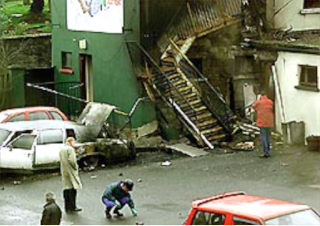
(From: “Bombing follows dissident pattern,” BBC News, http://www.news.bbc.co.uk, February 7, 2000 | Photo: RUC forensic experts examine the scene of the bomb attack at Mahons Hotel in Irvinestown, Northern Ireland, Associated Press)
At the 1961 Irish general election, Mac Giolla unsuccessfully contests the Tipperary North constituency for Sinn Féin. In 1962, he becomes President of Sinn Féin and is one of the people who moves the party to the left during the 1960s. In 1969, Sinn Féin splits, and he remains leader of Official Sinn Féin. It is also in 1962 that he marries May McLoughlin who is also an active member of Sinn Féin as well as Cumann na mBan, the women’s section of the IRA. In 1977, the party changes its name to Sinn Féin the Workers Party and in 1982 it becomes simply the Workers’ Party.
In 1999, Mac Giolla writes to the chairman of the Flood Tribunal calling for an investigation into revelations that former Dublin Assistant City and County Manager George Redmond had been the official supervisor at the election count in Dublin West and was a close associate of Liam Lawlor. In 2003, Redmond is convicted of corruption by a Dublin court but subsequently has his conviction quashed due to conflicting evidence.
In his eighties Mac Giolla continues to be active and is a member of the group which campaigns to prevent the demolition of No. 16 Moore Street in Dublin city centre, where the surrender after the Easter Rising was completed. He also serves on the Dublin ’98 committee to commemorate the 200th anniversary of the Irish Rebellion of 1798.
Tomás Mac Giolla dies in Beaumont Hospital in Beaumont, Dublin on February 4, 2010, after a long illness.
(Pictured: Tomás Mac Giolla, former president of the Workers’ party and lord mayor of Dublin in 2007, by Niall Carson, PA Wire, Press Association Images)
On February 1, 1998, up to 40,000 people march from the nationalistCreggan estate to the Bogside area of Derry to commemorate the 26th anniversary of Bloody Sunday and to remember the 14 people who died after paratroopers opened fire during disturbances 26 years earlier. Organisers say it is one of the biggest Bloody Sunday marches to date.
Jean Heggarty, whose brother Kevin was among those killed on January 31, 1972, pays tribute to the families’ quest for truth. “The families have never doubted the truth would survive. Due to their determination 26 years later, Tony Blair stated in the House of Commons that he would establish the truth,” she says.
John Kelly, whose brother Michael was killed, says, “The families have had a long struggle but what Tony Blair has said has really surprised us. I think we are in a more jovial mood after that announcement.”
The Sinn Féin chief negotiator, Martin McGuinness, calls for prosecutions to result from the new Bloody Sunday inquiry. He says those commanding the paratroopers on the day should be called to account for their actions.
McGuinness includes in his remarks General Sir Robert Ford, who was Commander of Land Forces in Northern Ireland at the time of the killings. “I think the role of General Ford in particular is going to come under the microscope,” he says. “If people such as General Ford are found to be complicit in the killings then I think they should be subjected to proceedings in the courts. The implications of all that are enormous for the British establishment.”
In the immediate aftermath of the shootings, General Ford told the BBC that his men had returned only three shots after having between 10 and 20 rounds fired at them.
(From: “Special Report: Remembering Bloody Sunday,” BBC News, news.bbc.co.uk, February 1, 1998 | Pictured: In driving rain, relatives lay wreaths at the Bloody Sunday memorial)




 seamus dubhghaill