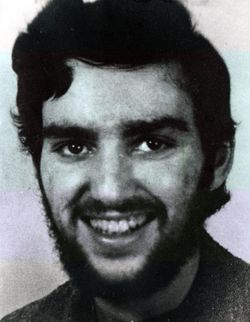
O’Hara joins Na Fianna Éireann in 1970 and, in 1971, his brother Sean is interned in Long Kesh Prison. In late 1971, at the age of 14, he is shot and wounded by a soldier while manning a barricade. Due to his injuries, he is unable to attend the civil rights march on Bloody Sunday but watches it go by him in the Brandywell Stadium, and the events of the day have a lasting effect on him.
In October 1974, O’Hara is interned in Long Kesh Prison, and upon his release in April 1975 he joins the Irish Republican Socialist Party (IRSP) and INLA. He is arrested in Derry in June 1975 and held on remand for six months. In September 1976, he is arrested again and once more held on remand for four months.
On May 10, 1978, O’Hara is arrested on O’Connell Street in Dublin under section 30 of the Offences Against the State Act and is released eighteen hours later. He returns to Derry in January 1979 and is active in the INLA. On May 14, 1979, he is arrested and is convicted of possessing a hand grenade. He is sentenced to eight years in prison in January 1980.
O’Hara becomes Officer Commanding of the INLA prisoners at the beginning of the first hunger strike in 1980, and he joins the 1981 strike on March 22.
On Thursday, May 21, 1981, at 11:29 PM, Patsy O’Hara dies at the age of 23 after 61 days on hunger strike. In accordance with his wishes, his parents do not get him the medical intervention needed to save his life. His corpse is found to be mysteriously disfigured prior to its departure from prison and before the funeral, including signs of his face being beaten, a broken nose, and cigarette burns on his body.
Queen Elizabeth II spends the last of her four days in Ireland visiting Cork on May 20, 2011, where she once again is greeted warmly. Despite initial concerns about security, the visit proves to be a huge success for both countries. The Queen’s apology at Dublin Castle for the treatment her government meted out to Ireland over many years is received with enormous positive, emotional response.
Large crowds line the streets in Cork city centre and the Queen is given a tour of the city’s English Market by the Lord Mayor of Cork, Terry Shannon. She meets some stall owners and speaks to members of the public after she leaves the market. There is a carnival atmosphere on the streets of Cork and the visit is more relaxed than many engagements in Dublin.
The Queen indicates she would like to return to Ireland for another visit. TaoiseachEnda Kenny says he invited her to return as she boarded her flight at Cork Airport. Kenny says the Queen told him she and the royal party enjoyed the visit. He pays tribute to everyone involved in the State visit. He says Ireland responded magnificently to the visit, from the President right down to ordinary people, who showed restraint and understanding.
Kenny says the Queen had received a real Irish welcome, which he says demonstrates the importance of a new beginning for both islands. He says that Ireland has measured up to the highest global standards and the county can be proud.
Tánaiste and Minister for Foreign AffairsEamon Gilmore says the visit has enhanced Ireland’s reputation abroad at a time when there are only negative headlines. He says that, because of the visit, the world is finally getting a picture of a country that does things well and that is working through its difficulties.
Sinn Féin President Gerry Adams says that, while expressing concerns about Queen Elizabeth’s visit, he also hopes some good will come from it.
At Cork Airport she walks to her plane passing an army guard of honour and Taoiseach Enda Kenny is there to bid her farewell. The plane departs bringing an end to her four-day State visit.
(From: “Queen Elizabeth II concludes Irish visit,” RTÉ.ie, the website of Raidió Teilifís Éireann, May 20, 2011)
A farmer’s son, Kelly is raised amid the horror of the Irish Civil War. The family is burned out when he is five and, penniless, goes north to take a worker’s house near the Harland & Wolff shipyard in Belfast. Even though they are Protestant the Kellys are met with a cold welcome. To counter that, his mother starts a bakery while he and his father sell the hot rolls to the area pubs.
Kelly initially attends a shipyard workers’ school, sometimes without shoes, and then goes on to Methodist College Belfast, where only boys prepared to work hard are welcome. His mother, who had taught him to play the piano by marking out the keyboard on the kitchen table, is so cross when she hears that he has been playing football in the street that she tells the headmaster that he does not have enough homework.
On a visit to an elder sister at Trinity College, Dublin, Kelly is so impressed by her smoking and her painted nails that he decides to follow her to the university, where he reads legal science. After being called to the Bar of Northern Ireland in 1944, he has the usual slow start, traveling up to 100 miles to earn a five-guinea fee. However, aided by a photographic memory and the patronage of Catholicsolicitors, he gradually builds up a large practice, concentrating on crime and workers’ compensation while earning a reputation as the finest cross-examiner in the province.
Kelly first makes a mark by his successful defence of an aircraftman accused of killing a judge’s daughter. The man is found guilty but insane, though the complications involved bring it back to court 20 years later. After appointment as Queen’s Counsel in 1958 he skillfully conducts two cases which go to the House of Lords. One involves the liability of a drunken psychopath, the other the question of automatism where a person, acting like a sleepwalker, does not know what he is doing.
In 1973, Kelly is appointed as a judge of the High Court of Northern Ireland, and then as a Lord Justice of Appeal of Northern Ireland in 1984, when he is also knighted and appointed to the Privy Council of the United Kingdom. On the bench he proves a model of fairness and courtesy with a mastery of facts, but his role often puts him in danger.
A Provisional Irish Republican Army (IRA) gang once targets him with a bomb-laden milk van, intending to drive it through his gates. But the police are alerted and immediately take him to Stormont, where he lives for the next two months.
For a year Kelly presides alone over a non-jury Diplock court, protected by armed police and wearing a bulletproof vest before writing his judgment under Special Air Service (SAS) guard in England. He convicts dozens of people on “supergrass” evidence, though there are subsequently doubts about the informant and some of his judgments are overturned.
One of the accused, Kevin Mulgrew, is sentenced to 963 years in prison, with Kelly telling him, “I do not expect that any words of mine will ever raise in you a twinge of remorse.” While the IRA grumbles about the jail terms he dispenses, and he is often portrayed as an unthinking legal hardliner by Sinn Féin, he is a more subtle figure and is often merciful towards those caught up in events or those whom he considers too young for prison.
Kelly retires in 1995 and moves to England, where he dies at the age of 88 at his home in Berkshire on December 5, 2008, following a short illness. He is survived by his wife, Pamela Colmer.
(From: “Basil Kelly,” Independent.ie (www.independent.ie), January 4, 2009)
The ideas that lead to Sinn Féin are first propounded by the United Irishman newspaper and its editor, Arthur Griffith. An article by Griffith in that paper in March 1900 calls for the creation of an association to bring together the disparate Irish nationalist groups of the time and, as a result, Cumann na nGaedheal is formed at the end of 1900. Griffith first puts forward his proposal for the abstention of Irish members of parliament (MP) from the Parliament of the United Kingdom at the 1902 Cumann na nGaedheal convention. A second organisation, the National Council, is formed in 1903 by Maud Gonne and others, including Griffith, on the occasion of the visit of King Edward VII to Dublin. Its purpose is to lobby Dublin Corporation to refrain from presenting an address to the king. The motion to present an address is duly defeated, but the National Council remains in existence as a pressure group with the aim of increasing nationalist representation on local councils.
Griffith elaborates his policy in a series of articles in the United Irishman in 1904, which outline how the policy of withdrawing from the imperial parliament and passive resistance had been successfully followed in Hungary, leading to the Austro-Hungarian Compromise of 1867 and the creation of a dual monarchy, and proposes that Irish MPs should follow the same course. These are published later that year in a booklet entitled The Resurrection of Hungary: A Parallel for Ireland. Also in 1904, Mary Ellen Butler, a friend of Griffith and cousin of Ulster Unionist Party leader Edward Carson, remarks in a conversation that his ideas are “the policy of Sinn Féin, in fact” and Griffith enthusiastically adopts the term. The phrase Sinn Féin (‘Ourselves’ or ‘We Ourselves’) had been in use since the 1880s as an expression of separatist thinking and was used as a slogan by the Gaelic League in the 1890s.
The first annual convention of the National Council on November 28, 1905, is notable for two things: the decision, by a majority vote (with Griffith dissenting), to open branches and organise on a national basis; and the presentation by Griffith of his ‘Hungarian’ policy, which is now called the Sinn Féin policy. This meeting is usually taken as the date of the foundation of the Sinn Féin party. In the meantime, a third organisation, the Dungannon Clubs, named after the Dungannon Convention of 1782, has been formed in Belfast by Bulmer Hobson, and it also considers itself to be part of ‘the Sinn Féin movement.’
By 1907, there is pressure on the three organisations to unite — especially from the United States, where John Devoy offers funding, but only to a unified party. The pressure increases when Charles Dolan, the Irish Parliamentary Party MP for North Leitrim, announces his intention to resign his seat and contest it on a Sinn Féin platform. On April 21, 1907, Cumann na nGaedheal and the Dungannon Clubs merge as the ‘Sinn Féin League.’ Negotiations continue until August when, at the National Council annual convention, the League and the National Council merge on terms favourable to Griffith. The resulting party is named Sinn Féin, and its foundation is backdated to the National Council convention of November 1905.
In the 1908 North Leitrim by-election, Sinn Féin secures 27% of the vote. Thereafter, both support and membership fall. Attendance is poor at the 1910 Ardfheis, and there is difficulty finding members willing to take seats on the executive. While some local councillors are elected running under the party banner in the 1911 local elections, by 1915 the party is, in the words of one of Griffith’s colleagues, “on the rocks,” and so insolvent financially that it cannot pay the rent on its headquarters in Harcourt Street in Dublin.
Following the Easter Rising in 1916, Sinn Féin grows in membership, with a reorganisation at its Ard Fheis in 1917. Its split in 1922 in response to the Anglo-Irish Treaty which leads to the Irish Civil War leads to the origins of Fianna Fáil and Fine Gael, the two parties which have since dominated Irish politics. Another split in the remaining Sinn Féin organisation in the early years of the Troubles in 1970 leads to the Sinn Féin of today, which is a republican, left-wing nationalist and secular party.
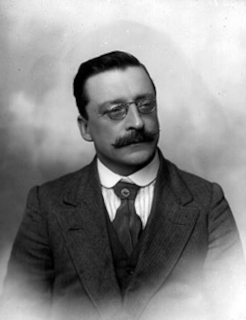
(Pictured: Arthur Griffith, founder (1905) and third president (1911-17) of Sinn Féin)
Herzog joins the British Army during World War II, operating primarily in Germany as a tank commander in the Armoured Corps. There, he is given his lifelong nickname of “Vivian” because the British could not pronounce the name, “Chaim.” A Jewish soldier had volunteered that “Vivian” is the English equivalent of “Chaim.”
After leaving the army, Herzog opens a private law practice. He returns to public life when the Six-Day War breaks out in 1967, serving as a military commentator for Kol Yisrael radio news. Following the capture of the West Bank, he is appointed Military Governor of East Jerusalem, and Judea and Samaria.
Herzog enters politics in the 1981 elections, winning a Knesset seat as a member of the Alignment. Two years later, in March 1983, he is elected to the largely ceremonial role of President. He serves two five-year terms before retiring in 1993. He dies on April 17, 1997, and is buried on Mount Herzl, Jerusalem. His son, Isaac Herzog, leads the Israeli Labour Party and the parliamentary Opposition in the Knesset from 2013 to 2018.
McGarrity’s family grows up in poverty, motivating his need to immigrate later in life. He grows up hearing his father discussing Irish politics, including topics such as the Fenians, the Irish Parliamentary Party (IPP), and Irish Home Rule. By the time he is an adult, he has developed a keen interest in politics himself.
McGarrity immigrates to the United States in 1892 at the age of 18. He is reputed to have walked to Dublin before boarding a cattle boat to Liverpool disguised as a drover, and then sailing to the United States using a ticket belonging to someone else. He settles in Philadelphia, Pennsylvania and becomes successful in the liquor business. His business fails, however, on three occasions, twice due to embezzlement by his business partner.
In 1893 McGarrity joins Clan na Gael, an Irish organisation based in the United States committed to aiding the establishment of an independent Irish state. Clan na Gael had been heavily involved with the Fenian Brotherhood that McGarrity had grown up hearing about, and by the latter half of the 19th century had become a sister organisation of the Irish Republican Brotherhood (IRB). In the decade just before McGarrity joins, Clan na Gael and the Fenian movement had waged the Fenian dynamite campaign, where they attempted to force the British state to make concessions in Ireland by bombing British Infrastructure. However, this had caused a split within Clan na Gael that is not mended until seven years after McGarrity joins when, in 1900, the factions reunite and plead to support “the complete independence of the Irish people, and the establishment of an Irish republic.” In the years that follow the 1880s and 1890s, he is, amongst others, credited with helping to stitch the organisation back together and bring it renewed strength.
McGarrity helps sponsor several Irish Race Conventions and founds and runs a newspaper called The Irish Press from 1918-22 that supports the Irish War of Independence. He is the founder of the Philadelphia chapter of Clan Na Gael.
When Éamon de Valera arrives in the United States in 1919 they strike up an immediate rapport and McGarrity manages de Valera’s tour of the country. He persuades de Valera of the benefits of supporting him and the Philadelphia branch against the New York branch of the Friends of Irish Freedom organisation led by John Devoy and Judge Daniel F. Cohalan. He becomes president of the American Association for the Recognition of the Irish Republic. He christens his newborn son Éamon de Valera McGarrity, although their relationship becomes strained upon de Valera’s entry back into Dáil Éireann in the Irish Free State.
The Irish Civil War sees a split in Clan na Gael just as it had split Sinn Féin back in Ireland. McGarrity and a minority of Clan na Gael members support the anti-treaty side but a majority support the pro-treaty side, including John Devoy and Daniel Cohalan. Furthermore, in October 1920 Harry Boland informs the Clan na Gael leadership that the IRB will be cutting their ties to the Clan unless the IRB is given more influence over their affairs. Devoy and Cohalan resist this, but McGarrity sees the Clan’s connection with the IRB as vital. While McGarrity’s faction is initially labelled “Reorganised Clan na Gael,” they are able to inherit total control of the Clan na Gael name as Devoy is not able to keep effective organisation of the group. In general, however, the in-fighting amongst the Irish on both sides of the Atlantic is quite disheartening for Irish Americans and in the years to come neither pro or anti-treaty sides of Clan na Gael see much in the way of donations.
With the scope of Clan na Gael now narrowed, and Devoy and Cohalan removed from the picture, McGarrity becomes chairman of the organisation. He does not support the founding of Fianna Fáil in 1926 and opposes the party’s entry into the Dáil in 1927. Even after the Irish Civil War, he still supports the idea that a 32-county Irish Republic can be achieved through force. in the spring of 1926, he receives Chief of Staff of the Irish Republican ArmyAndrew Cooney to the United States. Cooney and Clan na Gael formally agree that each organisation will support the other and that Clan na Gael will raise funds, purchase weapons and build support for the IRA in the United States.
Going into the late 1920s though Clan na Gael, as are most Irish American organisations, is struggling. Having limped past the split caused by the Irish Civil War, the rejection of Fianna Fáil has caused a second split in the membership. Many Irish Americans see the IRA and Fianna Fáil as one and the same at that point and Clan na Gael and McGarrity’s hostility to them causes much friction.
By July 1929, the Clan’s membership in one of its strongholds, New York City, is down to just 620 paid members. Then in October of that same year Wall Street crashes and the Great Depression hits. In 1933 McGarrity is left almost bankrupt after he is found guilty of “false bookkeeping entries.” His livelihood is saved when he becomes one of the main ticket agents in the United States for the Irish Hospitals’ Sweepstake. He is a personal friend of Joseph McGrath, one of the founders of the Sweepstake. The sweepstakes allow him to turn his fortunes around.
Despite the trying times of both Clan na Gael and his personal life, McGarrity holds fast in his belief in physical force Irish Republicanism. In 1939 he supports the demand from Seán Russell for the “S-Plan” bombing campaign in Britain, which proves disastrous. He allegedly meets Hermann Göring in Berlin in 1939 to ask for aid for the IRA, which leads indirectly to “Plan Kathleen.”
McGarrity is a lifelong friend of fellow Carrickmore native and avid Republican, Patrick McCartan. When he dies on September 4, 1940, a mass is held in the St. Mary’s Pro-Cathedral in Dublin. He remains an unrepentant physical force republican all his life. A number of McGarrity’s papers are in the National Library of Ireland. He donates his personal Library to Villanova University.
The IRA signs all its statements ‘J.J. McGarrity’ until 1969 when the organisation splits into the ‘Official‘ and ‘Provisional‘ movements. Thereafter the term continues to be used by the Officials while the Provisionals adopt the moniker ‘P.O’Neill.’
The government had set this date as a final deadline for a restoration of power-sharing before direct rule from London is restored permanently and now has to rush emergency legislation through the House of Commons to prevent this.
“After a long and difficult time in our province, I believe that enormous opportunities lie ahead for our province,” Paisley tells reporters, as he sits at a conference table next to Adams. The agreement “marks the beginning of a new era of politics on this island,” Adams agrees, but adds that he finds it “disappointing” that Northern Ireland‘s political institution cannot be restored immediately.
British prime minister Tony Blair hails the agreement, saying “This is a very important day for the people of Northern Ireland but also for the people and the history of these islands.” After talking by phone with his Irish counterpart, Taoiseach Bertie Ahern, he tells reporters, “In a sense, everything we have done over the last ten years has been a preparation for this moment, because the people of Northern Ireland have spoken through the election. They have said we want peace and power-sharing, and the political leadership has then come in behind that and said we will deliver what people want.”
In Ireland, Ahern calls the day’s developments “unprecedented and very positive,” and says both governments will cooperate with the new May 8 date for devolution.
The Secretary of State for Northern Ireland, Peter Hain, says a one clause emergency bill will be put through parliament with the agreement of opposition parties, and will need royal assent before midnight the following evening to prevent the dissolution of the Stormont assembly. He describes the day’s events as “really, really momentous.”
“Today the clouds have lifted, and the people can see the future,” Hain tells BBC Radio 4‘s The World at One. “These pictures of Ian Paisley and Gerry Adams will resonate around the world. They are a graphic manifestation of the power of politics over bigotry and conflict, bitterness and horror.”
The crucial meeting sees delegations from the DUP and Sinn Féin spend an hour together inside a room at Stormont to hammer out the final agreement for a return to power-sharing. Afterwards, both leaders talk about the work still needing to be done, including regular meetings between Paisley and Sinn Féin’s Martin McGuinness as the de facto first and deputy first ministers.
Clearly conscious of the historical significance of their talks, Paisley and Adams speak of the suffering caused by the decades of inter-community violence and their responsibility to ensure permanent peace and reconciliation. Northern Ireland’s politicians must “never forget those who have suffered during the dark period from which we are, please God, emerging,” Paisley says. “I want to make it clear that I am committed to delivering not only for those who voted for the DUP but for all the people of Northern Ireland. We must not allow our justified loathing for the horrors and tragedies of the past to become a barrier to creating a better and more stable future for our children,” he adds.
Adams says there is now new hope for the future, following the previous “sad history of orange and green.” He adds, “There are still many challenges, many difficulties, to be faced. But let us be clear: the basis of the agreement between Sinn Féin and the DUP follows Ian Paisley’s unequivocal and welcome commitment to support and participate fully in the political institutions on May 8. We’ve all come a very long way in the process of peace making and national reconciliation. We are very conscious of the many people who have suffered. We owe it to them to build the best future possible.”
The proposal for the historic meeting comes after a frantic weekend of consultation in Belfast and Berlin, where Blair and Ahern are attending a ceremony to mark 50 years of the European Union. Both prime ministers had repeatedly insisted the assembly would be dissolved if no agreement on an executive had been reached by today’s legal deadline. Britain is forced into a last-minute change of strategy after Paisley’s DUP agrees in principle on March 24 to share power with Sinn Féin but demands an extension of the deadline for the formation of the executive until May.
The DUP, which is badly split, says they need the additional time to see if Sinn Féin will comply with its commitment to cooperate with the Police Service of Northern Ireland. Until now Paisley’s DUP has always refused to meet Sinn Féin. Each represents what used to be seen as the two extremes of Northern Ireland sectarian politics.
(From: “Paisley and Adams agree deal” by Peter Walker and Owen Bowcott, The Guardian (www.theguardian.com), March 26, 2007 | Pictured: Ian Paisley and Gerry Adams hold their first face-to-face talks. Photograph: Paul Faith/ PA)
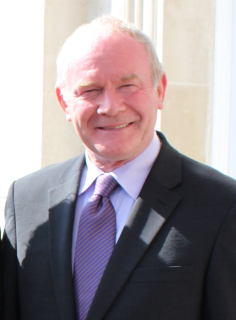
McGuinness is born James Martin Pacelli McGuinness on May 23, 1950 in Derry. He attends St. Eugene’s Primary School and later the Christian Brothers technical college, leaving school at the age of 15.
McGuinness joins the IRA about 1970, and by 1971 he is one of its leading organizers in Derry. In 1973 a Special Criminal Court in the Republic of Ireland sentences him to six months in prison after he is caught in a car containing large quantities of explosives and ammunition. Although the IRA keeps secret the membership of its seven-person Army Council, few doubt that McGuinness is one of its most important members from the 1970s through the 1990s. Even while reportedly planning attacks on civilians in Northern Ireland and on the British mainland, McGuinness is involved in spasmodic secret talks with British government ministers and officials to end the conflict. In 1972 McGuinness, with fellow IRA leader Gerry Adams, privately negotiates with British Secretary of State for Northern IrelandWilliam Whitelaw, but these and other talks over the next two decades are unsuccessful.
McGuinness contests seats in the British House of Commons on several occasions, losing in 1983, 1987, and 1992. However, in 1997 he is elected to the House of Commons to represent the constituency of Mid Ulster and, in line with party policy, he does not take his seat. He subsequently wins reelection to the seat in 2001, 2005, and 2010.
McGuinness is the IRA’s chief negotiator in the deliberations, also secret at first, that culminate in the Good Friday Agreement in 1998. This pact finally ends the conflict and eventually brings Sinn Féin into a coalition government to rule Northern Ireland. He is elected to the new Northern Ireland Assembly and in 1999 is appointed Minister of Education. In this post he eliminates the controversial eleven-plus examination, which determines which type of secondary school a child should attend. The test had been abolished in most of the rest of the United Kingdom more than 25 years earlier.
Disagreements over such issues as policing and the decommissioning of arms causes Northern Ireland’s Executive and Assembly to be suspended for some years, but a fresh agreement in 2006 paves the way for them to be revived. In elections in March 2007, both Sinn Féin and the antirepublican Democratic Unionist Party (DUP) gain seats, becoming the two largest parties in the Northern Ireland Assembly. McGuinness becomes Deputy First Minister, working with First Minister Ian Paisley, leader of the DUP. The two men, previously bitter enemies, perform so well together that they are dubbed the “Chuckle brothers.”
When Paisley retires in 2008, he is succeeded by the DUP’s Peter Robinson, who is considered to be even more militantly antirepublican. Once again, however, a shared need to rebuild the economy and attract international investment leads to cooperation between former opponents. In 2009 their government is in jeopardy as Sinn Féin and the DUP argue over the devolution of the police and justice system in Northern Ireland. McGuinness and Robinson are involved in the ensuing negotiations, and in February 2010 an agreement is reached for the transfer of powers from Britain to Northern Ireland in April.
In the Assembly elections in May 2011, McGuinness and Robinson are a formidable pair, and voters respond to their call for stability in a time of economic uncertainty. Sinn Féin gains an additional seat and increases its overall share of the vote, and McGuinness is assured an additional term as Deputy First Minister. In the autumn he steps down to run as Sinn Féin’s candidate for the presidency of Ireland. After finishing third in the election held on October 28, he returns to the position of Deputy First Minister a few days later. On June 27, 2012, in an event widely seen as having great symbolic importance for the ongoing reconciliation efforts in Northern Ireland, McGuinness and Elizabeth II shake hands twice, once in private and again in public, during a visit by the British monarch to Belfast.
In January 2017 McGuinness resigns as Deputy First Minister in response to First Minister Arlene Foster’s refusal to temporarily step down from her position during the investigation of a scandal relating to the government’s Renewable Heat Incentive (RHI), a mishandled program under which large amounts of state funds allegedly had been squandered. Foster had served as head of the department that oversaw the RHI before becoming First Minister. Under the power-sharing agreement the posts of First Minister and Deputy First Minister constitute a single joint office so that the resignation of one minister results in termination of the other’s tenure. When Sinn Féin chooses not to nominate a replacement for McGuinness within the required seven-day period, authority reverts to the British government’s Secretary of State for Northern Ireland in advance of a snap election on March 2.
Even before McGuinness’s resignation there had been speculation late in 2016 that he might step down for health reasons, and soon after resigning he confirms that he is suffering from amyloidosis, a rare disease brought about by deposits of abnormal protein in organs and tissue. With McGuinness removing himself from “frontline politics,” Michelle O’Neill leads Sinn Féin into the election. The disease claims McGuinness’s life only months later on March 21, 2017.
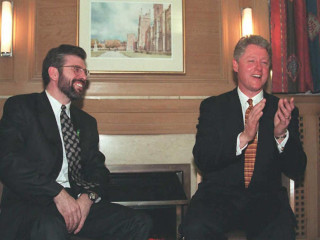
Some of the fifty people at the luncheon, most of them Irish American members of Congress, think Clinton might forgo a handshake because he is under tremendous pressure from Britain’s Prime MinisterJohn Major not to give Adams a warm embrace. But Clinton does not hesitate although the handshake comes after photographers have left the room.
“Gerry was concerned about the protocol of how he should go up to the President, but when he walked up, the President gave him a very big handshake,” says RepresentativePeter T. King, a Republican from Seaford, Long Island, who sits to the right of Adams at the lunch. After an awkward moment of silence, the room explodes with applause.
The President and the Sinn Féin leader speak for five minutes. Later Adams says, “The engagement was positive, was cordial.”
According to Rep. King, Clinton says he is committed to making the Irish peace effort succeed and, while talking to Adams, puts his fist in front of him and says, “This is going to work.” Adams says Clinton does not urge him to make sure the IRA disarms, something Major asked the President to do. Clinton invites Adams to a White House reception scheduled for the following day and, according to his aides, plans to speak to Major over the weekend in an effort to patch up their differences.
The tone at the luncheon is often light. Clinton jokes that finally he is at a place where people will not criticize him for taking a drink of Guinness. Also, Bruton hails Gingrich as an honorary Irishman, noting that his mother apparently descended from the Doherty clan of County Donegal.
Wearing a white carnation tinged with green, Gingrich gives the Taoiseach a bowl of Georgia peanuts and a book on the history of the United States Capitol. Telling Gingrich that he is not the first person to consider overhauling welfare, Bruton gives him an 1840’s book about welfare reform in Ireland.
TaoiseachEnda Kenny conveys his resignation to PresidentMichael D. Higgins at Áras an Uachtaráin on March 10, 2016, after failing to get re-elected to the position in a Dáil vote, becoming acting Taoiseach as the Dáil adjourns until March 22. “It’s not the outcome that I personally would have liked to see but I respect the verdict of the people,” Kenny says. The vote for the former Taoiseach stands at: For 57, Against 94, Abstain 5.
Kenny, the MayoTD, says the Cabinet will continue its work while the various parties try to form a government. A government statement issued in the evening reads, “The Taoiseach, Mr. Enda Kenny, T.D., has this evening conveyed to the President his resignation from office. In accordance with the Constitution, the Government and the Taoiseach will continue to carry on their duties until successors have been appointed.”
Kenny says when Fine Gael and the Labour Party entered government five years earlier “our very survival was in doubt.” He adds, “The Government had to face unprecedented sets of difficulties. Many believed the situation was hopeless. The country is in a different place now.”
The outgoing Taoiseach says he is “fully committed” to working with other parties and independents to form a new government. He adds that “a substantial number of people do not want to serve in government.” Fianna Fáil leader Micheál Martin says the situation is not unprecedented and people should put aside the notion that “speed” is an issue in forming a government. “Ireland is relatively unusual in how fast it carries out the formation of government,” he says.
A total of 50 Fine Gael TDs are re-elected to the 32nd Dáil. The five abstentions in the Enda Kenny vote are TDs Michael Harty, Noel Grealish, Denis Naughten, Michael Collins and Mattie McGrath. They say they will abstain on each vote for Taoiseach in an indication they are willing to hold further coalition talks.
The vote for the other nominees are: Fianna Fáil leader Micheál Martin: For 43, Against 108, 5 Abstain. Sinn Féin leader Gerry Adams: For 24, Against 116. AAA-PBP candidate Richard Boyd Barrett: For 9, Against 111.
(From: “Enda Kenny resigns as Taoiseach after failing to get re-elected as leader” by Kevin Doyle and Niall O’Connor, http://www.independent.ie, March 10, 2016)






 seamus dubhghaill