seamus dubhghaill

Promoting Irish Culture and History from Little Rock, Arkansas, USA


Leave a comment

Paddington & Victoria Stations Bombings

london-victoria-station

The Provisional Irish Republican Army (PIRA) explodes two bombs at London mainline stations on February 18, 1991, one at Victoria station and the other at Paddington station, killing one person and injuring 38 others all at Victoria station. It is the IRA’s second major attack in London in February 1991 after the Downing Street mortar attack eleven days earlier which is an attempt to wipe out the British war cabinet and British prime minister John Major. It is also the first IRA attack on civilians since the 1983 Harrods bombing, marking a strategic change in their bombing campaign.

The Paddington bomb, which goes off at 4:20 AM, is much smaller than the second bomb at Victoria and is designed to make sure the security services will take the Victoria bomb seriously and not as a hoax. There are no deaths or injuries at Paddington station, but the roof is badly damaged.

Sometime before 7:00 AM, a caller with an Irish accent says, “We are the Irish Republican Army. Bombs to go off in all mainline stations in 45 minutes.” The Victoria station bomb, which is hidden in a rubbish bin inside the station, goes off at 7:40 AM. Despite a 45-minute warning and the Paddington bomb three hours earlier, the security services are slow to act. The bomb kills one person instantly and injures 38 others from flying glass and other debris. This is the worst attack suffered by civilians in England by the IRA since the 1983 Harrods bombing which killed three policemen, three civilians and injured 50 people. All London’s rail terminals are closed, disrupting the journeys of almost half a million commuters and bringing chaos to London, which is the IRA’s intended goal. There is also a hoax call made to Heathrow Airport, causing the airport’s closure.

That night the Provisional IRA claims responsibility for the bombings but blames the British police for the casualties. A statement from the Provisional IRA GHQ says, “The cynical decision of senior security personnel not to evacuate railway stations named in secondary warnings, even three hours after the warning device had exploded at Paddington in the early hours of this morning was directly responsible for the casualties at Victoria.” The statement goes on, “All future warnings should be acted upon.” The main purpose of the bombings in the overall IRA strategy is to keep pressure up on John Major, his Government and to make sure he acts on the Irish Troubles.

Police defend the decision not to close all stations after receiving warning that bombs had been planted. Commander George Churchill-Coleman, head of Scotland Yard‘s anti-terrorist squad, says that dozens of hoax calls are received every day. “It is very easy with hindsight to be critical.” Churchill-Coleman also says that the bomb was “quite deliberately intended to maim and kill.”

A year later, a French TV crew interviews an IRA Commander who says he speaks on behalf of the IRA’s GHQ Staff. The commander of the unit says of the Victoria station bombing that warnings were given by telephone naming nine railroad stations in London and that a 50-minute warning was given. He goes on to say that the attack was not aimed at hurting anybody but to disrupt the British transport system.

This bombing marks the IRA’s shift to targeting civilian areas following the July 1990 London Stock Exchange bombing. It is also the first IRA attack on the London transport system since 1976. The IRA keeps bombing targets in England for the remainder of the year.

(Pictured: London Victoria Station – The main station building for this terminus, with trains servicing the south and south-eastern destinations, as well as Gatwick. In front is the bus station.)


Leave a comment

Murder of Patrick Finucane, Human Rights Lawyer

patrick-finucane

Patrick Finucane, Irish human rights lawyer, is killed on February 12, 1989, by loyalist paramilitaries acting in collusion with the British government intelligence service MI5. His killing is one of the most controversial during the Troubles in Northern Ireland.

Finucane is born into a Roman Catholic family on the Falls Road, Belfast on March 21, 1949. At the start of the Troubles, his family is forced out of their home. He graduates from Trinity College, Dublin in 1973. He comes to prominence due to successfully challenging the British government in several important human rights cases during the 1980s.

Finucane is shot fourteen times and killed at his home in Fortwilliam Drive, north Belfast, by Ken Barrett and another masked man using a Browning Hi-Power 9mm pistol and a .38 revolver respectively. The two gunmen knock down the front door with a sledgehammer and enter the kitchen where Finucane has been having a Sunday meal with his family. They immediately open fire and shoot him twice, knocking him to the floor. Then while standing over him, the leading gunman fires twelve bullets into his face at close range. Finucane’s wife Geraldine is slightly wounded in the shooting attack which their three children witness as they hide underneath the table.

The Royal Ulster Constabulary (RUC) immediately launches an investigation into the killing. The investigation, led by Detective Superintendent Alan Simpson, runs for six weeks and he later states that from the beginning, there had been a noticeable lack of intelligence coming from the other agencies regarding the killing. Finucane’s killing is widely suspected by human rights groups to have been perpetrated in collusion with officers of the RUC and, in 2003, the British Government Stevens Report states that the killing is indeed carried out with the collusion of police in Northern Ireland.

In September 2004, an Ulster Defence Association (UDA) member, and at the time of the murder a paid informant for the Royal Ulster Constabulary, Ken Barrett, pleads guilty to Finucane’s murder.

The Ulster Defence Association/Ulster Freedom Fighters (UDA/UFF) claim they killed Finucane because he was a high-ranking officer in the Irish Republican Army (IRA). Police at his inquest say they have no evidence to support this claim. Finucane had represented republicans in many high-profile cases, but he had also represented loyalists. Several members of his family have republican links, but the family strongly denies Finucane is a member of the IRA. Informer Sean O’Callaghan claims that he attended an IRA finance meeting alongside Finucane and Gerry Adams in Letterkenny in 1980. However, both Finucane and Adams have consistently denied being IRA members.

In Finucane’s case, both the RUC and the Stevens Report find that he is not a member of the IRA. Republicans strongly criticise the claims made by O’Callaghan in his book The Informer and subsequent newspaper articles. One Republican source says O’Callaghan “…has been forced to overstate his former importance in the IRA and to make increasingly outlandish accusations against individual republicans.”

In 2011 British Prime Minister David Cameron meets with Finucane’s family and admits the collusion, although no member of the British security services has yet been prosecuted.


Leave a comment

Assassination of Billy “King Rat” Wright

billy-wright

Billy “King Rat” Wright, prominent Ulster loyalist death squad leader during the ethno-nationalist conflict in Northern Ireland known as the Troubles, is murdered on December 27, 1997, in HM Prison Maze by three members of the Irish National Liberation Army (INLA) who manage to smuggle guns into the prison.

William Stephen “Billy” Wright, named after his grandfather, is born in Wolverhampton, England on July 7, 1960, to David Wright and Sarah McKinley, Ulster Protestants from Portadown, Northern Ireland. The family returns to Northern Ireland in 1964. While attending Markethill High School, Wright takes a part-time job as a farm labourer where he comes into contact with a number of staunchly unionist and loyalist farmers who serve with the Royal Ulster Constabulary (RUC) Reserve or the Ulster Defence Regiment (UDR). The conflict known as the Troubles has been raging across Northern Ireland for about five years by this stage, and many young men such as Wright are swept up in the maelstrom of violence as the Provisional Irish Republican Army ramps up its bombing campaign and sectarian killings of Catholics by loyalists continue to escalate. During this time his opinions move towards loyalism and soon he gets into trouble for writing the initials “UVF” on a local Catholic primary school wall. When he refuses to clean off the vandalism, he is transferred from the area and sent to live with an aunt in Portadown.

Wright joins the Ulster Volunteer Force (UVF) in 1975. After spending several years in prison and becoming a born-again Christian, he resumes his UVF activities and becomes commander of its Mid-Ulster Brigade in the early 1990s, taking over from Robin “the Jackal” Jackson. According to the Royal Ulster Constabulary, he is involved in the sectarian killings of up to 20 Catholics, although he is never convicted for any. It is alleged that Wright, like his predecessor, is an agent of the RUC Special Branch.

Wright attracts considerable media attention during the Drumcree standoff, when he supports the Protestant Orange Order‘s desire to march its traditional route through the Catholic/Irish nationalist area of his hometown of Portadown. In 1994, the UVF and other paramilitary groups call ceasefires. However, in July 1996, Wright’s unit breaks the ceasefire and carries out a number of attacks, including a sectarian killing. For this, Wright and his Portadown unit of the Mid-Ulster Brigade are stood down by the UVF leadership. He is expelled from the UVF and threatened with execution if he does not leave Northern Ireland. He ignores the threats and, along with many of his followers, defiantly forms the breakaway Loyalist Volunteer Force (LVF), becoming its leader.

The LVF carries out a string of killings of Catholic civilians. In March 1997 Wright is sent to the HM Prison Maze for having threatened the life of a woman. While imprisoned, Wright continues to direct the LVF’s activities. On the morning of December 27, 1997, he is assassinated inside the prison by three INLA volunteers – Christopher “Crip” McWilliams, John “Sonny” Glennon and John Kennaway – armed with two smuggled pistols, a FEG PA-63 semi-automatic and a .22 Derringer. The LVF carries out a wave of sectarian attacks in retaliation. There is speculation that the authorities collude in his killing as he is a threat to the peace process. An inquiry finds no evidence of this but concludes there are serious failings by the prison authorities.

Owing to his uncompromising stance as an upholder of Ulster loyalism and opposition to the Northern Ireland peace process, Wright is regarded as a cult hero, icon, and martyr by hardline loyalists. His image adorns murals in loyalist housing estates and many of his devotees have tattoos bearing his likeness. His death is greeted with relief and no little satisfaction, however, from the Irish nationalist community.


Leave a comment

Birth of Kenneth Branagh, Actor, Director & Producer

kenneth-branagh

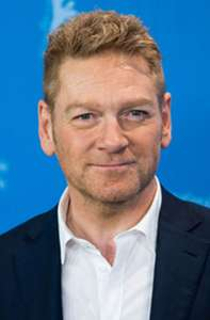
Sir Kenneth Charles Branagh, British actor, director, producer, and screenwriter, is born in Belfast on December 10, 1960.

Branagh is the middle of three children of working-class Protestant parents Frances (née Harper) and William Branagh, a plumber and joiner who runs a company that specialises in fitting partitions and suspended ceilings. He lives in the Tiger’s Bay area of the city and is educated at Grove Primary School.

At the age of nine, Branagh moves with his family to Reading, Berkshire, England, to escape the Troubles. He is educated at Whiteknights Primary School, then Meadway School, Tilehurst, where he appears in school productions such as Toad of Toad Hall and Oh, What a Lovely War!. He attends the amateur Reading Cine & Video Society (now called Reading Film & Video Makers) as a member and is a keen member of Progress Theatre for whom he is now the patron. He goes on to train at the Royal Academy of Dramatic Art in London and in 2015 succeeds Richard Attenborough as its president.

Branagh has both directed and starred in several film adaptations of William Shakespeare‘s plays, including Henry V (1989) (for which he was nominated for the Academy Award for Best Actor and Academy Award for Best Director), Much Ado About Nothing (1993), Othello (1995), Hamlet (1996) (for which he was nominated for the Academy Award for Best Adapted Screenplay), Love’s Labour’s Lost (2000), and As You Like It (2006).

Branagh stars in numerous other films and television series including Fortunes of War (1987), Woody Allen‘s Celebrity (1998), Wild Wild West (1999), The Road to El Dorado (2000), Conspiracy (2001), Harry Potter and the Chamber of Secrets (2002), Warm Springs (2005), as Major General Henning von Tresckow in Valkyrie (2008), The Boat That Rocked (2009), Wallander (2008–2016), My Week with Marilyn (2011) as Sir Laurence Olivier (nominated for Academy Award for Best Supporting Actor), and as Royal Navy Commander Bolton in the action-thriller Dunkirk (2017). He directs such films as Dead Again (1991), in which he also stars, Swan Song (1992) (nominated for Academy Award for Best Live Action Short Film), Mary Shelley’s Frankenstein (1994) in which he also stars, The Magic Flute (2006), Sleuth (2007), the blockbuster superhero film Thor (2011), the action thriller Jack Ryan: Shadow Recruit (2014) in which he also co-stars, the live-action film Cinderella (2015), and the mystery drama adaptation of Agatha Christie‘s Murder on the Orient Express (2017), in which he also stars as Hercule Poirot.

Branagh narrates the series Cold War (1998), the BBC documentary miniseries Walking with Dinosaurs (1999), Walking with Beasts (2001) and Walking with Monsters (2005). He has been nominated for five Academy Awards, five Golden Globe Awards, and has won three BAFTAs, and an Emmy Award. He is appointed a Knight Bachelor in the 2012 Birthday Honours and is knighted on November 9, 2012. He is awarded the Freedom of the City of his native city of Belfast in January 2018.


Leave a comment

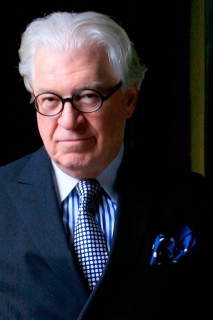
Birth of Frank Delaney, Novelist, Journalist & Broadcaster

frank-delaney

Frank Delaney, Irish novelist, journalist and broadcaster, is born in County Tipperary on October 24, 1942. He is the author of The New York Times best-seller Ireland, the non-fiction book Simple Courage: A True Story of Peril on the Sea, and many other works of fiction, non-fiction and collections.

Delaney begins working as a newsreader for the Irish state radio and television network RTÉ in 1970. In the early 1970s he becomes a news reporter for the BBC in Dublin, and covers an intense period of violence known as the Troubles. After five years of reporting on the violence, he moves to London to work in arts broadcasting. In 1978 he creates the weekly Bookshelf programme for BBC Radio 4, which covers books, writers and the business of publishing. Over the next five-and-a-half years he interviews over 1,400 authors, including Anthony Burgess, John Updike, Margaret Atwood, Christopher Isherwood and Stephen King.

On television, Delaney writes and presents for Omnibus, the BBC’s weekly arts series. He serves as the Literature Director of the Edinburgh Festival in 1980, and hosts his own talk show Frank Delaney in the early 1980s, which features many cultural and literary personalities. Afterward, he creates and presents Word of Mouth, the BBC’s radio programme about language, as well as a variety of radio and television documentaries including specials on James Joyce, Robert Graves, Ernest Hemingway in Paris, and the Shakespeare industry. He presents The Book Show on the Sky News satellite channel for many years.

Delaney’s first book, James Joyce’s Odyssey (1981), is well received and becomes a best-seller in the UK and Ireland. He writes and presents the six-part documentary series The Celts: Rich Traditions and Ancient Myths (1987) for the BBC, and writes the accompanying book. He subsequently writes five books of non-fiction (including Simple Courage), ten novels (including Ireland, Venetia Kelly’s Traveling Show and Tipperary), one novella, and a number of short stories. He also edits many compilations of essays and poetry.

After moving to the United States and settling in Kent, Connecticut in 2002, Delaney writes the screenplay for an adaptation of Goodbye, Mr. Chips (2002), which stars Martin Clunes and is shown on ITV in Britain, and in the Masterpiece Theatre series in the United States. His articles are published by newspapers in United States, the UK and Ireland, including on the Op-ed pages of The New York Times. He is a frequent public speaker, and is a contributor and guest on National Public Radio (NPR) programmes.

On Bloomsday 2010, Delaney launches Re:Joyce, a series of short weekly podcasts that go page-by-page through James Joyce’s Ulysses, discussing its allusions, historical context and references.

Frank Delaney dies in Danbury Hospital in Danbury, Connecticut on February 21, 2017 after suffering a stroke the previous day.


Leave a comment

First Edition of the “Irish Press” Published

irish-press-may-25-1995

The first edition of the Irish Press, a Dublin daily newspaper founded by Éamon de Valera as a platform for Fianna Fáil, is published on September 5, 1931.

Irish Press Ltd. is officially registered on September 4, 1928, three years before the paper is first published, to create a newspaper independent of the existing media where the Independent Newspapers group is seen as supporting Cumann na nGaedheal/Fine Gael, and The Irish Times being pro-union, and with a mainly middle-class or Protestant readership.

The paper’s first issue is published on the eve of the 1931 All-Ireland Senior Hurling Championship Final between Cork and Kilkenny. Other newspapers do not cover GAA sports in any detail at the time. Margaret Pearse, the mother of Patrick and Willie Pearse, presses the button to start the printing presses. The initial aim of its publisher is to achieve a circulation of 100,000 which it quickly accomplishes. It goes on to list 200,000 subscribers at its peak.

The money to launch the Irish Press is raised in the United States during the Irish War of Independence by a bond drive to finance the First Dáil. Five million dollars is raised; however, 60 percent of this money is left in various banks in New York City. No one knows why de Valera ordered the bulk of the money to be left in New York when he returned to Ireland in late 1920.

In 1927, as a result of legal action between the Irish Free State government and de Valera, a court in New York orders that the bond holders be paid back outstanding money due to them. However, de Valera’s legal team has anticipated the ruling and has prepared for the outcome. A number of circulars are sent to the bond holders asking them to sign over their holdings to de Valera. The bond holders are paid 58 cents to the dollar. This money is then used as startup capital to launch the Irish Press. Following the 1933 Irish General Election, de Valera uses his Dáil Éireann majority to pass a measure allowing the bond holders to be paid the remaining 42 percent of the money still owed.

In December 1931, editor Frank Gallagher is prosecuted by an Irish Free State military tribunal for publishing articles alleging that Garda Síochána had mistreated the Anti-Treaty republicans of the Irish Free State government. This is facilitated by Amendment 17 of the Constitution of the Irish Free State and Gallagher is convicted and fined £50. An example of animosity from those who support Independent Newspapers and the Free State government is that the Irish Press is excluded from the special train which delivers newspapers from Dublin to the countryside. As a result, it is circulated throughout Ireland by a specially rented train.

The Irish Press sustains itself with its own resources until The Sunday Press is founded in 1949. In its heyday, the Irish Press has a number of first-rate reporters and columnists. One notable section, New Irish Writing is edited by David Marcus.

In the 1970s, the Minister for Posts and Telegraphs, Conor Cruise O’Brien, tries to use and amend The Emergency Powers Act and Section 31 of the Broadcasting Authority Act, to censor coverage of the Troubles in Northern Ireland. The Irish Press editor, Tim Pat Coogan, publishes editorials attacking the Bill. The Fine Gael/Labour Coalition Government tries to prosecute the Irish Press for its coverage of the maltreatment of republican prisoners by the Garda “Heavy Gang,” with the paper winning the case.

The Irish Press starts two further newspapers, the Evening Press (1954), and The Sunday Press. The Evening Press is aimed at an urban readership and achieves a daily circulation of 100,000. The new newspapers subsidise the Irish Press when its circulation sags. Its adoption of a tabloid format does not rescue its declining circulation.

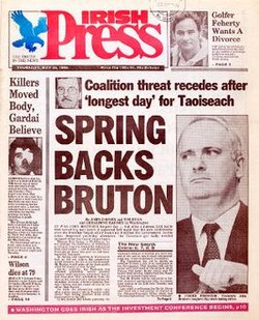
The final issue of the Irish Press and Evening Press is on Thursday, May 25, 1995. The newspapers close because of a bizarre industrial dispute over the sacking of the group business editor, Colm Rapple. The group has not been in a healthy financial state for several years. When it eventually closes, with indebtedness of £20 million, 600 people lose their jobs.

(Pictured: Cover of last ever edition of the Irish Press from May 25, 1995)


Leave a comment

First Use of Rubber Bullets in Northern Ireland

rubber-bullet

Rubber bullets are used for the first time in Northern Ireland on August 2, 1970. Rubber bullets are invented by the British Ministry of Defence for use against rioters in Northern Ireland during The Troubles.

Rubber bullets (also called rubber baton rounds) are rubber or rubber-coated projectiles that can be fired from either standard firearms or dedicated riot guns. They are intended to be a non-lethal alternative to metal projectiles. Like other similar projectiles made from plastic, wax and wood, rubber bullets may be used for short range practice and animal control but are most commonly associated with use in riot control and to disperse protests.

The British developed rubber rounds – the “Round, Anti-Riot, 1.5in Baton” – in 1970 for use against rioters in Northern Ireland. A low-power propelling charge gives them a muzzle velocity of about 200 feet per second and maximum range of about 110 yards. The intended use is to fire at the ground so that the round bounces up and hits the target on the legs, causing pain but not injury.

From 1970 to 1975, about 55,000 rubber bullets are fired by the British Army in Northern Ireland. Often, they are fired directly at people from close range, which results in three people being killed and many more badly injured. In 1975, they are replaced by plastic bullets. In Northern Ireland over 35 years (1970–2005), about 125,000 rubber and plastic bullets are fired – an average of ten per day – causing 17 deaths.

The baton round is made available to British police forces outside Northern Ireland from 2001. In 2013 however, Ministry of Defence papers declassified from 1977 reveal it is aware rubber bullets are more dangerous than was publicly disclosed. The documents contain legal advice for the Ministry of Defence to seek a settlement over a child who had been blinded in 1972, rather than go to court which would expose problems with the bullets and make it harder to fight future related cases. The papers state that further tests would reveal serious problems with the bullets, including that they were tested “in a shorter time than was ideal”, that they “could be lethal” and that they “could and did cause serious injuries.”

(Pictured: 37 mm British Army rubber bullet, as used in Northern Ireland)


Leave a comment

Death of John Patrick Wilson, Fianna Fáil Politician

john-wilson

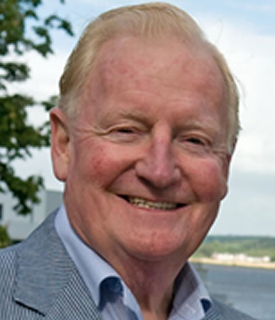
John Patrick Wilson, Fianna Fáil politician who serves as Tánaiste from 1990 to 1993, dies in Beaumont, Dublin on July 9, 2007, the day after his 84th birthday. He also serves as Minister for Defence and Minister for the Gaeltacht (1992-1993), Minister for the Marine (1989-1992), Minister for Tourism and Transport (1987-1989), Minister for Communications (March 1987), Minister for Posts and Telegraphs (March-December 1982), Minister for Education (1977-1981) and Teachta Dála (TD) for Cavan (1973-1992).

Wilson is born in Kilcogy, County Cavan on July 8, 1923. He is educated at St. Mel’s College in Longford, the University of London and the National University of Ireland. He graduates with a Master of Arts in Classics and a Higher Diploma in Education. He is a secondary school teacher at Saint Eunan’s College and Gonzaga College and also a university lecturer at University College, Dublin (UCD) before he becomes involved in politics. He is also a Gaelic footballer for Cavan GAA and wins two All-Ireland Senior Football Championship medals with the team, one in 1947 at the Polo Grounds in New York City. He is a member of the teachers’ trade union, the Association of Secondary Teachers Ireland and serves as president of the association.

Wilson is first elected to Dáil Éireann at the 1973 general election for the Cavan constituency, for Cavan–Monaghan in 1977 and at each subsequent election until his retirement after the dissolution of the 26th Dáil Éireann in 1992. He is succeeded as Fianna Fáil TD for Cavan-Monaghan by his special advisor, Brendan Smith, who goes on to serve as Minister for Agriculture, Fisheries and Food from 2008 to 2011. In 1977 Jack Lynch appoints Wilson to Cabinet as Minister for Education. He goes on to serve in each Fianna Fáil government until his retirement, serving in the governments of Jack Lynch, Charles Haughey and Albert Reynolds.

In 1990 Wilson challenges Brian Lenihan for the Fianna Fáil nomination for the 1990 presidential election. Lenihan wins the nomination but fails to be elected President and is also sacked from the government. Wilson is then appointed Tánaiste. He remains in the cabinet until retirement in 1993. Although the 26th Dáil Éireann is dissolved in December 1992, he serves in Government until the new government takes office.

Following his retirement from politics, Wilson is appointed the Commissioner of the Independent Commission for the Location of Victims’ Remains by Bertie Ahern. This position entails involvement with members of the Provisional Irish Republican Army (IRA) to assist in finding the bodies of the disappeared who were murdered by the Provisional IRA during The Troubles.

John Wilson dies at St. James Hospital, Dublin on July 9, 2007, one day after his 84th birthday. His funeral takes place at the Good Shepherd Church at Churchtown, Dublin. President Mary McAleese is one of a number of prominent figures among the mourners, while Taoiseach Bertie Ahern is represented by his Aide-de-Camp.


Leave a comment

The Falls Curfew

falls-curfew

The Falls Curfew, also called the Battle of the Falls, a British Army operation in the Falls Road district of Belfast, Northern Ireland takes place on July 3-5, 1970.

The Northern Ireland riots of August 1969 mark the beginning of the Troubles. In Belfast, Catholic Irish nationalists clash with Protestant Ulster loyalists and the mainly-Protestant Royal Ulster Constabulary (RUC), Northern Ireland’s police force. Hundreds of Catholic homes and businesses are burned and more than 1,000 families, mostly Catholics, are forced to flee. The rioting ends with Operation Banner, the deployment of British troops.

A week before the Falls Curfew, on Saturday, June 27, 1970, there is severe rioting in Belfast following marches by the Protestant/unionist Orange Order. At the Short Strand, a Catholic enclave in a Protestant part of the city, the Provisional Irish Republican Army (IRA) fights a five-hour gun battle with loyalists. Three people are killed, and the loyalists withdraw. The Provisional IRA presents itself as having successfully defended a vulnerable Catholic enclave from armed loyalist mobs.

Meanwhile, the Official IRA arranges for a large number of weapons to be brought into the mainly nationalist and Catholic Lower Falls area for distribution. The area is a stronghold of the Official IRA.

The operation begins at about 4:30 PM on Friday, July 3, as a search for weapons in the staunchly Irish nationalist district. As the search ends, local youths attack the British soldiers with stones and petrol bombs and the soldiers respond with CS gas. This quickly develops into gun battles between British soldiers and the Irish Republican Army (IRA). After four hours of continuous clashes, the British commander seals off the area, which comprises 3,000 homes, and imposes a curfew which lasts 36 hours. Thousands of British troops move into the curfew zone and carry out house-to-house searches for weapons, while coming under intermittent attack from the IRA and rioters. The searches cause much destruction, and a large amount of CS gas is fired into the area. Many residents complain of suffering abuse at the hands of the soldiers. On July 5, the curfew is brought to an end when thousands of women and children from Andersonstown march into the curfew zone with food and groceries for the locals.

During the operation, four civilians are killed by the British Army, at least 78 people are wounded and 337 are arrested. Eighteen soldiers are also wounded. Large quantities of weapons and ammunition are captured. The British Army admits afterwards that some of its soldiers had been involved in looting.

The Falls Curfew is a turning point in the Troubles. It is seen as having turned many Catholics/Irish nationalists against the British Army and having boosted support for the IRA.

(Pictured: British soldiers on the Falls Road during the 1970 curfew)


Leave a comment

Death of Brendan Duddy

brendan-duddy

Brendan Duddy, a businessman from Derry, Northern Ireland who plays a key role in the Northern Ireland peace process, dies on May 12, 2017. A notable Catholic republican, who is a pacifist and firm believer in dialogue, he becomes known by Secret Intelligence Service (MI6) as “The Contact.” In his book Great Hatred; Little Room – Making Peace in Northern Ireland, Tony Blair‘s political advisor Jonathan Powell describes Duddy as the “key” which leads to discussions between republicans and MI6, and ultimately the Northern Ireland peace process.

Duddy runs a fish and chip shop in the late 1960s which is supplied with beef burgers from a supplier whose van driver is Martin McGuinness. He is first approached by MI6 officer Frank Steele in the early 1970s but turns the approach down.

In light of the dissolution of Stormont in 1972, Duddy’s role as an intermediary starts in January 1972, when asked by friend and Derry’s Chief Police Office Frank Lagan to persuade the Official Irish Republican Army and the Provisional Irish Republican Army to remove their weapons from the Bogside. Both sides comply, but the Official IRA retains a few weapons for defensive purposes. After thirteen unarmed civil rights marchers are shot dead by British Parachute Regiment troops in what becomes known as Bloody Sunday, Duddy warns Lagan, “This is absolutely catastrophic. We’re going to have a war on our hands.”

In the aftermath of the events and repercussions of Bloody Sunday, MI6 agent Michael Oatley arrives in Belfast in 1973 seeking to understand the situation in Northern Ireland and hopefully create a communications channel between the IRA and the British Government. Duddy becomes the go-between for the communications, and this leads to the IRA ceasefire of 1975/76.

Duddy and Oatley are the main channel of communications between the British Government and the IRA leadership during the 1981 Irish hunger strike. Duddy is codenamed “Soon” by the British. Over the period of July 4-6, 1981, they exchange many telephone calls, with Duddy urging the “utmost haste” on the part of the British because “the situation would be irreparably damaged if a hunger striker died.” He suggests steps which could be taken to give the Provisional IRA a way of ending the strike. British Prime Minister Margaret Thatcher personally amends the text of an offer which is conveyed to the IRA through Duddy, but the British consider the reply unsatisfactory and do not continue to negotiate through Duddy. Hunger striker Joe McDonnell dies the following day.

In November 1991, as his now friend Oatley is about to retire from MI6 service, Duddy calls Oatley to a diner in Derry. When dinner has finished, McGuinness enters the property. During the meeting, McGuinness and Oatley discuss options for moving the situation forward. A few weeks later, Duddy is pursued by a British businessman who wants to create jobs in Derry. In the first meeting, the businessman produces a letter from then Secretary of State for Northern Ireland Peter Brooke, introducing the “businessman” as Oatley’s MI6 successor. Duddy calls the MI6 agent “Fred,” and acting as the go-between they successfully negotiate a ceasefire. Talks between McGuinness and representatives of the British government are held secretly in his house.

After the end of The Troubles, Duddy serves as a member of the Northern Ireland Policing Board and helps broker negotiations related to the marching season. He also testifies to the Bloody Sunday Inquiry, with regards his role and actions of both sides.

On March 26, 2008, the BBC broadcasts a documentary entitled The Secret Peacemaker about Duddy, directed by Peter Norrey, and presented by Peter Taylor, a journalist who has known Duddy is “the link” for ten years.

In the spring of 2009, Duddy donates his private archives to the James Hardiman Library, NUI Galway, where they are now available to researchers. They chart his involvement in the peace process from 1972 to 1993, and his ongoing interest, and correspondence relating to Northern Ireland, until 2007. The Brendan Duddy Archive is opened in 2011.

At the age of 80, Brendan Duddy dies at Altnagelvin Area Hospital in Derry, Northern Ireland on May 12, 2017.