Rubber bullets (also called rubber baton rounds) are rubber or rubber-coated projectiles that can be fired from either standard firearms or dedicated riot guns. They are intended to be a non-lethal alternative to metal projectiles. Like other similar projectiles made from plastic, wax and wood, rubber bullets may be used for short range practice and animal control but are most commonly associated with use in riot control and to disperse protests.
The British developed rubber rounds – the “Round, Anti-Riot, 1.5in Baton” – in 1970 for use against rioters in Northern Ireland. A low-power propelling charge gives them a muzzle velocity of about 200 feet per second and maximum range of about 110 yards. The intended use is to fire at the ground so that the round bounces up and hits the target on the legs, causing pain but not injury.
From 1970 to 1975, about 55,000 rubber bullets are fired by the British Army in Northern Ireland. Often, they are fired directly at people from close range, which results in three people being killed and many more badly injured. In 1975, they are replaced by plastic bullets. In Northern Ireland over 35 years (1970–2005), about 125,000 rubber and plastic bullets are fired – an average of ten per day – causing 17 deaths.
The baton round is made available to British police forces outside Northern Ireland from 2001. In 2013 however, Ministry of Defence papers declassified from 1977 reveal it is aware rubber bullets are more dangerous than was publicly disclosed. The documents contain legal advice for the Ministry of Defence to seek a settlement over a child who had been blinded in 1972, rather than go to court which would expose problems with the bullets and make it harder to fight future related cases. The papers state that further tests would reveal serious problems with the bullets, including that they were tested “in a shorter time than was ideal”, that they “could be lethal” and that they “could and did cause serious injuries.”
(Pictured: 37 mm British Army rubber bullet, as used in Northern Ireland)
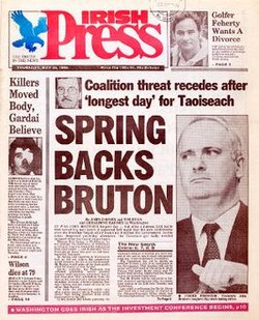
In 1990 Wilson challenges Brian Lenihan for the Fianna Fáil nomination for the 1990 presidential election. Lenihan wins the nomination but fails to be elected President and is also sacked from the government. Wilson is then appointed Tánaiste. He remains in the cabinet until retirement in 1993. Although the 26th Dáil Éireann is dissolved in December 1992, he serves in Government until the new government takes office.
John Wilson dies at St. James Hospital, Dublin on July 9, 2007, one day after his 84th birthday. His funeral takes place at the Good Shepherd Church at Churchtown, Dublin. President Mary McAleese is one of a number of prominent figures among the mourners, while Taoiseach Bertie Ahern is represented by his Aide-de-Camp.
A week before the Falls Curfew, on Saturday, June 27, 1970, there is severe rioting in Belfast following marches by the Protestant/unionist Orange Order. At the Short Strand, a Catholic enclave in a Protestant part of the city, the Provisional Irish Republican Army (IRA) fights a five-hour gun battle with loyalists. Three people are killed, and the loyalists withdraw. The Provisional IRA presents itself as having successfully defended a vulnerable Catholic enclave from armed loyalist mobs.
Meanwhile, the Official IRA arranges for a large number of weapons to be brought into the mainly nationalist and Catholic Lower Falls area for distribution. The area is a stronghold of the Official IRA.
The operation begins at about 4:30 PM on Friday, July 3, as a search for weapons in the staunchly Irish nationalist district. As the search ends, local youths attack the British soldiers with stones and petrol bombs and the soldiers respond with CS gas. This quickly develops into gun battles between British soldiers and the Irish Republican Army (IRA). After four hours of continuous clashes, the British commander seals off the area, which comprises 3,000 homes, and imposes a curfew which lasts 36 hours. Thousands of British troops move into the curfew zone and carry out house-to-house searches for weapons, while coming under intermittent attack from the IRA and rioters. The searches cause much destruction, and a large amount of CS gas is fired into the area. Many residents complain of suffering abuse at the hands of the soldiers. On July 5, the curfew is brought to an end when thousands of women and children from Andersonstown march into the curfew zone with food and groceries for the locals.
During the operation, four civilians are killed by the British Army, at least 78 people are wounded and 337 are arrested. Eighteen soldiers are also wounded. Large quantities of weapons and ammunition are captured. The British Army admits afterwards that some of its soldiers had been involved in looting.
The Falls Curfew is a turning point in the Troubles. It is seen as having turned many Catholics/Irish nationalists against the British Army and having boosted support for the IRA.
(Pictured: British soldiers on the Falls Road during the 1970 curfew)
Duddy runs a fish and chip shop in the late 1960s which is supplied with beef burgers from a supplier whose van driver is Martin McGuinness. He is first approached by MI6 officer Frank Steele in the early 1970s but turns the approach down.
In light of the dissolution of Stormont in 1972, Duddy’s role as an intermediary starts in January 1972, when asked by friend and Derry’s Chief Police Office Frank Lagan to persuade the Official Irish Republican Army and the Provisional Irish Republican Army to remove their weapons from the Bogside. Both sides comply, but the Official IRA retains a few weapons for defensive purposes. After thirteen unarmed civil rights marchers are shot dead by British Parachute Regiment troops in what becomes known as Bloody Sunday, Duddy warns Lagan, “This is absolutely catastrophic. We’re going to have a war on our hands.”
In the aftermath of the events and repercussions of Bloody Sunday, MI6 agent Michael Oatley arrives in Belfast in 1973 seeking to understand the situation in Northern Ireland and hopefully create a communications channel between the IRA and the British Government. Duddy becomes the go-between for the communications, and this leads to the IRA ceasefire of 1975/76.
Duddy and Oatley are the main channel of communications between the British Government and the IRA leadership during the 1981 Irish hunger strike. Duddy is codenamed “Soon” by the British. Over the period of July 4-6, 1981, they exchange many telephone calls, with Duddy urging the “utmost haste” on the part of the British because “the situation would be irreparably damaged if a hunger striker died.” He suggests steps which could be taken to give the Provisional IRA a way of ending the strike. British Prime MinisterMargaret Thatcher personally amends the text of an offer which is conveyed to the IRA through Duddy, but the British consider the reply unsatisfactory and do not continue to negotiate through Duddy. Hunger striker Joe McDonnell dies the following day.
In November 1991, as his now friend Oatley is about to retire from MI6 service, Duddy calls Oatley to a diner in Derry. When dinner has finished, McGuinness enters the property. During the meeting, McGuinness and Oatley discuss options for moving the situation forward. A few weeks later, Duddy is pursued by a British businessman who wants to create jobs in Derry. In the first meeting, the businessman produces a letter from then Secretary of State for Northern IrelandPeter Brooke, introducing the “businessman” as Oatley’s MI6 successor. Duddy calls the MI6 agent “Fred,” and acting as the go-between they successfully negotiate a ceasefire. Talks between McGuinness and representatives of the British government are held secretly in his house.
On March 26, 2008, the BBC broadcasts a documentary entitled The Secret Peacemaker about Duddy, directed by Peter Norrey, and presented by Peter Taylor, a journalist who has known Duddy is “the link” for ten years.
In the spring of 2009, Duddy donates his private archives to the James Hardiman Library, NUI Galway, where they are now available to researchers. They chart his involvement in the peace process from 1972 to 1993, and his ongoing interest, and correspondence relating to Northern Ireland, until 2007. The Brendan Duddy Archive is opened in 2011.
At the age of 80, Brendan Duddy dies at Altnagelvin Area Hospital in Derry, Northern Ireland on May 12, 2017.
Wright attracts considerable media attention at the Drumcree standoff, where he supports the Orange Order‘s desire to march its traditional route through the Catholic/Irish nationalist area of Portadown. In 1994, the UVF and other paramilitary groups call ceasefires. However, in July 1996, Wright’s unit breaks the ceasefire and carries out a number of attacks, including a sectarian killing. For this, Wright and his Portadown unit of the Mid-Ulster Brigade are stood down by the UVF leadership. He is expelled from the UVF and threatened with execution if he does not leave Northern Ireland. Wright ignores the threats and, along with many of his followers, defiantly forms the breakaway Loyalist Volunteer Force (LVF).
In March 1997 Wright is sent to the HM Maze Prison for having threatened the life of a woman. While imprisoned, Wright continues to direct the LVF’s activities. On December 27 of that year, he is assassinated at the prison by Irish National Liberation Army (INLA) prisoners as he is led out to a van for a visit with his girlfriend. The LVF carries out a wave of sectarian attacks in retaliation.
Owing to his uncompromising stance as an upholder of Ulster loyalism and opposition to the Northern Ireland peace process, Wright is regarded as a cult hero, cultural icon, and martyr figure by hardline loyalists. His image adorns murals in loyalist housing estates and many of his devotees have tattoos bearing his likeness.
Wright’s funeral procession moves at a snail’s pace on a grey and windy day. Groups of mourners take turns carrying the coffin. Women carry a wreath that simply says “Billy.” Twenty men with tight haircuts and white shirts with black armbands flank the cortège. There is heavy security. Troops stand guard on bridges and Royal Ulster Constabulary (RUC) Land Rovers prowl the housing estates. A spotter plane flies overhead. A lone piper plays “Abide with Me” before a banner bearing the letters “LVF.”
Wright is buried at Seagoe Cemetery, Portadown, Northern Ireland.
At 12:25 PM on December 11, 1971, when the Shankill Road is packed with Saturday shoppers, a green car pulls up outside the Balmoral Furniture Company at the corner of Carlow Street and Shankill Road. The shop is locally known as “Moffat’s” although Balmoral Furniture Company is its official name. One of the occupants gets out of the car and leaves a box containing a bomb on the step outside the front door. The person gets back into the car, and it speeds away. The bomb explodes moments later, bringing down most of the building on top of those inside the shop and on passersby outside.
Four people are killed as a result of the massive blast, including two babies, Tracey Munn (age 2 years) and Colin Nichol (age 17 months), who both die instantly when part of the wall crashes down upon the pram they are sharing. Two employees working inside the shop are also killed, Hugh Bruce (age 70 years) and Harold King (age 29 years). Unlike the other three victims, who are Protestant, King is a Catholic. Bruce, a former soldier and a Corps of Commissionaires member, is the shop’s doorman and is nearest to the bomb when it explodes. Nineteen people are injured in the bombing, including Tracey’s mother. The building, which was built in the Victorian era, has load-bearing walls supporting upper floors on joists. It is unable to withstand the blast and collapses, adding to the devastation and injury count.
The bombing causes bedlam in the crowded street. Hundreds of people rush to the scene where they form human chains to help the British Army and Royal Ulster Constabulary (RUC) free those trapped beneath the rubble by digging with their bare hands. Peter Taylor describes the scene as “reminiscent of the London Blitz” in World War II.
The Balmoral Furniture Company bombing is one of the catalysts that spark the series of tit-for-tat bombings and shootings by loyalists, republicans and the security forces that make the 1970s the bloodiest decade in the 30-year history of The Troubles.
(Pictured: Fireman is shown removing the body of one of the victims of the bombing at the Balmoral Furniture Showroom, December 11, 1971)
After finishing his education, Childers works for a period in a tourism board in Paris. In 1931, Éamon de Valera invites him to work for his recently founded newspaper, The Irish Press, where Childers becomes advertising manager. He becomes a naturalised Irish citizen in 1938. That same year, he is first elected as a Fianna Fáil Teachta Dála (TD) for Athlone–Longford. He remains in the Dáil Éireann until 1973, when he resigns to become President.
Childers joins the cabinet in 1951 as Minister for Posts and Telegraphs in the de Valera government. He then serves as Minister for Lands in de Valera’s 1957–59 cabinet, as Minister for Transport and Power under Seán Lemass, and, successively, as Transport Minister, Posts and Telegraphs Minister, and Health Minister under Jack Lynch. He becomes Tánaiste in 1969.
Fine Gael TD Tom O’Higgins, who had almost won the 1966 presidential election, is widely expected to win the 1973 election when he is again the Fine Gael nominee. Childers is nominated by Fianna Fáil at the behest of de Valera, who pressures Jack Lynch in the selection of the presidential candidate. He is a controversial nominee, owing not only to his British birth and upbringing but to his Protestantism. However, on the campaign trail his personal popularity proves enormous, and in a political upset, Childers is elected the fourth President of Ireland on May 30, 1973, defeating O’Higgins by 635,867 votes to 578,771.
Childers quickly gains a reputation as a vibrant, extremely hard-working president, and becomes highly popular and respected. However, he has a strained relationship with the incumbent government, led by TaoiseachLiam Cosgrave of Fine Gael. Childers had campaigned on a platform of making the presidency more open and hands-on, which Cosgrave views as a threat to his own agenda as head of government. Childers considers resigning from the presidency but is convinced to remain by Cosgrave’s Minister for Foreign Affairs and Trade, Garret FitzGerald.
The bomb in the Horse and Groom pub detonates at 8:30 PM. It kills Paul Craig, a 22-year-old plasterer, two members of the Scots Guards and two members of the Women’s Royal Army Corps. The Seven Stars pub is evacuated after the first blast, and thus there are no serious injuries when the second bomb explodes at 9:00 PM.
These attacks are the first in a year-long campaign by an IRA Active Service Unit who are eventually captured after the Balcombe Street siege. A similar bomb to those used in Guildford, with the addition of shrapnel, is thrown into the Kings Arms pub in Woolwich on November 7, 1974. Gunner Richard Dunne and Alan Horsley, a salesclerk, die in that explosion. On August 27, 1975, the same IRA unit detonates a bomb in Surrey at the Caterham Arms pub which injures over 30 people. Surrey police say it is “a carbon copy of the Guildford bombs.”
In December 1974 the police arrest Gerry Conlon, Paul Hill, Patrick Armstrong and Carole Richardson, later known as the Guildford Four. The Guildford Four are falsely convicted of the bombings in October 1975 after the Metropolitan Police use the Prevention of Terrorism Acts to force false confessions. All four are sentenced to life in prison.
The Guildford Four are held in prison for fifteen years, although Gerry Conlon dies near the end of his third year of imprisonment. All the convictions are overturned years later in the appeal courts after it is proved the Guildford Four’s convictions had been based on confessions obtained by torture, while evidence specifically clearing the Four is not reported by the police.
Longley is renowned for the quiet beauty of his compact, meditative lyrics. Known for using classical allusions to cast provocative light on contemporary concerns, including Northern Ireland’s “Troubles,” his poetry is also marked by sharp observation of the natural world, deft use of technique, and deeply felt emotion. His debut volume, No Continuing City (1969), heralds the arrival of a new talent from a region which has already produced recognized talents like Seamus Heaney and Derek Mahon. However, his early influences are English poets like Philip Larkin, Louis MacNeice, and the First World War poets, as well as masters from the classical tradition. The critic Langdon Hammer describes Longley’s poems as masterpieces of “lucidity, economy, sincerity…by means of meticulous, unpretentious technique.”
Longley’s work engages diverse subjects, including Homeric literature, the landscape of Carrigskeewaun, jazz, Walter Mitty, and the politics of Northern Ireland. On the public and political responsibilities of being a Northern Irish poet, he says, “Though the poet’s first duty must be to his imagination, he has other obligations, and not just as a citizen. He would be inhuman if he did not respond to tragic events in his own community, and a poor artist if he did not seek to endorse that response imaginatively.” Reviewing his Selected Poems (1993), critic Fran Brearton praises in particular Longley’s more political poems, noting his “use of a compassionate yet unsentimental voice, and an attention to detail which restores specificity at a point in history when it is most in danger of being lost in abstraction – numbers, dates, death-tolls counted beyond comprehension.”
The Quinn family, consisting of mother Chrissie and sons Richard, Mark and Jason, live in the Carnany estate in the predominantly Protestant town of Ballymoney. The family is of a mixed religious background. Mother Chrissie is Roman Catholic from a mixed background and the boys’ father Jim Dillon is Catholic. After separating from her estranged husband, Chrissie rears the boys as Protestant “to avoid the hassle.” Chrissie lives with her Protestant partner Raymond Craig in Carnany which is predominately Protestant, reflecting the religious make-up of Ballymoney itself. The boys, aged 9, 10 and 11, attend a local state school and on the evening before their deaths had been helping to build the estate’s Eleventh Night loyalist bonfire. A fourth brother, Lee, is staying with his grandmother in Rasharkin at the time of the attack.
The killings take place at the height of the stand-off over the Orange Order march at Drumcree, which creates a tense atmosphere in various towns across Northern Ireland. In the weeks leading up to the fatal attack, the children’s mother expresses fear that she is not welcome in the area and that there is a possibility the family home might be attacked by loyalists. The Ballymoney Times reports a story the week of the deaths, stating that a resident of the Carnany estate had called in and was concerned about tension in the area adding something serious might happen “unless Catholic residents were left alone.”
The attack occurs at approximately 4:30 in the morning as the inhabitants of the house sleep. A car containing members of the Ulster Volunteer Force (UVF), a loyalist paramilitary organisation, arrive at the house and throw a petrol bomb through a window at the rear of the house. The petrol bomb is made from a whiskey bottle. The sounds of the boys’ shouting awake their mother, who finds her bedroom full of smoke. Chrissie Quinn, Raymond Craig and family friend Christina Archibald escape the resulting fire with minor injuries. Chrissie believes the boys have escaped the fire as she is unable to locate them in the dense smoke before she jumps to safety from a first-floor window. Two of the brother’s bodies are found in their mother’s bedroom and the other in another bedroom. Chrissie is taken to the hospital and released the next day after receiving minor injuries and shock in the attack.
One man, Garfield Gilmour, is found guilty of murdering the three brothers fifteen months later and is sentenced to life imprisonment after admitting that he had driven three other men to the house to commit the fatal petrol-bombing. Although Gilmour names the three alleged killers, they are never charged due to a lack of concrete evidence. Gilmour’s conviction for murder is reduced to manslaughter on appeal on June 5, 2000, and he is released six years later. Nine days after his release, his life sentence is replaced by a fixed prison sentence of 14 years.
(Pictured: The Quinn brothers. Left to right: Jason, Mark, Richard)