seamus dubhghaill

Promoting Irish Culture and History from Little Rock, Arkansas, USA


5 Comments

Birth of Fenian John O’Leary

john-o-leary

John O’Leary, Irish republican and a leading Fenian, is born on July 23, 1830, in Tipperary, County Tipperary. He is imprisoned in England during the nineteenth century for his involvement in the Irish Republican Brotherhood.

O’Leary, born a Catholic, is educated at the local Protestant grammar school, The Abbey School, and later the Catholic Carlow College. He identifies with the views advocated by Thomas Davis and meets James Stephens in 1846.

He begins his studies in law at Trinity College, Dublin, in 1847, where, through the Grattan Club, he associates with Charles Gavan Duffy, James Fintan Lalor and Thomas Francis Meagher.

After the failure of the Young Ireland Rebellion of 1848, O’Leary attempts to rescue the Young Ireland leaders from Clonmel Gaol, and is himself imprisoned for a week from September 8, 1849. He takes part in a further attempted uprising in Cashel on September 16, 1849, but this proves abortive.

O’Leary abandons his study of law at Trinity College because he is unwilling to take the oath of allegiance required of a barrister. He enrolls at Queen’s College, Cork in 1850, to study medicine, later moving to Queen’s College, Galway, then on to further studies at Meath Hospital in Dublin, in Paris and in London. In 1855, he visits Paris, where he becomes acquainted with Kevin Izod O’Doherty, John Martin and the American painter, James Abbott McNeill Whistler. He subsequently becomes financial manager of the newly formed Irish Republican Brotherhood (IRB) and is joint editor of the IRB paper The Irish People.

On September 16, 1865, O’Leary is arrested and later tried on charges of high treason, eventually reduced to “treason felony.” He is sentenced to twenty years of penal servitude, of which five years are spent in English prisons, prior to his release and exile in January 1871. During his exile, he lives mainly in Paris, also visiting the United States, remains active in the IRB and its associated organisations, and writes many letters to newspapers and journals.

On the expiration of his 20-year prison term and therefore of the conditions associated with his release in 1885, O’Leary returns to Ireland. He and his sister, the poet Ellen O’Leary, both become important figures within Dublin cultural and nationalist circles, which include William Butler Yeats, Maud Gonne, Rose Kavanagh, Rosa Mulholland, George Sigerson, and Katharine Tynan. He also functions as an elder statesman of the separatist movement, being active in the Young Ireland Society, and acts as president of the Irish Transvaal Committee, which supports the Boer side in the Second Boer War.

John O’Leary dies at his residence in Dublin on the evening of March 16, 1907. He is referred to famously by W.B. Yeats in his poem September 1913: “Romantic Ireland’s dead and gone/It’s with O’Leary in the grave.”

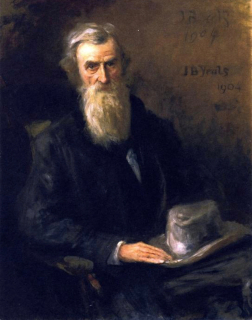
(Pictured: Painting of John O’Leary, a favorite subject of John Butler Yeats (1904). The National Gallery of Ireland owns three oil portraits of O’Leary.)


Leave a comment

Death of Denis “Dinny” Lacey

dinny-lacey

Denis “Dinny” Lacey, Irish Republican Army (IRA) officer during the Irish War of Independence and anti-Treaty IRA officer during the Irish Civil War, dies at Glen of Aherlow, County Tipperary on February 18, 1923.

Lacey is born on May 31, 1889 in the village of Attybrick, near Annacarty, County Tipperary. He joins the Irish Volunteers in 1913 and is sworn into the secretive Irish Republican Brotherhood (IRB) in 1914. He is introduced to the IRB by Seán Treacy. During the War of Independence (1919–1921) he is selected to command an IRA flying column of the 3rd Tipperary Brigade, in September 1920. The flying column mounts two successful ambushes of British forces – killing six British soldiers at Thomastown near Golden, and four Royal Irish Constabulary (RIC) men at Lisnagaul in the Glen of Aherlow.

In April 1921, following another ambush of British troops near Clogheen, he captures RIC inspector Gilbert Potter, whom he later executes in reprisal of the British hanging of republican prisoners.

In December 1921, Lacey’s unit splits over the Anglo-Irish Treaty. He opposes the Treaty and most of his men follow suit. He takes over command of the 3rd Tipperary Brigade as Séamus Robinson is appointed to commanded the anti-Treaty IRA’s Second Southern Division. In the ensuing civil war (June 1922-May 1923), he organises guerrilla activity in the Tipperary area against Pro-Treaty Irish Free State forces.

Denis Lacey is killed in an action against Free State troops at Ballydavid, near Bansha in the Glen of Aherlow on February 18, 1923. He is 33 years old at the time of his death. Over 1,000 Free State troops drawn from Cahir, Cashel, Clonmel, and Tipperary, under the command of General John T. Prout, with the intention of breaking up Lacey’s guerrilla unit, converge on the Glen where he and four other men from his column are billeted. Lacey and one of his men are killed and others are captured. Two National Army soldiers are killed in the action.

A memorial in Annacarty commemorates Lacey’s war service and subsequent death in action.


Leave a comment

Police Raid & Shut Down “The Irish People”

Police raid and close the offices of the Fenian newspaper The Irish People on September 15, 1865. Jeremiah O’Donovan Rossa, Thomas Clarke Luby, and John O’Leary are arrested.

In mid-1863, James Stephens informs his colleagues he wishes to start a newspaper, with financial aid from John O’Mahony and the Fenian Brotherhood in America. The offices are established at 12 Parliament Street, almost at the gates of Dublin Castle. The first edition of The Irish People appears on November 28, 1863. The staff of the paper along with Charles Kickham are Thomas Clarke Luby and Denis Dowling Mulcahy as the editorial staff. Jeremiah O’Donovan Rossa and James O’Connor are in charge of the business office, with John Haltigan being the printer. John O’Leary is brought from London to take charge in the role of Editor. Shortly after the establishment of the paper, James Stephens departs on an American tour, and to attend to organisational matters.

American Fenians make plans for a rising in Ireland, but the plans are discovered on July 15, 1865 when an emissary loses them at Kingstown railway station. They find their way to Dublin Castle and to Superintendent Daniel Ryan head of G Division. Ryan has an informer within the offices of The Irish People named Pierce Nagle, who supplies Ryan with an “action this year” message on its way to the Irish Republican Brotherhood unit in Tipperary. With this information, Ryan raids the offices of The Irish People on September 15, followed by the arrests of John O’Leary, Thomas Clarke Luby and Jeremiah O’Donovan Rossa. The last edition of the paper is dated September 16, 1865.

Before leaving for America, Stephens entrusts to Luby a document containing secret resolutions on the Committee of Organization or Executive of the IRB. Though Luby intimates its existence to O’Leary, he does not inform Kickham as there seems no necessity. This document later forms the basis of the prosecution against the staff of The Irish People. The document reads:

EXECUTIVE

I hereby appoint Thomas Clarke Luby, John O’Leary and Charles J. Kickham, a Committee of Organisation or Executive, with the same supreme control over the Home Organisation (Ireland, England, Scotland, etc.) I have exercised myself. I further empower them to appoint a Committee of Military Inspection, and a Committee of Appeal and Judgment, the functions of which Committee will be made known to each member of them by the Executive. Trusting to the patriotism and ability of the Executive, I fully endorse their action beforehand, and call on every man in our ranks to support and be guided by them in all that concerns our military brotherhood.

9 March 1864, Dublin
J. STEPHENS

Charles Kickham is caught after a month on the run and James Stephens is also eventually caught but with the support of Fenian prison warders John J. Breslin and Daniel Byrne is less than a fortnight in Richmond Bridewell Prison when he vanishes and escapes to France.

(From Stair na hÉireann, https://stairnaheireann.net/2015/09/15/1865-police-raid-and-close-the-irish-people-offices-odonovan-rossa-luby-and-oleary-are-arrested/)


Leave a comment

Birth of Watercolourist Michael Angelo Hayes

Painter Michael Angelo Hayes is born in Waterford on July 25, 1820. Probably the best 19th century painter of animals in Ireland, Hayes is most accomplished as a watercolourist, although he occasionally uses oils.

Hayes is the son and pupil of Tipperary watercolour miniaturist Edward Hayes RHA. It is clear from his christening that he is expected to become an artist.  Fortunately, the younger Hayes is a talented draughtsman, and by his late teens has acquired something of a reputation as a painter of horses and military subjects.

Hayes begins showing at the Royal Hibernian Academy (RHA) in 1837, then for three years 1840-1842.  In 1842, he is appointed Military Painter-in-ordinary to the Lord Lieutenant.  He passes the next few years in London, where he exhibits watercolours at the New Society of Painters in Water Colours, of which he is elected an Associate Member in 1848, the same year he makes his one and only contribution to the Royal Academy of Arts.

Returning to Dublin, Hayes resumes exhibiting at the RHA, at the same time becoming involved in its administration.  He is elected an Associate member in 1853, a full Academician the following year, and Secretary in 1856.  The affairs of the Academy are totally disorganized at the time, inducing Hayes and others to resolve the situation.  His efforts to reform the institution and secure its finances meets with entrenched opposition from older members, which results in Hayes being removed from his post, although he is successfully reinstated in 1861.

Not long afterwards he is appointed secretary to the Lord Mayor of Dublin, Peter McSwiney, who happens to be his brother-in-law, and later becomes City Marshal in 1867.  He continues as Secretary of the RHA until he resigns in 1870, and continues showing until 1874.

Hayes makes a special study of horses in motion, and in 1876 publishes his conclusions in an illustrated pamphlet, The Delineation of Animals in Rapid Motion.  One of his Dublin paintings, Sackville Street, Dublin, depicts a view of Dublin’s premier street in the 1850s. The painting is a documentary of social life in Dublin. It achieves widespread popularity when reprinted as a lithograph.

Michael Angelo Hayes dies prematurely in 1877 in a tragic drowning accident at his home.


Leave a comment

Death of Author & Journalist Standish James O’Grady

Standish James O’Grady, author, journalist, and historian, dies on May 18, 1928, at ShanklinIsle of WightHampshireEngland.

O’Grady is born on March 22, 1846, at Castletown, County Cork, the son of Reverend Thomas O’Grady, the scholarly Church of Ireland minister of Castletown Berehaven, County Cork, and Susanna Doe. After a rather severe education at Tipperary Grammar School, O’Grady follows his father to Trinity College, Dublin, where he wins several prize medals and distinguishes himself in several sports.

O’Grady proves too unconventional of mind to settle into a career in the church and earns much of his living by writing for the Irish newspapers. Reading Sylvester O’Halloran‘s General history of Ireland sparks an interest in early Irish history. After an initial lukewarm response to his writing on the legendary past in History of Ireland: Heroic Period (1878–81) and Early Bardic Literature of Ireland (1879), he realizes that the public wants romance, and so follows the example of James Macpherson in recasting Irish legends in literary form, producing historical novels including Finn and his Companions (1891), The Coming of Cuculain (1894), The Chain of Gold (1895), Ulrick the Ready (1896) and The Flight of the Eagle (1897), and The Departure of Dermot (1913).

O’Grady also studies Irish history of the Elizabethan period, presenting in his edition of Sir Thomas Stafford‘s Pacata Hibernia (1896) the view that the Irish people have made the Tudors into kings of Ireland in order to overthrow their unpopular landlords, the Irish chieftains. His The Story of Ireland (1894) is not well received, as it sheds too positive a light on the rule of Oliver Cromwell for the taste of many Irish readers. He is also active in social and political campaigns in connection with such issues as unemployment and taxation.

Until 1898, he works as a journalist for the Daily Express of Dublin, but in that year, finding Dublin journalism in decline, he moves to Kilkenny to become editor of the Kilkenny Moderator. It is here he becomes involved with Ellen Cuffe, Countess of Desart and Captain Otway Cuffe. He engages in the revival of the local woolen and woodworking industries. In 1900 he founds the All-Ireland Review and returns to Dublin to manage it until it ceases publication in 1908. O’Grady contributes to James Larkin‘s The Irish Worker paper.

O’Grady’s works are an influence on William Butler Yeats and George Russell and this leads to him being known as the “Father of the Celtic Revival.” Being as much proud of his family’s Unionism and Protestantism as of his Gaelic Irish ancestry, identities that are increasingly seen as antithetical in the late 1800s, he is described by Augusta, Lady Gregory as a “fenian unionist.”

Advised to move away from Ireland for the sake of his health, O’Grady passes his later years living with his eldest son, a clergyman in England, and dies on the Isle of Wight on May 18, 1928.

O’Grady’s eldest son, Hugh Art O’Grady, is for a time editor of the Cork Free Press before he enlists in World War I early in 1915. He becomes better known as Dr. Hugh O’Grady, later Professor of the Transvaal University College, Pretoria, who writes the biography of his father in 1929.


Leave a comment

Irish Free State Suspends Executions

irish-free-state-executionsOn February 8, 1923, the Irish Free State suspends executions until February 18, offering an amnesty to anyone who surrenders before that date.

In the aftermath of the sudden death of Arthur Griffith and the killing of Michael Collins, in August 1922, William T. Cosgrave becomes chairman of the provisional government. Cosgrave and his colleagues remain wedded to a ruthless military and political strategy that ensures, by May 1923, a decisive win over the Republicans and the end of the Irish Civil War. Cosgrave’s analysis is that “the executions have had a remarkable effect. It is a sad thing to say, but it is nevertheless the case.” He could also be chilling in his resolve: “I am not going to hesitate and if the country is to live and if we have to exterminate 10,000 republicans, the 3 millions of our people are bigger than the ten thousand.”

The Free State suspends executions and offers an amnesty in the hope that anti-treaty fighters will surrender. However, the war drags for another two months and witnesses at least twenty more official executions.

Several Republican leaders narrowly avoid execution. Ernie O’Malley, captured on November 4, 1922, is not executed because he is too badly wounded when taken prisoner to face a court-martial and possibly because the Free State is hesitant about executing an undisputed hero of the recent struggle against the British. Liam Deasy, captured in January 1923, avoids execution by signing a surrender document calling on the anti-treaty forces to lay down their arms.

The Anti-Treaty side calls a ceasefire on April 30, 1923 and orders their men to “dump arms,” ending the war on May 24. Nevertheless, executions of Republican prisoners continue after this time. Four Irish Republican Army (IRA) men are executed in May after the ceasefire order and the final two executions take place on November 20, months after the end of hostilities. It is not until November 1924 that a general amnesty is offered for any acts committed in the civil war.

In highlighting the severity of the Free State’s execution policy, however, it is important not to exaggerate its extent. The Free State takes over 12,000 Republicans prisoner during the war, of whom roughly 80, less than 1%, are executed. How those who are executed are chosen from the others captured in arms is unclear, however many more men are sentenced to the death penalty than are actually shot. This is intended to act as a deterrent to anti-Treaty fighters in the field, who know that their imprisoned comrades are likely to be executed if they kept up their armed campaign.

Perhaps this realism is also beginning to affect the republican self-declared “men of faith.” Dan Breen, who leads an IRA column in Tipperary during the Civil war, tells his fellow republicans, “In order to win this war you’ll need to kill 3 out of every 5 people in the country and it isn’t worth it.”


3 Comments

Birth of Flying Ace Thomas Falcon Hazell

thomas-falcon-hazell

Thomas Falcon Hazell, fighter pilot with the Royal Flying Corps and later the Royal Air Force during World War I, is born in Roundstone, County Galway, on August 7, 1892. Hazell scores 43 victories in 1917–1918 making him the fifth most successful British “flying ace” of the war, the third most successful Irish-born pilot behind Edward Mannock and George McElroy, and the only pilot to survive the war from both groups.

Upon the outbreak of the war in August 1914, Hazell volunteers for service as a private with the South Irish Horse. On October 10 he is commissioned as second lieutenant in the 7th Battalion, Royal Inniskilling Fusiliers. As part of the 49th Brigade in the 16th (Irish) Division, the 7th Inniskillings are initially based at Tipperary, where Hazell is promoted to lieutenant on June 4, 1915. The regiment lands in France in February 1916.

Soon afterwards Hazell transfers to the Royal Flying Corps. In April and May he is assigned to No. 5 Reserve Squadron, based at Castle Bromwich. He is appointed a flying officer on June 5 and survives a severe crash before completing his training. He eventually joins No. 1 Squadron on the Western Front. Flying Nieuport 17 Scouts, he shoots down 20 enemy aircraft between March and August 1917, being appointed a flight commander with the acting rank of captain on May 25, and is awarded the Military Cross on July 26.

After serving as an instructor at the Central Flying School in 1918, he takes command of “A” Flight, No. 24 Squadron, flying the S.E.5a. On August 22, 1918, Hazell shoots down an observation balloon despite its escort of seven Fokker D.VIIs. The escort is led by German ace Ernst Udet, who attacks and riddles Hazell’s petrol tank, propeller, and two longerons with bullets. In spite of this Hazell fights his way back, eyes full of petrol, and lands safely. Udet thinks he has forced the British pilot to crash and actually claims him as his 60th victory. Hazell finishes the war with 43 confirmed kills, the top British surviving ace of the war (excluding Dominion airmen). Hazell is twice awarded the Distinguished Flying Cross. On June 11, 1927, he returns to the RAF Depot at Uxbridge and is placed on the retired list on July 20, 1927, at his own request.

In 1944, at the age of 52, Hazell becomes the commander of “D” Company, 24th (Tettenhall) Battalion, South Staffordshire Home Guard during the later part of World War II.

Hazell dies in Newport, County Mayo, on September 4, 1946, and is buried at the Burrishoole Church of Ireland Cemetery there. In 2014 his grave, which had been largely forgotten and neglected, is restored, repaired, and re-dedicated in a ceremony on August 4, 2014, the 100th anniversary of the declaration of World War I.


Leave a comment

Executions of Patrick Pearse, Thomas Clarke, & Thomas MacDonagh

pearse-clarke-mac-donagh

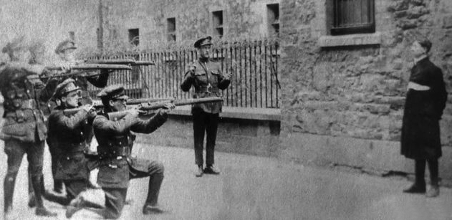
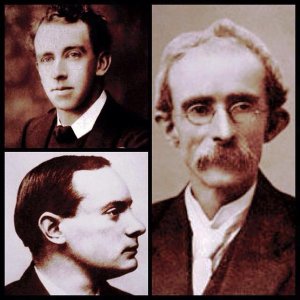
Patrick Pearse, Thomas Clarke, and Thomas MacDonagh are executed by firing squad in the Stonebreakers’ Yard at Kilmainham Gaol in Dublin on May 3, 1916. Pearse, Clarke, and MacDonagh are three of the seven signatories of the Proclamation of the Irish Republic.

Just three days after the end of the 1916 Easter Rising, the first military courts martial sits on May 2, 1916. Pearse, Clarke, and MacDonagh are immediately sentence to death. The three are taken that evening to the disused Kilmainham Gaol and are shot at dawn the following morning.

Patrick Pearse is born in Dublin in 1879, becoming interested in Irish cultural matters in his teenage years. In 1898, Pearse becomes a member of the Executive Commmittee of the Gaelic League. He graduates from the Royal University of Ireland in 1901 with a degree in Arts and Law. Pearse’s literary output is constant, and he publishes extensively in both Irish and English, becoming the editor of An Claidheamh Soluis, the newspaper of the Gaelic League. He is a keen believer in the value of education, and establishes two schools, Coláiste Éanna and Coláiste Íde, devoted to the education of Irish children through the Irish language.  Pearse is one of the founding members of the Irish Volunteers and the author of the Proclamation of the Irish Republic. He is Commander in Chief of the Irish forces and headquartered in the General Post Office (GPO) during the 1916 Easter Rising.

Thomas Clarke is born on the Isle of Wight in 1857, the son of a soldier in the British army. During his time in America as a young man, he joins Clan na Gael, later enduring fifteen years (1883-1898) of penal servitude for his role in a bombing campaign in London. In 1907, having returned from a second sojourn in America, his links with Clan na Gael in America copper-fastens his importance to the revolutionary movement in Ireland. He holds the post of Treasurer to the Irish Republican Brotherhood (IRB) and is a member of the Supreme Council from 1915. Clarke is the first signatory of the Proclamation of the Irish Republic through deference to his seniority. Clarke is also stationed at the GPO during Easter Week. Clarke tells his wife during his final night that he is relieved he is going to be executed because his greatest dread is that he would be sent back to prison.

Thomas MacDonagh is a native of Tipperary, born in 1878. He spends the early part of his career as a teacher. He moves to Dublin to study and is the first teacher on the staff at St. Enda’s School, the school he helps to found with Patrick Pearse. MacDonagh is well versed in literature, his enthusiasm and erudition earning him a position in the English department at University College Dublin. His play When the Dawn is Come is produced at the Abbey Theatre. He is appointed director of training for the Irish Volunteers in 1914, later joining the Irish Republican Brotherhood (IRB). MacDonagh is appointed to the IRB military committee in 1916. He is commander of the Second Battalion of Volunteers that occupies Jacob’s Biscuit Factory and surrounding houses during the Rising.

Immediately after the executions, Irish Parliamentary Party leader John Redmond warns British Prime Minister Herbert Asquith that “if any more executions take place in Ireland the position will become impossible for any constitutional party or leader.”

Asquith himself warns Sir John Maxwell that “anything like a large number of executions would…sow the seeds of lasting trouble in Ireland.”

These warnings fall upon deaf ears as thirteen additional executions take place in the following days.


Leave a comment

Postponement of the Easter Rising

general-post-office

On Saturday, April 22, 1916, the Easter Rising, originally planned for the following day, Easter Sunday, is postponed for one day.

At dawn a messenger from the Kerry Volunteers arrives in Dublin and informs James Connolly, Commandant of the Dublin Brigade, that Roger Casement had been arrested in County Kerry the previous day during a failed attempt to smuggle arms into Ireland on board the German ship Aud. A meeting of the Military Council is hastily organised, and the decision is made not to inform Chief-of-Staff of the Irish Volunteers, Eoin MacNeill, about Casement’s arrest.

Later in the morning, after attempting to escape the area, Karl Spindler, captain of the Aud, makes the decision to scuttle his ship after it is intercepted by the Royal Navy. Although Spindler and the crew are rescued, the armaments on board the Aud are lost. By early afternoon the Military Council is made aware of the loss of their arms shipment.

At 6:00 PM, Sean Fitzgibbon, Colm O’Loughlin, and Michael Joseph O’Rahilly arrive at Woodtown Park and inform MacNeill of the arrests and the loss of the Aud. After confronting Patrick Pearse at St. Enda’s School, a bilingual school for boys founded by Pearse, MacNeill and others, including O’Rahilly and Bulmer Hobson, gather at the house of Seumas O’Kelly on Rathgar Road and a decision is made to issue countermanding orders cancelling the Rising planned for Easter Sunday. To make sure that the countermanding order is received and understood, James Ryan is sent overnight to Cork, Colm O’Loughlin to Dundalk and Coalisland, Sean Fitzgibbon to Waterford, and Min Ryan to Wexford. O’Rahilly travels to Limerick, Kerry, Cork, and Tipperary. This succeeds in delaying the rising for only one day, although it greatly reduces the number of Volunteers who turn out.

During the evening, Major-General Sir Lovick Friend, General Officer Commanding of British forces in Ireland, travels to London on leave in wake of the capture of the Aud believing that any potential insurgency has been stopped. Chief Secretary Augustine Birrell is also in London having attended a Cabinet meeting. Both men remain in London through Easter, leaving Under Secretary Matthew Nathan as the most senior British official remaining in Dublin. Lord Lieutenant of Ireland, Ivor Churchill Guest, 1st Viscount Wimborne, urges Nathan to order the arrest of a large number of rebel leaders however he is unwilling to do so without the authorisation of Chief Secretary Birrell.


Leave a comment

The Fenian Rising of 1867

The Fenian Rising of 1867, a rebellion against British rule in Ireland organised by the Irish Republican Brotherhood (IRB), begins in Dublin, Cork, Limerick, Clare, and Tipperary on March 5, 1867.

The Irish Republican Brotherhood is founded in Dublin by James Stephens in 1858. After the end of the American Civil War, the IRB hopes to recruit willing Irish veterans of that war for an insurrection in Ireland aimed at the foundation of an Irish Republic.

In 1865, the Fenians begin preparing for a rebellion by collecting firearms and recruiting men willing to fight. In September 1865, the British move to close down the Fenian newspaper The Irish People and arrest many of the leadership. In 1866, habeas corpus is suspended in Ireland and there are hundreds more arrests of Fenian activists.

In early 1867, prior to the March 5 rising, Thomas J. Kelly, Stephens’ successor as leader of the IRB, tries to launch an insurrection but it proves uncoordinated and fizzles in a series of skirmishes. In February 1867, there is an unsuccessful rising in County Kerry.

The largest of the March 5 engagements takes place at Tallaght, when several hundred Fenians, on their way to the meeting point at Tallaght Hill, are attacked by the Royal Irish Constabulary (RIC) near the police barracks and are driven away after a firefight. A total of twelve people are killed across the country on this day. When it becomes apparent that the coordinated rising that had been planned is not transpiring, most rebels simply go home.

The rising fails as a result of lack of arms and planning, but also because of the British authorities’ effective use of informers. Most of the Fenian leadership is arrested before the rebellion takes place.

Though the Rising of 1867 is unsuccessful, they proclaim an Irish Republic, almost 50 years before the Proclamation of the Irish Republic in Easter 1916. This proclamation sheds some light on early Fenianism as it is centered with the ideas of republican democracy but is, however, flavoured with socialist ideals and a class revolution rather than a nationalist revolution per se. The proclamation claims that their war is “against the aristocratic locusts, whether English or Irish” which denotes that their ideology at this time is in some way embedded in class differences against the landed aristocracy rather than merely against British rule.

The rising itself is a total military failure, but it does have some political benefits for the Fenian movement. There are large protests in Ireland against the execution of Fenian prisoners, many of whose death sentences are, as a result, reprieved. In 1873, the Irish Republican Brotherhood adopts a new constitution, which states that armed rebellion will not be pursued again until it has mass backing from the people. The Fenians cooperate with the Irish National Land League in the land agitation from the 1870s onwards and in the rise of the Irish Parliamentary Party. Not all Fenians agree with the new policy and several breakaway groups emerge that continue to believe in the use of political violence in pursuit of republican objectives.