seamus dubhghaill

Promoting Irish Culture and History from Little Rock, Arkansas, USA


Leave a comment

Birth of Eamonn Andrews, Radio & Television Presenter

eamonn-andrews

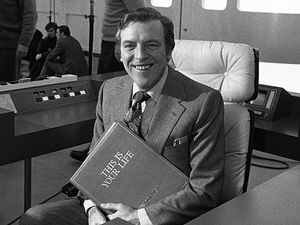
Eamonn Andrews, radio and television presenter considered to be Ireland’s first media superstar, is born in Synge Street, Dublin, on December 19, 1922.

Andrews is educated at Synge Street CBS and begans his career as a clerk in an insurance office. He is a keen amateur boxer and wins the Irish junior middleweight title in 1944.

In 1946, he becomes a full-time freelance sports commentator, working for Radio Éireann, Ireland’s national broadcaster. In 1950, he begins presenting programmes for the BBC, being particularly well known for boxing commentaries, and soon becomes one of television’s most popular presenters. He begins hosting the game show What’s My Line? in 1951.

Throughout the 1950s, he commentates on the major British heavyweight fights on the BBC Light Programme, with inter-round summaries by W. Barrington Dalby. On January 20, 1956, he reaches No. 18 in the UK Singles Chart with a “spoken narrative” recording named “The Shifting Whispering Sands (Parts 1 & 2),” which is produced by George Martin with musical backing by the Ron Goodwin Orchestra. The song later reappears on Kenny Everett‘s compilation album The World’s Worst Record Show, which is released in June 1978.

Between 1955 and 1964, Andrews presents the long-running Sports Report on BBC’s Light Programme, now Radio 2. In 1965, he leaves the BBC to join the ITV contractor ABC, where he pioneers the talk show format in the UK. He hosts a chat show on ITV, The Eamonn Andrews Show, for five years. He is known for coming up with off-the-cuff linkings that do not work such as, “Speaking of cheese sandwiches, have you come far?” This is parodied by the character Seamus Android on Round the Horne in the 1960s, performed by Bill Pertwee. In the 1960s he presents Thames Television‘s Today news magazine programme.

Andrews is probably best known as the presenter of the UK’s version of This Is Your Life, between its inception in 1955 and his death in 1987, when he is succeeded by Michael Aspel, who had also succeeded Andrews as host of Crackerjack more than two decades earlier. Andrews becomes the very first This Is Your Life subject on British television when he is surprised by the show’s creator, Ralph Edwards. Andrews also creates a long-running panel game called Whose Baby? that originally runs on the BBC and later on ITV. He is a regular presenter of the early Miss World pageants.

Andrews’ chairs the Radio Éireann Authority, now the RTÉ Board, between 1960 and 1964, overseeing the introduction of State television to Ireland and establishing the Irish State broadcaster as an independent semi-state body. About this time, he also acquires a number of business interests in Ireland, including recording studios and a dance hall.

After months of illness during 1987, originally caused by a virus contracted during an airline flight, but which is not recognised at the time, he dies from heart failure on November 5, 1987, at the age of 64, at Cromwell Hospital, London. He had recorded his last edition of This Is Your Life six days previously on October 30, 1987, surprising Crossroads actress Jane Rossington. After his death, the show, and two others that have yet to be broadcast, are postponed until, with his widow’s permission, they are broadcast in January 1988. His widow, Gráinne, whom he married in 1951, dies 18 months later. They had three adopted children.

His contribution to U.K. radio is commemorated in The Radio Academy Hall of Fame. Andrews appears as the linking narrator who introduces the unrelated segments that comprise the portmanteau film, Three Cases of Murder (1955).


Leave a comment

Death of Singer & Songwriter Kirsty MacColl

kirsty-maccollKirsty Anna MacColl, English singer and songwriter, dies on December 18, 2000, at the age of 41 after being hit by a powerboat while on holiday in Cozumel, Mexico.

MacColl records several pop hits between the early 1980s and the 1990s, including “There’s a Guy Works Down the Chip Shop Swears He’s Elvis” and cover versions of Billy Bragg‘s “A New England” and The Kinks‘ “Days.” She also sings on recordings produced by her husband Steve Lillywhite, most notably “Fairytale of New York” by The Pogues.

Early in her career, MacColl signs a solo deal with Stiff Records. She moves to Polydor Records in 1981 but they drop her just as she has completed recording the songs for a planned second album. She returns to Stiff Records however, following their 1986 bankruptcy, MacColl is left unable to record in her own right, as no record company buys her contract from the Official Receiver. She has regular session work as a backing vocalist, and she frequently sings on records produced or engineered by her husband including tracks for Robert Plant, The Smiths, Alison Moyet, Shriekback, Simple Minds, Talking Heads, Big Country, Anni-Frid Lyngstad (of ABBA), and The Wonder Stuff among others.

MacColl re-emerges in the British charts in December 1987, reaching Number 2 with The Pogues on “Fairytale of New York,” a duet with Shane MacGowan. This leads to her accompanying The Pogues on their British and European tour in 1988.

After the contract issue is resolved, MacColl returns to recording as a solo artist and receives critical acclaim upon the release of Kite in 1989. While continuing to write and record, she is also featured on the British sketch comedy French and Saunders.

In 2000, following her participation in the presentation of a radio programme for the British Broadcasting Corporation in Cuba, MacColl takes a holiday in Cozumel, Mexico, with her sons and her partner, musician James Knight. On December 18, she and her sons go diving at the Chankanaab reef, part of the National Marine Park of Cozumel, in a designated diving area that watercraft are restricted from entering. With the group is a local veteran divemaster, Iván Díaz. As the group is surfacing from a dive, a powerboat moving at high speed enters the restricted area. MacColl sees the boat coming before her sons. Louis, then 13, is not in its path, but 15-year-old Jamie is. She is able to push him out of the way but in doing so she is struck by the boat and dies instantly. MacColl’s body is repatriated to the United Kingdom and is cremated after a humanist funeral at Mortlake Crematorium in South-West London.

empty-bench-in-soho-squareIn 2001, a bench is placed by the southern entrance to London’s Soho Square as a memorial to MacColl, after a lyric from one of her most poignant songs: “One day I’ll be waiting there / No empty bench in Soho Square.” Every year on the Sunday nearest her October 10 birthday, fans from all over the world hold a gathering at the bench to pay tribute to her and sing her songs.

MacColl’s collaboration with the Pogues, “Fairytale of New York,” remains a perennial Christmas favourite. In 2004, 2005, and 2006, it is voted favourite Christmas song in a poll by music video channel VH1. The song is re-released in the United Kingdom in December 2005, with proceeds being split between the Justice for Kirsty Campaign and charities for the homeless. The re-release reaches number 3 on the U.K. charts, and spends five weeks in the top 75 over the Christmas and New Year period. It reaches the top 10 for the third time in its history in 2006, peaking at number 6, and charts yet again in December 2007. The song also makes the Top 20 in subsequent years, and has spent more time in the top 20 than any other song.


Leave a comment

The Good Friday Agreement Comes Into Operation

good-friday-agreement-signing

The Good Friday Agreement, a major political development in the Northern Ireland peace process, comes into operation on December 2, 1999, as the British and Irish governments formally notify each other that all the necessary arrangements are in place.

The notification ceremony takes place at Iveagh House, St. Stephen’s Green, headquarters of the Department of Foreign Affairs and Trade, at a joint signing by Minister for Foreign Affairs and Trade David Andrews and Secretary of State for Northern Ireland Peter Mandelson.

Northern Ireland‘s present devolved system of government is based on the agreement. The agreement also creates a number of institutions between Northern Ireland and the Republic of Ireland, and between the Republic of Ireland and the United Kingdom.

The agreement is made up of two inter-related documents, both agreed upon in Belfast on Good Friday, April 10, 1998. The first is a multi-party agreement by most of Northern Ireland’s political parties. The second is an international agreement between the British and Irish governments, known as the British-Irish Agreement.

The agreement sets out a complex series of provisions, or strands, relating to a number of areas:

Strand 1 addresses the status and system of government of Northern Ireland within the United Kingdom and establishes two major institutions – the Northern Ireland Assembly and the Northern Ireland Executive.

Strand 2 addresses the relationship between Northern Ireland and the Republic of Ireland and the institutions to be created between them – the North/South Ministerial Council, the North/South Inter-Parliamentary Association, and the North/South Consultative Forum.

Strand 3 addresses the relationship between the Republic of Ireland and the United Kingdom and institutions to be created between Ireland and Great Britain – the British/Irish Intergovernmental Conference, the British-Irish Council, and an expanded British-Irish Parliamentary Assembly.

Issues relating to sovereignty, civil and cultural rights, decommissioning of weapons, justice, and policing are central to the agreement.

The agreement is approved by voters across the island of Ireland in two referendums held on May 22, 1998. In Northern Ireland, voters are asked whether they support the multi-party agreement. In the Republic of Ireland, voters are asked whether they will allow the state to sign the agreement and allow necessary constitutional changes to facilitate it. The people of both jurisdictions need to approve the agreement in order to give effect to it.

The Good Friday Agreement comes into force on December 2, 1999. The Democratic Unionist Party (DUP) is the only major political group in Northern Ireland to oppose the Good Friday Agreement.

(Pictured: British Prime Minister Tony Blair and Irish Taoiseach Bertie Ahern sign the Good Friday Agreement)


Leave a comment

Birth of Sir Hugh Percy Lane, Gallery Director & Collector

hugh-percy-lane

Sir Hugh Percy Lane, art dealer, collector, and gallery director, is born in County Cork on November 9, 1875. He is best known for establishing Dublin‘s Municipal Gallery of Modern Art, the first known public gallery of modern art in the world, and for his contribution to the visual arts in Ireland, including the Lane Bequest.

Lane is brought up in Cornwall, England, and begins his career as an apprentice painting restorer and later becomes a successful art dealer in London.

Through regular visits to the home of his aunt, Lady Gregory, in Coole Park, near Gort in County Galway, Lane remains in contact with Ireland. He soon counts among his family, friends, and social circle those who collectively form the core of the Irish cultural renaissance in the early decades of the 20th century.

Extolling the cause of Irish art abroad, Lane also becomes one of the foremost collectors and dealers of Impressionist paintings in Europe, and amongst those works purchased by him for the new gallery are La Musique aux Tuileries by Édouard Manet, Sur la Plage by Edgar Degas, Les Parapluies by Pierre-Auguste Renoir, and La Cheminée by Jean-Édouard Vuillard.

The Municipal Gallery of Modern Art opens in January 1908 in temporary premises in Harcourt Street, Dublin. Lane hopes that Dublin Corporation will run it, but the corporation is unsure if it will be financially viable. Lane does not live to see his gallery permanently located as he dies on May 7, 1915, during the sinking of the RMS Lusitania off the west coast of Cork. The gallery, extended in 2005, is now in Parnell Square in central Dublin.

For his “services to art” in Ireland, Lane is knighted in June 1909 at the comparatively young age of 33.

Following his death, Lane’s will bequeaths his collection to London, but an unwitnessed later codicil bequeaths it to Dublin. Having possession, London’s National Gallery does not recognise the codicil. At the request of Lane’s aunt, Lady Gregory, W.T. Cosgrave, leader of the Irish Government unsuccessfully approaches Ramsay MacDonald on the matter in 1929. When John A. Costello becomes Taoiseach in 1948, he initiates further negotiations with the government of the United Kingdom, eventually leading to a compromise in 1959, under Taoiseach Seán Lemass, whereby half of the Lane Bequest will be loaned and shown in Dublin every five years. In 1993 the agreement is varied so that 31 of the 39 paintings would stay in Ireland. The remaining 8 are divided into two groups, so that four would be loaned for six years at a time to Dublin. In 2008, The National Gallery in London arranges for the entire collection to be on display in Dublin together for the first time.


Leave a comment

The Remembrance Day Bombing

remembrance-day-bombing

The Remembrance Day bombing, also known as the Enniskillen bombing or Poppy Day massacre, takes place on November 8, 1987, in Enniskillen, County Fermanagh, Northern Ireland. A Provisional Irish Republican Army (IRA) bomb explodes near the town’s war memorial during a Remembrance Sunday ceremony, which is being held to commemorate British military war dead. Eleven people, many of them old age pensioners, are killed and 63 are injured.

The bomb explodes as a parade of Ulster Defence Regiment (UDR) soldiers is making its way to the memorial and as people wait for the ceremony to begin. It blows out the wall of the Reading Rooms, where many of the victims are standing, burying them under rubble and hurling masonry towards the gathered crowd. Bystanders rush to free those trapped in the rubble.

Eleven people, all Protestant, are killed by the Provisional IRA that day, including three married couples. The dead are Wesley and Bertha Armstrong, Kitchener and Jessie Johnston, William and Agnes Mullan, John Megaw, Georgina Quinton, Marie Wilson, Samuel Gault, and Edward Armstrong. Armstrong is a serving Royal Ulster Constabulary (RUC) officer and Gault has recently left the force. Gordon Wilson, whose daughter Marie dies in the blast and who is himself injured, goes on to become a peace campaigner and member of Seanad Éireann. The twelfth fatality, Ronnie Hill, dies after spending 13 years in a coma. Sixty-three people are injured, including thirteen children. Ulster Unionist politicians Sam Foster and Jim Dixon are among the crowd. Dixon receives extensive head injuries but recovers. A local businessman captures the immediate aftermath of the bombing on video camera. His footage, showing the effects of the bombing, is broadcast on international television.

A few hours after the blast, the IRA calls a radio station and says it has abandoned a 150-pound bomb in Tullyhommon, twenty miles away, after it failed to detonate. That morning, a Remembrance Sunday parade, which includes many members of the Boys’ and Girls’ Brigades, has unwittingly gathered near the Tullyhommon bomb. Soldiers and RUC officers were also there, and the IRA says it attempted to trigger the bomb when soldiers were standing beside it. The bomb is defused by security forces and is found to have a command wire leading to a “firing point” across the border.

The IRA apologises, saying it had made a mistake and that the target had been the UDR soldiers who were parading to the memorial. The bombing leads to an outcry among politicians in the Republic of Ireland and the United Kingdom. British Prime Minister Margaret Thatcher says, “It’s really desecrating the dead and a blot on mankind.” The Secretary of State for Northern Ireland, Tom King, denounces the “outrage” in the House of Commons, as does the Irish Minister for Foreign Affairs, Brian Lenihan, in Dáil Éireann. Seanad Éireann Senator Maurice Manning speaks of people’s “total revulsion.” It also facilitates the passing of the Extradition Act, which makes it easier to extradite IRA suspects from the Republic of Ireland to the United Kingdom.

The bombing is seen by many Northern Irish Protestants as an attack on them, and loyalist paramilitaries ″retaliate″ with attacks on Catholic civilians. The day after the bombing, five Catholic teenagers are wounded in a shooting in Belfast, and a Protestant teenager is killed by the Ulster Defence Association after being mistaken for a Catholic. In the week after the bombing, there are fourteen gun and bomb attacks on Catholics in Belfast.

The Remembrance Day bombing has been described as a turning point in the Troubles and an incident that shook the IRA “to its core.”


Leave a comment

Founding of Republican Sinn Féin

republican-sinn-fein

Republican Sinn Féin (Irish: Sinn Féin Poblachtach), an unregistered Irish Republican political organisation, is founded at the West County Hotel in Dublin on November 2, 1986.

Republican Sinn Féin (RSF) claim to be heirs of the Sinn Féin party founded in 1905 and take its present form in 1986 following a split with Provisional Sinn Féin. RSF members take seats when elected in local Irish councils but do not recognise the partition of Ireland and subsequently the legitimacy of the Northern Ireland or Republic of Ireland governments, so does not register itself under them.

The decision to form, or to reorganise or reconstitute as its supporters see it, the organisation was taken in response to Gerry Adams-led Sinn Féin’s decision at its 1986 ardfheis to end its policy of abstentionism and to allow elected Sinn Féin Teachtaí Dála take their seats in Leinster House‘s Dáil Éireann. The supporters of Ruairí Ó Brádaigh and Dáithí Ó Conaill who go on to form RSF oppose this move as it signals a departure from the traditional republican analysis which views the parliament of the Republic of Ireland as an illegal assembly, set up by an act of the British parliament. They argue that republicans owe their allegiance to the All-Ireland (32 County) Irish Republic, maintaining that this state exists de jure and that its authority rests with the IRA Army Council. Hence, if elected, its members refuse to take their seats in the Oireachtas.

The organisation views itself as representing “true” or “traditional” Irish republicanism, while in the mainstream media the organisation is portrayed as a political expression of “dissident republicanism.” Republican Sinn Féin rejects the Good Friday Agreement and indeed the Anglo-Irish Treaty. As part of this they refuse to discount Irish republicans using militant means to “defend the Irish Republic” and considers the Continuity Irish Republican Army (IRA) to be the legitimate army of the Irish Republic. The CIRA is designated as a terrorist organisation by the governments of the United Kingdom and Republic of Ireland.


Leave a comment

The Deal Barracks Bombing

deal-barracks-bombing

The Deal barracks bombing, an attack by the Provisional Irish Republican Army (IRA) on the Royal Marines School of Music building at the Royal Marine Depot in Deal, England, takes place on September 22, 1989. The building collapses, killing eleven marines from the Royal Marines Band Service and wounds 21 others.

Throughout the 1980s, the IRA has been waging a paramilitary campaign against targets in Britain and Northern Ireland with the stated aim of achieving the separation of Northern Ireland from the rest of the United Kingdom. These operations have included an attempt to kill British Prime Minister Margaret Thatcher in 1984 and a similar attack on a military band in London in 1982.

At 8:22 AM on September 22, 1989, a 15 lb. time bomb detonates in the recreational centre changing room at the Royal Marines School of Music. The blast destroys the recreational centre, levels the three-story accommodation building next to it, and causes extensive damage to the rest of the base and nearby civilian homes. The blast is heard several kilometres away, shaking windows in the centre of Deal, and creating a large pall of smoke over the town. Most of the personnel who use the building as a barracks have already risen and are practising marching on the parade ground when the blast occurs. These marines witness the buildings collapse and many of the personnel are in a state of shock for days afterwards.

Some marines remain behind in the building and thus receive the full force of the explosion. Many are trapped in the rubble for hours and military heavy lifting equipment is needed to clear much of it. Kent Ambulance Service voluntarily agrees to end its industrial strike action to aid those wounded by the blast. Ten marines die at the scene with most trapped in the collapsed building, although one body is later found on the roof of a nearby house. Another 21 are seriously injured and receive treatment at hospitals in Dover, Deal, and Canterbury. One of these men, 21-year-old Christopher Nolan, dies of his wounds on October 18, 1989. Three of those killed are buried nearby at the Hamilton Road Cemetery in Deal.

The IRA claims responsibility for the bombing, saying it is a continuation of their campaign to rid Northern Ireland of all British troops who have been deployed there since 1969. Many British people are shocked at the attack, carried out on a ceremonial military band whose only military training is geared towards saving lives.

The British Government also condemns the IRA’s attack. Prime Minister Margaret Thatcher makes a statement from Moscow, where she is on an official visit, saying that she is “shocked and extremely sad.” Leader of the Official Opposition, Neil Kinnock, describes the attack as an “awful atrocity” and says, “Even the people who say they support what the IRA calls its cause must be sickened by the way in which such death and injury is mercilessly inflicted.”

One week after the bombing, the staff and students at the School of Music march through the town of Deal, watched and applauded by thousands of spectators. They maintain gaps in their ranks to mark the positions of those unable to march through death or serious injury.


2 Comments

Irish Free State Admitted to League of Nations

league-of-nations-delegationThe Irish Free State is admitted into the League of Nations on September 10, 1923.

In 1922, Éamon de Valera speaks at a League of Nations meeting and is critical of Article 10 of the League Covenant which preserves the existing of territorial integrity of member states. This article prevents Ireland from gaining membership in the League of Nations, because it is a territory of the United Kingdom, who is a member state. However, it does not clarify what rights dominion states have and if they can have their own seat. This means that when the Constitution of the Irish Free State goes into effect, the Irish government does not know what type of role it can play in the League of Nations and if, at that point, it is possible to become a member. The League of Nations final decision is that Ireland can not become a member until it’s constitution is officially enacted and it officially becomes a free state.

The Constitution of the Irish Free State is enacted on December 6, 1922, and is recognized as an official international instrument. This allows Ireland to submit an application for entry into the League of Nations.

The applications process goes smoothly until the spring of 1923 when the Seanad Éireann, the upper house of the Oireachtas, complains that only Dáil Éireann, the lower house, has approved the application. A previous decision has made the application an Executive Council decision, and under the Provisional Government, the Seanad has approved the application process. With this approval, the Executive Council continues the application process, however, the new Seanad is upset about their lack of input. This problem is settled when the Attorney-General creates the League of Nations (Guarantee) Bill, which gives both Houses an opportunity to discuss and approve the application.

With this approval in September, Ireland is admitted as a full and equal member to the League of Nations on September 10, 1923, giving it access to the rest of the world. This membership means that Ireland now has representatives in one place, who can meet with other representatives, instead of sending delegates to each country. One location not only saves time, but money. Early Irish foreign policy is driven by the need to stress the country’s legal status as a platform from which to pursue a fuller foreign policy. With admission to the League of Nations this is now possible. Ireland’s acceptance into the League of Nations helps create legitimacy for the new nation.

(Pictured: Irish Delegation to the League of Nations, 1923)


Leave a comment

Final Concert by Phil Lynott & Thin Lizzy

thin-lizzy-1983

Although a version of the band still tours today, the definitive Thin Lizzy lineup, according to the official Thin Lizzy website, plays its last concert at the Monsters Of Rock festival in Nuremburg, Germany, on September 4, 1983. Afterwards the band members go their separate ways.

Formed in 1969 featuring bass guitarist and lead vocalist Phil Lynott and drummer Brian Downey, the band goes through various members including Gary Moore before Scott Gorham and Brian Robertson join the band in the mid-1970s. Thin Lizzy’s big breakthrough comes with the Jailbreak album in 1976 featuring the hit single The Boys Are Back In Town.

After the success of the Jailbreak album, Thin Lizzy’s popularity begins to subside in the United States, with each successive album finding less success. They manage, however, to maintain a presence in the United Kingdom. Another problem contributing to the band’s demise is Lynott’s drug use, which begins to escalate around this time and eventually ruins his marriage.

Two more Thin Lizzy albums, Renegade and Thunder and Lightning, follow over the next two and half years, as does a second solo offering by Lynott, The Phillip Lynott Album. Despite this, things continue to unravel for Lynott and company.

They plan a farewell tour to coincide with the March 1983 release of Thunder and Lightning, which features a heavier approach and proves to be their most popular album in some time. This ends up being a year-long adventure whose high point is a special performance at the legendary Hammersmith Odeon. For the show, Lynott brings in former band members Brian Robertson, Eric Bell, and Gary Moore as special guests.

The final concert in the United Kingdom takes place on August 28, 1983, at the Reading Festival, while their final concert with Lynott in the lineup finds them in Nuremberg on a bill that includes Whitesnake, Ozzy Osbourne, Blue Öyster Cult, Motörhead, and others. Lizzy’s set features old favorites along with a few new songs.

Lynott dies on January 4, 1986, of heart failure and pneumonia. Although the band eventually regroups with various ex-members trying to sail the ship, it never rekindles its past success without their leader.


Leave a comment

Birth of Irish Dancer & Choreographer Michael Ryan Flatley

michael-flatley

Michael Ryan Flatley, Irish American dancer, choreographer, and musician, is born to Irish parents in Chicago, Illinois on July 16, 1958. He becomes internationally known for Irish dance shows Riverdance, Lord of the Dance, Feet of Flames, and Celtic Tiger.

Flatley begins dancing lessons at age 11 and, at age 17, is the first American to secure a World Irish Dance title at the World Irish Dance Championships, the Oireachtas Rince na Cruinne. He is also an accomplished flautist, having won twice in the All-Ireland Fleadh Cheoil Concert Flute competitions from 1975-1976.

Flatley is taught dance by Dennis Dennehy at the Dennehy School of Irish Dance in Chicago. After graduating from Brother Rice High School, on Chicago’s Southwest Side, he opens a dance school but later closes it to focus on performing.

In 1978 and 1979 Flatley tours with Green Fields of America and then with The Chieftains in the 1980s. In May 1989, Flatley sets a Guinness Book world record for tapping speed at 28 taps per second, and subsequently breaks his own record in 1998 with 35 taps per second.

Flatley creates and choreographs the original Riverdance and leads the show to great success as the intermission act in the Eurovision Song Contest staged in Ireland on April 30, 1994. Flatley abruptly leaves the show over creative control disputes in October 1995.

Shortly after the Riverdance split, Flatley creates Lord of the Dance, which plays mostly in arenas and stadiums instead of stage theaters. He also puts together a dance production called Feet of Flames in 1998. Flately’s Irish dance show Celtic Tiger opens in July 2005. The show explores the history of the Irish people and Irish emigration to the United States, fusing a wide range of dance styles, including jazz.

Flatley returns to the stage in 2009 for a limited run of the “Hyde Park” version of Feet of Flames in Taiwan. His return is met with multiple standing ovations and the run of shows has to be extended to meet the demand for tickets.

Flatley premiers Lord of the Dance: Dangerous Games at the celebrated Palladium Theatre on London’s West End in 2014 and moves to the Dominion Theatre in 2015 where he makes his final appearance on the West End stage before revisiting another sold out Wembley Arena for his final performance in the United Kingdom.

Flatley embarks on his final tour on February 19, 2016 and performs on stage for the last time at The Colosseum at Caesar’s Palace in Las Vegas, NV, on March 17, 2016. He continues as the show’s creator, producer, and choreographer.