Whelan is best known for composing a piece for the interval of the 1994 Eurovision Song Contest. The result, Riverdance, is a seven-minute display of traditional Irish dancing that becomes a full-length stage production and spawns a worldwide craze for Irish dancing and Celtic music and also wins him a Grammy Award. It is released as a single in the United Kingdom in 1994, credited to “Bill Whelan and Anúna featuring the RTÉ Concert Orchestra.” It reaches number 9 and stays in the charts for 16 weeks. The album of the same title reaches number 31 in the album charts in 1995. He also composes a symphonic suite version of Riverdance, with its premiere performed by the Ulster Orchestra on BBC Radio 3 in August 2014.
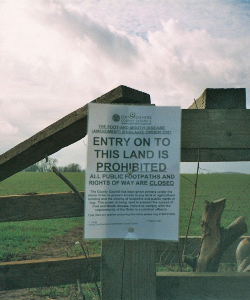
On February 21, 2001, Ireland’s multi-billion-pound livestock industry goes on full alert for signs of foot-and-mouth disease after the first outbreak in the United Kingdom in twenty years is confirmed in pigs. This epizootic sees 2,026 cases of the disease in farms across most of the British countryside. Over 6 million cows and sheep are killed in an attempt to halt the disease. By the time the disease is halted in October 2001, the crisis is estimated to have cost the United Kingdom £8bn (US$16bn).
The first case of the disease to be detected is at Cheale Meats abattoir in Little Warley, Essex on February 19, 2001, on pigs from Buckinghamshire and the Isle of Wight. Over the next four days, several more cases are announced in Essex. On February 23, a case is confirmed in Heddon-on-the-Wall, Northumberland, from where the pig in the first case had come. This farm is later confirmed as the source of the outbreak and the owner, Bobby Waugh of Pallion, is convicted of failing to inform the authorities of a notifiable disease, and later of feeding his pigs “untreated waste.”
Several cases of foot-and-mouth are reported in Ireland and mainland Europe, following unknowing transportation of infected animals from the UK. The cases spark fears of a continent-wide pandemic, but these fears prove unfounded.
Ireland suffers one case in a flock of sheep in Jenkinstown, County Louth in March 2001. A cull of healthy livestock around the farm is ordered. Irish special forces snipe wild animals such as deer capable of bearing the disease in the area.
The outbreak greatly affects the Irish food and tourism industry. The 2001 Saint Patrick’s Day festival is cancelled, but later rescheduled two months later in May. Severe precautionary measures are put into place throughout Ireland since the outbreak of the disease in the UK, with most public events and gatherings cancelled, controls on farm access, and measures such as disinfectant mats at railway stations, public buildings and university campuses. The 2001 Oireachtas Rince naa Cruinne, or Irish Dance World Championships, is cancelled as a result of these measures. Causeway 2001, an Irish Scouting Jamboree is also cancelled. Three matches involving the Ireland national rugby union team in the 2001 Six Nations Championship are postponed until the autumn.
The SS Tuscania, a luxury liner of the Cunard Line subsidiary Anchor Line converted for troop use, is torpedoed and sunk on February 5, 1918 off Rathlin Island, north of Ireland by the German U-boatUB-77. The ship is transporting over 2,000 American troops to the war in Europe. Over 200 people lose their lives.
SS Tuscania makes international headlines for rescuing passengers and crew from the burning Greek steamer SS Athinai on September 20, 1915. In 1916, SS Tuscania is refitted and pressed into service as a troopship. She makes the news again in March 1917 by evading a submarine and a suspected Imperial German Navyarmed merchant cruiser.
On January 24, 1918, SS Tuscania departs Hoboken, New Jersey, with 384 crew members and 2,013 United States Army personnel aboard. On the morning of February 5, 1918, she turns south for the North Channel en route to Liverpool. The German submarine UB-77 sights SS Tuscania′s convoy during the day and stalks it until early evening. Under the cover of darkness at about 6:40 PM, the submarine′s commanding officer, Korvettenkapitän Wilhelm Meyer, orders two torpedoes fired at SS Tuscania. The second of these strikes home, sending her to the bottom of the Irish Sea within about four hours. SS Tuscania sinks nearly three years to the day after her maiden voyage as a passenger liner. Approximately 210 of the troops and crew are lost, while many others are rescued by the Royal Navydestroyers HMS Mosquito and HMS Pigeon.
On January 1, 1908, Nimrod sails for the Antarctic from Lyttelton Harbour, New Zealand. Shackleton’s original plans had envisaged using the old Discovery Expedition base in McMurdo Sound to launch his attempts on the South Pole and South Magnetic Pole. Before leaving England, he had been pressured to give an undertaking to Captain Robert Falcon Scott that he would not base himself in the McMurdo area, which Scott was claiming as his own field of work. Shackleton reluctantly agrees to look for winter quarters at either the Barrier Inlet, which the Discovery Expedition had briefly visited in 1902, or King Edward VII Land.
To conserve coal, the ship is towed 1,650 miles by the steamer Koonya to the Antarctic ice, after Shackleton had persuaded the New Zealand government and the Union Steamship Company to share the cost. In accordance with Shackleton’s promise to Scott, the ship heads for the eastern sector of the Great Ice Barrier, arriving there on January 21, 1908. They find that the Barrier Inlet has expanded to form a large bay, in which are hundreds of whales, which leads to the immediate christening of the area as the Bay of Whales. It is noted that ice conditions are unstable, precluding the establishment of a safe base there. An extended search for an anchorage at King Edward VII Land proves equally fruitless, so Shackleton is forced to break his undertaking to Scott and set sail for McMurdo Sound, a decision which, according to second officer Arthur Harbord, is “dictated by common sense” in view of the difficulties of ice pressure, coal shortage and the lack of any nearer known base.
Nimrod arrives at McMurdo Sound on January 29, but is stopped by ice 16 miles north of Discovery‘s old base at Hut Point. After considerable weather delays, Shackleton’s base is eventually established at Cape Royds, about 24 miles north of Hut Point. The party is in high spirits, despite the difficult conditions. Shackleton’s ability to communicate with each man keeps the party happy and focused.
The “Great Southern Journey”, as Frank Wild calls it, begins on October 29, 1908. On January 9, 1909, Shackleton and three companions (Wild, Eric Marshall and Jameson Adams) reach a new Farthest South latitude of 88° 23′ S, a point only 112 miles from the Pole. En route the South Pole party discovers the Beardmore Glacier, named after Shackleton’s patron Sir William Beardmore, and become the first persons to see and travel on the South Polar Plateau. Their return journey to McMurdo Sound is a race against starvation, on half-rations for much of the way. At one point, Shackleton gives his one biscuit allotted for the day to the ailing Frank Wild, who writes in his diary, “All the money that was ever minted would not have bought that biscuit and the remembrance of that sacrifice will never leave me.” They arrive at Hut Point just in time to catch the ship.
The expedition’s other main accomplishments include the first ascent of Mount Erebus, and the discovery of the approximate location of the South Magnetic Pole, reached on January 16, 1909 by Edgeworth David, Douglas Mawson, and Alistair Mackay. Shackleton returns to the United Kingdom as a hero, and soon afterwards publishes his expedition account, Heart of the Antarctic.
In 1910, Shackleton makes a series of three recordings describing the expedition using an Edison Phonograph.
Several mostly intact cases of whisky and brandy left behind in 1909 are recovered in 2010 for analysis by a distilling company. A revival of the vintage (and since lost) formula for the particular brands found has been offered for sale with a portion of the proceeds to benefit the Antarctic Heritage Trust (New Zealand) which discovered the lost spirits.
(Pictured: Nimrod Expedition South Pole Party (left to right): Frank Wild, Ernest Shackleton, Eric Marshall and Jameson Adams)
The American Committee for Relief in Ireland (ACRI) is founded through the initiative of Dr. William J. Maloney and others on December 16, 1920, with the intention of giving financial assistance to civilians in Ireland who have been injured or suffer severe financial hardship due to the ongoing Irish War of Independence.
The Committee is only one of several U.S. based philanthropic organisations that emerge following World War I with a view to influencing the post-war settlement from their perspective of social justice, economic development and long term stability in Europe. Some of them concentrate their efforts on events in Ireland, and while activists of Irish ethnicity are well represented, membership is far from confined to Americans of Irish heritage. Apart from the ACRI, bodies such as the American Commission on Irish Independence and the American Commission on Conditions in Ireland raise money and attempt to influence U.S. foreign policy in a manner sympathetic to the goal of Irish secession from the United Kingdom.
This period of Irish political radicalism coincides with a Red Scare in the United States. Jim Larkin, an Irish trade unionist, who has been closely associated with James Connolly in Ireland and with the Wobblies in the U.S., is serving a five-year sentence in Sing Sing prison for promoting his socialist agenda. While his political views differ fundamentally from most of the Sinn Féin leadership, Irish republicanism is seen by many of the American establishment as based on a questionable ideology. During the Irish War of Independence, the activities of Irish-American fund-raising organisations are viewed with suspicion and kept under close scrutiny by the intelligence services including J. Edgar Hoover, head of the General Intelligence Division of the Federal Bureau of Investigation. U.S. policy towards Irish concerns, initially hostile or at best indifferent, become somewhat less so following the 1920 U.S. presidential election and the landslide victory of Warren G. Harding over James M. Cox.
Following the burning of parts of Cork on December 11, 1920 by elements of the British security forces known as the Black and Tans, approaches are made by the city’s Lord Mayor, Donal O’Callaghan, to the American Red Cross for humanitarian assistance. The society, having taken advice from President Woodrow Wilson, the British embassy, the Foreign Office and the British Red Cross, decline at this time to act on his appeal. Numerous organisations and committees across the United States, operating independently in raising humanitarian aid money for Ireland realise that their funds will not be channelled through the U.S. Committee of the Red Cross and so another distribution channel is needed.
Five days after the inferno at Cork, a widely publicised meeting takes place at the Banker’s Club in New York City. It is organised by William Maloney with the intention of establishing a single nationwide organisation. It will have as its goal, explicitly and solely for the purpose of humanitarian relief, the raising and distribution in Ireland of $10 million. The body which soon emerges styles itself “The American Committee for Relief in Ireland.” One of its founding members, Levi Hollingsworth Wood, approaches a Dublin-based businessman and fellow Quaker, James Douglas, requesting his assistance in the local distribution of the funds on a non-partisan basis. In Ireland, Douglas speaks with Laurence O’Neill, the Lord Mayor of Dublin, who in turn contacts senior members of Sinn Féin to inform them of the wishes of the American Committee. These meetings culminate in the establishment of the Irish White Cross, for the purpose of local distribution of the Committee’s funds.
The declaration affirms both the right of the people of Ireland to self-determination, and that Northern Ireland will be transferred to the Republic of Ireland from the United Kingdom only if a majority of its population is in favour of such a move. It also includes, as part of the prospective of the so-called “Irish dimension,” the principle of consent that the people of the island of Ireland, have the exclusive right to solve the issues between North and South by mutual consent.
The latter statement, which later becomes one of the points of the Good Friday Agreement, is key to produce a positive change of attitude by the republicans towards a negotiated settlement. The joint declaration also pledges the governments to seek a peaceful constitutional settlement, and promises that parties linked with paramilitaries, such as Sinn Féin, can take part in the talks, so long as they abandon violence.
Aeneas Coffey, Irish inventor and distiller, dies in England on November 26, 1852. He is born in Calais, France, to Irish parents in 1780. He is educated at Trinity College, Dublin, and enters the excise service around 1799–1800 as a gauger. He marries Susanna Logie in 1808, and they have a son, also named Aeneas, who may have been their only child.
According to British customs and excise records, Coffey is a remarkable man with widespread interests and multiple talents who rises quickly through the excise service ranks. He is appointed sub-commissioner of Inland Excise and Taxes for the district of Drogheda in 1813. He is appointed Surveyor of Excise for Clonmel and Wicklow in 1815. In 1816 he is promoted to the same post at Cork. By 1818 he is Acting Inspector General of Excise for the whole of Ireland and within two years is promoted to Inspector General of Excise in Dublin.
Coffey is a strong, determined upholder of the law, but aware of its shortcomings. He survives many nasty skirmishes with illegal distillers and smugglers, particularly in County Donegal in Ulster and in the west of Ireland, where moonshining is most rife. On several occasions he proposes to the government simple, pragmatic solutions to rules and regulations which have hampered legal distillers. Not all of his ideas are accepted. Between 1820 and 1824 he submits reports and gives evidence to Parliamentary Commissions of Inquiry on many aspects of distilling, including formalising the different spellings of Irish whiskey and Scotch whisky. His 1822 report is solidly backed by the Irish distillers. He believes in making it viable to distill legally, and illegal distilling might largely disappear.
He assists the government in the drafting of the 1823 Excise Act which makes it easier to distill legally. It sanctions the distilling of whiskey in return for a licence fee of £10, and a set payment per gallon of proof spirit. It also provides for the appointment of a single Board of Excise, under Treasury control, for the whole of the United Kingdom, replacing the separate excise boards for England, Scotland and Ireland. The 1823 Excise Act also provides for not more than four assistant commissioners of excise to transact current business in Scotland and Ireland, under the control of the board in London. Coffey resigns from government excise service at his own request in 1824.
Between his Dublin education and his work as an excise officer, Coffey has ample opportunity to observe the design and workings of whiskey stills, as Ireland is the world’s leading producer of whiskey in the 19th century, and Dublin is at the center of that global industry. This is how Coffey becomes familiar with a design differing from the traditional copper pot alembic still commonly used in Ireland, the continuous, or column, still. First patented by a Cork County distillery in 1822, the column still remains a relatively inefficient piece of equipment, although it points the way towards a cheaper and more productive way to distill alcohol. It is that last point that captures Coffey’s imagination. He makes his own modifications to existing column still designs, so as to allow a greater portion of the vapors to re-circulate into the still instead of moving into the receiver with the spirit. The result is more efficient, producing a lighter spirit at higher alcohol content. Coffey patents his design in 1830, and it becomes the basis for every column still used ever since.
On his retirement from service, Coffey goes into the Irish distilling business. For a short time he runs the Dodder Bank Distillery, Dublin and Dock Distillery in Grand Canal Street, Dublin, before setting up on his own as Aeneas Coffey Whiskey Company in 1830. The development of the Coffey still makes distillation of his own whiskey much more economical.
Nothing is known of the final years and last resting place of Aeneas Coffey. His only son, also called Aeneas Coffey, emigrates to South Africa and manages a distillery. He marries but his wife dies childless. He returns to England and spends his final years near London.
In a final week of farewell flights around the United Kingdom, a British Airways Concorde visits Birmingham on October 20, Belfast on October 21, Manchester on October 22, Cardiff on October 23, and Edinburgh on October 24. Each day the aircraft makes a return flight out and back into Heathrow Airport to the cities concerned, often overflying those cities at low altitude. Over 650 competition winners and 350 special guests are carried.
On the evening of October 23, 2003, Queen Elizabeth II consents to the illumination of Windsor Castle as Concorde’s final west-bound commercial flight departs London and flies overhead. This is an honour normally reserved for major state events and visiting dignitaries.
British Airways retires its aircraft the next day, October 24. G-BOAG leaves New York City to a fanfare similar to her Air France predecessor’s, while two more made roundtrips, G-BOAF over the Bay of Biscay, carrying VIP guests including many former Concorde pilots, and G-BOAE to Edinburgh. The three aircraft then circle over London, having received special permission to fly at low altitude, before landing in sequence at Heathrow.
The two round-trip Concordes land at 4:01 and 4:03 PM BST, followed at 4:05 by the one from New York. All three aircraft then spend 45 minutes taxiing around the airport before finally disembarking the last supersonic fare-paying passengers. The pilot of the New York to London flight is Mike Bannister.
All of British Airway’s Concordes have been grounded, have lost their airworthiness certificates and have been drained of hydraulic fluid. Ex-chief Concorde pilot and manager of the fleet, Jock Lowe, estimates it would cost £10-15 million to make G-BOAF airworthy again. British Airways maintains ownership of the Concordes and has stated that their Concordes will not be flown again.
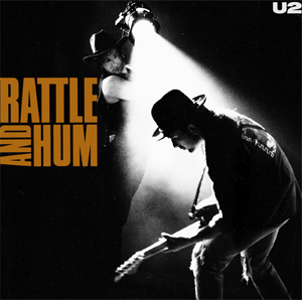
Although Rattle and Hum is intended to represent the band paying tribute to rock legends, some critics accuse U2 of trying to place themselves amongst the ranks of these artists. Critical reception to both the album and the film is mixed. One Rolling Stone editor speaks of the album’s “excitement”, another describes it as “misguided and bombastic.” The film grosses just $8.6 million, but the album is a commercial success, reaching number one in several countries and selling 14 million copies. Lead single “Desire” becomes the band’s first U.K. number-one song while reaching number three in the United States.
At the end of 1988, Rattle and Hum is voted the 21st-best album of the year in the Pazz & Jop, an annual poll of American critics published by The Village Voice. In other critics’ lists of the year’s top albums, it is ranked number one by HUMO, second by the Los Angeles Times and Hot Press, 17th by OOR, 23rd by New Musical Express (NME), and 47th by Sounds.
Lifetime sales for the album have surpassed 14 million copies.
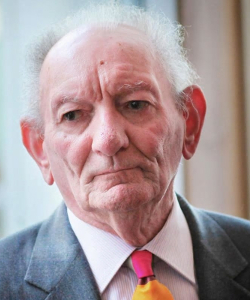
Recognised for early works such as Philadelphia, Here I Come! and Faith Healer, Friel has 24 plays published in a career of more than a half-century. He is elected to the honorary position of Saoi of Aosdána. His plays are commonly produced on Broadway in New York City throughout this time, as well as in Ireland and the United Kingdom. In 1980 Friel co-founds Field Day Theatre Company, and his play Translations is the company’s first production. With Field Day, Friel collaborates with Seamus Heaney, 1995 recipient of the Nobel Prize in Literature. Heaney and Friel first become friends after Friel sends the young poet a letter following publication of his book Death of a Naturalist. Friel’s play Dancing at Lughnasa wins three Tony Awards in 1992.
After a long illness Friel dies at the age of 86 in the early morning of Friday, October 2, 2015, in Greencastle, County Donegal. He is survived by his wife Anne and children Mary, Judy, Sally and David. A daughter, Patricia, predeceases him in 2012.