McEnery is born on April 28, 1892, to Henry McEnery and Margaret (née Stack) at 4 Slieveawaddra, Drommartin, County Kerry. His mother and father are national teachers, and his father is also a farmer. Some of his older siblings become teachers and his brother is a Catholic priest.
McEnery marries Johannah (Hannah) Donnelly at Causeway, County Kerry, on April 13, 1918. Their only child, Henry, known as “Sunny,” is born on June 11, 1920.
McEnery joins the Irish Volunteers and is a lieutenant in the 3rd Battalion, North Kerry. As in the Volunteers, in the IRA he is a lieutenant, 3rd Battalion, in the Kerry No.1 Brigade (also of North Kerry). He is part of Timothy “Aeroplane” Lyons‘s column, which is involved in the burning of a Civic Guard station at Ballyheigue and a robbery of the Ballyduff post office. He is captured and imprisoned by the National Army and claims under interrogation that he was forced to join Lyons’s column under fear of death, accused of being a traitor. Despite giving an undertaking, he would not resume militant activity, he rejoins Lyons’s column following his release.
On April 16, McEnery takes part in the column’s ambush on a Free State raiding party at Meenoghane. The National Army’s 1st Western Division supplies reinforcements quickly and pursues the column to Clashmealcon, where the members hide in Dumfort’s Cave on the Atlantic cliffs with no possible escape. Two National Army troops are shot and killed by Lyons when trying to enter the cave. Two of the column’s men fall and drown after trying to scale the cliff at night. McEnery surrendered with Reginald Walter Stenning and Edmond Greaney. They are taken to Ballymullen Barracks in Tralee. Lyons falls from a rope and is shot while lying on the rocks below.
On April 18, McEnery and his two remaining colleagues are charged with the Ballyheigue burning, the Ballyduff robbery, stripping civic guards at Ballyheigue, attacking National troops at Clashmealcon and armed opposition to the government. They are tried and sentenced to death by Paddy Daly, OC of the National Army in Kerry. The following day, Daly asks for confirmation of the sentences, which duly arrive. McEnery is shot at 8:00 a.m. on April 25, three days before his 31st birthday. He is initially interred at the gaol. A death entry is made in the register the following month, incorrectly giving his age as 28. His body is finally released, along with those of others executed, to relatives on October 28 of the following year, when hundreds gather outside the gaol.
McEnery is buried alongside executed colleagues in the republican plot at Rahela Cemetery, Ballyduff. Hannah McEnery is granted £250 from the Irish White Cross and their son Henry £1 per week until working age. In 1932, pending new legislation, she applies for an allowance because of her dependency on McEnery and is awarded £67 and 10 shillings per annum (increased to £250 in the 1950s), and £18 per annum for their son.
McEnery is counted as one of “the seventy-seven,” a term made popular amongst republicans after the writing of Dorothy Macardle in memory of those executed by Free State troops.
On April 23, 1921, District Inspector Potter is captured by the 3rd (South) Tipperary Brigade, IRA, following the Hyland’s Cross Ambush. This occurs near Curraghcloney, close to the village of Ballylooby. The ambush party is initially made up of a combination of the 1st and 2nd Flying Columns of the 3rd Tipperary Brigade. This is the largest force assembled to date by the Tipperary IRA in anticipation of a major battle. However, the convoy of military lorries that is expected never materialises. Dan Breen and Con Moloney return to battalion headquarters, while Seán Hogan‘s Column withdraws northward in the direction of the Galtee Mountains.
As Dinny Lacey‘s (No.1) Column prepares to leave toward the south, a small party of British soldiers accompanying two horse-drawn carts unexpectedly approaches from Clogheen and are immediately fired upon. Amid some confusion Lacey’s scattered men withdraw southward toward the Knockmealdown Mountains. One British soldier, Frank Edward Conday, is fatally wounded and two others from the relieving party are wounded. Reports that army lorries are burned during the exchange may have been abandoned by the relieving soldiers sent from Clogheen.
By chance, Potter, who is returning by car from police duties at Ballyporeen, drives into a section of the withdrawing No.1 Column. Although in mufti, he is recognised by one of the IRA volunteers and taken prisoner. As part of a new strategy, he is held as a hostage for the safe release of Thomas Traynor, an IRA volunteer (and father of ten young children), then under sentence of death at Mountjoy Gaol. The IRA offers to release Potter in exchange for Traynor’s release, however, Traynor is executed. Traynor has since been honoured by the Irish state as one of “The Forgotten Ten.”
The Column, under sporadic fire from soldiers alerted at the nearby Clogheen barracks, follow the contours of the mountains to the village of Newcastle. Losing their pursuers, they stay for a period of time at the townland of Glasha. Here Potter is detained in an out-building of a farm which is regularly used by the IRA as a safe house. From there the party is guided into the Nire Valley by a contingent of local Waterford Volunteers and on to the Comeragh Mountains.
Accounts from Rathgormack, County Waterford, suggest that Potter is kept for at least one night at a nearby ringfort before being taken down the hill to a field then owned by Powers of Munsboro, where he meets his ultimate fate. At 7:00 p.m., on April 27, following news of Traynor’s execution by hanging, he is shot to death and hastily buried in a shallow grave on the banks of the River Clodiagh. A diary he kept during his period of captivity and some personal effects and farewell letters are returned anonymously to his wife, Lilias. This is the first confirmation she has that he had been killed. The artifacts are later lost when his son’s ship is torpedoed in 1942, during World War II.
On May 18, three weeks after Potter’s death, a notice of officially sanctioned military reprisals appears in local newspapers.
During the Truce, by arrangement through specially appointed Liaison Officers, Potter’s body is disinterred by the IRA and conveyed to Clonmel where it is returned to his widow. Two days later his body is brought to Cahir and buried with full military honours at the Church of Ireland cemetery at Kilcommon, 4 kilometres south of the town. The funeral is presided over by Bishop Miller of Waterford and attended by the Band of the Royal Lincolnshire Regiment, the locally stationed Royal Field Artillery and officers and men of the RIC, takes place in the afternoon of August 30, 1921.
Coalisland is a town in County Tyrone that has a tradition of militant republicanism; five residents are killed by British security forces before the first IRA ceasefire in 1994. In February 1992, four IRA volunteers are killed in a gun battle with the SAS during their escape after a machine gun attack on the RUC/British Army barracks there. Three months later, an IRA bomb attack on a British Army patrol at Cappagh, in which a paratrooper loses his legs, triggers a series of clashes between local residents and British troops on May 12 and 17. A number of civilians and soldiers are injured, a soldier’s backpack radio destroyed, and two British weapons stolen. The melee is followed by a 500-strong protest in the town and bitter exchanges between Republic of Ireland and British officials. Further scuffles between civilians and soldiers are reported in the town on March 6, 1994.
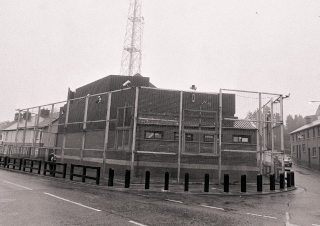
At 9:40 p.m. on Wednesday, March 26, 1997, a grenade is thrown at the joint British Army/RUC base at Coalisland, blowing a hole in the perimeter fence. The RUC reports that a 1 kg device hit the fence ten feet off the ground. Another source claims that the device is a coffee-jar bomb filled with Semtex. The grenade is thrown or fired by two unidentified men. At the time of the attack, there is an art exhibition at Coalisland Heritage Hall, also known as The Mill, from where the explosion and the gunshots that follow are clearly heard. The incident lasts less than two minutes.
Just one minute after the IRA attack, bypassers hear high-velocity rounds buzzing around them. A number of men, apparently SAS soldiers, get out of civilian vehicles wearing baseball caps with “Army” stamped on the front. A source initially describes them as members of the 14 Field Security and Intelligence Company. The men are firing Browning pistols and Heckler & Kochsubmachine guns. Witnesses say there are eight to ten gunshots, while a republican source claims that up to eighteen rounds are fired. Nineteen-year-old Gareth Doris is shot in the stomach and falls to the ground. He is allegedly returning from the local church and is in the company of a priest when he is shot. A local priest, Seamus Rice, is driving out of the church car park when his car is hit by bullets, smashing the windscreen.
Three minutes after the blast, hundreds of angry residents gather at the scene and confront the undercover soldiers. The soldiers fire live rounds at the ground and into the air to keep people back. The crowd keeps drawing back and moving forward again until 9:50 p.m., when the RUC arrives and begins firing plastic bullets at the protesters. Two women are wounded by plastic bullets and the undercover soldiers then flee in unmarked cars, setting off crackers or fireworks at the same time. Sinn FéincouncillorFrancie Molloy claims that the protesters forced the SAS to withdraw, saving Doris’s life in the process. Witnesses allegedly fear an undercover soldier brandishing a pistol would have killed the wounded Doris with a shot to his head.
Afterward, hundreds of residents are forced to leave their homes as security forces search the area near the base. This keeps tensions high, according to local republican activist Bernadette McAliskey. Two men are later questioned by the RUC about the attack.
The attack, along with two large bombings the same day in Wilmslow, England, raise concerns that the IRA is trying to influence the upcoming UK general election. Martin McGuinness describes the shooting as “murderous,” while independent councillor Jim Canning says that more than a dozen soldiers “were threatening to shoot anybody who moved […] while a young man lay shot on the ground.” Republican sources claim that this is another case of shoot-to-kill policy by the security forces. Ulster Unionist Party (UUP) MPKen Maginnis, however, praises the SAS for their actions.
Gareth Doris is admitted to South Tyrone Hospital in Dungannon, where he is arrested after undergoing surgery. He is later transferred to Musgrave Park Hospital in Belfast. He is later convicted for involvement in the bombing and sentenced to ten years in jail, before being released in 2000 under the terms of the Good Friday Agreement. Gareth is the cousin of Tony Doris, an IRA member killed in an SAS ambush in the nearby village of Coagh on June 3, 1991, and a cousin of Sinn Féin leader Michelle O’Neill. According to Sinn Féin councillor Brendan Doris, another cousin of Gareth, “He absolutely denies being involved in terrorist activity of any description.” Amnesty International raises its concerns over the shooting and the fact that no warning is given beforehand.
DNA evidence collected in the area of the shooting leads to the arrest of Coalisland native Paul Campbell by the Police Service of Northern Ireland (PSNI) in 2015, on the charges of being the other man with Doris during the attack. In February 2020, he is convicted by a Diplock court in Belfast. He denies the charges but receives a seven-and-a-half-year sentence. The prosecutor acknowledges that Campbell would have been released by this time under the provisions of the Good Friday Agreement but argues that that was a decision for the parole commission, not the court.
On July 5, 1997, on the eve of the 1997 nationalist riots in Northern Ireland, the British Army/RUC base is the scene of another attack, when an IRA volunteer engages an armoured RUC vehicle with gunfire beside the barracks. One female officer is wounded. The former RUC station at Coalisland is eventually shut down in 2006 and sold for private development in 2010.
(Pictured: Coalisland RUC/British Army base in Coalisland, County Tyrone, Northern Ireland)
Following the ambush, the British carry out a sweep in which they capture three of the IRA volunteers involved and kill another who had not taken part.
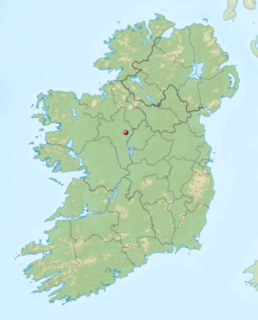
County Roscommon is not one of the more violent areas of Ireland during the conflict. The local IRA argues to their GHQ that it is very difficult to conduct guerrilla warfare in the flat open countryside there. Prior to the action at Scramogue, the biggest previous incident had been in October 1920, when four RIC officers were killed in an ambush near Ballinderry.
Sean Connolly is sent by IRA GHQ from Longford to re-organise the Roscommon IRA and chooses the ambush site at Scramoge. However, he is killed twelve days before the action, at the Selton Hill ambush in neighbouring County Leitrim.
Both the North and South Roscommon brigades of the IRA take part and are commanded by Patrick Madden. There are 39 volunteers in the flying column, but only 14 take part in the actual attack. The remainder are tasked with blocking roads to keep the IRA’s line of retreat open. The IRA party is armed with thirteen rifles (eleven Lee–Enfields, one Winchester and one sporting rifle), twenty shotguns (though some are in bad condition) and two or three Webley revolvers. This is the largest collection of arms that the IRA assembles in Roscommon during the war and some of them have been borrowed from IRA units in Longford.
Among the volunteers who take part are Martin Fallon, ‘Cushy’ Hughes, Frank Simons, Luke Duffy, Peter Casey, Peter Collins, Patrick Gallagher and Tom Compton. Several of the IRA men, including Hughes, had served in the Irish Guards (IG) in World War I, but had been persuaded by Pat Madden to join the IRA upon their return.
The ambush site is carefully prepared. It is located at a sharp bend on the Strokestown–Longford road. A farmhouse and barn at the bend have been taken over and loopholed, and a trench is dug behind a hedge alongside the road. Only a mile from the IRA’s position, the British 9th Queen’s Royal Lancers regiment is garrisoned in Strokestown House.
The IRA waits in their position all day for British forces to come from Strokestown. Just as a troop lorry finally appears, two civilians came up the road in a pony and trap and have to be frantically waved out of the way.
The lorry carries a nine-man British Army and Royal Irish Constabulary (RIC) patrol traveling on the Strokestown–Longford road. The British inquiry into the incident is to question why the lorry is unescorted, as their practice is not to travel in lone vehicles.
The IRA opens fire from very close range, killing the driver and halting the lorry in its tracks. Several of the soldiers and policemen are hit and they scrambled for cover behind a wall along the road. The lorry has a Hotchkiss machine gun bolted onto it, but its gunner gets off only one burst before being badly wounded and the gun is put out of action. The commander of the patrol, Captain Roger Grenville Peek, is hit in the lorry but tries to run to safety, only to be hit again and killed 400 yards down the road. The other officer with the party, Lieutenant Tennant, is also killed by a shotgun blast. After the death of the two officers, the surviving British, several of whom are wounded, surrender.
Just as the firing is dying down, another lorry, an RIC/Black and Tan patrol, approaches the ambush site but turns back after coming under fire.
Four of the British force are killed – this includes two British Army officers (Roger Grenville Peek and John Harold Anthony Tennant), a Royal Army Service Corps (RASC) driver, and one RIC man (Constable Edward Leslie).
Two men in civilian clothes are also found in the lorry. They turn out to be Black and Tans, Constable Buchanan and Constable Evans, who had been placed under arrest by the soldiers. They are made prisoners by the IRA. The ambush party takes the British arms, including the Hotchkiss gun, burn the lorry and make their escape over the hill of Slieve Bawn.
The IRA leaders, Pat Madden, Luke Duffy and Frank Simons, decide to murder the two Black and Tans, despite their offering to show the IRA how to use the captured machine gun. The IRA officers’ reason that if the prisoners identify the IRA men who had taken part in the ambush, the volunteers will be at risk of being executed if captured. The two are taken to remote locations and shot over the next two days.
The British garrison in Roscommon town mounts a sweep directly after the ambush with eight lorries and one Whippet tank. Three volunteers who had taken part are arrested afterward. Pat Mullooly and Brian Nagle of the North Roscommon Brigade are arrested as they try to get away from the scene of the ambush, as is “Cushy” Hughes, who is picked up when he is drawing his soldier’s pension in Roscommon. Mullooly and Nagle are badly beaten by their captors on the road to Roscommon. The next day, another volunteer, Michael Mullooly, brother of Pat Mullooly, is shot dead in his home by the RIC.
O’Hegarty comes from a family with strong nationalist roots. His parents are John, a plasterer and stucco worker, and Katherine (née Hallahan) Hegarty. His elder brother is Patrick Sarsfield O’Hegarty, the writer. His parents’ families emigrated to the United States after the Great Famine, and his parents married in Boston. His father is a member of the Irish Republican Brotherhood (IRB). In 1888, his father dies of tuberculosis at the age of 42, and his mother has to work to support the family.
O’Hegarty is educated at the Christian BrothersNorth Monastery school in Cork. By 1902, he has left school to work as a sorter in the local post office, rising to post office clerk. He is a supporter of the Gaelic revival, Irish traditional music, and Gaelic games. A committed sportsman, in his twenties he is captain of the Post Office HQ’s hurling team. He follows his brother Patrick into Conradh na Gaeilge and eventually the Irish Volunteers and the Irish Republican Brotherhood. He is a member of the Celtic Literary Society by 1905 and founds the Growney branch of Conradh na Gaeilge in 1907. A puritanical character by nature, he is a non-smoker and never drinks.
O’Hegarty is a founder of the local branch of the Irish Volunteers in Cork in December 1913. In June of the following year, he is appointed to the Cork section of the Volunteer Executive, and then to the Military Council. In October, the Dublin government discovers his illegal activities, and he is dismissed. Excluded from Cork under the Defence of the Realm Act (DORA) regulations, he moves to Ballingeary, where he works as a labourer. From there he moves to Enniscorthy, County Wexford, where he lives with Larry de Lacy. On February 24, 1915, he is arrested and tried under the Defence of the Realm Act for putting up seditious posters. But for this and a second charge of “possession of explosives” he is discharged. The explosives belonged to de Lacy.
The Volunteers appoint O’Hegarty as Commandant of Ballingeary and Bandon. During the Easter Rising, he is stationed in Ballingeary when visited by Michael McCarthy of Dunmanway to propose an attack on a Royal Irish Constabulary (RIC) post at Macroom. But their strength is fatally weakened and, having no reserves, they call off the attempt. In 1917, he becomes Vice-commandant of No.1 Cork Brigade. He works as a storekeeper at the workhouse but is intimidating, and clashes with the Poor Law Guardians.
During the Irish War of Independence, O’Hegarty is one of the most active in County Cork. Like others, he is exasperated with Tomás Mac Curtain’s inactivity and refusal to be more bellicose. One such is battalion commander Richard Langford, who joins with O’Hegarty’s unit to make an unauthorized raid on the RIC post at Macroom. Langford is court-martialed, but O’Hegarty continues to rise in the ranks. When a RIC Inspector is murdered, Mac Curtain condemns the shootings and calls for their end. On March 19, 1920, Mac Curtain is shot and killed in his home in Cork. The coroner blames the British establishment in Dublin, but the police never make any attempt to investigate the killings. Shortly after these events General Hugh Tudor begins the policy of official reprisals.
In January 1920, an inquiry is held into corruption alleged against “Hegarty’s Mob” or “Hegarty’s Crowd” running Cork City. O’Hegarty blames the former mayors for the charges of incompetence but remains on good terms with them.
In a raid on Cork City Hall on August 12, 1920, the British manage to net all the top brass of the IRA in Cork. In an incredible failure of intelligence, they do not identify the leadership as their prisoners. They are all released, including Liam Lynch, and O’Hegarty. Only Terence MacSwiney, the new Lord Mayor of Cork, is kept in custody and sent to England.
On February 25, 1921, the Coolavokig ambush is carried out by the 1st Cork Brigade under O’Hegarty at Ballyvourney village, on the road between Macroom and Ballyvourney. The IRA suffers no casualties; however, the number of British casualties has been disputed to this day.
The brigade commanders in the southern division retain a residual lingering resentment of Dublin GHQ’s lack of leadership and supplies. Seán Moylan, commandant of No. 2 Cork Brigade, thinks good communications with No.1 Brigade are to be vital, but little of this is seen via the organizer, Ernie O’Malley, at GHQ. At a meeting set up for April 26, 1921, when the manual of Infantry Training 1914 is produced, the document raises great anger. The meeting ends in uproar when O’Hegarty, who is “a master of invective, tore the communication and its authors to ribbons.”
O’Malley and Liam Lynch, the general, meet with O’Hegarty in the mountains of West Cork, near a deserted farmhouse, just off the main road. In the retreat that follows, the Irish take heavy casualties and leave their wounded to the good care of the British. These are the “Round-ups” in which the Irish sleep outside in order to avoid being at home when the Army calls. They are told by the Brigade to learn the national anthem of England to avoid arrest.
In East Cork brigade, O’Hegarty uncovers a spy ring. He is ruthless in the treatment of Georgina Lindsay and her chauffeur, who give away information to the Catholic clergy, but is remarkably lenient on brigade traitors within. He is allegedly not too bothered about evidence but is reminded that all executions of a traitor have to be approved by Dublin first.
O’Hegarty becomes more and more aggressive toward the establishment, using tough language to impose his will over the area. He attempts to force the civilian Teachtai Dála (TDs) for Cork to stand down, to give way to military candidates, telling the Dáil in December 1921, that any TD voting for the treaty will be guilty of treason. But Éamon de Valera is decided and overrules any interference with the Civil Government. Like the commanders, de Valera rejects the treaty but has already been defeated in the Dáil on a vote by W. T. Cosgrave‘s majority.
On February 1, 1922, O’Hegarty marries Maghdalen Ni Laoghaire, a prominent member of Cumann na mBan.
O’Hegarty is on the IRA’s Executive Council, but when there is a meeting on April 9, 1922, it is proposed that the Army should oppose the elections by force. As a result, Florence O’Donoghue and Tom Hales join him in resigning. In May, he and Dan Breen enter into negotiations with Free Stater Richard Mulcahy. A statement is published in the press asking for unity and acceptance of the Treaty. During this time, the republicans become very demoralized and ill-disciplined, but they have to gain strength before announcing independence from Dublin. The debate amongst the anti-Treaty IRA command is increasingly rancorous.
The bitter divisions split the anti-treatyites into two camps. Two motions are debated at the Army Convention on June 18, 1922. At first, the motion to oppose the treaty by force is passed. These men include Tom Barry, Liam Mellows, and Rory O’Connor, who are all in favour of continuing the fight until the British are driven out of Ireland altogether. However, one brigade’s votes have to be recounted, and then the motion is narrowly defeated. Joe McKelvey is appointed the new chief of staff, but the IRA is in chaos. While he strongly opposes the Anglo-Irish Treaty, O’Hegarty takes a neutral role in the Irish Civil War and tries to avert hostilities breaking out into full-scale civil war. He emerges as a leader of the “Neutral IRA” with O’Donoghue. This is a “loose” confederation of 20,000 men who have taken part in the pre-truce wars but have remained neutral during the Civil War from January 1923. Over 150 persons attend its convention in Dublin on February 4, 1923. By April 1923, O’Malley is imprisoned in Mountjoy Prison. In a letter to Seamus O’Donovan on April 7, he blames Hegarty for all this compromise and “peace talk.”
It has been alleged by the author Gerard Murphy that O’Hegarty had a role in the assassination of the Commander-in-Chief, Michael Collins, in August 1922, along with Florrie O’Donoghue and Joe O’Connor. It is alleged that as members of the 1st Southern Division Cork, they are actually feigning claims of neutrality but remain part of the IRB in order to set up talks towards peace and the cessation of hostilities at the start of the Irish Civil War.
Although probably an atheist during the Irish War of Independence, O’Hegarty returns to the Catholic church later in life. On forming the Neutral Group of the IRA in December 1922, he tries to unify differences in the volunteers between Republicans and the Free Staters. He communicates with the Papal Nuncio during the inter-war years in an attempt to have Bishop of CorkDaniel Cohalan‘s excommunication bill lifted. Instead, he turns to commemoration as a way to earn favour in Rome, with the dedication of a Catholic church at St. Finbarr’s Cemetery. After his wife’s passing, he becomes a close friend with Florence O’Donoghue until his own death.
Hurley is born in Baurleigh, County Cork, near the village of Kilbrittain, on March 20, 1893, and is educated in the national school and subsequently passes the civil service examinations at age fifteen. According to his brother James, he is one of seven siblings, “born and reared in a farm of 35 acres.”
In 1918, Hurley is sentenced to five years penal servitude for possession of arms and plans of the British military fortifications at Bere Island. However, he is released in 1919 following a hunger strike. In the same year, his brother Willie, also an IRA Volunteer, dies of typhoid fever. He first becomes vice-commandant of the Volunteers or IRA Bandon Battalion and then in August 1920, after the arrest and imprisonment of Tom Hales, he becomes commander of the Third Cork Brigade of the IRA. One of his most important decisions is to establish a full-time guerrilla unit or flying column, under Tom Barry.
The 3rd Cork Brigade (also known as the West Cork Brigade) goes on to be one of the most active IRA units during the guerrilla war against the British in 1919–21. According to Barry, Hurley leads an ambush of the Royal Irish Constabulary (RIC) at Ahawadda in April 1920, killing three policemen, wounding one and taking their arms and ammunition. In July of that same year, he leads a successful attack on the Coastguard station at Howes Strand, capturing a large number of weapons and ammunition. Barry remarks that Hurley is “a remarkable man and a lovable personality” and “continually urged a fighting army policy.”
Hurley is present at the Tooreen ambush in October 1920 and subsequently is part of an assassination attempt on a judge who gives “harsh sentences” to IRA members. From December 1920 until January 1921, he takes command of the 3rd Cork Brigade’s flying column while Barry is ill. He also tours IRA units to assess the impact of the decree of excommunication on the guerrilla movement issued by CatholicBishop of Cork, Daniel Cohalan.
In February 1921, Hurley leads the disastrous Upton train ambush on February 15, 1921, an attack on a train carrying British troops. In the action, the attacking IRA party is heavily outnumbered and the firefight results in three IRA men and six civilians being killed. He is also badly wounded in the face and ankle. Barry writes of the aftermath of the ambush that “he (Hurley) mourned deeply for his dead comrades and for the dead civilians, whom he did not know.”
Hurley is killed in action by British troops just before the Crossbarry ambush on March 19, 1921. He is staying in a house with a pro-republican family, where he is recuperating from the serious wounds he had received at Upton a month earlier. When he realises that he is surrounded by the British forces, he flees the house, as Barry comments in his book, to reduce the danger to those in the house, and is shot dead by pursuing troops. Barry remarks that he “died in the manner in which we expected.”
The British Army places Hurley’s body at the workhouse in Bandon. However, members of Cumann na mBan surreptitiously take his body and he is given a secret republican funeral in Clogagh. A local ballad exists that commemorates him. In addition, the Gaelic Athletic Association grounds in Bandon is named after him in 1971.
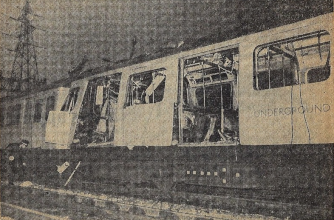
A 5-lb. (2.3 kg) bomb on a Metropolitan line train explodes prematurely in the front carriage of the train, injuring seven passengers. The bomb detonates prior to reaching the City of London, where it is thought the intended target to be Liverpool Street station at rush hour. Adrian Vincent Donnelly, a Provisional Irish Republican Army (IRA) volunteer, then shoots Post Office engineer Peter Chalk in the chest, and kills train driver Julius Stephen, who had attempted to catch him. Donelly exits the station to the street and threatens people with his revolver before Police Constable Raymond Kiff catches up with him. Shouting “You English bastards!” Donelly shoots himself in the chest but survives and is apprehended by Kiff.
Eleven days prior to the West Ham station attack, an IRA bomb explodes in a train at Cannon Street station. The day after the West Ham attack, a bomb on a train at Wood Green tube station explodes, injuring a man. On March 17, a 9-lb. (4.1 kg) bomb is discovered in a train at Neasden Depot. After these events, the London Transport Executive launches a security operation and assigns 1,000 plainclothed policemen on the London Underground system.
An appeal to raise money is launched for the family of the driver of the train, Julius Stephen, who left behind a widow and a family. As of August 1976, £17,000 had been raised.
(Pictured: The underground train damaged in the explosion, The Times, March 16, 1976)
The Pearse Street Ambush takes place in Dublin on March 14, 1921, during the Irish War of Independence. Dublin awakes to the news that six Irish Republican Army (IRA) volunteers, captured in an ambush at Drumcondra two months earlier, have been hanged. The gates of Mountjoy Gaol are opened at 8:25 a.m. and news of the executions is read out to the distraught relatives of the dead. As many as 40,000 people gather outside and many mournfully say the Rosary for the executed men.
The Labour movement calls a half-day general strike in the city in protest at the hangings. The clandestine Republican government declares a day of national mourning. All public transport comes to a halt and republican activists make sure the strike is observed.
By the evening, the streets clear rapidly as the British-imposed curfew comes into effect at 9:00 p.m. each night. The city is patrolled by regular British troops and the much-feared paramilitary police, or Auxiliaries, as people scurry home and await IRA retaliation for the hangings. This is not long in coming.
Pearse Street is just south of the River Liffey, running from Ringsend, an old fishing port, to the city centre. Number 144 Pearse Street houses the company headquarters of the IRA’s Dublin Brigade 3rd Battalion at St. Andrews Catholic Hall. It has been used for this purpose since before the 1916 Easter Rising.
On the evening of March 14, Captain Peadar O’Meara sends the 3rd Battalion out to attack police or military targets. As many as thirty-four IRA men prowl the area, armed with the standard urban guerrilla arms of easily hidden handguns and grenades. One young volunteer, Sean Dolan, throws a grenade at a police station on nearby Merrion Square, which bounces back before it explodes, blowing off his own leg.
At around 8:00 p.m., with the curfew approaching, a company of Auxiliaries, based in Dublin Castle is sent to the area to investigate the explosion. It consists of one Rolls-Royce armoured car and two tenders holding about 16 men. Apparently, the Auxiliaries have some inside information as they made straight for the local IRA headquarters at 144 Pearse Street. One later testifies in court that “I had been notified there were a certain number of gunmen there.”
However, the IRA is waiting. As soon as the Auxiliaries approach the building, they are fired upon from three sides. What the newspapers describe as “hail of fire” tears into the Auxiliaries’ vehicles. Five of the eight Auxiliaries in the first tender are hit in the opening fusillade. Two of them are fatally injured, including the driver, an Irishman named O’Farrell, and an Auxiliary named L. Beard.
The IRA fighters, however, are seriously outgunned. The Rolls Royce armoured car is impervious to small arms fire (except its tyres, which are shot out) and the mounted Vickers heavy machine gun sprays the surrounding houses with bullets. The unwounded Auxiliaries also clamber out of their tenders and return fire at the gun flashes from street corners and rooftops.
Civilian passersby thow themselves to the ground to avoid the bullets but four are hit, by which side it is impossible to tell. The British military court of inquiry into the incident finds that the civilians had been killed by persons unknown, if by the IRA then they were “murdered,” if hit by Auxiliaries the shootings were “accidental.” This, aside from demonstrating the court’s bias, shows that no one is sure who had killed them.
Firing lasts for only five minutes but in that time seven people, including the two Auxiliaries, are killed or fatally wounded and at least six more are wounded. Eighteen-year-old Bernard O’Hanlon, originally from Dundalk, lay sprawled, dead, outside 145 Pearse Street, his British Bull Dog revolver under him which has five chambers, two of which contain expended rounds and three of which contain live rounds, indicating he had gotten off just two shots before being cut down.
Another IRA Volunteer, Leo Fitzgerald, is also killed outright. Two more guerrillas are wounded, one in the hip and one in the back. They, along with Sean Dolan, who had been wounded by his own grenade, are spirited away by sympathetic fire brigade members and members of Cumann na mBan and treated in nearby Mercer’s Hospital.
Three civilians lay dead on the street. One, Thomas Asquith, is a 68-year-old caretaker, another, David Kelly, is a prominent Sinn Féin member and head of the Sinn Féin Bank. His brother, Thomas Kelly, is a veteran Sinn Féin politician and a Member of Parliament since 1918. The third, Stephen Clarke, aged 22, is an ex-soldier and may have been the one who had tipped off the Auxiliaries about the whereabouts of the IRA meeting house. An internal IRA report notes that he was “under observation… as he was a tout [informant] for the enemy.”
Two IRA men are captured as they flee the scene. One, Thomas Traynor, a 40-year-old veteran of the Easter Rising, is carrying an automatic pistol, but claims to have had no part in the ambush itself. He had, he maintains, simply been asked to bring in the weapon to 144 Great Brunswick Street. The other is Joseph Donnelly, a youth of just 17 years of age.
As most of the IRA fighters get away through houses, over walls and into backstreets, the Auxiliaries ransack St. Andrew’s Catholic Hall at number 144 Pearse Street but find little of value. Regular British Army troops quickly arrive from nearby Beggars Bush Barracks and cordon off the area, but no further arrests are made. Desultory sniping carries on in the city for several hours into the night.
March 14, 1921, was bloody day in Dublin. Thirteen people had died violently in the city by the end of the day – six IRA Volunteers executed that morning, two more killed in action at Pearse Street, two Auxiliaries killed in action and three civilians in the crossfire. It is the worst day of political violence in the city since Bloody Sunday on November 21, 1920, when 31 had been killed.
(From: “The Pearse Street Ambush, Dublin, March 14, 1921” by John Dorney, The Irish Story, http://www.theirishstory.com, January 26, 2015 | Pictured: British Army troops keep crowds back from Mountjoy Prison during the executions, March 14 1921.)
Cronin is born on August 29, 1922, in Dublin, the only son among three children of Con Cronin, a member of the IRA, and his wife Kate. After his father’s death, his mother works as a cook in a boarding school while the children are brought up by relatives in Ballinskelligs in the County KerryGaeltacht. Educated locally, he is deeply influenced by his Gaeltacht childhood; his later writings often refer to the hypocrisy of a state that romanticises the Gaeltacht while neglecting its social problems.
During World War II, Cronin’s sisters emigrate to England to train as nurses while he works as a labourer for Kerry County Council. In December 1941, he joins the Irish Army and is selected in 1943 for an officers’ training course, on which he forms a lifelong friendship with the future theatre directorAlan Simpson. He is commissioned and remains in the army until 1948.
Shortly thereafter Cronin emigrates to New York City, where he finds work as a journalist writing for The Advocate, an Irish American newspaper. He is strongly influenced by interviewing 1916 veterans for The Advocate and by contact with left-wing Irish American associates of Michael Quill, who played leading roles in the foundation of the Transport Workers Union of America. He becomes active in the semi-secret separatist organisation Clan na Gael, and in autumn 1955 returns to Ireland with the aim of helping the IRA to prepare for another military campaign.
Cronin begins work as a sub-editor with the Evening Press and also contributes summaries of world affairs to The Irish Times.
Cronin establishes contact with the IRA, and his military experience leads to his rapid assignment to GHQ staff. He is initially placed in charge of training and instruction, composing a manual on guerrilla warfare and twelve lectures on battlefield training. He teaches new military techniques and new recruits, such as the future IRA Chief of Staff Ruairí Ó Brádaigh, find him deeply impressive.
Cronin becomes a leading advocate of an early IRA campaign against Northern Ireland and becomes the chief strategist for Operation Harvest, a campaign which sees the carrying out of a range of military operations from direct attacks on security installations to disruptive actions against infrastructure. He is arrested on January 8, 1957, near the border in County Cavan. He is imprisoned several times over the course of the campaign (1956–1962).
Most of the IRA and Sinn Féin leadership are interned by the Dublin government on July 6, 1957. Cronin, one of the few to escape, becomes IRA Chief of Staff. He also acts for a time as editor of the movement’s newspaper, United Irishman. He tries to secure weapons from various sources, leading an unsuccessful raid on a British Army base at Blandford Camp in Dorset on February 16, 1958, and through contacts with Spanish republican exiles in Paris. The Irish American community remains the IRA’s main source of external support.
Cronin is arrested on September 30, 1958, and interned, causing considerable disarray, as he had been running much of the campaign single-handed. When the internees are released in March 1959, he resumes his position as Chief of Staff after a factional dispute causes the resignations of Tomás Óg Mac Curtain and the former Chief of Staff Tony Magan. He continues to argue that a sustained guerrilla campaign might yet succeed, but in June 1960 is again arrested and imprisoned for six months.
In November 1960, the Irish Freedom Committee (IFC), a Clan na Gael splinter group, accuses Cronin of being a communist and a “Free State agent,” supposedly implicated in the 1944 execution of Charlie Kerins. The IRA supports Cronin, but he nevertheless decides to resign successively as Chief of Staff, as a member of the Army Council, and as an IRA volunteer, on the grounds that his presence endangers the American support necessary for the continuance of the campaign. He then secures a job as a journalist on the Irish Independent. He withdraws his resignation in November 1961 after the Irish government reinstates military tribunals to try suspected IRA men. He is subsequently sentenced to six months’ imprisonment by a military tribunal and is in prison when the border campaign ends on February 26, 1962. Released on amnesty on April 19, 1962, he finally resigns from the IRA the next day.
By February 1966, Cronin has returned to the United States, where he resides for the remainder of his life, with regular visits to Ireland. He works as a journalist on the Newark Evening News and the Dow Jones News Service and is the U.S. correspondent of The Irish Times from 1967 to 1991, becoming that paper’s first Washington, D.C. correspondent.
In the 1970s Cronin takes a degree at New York University, then teaches and studies for a doctorate at The New School for Social Research in New York under Hans Morgenthau. His dissertation forms the basis for his magnum opus, Irish nationalism: its roots and ideology (1980). Although limited by its colonial model and socialist-republican intellectual framework, this historically oriented account draws on his extensive research and personal contacts to some effect.
Cronin is the author of a dozen books and pamphlets, including a biography of republican Frank Ryan, Washington’s Irish Policy 1916-1986: independence, partition, neutrality (1987), an authoritative account of Irish-US relations, Our Own Red Blood: The Story of the 1916 Rising (1966), and a number of works on guerrilla strategy, including an early Sinn Féin pamphlet Resistance under the pseudonym of J. McGarrity.
After the death of his first wife in 1974, Cronin marries Reva Rubinstein, a toxicologist. In 1980 they move to Washington, D.C. He has no children by either marriage, though his second wife brings him a stepson. After several years of illness, he dies in Baltimore, Maryland, on March 9, 2011. He is survived by his second wife, Reva Rubenstein Cronin.
Hales is born on a family farm owned by his father, Robert Hales, an activist in the Irish Land War and a reputed member of the Irish Republican Brotherhood (IRB) and his wife, Margaret (née Fitzgerald). He is the sixth of nine children (five sons and four daughters). He is educated at Ballinadee national school and Warner’s Lane school, Bandon. After leaving school he works at Harte’s timber yard, Bandon.
Hales joins and is involved with the Irish Volunteers movement from its inception in November 1913. Elected a delegate at the Volunteer national convention in the Abbey Theatre in 1915, he is among the majority who vote for the election of the national executive.
Hales is a part of a group of volunteers who are mobilised and plan to rise up in Cork during the 1916 Easter Rising. He sends a number of dispatches to Cork requesting further instructions. However, they receive last minute orders to stand down and there is no uprising in Cork to match that in Dublin. The Volunteers give up their arms and are later arrested.
By May 1916, Hales and his brothers, Seán, Bob, and William, are fighting with the IRA in west Cork during the Irish War of Independence. Terence MacSwiney is arrested in Hales’ home on May 3, 1916, and Hales himself escapes and goes on the run. He states that he was listed as “wanted” in the Hue and Cry police gazette.
In 1918, Hales takes part in a raid on a British gunboat and holds 25 armed Royal Irish Constabulary (RIC) members prisoner at Snugmore Castle. He takes part in a decoy in assisting his elder brother, Seán, to escape after his arrest in connection with the German Plot. He is elected Battalion Commandant of the 1st (Bandon) Battalion (1917–19), and Brigade Commandant of Cork 3rd Brigade, IRA, in January 1919.
In December 1919, Hales takes part in an ambush against the RIC at Kilbrittain and Bandon and is involved in the manufacture of gunpowder for IRA munitions. By this point he is the commander of the Third Cork Brigade of the IRA. In July 1920, he along with Harte is arrested by soldiers from the Essex Regiment.
The pair are taken to a nearby military barracks, where they are severely beaten while being interrogated by officers of the regiment. Hales has his fingernails pulled out, an event that later inspires a scene in the film The Wind That Shakes the Barley. However, neither Hales nor Harte give up any information and are eventually sent to a military hospital to recuperate. Hales is tried and is eventually sentenced to two years’ penal servitude, which he serves in Pentonville and Dartmoor prisons in England. He is commander of the Irish prisoners at Pentonville, but is released following a general amnesty after the Anglo-Irish Treaty in December 1921. According to Tom Barry, Harte suffers brain damage and goes insane before dying in Broadmoor Hospital.
A fifth Hales brother, Donal, settles in Genoa from 1913, and is appointed Irish Consular and Commercial Agent for Italy in February 1919. In this capacity he plays a leading propaganda role. Several letters from Michael Collins to Donal Hales still exist which are used by Hales to promote international awareness of the Irish conflict in Italian publications. Donal oversees a failed attempt to import a substantial number of Austrian weapons and ammunition captured from World War I, from Genoa in the spring of 1921, through the person of Gabriele D’Annunzio.
During the Irish Civil War, Tom and Seán Hales fight on opposite sides, with Hales fighting against the Anglo-Irish Treaty with the Anti-Treaty IRA while Seán joins the newly formed National Army of the Irish Free State. While the bothers end up on opposite sides of the war, they never openly criticise one another for their rival political stances.
Hales is elected to the anti-Treaty IRA executive in March 1922, but resigns in June over a proposal to prevent the Free State’s first general election in June 1922. He resumes his old rank during the Irish Civil War as commander of Cork 3 Brigade.
During the Irish Civil War in July 1922, Hales takes part in the raid and capture of Skibbereen Barracks and Ballineen by anti-Treaty forces. He is also involved in a skirmish with Free State troops at Newcestown. He is arrested in November 1922 and imprisoned first in Cork and then at the Curragh. He is released in December 1923, having taken part in a hunger strike for fourteen days. He mentions in his application for a military pension that he was a member of the Supreme Council of the IRB at this time.
In December 1922, Hales’s brother Seán is assassinated by the anti-Treaty IRA in Dublin, in reprisal for the Free State government’s execution of IRA prisoners. Hales later applies to the Irish government for a service pension under the Military Service Pensions Act, 1934 and is awarded nine years’ service in 1935 at Grade B for his service with the Irish Volunteers and the IRA between April 1, 1917, and September 30, 1923.
Hales makes his living as farmer. A member of the Mallow area board of the beet growers’ association from 1934 to 1942, he is also connected with other farming organisations. He marries Ann Lehane from Tirelton, Macroom, on April 30, 1927. They have five children, Seán, Robert, Thomas, Eileen, and Margaret.
Hales dies on April 29, 1966, at St. Finbarr’s Hospital, Cork, and is buried at St. Patrick’s Cemetery, Bandon.





 seamus dubhghaill