seamus dubhghaill

Promoting Irish Culture and History from Little Rock, Arkansas, USA


Leave a comment

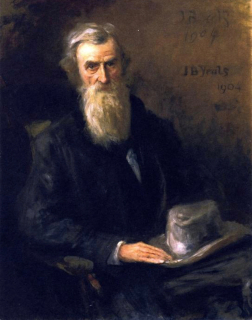
Death of Irish Artist John Butler Yeats

john-butler-yeats

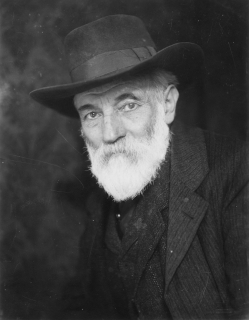
John Butler Yeats, Irish artist and the father of William Butler Yeats, Lily Yeats, Elizabeth Corbett Yeats and Jack Butler Yeats, dies in New York City on February 3, 1922. The National Gallery of Ireland holds a number of his portraits in oil and works on paper, including one of his portraits of his son William, painted in 1900. His portrait of John O’Leary (1904) is considered his masterpiece.

Yeats is born on March 16, 1839, in Lawrencetown, County Down, in what is now Northern Ireland. His parents are William Butler Yeats (1806–1862) and Jane Grace Corbert. He is the eldest of nine children. Educated in Trinity College Dublin and a member of the University Philosophical Society, Yeats begins his career as a lawyer and junior assistant briefly with Isaac Butt before he takes up painting in 1867 and studies at the Heatherley School of Fine Art.

Yeats marries Susan Pollexfen (13 July 1841 – 3 January 1900) on September 10, 1863, at St. John’s Church in Sligo. Susan Yeats is dismayed when her husband abandons the study of law to become an artist. She is described as a “shadowy figure” who goes “quietly, pitifully, mad.” They have six children: William Butler Yeats, Susan Mary “Lily” Yeats, Elizabeth Corbett “Lolly” Yeats, Robert Corbet Yeats, John “Jack” Butler Yeats and Jane Grace Yeats.

There are few records of his sales, so there is no catalogue of his work in private collections. It is possible that some of his early work may have been destroyed by fire in World War II. It is clear that he has no trouble getting commissions as his sketches and oils are found in private homes in Ireland, England and the United States. His later portraits show great sensitivity to the sitter. However, he is a poor businessman and is never financially secure. He moves frequently and shifts several times between England and Ireland.

In 1907, at the age of 68, he travels to New York aboard the RMS Campania, with his daughter Lily, and never returns to Ireland. In October 1909 he moves into his final home, a boarding house run by the Petitpas sisters which is located at 317 West Twenty-Ninth Street. In New York, he is friendly with members of the Ashcan School of painters.

John Butler Yeats dies in the boarding house on February 3, 1922. Edmund Quinn makes a death mask which is now in the collection of the Yeats Society in Sligo. Yeats is buried in Chestertown Rural Cemetery in Chestertown, New York, next to his friend, Jeanne Robert Foster.


Leave a comment

Death of Padraic Colum, Poet & Novelist

padraic-colum

Padraic Colum, Irish-born American poet, novelist, biographer, playwright, and children’s author whose lyrics capture the traditions and folklore of rural Ireland, dies in Enfield, Connecticut on January 11, 1972. He is one of the leading figures of the Irish Literary Revival.

Colum was born on December 8, 1881, in Columcille, County Longford, the first of eight children born to Patrick and Susan Columb. In 1892, the family moves to Glasthule, near Dublin and he attends the local national school. He starts writing after he finishes school and meets a number of the leading Irish writers of the time, including W. B. Yeats, Lady Gregory and Æ. He also joins the Gaelic League and is a member of the first board of the Abbey Theatre. He becomes a regular user of the National Library of Ireland, where he meets James Joyce and the two become lifelong friends.

Influenced by the literary activity of the Celtic revival centered in Dublin at the turn of the century, Colum publishes the collection of poetry Wild Earth (1907). He co-founds The Irish Review in 1911, then three years later settles permanently in the United States. His varied literary output includes volumes of poetry including Dramatic Legends (1922) and Creatures (1927), plays such as Broken Soil (first performed 1903) and The Land (1905), novels, anthologies of folklore and children’s books. The reminiscence Our Friend James Joyce (1959) is written with his wife Mary (Maguire), a well-known literary critic.

The Colums spent the years from 1930 to 1933 living in Paris and Nice, where Padraic renews his friendship with James Joyce and becomes involved in the transcription of Finnegans Wake. After their time in France, the couple moves to New York City, where they do some teaching at Columbia University and City College of New York. He is a prolific author and publishes a total of 61 books, not counting his plays. While in New York, he writes the screenplay for the 1954 stop-motion animated film Hansel and Gretel: An Opera Fantasy. It is his only screenplay.

Mary dies in 1957, and Colum completes Our Friend James Joyce, which they had worked on together. It is published in 1958. He divides his later years between the United States and Ireland. In 1961 the Catholic Library Association awards him the Regina Medal.

Padraic Colum dies on January 11, 1972, at the age of 90, in Enfield, Connecticut. He is buried in St. Fintan’s Cemetery in Sutton, Dublin.


Leave a comment

W.B. Yeats Receives Nobel Prize in Literature

william-butler-yeats-1

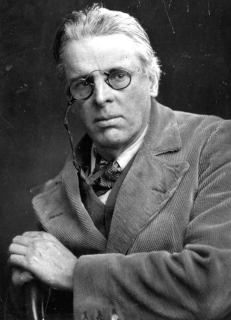
William Butler Yeats, Irish poet and one of the foremost figures of 20th century literature, receives Nobel Prize in Literature on December 10, 1923.

Yeats is born at Sandymount in County Dublin on June 13, 1865. His father, John Butler Yeats, is a lawyer and a well-known portrait painter. He is educated in London and in Dublin but spends his summers in the west of Ireland in the family’s summer house at Connacht. The young Yeats is very much part of the fin de siècle in London. At the same time, he is active in societies that attempt an Irish literary revival. His first volume of verse appears in 1887, but in his earlier period his dramatic production outweighs his poetry both in bulk and in import.

Together with Lady Gregory, Yeats founds the Irish Literary Theatre, which later becomes the Abbey Theatre, and serves as its chief playwright until the movement is joined by John Millington Synge. His plays usually treat Irish legends and also reflect his fascination with mysticism and spiritualism. The Countess Cathleen (1892), The Land of Heart’s Desire (1894), Cathleen ni Houlihan (1902), The King’s Threshold (1904), and Deirdre (1907) are among the best known.

After 1910, Yeats’s dramatic art takes a sharp turn toward a highly poetical, static, and esoteric style. His later plays are written for small audiences. They experiment with masks, dance, and music, and are profoundly influenced by the Japanese Noh plays. Although a convinced patriot, he deplores the hatred and the bigotry of the Nationalist movement, and his poetry is full of moving protests against it. He is appointed to the Irish Senate, Seanad Éireann, in 1922.

Yeats is one of the few writers whose greatest works are actually written after the award of the Nobel Prize. Whereas he receives the Prize chiefly for his dramatic works, his significance today rests on his lyric achievement. His poetry, especially the volumes The Wild Swans at Coole (1919), Michael Robartes and the Dancer (1921), The Tower (1928), The Winding Stair and Other Poems (1933), and Last Poems and Plays (1940), make him one of the outstanding and most influential twentieth-century poets writing in English. His recurrent themes are the contrast of art and life, masks, cyclical theories of life (the symbol of the winding stairs), and the ideal of beauty and ceremony contrasting with the hubbub of modern life.

Yeats dies at the age of 73 at the Hôtel Idéal Séjour, in Menton, France, on January 28, 1939. He is buried after a discreet and private funeral at Roquebrune-Cap-Martin. In September 1948, his body is moved to the churchyard of St. Columba’s Church, Drumcliff, County Sligo, on the Irish Naval Service corvette Macha.

(From Nobel Lectures, Literature 1901-1967, Editor Horst Frenz, Elsevier Publishing Company, Amsterdam, 1969)


Leave a comment

Birth of Irish Language Scholar Osborn Bergin

CREATOR: gd-jpeg v1.0 (using IJG JPEG v62), quality = 100

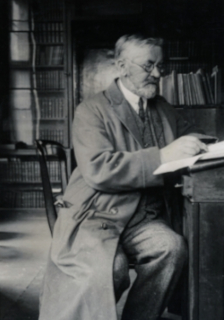
Osborn Joseph Bergin, a scholar of the Irish language and early Irish literature, is born in Cork, County Cork on November 26, 1873.

Bergin is the sixth child and eldest son of Osborn Roberts Bergin and Sarah Reddin, and is educated at Queen’s College Cork, now University College Cork. He then goes to Germany for advanced studies in Celtic languages, working with Heinrich Zimmer at the Friedrich Wilhelm University in Berlin, now the Humboldt University of Berlin, and later with Rudolf Thurneysen at the University of Freiburg, where he writes his dissertation on palatalization in 1906. He then returns to Ireland and teaches at the School of Irish Learning and at University College Dublin.

Within one year of becoming Director of the School of Irish Studies in the Dublin Institute for Advanced Studies, Bergin resigns both the senior professorship and his office of director. The reason for his resignation is never made public.

Bergin, who never uses the name Joseph except when signing with his initials, does not seem to have felt the need of institutional religion, and during his lifetime, he rarely attends religious services. He develops Irish nationalist sympathies and remains a firm nationalist all his life but without party affiliations. From the number of Irish speakers living in Cork, he quickly masters the spoken Irish of West Munster. By 1897, his knowledge of spoken and literary Modern Irish is so strong that he is appointed lecturer in Celtic in Queen’s College, Cork. It is during this time that he becomes an active member of the Gaelic League.

Bergin publishes extensively in the journal for Irish scholarship, Ériu. He is best known for his discovery of Bergin’s Law, which states that while the normal order of a sentence in Old Irish is verb-subject-object, it is permissible for the verb, in the conjunct form, to be placed at the end of the sentence. His friend Frank O’Connor writes humorously that while he discovers the law “he never really believed in it.” He writes poetry in Irish and makes a number of well-received translations of Old Irish love poetry.

Bergin is celebrated in Brian O’Nolan‘s poem Binchy and Bergin and Best, originally printed in the Cruiskeen Lawn column in The Irish Times and now included in The Best of Myles. He is noted for his feuds with George Moore and William Butler Yeats, but he enjoys a lifelong friendship with George William Russell. Frank O’Connor describes Bergin’s eccentricities affectionately in his memoir My Father’s Son.

Osborn Bergin dies in a nursing home in Dublin at the age of 76 on October 6, 1950, having never married.


5 Comments

Birth of Fenian John O’Leary

john-o-leary

John O’Leary, Irish republican and a leading Fenian, is born on July 23, 1830, in Tipperary, County Tipperary. He is imprisoned in England during the nineteenth century for his involvement in the Irish Republican Brotherhood.

O’Leary, born a Catholic, is educated at the local Protestant grammar school, The Abbey School, and later the Catholic Carlow College. He identifies with the views advocated by Thomas Davis and meets James Stephens in 1846.

He begins his studies in law at Trinity College, Dublin, in 1847, where, through the Grattan Club, he associates with Charles Gavan Duffy, James Fintan Lalor and Thomas Francis Meagher.

After the failure of the Young Ireland Rebellion of 1848, O’Leary attempts to rescue the Young Ireland leaders from Clonmel Gaol, and is himself imprisoned for a week from September 8, 1849. He takes part in a further attempted uprising in Cashel on September 16, 1849, but this proves abortive.

O’Leary abandons his study of law at Trinity College because he is unwilling to take the oath of allegiance required of a barrister. He enrolls at Queen’s College, Cork in 1850, to study medicine, later moving to Queen’s College, Galway, then on to further studies at Meath Hospital in Dublin, in Paris and in London. In 1855, he visits Paris, where he becomes acquainted with Kevin Izod O’Doherty, John Martin and the American painter, James Abbott McNeill Whistler. He subsequently becomes financial manager of the newly formed Irish Republican Brotherhood (IRB) and is joint editor of the IRB paper The Irish People.

On September 16, 1865, O’Leary is arrested and later tried on charges of high treason, eventually reduced to “treason felony.” He is sentenced to twenty years of penal servitude, of which five years are spent in English prisons, prior to his release and exile in January 1871. During his exile, he lives mainly in Paris, also visiting the United States, remains active in the IRB and its associated organisations, and writes many letters to newspapers and journals.

On the expiration of his 20-year prison term and therefore of the conditions associated with his release in 1885, O’Leary returns to Ireland. He and his sister, the poet Ellen O’Leary, both become important figures within Dublin cultural and nationalist circles, which include William Butler Yeats, Maud Gonne, Rose Kavanagh, Rosa Mulholland, George Sigerson, and Katharine Tynan. He also functions as an elder statesman of the separatist movement, being active in the Young Ireland Society, and acts as president of the Irish Transvaal Committee, which supports the Boer side in the Second Boer War.

John O’Leary dies at his residence in Dublin on the evening of March 16, 1907. He is referred to famously by W.B. Yeats in his poem September 1913: “Romantic Ireland’s dead and gone/It’s with O’Leary in the grave.”

(Pictured: Painting of John O’Leary, a favorite subject of John Butler Yeats (1904). The National Gallery of Ireland owns three oil portraits of O’Leary.)


Leave a comment

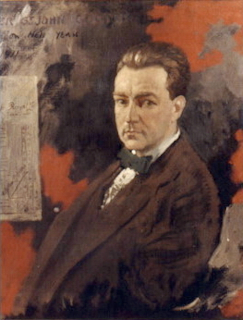
Birth of Seumas O’Sullivan, Poet & Editor

seamus-o-sullivan

Seumas O’Sullivan, Irish poet and editor of The Dublin Magazine born James Sullivan Starkey, is born in Dublin on July 17, 1879.

O’Sullivan spends his adult life in the Dublin suburb of Rathgar. In 1926 he marries the artist Estella Solomons, sister of Bethel Solomons. Her parents are opposed to the marriage as Seumas is not Jewish.

O’Sullivan’s books include Twilight People (1905), Verses Sacred and Profane (1908), The Earth Lover (1909), Selected Lyrics (1910), Collected Poems (1912), Requiem (1917), Common Adventures (1926), The Lamplighter (1929), Personal Talk (1936), Poems (1938), Collected Poems (1940), and Dublin Poems (1946). Terence de Vere White praises him as “a true poet,” and is critical of William Butler Yeats for leaving him out of his anthology of Irish poets, which he thinks a particularly strange decision since Yeats and O’Sullivan are friends, although they quarrel from time to time. In 1936 a version of a play by Irish playwright Teresa Deevy called The King of Spain’s Daughter is included in The Dublin Magazine which is edited by Seumas O’Sullivan.

O’Sullivan and B.J. Brimmer Company are accredited within the ‘Acknowledgments’ of People and Music by Thomasine C. McGehee, published via Allyn & Bacon within the Junior High School Series and edited by James M. Glass, 1929 and 1931 respectively, for both the frontispiece In Mercer Street and the excerpt from Ballad of a Fiddler on page 93.

O’Sullivan has a great admiration for Patrick Kavanagh, and in the 1940s he is one of the very few Irish editors who is prepared to publish his poetry.

O’Sullivan’s father, William Starkey (1836-1918), a physician, is also a poet and a friend of George Sigerson.

O’Sullivan is a friend of most of the leading literary figures in Dublin, including William Butler Yeats, James Stephens and George William Russell. His “at homes” on Sunday afternoons are a leading feature of Dublin literary life, as are Russell’s Sunday evenings and Yeats’s Monday evenings. He is inclined to be quarrelsome due to his heavy drinking and on one occasion he insults James Stephens publicly at a literary dinner. Even the kind-hearted Russell admits that “Seumas drinks too much.” Yeats’ verdict is that “the trouble with Seumas is that when he’s not drunk, he’s sober.”

Seumas O’Sullivan dies on March 24, 1958.

(Pictured: Portrait of Seumas O’Sullivan by Estella Frances Solomons)


Leave a comment

Douglas Hyde Inaugurated First President of Ireland

douglas-hyde

Dr. Douglas Hyde, Gaelic scholar from County Roscommon, is inaugurated as the first President of Ireland on June 25, 1938.

Hyde is born at Longford House in Castlerea, County Roscommon, on January 17, 1860. In 1867, his father is appointed prebendary and rector of Tibohine, and the family moves to neighbouring Frenchpark, in County Roscommon. He is home schooled by his father and his aunt due to a childhood illness. While a young man, he becomes fascinated with hearing the old people in the locality speak the Irish language.

Rejecting family pressure to follow previous generations with a career in the Church, Hyde instead becomes an academic. He enters Trinity College, Dublin, where he gains a great facility for languages, learning Latin, Greek, Hebrew, French, and German, but his great passion in life is the preservation of the Irish language.

After spending a year teaching modern languages in Canada, Hyde returns to Ireland. For much of the rest of his life he writes and collects hundreds of stories, poems, and folktales in Irish, and translates others. His work in Irish helps to inspire many other literary writers, such as W.B. Yeats and Lady Gregory.

In 1892, Hyde helps establish the Gaelic Journal and in November of that year writes a manifesto called The necessity for de-anglicising the Irish nation, arguing that Ireland should follow her own traditions in language, literature, and even in dress.

In 1893, Hyde founds the Gaelic League (Conradh na Gaeilge) along with Eoin MacNeill and Fr. Eugene O’Growney and serves as its first president. Many of the new generation of Irish leaders who play a central role in the fight for Irish independence in the early twentieth century, including Patrick Pearse, Éamon de Valera, Michael Collins, and Ernest Blythe first become politicised and passionate about Irish independence through their involvement in the Gaelic League. Hyde does not want the Gaelic League to be a political entity, so when the surge of Irish nationalism that the Gaelic League helps to foster begins to take control of many in the League and politicize it in 1915, Hyde resigns as president.

Hyde takes no active part in the armed upheaval of the 1910s and 1920s, but does serve in Seanad Éireann, the upper house of the Irish Free State‘s Oireachtas, as a Free State senator in 1925-26. He then returns to academia, as Professor of Irish at University College Dublin, where one of his students is future Attorney General and President of Ireland Cearbhall Ó Dálaigh.

In 1938, Hyde is unanimously elected to the newly created position of President of Ireland, a post he holds until 1945. He is inaugurated on June 26, 1938, in the first inaugural ceremony in the nation’s history. He sets a precedent by reciting the Presidential Declaration of Office in Irish. His recitation, in Roscommon Irish, is one of a few recordings of a dialect of which Hyde is one of the last speakers. Upon inauguration, he moves into the long vacant Viceregal Lodge in Phoenix Park, since known as Áras an Uachtaráin.

Hyde’s selection and inauguration receive worldwide media attention and is covered by newspapers in Australia, New Zealand, South Africa, Argentina, and Egypt. Adolf Hitler “orders” the Berlin newspapers “to splash” on the Irish presidential installation ceremony. However, the British government ignores the event. The Northern Ireland Finance Minister, John Miller Andrews, described Hyde’s inauguration as a “slight on the King” and “a deplorable tragedy.”

Despite being placed in a position to shape the office of the presidency via precedent, Hyde by and large opts for a quiet, conservative interpretation of the office.

In April 1940 Hyde suffers a massive stroke and plans are made for his lying-in-state and state funeral, but to the surprise of everyone he survives, albeit paralysed and confined to a wheelchair. One of Hyde’s last presidential acts is a visit to the German ambassador Eduard Hempel on May 3, 1945, to offer his condolences on the death of Adolf Hitler, a visit which remains a secret until 2005.

Hyde leaves office on June 25, 1945, opting not to nominate himself for a second term. He opts not return to his Roscommon home due to his ill-health but rather moves into the former Secretary to the Lord Lieutenant’s residence in the grounds of Áras an Uachtaráin, where he lived out the remaining four years of his life.

Hyde dies in Dublin on July 12, 1949, at age 89. As a former President of Ireland, he is accorded a state funeral which, as a member of the Church of Ireland, takes place in Dublin’s Church of Ireland St. Patrick’s Cathedral. Since contemporary rules of the Roman Catholic Church in Ireland at the time prohibit Roman Catholics from attending services in non-Catholic churches, all but one member of the Catholic cabinet remains outside the cathedral grounds while Hyde’s funeral takes place. Hyde is buried in Frenchpark, County Roscommon at Portahard Church.


Leave a comment

Birth of Forrest Reid, Novelist & Critic

forrest-reid

Forrest Reid, novelist, literary critic and translator, is born in Belfast on June 24, 1875. He is, along with Hugh Walpole and J. M. Barrie, a leading pre-war novelist of boyhood. He is still acclaimed as the greatest of Ulster novelists and is recognised with the award of the 1944 James Tait Black Memorial Prize for his novel Young Tom.

Reid is the youngest son of a Protestant family of twelve, six of whom survive. His mother, his father’s second wife, comes from an aristocratic Shropshire family. Although proud of this ancestry, he finds the strict Protestant ethics of his immediate family constricting. He is educated at the Royal Belfast Academical Institution, after which he is initially apprenticed into the Belfast tea-trade before going to Christ’s College, Cambridge, where he reads medieval and modern languages, and is influenced by the novelist E. M. Forster. His first book, The Kingdom of Twilight, is published in 1904. Following graduation in 1908, he returns to Belfast to pursue a writing career.

As well as his fiction, Reid also translates poems from the Greek Anthology. His study of the work of W. B. Yeats, W. B. Yeats: A Critical Study, has been acclaimed as one of the best critical studies of that poet. He also writes the definitive work on the English woodcut artists of the 1860s, Illustrators of the Sixties (1928). His collection of original illustrations from that time is housed in the Ashmolean Museum, Oxford.

Reid is a close friend of Walter de la Mare, whom he first meets in 1913, and about whose fiction he publishes a perceptive book in 1929. He is also an influence on novelist Stephen Gilbert and has good connections to the Bloomsbury Group of writers. He is a founding member of the Imperial Art League (later the Artists League of Great Britain) and is also a close friend of Arthur Greeves, the artist known to be C. S. Lewis‘s best friend. Greeves paints several portraits of Reid, now all in the possession of the Royal Belfast Academical Institution.

Reid publishes articles in many magazines, including Uladh, The Westminster Review and the Ulster Review, and he reviews books for The Manchester Guardian. Apostate, an autobiography, is published in 1926, and its sequel, Private Road, is published in 1940. He is a founder member of the Irish Academy of Letters.

Forrest Reid dies on January 4, 1947, in Warrenpoint, County Down, Northern Ireland.

Though Reid’s books are not necessarily well known today, he has been labelled “the first Ulster novelist of European stature,” and comparisons have been drawn between his own coming of age novel of Protestant Belfast, Following Darkness (1912), and James Joyce‘s seminal novel of growing up in Catholic Dublin, A Portrait of the Artist as a Young Man (1914). Reid’s fiction, which often uses submerged narratives to explore male beauty and love, can be placed within the historical context of the emergence of a more explicit expression of homosexuality in English literature in the 20th century.

A ‘Forrest Reid Collection’ is held at the University of Exeter, consisting of first editions of all Reid’s works and books about him. Many of his original manuscripts are in the archives of the Belfast Central Library. In 2008, Queen’s University Belfast catalogues a large collection of Forrest Reid documentary material including many letters from E. M. Forster.

In 1952 Forster travels to Belfast to unveil a plaque commemorating Forrest Reid’s life at 13 Ormiston Crescent.


Leave a comment

Birth of Author Violet Florence Martin

violet-florence-martin

Violet Florence Martin, Irish author, is born at Ross House in Connemara, County Galway on June 11, 1862. She is the co-author of a series of novels with her cousin Edith Somerville under the pen name of Martin Ross in the late nineteenth and early twentieth centuries.

Martin is the youngest of sixteen children of James Martin of Ross (1804–1872). The Martin family, a branch of the Martyn family – one of the Tribes of Galway – had settled at Ross by the early seventeenth century, having previously inhabited the town of Galway for some three hundred years. Her father is a Protestant, his grandfather having converted from the Catholic faith in order to retain the family estates under the Penal Laws. Nevertheless, each child of the family is secretly ‘baptised’ by the family servants.

Martin is a kinswoman of Richard Martin and her contemporary, Edward Martyn, two other notable members of the tribe. Her older brother, Robert Jasper Martin, is a noted songwriter and a well-regarded member of the Tory party in London. She shares a great-grandmother with the writer Maria Edgeworth, whose use of Irish vernacular speech she follows in her work.

Martin’s father manages to save both his estate and his tenants during the Great Famine boasting that not one of his people died during the disaster, but at the cost of bankruptcy. Following his death in 1872, the family moves to Dublin and only returns to Ross in 1888 following revelations of financial fraud of the estate by their agent.

Martin and Edith Somerville are second cousins. They originally meet on January 17, 1886, at Castletownshend, after which they become lifelong companions and literary partners. They come to share a home in Drishane, County Cork. In 1889, Violet adopts the pseudonym Martin Ross, which comprises her surname and the name of her ancestral home. Thus, the authors are called Somerville and Ross. Their works include The Real Charlotte (1889), Some Reminiscences of an Irish R.M. and In the Vine Country.

Martin is a convinced Irish Unionist, in opposition to Somerville’s open nationalism. Both she and her brother Robert are well-regarded members of the literary circle in Irish unionism. However, unlike her brother, Martin is a convinced suffragette, becoming vice-president of the Munster Women’s Franchise League. While on friendly terms with the leading members of the Gaelic literary revival such as W.B. Yeats and Lady Gregory, she objects to their romantic version of Irish peasantry. She is on good terms with Edward Martyn, partner of Gregory and Yeats – and her kinsman – and shares his love of the Irish language and culture.

Martin is seriously injured in a riding accident in November 1898, from which she never fully recovers. This is a contributing factor to her death in Drishane, County Cork, on December 21, 1915. Edith Somerville continues to write under their joint literary names, claiming that they are still in contact. The two women leave thousands of letters and 116 volumes of diaries, detailing their lives, much of them yet unpublished. Edith dies at Castletownshend in October 1949, aged 91, and is buried alongside Violet Florence Martin at Saint Barrahane’s Church, Castletownsend, County Cork.


Leave a comment

Birth of Helen Waddell, Poet & Playwright

helen-waddell

Helen Jane Waddell, Irish poet, translator and playwright, is born in Tokyo, Japan on May 31, 1889.

Waddell is the tenth and youngest child of Hugh Waddell, a Presbyterian minister and missionary who is lecturing in the Imperial University. She spends the first eleven years of her life in Japan before her family returns to Belfast. Her mother dies shortly afterwards, and her father remarries. Hugh Waddell himself dies and leaves his younger children in the care of their stepmother. Following the marriage of her elder sister Meg, she is left at home to care for her stepmother, whose health is deteriorating by this time.

Waddell is educated at Victoria College for Girls and Queen’s University Belfast, where she studies under Professor Gregory Smith, graduating in 1911. She follows her BA with first class honours in English with a master’s degree, and in 1919 enrolls in Somerville College, Oxford, to study for her doctorate. A traveling scholarship from Lady Margaret Hall in 1923 allows her to conduct research in Paris. It is at this time that she meets her life-long friend, Maude Clarke.

Waddell is best known for bringing to light the history of the medieval goliards in her 1927 book The Wandering Scholars and translating their Latin poetry in the companion volume Medieval Latin Lyrics. A second anthology, More Latin Lyrics, is compiled in the 1940s but not published until after her death. Her other works range widely in subject matter. For example, she also writes plays. Her first play is The Spoiled Buddha, which is performed at the Opera House, Belfast, by the Ulster Literary Society. Her The Abbe Prevost is staged in 1935. Her historical novel Peter Abelard is published in 1933. It is critically well received and becomes a bestseller.

Waddell also writes many articles for the Evening Standard, The Manchester Guardian and The Nation, and does lecturing and broadcasting.

Waddell is the assistant editor of The Nineteenth Century magazine. Among her circle of friends in London, where she is vice-president of the Irish Literary Society, are William Butler Yeats, Virginia Woolf, Rose Macaulay, Max Beerbohm and George William Russell. Her personal and professional friendship with Siegfried Sassoon apparently makes the latter’s wife suspicious. Although she never marries, she has a close relationship with her publisher, Otto Kyllmann of Constable & Company.

Waddell receives honorary degrees from Columbia, Belfast, Durham and St. Andrews and wins the Benson Medal of the Royal Society of Literature.

A serious debilitating neurological disease puts an end to her writing career in 1950. She dies in London on March 5, 1965, and is buried in Magherally churchyard, County Down, Northern Ireland. A prize-winning biography of her by the Benedictine nun Dame Felicitas Corrigan is published in 1986.