seamus dubhghaill

Promoting Irish Culture and History from Little Rock, Arkansas, USA


Leave a comment

Founding of the Irish National Land League

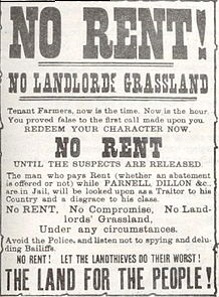
land-league-poster

The Irish National Land League, one of the most important political organizations in Irish history which seeks to help poor tenant farmers, is founded at the Imperial Hotel in Castlebar, County Mayo, on October 21, 1879. Its primary aim is to abolish landlordism in Ireland and enable tenant farmers to own the land they work on. The national organization is modeled on the Land League of Mayo, which Michael Davitt had helped found earlier in the year.

At the founding meeting Charles Stewart Parnell is elected president of the league. Davitt, Andrew Kettle, and Thomas Brennan are appointed as honorary secretaries. This unites practically all the different strands of land agitation and tenant rights movements under a single organisation.

Parnell, Davitt, John Dillon, and others including Cal Lynn then go to the United States to raise funds for the League with spectacular results. Branches are also set up in Scotland, where the Crofters Party imitates the League and secures a reforming Act in 1886.

The government introduces the Landlord and Tenant (Ireland) Act 1870, which proves largely ineffective. It is followed by the marginally more effective Land Acts of 1880 and 1881. These establish a Land Commission that starts to reduce some rents. Parnell together with all of his party lieutenants including Father Eugene Sheehy, known as “the Land League priest,” go into a bitter verbal offensive and are imprisoned in October 1881 under the Protection of Person and Property Act 1881 in Kilmainham Gaol for “sabotaging the Land Act.” It is from here that the No-Rent Manifesto is issued, calling for a national tenant farmer rent strike until “constitutional liberties” are restored and the prisoners freed. It has a modest success In Ireland and mobilizes financial and political support from the Irish Diaspora.

Although the League discourages violence, agrarian crimes increase widely. Typically, a rent strike is followed by eviction by the police and the bailiffs. Tenants who continue to pay the rent can be subject to a boycott by local League members. Where cases go to court, witnesses would change their stories, resulting in an unworkable legal system. This in turn leads on to stronger criminal laws being passed that are described by the League as “Coercion Acts.”

The bitterness that develops helps Parnell later in his Home Rule campaign. Davitt’s views as seen in his famous slogan: “The land of Ireland for the people of Ireland” is aimed at strengthening the hold on the land by the peasant Irish at the expense of the alien landowners. Parnell aims to harness the emotive element, but he and his party are strictly constitutional. He envisions tenant farmers as potential freeholders of the land they have rented.


Leave a comment

Free State Government Purchases Copyright to “The Soldiers Song”

amhran-na-bhfiann

The Irish Free State government purchases the copyright of Peadar Kearney‘s The Soldiers Song on October 20, 1933, which becomes the Irish national anthem Amhrán na bhFiann. The song has three verses, but only the choral refrain is officially designated the national anthem.

A Soldiers’ Song is composed in 1907, with words by Peadar Kearney and music by Kearney and Patrick Heeney. The text is first published in Irish Freedom by Bulmer Hobson in 1912. It is used as a marching song by the Irish Volunteers and is sung by rebels in the General Post Office (GPO) during the Easter Rising of 1916. Its popularity increases among rebels held in Frongoch internment camp after the Rising, and the Irish Republican Army (IRA) in the Irish War of Independence (1919–21). After the establishment of the Irish Free State in 1922, a large proportion of the IRA’s men and apparatus become the National Army. The Soldiers’ Song remains popular as an Army tune and is played at many military functions.

The Free State does not initially adopt any official anthem. The delicate political state in the aftermath of the Irish Civil War provokes a desire to avoid controversy. Ex-Unionists continue to regard God Save the King as the national anthem, as it has been for the rest of the British Empire. W. T. Cosgrave, President of the Executive Council of the Irish Free State expresses opposition to replacing The Soldiers’ Song, which is provisionally used within the State.

There is concern that the lack of an official anthem is giving Unionists an opportunity to persist with God Save the King. The Soldiers’ Song is widely if unofficially sung by nationalists. On July 12, 1926, the Executive Council of the Irish Free State decides to adopt it as the National Anthem, with Cosgrave the driving force in the decision. However, this decision is not publicised.

In 1928, the Army band establishes the practice of playing only the chorus of the song as the Anthem, because the longer version is discouraging audiences from singing along.

The anthem is played by Radio Éireann at close down from its inception in 1926. Cinemas and theatres do so from 1932 until 1972. Peadar Kearney, who has received royalties from publishers of the text and music, issues legal proceedings for royalties from those now performing the anthem. He is joined by Michael Heeney, brother of Patrick Heeney, who had died in 1911. In 1934, the Department of Finance acquires the copyright of the song for the sum of £1,200. Copyright law changes in 1959, such that the government has to reacquire copyright in 1965, for £2,500. As per copyright law, the copyright expires in December 2012, following the 70th anniversary of Kearney’s death. In 2016, three Fianna Fáil senators introduce a private member’s bill intended to restore the state’s copyright in the anthem.


Leave a comment

The Guildford Four Are Released From Prison

guildford-four-release

After serving 15 years in prison, the Guildford Four, Gerry Conlon, Patrick Armstrong, Carole Richardson, and Paul Hill, are released on October 19, 1989, in what is considered to be one of the biggest-ever miscarriages of justice in Britain.

On October 5, 1974, an Irish Republican Army (IRA) bomb kills four people in a Guildford pub frequented by British military personnel, while another bomb in Woolwich kills three. British investigators rush to find suspects and soon settle on Gerry Conlon and Paul Hill, two residents of Northern Ireland who are in the area at the time of the terrorist attack.

Under the recently rewritten Prevention of Terrorism Act, British investigators are allowed to hold and interrogate terrorist suspects for five days without any hard evidence. Conlon and Hill, who are nonpolitical petty criminals, are among the first suspects held under the new law. During their prison stay, investigators fabricate against them an IRA conspiracy that implicates a number of their friends and family members. The officers then force the two suspects to sign confessions under physical and mental torture. In October 1975, Gerry Conlon, Paul Hill, Paddy Armstrong, and Carole Richardson are sentenced to life in prison – mandatory for adults convicted of murder. Seven of their relatives and friends, called the Maguire Seven, are sentenced to lesser terms on the basis of questionable forensic evidence.

In 1989, detectives from Avon and Somerset Constabulary, investigating the handling of the case, find three significant pieces of evidence in relation to Surrey Police‘s handling of the Guildford Four and their statements.

Firstly, typed notes from Patrick Armstrong’s police interviews which had been heavily edited. Deletions and additions had been made, and the notes had been rearranged. These notes, and their amendments, are consistent with hand-written and typed notes presented at the trial, which suggest that the hand-written notes are made after the interviews had been conducted. The notes presented had been described in court as contemporaneous records.

Secondly, a series of manuscript notes relating to an interview with Hill, which show that Hill’s fifth statement is taken in breach of Judges’ Rules and may well have been inadmissible as evidence. The information is not made available to the Director of Public Prosecutions or the prosecution. Further, the officers involved had denied under oath that such an interview had happened.

Thirdly, detention records are inconsistent with the times and durations of the claimed interviews reported by the Surrey police.

In the face of growing public protest and after the disclosure of exonerating evidence, including the admittance of guilt in the bombings by an imprisoned IRA member, the group’s conviction is declared “unsafe and unsatisfactory.” The Guildford Four are cleared of all charges and released after 15 years in prison. The following year a British appeals court also overturns the convictions of the Maguire Seven, who were jailed on the basis of forensic evidence that is shown to have no relevant scientific basis.

(Pictured: Gerry Conlon on his release from prison in 1989)


Leave a comment

Death of Irish Priest Eugene O’Growney

eugene-o-growney

Eugene O’Growney, Irish priest, scholar, and a key figure in the Gaelic revival of the late 19th century, dies in Los Angeles, California, on October 18, 1899. He was born at Ballyfallon, Athboy, County Meath, on August 25, 1863.

The Irish language has largely retreated from Meath when O’Growney is born, and neither of his parents speak it. He becomes interested in the language when he chances upon the Irish lessons in the nationalist newspaper Young Ireland. He has help at first from a few old people who speak the language, and while at St. Patrick’s Pontifical University, Maynooth, where he continues his studies for the priesthood. He spends his holidays in Irish-speaking areas in the north, west, and south. He gets to know the Aran Islands and writes about them in the bilingual Gaelic Journal (Irisleabhar na Gaedhilge). He is ordained in 1888. His proficiency in the language leads him to be appointed in the re-established Chair of Irish at Maynooth in 1891. He serves as editor of the Gaelic Journal between 1894 and 1899 and during his tenure ensures that more material is published in Irish.

For O’Growney, language, nationality, and religion are closely linked. In 1890, writing in the Irish Ecclesiastical Review, he describes literature in Irish as “the most Catholic literature in the world.” He is aware, however, of its other aspects, adding that “even if Irish were to perish as a spoken language, it would remain valuable from the pure literature point of view.”

O’Growney’s Simple Lessons in Irish, first published in the newspaper the Weekly Freeman, prove so popular that they are published in booklet form. There are five books in the series and, by 1903, 320,000 copies have been sold.

O’Growney is a founding member of the Gaelic League, which is created in Dublin in 1893 “for the purpose of keeping the Irish language spoken in Ireland,” and later becomes its vice-president.

In 1894, failing health causes him to go to Arizona and California, where he dies in Los Angeles in 1899. Some years later, with the aid of Irish sympathisers in the United States, his body is brought back to Ireland.

His funeral, held on September 26, 1903 at the Catholic Pro-Cathedral, Dublin, is attended by 6,000 people, including members of the trade guilds, clerics, politicians, members of the nationalist Gaelic Athletic Association, and students. Eugene O’Growney is buried at Maynooth.


Leave a comment

Henry II Lands at Waterford

henry-ii-at-waterford

Henry II, fearful that Richard de Clare, 2nd Earl of Pembroke, also known as Strongbow, will grow too powerful in Ireland, lands with an army at Waterford on October 17, 1171. The Normans, Norse, and Irish all submit to him, except for the most remote Irish kings.

Henry is worried about the growing power of the Cambro-Norman knights, in particular Strongbow, who has in the previous two years carved out what is a substantial new territory, as well as a delicately located new territory with regard to Henry’s own holdings in what is termed the Angevin Empire.

Henry’s presence changes the game for the Norman lords. Either they agree to do as he asks, submit to his sovereignty and accept the land they have grasp through force of arms as his gift, or branded as rebels they face their King with an army of 1,000 knights.

The Lords see the way of things and agree to the demand. Many of the Gaelic Irish, seeing Henry as a potential ally against the power of the Norman Lords, swear allegiance as well.

Henry receives recognition and hostages from the Ostmen of Wexford, who have captured Robert FitzStephen, as well as from many other kings in Ireland including Diarmait MacCarthaigh, king of Cork, Domnall Mór Ua Briain, king of Limerick, Murchadh O Cearbhaill, king of Airgialla, Tighearnán Mór Ua Ruairc, king of Breifne, and Donn Sléibe mac Con Ulad Mac Duinn Sléibe, king of Ulaid.

Henry formally grants Leinster to Strongbow in return for homage, fealty, and the service of 100 knights, reserving to himself the city and kingdom of Dublin and all seaports and fortresses. He also grants the kingdom of Meath, from the River Shannon to the sea, to his own follower Hugh de Lacy.

Henry II’s arrival at Waterford puts to rest the idea of an independent Irish kingdom that any Norman lord might imagine and determines a course for Ireland for some 750 years.


Leave a comment

Birth of Oscar Wilde

oscar-wilde

Oscar Fingal O’Flahertie Wills Wilde, playwright, novelist, essayist, and poet, is born on October 16, 1854, at 21 Westland Row, Dublin, now home of the Oscar Wilde Centre, Trinity College. After writing in different forms throughout the 1880s, he becomes one of London‘s most popular playwrights in the early 1890s. He is remembered for his epigrams, his novel The Picture of Dorian Gray, his plays, as well as the circumstances of his imprisonment and early death.

Wilde’s parents are successful Anglo-Irish Dublin intellectuals. Their son becomes fluent in French and German early in life. At university, Wilde read Greats and proves himself to be an outstanding classicist, first at Dublin, then at Magdalen College, Oxford. He becomes known for his involvement in the rising philosophy of aestheticism, led by two of his tutors, Walter Pater and John Ruskin. After university, Wilde moves to London into fashionable cultural and social circles.

As a spokesman for aestheticism, Wilde tries his hand at various literary activities. He publishes a book of poems, lectures in the United States and Canada on the new “English Renaissance in Art,” and then returns to London where he works prolifically as a journalist. Known for his biting wit, flamboyant dress and glittering conversation, Wilde becomes one of the best-known personalities of his day.

At the turn of the 1890s, he refines his ideas about the supremacy of art in a series of dialogues and essays, and incorporates themes of decadence, duplicity, and beauty into his only novel, The Picture of Dorian Gray (1890). The opportunity to construct aesthetic details precisely, and combine them with larger social themes, draws Wilde to write drama. He writes Salome (1891) in French in Paris, but it is refused a licence for England due to the absolute prohibition of Biblical subjects on the English stage. Unperturbed, Wilde produces four society comedies in the early 1890s, which make him one of the most successful playwrights of late Victorian London.

At the height of his fame and success, while his masterpiece, The Importance of Being Earnest (1895), is still on stage in London, Wilde has the John Douglas, 9th Marquess of Queensberry prosecuted for libel. The Marquess is the father of Wilde’s lover, Lord Alfred Douglas. The charge carries a penalty of up to two years in prison. The trial unearths evidence that causes Wilde to drop his charges and leads to his own arrest and trial for gross indecency with men. After two more trials he is convicted and imprisoned for two years’ penal labour.

In 1897, in prison, he writes De Profundis, which is published in 1905, a long letter which discusses his spiritual journey through his trials, forming a dark counterpoint to his earlier philosophy of pleasure. Upon his release he leaves immediately for France, never to return to Ireland or Britain. There he writes his last work, The Ballad of Reading Gaol (1898), a long poem commemorating the harsh rhythms of prison life.

Wilde dies destitute of cerebral meningitis in Paris on November 30, 1900. at the age of 46. He is initially buried in the Cimetière parisien de Bagneux outside Paris. In 1909 his remains are disinterred and transferred to Père Lachaise Cemetery, inside the city.


Leave a comment

Seamus Heaney Awarded Nobel Prize in Literature

seamus-heaney

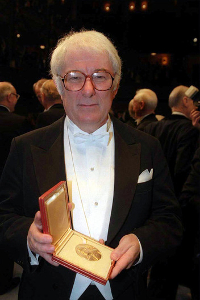
Seamus Heaney, poet, playwright, translator, and lecturer, is awarded the Nobel Prize in Literature on October 15, 1995.

Heaney is born in April 1939 near Castledawson, County Derry, Northern Ireland, where his family engages in farming and selling cattle. His education includes studies at Queen’s University Belfast, where he also serves as a lecturer in the late 1960s. He makes his debut as a poet then, but continues to divide his time between his own writing and academia. He works at Carysforth College in Dublin, at Harvard University in Cambridge, Massachusetts, and at Oxford University.

Heaney’s poetry is often down-to-earth. For him, poetry is like the earth – something that must be plowed and turned. Often he paints the gray and damp landscape from the British Isles. Peat moss has a special place in his poetry. The poems often are connected with daily experiences, but they also derive motifs from history, all the way back to prehistoric times. Heany’s profound interest in the Celtic and the pre-Christian as well as in Catholic literary tradition has found expression in a number of essays and translations.

Heaney is awarded the Nobel Prize in Literature in 1995 for what the Nobel committee describes as “works of lyrical beauty and ethical depth, which exalt everyday miracles and the living past.” He is on holiday in Greece with his wife, Marie, when the news breaks. No one, not even journalists or his own children, can locate him until he appears at Dublin Airport two days later, though an Irish television camera traces him to Kalamata. Asked how it feels having his name added to the Irish Nobel pantheon featuring William Butler Yeats, George Bernard Shaw, and Samuel Beckett, Heaney responds, “It’s like being a little foothill at the bottom of a mountain range. You hope you just live up to it. It’s extraordinary.” He and Marie are immediately whisked straight from the airport to Áras an Uachtaráin for champagne with President Mary Robinson.


Leave a comment

Founding of the Society of United Irishmen

society-of-united-irishmen

The Society of United Irishmen, a liberal political organisation that initially seeks Parliamentary reform, is founded in Belfast on October 14, 1791. It evolves into a revolutionary republican organisation, inspired by the American Revolution and allied with Revolutionary France. It launches the Irish Rebellion of 1798 with the objective of ending British monarchical rule over Ireland and founding a sovereign, independent Irish republic.

The enthusiasm for the French Revolution sees great Irish interest in Thomas Paine‘s The Rights of Man released in May 1791. A couple of months later the Belfast Volunteer company gathers to celebrate the second anniversary of the fall of the Bastille. It is intended that a new radical society is to be announced during the celebrations which William Drennan, who is to give a declaration, asks to add in resolutions. Drennan refuses due to the short notice of the request and suggests that Theobald Wolfe Tone be asked.

Tone’s reformist radicalism has advanced beyond that of the Whigs, and he proposes three resolutions for the new society, which he names the Society of United Irishmen. The first resolution is for the denouncing of the continuing interference of the British establishment in Irish affairs. The second is for the full reform of the Irish parliament and its representation. The last resolution calls for a union of religious faiths in Ireland to “abolish the differences that had long divided Irishmen” and seeks to give Catholics political rights. This last proposal, however, is quietly dropped by the Belfast Volunteers to ensure unanimity for the proposals amongst the people.

This seems to delay the launch of the new society and by August 1791 Tone, in response to the rebuff of his third resolution, publishes the popular and robust An Argument on Behalf of the Catholics of Ireland, which argues why they should be included in attempts at reform. That October, Tone is invited to a debate on the creation of a new society by a group of people including Samuel Neilson. Here he finds that his resolutions are now found a few months later to be “too tame.” A new set of resolutions is drafted and agreed upon on October 14, which the Belfast branch of the Society of United Irishmen adopts on October 18, and the Dublin branch on November 9. The main problem they identify for Ireland is the issue of national sovereignty.

All attendees at the first meeting of the Belfast branch are Protestant. Two, Theobald Wolfe Tone and Thomas Russell, are Anglicans and the remainder are Presbyterian, most of whom are involved in the linen trade in Belfast. Along with Tone and Russell, the men involved are William Sinclair, Henry Joy McCracken, Samuel Neilson, Henry Haslett, Gilbert McIlveen, William Simms, Robert Simms, Thomas McCabe, and Thomas Pearce. After forming, the Society names chandler Samuel McTier as its first President.


Leave a comment

Birth of Mick Doyle, Rugby Union Player & Coach

mick-doyle

Mick Doyle, Irish rugby union international player and coach, is born in Castleisland, County Kerry, on October 13, 1941.

Doyle begins playing rugby union at Newbridge College, County Kildare. He goes on to study veterinary science at University College Dublin, who he also represents at rugby. He makes his Ireland debut against France on January 23, 1965, scoring a try in the game. While representing Ireland he also studies at the University of Cambridge where he gains a Blue in the 1965 Varsity match against the Oxford University RFC. Doyle also studies at the University of Edinburgh and plays club rugby for Edinburgh Wanderers before returning to Ireland.

Doyle goes on to earn the distinction of never being dropped during his 20-cap international career as a flanker. Doyler, as he is affectionately known, scores the winning try against Wales in the 1967 Five Nations Championship, tours Australia with Ireland in 1967 and South Africa with the British and Irish Lions the following year.

His last game for Ireland is against Australia in October 1968, when he lines out alongside his brother Tommy. He coaches Leinster to Interprovincial Championship success five times between 1979 and 1983 before he succeeds Willie John McBride as Ireland coach during the 1984–85 season. Under In 1985, under Doyle’s stewardship, Ireland wins the Triple Crown and Five Nations Championship.

Doyle leads Ireland to the inaugural 1987 Rugby World Cup, but that joy is tinged with sadness as he suffers a heart attack at the opening dinner. He battles illness and adversity and his recovery from a brain problem is chronicled in his book 0.16.

In later years, apart from working in his veterinary practice, Doyle is a regular contributor to rugby matters on RTÉ Radio One.

Mick Doyle is killed in an automobile accident in Dungannon, County Tyrone, on May 11, 2004.


Leave a comment

Canonisation of Sir Oliver Plunkett

oliver-plunkett

Sir Oliver Plunkett is canonised in Rome by Pope Paul VI on October 12, 1975, the first new Irish saint in almost seven hundred years, and the first of the Irish martyrs to be beatified. For the canonisation, the customary second miracle is waived.

Plunkett is born on November 1, 1625, in Loughcrew, County Meath, to parents with Hiberno-Norman ancestors. Until his sixteenth year, his education is entrusted to his cousin Patrick Plunkett, Abbot of St. Mary’s, Dublin, and brother of Luke Plunkett, the first Earl of Fingall, who later becomes successively Bishop of Ardagh and of Meath. As an aspirant to the priesthood, Plunkett sets out for Rome in 1647.

Plunkett is admitted to the Pontifical Irish College in Rome and proves to be an able pupil. He is ordained a priest in 1654 and deputed by the Irish bishops to act as their representative in Rome. Meanwhile, the Cromwellian conquest of Ireland (1649–1653) has defeated the Roman Catholic cause in Ireland. As a result, it is impossible for Plunkett to return to Ireland for many years, so he petitions to remain in Rome. At the Congregation of Propaganda Fide on July 9, 1669, he is appointed Archbishop of Armagh and is consecrated on November 30 at Ghent. He returns to Ireland on March 7, 1670, as the English Restoration of 1660 has begun on a basis of toleration.

Plunkett sets about reorganising the ravaged Roman Church and builds schools both for the young and for clergy. The Penal Laws have been relaxed in line with the Declaration of Breda in 1660 and he is able to establish a Jesuit College in Drogheda in 1670, which becomes the first Catholic-Protestant integrated school in Ireland.

On the enactment of the Test Act in 1673, to which Plunkett does not agree for doctrinal reasons, the college is closed and demolished. Plunkett goes into hiding, travelling only in disguise, and refuses a government edict to register at a seaport to await passage into exile.

In 1678 the so-called Popish Plot, concocted in England by clergyman Titus Oates, leads to further anti-Roman Catholic action. Archbishop Peter Talbot of Dublin is arrested, and Plunkett again goes into hiding. Despite being on the run and with a price on his head, Plunkett refuses to leave his flock.

Plunkett is arrested in Dublin in December 1679 and imprisoned in Dublin Castle. He is tried at Dundalk for conspiring against the state by allegedly plotting to bring 20,000 French soldiers into the country, and for levying a tax on his clergy to support 70,000 men for rebellion. The trial soon collapses as the prosecution witnesses are themselves wanted men and afraid to appear in court. Plunkett is moved to Newgate Prison in London in order to face trial at Westminster Hall. The first grand jury finds no true bill, but he is not released. The second trial is generally regarded as a serious miscarriage of justice as Plunkett is denied defending counsel.

Archbishop Plunkett is found guilty of high treason in June 1681 “for promoting the Roman faith,” and is condemned to death. Plunkett is hanged, drawn, and quartered at Tyburn on July 1, 1681, the last Roman Catholic martyr to die in England. His body is initially buried in two tin boxes in the courtyard of St. Giles in the Fields church. The remains are exhumed in 1683 and moved to the Benedictine monastery at Lamspringe, near Hildesheim in Germany. His head is brought to Rome, and from there to Armagh, and eventually to Drogheda where it has rested in St. Peter’s Church since June 29, 1921. Most of the body is brought to Downside Abbey, England, where the major part is located today, with some parts remaining at Lamspringe.