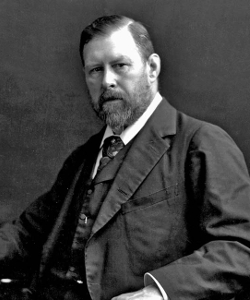
Stoker is born on November 8, 1847, in Clontarf, Dublin. During his lifetime, he is better known as the personal assistant of actor Henry Irving and business manager of the Lyceum Theatre, London, which Irving owns.
Stoker’s father, Abraham Stoker, is a civil servant and his mother, Charlotte Mathilda Blake Thornley, is a charity worker and writer. Stoker is a sickly child and is bedridden with an unknown illness until he starts school at the age of seven, when he makes a complete recovery. Growing up his mother tells him a lot of horror stories which may have influence on his later writings.
In 1864 Stoker enters Trinity College, Dublin. While attending college he begins working as an Irish civil servant. He also works part time as a free lance journalist and drama critic. In 1876 he meets Henry Irving, a famous actor, and they soon become friends. Not long after that, Stoker meets and falls in love with an aspiring actress named Florence Balcombe whom he marries on December 4, 1878 at St. Anne’s Parish Church, Dublin. In 1878 he accepts a job working in London as Irving’s personal secretary.
On December 9, Stoker and his new wife move to England to join Irving. His first book The Duties of Clerks of Petty Sessions in Ireland, though written while he is still in Dublin, is published in 1879. On December 30, 1879 Stoker and his wife have their only child, a son Noel. While in England Stoker also writes several novels and short stories. His first book of fiction, Under the Sunset, is published in 1881.
Stoker visits the English coastal town of Whitby in 1890, a visit that is said to be part of the inspiration for Dracula. Before writing Dracula, he meets Ármin Vámbéry, a Hungarian writer and traveler. Dracula likely emerges from Vámbéry’s dark stories of the Carpathian Mountains. Stoker then spends several years researching European folklore and mythological stories of vampires.
Dracula is an epistolary novel, written as a collection of realistic but completely fictional diary entries, telegrams, letters, ship’s logs, and newspaper clippings, all of which add a level of detailed realism to the story, a skill which Stoker develops as a newspaper writer. At the time of its publication, Dracula is considered a “straightforward horror novel” based on imaginary creations of supernatural life.
The original 541-page typescript of Dracula is believed to have been lost until it is found in a barn in northwestern Pennsylvania in the early 1980s. It consists of typed sheets with many emendations, plus handwritten on the title page is “THE UN-DEAD.” The author’s name is shown at the bottom as Bram Stoker. The typescript is purchased by Microsoft co-founder Paul Allen.
After suffering a number of strokes, Abraham “Bram” Stoker dies at No. 26 St. George’s Square, London on April 20, 1912. Some biographers attribute the cause of death to tertiary syphilis, others to overwork. He is cremated and his ashes are placed in a display urn at Golders Green Crematorium in north London.
The contract to build USS The Sullivans is awarded to Bath Iron Works in Bath, Maine on April 8, 1992, and her keel is laid down on July 27, 1994. She is launched on August 12, 1995, and sponsored by Kelly Ann Sullivan Loughren, granddaughter of Albert Sullivan. The ship is commissioned on April 19, 1997, with Commander Gerard D. Roncolato in command. Upon her commissioning, the ship is given the motto that is thought to have been spoken by the brothers when asked to separate during World War II, “We Stick Together.”
On April 26, 1997, USS The Sullivans departs New York City for Norfolk, Virginia, where, after arriving on April 27, the crew completes underway replenishment qualifications with USS Platte (AO-186). The warship then sails for Naval Station Mayport in Jacksonville, Florida, on April 29 and arrives in her new homeport on May 2. After completing two days of gunnery trials in mid-May, USS The Sullivans embarks upon her shakedown deployment to the West Indies on May 27.
Members of al-Qaeda attempt an attack on USS The Sullivans while in port at Aden, Yemen on January 3, 2000, as a part of the 2000 millennium attack plots. The plan is to load a boat full of explosives and detonate it near USS The Sullivans; however, the boat is so overladen that it sinks. Later, al-Qaeda attempts the same type of attack a second time, successfully bombing USS Cole (DDG-67) on October 12, 2000.
In February 2002 USS The Sullivans deploys with the USS John F. Kennedy carrier battle group to the Arabian Sea in support of Operation Enduring Freedom.
On September 14, 2020, it is announced that USS The Sullivans will be part of HMS Queen Elizabeth‘s Task Group for the GROUPEX and Joint Warrior exercises. On January 19, 2021, a declaration confirms that USS The Sullivans will form part of the escort for HMS Queen Elizabeth during her first active deployment as part of the UK Carrier Strike Group in 2021.
(Photo: U.S. Navy photo of USS The Sullivans on the Mediterranean Sea in July 2002 by Photographer’s Mate 1st Class Jim Hampshire)
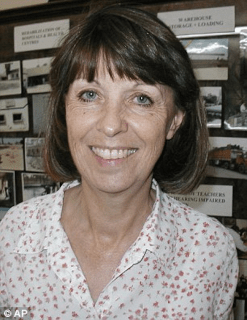
Margaret Hassan, Irish-born aid worker also known as “Madam Margaret,” is born Margaret Fitzsimons in Dalkey, County Dublin on April 18, 1945. She works in Iraq for many years until she is abducted and murdered by unidentified kidnappers in Iraq in 2004. Her remains have never been recovered.
Soon after the end of World War II Hassan’s family moves to London, where she spends most of her early life and where her younger siblings are born. At the age of 27, she marries Tahseen Ali Hassan, a 29-year-old Iraqi studying engineering in the United Kingdom. She moves to Iraq with him in 1972, where she begins work with the British Council of Baghdad, teaching English. Eventually she learns Arabic and becomes an Iraqi citizen.
During the early 1980s, Hassan becomes the assistant director of studies at the British Council, later becoming director. Meanwhile, her husband works as an economist. She remains in Baghdad during the 1991 Gulf War, although the British Council suspends operations in Iraq, and she is left jobless at the end of it.
Hassan joins humanitarian relief organisation CARE International in 1991. Sanitation, health, and nutrition become major concerns in the sanctioned Iraq. She is crucially involved in bringing leukemia medicine to child cancer victims in Iraq in 1998. She becomes a vocal critic of the United Nations restrictions. She is opposed to the United States invasion of Iraq in 2003, arguing that the Iraqis are already “living through a terrible emergency. They do not have the resources to withstand an additional crisis brought about by military action.”
By 2004, Hassan is head of Iraqi operations for CARE. Well known in many of Baghdad’s slums and other cities, she is especially interested in Iraq’s young people, whom she calls “the lost generation.” Her presence draws large crowds of locals.
Hassan is kidnapped in Baghdad on October 19, 2004, and is killed some weeks later on November 8. In a video released of her in captivity she pleads for help and begs British Prime MinisterTony Blair to remove British troops from Iraq. She adds that she does not “want to die like Mr. Bigley,” a reference to Kenneth Bigley, who had been executed in Iraq only weeks earlier.
Patients of an Iraqi hospital take to the streets in protest against the hostage takers’ actions. On October 25, between 100 and 200 Iraqis protest outside CARE’s offices in Baghdad, demanding her release. Prominent elements of the Iraqi insurgency and Iraqi political figures condemn the kidnapping and call for her release. On November 2, Al Jazeera reports that the kidnappers threatened to hand her over to the group led by Abu Musab al-Zarqawi and who is responsible for the execution of Bigley. On November 6, a statement purportedly from al-Zarqawi appears on an Islamist website calling for the release of Hassan unless the kidnappers have information she is aligned with the invading coalition. The statement cannot be authenticated and Hassan’s whereabouts in the video are unknown.
On 15 November, U.S. Marines in Fallujah uncover the body of an unidentified blonde- or grey-haired woman with her legs and arms cut off and throat slit. The body cannot be immediately identified, but is thought unlikely to be Hassan, who has brown hair. There is one other western woman known missing in Iraq at the time the body is discovered, Teresa Borcz Khalifa, a Polish-born long-time Iraqi resident. Khalifa is released by her hostage takers on November 20.
On November 16, CNN reports that CARE has issued a statement indicating that the organisation is aware of a videotape showing Hassan’s execution. Al-Jazeera reports that it has received a tape showing Hassan’s murder but is unable to confirm its authenticity. The video shows Hassan being shot with a handgun by a masked man. It is not known who is responsible for Hassan’s abduction and murder. The group holding her never identifies itself in the hostage videos.
CARE International suspends operations in Iraq because of Hassan’s kidnapping. At least eight other women kidnapped by insurgents during the conflict are released unharmed by their captors. It is unclear why Hassan, who was opposed to the war, lived in Iraq for many years, held Iraqi citizenship, was married to an Arab Muslim and spoke fluent Arabic was killed.
On May 1, 2005, three men are questioned by Iraqi police in connection with the murder. On June 5, 2006, news reports emerge that an Iraqi man by the name of Mustafa Salman al-Jubouri has been sentenced to life imprisonment for “aiding and abetting the kidnappers” but two other men are acquitted. Al-Jubouri appeals this sentence and is given a shorter imprisonment.
An Iraqi man named Ali Lutfi Jassar al-Rawi, also known as Abu Rasha, an architect from Baghdad, is arrested by Iraqi and U.S. forces in 2008 after contacting the British Embassy in Baghdad and attempting to extort 1 million dollars in return for disclosing the location of Hassan’s body. Though Jassar signs statements confessing to the charges, he pleads not guilty, stating he was forced to sign them after receiving beatings and electrical shocks during questioning.
On June 2, 2009, the Press Association reports that Jassar is given a life sentence by Baghdad’s Central Criminal Court for being involved in Hassan’s abduction and murder, and for attempting to blackmail the British Embassy. Hassan’s family welcomes the court’s decision but pleads with Jassar to tell them where her body is so they can return her to Britain for burial. On July 14, 2010, a day before Jassar is due to appear in court for retrial, it is reported that he could not be located in the prison facility where he was being held. He had been missing for a month.
Herzog joins the British Army during World War II, operating primarily in Germany as a tank commander in the Armoured Corps. There, he is given his lifelong nickname of “Vivian” because the British could not pronounce the name, “Chaim.” A Jewish soldier had volunteered that “Vivian” is the English equivalent of “Chaim.”
After leaving the army, Herzog opens a private law practice. He returns to public life when the Six-Day War breaks out in 1967, serving as a military commentator for Kol Yisrael radio news. Following the capture of the West Bank, he is appointed Military Governor of East Jerusalem, and Judea and Samaria.
Herzog enters politics in the 1981 elections, winning a Knesset seat as a member of the Alignment. Two years later, in March 1983, he is elected to the largely ceremonial role of President. He serves two five-year terms before retiring in 1993. He dies on April 17, 1997, and is buried on Mount Herzl, Jerusalem. His son, Isaac Herzog, leads the Israeli Labour Party and the parliamentary Opposition in the Knesset from 2013 to 2018.
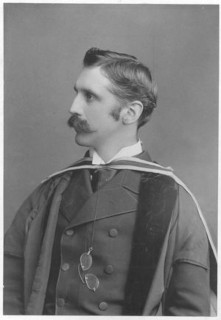
Butcher leaves Trinity on his marriage, in 1876, to Rose Julia Trench (1840-1902), the daughter of ArchbishopRichard Chenevix Trench. The marriage produces no children.
Butcher dies in London on December 29, 1910, and his body is returned to Scotland and interred at the Dean Cemetery in Edinburgh with his wife. His grave has a pale granite Celtic cross and is located near the northern path of the north section in the original cemetery.
Butcher’s many publications include, in collaboration with Andrew Lang, a prose translation of Homer‘s Odyssey which appears in 1879 and the OCT edition of Demosthenes, Orationes, vol. I (Or. 1-19, Oxford, 1903), II.i (Or. 20–26, Oxford, 1907).
O’Keeffe retires reluctantly on medical advice after the 1984 Munster Final with a serious hip complaint, having played relatively few games in the previous eighteen months. He has hip replacement surgery some twenty years later. His last game for Kerry is in the full back position against Tipperary in the 1984 Munster Senior Club Football Championship semi-final. He always maintains that his most dangerous opponent is likely Dublin‘s Jimmy Keaveney, with whom he enjoys several battles. His performance against Offaly‘s Matt Connor in the 1982 All-Ireland final is all the more remarkable considering he has little or no training preparation owing to injury. He is consistently named as full back in various GAA players/managers best ever team selections, particularly in the years leading up to the GAA’s Centenary and beyond.
O’Keeffe is captain of the Austin Stacks team that wins the 1976 County Senior Football Championship. He also wins medals in 1973, 1974, 1979 and 1986 (following a brief comeback), as well as a Munster Club Championship in 1976 and an All-Ireland in 1977. He also wins a County Minor Hurling Championship with the club in 1967. He also captains the St. Brendan’s College, Killarney side to the school’s first Hogan Cup title in 1969.
With the University College Dublin GAA team, O’Keeffe wins a Dublin County Championship in 1974, and the Leinster Club Championships and All-Ireland Club Championships in 1973-74 and 1974-75. He also wins Sigerson Cup medals in 1973, 1974, and 1975.
O’Keeffe teaches history, Social, Personal and Health Education (SPHE), and Physical Education at Tralee Christian Brothers School before retiring after forty years in 2011.
In May 2020, the Irish Independent places O’Keeffe at number ten in its “Top 20 footballers in Ireland over the past 50 years.”
The inaugural meeting of Aosdána, an Irish association of artists, takes place in the Old Parliament House in Dublin on April 14, 1983. It is created in 1981 on the initiative of a group of writers with support from the Arts Council of Ireland. Membership, which is by invitation from current members, is limited to 250 individuals, up from 200 prior to 2005. Its governing body is called the Toscaireacht.
At the suggestion of writer Anthony Cronin, who becomes a founding member, Aosdána is originally established in 1981 by TaoiseachCharles Haughey, well known for his support for the Arts, although columnist Fintan O’Toole has argued that this also serves to deflect criticism of Haughey’s political actions. Haughey’s successor, Garret FitzGerald, formally addresses the inaugural assembly of Aosdána in Dublin.
The process of induction into Aosdána relies entirely on members proposing new members. Applications by artists themselves are not allowed. Some members receive a stipend, called the Cnuas, from the Arts Council of Ireland. This stipend is intended to allow recipients to work full-time at their art. The value of the Cnuas in 2015 is €17,180.
The poet Pearse Hutchinson, a member of Aosdána, describes the organisation as “a miracle and a godsend” that allows him to continue writing at a time when he might have had to give up. Composer Roger Doyle has also spoken about the difference it makes, “I was elected to Aosdána in 1986. This gave me a small stipend from the Government each year, which enabled me to devote all my time to composing. This changed my life for the better and I have composed non-stop since then.”
The Toscaireacht is a committee of ten members, called Toscairí, of the Aosdána. It meets several times a year to deal with the administration and external relations of Aosdána, reports to every General Assembly, which meets once a year, and sets its Agenda. When new members of Aosdána are proposed, the Toscairí have the task of verifying that the nomination process has been complied with, and also that the candidate is willing to accept membership, before the next stage of election is begun.
Toscairí are elected to the Toscaireacht by the members of Aosdána for two year terms. All members of Aosdána are eligible for election, and nominations must be made in writing by three members. The electoral process is in two stages. First, within each of Aosdána’s three disciplines (Music, Literature, and Visual Arts), the two nominees with the highest number of votes are elected. This guarantees a minimum of two Toscairí from each of the disciplines. Next, the remaining four places are filled by the remaining nominees from any discipline who have the highest number of votes.
The procedure at meetings is laid down in the Toscaireacht’s Standing Orders. Minutes of its meetings appear on Aosdána’s web site (aosdana.artscouncil.ie).
Leslie is born on July 27, 1650, in Dublin, the sixth son and one of eight surviving children of John Leslie (1571-1671) and Katherine Conyngham (or Cunningham), daughter of Dr. Alexander Cunningham, Dean of Raphoe. He is allegedly named after the executed Charles I and educated at Enniskillen school and Trinity College, Dublin. After his father dies in 1671, he studies law in London before changing career and being ordained as an Anglican priest in 1681. Shortly afterwards, he returns to the family estate at Glaslough in County Monaghan and marries Jane Griffith. They have a daughter, Vinigar Jane, who appears to have died young and two sons, Robert (1683-1744) and Henry who are also Jacobites and spend time in exile.
Leslie is appointed assistant curate for the Church of Ireland parish of Donagh but as most of his parish is Roman Catholic or Presbyterian, he has few duties. His father had been chaplain to Charles I and a key supporter of Caroline religious reforms, first in Scotland, then in Ireland as Bishop of Raphoe in 1633, while the estate at Glaslough was granted by Charles II in 1660 as a reward for his service. With this background, Leslie is a firm supporter of the Stuart dynasty, although deeply hostile to Catholicism and soon becomes involved in political and theological disputes.
Shortly afterwards, Leslie becomes Clarendon’s personal chaplain and like his patron refuses to take the oath of allegiance to William III and Mary II. Like other non-jurors, he is deprived of his Church offices and becomes instead one of the most prominent Jacobite and Tory propagandists. This includes a long dispute with his Trinity College contemporary William King, who supports the Revolution. Gilbert Burnet, Bishop of Salisbury, later names him ‘the violentest Jacobite’ active in England during these years.
Much of Leslie’s early writing focuses on Scotland, where the 1690 Settlement ends Episcopacy and restores a Presbyterian kirk. He uses this to inspire concern about William’s intentions towards the Church of England. Ironically, his modern fame now rests primarily on a pamphlet written in 1695, called Gallienus Redivivus, or Murther will out, &c. Being a true Account of the De Witting of Glencoe, Gaffney. The focus of this is William’s alleged complicity in the 1672 death of Dutch Republican leader Johan de Witt, with other crimes including Glencoe included as secondary charges. During the Jacobite rising of 1745, Charles Stuart orders Leslie’s pamphlet and the 1695 Parliamentary minutes of the investigation to be reprinted in the EdinburghCaledonian Mercury.
During the 1690s, Leslie serves as a messenger between James’ court in exile at Château de Saint-Germain-en-Laye and the Non-Juror community in England, including the non-juror bishops Jeremy Collier, Thomas Ken and George Hickes. He defends Collier and two other non-juror priests when they become involved in a furor over the execution of Sir John Friend and Sir William Parkyns for their role in the 1696 Jacobite plot to assassinate William. Immediately prior to the execution, the clergymen declare the two absolved of their sins, effectively declaring the correctness of their actions, while also performing a rite not recognised by the Church of England.
In 1702, the accession of Queen Anne, the last Stuart monarch, causes a resurgence in Jacobite activity and in 1704, Leslie begins a weekly periodical initially called The Observator, later The Rehearsal of Observator and finally The Rehearsal. Although his Tory readership shares his High Church principles, he is primarily a Jacobite and violently opposes the common practice of ‘occasional conformity.’ The Rehearsal is forced to close in 1709 and he falls out with his former allies, including Henry Sacheverell whose trial helped the Tories win a landslide victory in the 1710 British general election.
Despite his Tory allies now being in government, a warrant is issued for Leslie’s arrest for his tract The Good Old Cause, or, Lying in Truth. In 1711 he escapes to Paris, where James Francis Edward Stuart has succeeded his father as the Stuart heir in 1701. He continues to write polemics and act as a Jacobite agent. However, after the failed Jacobite rising of 1715, France withdraws support for the Stuarts who are forced to leave France, eventually being invited to settle in Rome by Pope Benedict XIV. The Spanish-sponsored 1719 Rising in Scotland is judged to have done more damage to the Jacobite cause than otherwise, one of its leaders concluding “it bid fair to ruin the King’s Interest and faithful subjects in these parts.”
Despite these failures, Leslie remains a dedicated Jacobite but his lifelong antipathy towards Catholicism makes living in Rome as a Papal pensionary difficult, while hopes of converting James to Anglicanism fades due to his devout personal Catholicism. He returns to Paris in 1717 and in 1719 publishes a two folio-volume edition of his Theological Works. It is later claimed these placed him ‘very high in the list of controversial authors, the ingenuity of the arguments being equalled only by the keenest and pertinacity with which they are pursued.’ He invites friends and supporters to subscribe to these and by 1721, over 500 members of the House of Lords and House of Commons have pledged a total of £750. Charles Spencer, 3rd Earl of Sunderland finally allows him to return home, with the stipulation he cease his political activities.
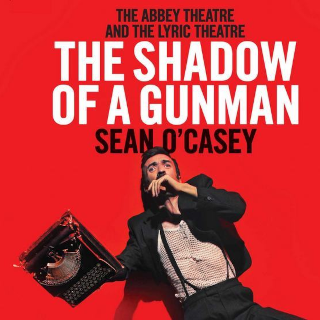
The play is the first in O’Casey’s “Dublin Trilogy” – the other two being Juno and the Paycock (1924) and The Plough and the Stars (1926). It is set in Dublin in May 1920 during the Irish War of Independence and centres on the mistaken identity of a building tenant who is thought to be an Irish Republican Army (IRA) assassin. Each act takes place in Seumus Shield’s room in a tenement in Hilljoy Square.
Donal Davoren is a poet who has come to room with Seumus Shields in a poor, Dublin tenement slum. Many of the residents of the tenement mistake Donal for an IRA gunman on the run. Donal does not refute this notoriety, especially when it wins him the affection of Minnie Powell, an attractive young woman in the tenement. Meanwhile, Seumus’ business partner, Mr. Maguire, drops a bag off at Seumus’ apartment before participating in an ambush in which he is killed. Seumus believes the bag to contain household items for re-sale. The city is put under curfew as a result of the ambush. The Black and Tans raid the tenement and, at that point, Donal and Seumus discover the bag is full of Mills bombs. Minnie Powell takes the bag and hides it in her own room. The Black and Tans find nothing of note in Seumus’ room, but arrest Minnie Powell, who is later shot and killed trying to escape.
In the music video for Northern Irish rock/pop band The Adventures song “Send My Heart” (1984), the lead character is seen trying out for a version of the play.
As a minority party after 1910 elections, the Liberal Party depends on the Irish vote, controlled by John Redmond. To gain Irish support for the budget and the parliament bill, Asquith promises Redmond that Irish Home Rule will be the highest priority. It proves much more complex and time-consuming than expected. Support for self-government for Ireland had been a tenet of the Liberal Party since 1886, but Asquith has not been as enthusiastic, stating in 1903 (while in opposition) that the party should never take office if that government would be dependent for survival on the support of the Irish Nationalist Party. After 1910, though, Irish Nationalist votes are essential to stay in power. Retaining Ireland in the Union is the declared intent of all parties, and the Nationalists, as part of the majority that keep Asquith in office, are entitled to seek enactment of their plans for Home Rule, and to expect Liberal and Labour support. The Conservatives, with die-hard support from the ProtestantOrange Order of Ulster, are strongly opposed to Home Rule. The desire to retain a veto for the House of Lords on such bills has been an unbridgeable gap between the parties in the constitutional talks prior to the December 1910 United Kingdom general election.
The cabinet committee (excluding Asquith) that in 1911 plans the Third Home Rule Bill opposes any special status for Protestant Ulster within majority-Catholic Ireland. In 1913, Asquith writes to Winston Churchill, stating that the Prime Minister has always believed and stated that the price of Home Rule should be a special status for Ulster. In spite of this, the bill as introduced in April 1912 contains no such provision and is meant to apply to all Ireland. Neither partition nor a special status for Ulster is likely to satisfy either side. The self-government offered by the bill is very limited, but Irish Nationalists, expecting Home Rule to come by gradual parliamentary steps, favours it. The Conservatives and Irish Unionists oppose it. Unionists begin preparing to get their way by force if necessary, prompting nationalist emulation. Though very much a minority, Irish Unionists are generally better financed and more organised.
Since the Parliament Act the Unionists can no longer block Home Rule in the House of Lords, but only delay Royal Assent by two years. Asquith decides to postpone any concessions to the Unionists until the bill’s third passage through the House of Commons, when he believes the Unionists will be desperate for a compromise. Biographer Roy Jenkins concludes that had Asquith tried for an earlier agreement, he would have had no luck, as many of his opponents wanted a fight and the opportunity to smash his government. Sir Edward Carson, MP for the University of Dublin and leader of the Irish Unionists in Parliament, threatens a revolt if Home Rule is enacted. The new Conservative leader, Bonar Law, campaigns in Parliament and in Northern Ireland, warning Ulstermen against “Rome Rule,” that is, domination by the island’s Catholic majority. Many who oppose Home Rule feel that the Liberals have violated the Constitution by pushing through major constitutional change without a clear electoral mandate, with the House of Lords, formerly the “watchdog of the constitution,” not reformed as had been promised in the preamble of the 1911 Act and thus justified actions that in other circumstances might be treason.
The passions generated by the Irish question contrast with Asquith’s cool detachment, and he writes about the prospective partition of the county of Tyrone, which has a mixed population, deeming it “an impasse, with unspeakable consequences, upon a matter which to English eyes seems inconceivably small, and to Irish eyes immeasurably big.” As the House of Commons debate the Home Rule bill in late 1912 and early 1913, unionists in the north of Ireland mobilise, with talk of Carson declaring a Provisional Government and Ulster Volunteer Forces (UVF) built around the Orange Lodges, but in the cabinet, only Churchill views this with alarm.
These forces, insisting on their loyalty to the British Crown but increasingly well-armed with smuggled German weapons, prepare to do battle with the British Army, but Unionist leaders are confident that the army will not aid in forcing Home Rule on Ulster. As the Home Rule bill awaits its third passage through the House of Commons, the so-called Curragh incident occurs in March 1914. With deployment of troops into Ulster imminent and threatening language by Churchill and the Secretary of State for War, John Seely, around sixty army officers, led by Brigadier GeneralHubert Gough, announce that they would rather be dismissed from the service than obey. With unrest spreading to army officers in England, the Cabinet acts to placate the officers with a statement written by Asquith reiterating the duty of officers to obey lawful orders but claiming that the incident had been a misunderstanding. Seely then adds an unauthorised assurance, countersigned by Sir John French, the professional head of the army, that the government has no intention of using force against Ulster. Asquith repudiates the addition, and requires Seely and French to resign, taking on the War Office himself, retaining the additional responsibility until hostilities against Germany begin.
Within a month of the start of Asquith’s tenure at the War Office, the UVF lands a large cargo of guns and ammunition at Larne, but the Cabinet does not deem it prudent to arrest their leaders. On May 12, Asquith announces that he will secure Home Rule’s third passage through the House of Commons (accomplished on May 25), but that there will be an amending bill with it, making special provision for Ulster. But the House of Lords make changes to the amending bill unacceptable to Asquith, and with no way to invoke the Parliament Act on the amending bill, Asquith agrees to meet other leaders at an all-party conference on July 21 at Buckingham Palace, chaired by King George V. When no solution can be found, Asquith and his cabinet plans further concessions to the Unionists, but this does not occur as the crisis in Europe erupts into war.
In September 1914, after the outbreak of the conflict, Asquith announces that the Home Rule bill will go on the statute book as the Government of Ireland Act 1914 but will not go into force until after the war. He adds that in the interim a bill granting special status to Ulster will be considered. This solution satisfies neither side.
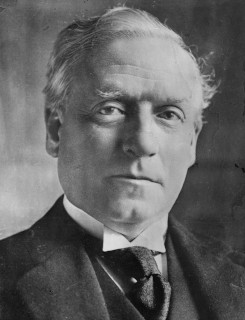
(Pictured: H.H. Asquith, former Prime Minister of the United Kingdom)





 seamus dubhghaill