seamus dubhghaill

Promoting Irish Culture and History from Little Rock, Arkansas, USA


Leave a comment

Birth of Christopher Augustine Reynolds, Archbishop of Adelaide

Christopher Augustine Reynolds, the first Catholic Archbishop of Adelaide, South Australia, is born in Dublin on August 11, 1834.

Reynolds is the son of Patrick Reynolds and his wife Elizabeth, née Bourke. Educated by the Carmelites at Clondalkin, Dublin, he later comes under the influence of the Benedictines when he volunteers for the Northern Territory mission of Bishop Rosendo Salvado Rotea, and is sent to Subiaco near Rome to train for the priesthood. He leaves after three years and goes to the Swan River Colony with Bishop Joseph Serra to continue his training at New Norcia, arriving at Fremantle in May 1855. Probably because of poor health, he leaves the Benedictines and in January 1857 goes to South Australia. He completes his training under the Jesuits at Sevenhill and is ordained in April 1860 by Bishop Patrick Geoghegan. He is parish priest at Wallaroo (where he builds the church at Kadina), Morphett Vale and Gawler. When Bishop Laurence Sheil dies in March 1872, he is appointed administrator of the diocese of Adelaide. On November 2, 1873, in Adelaide he is consecrated bishop by Archbishop John Bede Polding.

Reynolds has a large diocese and in 1872-80 travels over 52,000 miles in South Australia. The opening up of new agricultural districts, an increase in Irish migrants and diocesan debts had produced a grave shortage of clergy. But his most urgent problem is conflicts between and within the clergy and laity over education, especially the role to be played by the Sisters of St. Joseph of the Sacred Heart. He supports the Sisters, reopens schools closed by Archbishop Sheil and, though opposed by the Bishop of the Diocese of Bathurst Matthew Quinn, helps the Superior, Mother Mary MacKillop, secure Rome’s approval for autonomy for her Sisterhood.

Reynolds is not a good administrator and his strenuous efforts to extend Catholic education after the Education Act of 1875 incurs alarming debts. In 1880-81 he visits Rome. On his return, increasingly concerned with finances, disturbed at the prospect of losing St. Joseph nuns and, to some extent misled by jealousy and intrigue, he dramatically reverses his policy towards the Sisterhood and on November 14, 1883, relieves Mother Mary of her duties as Mother Superior. Though the Plenary Council of the Bishops of Australasia, held in Sydney in 1885, support him, in 1888 Pope Leo XIII decrees a central government for the Sisterhood, to be located in Sydney. The council requests that Adelaide be raised to an archiepiscopal and metropolitan see and on September 11, 1887, Reynolds is invested archbishop by Cardinal Francis Moran.

Reynolds’s health is never robust and after a two-year illness he dies on June 12, 1893, in Adelaide, where he is buried. Although he is austere and hard-working, he leaves his successor church debts of over £56,000. A particularly fine preacher, he is widely respected for his missionary zeal and for an ecumenical spirit unusual for his time.

(From: Australian Dictionary of Biography, http://www.adb.anu.edu.au, Ian J. Bickerton)

Leave a comment

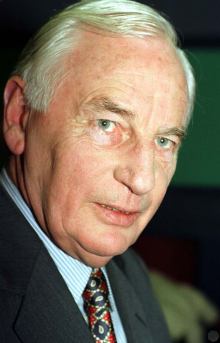
Birth of Peter Barry, Fine Gael Politician

Peter Barry, Fine Gael politician and businessman, is born in Blackrock, Cork, County Cork on August 10, 1928. He serves as Tánaiste from January 1987 to March 1987, Deputy Leader of Fine Gael from 1977 to 1987 and 1991 to 1993, Minister for Foreign Affairs from 1982 to 1987, Minister for the Environment from 1982 to 1981, Minister for Education from 1976 to 1977, Minister for Transport and Power from 1973 to 1976 and Lord Mayor of Cork from 1970 to 1971. He served as a Teachta Dála (TD) from 1969 to 1997.

Barry is the son of Anthony Barry, a Fine Gael TD and well-known businessman. He is educated at Christian Brothers College, Cork and then becomes the major shareholder in the family company, Barry’s Tea.

Barry is first elected to Dáil Éireann as a Fine Gael Teachta Dála (TD) for the Cork City South-East constituency at the 1969 Irish general election. He goes go on to win a Dáil seat at eight successive general elections, changing constituency to Cork City in 1977 and Cork South-Central in 1981. When Fine Gael comes to power following the 1973 Irish general election, he is appointed Minister for Transport and Power. In 1976, he becomes Minister for Education. In 1979, after Garret FitzGerald becomes leader of Fine Gael, he is elected deputy leader. From June 1981 to March 1982, he serves as Minister for the Environment.

From December 1982 to 1987, Barry is Minister for Foreign Affairs. In this capacity he is heavily involved in the negotiations which result in the 1985 Anglo-Irish Agreement. He also becomes the first joint chairman of the Anglo-Irish Intergovernmental Conference, established under the Agreement by the Irish and British governments. Following the Labour Party‘s withdrawal from the coalition government in 1987, he becomes Tánaiste, for a brief period. He is the first member of Fine Gael to hold the office of Tánaiste.

When FitzGerald resigns as Fine Gael leader after the 1987 Irish general election, Barry is one of three candidates, along with Alan Dukes and John Bruton, who contest the party leadership. Dukes is the eventual victor.

Barry retires at the 1997 Irish general election, at which his seat is held for Fine Gael by his daughter Deirdre Clune. She later serves as a Senator representing the Cultural and Educational Panel, but resigns in 2014, on being elected as a Member of the European Parliament for Ireland South.

Barry dies in Cork at the age of 88 on August 26, 2016, following a short illness. Irish President Michael D. Higgins says Barry will be deeply missed. “His view of Irish history was a long one and he brought all that wisdom to bear in his contributions to achieving the Anglo-Irish Agreement. As a person he was immensely popular across all parties and, of course, he had a deep commitment to Cork city and its heritage.”


Leave a comment

Birth of Josephine Bracken, Common-law wife of José Rizal

Marie Josephine Leopoldine Bracken, the common-law wife of Philippine national hero José Rizal, is born in Victoria Barracks in Victoria, British Hong Kong, on August 9, 1876.

Bracken is born to Irish parents James Bracken, a corporal in the British Army, and Elizabeth Jane McBride, of Belfast. After her mother dies shortly after childbirth, her father gives her up for adoption. She is taken in by her godfather, the American George Taufer, a blind, and fairly well-to-do engineer of the pumping plant of the Hong Kong Fire Department, and his late Portuguese wife. He later remarries another Portuguese woman from Macau, Francesca Spencer, with whom he has another daughter.

After the second Mrs. Taufer dies in 1891, Taufer decides to remarry again but the new wife turns out to be difficult to deal with for Bracken. She spends two months in the Convent of the Canossian Sisters, where she previously attended early years of school. She decides to go back only after Taufer calls at the convent’s door pleading with her to come back home as his third wife turned out to be a bad housekeeper. A few months later she has trouble again with the third Mrs. Taufer and haunts her out of the house.

Bracken later recommends that her blind adoptive father see José Rizal, who is a respected ophthalmologist who had practiced at Rednaxela Terrace in Hong Kong. By this time, he is a political exile in Dapitan, Zamboanga del Norte in southern Philippines. The family sails to the Philippines and arrives in Manila on February 5, 1895, and later that month Bracken and Taufer sail to Dapitan.

Taufer’s double cataract is beyond Rizal’s help, but he falls in love with Bracken. Taufer vehemently opposes the union but finally listens to reason. She accompanies Taufer to Manila on his way back to Hong Kong, together with Rizal’s sister, Narcisa, on March 14, 1895. Rizal applies for marriage but because of his writings and political stance, the local priest Father Obach, will only agree to the ceremony if Rizal obtains permission from the Bishop of Cebu. Either the Bishop does not write him back or Rizal is not able to mail the letter because of Taufer’s sudden departure.

Before heading back to Dapitan to live with Rizal, Bracken introduces herself to members of his family in Manila. His mother suggests a civil marriage, which she believes to be a lesser “sacrament” but free from hypocrisy — and thus less a burden to Rizal’s conscience — than making any sort of political retraction. Nevertheless, Bracken and Rizal live together as husband and wife in Barangay Talisay, Dapitan, beginning in July 1895. The couple has a son, Francísco Rizal y Bracken, who is born prematurely and dies within a few hours of birth.

On the evening before his execution on December 30, 1896, on charges of treason, rebellion and sedition by the Spanish colonial government, the Catholic Church claims that Rizal returned to the faith and is married to Bracken in a religious ceremony officiated by Father Vicente Balaguer, S.J. sometime between 5:00 AM and 6:00 AM, an hour before his scheduled execution at 7:00 AM. Despite claims by Father Balaguer and Bracken herself, some sectors, including members of Rizal’s family, dispute that the wedding had occurred because no records are found attesting to the union.

Following Rizal’s death, Bracken joins revolutionary forces in Cavite province, where she takes care of sick and wounded soldiers, boosting their morale, and helping operate reloading jigs for Mauser cartridges at the Imus Arsenal under revolutionary general Pantaleón García. Imus is under threat of recapture, so Bracken, making her way through the thicket and mud, moves with the operation to the Cavite mountain redoubt of Maragondon. She witnesses the Tejeros Convention on March 22, 1897, before returning to Manila, and is later summoned by the Spanish Governor-General, who threatens her with torture and imprisonment if she does not leave the colony. Owing however to her adoptive father’s American citizenship, she cannot be forcibly deported, but she voluntarily returns to Hong Kong upon the advice of the American consul in Manila.

Upon returning to Hong Kong, Bracken once more lives in her father’s house. After his death, she marries Vicente Abad, a Cebuano mestizo, who represents his father’s tabacalera company in the British territory. A daughter, Dolores Abad y Braken, is born to the couple on April 17, 1900. A later testimony of Abad affirms that her mother “was already suffering from tuberculosis of the larynx” at the time of the wedding.

Bracken dies of tuberculosis on March 15, 1902, in Hong Kong and is interred at the Happy Valley Cemetery.


Leave a comment

Death of Edward Daly, Catholic Bishop of Derry

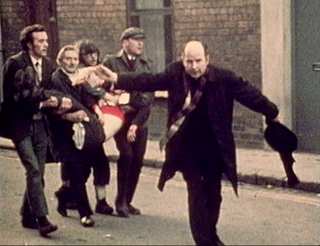
The retired Catholic Bishop of Derry, Dr. Edward Daly, whose photograph becomes the iconic image of Bloody Sunday in 1972, dies at the age of 82 on August 8, 2016.

Daly is born in Ballyshannon, County Donegal, but raised in Belleek, County Fermanagh in Northern Ireland. He attends and boards at St. Columb’s College in Derry on a scholarship, after which he spends six years studying towards ordination to the priesthood at the Pontifical Irish College in Rome. He is ordained a priest of the Diocese of Derry in Belleek on March 16, 1957. His first appointment is as a Curate in Castlederg, County Tyrone. In 1962, he is appointed a Curate in St. Eugene’s Cathedral in Derry, with responsibility for the Bogside area of the city. He leaves briefly in the 1970s to serve as a religious advisor to RTÉ in Dublin in the Republic of Ireland but spends the majority of his career in Derry.

During his time in Derry, Daly takes part in the civil rights marches. He has first-hand experience of the Battle of the Bogside in 1969, the early years of the Troubles, internment, and the events of Bloody Sunday, in which British soldiers fire on unarmed protesters on January 30, 1972, killing 14 people. He becomes a public figure after he is witnessed using a blood-stained handkerchief as a white flag in an attempt to escort 17-year-old Jackie Duddy, a wounded protester, to safety. Duddy dies of his injuries soon after and Daly administers the last rites. He later describes the events as “a young fella who was posing no threat to anybody being shot dead unjustifiably.”

Daly gives an interview to the BBC in which he insists, contrary to official reports, that the protesters were unarmed. He testifies as such to the Widgery Tribunal, though he also testifies that he had seen a man with a gun on the day, to the anger of some of those involved. The Widgery Report largely exonerates the British Army, perpetuating the controversy. Years later, he says that the events of Bloody Sunday were a significant catalyst to the violence in Northern Ireland, and that the shootings served to greatly increase recruitment to the Irish Republican Army (IRA).

Prior to Bloody Sunday, Daly is sympathetic to the “old” IRA, of which his father was a member, but the events of Bloody Sunday leave him of the opinion that “violence is completely unacceptable as a means to a political end,” which leads to tension with the Provisional Irish Republican Army throughout his career.

Daly is appointed Bishop of Derry in 1974, a position he holds until he is forced to retire in October 1993 after suffering a stroke. He continues in the role of chaplain to Derry’s Foyle Hospice until February 2016.

Daly makes headlines in 2011 when he says there needs to be a place in the modern Catholic Church for married priests. He addresses the controversial issue in his book about his life in the Church, A Troubled See. Allowing clergymen to marry would ease the church’s problems, he says.

Daly is awarded the Freedom of the City by Derry City Council in 2015 in a joint ceremony with Bishop James Mehaffey, with whom he had worked closely while the two were in office. He is “hugely pleased to accept [the award], particularly when it is being shared with my friend and brother, Bishop James.” The city’s mayor, Brenda Stevenson, announces that the joint award is in recognition of the two bishops’ efforts towards peace and community cohesion.

Daly dies on August 8, 2016, at Altnagelvin Area Hospital in Derry, having been admitted after a fall several weeks previously. He had also been diagnosed with cancer. He is surrounded by family and local priests.

Daly’s remains are taken to St. Eugene’s Cathedral, where he lay in state with mourners able to file past. His coffin is sealed at midday on August 11, 2016, and buried after Requiem Mass in the grounds of St. Eugene’s Cathedral alongside his predecessor as Bishop of Derry, Neil Farren. The bells of the cathedral toll for one hour on the morning of Daly’s death while many local people arrived to pay tribute. The mayor of Derry, Hilary McClintock, opens a book of condolence in the city’s guildhall for members of the public to sign. The funeral, conducted by the incumbent Bishop of Derry Donal McKeown, is attended by multiple religious and political leaders from across Ireland and retired leaders from throughout his career. A message from Pope Francis is read aloud at the beginning of the service. Hundreds of members of the public also attend the funeral, some lining the route from the cathedral to the gravesite. His coffin is greeted with applause as it is carried out of the cathedral for burial.

(Pictured: Father Edward Daly, waving a blood-stained white handkerchief as he escorts a mortally-wounded protester to safety during the events of Bloody Sunday (1972) in Derry, Northern Ireland, an image which becomes one of the most recognisable moments of the Troubles)


Leave a comment

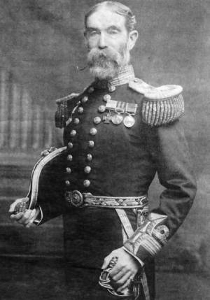
Death of Victoria Cross Recipient Charles Davis Lucas

Charles Davis Lucas, Irish recipient of the Victoria Cross, dies in Great Culverden, Kent, England on August 7, 1914.

Lucas is born in Druminargal House, Poyntzpass, County Armagh, in what is now Northern Ireland, on February 19, 1834. He enlists in the Royal Navy in 1848 at the age of 13, serves aboard HMS Vengeance, and sees action in the Second Anglo-Burmese War of 1852–53 aboard the frigate HMS Fox at Rangoon, Pegu, and Dalla. By age 20, he has become a mate.

On June 21, 1854, in the Baltic Sea during the Crimean War, HMS Hecla, along with two other ships, is bombarding Bomarsund, a fort in the Åland Islands off Finland. The fire is returned from the fort, and, at the height of the action, a live shell lands on HMS Hecla‘s upper deck with its fuse still hissing. All hands are ordered to fling themselves flat on the deck, but 20-year-old Lucas with great presence of mind runs forward and hurls the shell into the sea where it explodes with a tremendous roar before it hits the water. Thanks to his action no one on board is killed or seriously wounded by the shell and, accordingly, he is immediately promoted to lieutenant by his commanding officer. His act of bravery is the first to be rewarded with the Victoria Cross in 1857.

In 1879 Lucas marries Frances Russell Hall, daughter of Admiral William Hutcheon Hall, who had been captain of HMS Hecla in 1854. The couple has three daughters together. Lucas serves for a time as Justice of the Peace for both Kent and Argyllshire.

Lucas’s later career includes service on HMS Calcutta, HMS Powerful, HMS Cressy, HMS Edinburgh, HMS Liffey and HMS Indus. He is promoted to commander in 1862 and commands the experimental armoured gunboat HMS Vixen in 1867. He is promoted to captain in 1867, before retiring on October 1, 1873. He is later promoted to rear admiral on the retired list in 1885. During his career he receives the India General Service Medal with the bar Pegu 1852, the Baltic Medal 1854–55, and the Royal Humane Society Lifesaving Medal.

Lucas dies in Great Culverden, Kent on August 7, 1914. He is buried at St. Lawrence’s Church, Mereworth, Maidstone, Kent.

Lucas’s campaign medals, including his Victoria Cross, are displayed at the National Maritime Museum in Greenwich, London. They are not the original medals, which were left on a train and never recovered. Replacement copies were made, though the reverse of the Victoria Cross copy is uninscribed.


Leave a comment

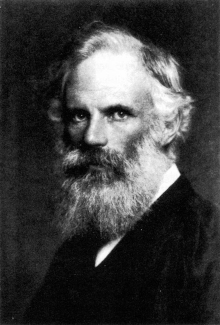
Birth of Classical Scholar Sir William Ridgeway

Sir William Ridgeway, FBA, Anglo-Irish classical scholar and the Disney Professor of Archaeology at the University of Cambridge, is born on August 6, 1853, at Ballydermot, Kings County (now County Offaly).

Ridgeway is the son of Rev. John Henry Ridgeway and Marianne Ridgeway. He is a direct descendant of one of Oliver Cromwell’s settlers in Ireland. He is educated at Portarlington School and Trinity College Dublin, after which he studies at Peterhouse, Cambridge then Gonville and Caius College, Cambridge, completing the Classical tripos there in 1880.

In 1880, Ridgeway marries Lucinda Maria Kate Samuels in Rathdown, County Dublin. Their daughter Lucy Marion Ridgeway (1882–1958) marries economist John Archibald Venn in 1906.

In 1883, Ridgeway is elected Professor of Greek at Queen’s College, Cork, then Disney Professor of Archaeology at Cambridge in 1892. He also holds tenure as Gifford lecturer in Religion at the University of Aberdeen from 1909 to 1911 from which is published The Evolution of Religions of Ancient Greece and Rome.

Ridgeway contributes articles to the Encyclopedia Biblica (1903), Encyclopædia Britannica (1911) and writes The Origin of Metallic Currency and Weight Standards (1892), and The Early Age of Greece (1901) which are significant works in Archaeology and Anthropology.

Ridgeway is President of the Royal Anthropological Institute of Great Britain and Ireland from 1908-10 and is instrumental in the foundation of the Cambridge school of Anthropology.

Ridgeway receives an honorary Doctorate of Letters (D.Litt.) from the University of Dublin in June 1902 and is elected a Fellow of the British Academy in 1904. For his research on horses, he receives the Doctor of Science (Sc.D.) of Cambridge in 1909. He is knighted in the 1919 Birthday Honours list.

Ridgeway dies on August 12, 1926.

(Pictured: “Sir William Ridgeway” by Richard Jack (1866-1952), oil on canvas, 1921, Gonville & Caius College, University of Cambridge)


Leave a comment

Death of Poet Matthew Gerard Sweeney

Matthew Gerard Sweeney, Irish poet, dies at Cork University Hospital in Wilton, Cork on August 5, 2018. His work has been translated into Dutch, Italian, Hebrew, Japanese, Latvian, Mexican Spanish, Romanian, Slovakian and German.

Sweeney is born at Lifford, County Donegal, on October 6, 1952. Growing up in Clonmany, he attends Gormanston College (1965–70). He then reads sciences at University College Dublin (1970–72). He goes on to study German and English at the Polytechnic of North London, spending a year at the University of Freiburg, before graduating with a BA Honours degree in 1978.

Sweeney meets Rosemary Barber in 1972 and they marry in 1979. Two offspring – daughter Nico and son Malvin – are produced before the couple goes their separate ways in the early 21st century. Having lived in London for many years until 2001, he separates from Rosemary and goes to live in Timișoara, Romania and Berlin. In 2007, he meets his partner, Mary Noonan, and in early 2008 he moves to Cork to live with her there.

Sweeney produces numerous collections of poetry for which he wins several awards. His novels for children include The Snow Vulture (1992) and Fox (2002). He authors a satirical thriller, co-written with John Hartley Williams, and entitled Death Comes for the Poets (2012).

As Bill Swainson, Sweeney’s editor at Allison & Busby in the 1980s, recalls: “As well as writing his own poetry, Matthew was a great encourager of poetry in others. The workshops he animated, and later the residencies he undertook, were famous for their geniality and seriousness and fun. Sometime in the late 1980s I attended one of these workshops in an upstairs room of a pub in Lamb’s Conduit Street, Bloomsbury, where the poems were circulated anonymously and carefully read and commented on by all. Around the pushed-together tables were Ruth Padel, Eva Salzman, Don Paterson, Maurice Riordan, Jo Shapcott, Lavinia Greenlaw, Michael Donaghy, Maura Dooley and Tim Dooley.” Sweeney later has residencies at the University of East Anglia and Southbank Centre, among many others. He reads at three Rotterdam Poetry Festivals, in 1998, 2003 and 2009.

According to the poet Gerard Smyth: “I always sensed that in the first instance [Sweeney] regarded himself as a European rather than an Irish poet – and rightly so: like the German Georg Trakl whom he admired he apprehended the world in a way that challenged our perceptions and commanded our attention.” Sweeney’s work has been considered “barely touched by the mainstream of English writing” and more so by the German writers Heinrich von Kleist, Georg Büchner, Franz Kafka, Günter Grass and Heinrich Böll, as well as the aforementioned Georg Trakl. According to Poetry International Web, he would be among the top five most famous Irish poets on the international scene.

Sweeney’s final year sees the publication of two new collections: My Life As A Painter (Bloodaxe Books) and King of a Rainy Country (Arc Publications), inspired by Charles Baudelaire‘s posthumously published Petits poèmes en prose.

Having been diagnosed with motor neuron disease the previous year, Sweeney dies at the age of 65 at Cork University Hospital on August 5, 2018, surrounded by family and friends. He continues writing up until three days before his death. In an interview shortly before his death he is quizzed on his legacy, to which he gives the response, “Mostly what awaits the poet is posthumous oblivion. Maybe there will be a young man in Hamburg, or Munich, or possibly Vienna, for whom my German translations will be for a while important – and might just contribute to him becoming a German language poet with Irish leanings.”

Among those attending a special ceremony on August 8, 2018 at the Triskel Arts Centre in Cork to celebrate Sweeney’s life are fellow poets Jo Shapcott, Thomas McCarthy, Gerry Murphy, Maurice Riordan and Padraig Rooney. On August 9, 2018, he is buried in Clonmany New Cemetery in County Donegal.


Leave a comment

Belfast Nationalists Vote Against Orange Parades

Nationalist residents of Belfast’s Lower Ormeau Road vote overwhelmingly on August 4, 2000, against allowing Orange Order parades through the flashpoint district. Results indicate that over 90% of those polled in a secret vote on the mainly nationalist lower Ormeau area of south Belfast want such parades rerouted.

The nationalist residents’ group, the Lower Ormeau Concerned Community (LOCC), which organised the ballot, says the majority of the 600 people who voted want the parades rerouted. In a statement it says it welcomes the result as “an overwhelming and democratic expression of our community’s desire to live free from sectarian harassment”.

LOCC spokesman Gerard Rice says, “We do not claim to speak for loyalist residents.” He adds that the loyal orders will now have to listen to the people of the area. “The whole point in this exercise was not to vindicate our position, but to set out clearly an informed position as to what exactly the opinion in our community is and has been for many years,” he tells BBC Radio Ulster.

“The Orange Order and other loyal institutions have said for many, many years that really people living on the Ormeau Road want parades. That they are actually a colourful event that people can enjoy. We have said that many people within our community would say parades by the loyal institutions were seen as sectarian, coat trailing exercises, the institutions were seen as anti-Catholic and sectarian organisations. Now we can actually say that 95.9% of our community believe that to be true.”

However, the Belfast County Grand Master of the Orange Order rejects the results of the poll. Dawson Baillie says the vote was unrepresentative because it did not include the staunchly loyalist Donegall Pass area and the Ballynafeigh district above the Ormeau Bridge. “We believe that it’s our right and everyone’s right to walk down a main thoroughfare. We’re not going into side streets on the right-hand side of that part of the Ormeau Road or the left-hand side. We go straight down the main thoroughfare. Our parade at any given point would take no more than three to four minutes to pass.”

Unionists question the validity of the poll as it excludes nearby loyalist areas. Dawn Purvis of the Progressive Unionist Party says the poll would not help to resolve the situation. “You don’t get people to enter into talks on the basis of no parade. You get people to enter into talks on the basis of an accommodation,” she says. “If that poll had been held to show what concerns the people of Lower Ormeau have over loyal order parades, that would have been better, that would have been a way forward, trying to address the concerns of the residents of the Lower Ormeau Road. LOCC have not been forthcoming with those concerns, so the talks haven’t moved forward.”

Reverend Martin Smyth, the Belfast South MP, says it had been “a stage-managed exercise” to show how well the group could conduct their business in that area and “to gather support from those who don’t want a procession down that road.”

However, Rice rejects the suggestions that it is unrepresentative because loyalist areas had been left out. Another LOCC representative, John Gormley, says they would welcome equivalent ballots from the loyalist part of the Ormeau area.

Local parish priest Father Anthony Curran says he is satisfied with the conduct of the vote. “A large number of people seem to have come out, a very broad section of the community, elderly young middle-aged, sick. They came free from fear and intimidation.”

A similar poll was last conducted in the Lower Ormeau area in 1995 by management consultants Coopers & Lybrand, when a large majority voted against allowing loyalist marches in the area.

The Northern Ireland Parades Commission has barred the Orange Order from marching through the Lower Ormeau area during its Twelfth of July demonstrations for the previous two years.

(From: “Poll ‘rejects’ loyal order parades” by BBC News (news.bbc.co.uk), August 4, 2000)


Leave a comment

Birth of George Francis FitzGerald, Academic & Physicist

Professor George Francis FitzGerald FRS FRSE, Irish academic and physicist, is born at No. 19, Lower Mount Street in Dublin on August 3, 1851. He is known for his work in electromagnetic theory and for the Lorentz–FitzGerald contraction, which becomes an integral part of Albert Einstein‘s special theory of relativity.

FitzGerald is born to the Reverend William FitzGerald and his wife Anne Frances Stoney. He is the nephew of George Johnstone Stoney, the Irish physicist who coins the term “electron.” After the particles are discovered by J. J. Thomson and Walter Kaufmann in 1896, FitzGerald is the one to propose calling them electrons. He is also the nephew of Bindon Blood Stoney, an eminent Irish engineer. His cousin is Edith Anne Stoney, a pioneer female medical physicist.

Professor of Moral Philosophy at Trinity College Dublin and vicar of St. Anne’s, Dawson Street, at the time of his son’s birth, William FitzGerald is consecrated Bishop of Cork, Cloyne and Ross in 1857 and translates to Killaloe and Clonfert in 1862. George returns to Dublin and enters TCD as a student at the age of sixteen, winning a scholarship in 1870 and graduating in 1871 in Mathematics and Experimental Science. He becomes a Fellow of Trinity in 1877 and spends the rest of his career there, serving as Erasmus Smith’s Professor of Natural and Experimental Philosophy from 1881 to 1901.

Along with Oliver Lodge, Oliver Heaviside and Heinrich Hertz, FitzGerald is a leading figure among the group of “Maxwellians” who revise, extend, clarify, and confirm James Clerk Maxwell‘s mathematical theories of the electromagnetic field during the late 1870s and the 1880s.

In 1883, following from Maxwell’s equations, FitzGerald is the first to suggest a device for producing rapidly oscillating electric currents to generate electromagnetic waves, a phenomenon which is first shown to exist experimentally by the German physicist Heinrich Hertz in 1888.

In 1883, FitzGerald is elected Fellow of the Royal Society. In 1899, he is awarded a Royal Medal for his investigations in theoretical physics. In 1900, he is made an honorary fellow of the Royal Society of Edinburgh.

FitzGerald is better known for his conjecture in his short letter to the editor of Science. “The Ether and the Earth’s Atmosphere” explains that if all moving objects were foreshortened in the direction of their motion, it would account for the curious null-results of the Michelson–Morley experiment. He bases this idea in part on the way electromagnetic forces are known to be affected by motion. In particular, he uses some equations that had been derived a short time before by his friend the electrical engineer Oliver Heaviside. The Dutch physicist Hendrik Lorentz hits on a very similar idea in 1892 and develops it more fully into Lorentz transformations, in connection with his theory of electrons.

The Lorentz–FitzGerald contraction hypothesis becomes an essential part of the Special Theory of Relativity, as Albert Einstein publishes it in 1905. He demonstrates the kinematic nature of this effect, by deriving it from the principle of relativity and the constancy of the speed of light.

FitzGerald suffers from many digestive problems for much of his shortened life. He becomes very ill with stomach problems. He dies on February 22, 1901, at his home, 7 Ely Place in Dublin, the day after an operation on a perforated ulcer. He is buried in Mount Jerome Cemetery.

A crater on the far side of the Moon is named after FitzGerald, as is a building at Trinity College Dublin.


Leave a comment

Death of Kieran Doherty, Irish Republican Hunger Striker

Kieran Doherty, Irish republican hunger striker and politician who serves as a Teachta Dála (TD) for the Cavan–Monaghan constituency from June 1981 to August 1981, dies on August 2, 1981, in HM Prison Maze (known to republicans as Long Kesh) on the 73rd day of his hunger strike. He is a volunteer in the Belfast Brigade of the Provisional Irish Republican Army (IRA).

Doherty is the third son in a family of six. He is born on October 16, 1955, in the Andersonstown area of Belfast and is educated at St. Theresa’s Primary School and Glen Road Christian Brothers School (CBS). The Doherty brothers are known cyclists and sportsmen in the Andersontown area. He wins an Antrim Gaelic football medal at minor level in 1971.

Doherty joins Fianna Éireann in 1971 and is interned by the British Government between February 1973 and November 1975. His brothers Michael and Terence are interned between 1972 and 1974.

Doherty works as an apprentice heating engineer. His girlfriend is Geraldine Scheiss and, although they never become formally engaged, they become very close toward the end of his life. Before his arrest, she had not known that he is in the IRA.

In August 1976, while he is out to set a bomb, the van in which he is riding is chased by the Royal Ulster Constabulary (RUC). During the chase Doherty manages to leave the van and hijack a car. He later ditches the car and is found one mile away from the car. He is convicted and sentenced to 18 years for possession of firearms and explosives, with another four years for the hijack.

Doherty starts his hunger strike on May 22, 1981. While on hunger strike, he is elected as an Anti H-Block TD for the Cavan–Monaghan constituency at the 1981 Irish general election, which is held on June 11. He receives 9,121 (15.1%) first preference votes and is elected on the fourth count. The two seats gained by Anti H-Block candidates denies Taoiseach Charles Haughey the chance to form a government, and the 22nd Dáil Éireann sees a Fine GaelLabour Party coalition government come to office, with Garret FitzGerald as Taoiseach.

Doherty dies at the age of 25 on August 2, 1981. He lasts 73 days on hunger strike, the longest of the 1981 hunger strikers, and only one day short of Terence MacSwiney. He is the shortest-serving Dáil deputy ever, serving as a TD for only two months.

Doherty is commemorated on the Irish Martyrs Memorial at Waverley Cemetery in Sydney, Australia. In October 2016, a painting of him is unveiled in Leinster House by Sinn Féin.