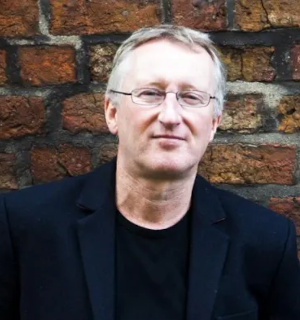
Bateman attends Bangor Grammar School leaving at the age of 16 when he is hired by Annie Roycroft to join the County Down Spectator as a “cub” reporter, then columnist and deputy editor. A collection of his columns is published as Bar Stool Boy in 1989.
Bateman has been writing novels since his debut, Divorcing Jack, in 1994. Divorcing Jack wins a Betty Trask Award in the same year and is adapted into a 1998 film starring David Thewlis. Several of his novels feature the semi-autobiographical Belfast journalist, Dan Starkey.
Bateman’s book Murphy’s Law is adapted from the BBC television series Murphy’s Law (2001–2007), featuring James Nesbitt. He explains on his website that “Murphy’s Law was written specifically for James Nesbitt, a local actor who became a big TV star through Cold Feet. The ninety-minute pilot for Murphy’s Law on BBC One was seen by more than seven million people, and led to three TV series, on which I was the chief writer.”
Bateman’s eight-part series Scúp is written in English and translated into Irish. It is produced by Stirling Productions and BBC Northern Ireland. A second series has since been commissioned.
At the Athyby-election on June 12, 1741, following the death of Sir Walter Dixon Borrowes, James FitzGerald, styled Lord Ophaly and later 1st Duke of Leinster, is returned. In the course of the election there is a duel between William Paul Warren and Jack Hardy, which leads to Hardy’s right hand and arm being shattered. It is thought that it might have to be amputated.
In 1761 FitzGerald is created Earl of Offaly and Marquess of Kildare in the Peerage of Ireland and in 1766 he is further honoured when he is made Duke of Leinster, becoming by this time the Premier Duke, Marquess and Earl in the Peerage of Ireland.
FitzGerald dies at Leinster House, Dublin, on November 19, 1773, aged 51, and is buried in the city’s Christ Church Cathedral. He is succeeded by his second (but eldest surviving) son, William, Marquess of Kildare. The Duchess of Leinster causes a minor sensation by marrying her lover William Ogilvie in 1774 but continues to be known as The Dowager Duchess of Leinster. She has a further three children by him. She dies in London on March 27, 1814, aged 82.
In 1999, Irish Screen, BBC America and WGBH produce Aristocrats, a six-part limited television series based on the lives of Emily Lennox and her sisters. FitzGerald is portrayed by Ben Daniels.
The general election of 1981 is the first one of five during the 1980s. The election also sees three new leaders of the three main parties fight their first general election. Charles Haughey had become Taoiseach and leader of Fianna Fáil at the end of 1979, Garret FitzGerald is the new leader of Fine Gael and Frank Cluskey is leading the Labour Party.
Haughey and Fianna Fáil seem extremely popular with the electorate in early 1981. He is expected to call the election at the time of the Fianna Fáil ardfheis on February 14, but the Stardust fire causes the ardfheis to be postponed, and the Republican hunger strike in the Maze Prison begins in March. By the dissolution in May, much of the earlier optimism in the party has filtered out. The Anti H-Block movement fields abstentionist candidates in solidarity with the hunger strikers, undermining the Republican credentials of Fianna Fáil.
Fianna Fáil’s manifesto promises more spending programmes and Fine Gael puts forward a series of tax-cutting plans.
Fianna Fáil loses seats as a result of sympathy to the Anti H-Block candidates and the attractive tax proposals of Fine Gael. It is the worst performance for Fianna Fáil in twenty years. Meanwhile, Labour Party leader Frank Cluskey loses his seat, necessitating a leadership change with Michael O’Leary succeeding Cluskey. A Fine Gael–Labour Party coalition government comes to power. Fine Gael and the Labour Party form the 17th Government of Ireland, a minority coalition government, with Garret FitzGerald becoming Taoiseach.
(Pictured: Fine Gael’s Garret FitzGerald, who is appointed Taoiseach following the 1981 Irish General Election)
Dowling begins his hurling career at club level with the O’Loughlin Gaels. He breaks onto the club’s top adult team as a 16-year-old in 1994 and enjoys his first success the following year when the club wins the 1995 Kilkenny Premier Junior Hurling Championship. He wins a Kilkenny Intermediate Hurling Championship title in 1996 and promotion to the top flight of Kilkenny hurling. He goes on to make numerous championship appearances at senior level and is at left wing-back on the O’Loughlin Gaels’ Leinster Senior Club Hurling Championship-winning team in 2003. His club career ends as a result of a hip injury in 2010, by which time he has also won two Kilkenny Senior Championship titles.
At inter-county level, Dowling is part of the Kilkenny minor team that wins back-to-back Leinster Minor Hurling Championships in 1995 and 1996 before winning the All-Ireland Under-20 Hurling Championship in 1999. He joins the Kilkenny senior team in 2001. From his debut, he lines out as a half-back or a midfielder and makes a combined total of 25 National League and Championship appearances in a career that ends with his last game in 2005. During that time, he is part of two All-Ireland Senior Hurling Championship-winning teams – in 2002 and 2003. He also secures three successive Leinster Senior Hurling Championship medals and three National Hurling League medals. He is dropped from the panel in June 2005.
Murphy is born in 1767. While his birthplace in Ireland is undetermined, various locations, such as Ballinoulart, Castleannesley or in Kilnew, County Wexford, are documented as possibilities. He is ordained a priest in 1785 at Wexford after completing hedge school in Oulart. His first parish is at Ballycanew, after Theology and Philosophy studies at the Irish College in Bordeaux in France. Murphy joins the Rebellion on May 27, 1798, following the vandalism of his church by Crownyeomen, despite a mostly pacifist stance by the church leadership.
Murphy proceeds toward battle at Gorey, Kilthomas Hill, then Ballyorril Hill where he meets with fellow priest Fr. John Murphy of Boolavogue. He is attacking a gun position on horseback at the Battle of Arklow on June 9, 1798, when he is killed by gunfire. His grave is at Castle Ellis.
(Pictured: Michael Murphy Monument in Arklow, County Wicklow)
McNally is born in Dublin in 1752, the son of a merchant and wine importer. He is raised by his mother with the support of his uncle. He is born into a Roman Catholic family, but at some point in the 1760s he converts to the Church of Ireland. He is passionate about theatre, entirely self-educated and initially becomes a merchant in Bordeaux like his father.
However, in 1774 McNally goes to London to study law at the Middle Temple but returns to Dublin to be called to the Irish bar in 1776. After returning to London in the late 1770s, he qualifies as a barrister in England as well, in 1783. He practises for a short time in London and, while there, supplements his income by writing plays and editing The Public Ledger.
Returning to Ireland, McNally developes a successful career as a barrister in Dublin. He develops an expertise in the law of evidence and, in 1802, publishes what becomes a much-used textbook, The Rules of Evidence on Pleas of the Crown. The text plays a crucial role in defining and publicising the beyond reasonable doubt standard for criminal trials.
Not long after returning to Ireland, McNally becomes involved in radical politics, having already in 1782 published a pamphlet in support of the Irish cause. He becomes Dublin’s leading radical lawyer of the day. In 1792, he represents James Napper Tandy, a radical member of the Irish Parliament, in a legal dispute over parliamentary privilege. In the early 1790s, he becomes a founder member of the United Irishmen, a clandestine society which soon develops into a revolutionary Irish republican organisation. He ranks high in its leadership and acts as the organisation’s chief lawyer, representing many United Irishmen in court. This includes defending Wolfe Tone and Robert Emmet, the leaders of the 1798 and 1803 rebellions respectively, at their trials for treason. In 1793, he is wounded in a duel with Sir Jonah Barrington, who had insulted the United Irishmen. Barrington subsequently describes McNally as “a good-natured, hospitable, talented and dirty fellow.”
After McNally’s death in 1820, it emerges that he had for many years been an informant for the government, and one of the most successful British spies in Irish republican circles that there has ever been. In 1794, when a United Irishmen plot to seek aid from Revolutionary France is uncovered by the British government, McNally turns informer to save himself, although, subsequently, he also receives payment for his services. He is paid an annual pension in respect of his work as an informer of £300 a year, from 1794 until his death in 1820.
From 1794, McNally systematically informs on his United Irishmen colleagues, who often gather at his house for meetings. It is he that betrays Lord Edward FitzGerald, one of the leaders of the 1798 rebellion, as well as Robert Emmet in 1803. A significant factor in the failure of the 1798 rebellion is the excellent intelligence provided to the government by its agents. McNally is considered to be one of the most damaging informers.
The United Irishmen represented by McNally at their trials are invariably convicted and he is paid by the crown for passing the secrets of their defence to the prosecution. During the trial of Emmet, he provides details of the defence’s strategy to the crown and conducts his client’s case in a way that assists the prosecution. For example, three days before the trial he assures the authorities that Emmet “does not intend to call a single witness, nor to trouble any witness for the Crown with a cross-examination, unless they misrepresent facts… He will not controvert the charge by calling a single witness.” For his assistance to the prosecution in Emmet’s case, he is paid a bonus of £200, on top of his pension, half of which is paid five days before the trial.
After McNally’s death, his activities as a government agent become generally known when his heir attempts to continue to collect his pension of £300 per year. He is still remembered with opprobrium by Irish nationalists. In 1997, the Sinn Féin newspaper, An Phoblacht, in an article on McNally, describes him as “undoubtedly one of the most treacherous informers of Irish history.”
McNally is a successful dramatist and writes a number of well-constructed but derivative comedies, as well as comic operas. His first dramatic work is The Ruling Passion, a comic opera written in 1771, and he is known to have authored at least twelve plays between 1779 and 1796 as well as other comic operas. His works include The Apotheosis of Punch (1779), a satire on the Irish playwright Richard Brinsley Sheridan, Tristram Shandy (1783), which is an adaptation of Laurence Sterne‘s novel, Robin Hood (1784), Fashionable Levities (1785), Richard Cœur de Lion (1786), and Critic Upon Critic (1788).
McNally also writes a number of songs and operettas for Covent Garden. One of his songs, The Lass of Richmond Hill, becomes very well-known and popular following its first public performance at Vauxhall Gardens in London in 1789. It is said to be a favourite of George III and popularises the romantic metaphor “a rose without a thorn,” a phrase which he used in the song.
Nothing is known of McNally’s first wife Mary O’Brien, other than that she dies in 1786. In London in 1787, he elopes with Frances I’Anson, as her father William I’Anson a solicitor, disapproves of McNally. Frances, and her family’s estate, Hill House in Richmond, North Yorkshire, is the subject of a song with lyrics by McNally and composed by James Hook, The Lass of Richmond Hill. In 1795, Frances dies during childbirth at age 29 and is survived by only one daughter. In early 1799, McNally marries his third wife, Louisa Edgeworth, the daughter of a clergyman from County Longford.
When McNally’s son, who has the same and professions, dies on February 13, 1820, it is widely reported to have been McNally. The son is buried in Donnybrook, Dublin, on February 17, 1820, and McNally sends a letter on March 6, 1820, to the Proprietor of Saunders’s Newsletter seeking damages for the severe injury caused by the circulation of his death. In June 1820, McNally is on his deathbed, and although he had been a Protestant for most of his adult life, he seeks absolution from a Roman Catholic priest. He dies and is also buried in Donnybrook on June 8, 1820.
The outbreak of the United Irish rebellion in Leinster on May 23 had prompted calls from Ulster United Irishmen to take to the field in support of their southern comrades. However, the organisation in Ulster had been severely damaged in a brutal disarmament campaign the previous year, and the new leadership are less radical and are not willing take to the field without French assistance, which is expected daily.
After waiting for two weeks while the rebellion rages in the south, the grassroots United Irish membership in Antrim decides to hold a number of meetings independent of their leaders. The outcome is the election of Henry Joy McCracken as their adjutant general and the decision to rise immediately. McCracken, together with James Hope, quickly formulate a plan to attack and seize all government outposts in County Antrim and then for the main attack to fall on Antrim town. Then using artillery seized at Antrim, the rebels are to march on Belfast in conjunction with the United Irish rebels in County Down.
McCracken has high hopes that many members of the militia will desert and join him, as disaffection is believed to be widespread, evidenced by the execution of four of the Monaghan militia for treason in Belfast in May.
On 6 June, McCracken and James Hope issue a proclamation calling for the United army of Ulster to rise. The initial plan meets with success, as the towns of Larne, Ballymena, Portaferry and Randalstown are taken and the bridge at Toome damaged to prevent the government from rushing reinforcements into Antrim from west of the River Bann. The rebels then assemble at Donegore Hill in preparation for the march and attack on Antrim town, where an emergency meeting of the county’s magistrates called by the county governor, Lord O’Neill, is due to take place.
Although almost 10,000 rebels assemble at Donegore, many display reluctance for the coming fight and stay on the hill in reserve or desert later so that probably fewer than 4,000 actually take part in the attack. The United Irishmen in Ulster are mostly Presbyterian, but are joined with CatholicDefenders and the tension between the two groups on the march likely causes some desertions. These difficulties lead to a loss of momentum, and the attack is delayed. McCracken is forced to make adjustments to his plan of attack, which had envisaged a simultaneous overwhelming assault on the town from four separate points.
The town is garrisoned by a small force of about 200 yeomen, cavalry under Lt. Col. William Lumley and armed volunteers but they also have four artillery pieces and the delay in the rebel attack allows them to send requests for assistance to Belfast and Lisburn from where reinforcements are already on the way. The garrison forms themselves at the base of the demesne wall of Antrim Castle, with artillery to the front and cavalry to the rear with their flanks anchored by the Market House and Presbyterian Meeting House. A part of the Scottish Quarter in the town is also burned by the garrison as it is perceived to be a stronghold of rebel sympathisers.
The attack finally begins shortly before 3:00 p.m. when the rebels begin a cautious march through the town. As rebel front ranks arrive to face the garrison’s defensive line, artillery opens fire on the rebels, causing them to pull back out of range. Large clouds of dust and smoke are thrown up which, together with the fires from the Scottish Quarter, obscure the garrison’s view of events.
The rebel withdrawal is mistaken for a full retreat and the cavalry moves out to pursue and rout the supposed fleeing rebels. The cavalry effectively runs into a gauntlet of rebels who are protected by a long churchyard wall and stationed in houses along the main street, suffering heavy losses to the gunfire and pikes of the rebels.
After routing the cavalry, the rebels attack the remainder of the garrison, which then begins to pull back to the safety of the castle wall. This is mistaken by a newly arrived rebel column as an attack on them, causing them to flee in panic. In the confusion, the county commander, Lord O’Neill, trapped with his magistrates, is fatally wounded by James Clements who avoids trial by joining the army. A rebel attempt to seize the artillery is only narrowly beaten off by troops stationed behind the demesne wall.
At this critical juncture, British reinforcements from Belfast arrive outside the town and, assuming it to be held by the rebels, begin to shell it with their artillery. This prompts more desertions and the rebel army begins to disintegrate, but their withdrawal is protected by a small band under James Hope which fights a successful rearguard action from the church grounds along the main street. This allows the bulk of the rebels to withdraw safely.
When the military enters the town, they begin a spree of looting, burning and murder, of which the most enthusiastic perpetrators are reported to be the Monaghan militiamen, who are anxious to prove their loyalty and expunge the shame of the recent executions of their comrades for sedition. The town of Templepatrick is burned to the ground and Old Stone Castle is razed to the ground. McCracken, Hope and their remaining supporters withdraw northward, establishing camps of ever dwindling size along the route of their retreat until news of the defeat at Ballynahinch causes their final dispersion. McCracken is arrested by yeomen on July 7 and is hanged in Belfast on July 17, having refused an offer of clemency in return for informing on his comrades.
Commemoration of the centenary of the battle, marked by a nationalist parade in Belfast on June 6, 1898, provokes loyalist riots.
Campbell’s books, mostly collections of humorous pieces that were originally published in newspapers and magazines, include A Long Drink of Cold Water (1949), A Short Trot with a Cultured Mind (1950), An Irishman’s Diary (1950), Life in Thin Slices (1951), Patrick Campbell’s Omnibus (1954), Come Here Till I Tell You (1960), Constantly in Pursuit (1962), How to Become a Scratch Golfer (1963), Brewing Up in the Basement (1963), Rough Husbandry (1965), The P-P-Penguin Patrick Campbell (1965), All Ways on Sundays (1966), A Bunch of New Roses (1967), an autobiography My Life and Easy Times (1967), The Coarse of Events (1968), Gullible Travels (1969), The High Speed Gasworks (1970), Waving All Excuses (1971), Patrick Campbell’s Golfing Book (1972), Fat Tuesday Tails (1972), 35 Years on the Job (1973), and The Campbell Companion (1987). Many of his books are illustrated by Quentin Blake.
Campbell is married three times, first in 1941 to Sylvia Alfreda Willoughby Lee, whom he divorces in 1947. He then marries Chery Louise Munro in 1947. The two divorce in 1966, the year he marries Vivienne Orme.
Campbell speaks with a stammer, but nevertheless delights television audiences with his wit, notably as a regular team captain on the long-running show Call My Bluff, opposite his longtime friend, Frank Muir. Muir notes that “When he was locked solid by a troublesome initial letter he would show his frustration by banging his knee and muttering ‘Come along! Come along!'” Some of his funniest short stories describe incidents involving his stammer. He stands six feet five inches tall, and several of his funniest pieces deal with the problems faced by a man of his build in merely finding shoes or clothes that fit him. He also makes regular appearances in That Was The Week That Was.
Campbell lives for many years in the South of France, commuting to England for his television work and continuing to produce his weekly column in The Sunday Times, which he drops in 1978.
In 1972 a period of illness leads to the discovery that Campbell had suffered an undetected heart attack some years previously and has a permanent heart weakness. An attack of viral pneumonia in 1980 exacerbates this condition, and he dies suddenly on November 9, 1980 while talking to a nurse at University College Hospital, London. He is succeeded as the 4th and last Lord Glenavy by his novelist brother Michael.
Cleeve is the eldest son of Edward Elmes Cleeve, an English immigrant, and Sophia Journeaux, whose family came from Ireland.
In 1860, Cleeve travels to Ireland to stay with his mother’s relatives who run an agricultural machinery business in Limerick known as J.P. Evans & Company. He decides to remain in Ireland and eventually assumes control of the business.
Cleeve marries Phoebe Agnes Dann in 1874 and they have five children. The author and broadcaster Brian Cleeve is his grand nephew.
In 1883, Cleeve starts a new enterprise, the Condensed Milk Company of Ireland, in conjunction with two local businessmen. The company manufactures dairy products, such as condensed milk, butter, cheese and confectionery. Its headquarters are located in Limerick city, on the northern bank of the River Shannon. The business expands over the next 20 years to become the largest of its type in the United Kingdom.
Cleeve is also senior partner in the Cleeve Canning and Cold Storage Company based in British Columbia. He is also the President of Limerick Chamber in 1908-09.
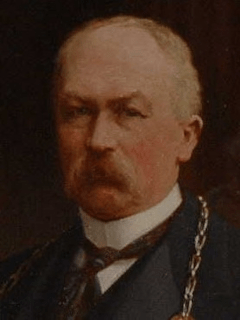
In 1899, Cleeve is voted onto the Limerick City Council. That same year, his fellow councillors elect him as High Sheriff of Limerick City, the Queen’s representative in the city. He holds the position again in 1907 and 1908.
In December 1908, Cleeve is taken ill at a public function. Despite undergoing surgery, he dies of peritonitis on December 19, 1908, at the age of 64. According to contemporary newspaper reports his funeral is one of the largest seen in Limerick city, with crowds lining the streets up to an hour before the cortège passes. He is buried in the churchyard of St. Mary’s Cathedral in the city.
In his history of the RCSI, physician Charles Cameron writes that he has been unable to learn anything about Woodroffe’s parents or his early life.
Woodroffe is appointed assistant-surgeon to Dr. Steevens’ Hospital in 1763, and resident surgeon from 1765, an office which he holds until his death. In 1780 he becomes surgeon to the House of Industry Hospitals in Dublin and remains so for the rest of his life. In 1769 he is living in Crow Street. He moves to Fownes Street in 1774, and in 1784 he is living in St. Andrew’s Street.
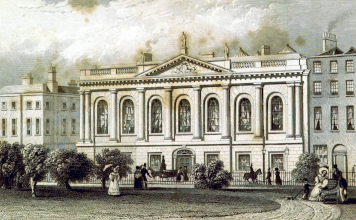
Woodroffe is one of the founding members of the Dublin Society of Surgeons that later becomes the Royal College of Surgeons in Ireland and is one of those to whom the first charter is granted in 1784. In 1786, he follows William Dease as treasurer to the college, and holds the office for eight years. He is president of the college in 1788. His appointments also include surgeon to the Blue Coat School, the Foundling Hospital, and the Hospital for Incurables, Lazar’s Hill (now Townsend Street). Several notable surgeons such as Abraham Colles are apprenticed to him. Colles takes over as resident surgeon at Dr. Steevens’ Hospital after Woodroffe’s death.
Woodroffe dies on June 4, 1799, in St. Andrew’s Street, and is interred in St. Andrew’s churchyard.



 seamus dubhghaill