seamus dubhghaill

Promoting Irish Culture and History from Little Rock, Arkansas, USA


Leave a comment

Birth of Henry Harrison, Politician & Writer

henry-harrison

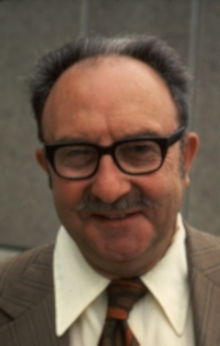
Captain Henry Harrison, nationalist politician and writer, is born in Holywood, County Down on December 17, 1867.

A Protestant nationalist, Harrison is the son of Henry Harrison and Letitia Tennent, the daughter of Robert James Tennent, who had been Liberal Party MP for Belfast from 1847 to 1852. Later, when widowed, she marries the author Hartley Withers.

Harrison goes to Westminster School and then to Balliol College, Oxford. While there he develops an admiration for Charles Stewart Parnell and becomes secretary of the Oxford University Home Rule League. At this time, the Land War is in progress and in 1889 he goes to Ireland to visit the scene of the evictions in Gweedore, County Donegal. He becomes involved in physical confrontations with the Royal Irish Constabulary and as a result becomes a Nationalist celebrity overnight. The following May, Parnell offers the vacant parliamentary seat of Mid Tipperary to Harrison, who leaves Oxford at age 22, to take it up, unopposed.

Only six months later, following the divorce case involving Katharine O’Shea, the Irish Parliamentary Party splits over Parnell’s leadership. Harrison strongly supports Parnell, acts as his bodyguard and aide-de-camp, and after Parnell’s death devotes himself to the service of his widow Katharine. From her he hears a completely different version of the events surrounding the divorce case from that which had appeared in the press, and this is to form the seed of his later books.

At the 1892 United Kingdom general election in Ireland, Harrison does not defend Mid-Tipperary. He stands at West Limerick as a Parnellite instead but comes nowhere near winning the seat. In the 1895 United Kingdom general election in Ireland, he stands at North Sligo, polling better but again far short of winning. In 1895 he marries Maie Byrne, an American, with whom he has a son. He comes to prominence briefly again in 1903 when, in spite of his lack of legal training, he successfully conducts his own case in a court action all the way to the House of Lords.

Otherwise, however, Harrison disappears from public view until his war service with the Royal Irish Regiment when he serves on the Western Front with distinction in the New British Army formed for World War I, reaching the rank of Captain and being awarded the Military Cross (MC). He organises patrols in “No Man’s Land” so successfully that he is appointed special patrol officer to the 16th (Irish) Division. He is invalided out and becomes a recruiting officer in Ireland. He is appointed an Officer of the Order of the British Empire in the 1919 New Year Honours.

Harrison then makes a return to Irish politics, working with Sir Horace Plunkett as Secretary of the Irish Dominion League, an organisation campaigning for dominion status for Ireland within the British Empire. He is a lifelong opponent of Irish partition. He is Irish correspondent of The Economist from 1922 to 1927 and owner-editor of Irish Truth from 1924 to 1927.

Harrison’s two books defending Parnell are published in 1931 and 1938. They have had a major impact on Irish historiography, leading to a more favourable view of Parnell’s role in the O’Shea affair. F. S. L. Lyons comments that he “did more than anyone else to uncover what seems to have been the true facts” about the Parnell-O’Shea liaison. The second book, Parnell, Joseph Chamberlain and Mr Garvin, is written in response to J. L. Garvin‘s biography of Joseph Chamberlain, which had ignored his first book, Parnell Vindicated: The Lifting of the Veil. Later, he successfully repulses an attempt in the official history of The Times to rehabilitate that newspaper’s role in using forged letters to attack Parnell in the late 1880s. In 1952 he forces The Times to publish a four-page correction written by him as an appendix to the fourth volume of the history.

During the difficult years of the Anglo-Irish Trade War over the land purchase annuities, declaration of the Republic, Irish neutrality during World War II, and departure from the Commonwealth, Harrison works to promote good relations between Britain and Ireland. He publishes various books and pamphlets on the issues in dispute and writes numerous letters to The Times. He also founds, with General Sir Hubert Gough, the Commonwealth Irish Association in 1942.

At the time of his death on February 20, 1954, Harrison is the last survivor of the Irish Parliamentary Party led by Parnell, and as a member of the pre-1918 Irish Parliamentary Party, he seems to have been outlived only by John Patrick Hayden, who dies a few months after him in 1954 and by Patrick Whitty and John Lymbrick Esmonde who are only MPs for a very short time during World War I. He is buried in Holywood, County Down.
Leave a comment

Birth of Barney McKenna, Founding Member of The Dubliners

File source: https://commons.wikimedia.org/wiki/File:Barney_001.jpg

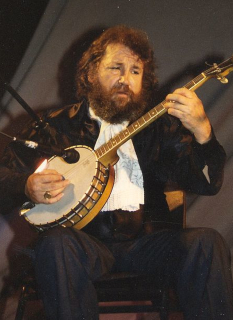
Bernard Noël “Banjo Barney” McKenna, Irish musician and a founding member of The Dubliners, is born on December 16, 1939 in Donnycarney, Dublin. He plays the tenor banjo, violin, mandolin, and melodeon. He is most renowned as a banjo player.

McKenna plays the banjo from an early age, initially because he cannot afford to buy the instrument of his choice, a mandolin. He is a member of The Dubliners from 1962 and is the only living member of the original formation at the time of his death. Prior to joining the Dubliners, he spends a few months in The Chieftains. In addition to his work on traditional Irish music, he also plays jazz on occasion.

McKenna uses GDAE tuning on a 19-fret tenor banjo, an octave below fiddle/mandolin and, according to musician Mick Moloney, is single-handedly responsible for making the GDAE-tuned tenor banjo the standard banjo in Irish music.

McKenna remains a great favourite with live audiences, and some of the loudest and most affectionate applause follows the tunes and songs on which he is the featured performer. He is well known for his unaccompanied renditions of songs such as “South Australia” and “I Wish I Had Someone to Love Me.” His banjo solos on tunes such as “The Maid Behind the Bar,” “The High Reel” and “The Mason’s Apron,” where he is usually accompanied by Eamonn Campbell on guitar, are often performed to cries of “C’mon Barney!” from audience or band members. Another featured spot in Dubliners performances is the mandolin duet that he plays with John Sheahan, again with Eamonn Campbell providing guitar accompaniment. As he often points out to the audience, “It’s an Irish duet, so there’s three of us going to play it.”

McKenna’s tendency to relate funny, and often only marginally believable, stories is legendary amongst Dubliners fans and friends. These anecdotes become known as Barneyisms, and his friend and former Dubliners bandmate Jim McCann collects them for the book An Obstacle Confusion: The Wonderful World of Barney McKenna.

McKenna dies unexpectedly on the morning of April 5, 2012 after collapsing in the kitchen of his home in Howth, County Dublin. He is buried at St. Loman’s Cemetery in Trim, County Meath, on April 9, 2012. Initially it is unclear whether The Dubliners will continue their 50th Anniversary Tour in the wake of McKenna’s death. However they soon confirm that they would “do their best to honour all the concert dates for the rest of the year [2012].”


Leave a comment

The Battle of Colenso

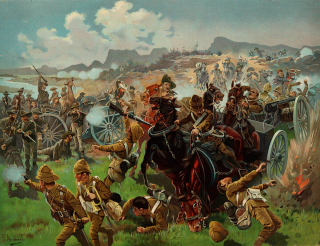
battle-of-colensoOn December 15, 1899, Irish units of the Boer army face the Royal Dublin Fusiliers, Connaught Rangers, and the 6th (Inniskillings) Dragoons in the battle of Colenso, the third and final battle fought during the Black Week of the Second Boer War. It is fought between British and Boer forces from the independent South African Republic and Orange Free State in and around Colenso, KwaZulu-Natal, South Africa. Inadequate preparation and reconnaissance and uninspired leadership lead to a British defeat.

Early on the morning of December 15, Major General Arthur Henry Seton Hart-Synnot, commander of the 5th (Irish) Infantry Brigade, gives his men half an hour’s parade ground drill, then leads them in close column towards the Bridle Drift. However, his locally recruited guide, who speaks no English, leads the brigade towards the wrong ford, the Punt Drift at the end of a loop in the river. Louis Botha, commander of the Boers on this front, orders his men to hold their fire until the British attempt to cross the river. However Hart-Synnot’s brigade, jammed into the loop of the river, is too good a target to miss and the Boers open fire. Hart-Synnot’s brigade suffers over 500 casualties before they can be extricated. The battalions repeatedly try to extend to the left and locate the Bridle Drift. On each occasion, Hart-Synnot recalls them and sends them back into the loop.

Meanwhile, as Major-General Henry J. T. Hildyard moves his 2nd Infantry Brigade towards Colenso, the two batteries of field guns under Colonel Charles James Long forge ahead of him and deploy in the open well within rifle range of the nearest Boers. Once again, this is too tempting a target, and the Boers open fire. The British gunners fight on, even though suffering heavy casualties, but ammunition cannot be brought to them and they are eventually forced to take shelter in a dry stream bed behind the guns. The bullock-drawn naval guns have not been able to keep up with the field pieces, but are able to come into action 1,500 metres from the Boer trenches.

General Sir Redvers Buller, who has also heard that his light horse are pinned down at the foot of the hill known as Hlangwane south of the river and unable to advance, decides to call the battle off at this point, even though Hildyard’s men, advancing in open order, have just occupied Colenso. He goes forward, being slightly wounded himself, and calls for volunteers to recover Long’s guns. Two teams approach them, hook up and bring away two weapons. A second attempt to recover the rest of guns fails when horses and volunteers are shot down by Boer rifle fire.

During the afternoon, the British fall back to their camp, leaving ten guns, many wounded gunners and some of Hildyard’s men behind to be captured during the night. Although Buller had committed few of his reserves, he reasons that a full day under a boiling sun would have sapped their morale and strength. Major General Neville Lyttelton (4th Infantry Brigade) commits some of his troops to help Hart’s brigade withdraw, but the cautious Major General Geoffrey Barton (6th Infantry Brigade) refuses to support Lord Dundonald‘s or Hildyard’s hard-pressed troops.

Buller’s army loses 143 killed, 756 wounded and 220 captured. Boer casualties are eight killed and 30 wounded.

After the battle of Colenso, four soldiers are awarded the Victoria Cross, the highest decoration for gallantry that can be awarded to British forces. All crossed an exposed area of intense Boer fire and rescued two of the twelve guns of the 14th and 66th Batteries when their crews had become casualties or were driven from their weapons. They are Captain Walter Norris Congreve, Captain Harry Norton Schofield, Corporal George Edward Nurse and Lieutenant Frederick Hugh Sherston Roberts, son of Field Marshal Frederick Sleigh Roberts, who died of his wounds two days later.

(Pictured: Boers capturing the British guns at the Battle of Colenso on December 15, 1899 in the Boer War. Picture by Fritz Neumann.)


Leave a comment

1918 Irish General Election

irish-general-election-1918

Sinn Féin, pledged to an Irish Republic, wins 73 of 105 Irish Member of Parliament (MP) seats in the 1918 United Kingdom general election in Ireland held on December 14, 1918. Winners include Constance Markievicz who becomes the first woman elected to the Parliament of the United Kingdom. In 1919 she is appointed Minister for Labour, the first female minister in a democratic government cabinet.

The Irish general election is that part of the 1918 United Kingdom general election which takes place in Ireland. The election is now seen as a key moment in modern Irish history because it sees the overwhelming defeat of the moderate nationalist Irish Parliamentary Party (IPP), which had dominated the Irish political landscape since the 1880s, and a landslide victory for the radical Sinn Féin party. The party had never stood in a general election but had won six seats in by-elections in 1917–1918. Sinn Féin vows in its manifesto to establish an independent Irish Republic. In Ulster, however, the Unionist Party is the most successful party.

The election is held in the aftermath of World War I, the Easter Rising and the Conscription Crisis. It is the first general election to be held after the Representation of the People Act 1918. It is thus the first election in which women over the age of 30, and all men over the age of 21, can vote. Previously, all women and most working-class men had been excluded from voting.

In the aftermath of the elections, Sinn Féin’s elected members refuse to attend the British Parliament in Westminster. Instead, they form a parliament in Dublin, the First Dáil Éireann, which declares Irish independence as a republic. The Irish War of Independence is conducted under this revolutionary government which seeks international recognition and sets about the process of state-building.


Leave a comment

Birth of William McCrea, Astronomer & Mathematician

CREATOR: gd-jpeg v1.0 (using IJG JPEG v80), quality = 100

Sir William Hunter McCrea, English astronomer and mathematician, is born in Dublin on December 13, 1904.

McCrea’s family moves to Kent in 1906 and then to Derbyshire where he attends Chesterfield Grammar School. His father is a school master at Netherthorpe Grammar School in Staveley. He goes to Trinity College, Cambridge in 1923 where he studies mathematics, later gaining a PhD in 1929 under Ralph H. Fowler.

In 1928, McCrea studies Albrecht Unsöld‘s hypothesis and discovers that three quarters of the sun is made of hydrogen and about one quarter is helium with 1% being other elements. Previous to this many people thought the sun consisted mostly of iron. After this, people realise most stars consist of hydrogen.

From 1930 McCrea lectures in mathematics at the University of Edinburgh. In 1931, during his time in Edinburgh, he is elected a Fellow of the Royal Society of Edinburgh. His proposers are Sir Edmund Taylor Whittaker, Sir Charles Galton Darwin, Edward Copson and Charles Glover Barkla. He wins the Society’s Keith Medal, jointly with Edward Copson, for the period 1939-1941.

In 1932 McCrea moves to Imperial College London as a Reader and marries Marian Core the following year. In 1936 he becomes Professor of Mathematics and head of the mathematics department at the Queen’s University Belfast.

During World War II McCrea is co-opted onto the Admiralty Operational Research Group. After the war, he joins the mathematics department at Royal Holloway College in 1944. He is elected a Fellow of the Royal Society of London in 1952.

McCrea is president of the Royal Astronomical Society from 1961 to 1963 and president of Section A of the British Association for the Advancement of Science from 1965–1966.

In 1964 McCrea proposes mass transfer mechanism as an explanation of blue straggler stars. In 1965, he creates the astronomy centre of the physics department at the University of Sussex.

McCrea wins the Gold Medal of the Royal Astronomical Society in 1976 and is knighted by Queen Elizabeth II in 1985.

William McCrea dies on April 25, 1999, at Lewes in Sussex. The McCrea Building on the Royal Holloway College campus is named after him.


Leave a comment

The Balcombe Street Siege Ends

balcombe-street-siege

The six-day Balcombe Street siege in London ends peacefully on December 12, 1975, after four Provisional Irish Republican Army (IRA) gunmen free their two hostages and give themselves up to the Metropolitan Police Service (MPS).

In 1974 and 1975, London is subjected to a 14-month campaign of gun and bomb attacks by the Provisional IRA. Some 40 bombs explode in London, killing 35 people and injuring many more. The four members of what becomes known as the “Balcombe Street gang,” Joe O’Connell, Edward Butler, Harry Duggan and Hugh Doherty, are part of a six-man IRA Active Service Unit (ASU) that also includes Brendan Dowd and Liam Quinn.

The Balcombe Street siege starts after a chase through London, as the MPS pursues Doherty, O’Connell, Butler and Duggan through the streets after they had fired gunshots through the window of Scott’s restaurant in Mount Street, Mayfair. The four IRA men ultimately run into a block of council flats in Balcombe Street, adjacent to Marylebone station, triggering the six-day standoff.

The four men go to 22b Balcombe Street in Marylebone, taking its two residents, middle-aged married couple John and Sheila Matthews, hostage in their front room. The men declare that they are members of the IRA and demand a plane to fly both them and their hostages to Ireland. Scotland Yard refuses, creating a six-day standoff between the men and the police. Peter Imbert, later Commissioner of the Metropolitan Police Service, is the chief police negotiator.

The men surrender after several days of intense negotiations between Metropolitan Police Bomb squad officers, Detective Superintendent Peter Imbert and Detective Chief Superintendent Jim Nevill, and the unit’s leader Joe O’Connell, who goes by the name of “Tom.” The other members of the gang are named “Mick” and “Paddy,” thereby avoiding revealing to the negotiators precisely how many of them are in the living room of the flat. The resolution of the siege is a result of the combined psychological pressure exerted on the gang by Imbert and the deprivation tactics used on the four men. The officers also use carefully crafted misinformation, through the BBC Radio news to further destabilise the gang into surrender. A news broadcast states that the British Special Air Service are going to be sent in to storm the building and release the hostages. This seems to deter the gang and they eventually give themselves up to the police.

The four are found guilty at their Old Bailey trial in 1977 of seven murders, conspiring to cause explosions, and falsely imprisoning John and Sheila Matthews during the siege. O’Connell, Butler and Duggan each receive 12 life sentences, and Doherty receives 11. Each of the men is later given a whole life tariff, the only IRA prisoners to receive this tariff. During the trial they instruct their lawyers to “draw attention to the fact that four totally innocent people were serving massive sentences” for three bombings in Woolwich and Guildford. Despite telling the police that they are responsible, they are never charged with these offences and the Guildford Four and Maguire Seven remain in prison for 15 more years, until it is ruled that their convictions are unsafe.

After serving 23 years in English prisons, the four men are transferred to the high security wing of Portlaoise Prison, County Laois, in early 1998. They are presented by Gerry Adams to the 1998 Sinn Féin Ardfheis as “our Nelson Mandelas,” and are released together with Brendan Dowd and Liam Quinn in 1999 as part of the Good Friday Agreement.


Leave a comment

Birth of Erskine H. Childers, 4th President of Ireland

erskine-hamilton-childers-1

Erskine Hamilton Childers, Irish politician and a member of the Fianna Fáil party who serves as the fourth President of Ireland (1973–74), is born on December 11, 1905, in the Embankment Gardens, Westminster, London, to a Protestant family, originally from Glendalough, County Wicklow.

Childers is educated at Gresham’s School, Holt, and the University of Cambridge, hence his striking British upper-class accent. On November 24, 1922, when he is sixteen, his father, Robert Erskine Childers, is executed by the new Irish Free State on politically inspired charges of gun-possession. The pistol he had been found with had been given to him by Michael Collins. Before his execution, in a spirit of reconciliation, the elder Childers obtains a promise from his son to seek out and shake the hand of every man who had signed his death warrant.

Following his father’s funeral, he returns to Gresham’s, then two years later he goes on to Trinity College, Cambridge. He returns to Ireland in 1932 and becomes advertising manager of The Irish Press, the newly founded newspaper owned by the family of Éamon de Valera.

Childers’s political debut is as a successful Fianna Fáil candidate for a seat in Dáil Éireann, the lower house of the Oireachtas, the Irish parliament, in 1938. He becomes a Parliamentary secretary in 1944 and is later Minister for Posts and Telegraphs (1951–54), Minister for Lands (1957–59), and Minister for Transport and Power (1959–69). He also serves as Tánaiste and Minister for Health (1969–73). He supports Taoiseach Jack Lynch’s condemnation of the violence in Northern Ireland and Lynch’s advocacy of a European role for the Irish republic within the European Economic Community (now European Community, embedded in the European Union).

Childers is nominated as the presidential candidate of Fianna Fáil at the behest of de Valera, who pressures Jack Lynch in the selection of the presidential candidate. He is a controversial nominee, owing not only to his British birth and upbringing but to his Protestantism. However, on the campaign trail his personal popularity proved enormous, and in a political upset at the 1973 Irish presidential election, he is elected the fourth President of Ireland on May 30, 1973, defeating Tom O’Higgins by 635,867 (52%) votes to 578,771 (48%). He becomes the second Protestant to hold the office, the first being Douglas Hyde (1938–1945).

Prevented from transforming the presidency as he desires, Childers instead throws his energy into a busy schedule of official visits and speeches, which is physically taxing.

On November 17, 1974, during a conference to the psychiatrists of the Royal College of Physicians of Ireland in Dublin, Childers suffers a congestional heart failure causing him to lie sideways and turn blue before suddenly collapsing. He is pronounced dead the same day at Mater Misericordiae University Hospital.

Childers’s state funeral in St. Patrick’s Cathedral, Dublin, is attended by his presidential predecessor Éamon de Valera and world leaders including Louis Mountbatten, 1st Earl Mountbatten of Burma (representing Queen Elizabeth II), the British Prime Minister Harold Wilson and British Opposition Leader Edward Heath, and Presidents and crowned heads of state from Europe and beyond. He is buried in the grounds of the Church of Ireland Derralossary Church, in Roundwood, County Wicklow.


Leave a comment

W.B. Yeats Receives Nobel Prize in Literature

william-butler-yeats-1

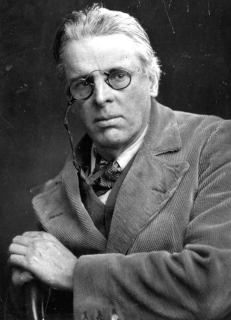
William Butler Yeats, Irish poet and one of the foremost figures of 20th century literature, receives Nobel Prize in Literature on December 10, 1923.

Yeats is born at Sandymount in County Dublin on June 13, 1865. His father, John Butler Yeats, is a lawyer and a well-known portrait painter. He is educated in London and in Dublin but spends his summers in the west of Ireland in the family’s summer house at Connacht. The young Yeats is very much part of the fin de siècle in London. At the same time, he is active in societies that attempt an Irish literary revival. His first volume of verse appears in 1887, but in his earlier period his dramatic production outweighs his poetry both in bulk and in import.

Together with Lady Gregory, Yeats founds the Irish Literary Theatre, which later becomes the Abbey Theatre, and serves as its chief playwright until the movement is joined by John Millington Synge. His plays usually treat Irish legends and also reflect his fascination with mysticism and spiritualism. The Countess Cathleen (1892), The Land of Heart’s Desire (1894), Cathleen ni Houlihan (1902), The King’s Threshold (1904), and Deirdre (1907) are among the best known.

After 1910, Yeats’s dramatic art takes a sharp turn toward a highly poetical, static, and esoteric style. His later plays are written for small audiences. They experiment with masks, dance, and music, and are profoundly influenced by the Japanese Noh plays. Although a convinced patriot, he deplores the hatred and the bigotry of the Nationalist movement, and his poetry is full of moving protests against it. He is appointed to the Irish Senate, Seanad Éireann, in 1922.

Yeats is one of the few writers whose greatest works are actually written after the award of the Nobel Prize. Whereas he receives the Prize chiefly for his dramatic works, his significance today rests on his lyric achievement. His poetry, especially the volumes The Wild Swans at Coole (1919), Michael Robartes and the Dancer (1921), The Tower (1928), The Winding Stair and Other Poems (1933), and Last Poems and Plays (1940), make him one of the outstanding and most influential twentieth-century poets writing in English. His recurrent themes are the contrast of art and life, masks, cyclical theories of life (the symbol of the winding stairs), and the ideal of beauty and ceremony contrasting with the hubbub of modern life.

Yeats dies at the age of 73 at the Hôtel Idéal Séjour, in Menton, France, on January 28, 1939. He is buried after a discreet and private funeral at Roquebrune-Cap-Martin. In September 1948, his body is moved to the churchyard of St. Columba’s Church, Drumcliff, County Sligo, on the Irish Naval Service corvette Macha.

(From Nobel Lectures, Literature 1901-1967, Editor Horst Frenz, Elsevier Publishing Company, Amsterdam, 1969)


Leave a comment

President McAleese & Queen Elizabeth II Meet in Belfast

mcaleese-and-queen-elizabeth

President of Ireland Mary McAleese and Queen Elizabeth II shake hands on Northern Ireland soil for the first time on December 9, 2005 — a symbolic milestone following years of peacemaking in this long-disputed British territory.

The British monarch and the Republic of Ireland‘s head of state chat and pose together at Hillsborough Castle, outside Belfast, for an occasion that would have provoked hostility within Northern Ireland’s Protestant majority just a few years earlier. But their trouble-free meeting becomes inevitable once Ireland dropped its territorial claim to Northern Ireland as part of the landmark Good Friday Agreement peace accord of 1998. The visit also fuels speculation the queen could soon make her first official visit to the neighboring Republic of Ireland, where the Irish Republican Army assassinated Lord Louis Mountbatten, the uncle of her husband, Prince Philip, Duke of Edinburgh.

No British monarch has visited the territory of the modern-day Republic of Ireland since George V visited Dublin in 1911, a decade before the island’s partition into a mostly Protestant north that remains within the United Kingdom, and a predominantly Catholic rest of Ireland that gradually gains full independence from Britain.

Camera crews are allowed to film the moment, but not record the sound, when McAleese shakes the queen’s hand at the start of a 20-minute meeting, their fourth since 1998. Previous meetings occurred at Buckingham Palace and on a World War I battlefield site. McAleese later calls it “a very special day for Anglo-Irish relationships” that brings forward the day when the queen will visit the Irish Republic.

McAleese, a Belfast-born Catholic, had made scores of visits to Northern Ireland since being elected to the Irish Republic’s largely symbolic presidency in 1997. As part of her presidential theme of “building bridges,” she regularly invites Protestant groups to her official Dublin mansion and has built impressive diplomatic contacts with northern Protestants.

Before McAleese’s arrival, visits north by an Irish president were rare events that drew public protests from Protestants, who demanded that Ireland remove its territorial claim from its 1937 constitution. The republic’s voters overwhelmingly supported this in a May 1998 referendum, an action completed in December 1999.

The queen has avoided traveling to the Irish Republic, in part, because of security fears following the IRA assassination of Mountbatten in August 1979. He, his daughter-in-law and two teenage boys are killed when the IRA blows up his private boat near his castle in County Sligo. However, Prince Philip and their son, Prince Charles, make several visits to the Irish Republic in the decade following the IRA’s 1994 cease-fire.


Leave a comment

The Battle of Brihuega

File source: https://commons.wikimedia.org/wiki/File:Vendome-and-PhilipV.jpgThe Irish “Hibernia” regiment and other Irish units of Spain fight at the Battle of Brihuega on December 8, 1710 in the War of the Spanish Succession, during the allied retreat from Madrid to Barcelona. The British rearguard under James Stanhope, 1st Earl Stanhope, is cut off within the town of Brihuega and overwhelmed by a Franco-Spanish army under Louis Joseph de Bourbon, Duke of Vendôme. Brihuega with other events brings an end to the British participation in the war.

The Duke of Vendôme sets out from Talavera de la Reina with his troops and pursues the retreating British army with a speed perhaps never equalled in such a season and in such a country. The middle-aged Frenchman leads his Franco-Spanish army day and night. In typical Vendôme style, he swims, at the head of his cavalry, the flooded Henares and in a few days overtakes Stanhope, who is at Brihuega with the left wing of the Grand Alliance army.

“Nobody with me,” said the British general, “imagined that they had any foot within some days’ march of us and our misfortune is owing to the incredible diligence which their army made.” Stanhope has barely enough time to send off a messenger to the centre of the army, which is some leagues from Brihuega, before Vendôme is upon him on the evening of December 8. The next morning the town is invested on every side.

Blasting the walls of Brihuega with heavy cannon, a mine is sprung under one of the gates. The British keep up a terrible fire until their powder is spent. They then fight desperately against overwhelming odds as Vendôme’s men storm the city with bayonets fixed and begin to take the town by bloody close quarters fighting, street by street. The British set fire to the buildings which their assailants have taken but in vain. The British general sees that further resistance will produce only a useless carnage. He concludes a capitulation and his army becomes prisoners of war on honourable terms.

Scarcely had Vendôme signed the capitulation, when he learns that General Guido Starhemberg is marching to the relief of Stanhope. On December 10 the two meet in the bloody Battle of Villaviciosa, after which Starhemberg continues the allied retreat.

The British troops do not remain in captivity for very long before they are exchanged and sent home in October 1711.

The defeat helps justify the Harley ministry‘s plan to agree to a compromise peace with France at the Treaty of Utrecht. Opponents of the deal protest on the grounds of “No Peace Without Spain.” Nonetheless Allied forces are withdrawn, with the final action taking place at the Siege of Barcelona in 1714.