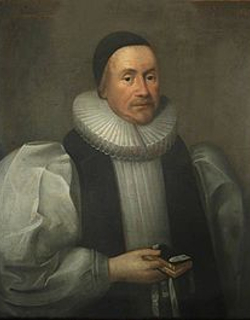
Early in life Ussher is determined to pursue a career with the Church of England, a resolve quite similar to that of the Biblical Judge, Samuel.
A gifted polyglot, Ussher enters Dublin Free School and then the newly founded Trinity College, Dublin on January 9, 1594, at the age of thirteen (not an unusual age at the time). He receives his Bachelor of Arts degree by 1598 and is a fellow and MA by 1600. In May 1602, he was ordained in the Trinity College Chapel as a deacon (and possibly priest on the same day) in the ProtestantChurch of Ireland by his uncle Henry Ussher, the Archbishop of Armagh and Primate of All Ireland.
At the age of 26, Ussher becomes Professor and Chairman of the Department of Divinity at Dublin University, and he holds his professorship from 1609 to 1621. In 1625, he becomes Archbishop of Armagh, an office he apparently holds until his death. In 1628, King James I makes him a Privy Councillor.
Ussher is considered well-read and well-versed in history, a subject that soon becomes his primary focus. He writes several histories of the doings of the Irish and English churches dating back to Roman times. He also makes himself an expert in Semitic languages, an expertise that informs his argument in favor of the Masoretic Text of the Bible in preference to the Septuagint.
Ussher’s Confessions appear in 1643, followed in 1646 by his fifth work, Here I Stand. His most famous work, the dating of the creation as calculated from the Biblical record, appears in writing in the 1650s.
In 1656, Ussher goes to stay in the Countess of Peterborough’s house in Reigate, Surrey. On March 19, he feels a sharp pain in his side after supper and takes to his bed. His symptoms seem to have been those of a severe internal haemorrhage. Two days later, on March 21, 1656, he dies at the age of 75. His last words are reported as: “O Lord, forgive me, especially my sins of omission.” His body is embalmed and is to have been buried in Reigate, but at Oliver Cromwell‘s insistence he was given a state funeral on April 17 and was buried in the chapel of St. Erasmus in Westminster Abbey.
Ussher’s extensive library of manuscripts, many of them Middle Eastern originals, become part of the collection at Dublin University.
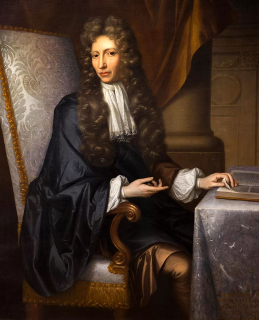
Boyle is born on January 25, 1627, at Lismore Castle, in County Waterford. At age eight, he begins his formal education at Eton College, where his studious nature quickly becomes apparent. In 1639 he and his brother Francis embark on a grand tour of the continent together with their tutor Isaac Marcombes. In 1642, owing to the Irish rebellion, Francis returns home while Robert remains with his tutor in Geneva and pursues further studies.
Boyle returns to England in 1644, where he takes up residence at his hereditary estate of Stalbridge in Dorset. There he begins a literary career writing ethical and devotional tracts, some of which employ stylistic and rhetorical models drawn from French popular literature, especially romance writings. In 1649 he begins investigating nature via scientific experimentation. From 1647 until the mid-1650s, he remains in close contact with a group of natural philosophers and social reformers gathered around the intelligencer Samuel Hartlib. This group, the Hartlib Circle, includes several chemists who heighten his interest in experimental chemistry.
Boyle spends much of 1652–1654 in Ireland overseeing his hereditary lands and performing some anatomic dissections. In 1654 he is invited to Oxford, and he takes up residence at the university until 1668. In Oxford he is exposed to the latest developments in natural philosophy and becomes associated with a group of notable natural philosophers and physicians, including John Wilkins, Christopher Wren, and John Locke. These individuals, together with a few others, form the “Experimental Philosophy Club.” Much of Boyle’s best known work dates from this period.
In 1659 Boyle and Robert Hooke, the clever inventor and subsequent curator of experiments for the Royal Society, complete the construction of their famous air pump and use it to study pneumatics. Their resultant discoveries regarding air pressure and the vacuum appear in Boyle’s first scientific publication, New Experiments Physico-Mechanicall, Touching the Spring of the Air and Its Effects (1660). Boyle and Hooke discover several physical characteristics of air, including its role in combustion, respiration, and the transmission of sound. One of their findings, published in 1662, later becomes known as “Boyle’s law.” This law expresses the inverse relationship that exists between the pressure and volume of a gas, and it is determined by measuring the volume occupied by a constant quantity of air when compressed by differing weights of mercury.
Among Boyle’s most influential writings are The Sceptical Chymist (1661), which assails the then-current Aristotelian and especially Paracelsian notions about the composition of matter and methods of chemical analysis, and the Origine of Formes and Qualities (1666), which uses chemical phenomena to support the corpuscularian hypothesis. He argues so strongly for the need of applying the principles and methods of chemistry to the study of the natural world and to medicine that he later gains the appellation of the “father of chemistry.”
Boyle is a devout and pious Anglican who keenly champions his faith. He sponsors educational and missionary activities and writes a number of theological treatises. He is deeply concerned about the widespread perception that irreligion and atheism are on the rise, and he strives to demonstrate ways in which science and religion are mutually supportive. For Boyle, studying nature as a product of God’s handiwork is an inherently religious duty. He argues that this method of study would, in return, illuminate God’s omnipresence and goodness, thereby enhancing a scientist’s understanding of the divine. The Christian Virtuoso (1690) summarizes these views and may be seen as a manifesto of his own life as the model of a Christian scientist.
In 1668 Boyle leaves Oxford and takes up residence with his sister Katherine Jones, Vicountess Ranelagh, in her house on Pall Mall in London. There he sets up an active laboratory, employs assistants, receives visitors, and publishes at least one book nearly every year. Living in London also provides him the opportunity to participate actively in the Royal Society.
Boyle is a genial man who achieves both national and international renown during his lifetime. He is offered the presidency of the Royal Society and the episcopacy but declines both. Throughout his adult life, he is sickly, suffering from weak eyes and hands, recurring illnesses, and one or more strokes. He dies at age 64 on December 31, 1691, after a short illness exacerbated by his grief over Katherine’s death a week earlier. He leaves his papers to the Royal Society and a bequest for establishing a series of lectures in defense of Christianity. These lectures, now known as the Boyle Lectures, continue to this day.
More broadly, the term “Wild Geese” is used in Irish history to refer to Irish soldiers who leave to serve in continental European armies in the 16th, 17th and 18th centuries, or even, poetically, Irish soldiers in British armies as late as World War I.
Irish recruitment for continental armies dries up after it is made illegal in 1745. In 1732 Sir Charles Wogan indicates in a letter to Jonathan Swift, Dean of St. Patrick’s Cathedral, Dublin, that 120,000 Irishmen have been killed and wounded in foreign service “within these forty years.” Swift later replies, “I cannot but highly esteem those gentlemen of Ireland who, with all the disadvantages of being exiles and strangers, have been able to distinguish themselves by their valour and conduct in so many parts of Europe, I think, above all other nations.”
It was some time before the British armed forces begin to tap into Irish Catholic manpower. In the late eighteenth century, the Penal Laws are gradually relaxed and in the 1790s the laws prohibiting Catholics bearing arms are abolished.
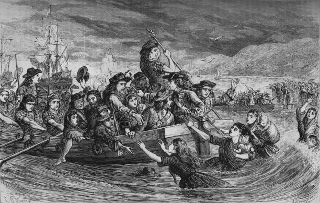
Sarsfield is honored to this day in the crest of County Limerick. The Flight of the Wild Geese is remembered in the poetic words… “War-battered dogs are we, Fighters in every clime, Fillers of trench and of grave, Mockers, bemocked by time. War-dogs, hungry and grey, Gnawing a naked bone, Fighters in every clime, Every cause but our own.”
(Pictured: ‘Irish Troops Leaving Limerick’, 1692, (Cassell Petter & Galpin, London, Paris & New York, c1880), Artist Unknown)
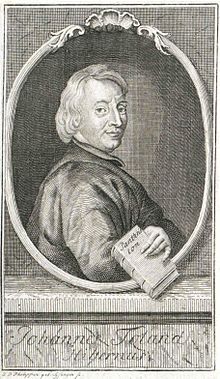
Very little is known of Toland’s early life. His parents are unknown. He later writes that he had been baptised Janus Junius, a play on his name that recalls both the Roman two-faced god Janus and Lucius Junius Brutus, reputed founder of the Roman Republic. According to his biographer, Pierre des Maizeaux, he adopts the name John as a schoolboy with the encouragement of his schoolteacher.
In Toland’s first and best-known book, Christianity not Mysterious (1696), he argues that the divine revelation of the Bible contains no true mysteries. Rather, all the dogmas of the faith can be understood and demonstrated by properly trained reason from natural principles. For this argument he is prosecuted by a grand jury in London. As he is a subject of the Kingdom of Ireland, members of the Parliament of Ireland propose that he should be burned at the stake. In his absence three copies of the book are burned by the public hangman in Dublin as the content is contrary to the core doctrines of the Church of Ireland. Toland bitterly compares the Protestant legislators to “Popish Inquisitors who performed that Execution on the Book, when they could not seize the Author, whom they had destined to the Flames.”
After his departure from Oxford, Toland resides in London for most of the rest of his life but is also a somewhat frequent visitor to Continental Europe, particularly Germany and the Netherlands. He lives on the Continent from 1707 to 1710.
John Toland dies in Putney on March 10, 1722. Just before he dies, he composes his own epitaph: “He was an assertor of liberty, a lover of all sorts of learning … but no man’s follower or dependent. Nor could frowns or fortune bend him to decline from the ways he had chosen.” The 1911 Encyclopædia Britannica says of him that at his death in London at age 51 “he died… as he had lived, in great poverty, in the midst of his books, with his pen in his hand.”
Very shortly after his death a lengthy biography of Toland is written by Pierre des Maizeaux.
The Treaty of Limerick, which actually consists of two treaties, is signed on October 3, 1691, ending the Williamite War in Ireland between the Jacobites and the supporters of William III of England, widely known as William of Orange. Reputedly they are signed on the Treaty Stone, an irregular block of limestone which once served as a mounting block for horses. This stone is now displayed on a pedestal in Limerick, put there to prevent souvenir hunters from taking pieces of it. Because of the treaty, Limerick is sometimes known as the Treaty City.
After his victory at the Battle of the Boyne in July 1690, William III issues the Declaration of Finglas which offers a pardon to Jacobite soldiers but excludes their senior officers from its provisions. This encourages the Jacobite leaders to continue fighting and they win a major victory during the 1691 Siege of Limerick. However, defeats the following year at the Battle of Aughrim and the second siege of Limerick leave the Williamites victorious. Nonetheless the terms they offer to Jacobite leaders at Limerick are considerably more generous than those a year earlier at Finglas.
One treaty, the Military Articles, deals with the treatment of the disbanded Jacobite army. This treaty contains twenty-nine articles. Under the treaty, Jacobite soldiers in formed regiments have the option to leave with their arms and flags for France to continue serving under James II of England in the Irish Brigade. Some 14,000 Jacobites choose this option. Individual soldiers wanting to join the French, Spanish or Austrian armies also emigrate in what becomes known as the Flight of the Wild Geese. The Jacobite soldiers also have the option of joining the Williamite army. One thousand soldiers chose this option. The Jacobite soldiers thirdly have the option of returning home which some 2,000 soldiers choose.
The second treaty, the Civil Articles, which contains thirteen articles, protects the rights of the defeated Jacobite landed gentry who choose to remain in Ireland, most of whom are Catholics. Their property is not to be confiscated so long as they swear allegiance to William III and Mary II, and Catholic noblemen are to be allowed to bear arms. William requires peace in Ireland and is allied to the Papacy in 1691 within the League of Augsburg.
It is often thought that the Treaty of Limerick is the only treaty between Jacobites and Williamites. A similar treaty had been signed on the surrender of Galway on July 22, 1691, but without the strict loyalty oath required under the Treaty of Limerick. The Galway garrison had been organised by the mostly Catholic landed gentry of counties Galway and Mayo, who benefited from their property guarantees in the following century.
(Pictured: The Treaty Stone on which the Treaty of Limerick may have been signed)
In the summer of 1647, Murrough O’Brien, 6th Baron Inchiquin, the Irish Protestant commander of the Protestant army of Cork, commences a campaign against the Irish Catholic strongholds in Munster. The counties of Limerick and Clare are raided, and he soon turns his attention to the bountiful eastern counties of Munster. In early September, his forces quickly take the Cahir Castle in Tipperary. This strong castle is well positioned to become a base for the Cork Protestant army, and it is used to raid and devastate the surrounding countryside. The Munster army under Lord Taaffe does not make any serious effort to oppose Inchiquin, probably the result of the political scheming of Donough MacCarty, 2nd Viscount Muskerry and other powerful Irish lords who hope to keep the Munster army intact for their own ends. As such, Inchiquin is allowed to make a major push towards the town and ecclesiastical centre of Cashel.
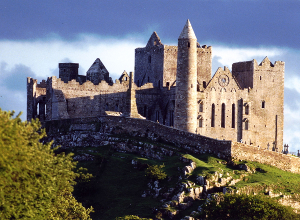
Inchiquin has already launched two minor raids against Cashel, and he now has the opportunity to launch a major assault. The Parliamentarian forces first storm nearby Roche Castle, putting fifty warders to the sword. This attack terrifies the local inhabitants of the region, some of whom flee to hiding places, while hundreds of others flee promptly to the Rock of Cashel, a stronger place than the town itself. Lord Taaffe has placed six companies in the fortified churchyard that sits upon the rock, and considers the place defensible, though he himself does not stay to put it to the test, leaving command to the Governor Lieutenant-Colonel Butler.
Arriving with his army at the Rock, Inchiquin calls for surrender within an hour. The defenders of the churchyard offer to negotiate but that is refused, and on the afternoon of September 15 the assault commences. The Parliamentarians are first reminded of earlier atrocities against Protestants, and then begin to deploy. The attack is led by around 150 dismounted horse officers with the remainder of the infantry following. Troops of horse ride along the flanks of the advancing force to encourage the infantry. The Irish soldiers attempt to drive off the attackers with pikes while the civilians inside hurl rocks down from the walls. In turn the attackers hurl firebrands into the compound, setting some of the buildings inside on fire. Although many are wounded, the Parliamentarians gradually fight their way over the walls, pushing the garrison into the church.
Initially, the Irish defenders manage to protect the Church, holding off the attackers trying to get through the doors, but the Parliamentarians then place numerous ladders against the many windows in the church and swarm the building. For another half an hour fighting rages inside the church, until the depleted defenders retreat up the bell tower. Only sixty soldiers of the garrison remain at this point, and they thus accept a call to surrender. However, after they have descended the tower and thrown their swords away, all are killed.
In the end all the soldiers and most of the civilians on the Rock are killed by the attackers. The Bishop and Mayor of Cashel along with a few others survive by taking shelter in a secret hiding place. Apart from these a few women are spared, after being stripped of their clothes, and a small number of wealthy civilians are taken prisoner, but these are the exceptions. Overall, close to 1,000 are killed, amongst them Lieutenant-Colonel Butler and catholic scholar Theobald Stapleton. The bodies in the churchyard are described by a witness as being five or six deep.
The slaughter is followed by extensive looting. There is much of value inside, for apart from pictures, chalices and vestments of the church, many of the slain civilians had also brought their valuables with them. The sword and ceremonial mace of the mayor of Cashel, as well as the coach of the bishop are captured. The plunder is accompanied by acts of iconoclasm, with statues smashed and pictures defaced. The deserted town of Cashel is also torched.
The atrocity at Cashel causes a deep impact in Ireland, as it is the worst single atrocity committed in Ireland since the start of fighting in 1641. Previously, the most infamous massacre amongst the Catholic population is that at Timolin in 1643, when 200 civilians are killed by James Butler, 1st Duke of Ormond‘s English Royalist army, but many more than this are killed at Cashel, and the Rock of Cashel is one of the chief holy places of Ireland. The slaughter of the garrison at Cashel and the subsequent devastation of Catholic held Munster earns Inchiquin the Irish nickname, Murchadh na Dóiteáin or “Murrough of the Burnings.”
The Annals of the Kingdom of Ireland or the Annals of the Four Masters, chronicles of medieval Irish history, are completed on August 10, 1636. The entries span from the Deluge, dated as 2,242 years after creation to 1616 AD.
The annals are mainly a compilation of earlier annals, although there is some original work, and are one of the principal Irish language sources for Irish history up to 1616. They are compiled between 1632 and 1636 at a Franciscan friary near the Drowes River in County Leitrim, on the border with County Donegal and County Sligo. The patron of the project is Fearghal Ó Gadhra, MP, a Gaelic lord in Coolavin, County Sligo. While many of the early chapters are essentially lists of names and dates, the later chapters, dealing with events of which the authors have first-hand accounts, are much more detailed.
The chief compiler of the annals is BrotherMícheál Ó Cléirigh from Ballyshannon, who is assisted by, among others, Cú Choigcríche Ó Cléirigh, Fearfeasa Ó Maol Chonaire and Peregrine Ó Duibhgeannain. Although only one of the authors, Mícheál Ó Cléirigh, is a Franciscan friar, they become known as “The Four Friars” or in the original Irish, Na Ceithre Máistrí. The Anglicized version of this is “The Four Masters,” the name that has become associated with the annals themselves.
Due to the criticisms by Irish historian Tuileagna Ó Maol Chonaire, the text is not published during the lifetime of any of the participants. The first substantial English translation (starting at 1171 AD) is published by Owen Connellan in 1846. The Connellan translation includes the annals from the eleventh to the seventeenth centuries. The only version to have a four-colour frontispiece, it includes a large folding map showing the location of families in Ireland. This edition, neglected for over 150 years, is republished in the early twenty-first century. The original Connellan translation is followed several years later by a full translation by the historian John O’Donovan. The translation is funded by a government grant of £1,000 obtained by the notable mathematician Sir William Rowan Hamilton while he is president of the Royal Irish Academy.
The reliability and usefulness of the Annals as a historical source has sometimes been questioned on the grounds that they are limited to accounts of the births, deaths and activities of the Gaelic nobility of Ireland and often ignore wider social trends or events. On the other hand, the Annals, as one of the few prose sources in Irish from this period, also provide a valuable insight into events such as the Desmond Rebellions and the Nine Years’ War from a Gaelic Irish perspective.
The early part of this work is based upon the Lebor Gabála Érenn. Today, most scholars regard the Lebor Gabála Érenn as primarily myth rather than history. It appears to be mostly based on medieval Christian pseudo-histories, but it also incorporates some of Ireland’s native pagan mythology. Scholars believe the goal of its writers was to provide an epic history for Ireland that could compare to that of the Israelites or the Romans, and which reconciled native myth with the Christian view of history.
By 1647, The Irish Catholic Confederation controls all of Ireland except for Parliamentarian enclaves around Dublin and Cork and a Scottish outpost in Ulster. The previous year they had rejected a treaty with the English Royalists in favour of eliminating the remaining British forces in Ireland.
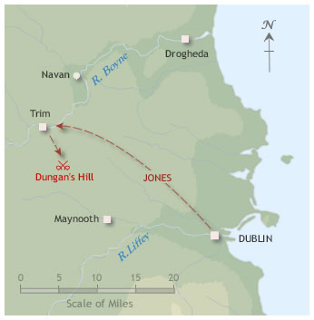
In August 1647, the Confederate Leinster army under Thomas Preston is attempting to take Dublin from the English Parliamentarian garrison under Michael Jones, when it is intercepted by the Roundheads and forced to give battle. Jones had marched to Trim to relieve the Parliamentarian outpost there at Trim Castle. Preston, who had been shadowing Jones’ movements, attempts to march on Dublin before Jones’ army returns there, but covers only 12 of the 40 miles before being caught at Dungan’s Hill, where the Confederate forces have to form up for battle.
From a Parliamentarian point of view, victory in this battle is presented to them by the incompetence of the Irish commander. Preston is a veteran of the Thirty Years’ War, where he had been a commander of the Spanish garrison at Leuven, but has no experience in open warfare or handling cavalry. Jones, by contrast, had been a cavalry officer in the English Civil War. As a result, Preston tries to move his cavalry along a narrow covered lane where they are trapped and subjected to enemy fire without being able to respond. Even worse, Preston has placed a large number of his troops in wheat fields over seven feet tall. As a result these troops are unable to see the Parliamentarians until it is too late. With the Confederate army spread out and in confusion, Jones’ troops fall in amongst them causing the demoralised Irish cavalry to flee the field, leaving the remainder of Preston’s infantry unsupported.
The Confederate army’s infantry are primarily equipped with pikes and heavy muskets and trained to stand in tercios in the Spanish manner. This means they are difficult to break, but also highly immobile, without cavalry to cover their cumbersome formation when it moves. What is worse, Preston has positioned them in a large walled field, so that when their cavalry has run away, the Parliamentarians can surround and trap them. Some of the Irish infantry, Scottish Highlanders brought to Ireland by Alasdair Mac Colla, manage to charge and break through Jones’ men and escape into a nearby bog, where the English cavalry could not follow. Preston and 2,000 to 3,000 of his regular infantry manage to follow the Highlanders to safety, but the remainder are trapped.
What happens next is disputed. The Irish infantry manages to hold off several assaults on their position, before trying to follow their comrades into the safety of the bog. This makes them lose their formation and the Parliamentarians get in amongst them and then surround them in the bogland. Parliamentarian accounts simply say that the Irish force is then destroyed. Irish accounts, however, claim that the Confederate troops surrender and are then massacred. One account, by a Catholic friar named O Meallain, says that the corpses of the Irish foot soldiers are found with their hands tied. A recent study suggests that the Irishmen probably tried to surrender, but that, according to the conventions of 17th century warfare, this had to be accepted before it entitled them to safety. In this case, it was not accepted and the infantrymen were butchered.
Around 3,000 Confederate troops and a small number of Parliamentarians die at Dungan’s Hill. One of the English regimental commanders, Colonel Anthony Hungerford, is shot in the mouth, a wound that invalids him out of the English Army. Most of the dead are Irish infantrymen killed in the last stage of the battle. Those prisoners who are taken are mainly officers, whom the Parliamentarians can either ransom or exchange for prisoners of their own. Richard Talbot, a junior cavalry officer but later Earl of Tyrconnell and Lord Deputy of Ireland, is among the Confederate prisoners.
In the immediate aftermath of the battle, Owen Roe O’Neill‘s Ulster Army marches through the pass of Portlester Mill to mount an effective rearguard action, routing Jones’ advanced brigade and enabling the survivors of the Leinster army to escape. Jones, fearing O’Neills army, does not continue the pursuit and returns to Dublin. O’Neill and his Ulstermen return four months later to bury the dead Confederates.
Rathlin Island is used as a sanctuary because of its natural defences and rocky shores. In earlier times, when the wind blows from the west it is almost impossible to land a boat. It is also respected as a hiding place, as it is the one-time abode of Saint Columba. Installing themselves in Rathlin Castle (also known as Bruce’s Castle), the MacDonnells of Antrim make Rathlin their base for resistance to the Enterprise of Ulster. Their military leader, Sorley Boy MacDonnell (Scottish Gaelic: Somhairle Buidhe Mac Domhnaill) and other Scots have thought it prudent to send their wives, children, elderly, and sick to Rathlin Island for safety.
Acting on the instructions of Sir Henry Sidney and the Walter Devereux, 1st Earl of Essex, Sir Francis Drake and Sir John Norreys take the castle by storm. Drake uses two cannons to batter the castle and when the walls give in, Norreys orders direct attack on July 25, and the Garrison surrenders. Norreys sets the terms of surrender, whereupon the constable, his family, and one of the hostages are given safe passage and all other defending soldiers are killed. On July 26, 1575, Norreys’ forces hunt the old, sick, very young and women who are hiding in the caves. Despite the surrender, they kill all the 200 defenders and more than 400 civilian men, women and children. Sir Francis Drake is also charged with the task of preventing any Scottish reinforcement vessels from reaching the island.
The entire family of Sorley Boy MacDonnell perishes in the massacre. Essex, who orders the killings, boasts in a letter to Francis Walsingham, the Queen’s secretary and spymaster, that Sorley Boy MacDonnell watched the massacre from the mainland helplessly and was “like to run mad from sorrow.”
Norreys stays on the island and tries to rebuild the walls of the castle so that the English might use the structure as a fortress. As Drake is not paid to defend the island, he departs with his ships. Norreys realises that it is not possible to defend the island without intercepting Scottish galleys and he returns to Carrickfergus in September 1575.
Patrick Darcy, a prominent constitutional lawyer who wrote the constitution of Confederate Ireland, delivers his famous Argument during a conference on June 9, 1641.
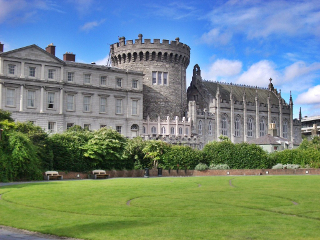
During a conference held in the dining room of Dublin Castle, Darcy delivers his Argument. Published in 1643 and reprinted in 1764, it is the first forceful and detailed statement of the rule of law in Ireland, articulating an effective constitutional position for her as England‘s colonial country. He is quoted arguing to William Molyneux that “no parliament but an Irish one can properly legislate for Ireland,” which is the central summation of his work.
In 1961, the American constitutional expert C.H. McIlwain says in compliment of Darcy’s Argument that it “constitute the first definite statement of the central point of the American opposition more than a century later. Patrick Darcy deserves a place in American constitutional history.”
The format of the 142-page Argument comprises a series of legal questions on the powers of the Parliament of Ireland in 1640–41. It refers to and suggests the extent by which the parliament’s general self-governing powers are superior to all ad-hoc (and possible illegal, unlawful or illicit) decisions by judges and royal officials in the Kingdom of Ireland. The relevant text nearest to the subject of Irish self-government is at page 130:
“Whither the Subjects of this kingdome bee a free people, and to be governed onely by the Common-lawes of England, and statutes of force in this kingdome. The subjects of this his Majesties kingdome of Ireland, are a free people, and to be governed onely according to the Common-law of England, and Statutes made & established by Parliament in this kingdome of Ireland, and according to the lawfull customes used in the same.”




 seamus dubhghaill