King’s support of the Glorious Revolution in 1688 serves to advance his position. He becomes Bishop of Derry in 1691. His years as a bishop are marked by reform and the building of churches and glebe houses, and by the dispensing of charity. His political influence is considerable. He is always consulted on judicial appointments and at times seems to have an effective veto over candidates he considers unsuitable.
He is advanced to the position of Archbishop of Dublin in 1703, a post he holds until his death. He gives £1,000 for the founding of “Archbishop King’s Professorship of Divinity” at Trinity College in 1718. His influence declines after the appointment of Hugh Boulter as Archbishop of Armagh in 1724.
William King dies in May 1729. Much of his correspondence survives and provides a historic resource for the study of the Ireland of his time.
The Richmond Tower at the end of the formal avenue leading to the Royal Hospital is designed by Francis Johnston, one of the leading architects of the day. This gateway originally stands beside the River Liffey at Bloody Bridge (now Rory O’More Bridge) but has to be moved after the arrival of the railway in 1844 increases traffic congestion. Johnston places his personal coat of arms above the arch, concealed by a piece of wood painted to match the stone, his idea being that his arms would be revealed to future generations after the wood becomes rotten. However, his little trick is uncovered when the gateway is taken down for removal. The coat of arms currently on the gateway is that of the Royal Hospital.
The Royal Hospital Kilmainham graveyards, including Bully’s Acre, are 400 metres to the west. A cross-shaft in the former cemetery may be the remains of a boundary cross associated with a ninth-century monastery located at this site.
Following the creation of the Irish Free State the Royal Hospital is considered as a potential home for Oireachtas Éireann, the new Irish national parliament. Eventually it is decided to keep parliament in its temporary home in Leinster House. The Hospital remains the home of a dwindling number of soldiers, before being variously used by the Garda Síochána and as a storage location for property belonging to the National Museum of Ireland. The large statue Queen Victoria which used to stand in the forecourt of Leinster House, before its removal in 1947, is stored in the main courtyard of the Hospital, as are various state carriages, including the famously spectacular State Coach of the Lord Chancellor of Ireland. The Royal Hospital Kilmainham is finally restored by the Irish Government in 1984 and controversially opens as the Irish Museum of Modern Art (IMMA). Some people working in heritage organisations criticise the decision to demolish the eighteenth-century barrack rooms in one section of the quadrangle to create open spaces for the IMMA.
In recent years, Royal Kilmainham Hospital has become a popular location for concerts during the summer months. Acts such as Blur, Leonard Cohen, The Flaming Lips, Jack White and Public Enemy have played within the grounds in the past.
O’Hanlon spends several years in exile as an officer with the French army and is awarded the title of Count of the French Empire. He returns to Ireland around 1660, after the Restoration of King Charles II of England. After realizing there will be no restitution of his family’s lands, he takes to the hills around Slieve Gullion and becomes a notorious highwayman.
Although O’Hanlon is often compared to a real-life Robin Hood, the truth is more complex. Protestant landlords, militia officers, and even Anglican and Catholic priests work as informal members of the O’Hanlon gang, giving him information and scouting sites for him to rob. He also forces the landlords and merchants of northern Ireland to pay protection money. It is stated that the criminal activities of O’Hanlon are bringing in more money than the King’s revenue collectors.
In 1674 the colonial authorities in Dublin put a price on O’Hanlon’s head with posters advertising for his capture, dead or alive. The Anglo-Irish landowner Henry St. John, who had been granted the traditional lands of the O’Hanlon clan, receives O’Hanlon’s undying hatred when he begins evicting his clansmen in large numbers. St. John responds by waging a private war against the O’Hanlon Gang. The loss of his 19-year-old son while pursuing O’Hanlon only makes Henry St. John increasingly brutal toward anyone suspected of aiding Redmond O’Hanlon. On September 9, 1679, St. John is riding on his estate with a manservant and the Reverend Lawrence Power, the Church of Ireland Rector of Tandragee. A party of O’Hanlon’s associates ride into view and seize him, warning that he would be killed if a rescue is attempted. Then, a group of the family’s retainers ride into view and open fire on the kidnappers. As a result, Henry St. John receives two pistol balls in the forehead.
At the landlord’s funeral, an outraged Reverend Power denounces the outlaws and the landowners who do business with them. Outraged, James Butler, 1st Duke of Ormond, the Lord Deputy of Ireland, orders the assassination of O’Hanlon.
Count Redmond O’Hanlon is murdered in his sleep by his foster brother and close associate Art MacCall O’Hanlon at Eight Mile Bridge near Hilltown, County Down, on April 25, 1681. Art receives a full pardon and two hundred pounds from the Duke of Ormond for murdering his leader. William Lucas, the militia officer who had recruited Art and arranges the killing, receives a Lieutenant’s commission in the British Army.
As is the custom of the day, there are gruesome displays of his body parts including his head which is placed on a spike over Downpatrick jail. His remains are eventually removed to lie in a family plot in Conwal Parish Church cemetery in Letterkenny, County Donegal, where his parents had fled from Henry St. John. His bones, however, are not left to rest in peace there and his grave is constantly desecrated by the duke’s supporters. His remains are finally removed by his family and interred in his final secret resting place, somewhere within Lurgan Parish.
The Glorious Revolution of 1688 is a relatively bloodless revolution in which James II, King of England, Ireland and Scotland and a Roman Catholic convert, is ousted from power by the Parliament of England. The English throne is then offered to his Protestant daughter Mary and her husband William III of England, also known as William of Orange. In Scotland, the privy council asks William III to assume responsibility for the government in January 1689, and he and Mary are formally offered the Scottish throne in March. The situation is different in Ireland where most of the population are Catholics. Irish Catholics are hoping that James will re-grant them lands, which had been seized from them after the Cromwellian conquest of Ireland (1649–53). James thus looks to Ireland to muster support in regaining his kingdoms just as his father, Charles I, had done in the English Civil War of the 1640s.
On December 10, James flees London. He is caught but flees a second time on December 23 and makes his way to France. On March 12, James I lands in Kinsale with 6,000 French soldiers. He takes Dublin and marches north with an army of Irish and French Catholics.
In April 1689 reinforcements from England arrive under the command of Colonel John Cunningham, who is a native of the city. He is under instructions to take his orders from the Derry City Governor, Lieutenant Colonel Robert Lundy. Lundy advises Colonel Cunningham to leave as arrangements have been made for the city to be surrendered. Lundy calls a meeting with several of his most loyal supporters to discuss surrender. News of the meeting spread, angering many of the citizens. That night, Lundy and many others leave the city aboard a ship to Scotland. The city’s defence is overseen by Major Henry Baker, Colonel Adam Murray, and Major George Walker, also an Anglican priest. Their slogan is “No Surrender.”
As the Jacobite army nears, all the buildings outside the city walls are set alight by the defenders to prevent them being used as cover by the besiegers.
The Jacobite army reaches Derry on April 18. James and his retinue ride to within 300 yards of Bishop’s Gate and demand the surrender of the city. He is rebuffed with shouts of “No surrender!” and some of the city’s defenders fire at him. James asks for surrender three more times but is refused each time. This marks the beginning of the siege. Cannon and mortar fire are exchanged, and disease takes hold within the city. James returns to Dublin and leaves his forces under the command of Richard Hamilton.
Royal Navy warships under Admiral George Rooke arrive in Lough Foyle on June 11 but initially decline to ram through the heavily defended defensive boom across the River Foyle at Culmore.
On July 28, two armed merchant ships, Mountjoy and Phoenix, sail toward the boom, protected by the frigate HMS Dartmouth under Captain John Leake. Mountjoy rams and breaches the boom, and the ships move in, unloading many tons of food to relieve the siege. The city had endured 105 days of siege during which some 4,000 Protestants of a population of 8,000 are said to have died.
The siege is commemorated yearly by the Protestant Apprentice Boys of Derry who stage the week-long Maiden City Festival culminating in a parade around the walls of the city by local members, followed by a parade of the city by the full Association. Although violence has attended these parades in the past, those in recent years have been largely peaceful.
The song “Derry’s Walls” is written to commemorate the siege.
Ormonde’s troops leave Dublin on April 2 and march unopposed from Naas to Athy and on to Maryborough, now Portlaoise, arriving on April 8. There they resupply the royalist garrisons and send cavalry forces to support those at Carlow and Birr, before returning to Athy on April 13. Setting out at 6:00 AM on April 15, and having decided to avoid a battle on their return march to Dublin, the government troops are blocked by Mountgarret’s rebel militias at Kilrush, two miles south of Suncroft, between Kilcullen and Moone in southeastern County Kildare.
The land is remarkably flat, with the exception of two ridges that run nearly parallel northward from a castle, with a marsh lying between. The army of Ormonde, consisting of 2,500 foot soldiers and 500 horses, assembles on the high grounds of Ardscull, Fontstown, and Kilrush, while the rebel army under Mountgarret, consisting of 8,000 foot soldiers and 400 horses, proceeds in the same direction along the heights of Birtown, Ballyndrum, Glasshealy, and Narraghmore. Mountgarret, having the advantage in numbers, and anxious for battle, outmarches Ormonde’s forces, and posts himself on Bull Hill and Kilrush, completely intercepting Ormonde’s further progress to Dublin. A general engagement becomes unavoidable. The left wing of the Irish is broken by the first charge. The right wing, animated by their leaders, maintains the contest for some time, but eventually falls back to neighbouring Battlemount. Here they break, flee and are pursued with great slaughter across the grounds they had marched over the previous day. Ormonde’s army then marches on to Dublin, arriving on April 17.
Ormonde’s army suffers twenty fatalities and approximately forty wounded in the Battle of Kilrush. Mountgarret’s rebel army loses more than 700, among which are several colonels. The victory is considered of such consequence that Ormonde is presented with a jewel valued at £50 by the Irish Government.
(Pictured: Sir Peter Lely’s oil painting of James Butler, 12th Earl of Ormonde)
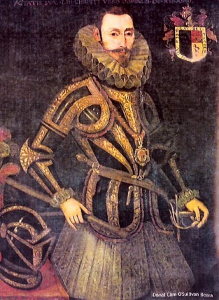
O’Sullivan Beare conceals 300 of the women, children and aged of his community in a stronghold on Dursey Island, but this position is attacked, and the defenders hanged. In what is later termed the Dursey Massacre, Philip O’Sullivan Beare, nephew of O’Sullivan Beare, writes that the women and children of the Dursey stronghold are massacred by the English, who tie them back-to-back, throw them from the cliffs, and shoot at them with muskets.
After the fall of Dursey and Dunboy, O’Sullivan Beare, Lord of Beara and Bantry, gathers his remaining followers and sets off northwards on December 31, 1602, on a 500-kilometre march with 1,000 of his remaining people. He hopes to meet Hugh O’Neill on the shores of Lough Neagh.
O’Sullivan Beare fights a long rearguard action northwards through Ireland, through Munster, Connacht and Ulster, during which the much larger English force and their Irish allies fight him all the way. The march is marked by the suffering of the fleeing and starving O’Sullivans as they seek food from an already decimated Irish countryside in winter. They face equally desperate people in this, often resulting in hostility, such as from the Mac Egans at Redwood Castle in County Tipperary and at Donohill in O’Dwyer’s country, where they raid the Earl of Ormonde‘s foodstore.
O’Sullivan Beare marches through Aughrim, where he raids villages for food and meets local resistance. He is barred entrance to Glinsk Castle and leads his refugees further north. On their arrival at Brian Oge O’Rourke‘s castle in Leitrim on January 4, 1603, after a fortnight’s hard marching and fighting, only 35 of the original 1,000 remain. Many had died in battles or from exposure and hunger, and others had taken shelter or fled along the route. O’Sullivan Beare had marched over 500 kilometres, crossed the River Shannon in the dark of a midwinter night, having taken just two days to make a boat of skin and hazel rods to carry 28 at a time the half-kilometre across the river, fought battles and constant skirmishes, and lost almost all of his people during the hardships of the journey.
In Leitrim, O’Sullivan Beare seeks to join with other northern chiefs to fight the English, and organises a force to this end, but resistance ends when Hugh O’Neill, 2nd Earl of Tyrone signs the Treaty of Mellifont. O’Sullivan Beare, like other members of the Gaelic nobility of Ireland who flees and seeks exile, making his escape to Spain by ship. O’Sullivan Beare settles in Spain and continues to plead with the Spanish government to send another invasion force to Ireland. King Phillip III gives him a knighthood, pension, and the title Earl of Bearhaven, but never that which he desires most, another chance to free his homeland.
Many generations of O’Sullivan Beare’s family later achieve prominence in Spain. In 1618, Donal Cam O’Sullivan Beare is killed in Madrid by John Bathe, an Anglo-Irishman, but the legend of “O’Sullivan’s March” lives on.
The Beara-Breifne Way long-distance walking trail follows closely the line of the historical march.
After acting as chaplain to Seth Ward, Bishop of Exeter and then Bishop of Salisbury, and Lord Chancellor Clarendon, he is elected principal of St. Alban Hall, Oxford, in 1673. In 1679 he is appointed provost of Trinity College, Dublin, where he does much to encourage the study of the Irish language. He helps to found the Dublin Philosophical Society and contributes to it a paper entitled Introductory Essay to the Doctrine of Sounds (printed in Philosophical Transactions, No. 156, Oxford, 1684).
In 1683 Marsh is consecrated Bishop of Ferns and Leighlin, but after the accession of James II he is compelled by the turbulent soldiery to flee to England in 1689, when he becomes Vicar of Gresford, Flintshire, and Canon of St. Asaph. Returning to Ireland in 1691 after the Battle of the Boyne, he is made Archbishop of Cashel, and three years later he becomes Archbishop of Dublin. About this time, he founds Marsh’s Library in Dublin, which is the oldest public library in Ireland. He becomes Archbishop of Armagh in 1703. Between 1699 and 1711 he is six times a Lord Justice of Ireland.
Narcissus Marsh dies on November 2, 1713. His funeral oration is pronounced by his successor at Dublin, Archbishop William King. A more acerbic account is provided by Jonathan Swift.
Many oriental manuscripts belonging to Narcissus Marsh are now in the Bodleian Library in Oxford.
Atherton is born in 1598 in Somerset, England. He studies at Oxford University and joins the ranks of the Anglican clergy. In 1634 he becomes Bishop of Waterford and Lismore in the Church of Ireland. In 1640 he is accused of buggery with a man, John Childe, his steward and titheproctor. They are tried under a law that Atherton himself had helped to institute. They are both condemned to death, and Atherton is executed in St. Stephen’s Green, Dublin. Reportedly, he confesses to the crime immediately before his execution, although he had proclaimed his innocence before that.
More recently, some historical evidence has been developed that shows Atherton might have been a victim of a conspiracy to discredit him and his patrons. This is attributable to Atherton’s status as an astute lawyer, who seeks to recover lost land for the relatively weak Protestant Church of Ireland during the 1630s. Unfortunately for Atherton, this alienates him from large landowners, who then allegedly use his sexuality to discredit him.
English Puritan, Congregationalist and Independent activists, as well as English and Scottish Presbyterian activists, contemporaneously campaign to abolish Episcopacy (bishops) within the embattled Church of England, Church of Scotland and Church of Ireland, notionally expediting the political interest in Atherton’s downfall.
Posthumous accusations of sexual wrongdoing also include allegations of “incest” with his sister-in-law, and infanticide of the resultant child, as well as zoophilia with cattle. However, these allegations begin to be circulated several months after his death in an anonymous pamphlet, and may have been intended to further discredit the bishop’s campaign to restore the finances of the Church of Ireland.
(Pictured: Anonymous pamphlet of the hangings of John Atherton and John Childe, 1641)
About 1520 Butler joins the household of CardinalThomas Wolsey, who praises him as a young gentleman “both wise and discreet.” In early 1522, it is proposed by King Henry VIII that he marry his cousin Anne Boleyn, who is the great-granddaughter of Thomas Butler, 7th Earl of Ormond. This is to resolve a dispute her father Thomas Boleyn, 1st Earl of Wiltshire has with James’ father over the Ormond inheritance and title. Wolsey himself supports the proposal. The marriage negotiation, comes to a halt for unknown reasons. Butler subsequently marries Lady Joan Fitzgerald in December 1532. Lady Joan is the daughter and heiress of the other great Munster landholder, the James FitzGerald, 10th Earl of Desmond and his wife Amy O’Brien. Their marriage produces seven sons.
During the early 1540s Butler gradually restores the Butler dynasty to their former position of influence, leading to antagonism from the quarrelsome Lord Deputy of Ireland, Sir Anthony St. Leger. St. Leger gives Butler command of the Irish forces in the Anglo-Scottish War of 1544. On the face of it this is an honour, but allies of Butler accuse St. Leger of deliberately sending him into danger. Butler himself demands an inquiry into claims that St. Leger had planned his murder, and the matter is thought to merit a Privy Council investigation. The Council finds in favour of St. Leger and he and Butler are ordered to work together amicably. Key Government allies of Butler like John Alan and Walter Cowley are removed from office, and Butler is struggling to maintain his standing when he is poisoned.
On October 17, 1546, James goes to London with many of his household. They are invited to dine at Ely Place in Holborn. He is poisoned along with his steward, James Whyte, and sixteen of his household. He dies nine days later, on October 28, leaving Joan a widow in her thirties.
It is surprising, in view of Butler’s high social standing, that no proper investigation into his death is carried out. Who is behind the poisoning remains a mystery. His host at the dinner, John Dudley, 1st Duke of Northumberland, though he could be notably ruthless, seems to have no motive for the crime, as he is not known to have had any quarrel with Butler. A recent historian remarks that it would be an extraordinary coincidence if St. Leger had no part in the sudden and convenient removal of his main Irish opponent.
The stadtholder dies suddenly, however, and the States are now embarrassed by Cromwell taking the idea too seriously. The English propose the joint conquest of all remaining Spanish and Portuguese possessions. England would take America and the Dutch would take Africa and Asia. But the Dutch have just ended their war with Spain and already taken over most Portuguese colonies in Asia, so they see little advantage in this grandiose scheme and propose a free trade agreement as an alternative to a full political union. This again is unacceptable to the British, who would be unable to compete on such a level playing field, and is seen by them as a deliberate affront.
The Act bans foreign ships from transporting goods from outside Europe to England or its colonies, and bans third-party countries’ ships from transporting goods from a country elsewhere in Europe to England. These rules specifically target the Dutch, who control much of Europe’s international trade and even much of England’s coastal shipping. It excludes the Dutch from essentially all trade with England, as the Dutch economy is competitive with, not complementary to the English, and the two countries therefore exchange few commodities. This Anglo-Dutch trade, however, constitutes only a small fraction of total Dutch trade flows.
The Act is often mentioned as a major cause of the First Anglo-Dutch War, though it is only part of a larger British policy to engage in war after the negotiations have failed. The English naval victories in 1653 (the Battle of Portland, the Battle of the Gabbard and the Battle of Scheveningen) show the supremacy of the Commonwealth navy in home waters. However, farther afield the Dutch predominate and are able to close down English commerce in the Baltic and the Mediterranean. Both countries hold each other in a stifling embrace.
The Treaty of Westminster (1654) ends the impasse. The Dutch fail to have the Act repealed or amended, but it seems to have had relatively little influence on their trade. The Act offers England only limited solace. It cannot limit the deterioration of England’s overseas trading position, except in the cases where England herself is the principal consumer, such as the Canary Islands wine trade and the trade in Puglian olive oil. In the trade with the West Indies, the Dutch keep up a flourishing “smuggling” trade, thanks to the preference of English planters for Dutch import goods and the better deal the Dutch offer in the sugar trade. The Dutch colony of New Netherland offers a loophole through intercolonial trade wide enough to drive a shipload of Virginia tobacco through.
The 1651 Act, like other laws of the Commonwealth period, is declared void on the Restoration of Charles II of England, having been passed by “usurping powers.” Parliament therefore passes new legislation. This is generally referred to as the “Navigation Acts,” and, with some amendments, remains in force for nearly two centuries.




 The
The  seamus dubhghaill