seamus dubhghaill

Promoting Irish Culture and History from Little Rock, Arkansas, USA


Leave a comment

Inaugural Meeting of the Irish Management Institute

irish-management-institute-logo

The Irish Management Institute, an educational institute in Dublin that offers Postgraduate Diplomas, Master’s Degrees, executive education programs and short courses in Business and Management, holds its inaugural meeting on December 9, 1952. In its role as a membership organisation it connects businesses around its mission of improving the practice of management in Ireland.

The idea for the institute originates from a committee set up by Michael Dargan, T.P. Hogan and other businessmen. The motivation is to establish an organisation that will further the science and practice of business management in Ireland. Those involved are inspired primarily by the American Management Association and The Conference Board. At the same time the then Minister for Industry and Commerce, Seán Lemass, has prompted a separate group of leading semi-state and private bosses into investigating a similar idea. Both groups merge and the inaugural meeting of the Irish Management Institute is held on December 9, 1952, in the Gresham Hotel. The founding chairman is Sir Charles Harvey.

The objective of the institute is to raise the standard of management in Ireland. Originally it does this through corporate and personal memberships, regular lectures and conferences, a journal called Irish Management, research and the establishment of a member’s library. After its first decade the institute becomes involved in management training courses.

Part of IMI’s original brief has been to encourage the universities to develop management education. In the early 1960s both University College Dublin (UCD) and Trinity College Dublin introduce master’s degrees in management. This is an indication of management’s growing stature as an academic discipline. In turn IMI creates the Sir Charles Harvey Award for exceptional graduates of these courses. The first recipient is Patrick J. Murphy.

IMI later goes on to become a provider of education. Its popular Certificate in Supervisory Management (CISM) is the first academic course run by IMI and is the institute’s first progression into all-island distance learning. In 1973 IMI partners with Trinity for the Master of Science in Management (MSc). The MSc epitomises IMI’s teaching philosophy and is notable for being the first management degree in the world to be based on action learning. Related courses follow over the next three decades. Other affiliations with Irish universities include a master’s in information technology development with NUI Galway and a research alliance with the University of Limerick. In 2003 IMI launches their support and delivery of the Flexible Executive Henley MBA programme.

An alliance between University College Cork and the Irish Management Institute is announced in June 2011 by Taoiseach Enda Kenny. The IMI and UCC had been collaborating since 2009. As of 2014, the majority of the degrees offered by the IMI are accredited by UCC. UCC controversially purchases the IMI and it is merged into UCC.

Leave a comment

Opening of Assembly’s College, Belfast

assemblys-college-belfast

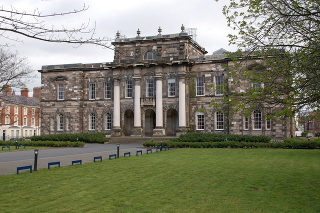
Assembly’s College, Belfast, opens for the training of Presbyterian clergy on December 5, 1853.

The Renaissance Revival style building with its grand Doric porch and Baroque attic is designed by Sir Charles Lanyon, the architect of the main building at Queen’s University Belfast and built with Scrabo stone at a cost of £5,000. Jean-Henri Merle d’Aubigné of Geneva participates in the opening ceremony alongside Henry Cooke, President of the Faculty. The five other professors in the new college are John Edgar, Robert Wilson, William Dool Killen, James G. Murphy and William Gibson.

There is a large influx of students in the wake of the 1859 Ulster revival and the south wing with its dining hall and student accommodations is added in 1869. Princeton Theological Seminary has an important influence in the shaping of the ethos of the College during this period as the Reverend Roberts Watts, who is appointed Professor of Systematic Theology in 1866, hopes to make “Belfast another Princeton.” The north wing with its wood-panelled chapel is designed by John Lanyon, son of original architect, and completed in 1881. The first degrees under the Royal Charter are conferred in 1883. However, the death of Watts in 1895 marks the beginning of the end of the Princetonian influence. A partial union takes place between the faculties in Belfast and Magee in 1922.

The newly formed Parliament of Northern Ireland meets in Assembly’s College from 1921 until 1932 while Stormont is being built with the House of Commons meeting in the Gamble Library and the Senate in the College chapel. During this period the College conducts classes in a house and provides library resources in a house on University Square. In 1926 the College becomes a Recognised College of Queen’s University. During this period the College comes under criticism for its embrace of theological liberalism. This culminates in a charge of heresy being brought against Professor James Ernest Davey in 1926-27. The College officially reopens in October 1932 and the inaugural lecture is delivered by the Scottish Historian Robert Rait.

Between 1941 and 1948 the Royal Ulster Constabulary, the city police, use the College as its own headquarters are bombed in the Belfast Blitz. In 1953, to mark the College’s centenary year, Prof. Davey is elected Moderator of the General Assembly.

In 1976 theological teaching at Magee College in Derry, County Londonderry, ceases and the two colleges amalgamate in 1978. The new college, constituted by an Act of Parliament, is named Union Theological College.

Today Union Theological College offers a full range of courses in Theology. The professors at the College constitute the Presbyterian Theological Faculty Ireland (PTFI) which was granted a Royal Charter in 1881 to confer academic degrees. The PTFI still awards degrees, diplomas and certificates. The majority of students are enrolled for degrees and diplomas, undergraduate and postgraduate, through the Institute of Theology of the Queen’s University of Belfast, in particular the BTh, BD, MTh and PhD.


Leave a comment

Death of Thomas Andrews, Chemist & Physicist

thomas-andrews

Thomas Andrews, chemist and physicist who does important work on phase transitions between gases and liquids, dies in Belfast on November 26, 1885. He is a longtime professor of chemistry at Queen’s University Belfast.

Andrews is born in Belfast on December 19, 1813, where his father is a linen merchant. He attends the Belfast Academy and the Royal Belfast Academical Institution, where at the latter of which he studies mathematics under James Thomson. In 1828 he goes to the University of Glasgow to study chemistry under Professor Thomas Thomson, then studies at Trinity College, Dublin, where he gains distinction in classics as well as in science. Finally, at the University of Edinburgh in 1835, he is awarded a doctorate in medicine.

Andrews begins a successful medical practice in his native Belfast in 1835, also giving instruction in chemistry at the Royal Belfast Academical Institution. In 1842, he marries Jane Hardie Walker. They have six children, including the geologist, Mary Andrews.

Andrews first becomes known as a scientific investigator with his work on the heat developed in chemical actions, for which the Royal Society awards him a Royal Medal in 1844. Another important investigation, undertaken in collaboration with Peter Guthrie Tait, is devoted to ozone. In 1845 he is appointed vice-president and professor of chemistry of the newly established Queen’s University Belfast. He holds these two offices until his retirement in 1879 at the age of 66.

His reputation mainly rests on his work with liquefaction of gases. In the 1860s he carries out a very complete inquiry into the gas laws — expressing the relations of pressure, temperature, and volume in carbon dioxide. In particular, he establishes the concepts of critical temperature and critical pressure, showing that a substance passes from vapor to liquid state without any breach of continuity.

In Andrews’ experiments on phase transitions, he shows that carbon dioxide may be carried from any of the states we usually call liquid to any of those we usually call gas, without losing homogeneity. The mathematical physicist Josiah Willard Gibbs cites these results in support of the Gibbs free energy equation. They also set off a race among researchers to liquify various other gases. In 1877-78 Louis Paul Cailletet is the first to liquefy oxygen and nitrogen.

Thomas Andrews dies in Belfast on November 26, 1885, and is buried in the city’s Borough Cemetery.


Leave a comment

Death of Michael Cusack, Founder of the GAA

michael-cusack

Michael Cusack, teacher and founder of the Gaelic Athletic Association, dies in Dublin on November 25, 1906.

Cusack is born on the eastern fringe of the Burren to Irish speaking parents in Carran, County Clare on September 20, 1847, during the Great Famine. He becomes a national school teacher and in 1874, after teaching in various parts of Ireland, becomes a professor at Blackrock College, then known as the French College. In 1877, he establishes his own civil service academy, Cusack’s Academy, in Dublin which proves successful in preparing pupils for the civil service examinations.

A romantic nationalist, Cusack is also reputed to have been associated with the Fenian movement. He is active in the Gaelic revival, initially as a member of the Society for the Preservation of the Irish Language which is founded in 1876, and later the Gaelic League who in 1879 breaks away from the Society. Also in 1879, he meets Pat Nally, who is a member of the Irish Republican Brotherhood and a leading nationalist and athlete. He finds that he and Nally agree on the influence of British landlordism on Irish athletics.

He would recall how both Nally and himself, While walking through Phoenix Park in Dublin and seeing only a handful of people playing sports in the park so depresses Cusack and Nally that they agree it is time to “make an effort to preserve the physical strength of [their] race.” Nally organises a National Athletics Sports meeting in County Mayo in September 1879 which is a success, with Cusack organising a similar event which is open to artisans in Dublin the following April.

On November 1, 1884, Cusack together with Maurice Davin, of Carrick-on-Suir, County Tipperary, calls a meeting in Hayes’ Commercial Hotel, Thurles, County Tipperary, and founds the Gaelic Athletic Association (GAA). Davin is elected president and Cusack becomes its first secretary. Later, Archbishop Thomas William Croke, Archbishop of Cashel & Emly, Michael Davitt and Charles Stewart Parnell become patrons. Cusack also becomes involved in the Irish language movement, founding The Celtic Times, a weekly newspaper which focuses on “native games” and Irish culture.

Michael Cusack dies in Dublin on November 27, 1906, at the age of 59. He is buried in Dublin’s Glasnevin Cemetery.


Leave a comment

Bill Clinton Receives Honorary Doctorate at DCU

bill-clinton-receives-honorary-doctorate-dcu

Former United States president Bill Clinton is conferred with an honorary doctorate at Dublin City University on October 17, 2017, for his crucial role in the Northern Ireland peace process.

“It was really quite something, there’s never been any peace agreement exactly like it before,” says Clinton on the Good Friday Agreement. “It broke like a thunder cloud across the world and other people were fighting in other places and they had this talk to say ‘well really do I want to put our children’s generation through this? Or if they can pull this off after all those decades maybe we could too.’”

Clinton says universities should be a place for open discussion about if people should live in individual tribes, or as communities with shared values and respect for one another, especially in today’s political climate.

“It is no exaggeration to say that the success of the Northern Ireland peace process is in very many ways due to the fact that President Clinton took the view that it was a conflict that could be resolved by his personal input and by the power and influence of the United States of America,” said Gary Murphy, from the School of Law and Government in the president’s introductory citation.

“There can be little doubt that the conflict in Northern Ireland was ultimately resolved because that great beacon of liberty, the United States of America, decided that it could use its influence to make a vital difference. That fateful decision was taken in the Oval Office by President Bill Clinton.”

“There was no electoral gain for him taking it. If anything, his initial forays into the Northern Ireland peace process were greeted with skepticism by both republicans and unionists in Northern Ireland and by downright distrust and suspicion in the corridors of power in London. But Bill Clinton persevered, and thanks to that perseverance we have peace in Ireland today.”

Also celebrated at the ceremony is Dr. Martin Naughton, KBE, founder of Glen Electric and one of Ireland’s most successful entrepreneurs and business leaders. From humble roots in Newry, County Down he becomes the global leader in electric heating and credits his success to his family ethos of honesty, morality, decency and integrity.

Sr. Stanislaus Kennedy is awarded the honorary doctorate for her longstanding work with the homeless and marginalised. She is the founder of Focus Ireland, which is now the largest voluntary organisation in Ireland, and has written many books on mindfulness and the importance of spirituality.

“As president I am often asked why DCU awards honorary doctorates, but Ireland has no national honours system, so it’s important that we recognise and honour outstanding achievements and role model individuals,” says Brian MacCraith.

(From The College View, http://www.thecollegeview.com, October 22, 2017)


Leave a comment

Death of Brian Merriman, Poet & Teacher

brian-merrimanBrian Merriman, Irish language poet and teacher, dies in County Limerick on July 27, 1805. His single surviving work of substance, the 1000-line long Cúirt An Mheán Oíche (The Midnight Court) is widely regarded as the greatest comic poem in the history of Irish literature.

Merriman ius born at Ennistymon, County Clare, the son of a journeyman stonemason, about 1747. He spends his childhood in the district of Lough Graney, near Killanena, Feakle. Some years later he is known to own a 20-acre farm near Lough Graney.

Merriman teaches at various schools in the area for about twenty years, first at Kilclaran and later in a school near his farm. The teaching profession in those days attracts those with a taste for literature. Many of the Irish poets of the 18th and 19th centuries are school teachers. It allows them to exist while they write. Later on he becomes resident tutor to the families of the local gentry.

This may be where Merriman gets the subject matter for his poem Cúirt an Mhéan Óiche. It is likely that he has access to books of European literature which give him ideas for the theme. His famous poem, written in his native Irish language, has well over a thousand lines. It has been translated into English as The Midnight Court by many translators. The principal themes are the plight of young women who lack husbands, clerical celibacy, free love, and the misery of a young woman married to a withered old man. It is written in the form of a vision or aisling. Merriman falls asleep on the shores of Lough Graney near Feakle in East Clare and finds himself present at a fairy court where the women of Ireland are discussing their great problems. It is believed that he writes the poem as a result of certain frustrations he has or of some complex he suffers from. His vigour, fluency and earthy humour make his poem widely popular and while he is still alive numerous manuscript copies are circulated.

Merriman marries around 1787 and has two daughters. In 1797, the Royal Dublin Society awards him two prizes for his flax crop. Around 1800 he moves to County Limerick, where he runs a school until his death on July 27, 1805. He is buried in Feakle. His grave has not been located but a plaque honouring his memory has been erected in Feakle churchyard.

In commemoration of Merriman’s poetic works an Annual Merriman Summer School is held each year in County Clare.


Leave a comment

Birth of Sir Philip Crampton, Surgeon & Anatomist

philip-crampton

Sir Philip Crampton, 1st Baronet, FRS, an eminent Irish surgeon and anatomist, is born in Dublin on June 7, 1777.

Crampton is the son of a dentist. He is a childhood friend of Theobald Wolfe Tone, the United Irishman, and a cousin, on his mother’s side, of Thomas Verner, Grand Master of the Orange Order. He joins the army when young and becomes an assistant surgeon. When he is appointed surgeon to the Meath Hospital in 1798, he is not yet fully qualified and goes on to graduate in Glasgow in 1800. A few years later he also becomes assistant surgeon at the Westmoreland Lock Hospital, Dublin and also builds up a large private practice at his house in Dawson St. He joins Peter Harkan in teaching anatomy in private lectures, forming the first private school of anatomy and surgery in the city.

Crampton becomes a Fellow of the Royal Society (FRS) in Ireland for a treatise on the construction of eyes of birds, written in 1813. This is later published, with other writings, in the Dublin Journal of Medical Science.

In 1821, together with Sir Henry Marsh and Dr. Charles Johnston, Crompton founds the Pitt St. Institution, a children’s hospital in Pitt St. (now Balfe St.). This hospital is the first teaching children’s hospital in Ireland or Great Britain. The main objective of the hospital is to treat sick children in one of the poorest parts of Dublin, The Liberties.

Crompton resigns the chief-surgeoncy of the Westmoreland Lock Hospital when he is appointed surgeon-general to the forces in Ireland. He remains as consulting surgeon to Dr. Steevens’ Hospital and the Dublin Lying-In Hospital. He is three times president of the Dublin College of Surgeons, and he is knighted in 1839.

Crompton is always interested in zoological science and plays an active part in founding the Royal Zoological Society of Ireland and is many times its president. He is also a member of the Royal Irish Academy.

Sir Philip Crampton dies at his residence, 14 Merrion Square, in Dublin on June 10, 1858.

The Crampton Memorial, at the junction of College St. with Pearse St. and D’Olier St., is erected from the design of sculptor John Kirk in 1862. It is of a curious design, consisting of a bust above a fountain and surmounted by a cascade of metal foliage. As it is slowly falling apart, it is removed in 1959. James Joyce references the monument in his novel Ulysses when Leopold Bloom passes the monument and thinks, “Sir Philip Crampton’s memorial fountain bust. Who was he?”


Leave a comment

Birth of Biblical Scholar James Henthorn Todd

james-henthorn-todd

James Henthorn Todd, biblical scholar, educator, and Irish historian, is born in Rathfarnham, a Southside suburb of Dublin, on April 23, 1805. He is noted for his efforts to place religious disagreements on a rational historical footing, for his advocacy of a liberal form of Protestantism, and for his endeavours as an educator, librarian, and scholar in Irish history.

Todd is the son of Charles Hawkes Todd, a professor of surgery, and Eliza Bentley, and is the oldest of fifteen children. Noted physician Robert Bentley Todd is among his younger brothers. His father dies a year after he receives a B.A. from Trinity College, Dublin in 1825, diminishing his prospects for success. However, he is able to remain at the college by tutoring and editing a church periodical.

Todd obtains a premium in 1829, and two years later is elected Fellow, taking deacon’s orders in the same year. From that time until 1850, when he becomes a Senior Fellow, he is among the most popular tutors in Trinity College.

Todd takes priest’s orders in 1832. He begins publishing in earnest, including papers on John Wycliffe, church history, and the religious questions of his day. He is Donnellan Lecturer in 1838 and 1839, publishing works related to the Antichrist in which he opposes the views of the more extreme of his co-religionists who apply this term to the Roman Catholicism and the Pope. In 1840 he graduates Doctor of Divinity.

In 1837 Todd is installed Treasurer at St. Patrick’s Cathedral in Dublin and becomes Precentor in 1864. His style of preaching is described as simple and lucid, and his sermons interesting. He co-founds Saint Columba’s College in 1843, a school which promotes the Irish language for those who intend to take orders, as well as promoting the principles of the Church of Ireland.

In 1849 Todd is made Regius Professor of Hebrew at Trinity, and a Senior Fellow the following year. In 1852 he is appointed Librarian, and working alongside John O’Donovan and Eugene O’Curry, he classifies and arranges the collection of manuscripts. When his office receives money, he spends it on the acquisition of manuscripts and rare books, and he deserves much credit for the library’s high ranking as one of the chief libraries of Europe.

Todd’s secular achievements are no less remarkable. In 1840 he co-founds the Irish Archaeological Society and acts as its honorary secretary. He is elected a member of the Royal Irish Academy and strives actively to acquire transcripts and accurate accounts of Irish manuscripts from foreign libraries. He is honorary secretary from 1847 to 1855, and president from 1856 to 1861. In 1860 he is given an ad eundem degree at the University of Oxford.

Todd is a notable person among notable people. His work is widely respected and cited. Among his friends and acquaintances are lawyer and poet Sir Samuel Ferguson, Conservative Member of Parliament (MP) and Roman Catholic convert Edwin Wyndham-Quin, fellow historian William Reeves, artist Sir George Petrie, and the Stokes family (physician father William, future lawyer and Celticist son Whitley, and future antiquarian daughter Margaret).

James Henthorn Todd dies at his house in Rathfarnham on June 28, 1869, and is buried in the churchyard of St. Patrick’s Cathedral.


Leave a comment

Birth of Daniel Corkery, Writer & Academic

daniel-corkery

Daniel Corkery, Irish politician, writer and academic, is born in Cork, County Cork on February 14, 1878. He is unquestionably best known as the author of The Hidden Ireland, his 1924 study of the poetry of eighteenth-century Irish Language poets in Munster.

Corkery is educated at the Presentation Brothers and St. Patrick’s College of Education, Dublin where he trains as a teacher. He teaches at Saint Patrick’s School in Cork but resigns in 1921 when he is refused the headmastership. Among his students are the writer Frank O’Connor and the sculptor Seamus Murphy.

After leaving St. Patrick’s, Corkery teaches art for the local technical education committee, before becoming inspector of Irish in 1925, and later Professor of English at University College Cork in 1930. Among his students in UCC are Seán Ó Faoláin and Seán Ó Tuama. He is often a controversial figure in academia for his “nativist” views on Irish literature, views which result in conflict with many Irish Language scholars, most notably Pádraig de Brún and his niece Máire Mhac an tSaoi. Ó Tuama, however, is frequently a staunch defender of Corkery’s reputation.

In his late twenties Corkery learns Irish and this brings him into contact with leading members of the Irish Language revival movement, including Terence MacSwiney, T. C. Murray and Con O’Leary, with whom he founds the Cork Dramatic Society in 1908. His plays Embers and The Hermit and the King are performed by the society. Later plays are staged at the famous Abbey Theatre, including The Labour Leader (1919) and The Yellow Bittern (1920).

Corkery is also a writer of short stories, including the collections A Munster Twilight (1916), The Hounds of Banba (1920), The Stormy Hills (1929), and Earth Out of Earth (1939), and a novel, The Threshold of Quiet (1917).

Corkery also writes non-fiction works, including The Hidden Ireland (1924), a highly influential work about the riches of eighteenth-century Irish poetry. In this he attempts to reconstruct a worldview preserved by Gaelic poets amongst the poor and oppressed Catholic peasantry of the Penal Laws era, virtually invisible in the Anglo-Irish tradition that has dominated the writing of Irish history. “An instant, influential classic,” writes Patrick Walsh, “its version of the past provided powerful cultural underpinning to the traditional nationalist history that became, in the 1930s, the educational orthodoxy of the new state.”

Corkery serves as a member of Seanad Éireann from 1951 to 1954 when he is nominated by the Taoiseach.

Daniel Corkery dies on December 31, 1964. His papers are held in the Boole Library of University College Cork.


Leave a comment

Opening of the Belfast Academical Institution

belfast-academical-institution

The Belfast Academical Institution, later the Royal Belfast Academical Institution, a grammar school in Belfast, is opened on February 1, 1814. Today, locally referred to as Inst, the school educates boys from ages 11 to 18. It is one of the eight Northern Irish schools represented on the Headmasters’ and Headmistresses’ Conference. The school occupies an 18-acre site in the centre of the city on which its first buildings were erected.

The first demands for the school which would become “Inst” comes from a group of Belfast merchants and professional gentlemen. They insist that the existing Belfast Academy under William Bruce does not offer a “complete, uniform, and extensive system of education.” They hope that a new school will give more access to the “higher” branches of learning as well as to those which would fit youths for a practical commercial career. The foundation stone of Inst is laid, in pouring rain, on July 3, 1810, by George Augustus Chichester, 2nd Marquess of Donegall. Donegall owns much of the land in the Belfast area and grants the school a lease for the grounds at an annual rent of £22–5s–1d. The eminent English architect John Soane, who designed the new Bank of England in 1788, offers to draw up plans in 1809.

Construction begins in 1810. Money is collected to pay for the buildings by encouraging rich merchants and businessmen to subscribe one hundred guineas each for the privilege of being able to nominate one boy to receive free education at Inst. The roof of the main building is completed during the winter of 1811. The Institution is formally opened at 1:00 PM on February 1, 1814. William Drennan announces that the aim is to “diffuse useful knowledge, particularly among the middling orders of society, as a necessity, not a luxury of life.” He also refers to the particularly noble and rural setting of the school – in front a fair and flourishing town, and backed by a sublime and thought-inspiring mountain. Until the middle of the 19th century, the RBAI is both a school and a university, a dual function which the Belfast Academy never had.