seamus dubhghaill

Promoting Irish Culture and History from Little Rock, Arkansas, USA


Leave a comment

Birth of John Brougham, Actor & Dramatist

john-brougham

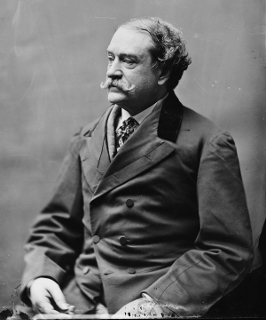
John Brougham, Irish American actor and dramatist, is born in Dublin on May 9, 1814.

Brougham’s father is an amateur painter and dies young. His mother is the daughter of a Huguenot, whom political adversity has forced into exile. He is the eldest of three children. Both of his siblings die in youth, and the father being dead, and the widowed mother left penniless, he is reared in the family and home of an uncle.

Brougham is prepared for college at an academy at Trim, County Meath, twenty miles from Dublin, and subsequently is sent to the University of Dublin. There he acquires classical learning and forms interesting and useful associations and acquaintances. He also becomes interested in private theatricals. He falls in with a crowd that puts on their own shows, cast by drawing parts out of a hat. Though he most always trades off larger roles so he can pay attention to his studies, he takes quite an interest in acting. He is a frequent attendant, moreover, at the Theatre Royal in Hawkins Street.

Brougham is educated with the intention of his becoming a surgeon and walks the Peth Street Hospital for eight months. However, misfortune comes upon his uncle, so he is obliged to provide for himself. Before leaving the university he, by chance, becomes acquainted with the actress Lucia Elizabeth Vestris.

Brougham goes to London in 1830 and, after a brief experience of poverty, suddenly determines to become an actor. He is destitute of everything except fine apparel, and he has actually taken the extreme step of offering himself as a cadet in the service of the East India Company. But, being dissuaded by the enrolling officer, who lends him a guinea and advises him to seek other employment, and happening to meet with a festive acquaintance, he seeks recreation at the Tottenham Theatre where Madame Vestris is acting.

Brougham’s acquaintance with Madame Vestris leads to him being engaged at the theatre, and he thus makes his first appearance on the London stage in July in Tom and Jerry, in which he plays six characters. In 1831 he is a member of Madame Vestris’s company and writes his first play, a burlesque. He remains with Madame Vestris as long as she and Charles Mathews retain Covent Garden Theatre, and he collaborates with Dion Boucicault in writing London Assurance, the role of Dazzle being one of those with which he becomes associated. His success at small or “low” comic roles such as Dazzle earn him the nickname “Little Johnny Brougham,” a moniker which he embraces, and which boosts his popularity with working-class audiences.

In 1840 Brougham manages the Lyceum Theatre, for which he writes several light burlesques, but in 1842 he moves to the United States, where he becomes a member of William Evans Burton‘s company, for which he writes several comedies, including Met-a-mora; or, the Last of the Pollywogs, a parody of John A. Stone and Edwin Forrest’s Metamora; or The Last of the Wamponoags, and Irish Yankee; or, The Birthday of Freedom.

Later Brougham is the manager of Niblo’s Garden, and in 1850 opens Brougham’s Lyceum, which, like his next speculation, the lease of the Bowery Theatre, is not a financial success, despite the popularity of such works as Po-ca-hon-tas; or, The Gentle Savage. He is later connected with James William Wallack‘s and Augustin Daly‘s theatres and writes plays for both.

In 1860 Brougham returns to London, where he adapts or writes several plays, including The Duke’s Motto for Charles Fechter. In November 1864 he appears at the Theatre Royal in his native Dublin in the first performance of Dion Boucicault’s Arrah-na-Pogue with Boucicault, Samuel Johnson and Samuel Anderson Emery in the cast.

After the American Civil War Brougham returns to New York City. Brougham’s Theatre is opened in 1869 with his comedies Better Late than Never and Much Ado About a Merchant of Venice, but this managerial experience is also a failure due to disagreements with his business partner, James Fisk. He then takes to playing the stock market. His last appearance onstage is in 1879 as “O’Reilly, the detective” in Boucicault’s Rescued.

John Brougham dies in Manhattan on June 7, 1880.


Leave a comment

Birth of Bing Crosby

bing-crosby

Harry Lillis “Bing” Crosby Jr., American singer and actor and descendant of Irish immigrants, is born on May 3, 1903, in Tacoma, Washington. His trademark warm bass-baritone voice makes him one of the best-selling recording artists of all time, selling over one billion analog records and tapes, as well as digital compact discs and downloads around the world.

Crosby’s parents are Harry Lillis Crosby Sr. (1870–1950), a bookkeeper of English descent, and Catherine Helen “Kate” (née Harrigan; 1873–1964), a second-generation Irish American. An ancestor, Simon Crosby, emigrates to America in the 17th century, and one of his descendants marries a descendant of Mayflower passenger William Brewster.

The first multimedia star, from 1931 to 1954 Crosby is a leader in record sales, radio ratings, and motion picture grosses. His early career coincides with technical recording innovations such as the microphone. This allows him to develop a laid-back, intimate singing style that influences many of the popular male singers who follow him, including Perry Como, Frank Sinatra, Dick Haymes, and Dean Martin. Yank, the Army Weekly magazine says that he is the person who has done the most for American soldiers’ morale during World War II.

The biggest hit song of Crosby’s career is his recording of Irving Berlin‘s “White Christmas,” which he introduces on a Christmas Day radio broadcast in 1941. The song then appears in his 1942 movie Holiday Inn. His record hits the charts on October 3, 1942, and rises to No. 1 on October 31, where it stays for eleven weeks.

In 1948, American polls declare him the “most admired man alive,” ahead of Jackie Robinson and Pope Pius XII. Also in 1948, Music Digest estimates that his recordings fill more than half of the 80,000 weekly hours allocated to recorded radio music.

Crosby wins an Academy Award for Best Actor for his role as Father Chuck O’Malley in the 1944 motion picture Going My Way and is nominated for his reprise of the role in The Bells of St. Mary’s opposite Ingrid Bergman the next year, becoming the first of six actors to be nominated twice for playing the same character. In 1963, he receives the first Grammy Global Achievement Award. He is one of 33 people to have three stars on the Hollywood Walk of Fame, in the categories of motion pictures, radio, and audio recording.

Crosby influences the development of the postwar recording industry. After seeing a demonstration of an early Ampex reel-to-reel tape recorder he places a large order for their equipment and convinces ABC to allow him to tape his shows. He becomes the first performer to pre-record his radio shows and master his commercial recordings onto magnetic tape. Through the medium of recording, he constructs his radio programs with the same directorial tools and craftsmanship (editing, retaking, rehearsal, time shifting) used in motion picture production, a practice that becomes an industry standard. In addition to his work with early audio tape recording, he helps to finance the development of videotape, purchases television stations, breeds racehorses, and co-owns the Pittsburgh Pirates baseball team.

On October 13, 1977, Crosby flies alone to Spain to play golf and hunt partridge. The following day, at the La Moraleja Golf Course near Madrid, he plays 18 holes of golf. As Crosby and his party head back to the clubhouse, Crosby says, “That was a great game of golf, fellas.” At about 6:30 PM, he collapses about 20 yards from the clubhouse entrance and dies instantly from a massive heart attack. At Reina Victoria Hospital he is administered the last rites of the Catholic Church and is pronounced dead. On October 18, following a private funeral Mass at St. Paul’s Catholic Church in Westwood, he is buried at Holy Cross Cemetery in Culver City, California. A plaque is placed at the golf course in his memory.


2 Comments

Birth of Actor Spencer Tracy

spencer-tracy

Spencer Bonaventure Tracy, American actor noted for his natural style and versatility, is born in Milwaukee, Wisconsin on April 5, 1900. One of the major stars of Hollywood’s Golden Age, Tracy wins two Academy Awards for Best Actor, from nine nominations, sharing the record for nominations in that category with Laurence Olivier.

Tracy is the second son of Caroline and John Edward Tracy, a truck salesman. His mother is a Presbyterian from a wealthy Midwestern family and his father is of Irish Catholic background.

Tracy first discovers his talent for acting while attending Ripon College, and he later receives a scholarship for the American Academy of Dramatic Arts. He spends seven years in the theatre, working in a succession of repertory theatres and intermittently on Broadway. His breakthrough comes in 1930, when his lead performance in The Last Mile catches the attention of Hollywood. After a successful film debut in Up the River, he is signed to a contract with Fox Film Corporation. His five years with Fox are unremarkable and he remains largely unknown to audiences after 25 films, most of them starring Tracy as the leading man. None of them are hits although The Power and the Glory (1933) features one of his most acclaimed performances.

In 1935, Tracy joins Metro-Goldwyn-Mayer, at the time Hollywood’s most prestigious studio. His career flourishes with a series of hit films, and in 1937 and 1938 he wins consecutive Oscars for Captains Courageous and Boys Town. By the 1940s, Tracy is one of the studio’s top stars. In 1942, he appears with Katharine Hepburn in Woman of the Year, beginning a popular partnership that produces nine movies over 25 years.

Tracy leaves MGM in 1955 and continues to work regularly as a freelance star, despite an increasing weariness as he ages. His personal life is troubled, with a lifelong struggle against alcoholism and guilt over his son’s deafness. He becomes estranged from his wife in the 1930s but never divorces, conducting a long-term relationship with Katharine Hepburn in private. Towards the end of his life, he works almost exclusively for director Stanley Kramer. It is for Kramer that he makes his last film, Guess Who’s Coming to Dinner in 1967, completed just 17 days before his death.

On June 10, 1967, Tracy awakens at 3:00 AM to make himself a cup of tea in his apartment in Beverly Hills, California that he shares with Hepburn. She hears a loud thump and finds Tracy lying dead on the kitchen floor from a heart attack.

A Requiem Mass is held for Tracy on June 12, 1967, at the Immaculate Heart of Mary Catholic Church in East Hollywood. Pallbearers included George Cukor, Stanley Kramer, Frank Sinatra, James Stewart, and John Ford. Out of consideration for Tracy’s family, Hepburn does not attend the funeral. Tracy is interred at Glendale‘s Forest Lawn Memorial Park, near his wife, Louise, and son John.

During his career, Tracy appears in 75 films and develops a reputation among his peers as one of the screen’s greatest actors. In 1999 the American Film Institute ranks Tracy as the 9th greatest male star of Classical Hollywood Cinema.


Leave a comment

Death of Olympic Gold Medalist Martin John Sheridan

martin-john-sheridan

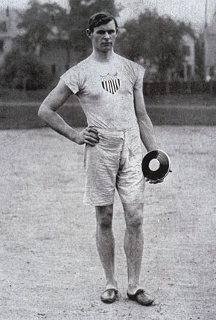
Martin John Sheridan, “one of the greatest athletes the United States has ever known” according to his obituary in The New York Times, dies in St. Vincent’s Hospital in Manhattan, New York City on March 27, 1918, the day before his 37th birthday.

Sheridan is born in Bohola, County Mayo on March 28, 1881. At 6’3″ and 194 lbs., Sheridan is the best all-around athlete of the Irish American Athletic Club, and like many of his teammates, serves with the New York City Police Department from 1906 until his death. He is so well respected in the NYPD, that he serves as the Governor’s personal bodyguard when the governor is in New York City.

A five-time Olympic gold medalist, with a total of nine Olympic medals, Sheridan is called “one of the greatest figures that ever represented this country in international sport, as well as being one of the most popular who ever attained the championship honor.” He wins the discus throw event at the 1904, 1906, and 1908 Summer Olympic Games as well as the shot put at the 1906 Olympics and the Greek discus in 1908. At the 1906 Intercalated Games in Athens, Greece he also wins silver medals in the standing high jump, standing long jump and the stone throw.

In 1907, Sheridan wins the National Amateur Athletic Union discus championship and the Canadian championship, and in 1908 he wins the Metropolitan, National and Canadian championships as well as two gold medals in the discus throw and bronze in the standing long jump at the 1908 Olympic Games.

Two of Sheridan’s gold medals from the 1904 Summer Olympic Games in St. Louis, Missouri, and one of his medals from the 1906 Intercalated Games in Athens, Greece, are currently located in the USA Track & Field‘s Hall of Fame History Gallery, in Washington Heights, Manhattan.

There are claims that Sheridan fuels a controversy in London in 1908, when flagbearer Ralph Rose refuses to dip the flag to King Edward VII. Sheridan supports Rose by explaining “This flag dips to no earthly king,” and it is claimed that his statement exemplifies both Irish and American defiance of the British monarchy. However, careful research has shown that this is first reported in 1952. Sheridan himself makes no mention of it in his published reports on the Games and neither does his obituary.

Martin Sheridan dies in Manhattan, New York City on March 27, 1918, a very early casualty of the 1918 flu pandemic. He is buried in Calvary Cemetery, Queens, New York. The inscription on the granite Celtic Cross monument marking his grave says in part: “Devoted to the Institutions of his Country, and the Ideals and Aspirations of his Race. Athlete. Patriot.” He is part of a group of Irish American athletes known as the “Irish Whales.”


Leave a comment

Birth of Boxer Jack McAuliffe

jack-mcauliffe

Jack McAuliffe, Irish American boxer who fights mostly out of Williamsburg, Brooklyn, is born in Cork, County Cork, on March 24, 1866. Nicknamed “The Napoleon of the Ring,” he is one of only fifteen world boxing champions to retire without a loss. He is the World Lightweight champion from 1886 to 1893. He is posthumously inducted into The Ring magazine Hall of Fame in 1954 and the International Boxing Hall of Fame in 1995.

McAuliffe’s parents are Cornelius McAuliffe and Jane Bailey, who are living at 5 Christ Church Lane, Cork, at the time of Jack’s birth. He emigrates to the United States in 1871, where he spends his early years in Bangor, Maine.

McAuliffe makes his first appearance as an amateur boxer in 1883. He turns professional soon after, fighting Jem Carney 78 rounds to a draw at Revere Beach, Massachusetts. He fights Billy Dacey for the lightweight championship and a $5,000 purse in 1888, knocking him out in eleven rounds. He is known as a strong two-handed fighter with “cat-like” reflexes.

McAuliffe is married twice, both times to stage actresses. His first wife is Katie Hart, who plays in farce comedies. After her death, he marries Catherine Rowe in 1894, whose stage name is Pearl Inman, of the song and dance team The Inman Sisters. Between marriages he dates a third actress, Sadie McDonald. McAuliffe and Rowe move back to Bangor, Maine, in 1894, where he undertakes preliminary training for a fight later that year at the Seaside Athletic Club on Coney Island.

McAuliffe retires in 1897. According to the International Boxing Hall of Fame, he has 36 professional fights. He finishes his career with 30 victories with 22 by knockout, five draws and one no decision.

Jack McAuliffe dies on November 5, 1937, at his home on Austin Street in Forest Hills, Queens.


Leave a comment

Birth of Production Designer Cedric Gibbons

cedric-gibbons

Austin Cedric Gibbons, Irish American art director and production designer for the film industry, is born in Dublin on March 23, 1893. He also makes a significant contribution to motion picture theater architecture from the 1930s to 1950s.

Gibbons was born to architect Austin P. Gibbons and Veronica Fitzpatrick Simmons. He is privately tutored and studies at the Art Students League of New York. In 1911 he begins working in his father’s office as a junior draftsman. From 1915 he serves as art director at Edison Studios in New Jersey and then serves in the United States Navy during World War I. He then joins Goldwyn Studios and begins a long career with Metro-Goldwyn-Mayer in 1924, the year the studio is founded.

Gibbons is one of the original 36 founding members of the Academy of Motion Picture Arts and Sciences and oversees the design of the Academy Awards statuette in 1928, a trophy for which he himself would be nominated 38 times for Best Production Design, winning eleven.

In 1930, Gibbons marries actress Dolores del Río and co-designs their house in Santa Monica, an intricate Art Deco residence influenced by Rudolf Schindler. They divorce in 1941. Three years later he marries actress Hazel Brooks, with whom he remains until his death.

Gibbons’s set designs, particularly those in such films as Born to Dance (1936) and Rosalie (1937), heavily inspire motion picture theater architecture in the late 1930s through 1950s. The style is found very clearly in the theaters that are managed by the Skouras brothers, whose designer Carl G. Moeller uses the sweeping scroll-like details in his creations. Among the more classic examples are the Loma Theater in San Diego, The Crest in Long Beach and Fresno, and the Culver Theater in Culver City. The style is sometimes referred to as Art Deco and Art Moderne.

Gibbons retires in 1956 with about 1,500 films credited to him, however, his contract with MGM dictates that he receives credit as art director for every MGM film released in the United States, even though other designers might do the bulk of the work. Even so, his actual hands-on art direction is believed to be about 150 films.

Gibbons’ second cousin, Frederick Gibbons, a musician, orchestra conductor, and entertainer who works with him at MGM, is the father of Billy Gibbons of the rock band ZZ Top.

Cedric Gibbons dies in Los Angeles on July 26, 1960, at the age of 67. He is buried in the Calvary Cemetery, East Los Angeles.


Leave a comment

Birth of Civil War Officer John O’Neill

john-oneill

John Charles O’Neill, Irish-born officer in the American Civil War and member of the Fenian Brotherhood, is born on March 9, 1834, in Drumgallon, Clontibret, County Monaghan. He is best known for his activities leading the Fenian raids on Canada in 1866 and 1871.

O’Neill receives some schooling in Drumgallon. He emigrates to New Jersey in 1848 at the height of the Great Famine in Ireland. He receives an additional year of education there and works in a number of jobs. In 1857 he enlists in the 2nd United States Dragoons and serves in the Utah War (May 1857 – July 1858), apparently deserting afterwards to California.

In California, he joins the 1st Cavalry and serves as a sergeant in the American Civil War with this regiment until December 1862, at which time he is commissioned as an officer in the 5th Indiana Cavalry. He is credited as being a daring fighting officer, but believes he has not received due promotion, which leads to a transfer to the 17th United States Colored Infantry as captain. He leaves the Union Army prior to the end of the conflict, marrying Mary Crow, with whom he has several children.

While in Tennessee, O’Neill joins the militant Irish American movement, the Fenian Brotherhood, which eschews politics in favor of militant action to expel the British presence in Ireland. He attaches himself to the group led by William Randall Roberts, who wishes to attack Canada.

O’Neill, ranked as colonel, travels to the Canada–US border with a group from Nashville to participate in the Fenian raids. The assigned commander of the expedition does not appear, so O’Neill takes command. On June 1, 1866, he leads a group of six hundred men across the Niagara River and occupies Fort Erie.

The following day, north of Ridgeway, Ontario, O’Neill’s group encounters a detached column of Canadian volunteers, commanded by Lt-Col. Alfred Booker. The inexperienced Canadians are routed by the Civil War veterans. O’Neill withdraws back to Fort Erie and fights a battle against a detachment led by John Stoughton Dennis. With overwhelming numbers of Canadian forces closing in, O’Neill oversees a successful evacuation on the night of June 2-3 back to United States territory. He is later charged with violating the neutrality laws of the United States, but the charges are later dropped.

The penetration of O’Neill’s organisation by British and Canadian spies ensures that his next venture into Canada, the Battle of Eccles Hill, in 1870 is known in advance, and Canada is accordingly prepared. After the Battle of Trout River ends in a disorganized rout, O’Neill is arrested by United States Marshal George P. Foster and charged with violating neutrality laws. He is sentenced to two years in prison in July 1870 but he and other Fenians are pardoned by President Ulysses S. Grant that October.

Though he renounces the idea of further attacks on Canada, he changes his mind at the urging of an associate of Louis Riel, William Bernard O’Donoghue. With the latter, and without the backing of the bulk of the Fenians, he leads an attack on the Hudson’s Bay Company‘s post at Pembina, Manitoba, on October 5, 1871. The area is then disputed between America and Canada. He is arrested by American troops.

In 1874 O’Neill embarks on a lecture tour along the east coast, encouraging the poor Irish that they would have a better standard of living if they would resettle with him in Nebraska. The first Irish colony in Nebraska is set up in Holt County in the town that bears his name today – O’Neill, Nebraska. His legacy is in the communities that exist in Nebraska today. These settlements are thriving and successful farming communities. John O’Neill can claim credit for the spirit of generosity that is still part of these communities today.

In 1877, while on a speaking tour in Little Rock, Arkansas, O’Neill becomes ill and returns to his home in Nebraska. His condition continues to deteriorate and, after been admitted to St. Joseph’s Hospital Omaha in November 1877, suffers a paralytic stroke and dies on January 8, 1878.


Leave a comment

The Boston Massacre

boston-massacre-1770

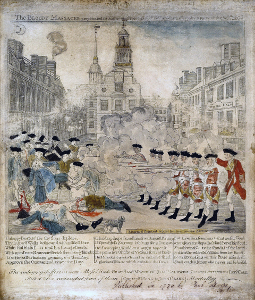
The Boston Massacre, a riot known as the Incident on King Street by the British, takes place in Boston, Massachusetts on March 5, 1770. British Army soldiers shoot and kill several people while under attack by a mob.

The incident is heavily publicized by leading Patriots, such as Paul Revere and Samuel Adams, to encourage rebellion against the British authorities. British troops have been stationed in Boston, capital of the Province of Massachusetts Bay, since 1768 in order to protect and support crown-appointed colonial officials attempting to enforce unpopular Parliamentary legislation.

Amid ongoing tense relations between the population and the soldiers, a mob forms around a British sentry, who is subjected to verbal abuse and harassment. He is eventually supported by eight additional soldiers, who are subjected to verbal threats and repeatedly hit by clubs, stones and snowballs. Without orders, they fire a ragged series of shots into the crowd, striking eleven men. Three Americans, ropemaker Samuel Gray, mariner James Caldwell, and Crispus Attucks, die instantly. Samuel Maverick, a 17-year-old apprentice ivory turner, is struck by a ricocheting musket ball at the back of the crowd and dies a few hours later, in the early morning of the next day. An Irish immigrant, Patrick Carr, dies two weeks later. Christopher Monk, another apprentice, is one of those seriously wounded in the attack. Although he recovers to some extent, he is crippled and eventually dies in 1780, purportedly due to the injuries he had sustained in the attack a decade earlier.

The crowd eventually disperses after Acting Governor Thomas Hutchinson promises an inquiry, but the crowd re-forms the next day, prompting the withdrawal of the troops to Castle Island. Eight soldiers, one officer, and four civilians are arrested and charged with murder. Defended by lawyer and future American president John Adams, six of the soldiers are acquitted, while the other two are convicted of manslaughter and given reduced sentences. The men found guilty of manslaughter are sentenced to branding on their hand. Depictions, reports, and propaganda about the event, notably the colored engraving produced by Paul Revere, further heighten tensions throughout the Thirteen Colonies.

(Pictured: Famous depiction of the Boston Massacre engraved by Paul Revere (copied from an engraving by Henry Pelham), colored by Christian Remick, and printed by Benjamin Edes. The Old State House is depicted in the background.)


Leave a comment

Irish Race Convention of 1916

hotel-astor-nyc

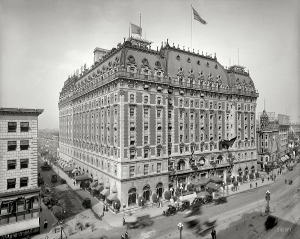
The third Irish Race Convention is held in New York City on March 4, 1916, and serves as an immediate call for the Easter Rebellion in Dublin. Previous conventions were held in Chicago (1881) and Dublin (1896). The Irish Race Conventions are a disconnected series of conventions held in Europe and the Americas between 1881 and 1994. The main participants and financial supporters of the conventions are usually Irish Americans.

The 1916 convention, comprising 2,300 delegates at the Hotel Astor, is held six weeks before the Easter Rising, and considers the division between the home Rule parties and the more militant nationalists. The Rising would be supported by Clan na Gael, but other members remain hopeful that the 1914 Home Rule Act, which had been passed but suspended during World War I, might work.

A majority at the convention support the American policy of neutrality during the war and are opposed to any alliance with Britain. Woodrow Wilson wins the United States presidential election in 1916 with help from Irish Americans and his campaign slogan of “He kept us out of War.”

An important result is the formation of the “Friends of Irish Freedom” that work as a coordinating body to support “the independence of Ireland, the industrial development of Ireland, the use and sale of Irish products, and to revive Irish culture.”

(Pictured: Hotel Astor, located in the Times Square area of Manhattan, New York City. The hotel was demolished in 1967 and replaced with the 54-story high-rise office tower One Astor Plaza.)


1 Comment

Death of General John Charles O’Neill

general-john-oneill

John Charles O’Neill, Irish-born officer in the American Civil War and member of the Fenian Brotherhood, dies on January 7, 1878. He is best known for his activities leading the Fenian raids on Canada in 1866 and 1871.

O’Neill is born on March 9, 1834, in Drumgallon, Clontibret, County Monaghan, where he receives some schooling. He emigrates to New Jersey in 1848 at the height of the Great Famine. He receives an additional year of education there and works various jobs. In 1857 he enlists in the 2nd United States Dragoons and serves in the Utah War (May 1857 – July 1858), apparently deserting afterwards to California.

In California, O’Neill joins the 1st Cavalry, and serves as a sergeant in the American Civil War with this regiment until December 1862, at which time he is commissioned as an officer in the 5th Indiana Cavalry. He is credited as being a daring fighting officer but believes he has not received due promotion, which leads to a transfer to the 17th United States Colored Infantry as captain. He leaves the Union Army prior to the end of the conflict, marrying Mary Crow, with whom he has several children.

While in Tennessee, O’Neill joins the militant Irish American movement, the Fenian Brotherhood, which eschews politics in favor of militant action to expel the British presence in Ireland. He attaches himself to the group led by William Randall Roberts, who wishes to attack Canada.

O’Neill, ranked as colonel, travels to the Canada–US border with a group from Nashville to participate in the Fenian raids. The assigned commander of the expedition does not appear, so O’Neill takes command. On June 1, 1866, he leads a group of six hundred men across the Niagara River and occupies Fort Erie.

The following day, north of Ridgeway, Ontario, O’Neill’s group encounters a detached column of Canadian volunteers, commanded by Lt-Col. Alfred Booker. The inexperienced Canadians are routed by the Civil War veterans. O’Neill withdraws back to Fort Erie and fights a battle against a detachment led by John Stoughton Dennis. With overwhelming numbers of Canadian forces closing in, O’Neill oversees a successful evacuation on the night of June 2-3 back to United States territory. He is later charged with violating the neutrality laws of the United States, but the charge is dropped.

The split between two factions of the Fenians remain, and penetration of O’Neill’s organisation by British and Canadian spies ensures that his next venture into Canada in 1870 is known in advance, and Canada is accordingly prepared. After the Battle of Trout River ends in a disorganized rout, O’Neill is arrested by United States Marshal George P. Foster and charged with violating neutrality laws. That leads to O’Neill’s imprisonment in July 1870 with a sentence of two years, but he and other Fenians are pardoned by President Ulysses S. Grant that October.

Though O’Neill renounces the idea of further attacks on Canada, he changes his mind at the urging of an associate of Louis Riel, William Bernard O’Donoghue. With the latter, and without the backing of the bulk of the Fenians, he leads an attack on the Hudson’s Bay Company‘s post at Pembina, Manitoba, on October 5, 1871. The area is then disputed between America and Canada. He is arrested by American troops.

Following his military career, O’Neill works for a firm of land speculators in Holt County, Nebraska. He dies of a paralytic stroke on January 7, 1878, and is buried in Omaha, Nebraska.