seamus dubhghaill

Promoting Irish Culture and History from Little Rock, Arkansas, USA


Leave a comment

Birth of Myles Walter Keogh, Last Man Killed at the Battle of Little Big Horn

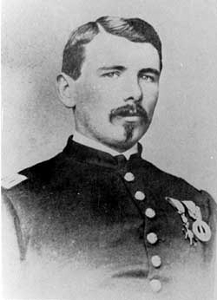
Myles Walter Keogh, soldier in the United States Army, is born in Orchard House in LeighlinbridgeCounty Carlow, on March 25, 1840. It is said by the Sioux that he is the last man killed at the Battle of Little Big Horn, where his horse is the only U.S. survivor.

Keogh attends the National School in Leighlinbridge and is long thought to have attended St. Patrick’s College in Carlow but that college has no record of his attendance. It is possible that he attends St. Mary’s Knockbeg College.

By 1860, a twenty-year-old Keogh volunteers, along with over one thousand of his countrymen, to rally to the defence of Pope Pius IX following a call to arms by the Catholic clergy in Ireland. By August 1860, Keogh is appointed second lieutenant of his unit in the Battalion of St. Patrick, Papal Army under the command of General Christophe Léon Louis Juchault de Lamoricière. Once the fighting is over and duties of the Pontifical Swiss Guard become more mundane, Keogh sees little purpose in remaining in Rome. In March 1862, with civil war raging in America, he resigns his commission in the Company of St. Patrick and sets out for New York City, arriving on April 2.

Keogh actively participates in several prominent American Civil War battles including the Shenandoah Valley, the Battle of Antietam, the Battle of Fredericksburg, and the Battle of Gettysburg.

Perhaps the strongest testimony to Keogh’s bravery and leadership ability comes at the Battle of the Little Bighorn, also known as Custer’s Last Stand, on June 25, 1876. The senior captain among the five companies wiped out with General George Armstrong Custer that day, and commanding one of two squadrons within the Custer detachment, Keogh dies in a “last stand” of his own, surrounded by the men of Company I. When the sun-blackened and dismembered dead are buried three days later, Keogh’s body is found at the center of a group of troopers. The slain officer is stripped but not mutilated, perhaps because of the “medicine” the Indians see in the Agnus Dei (“Lamb of God”) he wears on a chain about his neck or because many of Sitting Bull‘s warriors are believed to be Catholic. Keogh’s left knee has been shattered by a bullet that corresponds to a wound through the chest and flank of his horse, indicating that horse and rider may have fallen together prior to the last rally.

The badly injured animal is found on the fatal battlefield, and nursed back to health as the 7th Cavalry’s regimental mascot, which he remains until his death in 1890. This horse, Comanche, is considered the only U.S. military survivor of the battle, though several other badly wounded horses are found and destroyed at the scene. Keogh’s bloody gauntlet and the guidon of his Company I are recovered by the army three months after Little Bighorn at the Battle of Slim Buttes.

Originally buried on the battlefield, Keogh’s remains are disinterred and taken to Auburn, as he had requested in his will. He is buried at Fort Hill Cemetery on October 26, 1877, an occasion marked by citywide official mourning and an impressive military procession to the cemetery.

Tongue River Cantonment in southeastern Montana is renamed after him to be Fort Keogh. The fort is first commanded by Nelson A. Miles. The 55,000-acre fort is today an agricultural experiment station. Miles City, Montana is located two miles from the old fort.

Leave a comment

Birth of Merchant & Politician John Thomas Browne

John Thomas Browne, Irish-born merchant and politician, is born in BallylandersCounty Limerick, on March 23, 1845. He serves on the Houston City Council, serves two terms as Mayor of Houston, and serves three terms in the Texas House of Representatives.

Browne’s family emigrates to the United States in October 1851. His father dies not long after they arrive in New Orleans. In 1852, his mother relocates with her five children to HoustonTexas, to be closer to the family of her mother. Browne spends much of the 1850s on Spann Plantation in Washington County, Texas, at the behest of Father Gunnard, where he also receives an education. At age fourteen in 1859, he leaves the plantation and finds work hauling bricks in Madison County, Texas. He returns to Houston to first work as a baggage hauler, then performs messenger duties for Commercial and Southwestern Express Company before settling in at the Houston and Texas Central Railroad.

Browne joins the Confederacy, officially serving in Company A, 36 Texas Cavalry. He serves in Houston, detached from his unit, maintaining employment with the Houston and Texas Central Railroad, but in a new capacity as a fireman. He is briefly dispatched to the defense of Galveston, Texas. He is officially released from military duty in Houston on June 27, 1865.

Browne returns to messenger service in Houston after the Civil War. He works for Adams Express Company, then for Southern Express Company. He transitions into the grocery business first as a bookkeeper and clerk for H.P. Levy. Browne marries Mary Jane “Mollie” Bergin on September 13, 1871. They are the first marriage to be recorded at Annunciation Catholic Church. In 1872, Browne and Charles Bollfrass start a business as wholesale and retail grocers with $500 in capital. By the early 1890s, this grocery is amassing about $340,000 in annual sales. He is also a member of the Ancient Order of Hibernians and the Knights of Columbus.

Browne is elected to the Houston City Council, representing the Fifth Ward while chairing the Finance Committee in 1887. He runs for Mayor of Houston in 1892 and wins in a landslide. Browne’s first term as Mayor of Houston begins the same year as the Panic of 1893. He has campaigned on a platform of balancing the budget. The City of Houston runs budget deficits during Browne’s first term, but these deficits are proportionately lower than those in previous years. Browne had been an advocate for lowering municipal utility bills through municipal ownership of the utilities, however estimates for the City of Houston to build its own waterworks and electrical power plant go up to a range $500,000 to $900,000. Browne abandons this option while favoring a policy of dedicating all capital spending on street paving and sewerage. The Browne administration also hires a city planning expert to study demands based hypothetically on a population of 75,000.

Mayor Browne proposes converting the Houston Volunteer Firefighters to a professional department under municipal management. The City of Houston would have to buy existing equipment and horses from the volunteer department, but could lease firehouses and not be required to buy them. Houston City Council drafts an ordinance and passes it.

In April 1895, the Texas Supreme Court ruling in Higgins v. Bordages, “held that special assessment tax liens were unenforceable against urban homesteads.” The City of Houston imposes special tax levies for road and sewerage projects on owners of property abutting the sections of street being improved. The ruling effectively removes the only tool the city has for enforcing payment of the special assessments by homeowners. Road construction contractors stop all work because they fear the city will not pay them. Many homeowners stop paying their assessment bills.

To meet this immediate revenue crisis, the Browne administration devises a plan to issue $500,000 in municipal bonds to be sold over a three to four year period. The Labor Council opposes the bonding measure and organizes to defeat the measure when the referendum makes it to the ballot. The City of Houston has to find another way to compensate for $300,000 in uncollected taxes.

Browne represents Houston in the Texas House of Representatives from 1897 to 1899, and again in 1907.

John Thomas Browne dies August 19, 1941 died of pneumonia in Houston and is buried at Glenwood Cemetery.


Leave a comment

Birth of Physician & Writer William James MacNeven

William James MacNeven, Irish American physician and writer, is born on March 21, 1763, at Ballynahowna, near Aughrim, County Galway. One of the oldest obelisks in New York City is dedicated to him at St. Paul’s Chapel on Broadway while a second obelisk is dedicated to Thomas Emmet, a fellow United Irishman and Attorney General of New York. MacNeven’s monument features a lengthy inscription in Irish, one of the oldest existent dedications of this kind in the Americas.

The eldest of four sons, at the age of 12 MacNeven is sent by his uncle Baron MacNeven to receive his education abroad, for the penal laws render education impossible for Catholics in Ireland. This Baron MacNeven is William O’Kelly MacNeven, an Irish exile physician, who for his medical skill in her service has been created an Austrian noble by the Empress Maria Theresa. Young MacNeven makes his collegiate studies at Prague. His medical studies are made at Vienna where he is a pupil of Pestel and takes his degree in 1784. The same year he returns to Dublin to practise.

MacNeven becomes involved in the United Irishmen of the time, with such men as Lord Edward FitzGeraldThomas Addis Emmet, and his brother Robert Emmet. He is arrested in March 1798, and confined in Kilmainham Gaol, and afterwards in Fort George, Scotland, until 1802, when he is liberated and exiled. In 1803, he is in Paris seeking an interview with Napoleon Bonaparte in order to obtain French troops for Ireland. Disappointed in his mission, MacNeven comes to America, landing at New York on July 4, 1805.

In 1807, MacNeven delivers a course of lectures on clinical medicine in the recently established College of Physicians and Surgeons. Here in 1808, he receives the appointment of professor of midwifery. In 1810, at the reorganization of the school, he becomes the professor of chemistry, and in 1816 is appointed in addition to the chair of materia medica. In 1826 with six of his colleagues, he resigns his professorship because of a misunderstanding with the New York Board of Regents and accepts the chair of materia medica in Rutgers Medical College, a branch of the New Jersey institution of that name, established in New York as a rival to the College of Physicians and Surgeons. The school at once becomes popular because of its faculty, but after four years is closed by legislative enactment on account of interstate difficulties. The attempt to create a school independent of the regents results in a reorganization of the University of the State of New York.

MacNeven’s best known contribution to science is his “Exposition of the Atomic Theory” (New York, 1820), which is reprinted in the French Annales de Chimie. In 1821 he publishes with emendations an edition of Brande’s “Chemistry” (New York, 1829). Some of his purely literary works, his “Rambles through Switzerland” (Dublin, 1803), his “Pieces of Irish History” (New York, 1807), and his numerous political tracts attract wide attention. He is co-editor for many years of the “New York Medical and Philosophical Journal.”

William James MacNeven dies on July 13, 1841, at the age of 78 in New York City.


Leave a comment

Birth of Novelist Mickey Spillane

mickey-spillane

Frank Morrison Spillane, better known as Mickey Spillane, American crime novelist whose stories often feature his signature detective character Mike Hammer, is born in Brooklyn, New York City, on March 9, 1918. More than 225 million copies of his books have sold internationally. Spillane is also an occasional actor, once even playing Hammer himself.

Born in Brooklyn and raised in Elizabeth, New Jersey, Spillane is the only child of his Irish bartender father, John Joseph Spillane, and his Scottish mother, Catherine Anne. Spillane attends Erasmus Hall High School, graduating in 1935. He starts writing while in high school, briefly attends Fort Hays State College in Kansas, and works a variety of jobs, including summers as a lifeguard at Breezy Point, Queens, and a period as a trampoline artist for the Ringling Bros. and Barnum & Bailey Circus.

Spillane starts as a writer for comic books. While working as a salesman in Gimbels department store basement in 1940, he meets tie salesman Joe Gill, who later finds a lifetime career in scripting for Charlton Comics. Gill tells Spillane to meet his brother, Ray Gill, who writes for Funnies Inc., an outfit that packages comic books for different publishers. Spillane soon begins writing an eight-page story every day.

Spillane joins the United States Army Air Forces on December 8, 1941, the day after the attack on Pearl Harbor, becoming a fighter pilot and a flight instructor. While flying over Murrells Inlet, South Carolina, he says, “That is where I want to live.” Later, he uses his celebrity status to publicize the Grand Strand on television, but when it becomes a popular resort area and traffic becomes a problem, Spillane says, “I shouldn’t have told people about it.”

Spillane decides to boost his bank account by writing a novel. In nineteen days he writes I, the Jury. At the suggestion of Ray Gill, he sends it to E. P. Dutton. With the combined total of the 1947 hardcover and the Signet paperback (December 1948), I, the Jury sells 6-1/2 million copies in the United States alone. I, the Jury introduces Spillane’s most famous character, hard-boiled detective Mike Hammer.

Spillane is an active Jehovah’s Witness. He and Mary Ann Spillane have four children, and their marriage ends in 1962. In November 1965, he marries his second wife, nightclub singer Sherri Malinou. After that marriage ends in divorce and a lawsuit in 1983, Spillane shares his waterfront house in Murrells Inlet with his third wife, Jane Rogers Johnson, whom he marries in October 1983, and her two daughters.

In the 1960s, Spillane becomes a friend of the novelist Ayn Rand. Despite their apparent differences, Rand admires Spillane’s literary style, and Spillane becomes, as he describes it, a fan of Rand’s work.

He receives an Edgar Allan Poe Grand Master Award in 1995. Spillane’s novels go out of print, but in 2001, the New American Library begins reissuing them.

Spillane dies July 17, 2006, at his home in Murrells Inlet, of pancreatic cancer. After his death, his friend and literary executor, Max Allan Collins, begins the task of editing and completing Spillane’s unpublished typescripts, beginning with a Mike Hammer novel, The Goliath Bone (2008).

In July 2011, the town of Murrells Inlet names U.S 17 Business the “Mickey Spillane Waterfront 17 Highway.” The proposal first passes the Georgetown County Council in 2006 while Spillane is still alive, but the South Carolina General Assembly rejects the plan at that time.


Leave a comment

Founding of the American Irish Historical Society

american-irish-historical-society

The American Irish Historical Society (AIHS), a historical society devoted to Irish American history, is founded in Boston on January 20, 1897. In continuous operation since its founding, the Society has been non-partisan and non-sectarian since its inception. The Society is founded as a response to the establishment in 1889 of the Scotch-Irish Society.

AIHS is relocated to New York City in 1904 by T. H. Murray, then serving as Society’s Secretary-General. Perhaps the most notable member of AIHS at the time is President Theodore Roosevelt. The Society’s formal purpose is “to place permanently on record the story of the Irish in America from the earliest settlement to the present day, justly, impartially, fully, and sympathetically correcting neglect and misrepresentation by certain historians of the part taken in the founding, upbuilding and safeguarding of the Nation by persons of Irish birth and descent.” Notable members through the years have included politician William Bourke Cockran, tenor John McCormack, New York Governor Hugh Carey, and performer/composer George M. Cohan. In 1940, the Society moves its headquarters to a Beaux-Arts townhouse at 991 Fifth Avenue in New York City opposite the Metropolitan Museum of Art. The AIHS remains at this location today.

The Society hosts cultural and historical events, publishes a journal entitled The Recorder, and annually awards a Gold Medal to an Irish American or Irish-national of significant accomplishment. Past honorees have included Bono, George J. Mitchell, Mary Higgins Clark, Wilbur Ross, Michael J. Dowling, and Robert McCann.

During the holiday season of 2016, AIHS is home to the Irish Repertory Theatre‘s production of The Dead, 1904. The show is an adaptation of James Joyce‘s The Dead, by novelist Jean Hanff Korelitz and her husband, Irish poet, Paul Muldoon.


Leave a comment

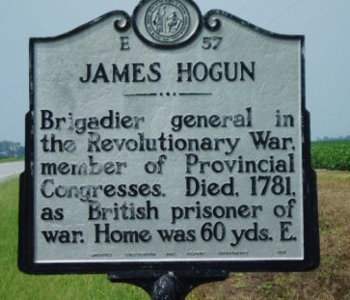
Death of James Hogun, American Revolutionary War Officer

James Hogun, Irish American military officer who is as one of five generals from North Carolina to serve with the Continental Army during the American Revolutionary War, dies on January 4, 1781.

Born in Ireland around 1721, Hogun migrates to North Carolina, then a British colony, in 1751. Settling in Halifax County, he raises a family and establishes himself as a prominent local figure.

A member of the county’s Committee of Safety, he represents it at the North Carolina Provincial Congress and helps to draft the first Constitution of North Carolina. When North Carolina decides to raise three more regiments for George Washington’s Continental Army, James Hogun is appointed colonel of one of them, the 7th North Carolina. He participates in the battles of Brandywine and Germantown in 1777, where Hogun is cited for “distinguished intrepidity.” The Continental Congress promotes Hogun to brigadier general in 1779, although several congressmen and the North Carolina General Assembly wish to see Thomas Clark of North Carolina promoted instead.

In November 1779, Hogun is sent south in command of the North Carolina Brigade to the aid of General Benjamin Lincoln, who is facing an anticipated British assault at Charleston, South Carolina. The march south, through one of the worst winters ever, is a severe one and Hogun’s numbers are reduced by the time he reached Charleston on March 3, 1780. Before the end of the month, British General Henry Clinton’s men are besieging the city. The Americans, though outnumbered more than two to one, have a few successes but soon they are running low on food and ammunition.

At a council of war May 11, the decision is made to surrender. The surrender the following day is one of the worst American defeats of the war — more than 2,500 men become British prisoners. The British hastily build a prison on Haddrel’s Point, a peninsula in Charleston’s harbor, to hold the prisoners, but the site is incomplete, and conditions are harsh.

Generals McIntosh, Lincoln, and Scott, and other high-ranking officers accept parole from the British and depart. Generals William Moultrie and Hogun refuse, preferring to stay with their men. The British are trying to recruit colonial soldiers to serve them in the West Indies. In spite of his flagging health, Hogun fears some of his men might weaken if he departs.

As winter sets in, Hogun’s condition worsens. On January 4, 1781, he passes away and was buried near the prison. Like so many other Irish-born soldiers before and after him, James Hogun had given his last full measure of devotion to his adopted country.


Leave a comment

Birth of Commodore Thomas Macdonough

thomas-macdonough

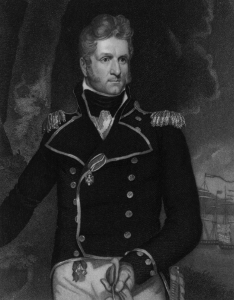
Commodore Thomas Macdonough, American naval officer noted for his roles in the first Barbary War and the War of 1812, whose family is from Dublin, is born on December 31, 1783, in the New Castle County, Delaware town then known as “The Trap,” but now renamed McDonough in his honor.

Before joining the U.S. Navy, Macdonough, for unknown reasons, changes the spelling of his last name from “McDonough” to “Macdonough.” He joins the Navy in 1800 as a midshipman and spends the first years of his naval career fighting pirates, including the famous Barbary pirates operating out of Tripoli. When the War of 1812 breaks out, Macdonough, then a lieutenant, is made the commander of all the Navy’s forces on Lake Champlain, an extremely important post due to the threat of British invasion from Canada. The opposing sides build their fleets on the Lake through most of 1813.

In August of that year, British General Sir George Prévost begins his invasion from Canada. Moving along the western edge of Lake Champlain, he hopes to use the guns of his fleet to help cover his advance. The British army outnumbers the Americans better than two to one, but Prévost needs to use the Lake to supply his army, thus the fleet of Thomas Macdonough becomes a prime target of the British fleet on Lake Champlain.

The two fleets are fairly evenly matched, but the guns of the British ships have an advantage in range. Macdonough comes up with a brilliant plan to negate this advantage. He anchors inside Plattsburgh Bay in such a manner that the British cannot fire at them from long range and have to come around Cumberland Head and approach them head on, presenting their bows to the American guns. From there it becomes a close-range slugging match, more to the liking of the Americans.

On board his flagship, the USS Saratoga, Macdonough fires the first shot, hitting the HMS Confiance, the flagship of Captain George Downie, commander of the British fleet. Macdonough continues to work the gun through the fierce 2 ½-hour battle. Twice his men are sure he has been killed as he is knocked out and lay on the deck. But twice he rises and returns to action. Finally, with Captain Downie dead, and their ships devastated, the largest ships of the British fleet strike their colors, and their gunboats run for home.

On land, General Prévost has engaged the American land forces as the British fleet attacks. When it becomes apparent the American fleet is victorious, Prévost knows that further movement south is futile. He breaks off the attack and retreats toward Canada. Thomas Macdonough’s fleet has ended the British invasion. It is one of the greatest victories in the history of the U.S. Navy.

For his enormous contribution to the momentous victory, the United States Congress has a medal struck in Macdonough’s honor, and New York and Vermont present him with huge tracks of land. He continues his Navy career after the war.

On November 10, 1825, Macdonough dies of consumption aboard ship while commanding the USS Constitution as it is passing Gibraltar. His body is returned to the United States and is buried in Middletown, Connecticut. He is laid to rest alongside his wife Ann Shaler, a lady of a prominent family in Middletown, she having died just a few months earlier.


Leave a comment

Assassination of Irish American John Fitzgerald Kennedy

kennedy-assassination

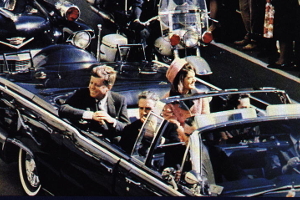
John Fitzgerald Kennedy, the 35th President of the United States, is assassinated at 12:30 PM CST (18:30 UTC) on Friday, November 22, 1963, in Dealey Plaza, Dallas, Texas. Kennedy is the first Roman Catholic president of the United States and descendant of immigrants from Ireland.

At 12:30 PM CST, as Kennedy’s uncovered 1961 Lincoln Continental four-door convertible limousine enters Dealey Plaza, Nellie Connally, the First Lady of Texas, turns around to President Kennedy, who is sitting behind her, and comments, “Mr. President, you can’t say Dallas doesn’t love you,” to which President Kennedy acknowledges by saying “No, you certainly can’t.” These are the last words ever spoken by John F. Kennedy.

From Houston Street, the presidential limousine makes the planned left turn onto Elm Street, allowing it access to the Stemmons Freeway exit. As it turns onto Elm, the motorcade passes the Texas School Book Depository. Shots are fired at Kennedy as the motorcade continues down Elm Street. About 80% of the witnesses recall hearing three shots.

A minority of the witnesses recognize the first gunshot they hear as weapon fire, but there is hardly any reaction to the first shot from a majority of the people in the crowd or those riding in the motorcade. Many later say they heard what they first thought to be a firecracker, or the backfire of a vehicle, just after the President started waving.

Within one second of each other, Kennedy, Texas Governor John Connally, and First Lady Jacqueline Kennedy, all turn abruptly from looking to their left to looking to their right. Connally, like the President a World War II military veteran, testifies that he immediately recognizes the sound of a high-powered rifle. He also testifies that when his head is facing about 20 degrees left of center, he is hit in his upper right back by a bullet he does not hear fired. After Connally is hit he shouts, “Oh, no, no, no. My God. They’re going to kill us all!”

Mrs. Connally testifies that just after hearing a loud, frightening noise that comes from somewhere behind her and to her right, she turns toward President Kennedy and sees him with his arms and elbows raised high, with his hands in front of his face and throat. She then hears another gunshot and then Governor Connally yelling. Mrs. Connally then turns away from Kennedy toward her husband, at which point another gunshot sounds and she and the limousine’s rear interior are covered with fragments of skull, blood, and brain.

According to the Warren Commission and the House Select Committee on Assassinations, as President Kennedy waves to the crowds on his right with his right arm upraised on the side of the limo, a shot enters his upper back, penetrates his neck, slightly damages a spinal vertebra and the top of his right lung, and exits his throat nearly centerline just beneath his larynx, nicking the left side of his suit tie knot. He raises his elbows and clenches his fists in front of his face and neck, then leans forward and left. Mrs. Kennedy, facing him, then puts her arms around him in concern.

A second shot strikes the President as the presidential limousine is passing in front of the John Neely Bryan north pergola concrete structure. Both the Warren Commission and the House Select Committee on Assassinations concludes that the second shot to hit the president enters the rear of his head and passing in fragments through his head, created a large, roughly oval hole on the rear, right side. The president’s blood and fragments of his scalp, brain, and skull land on the interior of the car, the inner and outer surfaces of the front glass windshield and raised sun visors, the front engine hood, the rear trunk lid, the follow-up Secret Service car and its driver’s left arm, and motorcycle officers riding on both sides of the President behind him.

After the President has been shot in the head, Mrs. Kennedy begins to climb out onto the back of the limousine, though she later has no recollection of doing so. United States Secret Service Special Agent Clint Hill, who is riding on the left front running board of the follow-up car, believes she is reaching for something, perhaps a piece of the President’s skull. He jumps onto the back of the limousine while at the same time Mrs. Kennedy returns to her seat. He clings to the car as it exits Dealey Plaza and accelerates, speeding to Parkland Memorial Hospital.

After Mrs. Kennedy crawls back into her limousine seat, both Governor Connally and Mrs. Connally hear her say more than once, “They have killed my husband,” and “I have his brains in my hand.”

The staff at Parkland Hospital’s Trauma Room 1 who treat President Kennedy observe that his condition is “moribund,” meaning that he has no chance of survival upon arriving at the hospital. George Burkley, the President’s personal physician, states that a gunshot wound to the skull is the cause of death. Burkley signs President Kennedy’s death certificate.

At 1:00 PM, CST (19:00 UTC), after all heart activity has ceased and after Father Oscar Huber has administered last rites, the President is pronounced dead.


2 Comments

Birth of Patrick Henry Jones, Postmaster of New York City

patrick-henry-jones

Patrick Henry Jones, American lawyer, public servant, and Postmaster of New York City during the mid-to late 19th century, is born on November 20, 1830, in County Westmeath.

Jones attends grammar school in Dublin for three years until emigrating with his family to the United States in 1840. They settle on a farm in Cattaraugus County, New York where Jones spends most of his childhood. Because of his poor background, he receives only a limited education at the Union School in Ellicottville. In 1850, the 20-year-old Jones becomes involved in journalism and travels as a correspondent throughout the Western States for a leading New York journal. He later becomes the local editor for the Buffalo Republic and one of the editors of the Buffalo Sentinel.

Eventually, Jones decides to pursue a career in law and later studies under the firm of Addison Rice. He is admitted to the bar in 1856 and afterwards practices law with Addison in Ellicottville as a full partner. By 1860, he has established himself as one of the most prominent lawyers in western New York. A lifelong Democrat, he becomes disillusioned by the party’s support of Southern succession from the Union and, in May 1861, decides to join the military in defense of the United States.

Upon the outbreak of the American Civil War, Jones readily joins the Union Army. On July 7, 1861, he enlisted with the 37th New York Volunteers, popularly known as the “Irish Rifles”, under Colonel John H. McCunn. Jones has a successful career serving in the Union Army, being involved in thirty major battles and countless skirmishes, and reaching the rank of brigadier general. He remains at that rank for the rest of the war and resigns on June 17, 1865. He is one of ten Irish Americans to become brigade commanders and one of four Irish-born officers to become a divisional commander.

After his resignation, Jones resumes his law practice in Ellicottville and in November 1865 is elected on the Republican ticket as Clerk of the New York Court of Appeals. On August 13, 1868, Jones is appointed by Gov. Reuben E. Fenton as Register of New York City to fill the vacancy resulting from the death of Charles G. Halpine. On April 1, 1869, Jones is appointed by President Ulysses S. Grant as Postmaster of New York City. From 1875 to 1877, Jones is again Register of New York City, elected in November 1874 on the Republican ticket. Afterwards he resumes his private practice.

In 1878, Jones is involved in the Alexander T. Stewart bodysnatching case when he is contacted by the kidnappers to act as an intermediary between themselves and the Stewart estate. When negotiations stall between the Stewart family’s lawyer Henry Hilton, he assists Stewart’s widow in negotiating for the return of her husband’s body.

Jones suffers serious medical problems in his old age, specifically deafness and chronic diarrhea, which his physician blames on his exposure to artillery fire and his time in the swamps along the Chickahominy River during his military service. He also suffered from constant pain in his right sciatic nerve, attributed to his old war wound suffered at Chancellorsville, as well as his wound in the gluteal region.

In early July 1900, Jones begins suffering from severe gastroenteritis. His condition does not respond to therapeutic treatments as he loses control of his bowels and is unable to keep down solid food, living on scalded milk and brandy. On July 18, 1900, Jones dies from cardiac failure, indirectly caused by his gastroenteritis, at his home in Port Richmond, New York. His funeral is held at St. Mary’s Church two days later and he is buried in St. Peter’s Cemetery.


Leave a comment

Accused Witch Ann Glover is Hanged in Boston

ann-glover

Goodwife “Goody” Ann Glover is hanged by the Puritans in Boston on November 16, 1688. She is the last person to be hanged in Boston as a witch, although the Salem witch trials in nearby Salem, Massachusetts, occur primarily in 1692.

Glover is born in Ireland as a Roman Catholic although her birth date and much of her background information is unknown. During Oliver Cromwell‘s invasion of Ireland where he rounds up thousands of Irish and Scots, Glover and her husband are transported as indentured servants to Barbados to work on the sugar plantations. Her husband is executed in Barbados for refusing to renounce his Catholic faith. Historians do not know the context but, at his death, he says that his wife is a witch.

By 1680, Glover and her daughter are living in Boston where they work as housekeepers for John Goodwin. In the summer of 1688, 13-year-old Martha Goodwin accuses Glover’s daughter of stealing laundry. This causes Glover to have a fierce argument with Martha and the Goodwin children which then supposedly causes them to become ill and start acting strange. The doctor that is called suggests it is caused by witchcraft because he could not diagnose or heal the children.

Glover is arrested and tried for witchcraft. It is unclear whether she cannot speak English or just refuses to speak it. It is more likely that she simply does not know English. Instead, she speaks her native language, Irish, and Latin. Reverend Cotton Mather writes that Glover is “a scandalous old Irishwoman, very poor, a Roman Catholic and obstinate in idolatry.” At her trial it is demanded of her to say the Lord’s Prayer. She recites it in Irish and broken Latin, but since she has never learned it in English, she cannot recite it in English. There is a belief that if someone cannot recite the Lord’s Prayer then they are a witch. Her house is searched and “small images” or doll-like figures are found. When Mather is interrogating her, she supposedly says that she prays to a host of spirits and Mather takes this to mean that these spirits are demons. Two Puritan men who supposedly speak Irish say that she confessed to using them for witchcraft. The identity of these men and whether they actually speak Irish is unknown. Many of the accusations against Glover use spectral evidence, which cannot be proven. Cotton Mather visits Glover in prison where he says she supposedly engages in nighttime trysts with the devil and other evil spirits. It is considered that Glover might not be of sound mind and could possibly be mentally ill. Five of six physicians examine her and find her to be competent, so she is then pronounced guilty and put to death by hanging.

On November 16, 1688, Glover is hanged in Boston amid mocking shouts from the crowd. When she is taken out to be hanged, she says that her death will not relieve the children of their malady. There are several testaments of what her final words are. According to some, she says that the children will keep suffering because there are other witches besides her who have been involved with bewitching the children and when asked to name the other witches, she refuses. Another account says that Glover says that killing her will be useless because it is someone else that has bewitched the children. Either way, Ann Glover does believe in witches. A Boston merchant who knows her, Robert Calef, says that “Goody Glover was a despised, crazy, poor old woman, an Irish Catholic who was tried for afflicting the Goodwin children. Her behavior at her trial was like that of one distracted. They did her cruel. The proof against her was wholly deficient. The jury brought her guilty. She was hung. She died a Catholic.”

Three hundred years later in 1988, the Boston City Council proclaims November 16 as Goody Glover Day. She is the only victim of the witchcraft hysteria in the Massachusetts Bay Colony to receive such a tribute. Although Ann Glover’s accusations and death take place before the commonly known Salem Witch Trials, she is the first Catholic martyr in Massachusetts and becomes the basis for many of the cases in the 1692 Salem witch trials.