seamus dubhghaill

Promoting Irish Culture and History from Little Rock, Arkansas, USA


Leave a comment

Death of Texas Politician John Thomas Browne

John Thomas Browne, Irish-born merchant and politician, dies in Houston, Texas on August 19, 1941. He serves on the Houston City Council, serves two terms as Mayor of Houston, and serves three terms in the Texas House of Representatives.

Browne is born March 23, 1845 in Ballylanders, County Limerick to Michael and Winifred (Hennessy) Browne. His family emigrates to the United States in October 1851. Not long after arriving in New Orleans, his father dies. In 1852, Winifred relocates with her five children to Houston to be closer to family of her mother.

Browne spends much of the 1850s on Spann Plantation in Washington County, Texas at the behest of Father Gunnard, where he also receives an education. At age fourteen in 1859, he leaves the plantation and finds work hauling bricks in Madison County, Texas. He returns to Houston to first work as a baggage hauler, then performs messenger duties for Commercial and Southwestern Express Company before settling in at the Houston and Texas Central Railroad.

Browne joins Company B of the Second Texas Infantry in the Confederate States Army during the American Civil War. He serves in Houston, detached from his unit, maintaining employment with the Houston and Texas Central Railroad, but in a new capacity as a fireman. He is briefly dispatched to the defense of Galveston, Texas. He is officially released from military duty in Houston on June 27, 1865.

Browne returns to messenger service in Houston after the Civil War. He works for Adams Express Company, then for Southern Express Company. He transitions into the grocery business first as a bookkeeper and clerk for H.P. Levy.

Browne is elected to the Houston City Council, representing the Fifth Ward while chairing the Finance Committee in 1887. He runs for Mayor of Houston in 1892 and wins in a landslide: 3900 to 600.

Browne’s first term as Mayor of Houston begins the same year as the Panic of 1893. He had campaigned on a platform of balancing the budget. The City of Houston runs budget deficits during Browne’s first term, but these deficits are proportionately lower than those in previous years. Browne is an advocate for lowering municipal utility bills through municipal ownership of the utilities. However, Browne abandons this option due to excessive costs for building a new waterworks and electrical power plant. He refocuses his efforts on a policy of dedicating all capital spending on street paving and sewerage.

Browne proposes converting the Houston Volunteer Firefighters to a professional department under municipal management. The City of Houston would be required to buy existing equipment and horses from the volunteer department, but can lease firehouses rather than buy them. The Houston City Council drafts an ordinance and passes it.

Browne represents Houston in the Texas House of Representatives from 1897 to 1899, and again in 1907. He is a member of the Ancient Order of Hibernians and the Knights of Columbus.

John Thomas Browne dies on August 19, 1941 of pneumonia in Houston. He is buried at Glenwood Cemetery in Houston. He is survived by six children and thirty-eight grandchildren. In 1979 his former residence in the Fifth Ward is used by an Italian American-owned grocery, Orlando’s Grocery.

Leave a comment

Death of Charles Thomson, Secretary of the Continental Congress

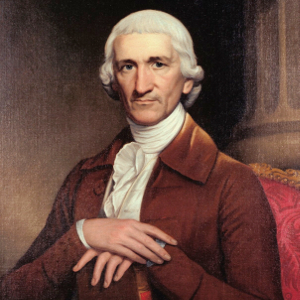
Charles Thomson, Irish-born Patriot leader in Philadelphia during the American Revolution and the secretary of the Continental Congress (1774–1789) throughout its existence, dies in Lower Merion Township, Pennsylvania, on August 16, 1824.

Thomson is born in Gorteade townland, Maghera parish, County Londonderry, to Scots Irish parents. After the death of his mother in 1739, his father emigrates to the British colonies in America with Charles and his brothers. His father dies at sea and the penniless boys are separated in America. Charles is cared for by a blacksmith in New Castle, Delaware, and is educated in New London Township, Pennsylvania. In 1750 he becomes a tutor in Latin at the Philadelphia Academy.

During the French and Indian War, Thomson is an opponent of the Pennsylvania proprietors’ American Indian policies. He serves as secretary at the Treaty of Easton (1758) and writes An Enquiry into the Causes of the Alienation of the Delaware and Shawanese Indians from the British Interest (1759), which blames the war on the proprietors. He is allied with Benjamin Franklin, the leader of the anti-proprietary party, but the two men part politically during the Stamp Act crisis in 1765. Thomson becomes a leader of Philadelphia’s Sons of Liberty. He is married to the sister of Benjamin Harrison V, another signer, as delegate, of the Declaration of Independence.

Thomson is a leader in the revolutionary crisis of the early 1770s. John Adams calls him the “Samuel Adams of Philadelphia.” Thomson serves as the secretary of the Continental Congress through its entirety. Through those 15 years, the Congress sees many delegates come and go, but Thomson’s dedication to recording the debates and decisions provides continuity. Along with John Hancock, president of the Congress, Thomson’s name (as secretary) appears on the first published version of the Declaration of Independence in July 1776.

Thomson’s role as secretary to Congress is not limited to clerical duties. Thomson is also noted for designing, with William Barton, the Great Seal of the United States. The Great Seal plays a prominent role in the January 14, 1784, ratification of the Treaty of Paris (1783). Britain’s representatives in Paris initially dispute the placement of the Great Seal and Congressional President Thomas Mifflin‘s signature, until mollified by Benjamin Franklin.

But Thomson’s service is not without its critics. James Searle, a close friend of John Adams, and a delegate, begins a cane fight on the floor of Congress against Thomson over a claim that he is misquoted in the “Minutes” that results in both men being slashed in the face. Such brawls on the floor are not uncommon, and many of them are promoted by argument over Thomson’s recordings. Political disagreements prevent Thomson from getting a position in the new government created by the United States Constitution. Thomson resigns as secretary of Congress in July 1789 and hands over the Great Seal, bringing an end to the Continental Congress.

Thomson spends his final years at Harriton House in Bryn Mawr, Pennsylvania working on a translation of the Bible. He also publishes a synopsis of the four evangelists in 1815. In retirement, Thomson also pursues his interests in agricultural science and beekeeping. According to Thomas Jefferson, writing to John Adams, Thomson becomes senile in his old age, unable to recognize members of his own household.


Leave a comment

Birth of Sister Anthony, Mary Ellen O’Connell

Mary Ellen O’Connell, Roman Catholic Religious Sister better known as Sister Anthony, S.C., is born in Limerick, County Limerick, on August 14, 1814.

Connell is the daughter of William O’Connell (1769-1841) and Catherine Murphy (-1821). In 1821, she emigrates with her family to Boston, and attends the Ursuline Academy in Charlestown, Massachusetts. On June 5, 1835, she enters the novitiate of the American Sisters of Charity in St. Joseph’s Valley, Maryland, founded by Saint Elizabeth Seton, and is professed in 1837, taking the name of Sister Anthony. Soon after, she goes to Cincinnati, Ohio.

Sister Anthony arrives in Cincinnati in 1837 to begin her work at St. Peter’s Orphan Asylum and School for girls. Given charge of St. Joseph’s Orphan Asylum for boys when it is begun in 1852, she later oversees the combining of the two asylums in the Cincinnati neighborhood of Cumminsville. She is in Cincinnati through 1852, when the Sisters in Cincinnati become independent of their founding motherhouse in Emmitsburg, Maryland. She is placed in charge of St. John’s Hostel for Invalids, a new hospital.

At the outbreak of the American Civil War, the Sisters volunteer as nurses. More than one-third of the community, which by then has more than one hundred members, serve. In June 1861, Sister Anthony is one of six Sisters of Charity who go to Camp Dennison, about 15 miles from Cincinnati. A request is made from Cumberland, Virginia for nursing assistance, and eight sisters are sent to serve the wounded of both armies.

The Battle of Shiloh brings ten sisters to the scene including Sister Anthony. Some describe her word as being law with officers, doctors, and soldiers once she has established herself as a prudent and trusted administrator and nurse. She and other sisters often are picked to treat wounded prisoners of war since they show no bias in serving rebel, yank, white, or black soldiers.

When Sister Anthony serves at Shiloh she becomes known as the “Angel of the Battlefield” and “the Florence Nightingale of America.” She goes out to the battlefield to help bring in the sick and dying and also develops the Battlefield Triage. Her method is “the first recognizably modern triage techniques in war zones, saved countless lives through faster hospital treatment and won her praise from President Lincoln.” Her medical skills allow her to intervene to save soldiers’ limbs from amputation.

Sister Anthony also serves at the battlefields of Winchester, VA, the Cumberland Gap, TN, Richmond, VA, Nashville, TN, Gallipolis, OH, Culpeper Court House, VA, Murfreesboro, TN, Pittsburg Landing, TN, and Lynchburg, VA. She also serves on a hospital ship on the Ohio River. She sees no distinction between Union and Confederate soldiers. She becomes personally acquainted with Jefferson Davis and knows a number of generals on both sides of the conflict.

After the war, in 1866, Joseph C. Butler and a friend, Louis Worthington, purchase a large building at Sixth and Lock Street, to present to Sister Anthony as a gift in recognition of the sisters’ service during the war. There are two conditions: that no one be excluded from the hospital because of color or religion, and that the hospital be named “The Hospital of the Good Samaritan,” to honor the sisters’ kindness. It opens that same year as the St. Joseph Foundling and Maternity Hospital. It still serves as St. Joseph Hospital, a residential facility for children and adults with severe mental and multiple physical disabilities.

Sister Anthony is also recognized for her work during the yellow fever epidemic of 1877. She retires from active service in 1880, and dies in 1897 in Cumminsville, Cincinnati, Ohio.

Sister Anthony’s portrait hangs in the Smithsonian Institution in Washington, D.C.


Leave a comment

Death of James O’Neill, Irish American Theatre Actor

James O’Neill, Irish American theatre actor and the father of American playwright Eugene O’Neill, dies in New London, Connecticut, on August 11, 1920.

O’Neill is born on November 15, 1847, in County Kilkenny. The family emigrates to the United States and settles in Buffalo, New York. In 1857 they move to Cincinnati, Ohio where James is apprenticed to a machinist.

At the age of 21, he makes his stage debut in a Cincinnati production of Dion Boucicault‘s The Colleen Bawn (1867). Also in 1867, he has a minor part in Edwin Forrest‘s production of Virginius, and then joins a travelling repertory company. By the age of 24 he has already established a reputation among theater managers as a box-office draw, particularly with the ladies. But he is also working doggedly at his craft, ridding himself of all vestiges of brogue and learning to pitch his voice resonantly. He is considered a promising actor, quickly working his way up the ranks to become a matinée idol.

In 1874 O’Neill joins Richard M. Hooley‘s company, and the following year tours San Francisco, Virginia City and Sacramento. He then heads back east to join the Union Square Company.

On June 14, 1877, while in New York City, O’Neill marries Mary Ellen Quinlan, daughter of Thomas and Bridget Quinlan. In the fall of 1877, three months after his marriage, a woman by the name of Nettie Walsh sues O’Neill, claiming that he had married her five years earlier, when she was only 15, and that he is the father of her three-year-old son. Nettie Walsh loses her case and the publicity, although it wounds his bride, enhances his reputation as a romantic leading man.

As early as 1875, while a stock star at Hooley’s Theatre in Chicago, O’Neill plays the title role in a stage adaptation of Alexandre Dumas‘ The Count of Monte Cristo. In early 1883 he takes over the lead role in Monte Cristo at Booth’s Theater in New York, after Charles R. Towne dies suddenly in the wings after his first performance. O’Neill’s interpretation of the part caused a sensation with the theater-going public.

O’Neill soon tires of the Count and his lines come out by rote and his performances become lackadaisical. Monte Cristo remains a popular favorite, so he continues the role on tour as regular as clockwork. He goes on to play this role over 6,000 times.

In the middle of 1920 O’Neill is struck by an automobile in New York City and taken to Lawrence+Memorial Hospital in New London, Connecticut. He dies, at the age of 72, on August 11, 1920, of colorectal cancer at the family summer home, the Monte Cristo Cottage, in Connecticut. His funeral at St. Joseph’s Church is attended by, among others, O’Neill’s sister, Mrs. M. Platt of St. Louis and Edward Douglass White, Sr., Chief Justice of the United States Supreme Court. O’Neill is buried in St. Mary’s cemetery.


Leave a comment

Patrick Francis Healy Becomes President of Georgetown University

Patrick Francis Healy, Jesuit priest and educator, becomes the 29th President of Georgetown University on July 31, 1874. He is known for expanding the school following the American Civil War. Healy Hall is constructed during his tenure and is named after him. It is designated as a National Historic Landmark in the late 20th century.

Healy is born into slavery in 1834 in Macon, Georgia, the third son of Irish American plantation owner Michael Healy and his African American slave Mary Eliza, who is the multiracial daughter of a black slave and white slaveowner. The law establishes during colonial slavery in the United States that children are to take the legal status of the mother. By the principle of partus sequitur ventrum, Patrick and his siblings are legally considered slaves in Georgia, although their father is free, and they are three-quarters or more European in ancestry.

Discriminatory laws in Georgia prohibit the education of slaves and require legislative approval for each act of manumission, making these essentially impossible to gain. Michael Healy arranges for all his children to leave Georgia and move to the North to obtain their educations and have opportunities in their lives. They are raised as Irish Catholics. Patrick’s brothers and sisters are nearly all educated in Catholic schools and colleges. Many achieve notable firsts for Americans of mixed-race ancestry during the second half of the 19th century, and the Healy family of Georgia is remarkably successful.

Healy sends his older sons first to a Quaker school in Flushing, New York. Despite the Quakers’ emphasis on equality, Patrick encounters some discrimination during his grade school years, chiefly because his father is a slaveholder, which by the late antebellum years the Quakers consider unforgivable. Patrick also meets resistance in the school as an Irish Catholic. When Michael Healy hears of a new Jesuit college, the College of the Holy Cross in Worcester, Massachusetts, he sends his four oldest sons, including Patrick, to study there in 1844. They are joined at Holy Cross by their younger brother Michael in 1849.

Following Patrick’s graduation in 1850, he enters the Jesuit order, the first African American to do so, and continues his studies. The order sends him to Europe to study in 1858. His mixed-race ancestry has become an issue in the United States, where tensions are rising over slavery. He attends the Catholic University of Leuven in Belgium, earning his doctorate, becoming the first American of openly acknowledged part-African descent to do so. During this period, he is also ordained to the priesthood on September 3, 1864.

In 1866 Healy returns to the United States and teaches philosophy at Georgetown University in Washington, D.C. On July 31, 1874, he is selected as the school’s twenty-ninth president. He is the first college president in the United States of African American ancestry. At the time, he identifies as Irish Catholic and is accepted as such.

Patrick Healy’s influence on Georgetown is so far-reaching that he is often referred to as the school’s “second founder,” following Archbishop John Carroll. Healy helps transform the small nineteenth-century college into a major university for the twentieth century, likely influenced by his European education.

He modernizes the curriculum by requiring courses in the sciences, particularly chemistry and physics. He expands and upgrades the schools of law and medicine. The most visible result of Healy’s presidency is the construction of the university’s flagship building designed by Paul J. Pelz, begun in 1877 and first used in 1881. The building is named in his honor as Healy Hall.

Healy leaves the College in 1882 and travels extensively through the United States and Europe, often in the company of his brother James, a bishop in Maine. In 1908 he returns to the campus infirmary, where he dies on January 10, 1910. He is buried on the grounds of the university in the Jesuit cemetery.


Leave a comment

Birth of Raymond Thornton Chandler, Novelist & Screenwriter

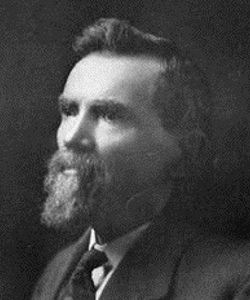
Raymond Thornton Chandler, American novelist and screenwriter, is born to Irish Quaker and Irish Catholic parents in Chicago, Illinois on July 23, 1888.

Chandler spends his early years in Plattsmouth, Nebraska, living with his mother and father near his cousins and his aunt and uncle. His father, an alcoholic civil engineer who works for the railway, abandons the family. To obtain the best possible education for Ray, his mother, originally from Ireland, moves them to the area of Upper Norwood in the London Borough of Croydon, England in 1900. In 1912, he borrows money from his Waterford uncle, who expects it to be repaid with interest, and returns to America, visiting his aunt and uncle before settling in San Francisco. The following year he moves to Los Angeles.

In 1932, at the age of forty-four, Chandler becomes a detective fiction writer after losing his job as an oil company executive during the Great Depression. His first short story, “Blackmailers Don’t Shoot,” is published in 1933 in Black Mask, a popular pulp magazine. His first novel, The Big Sleep, is published in 1939. In addition to his short stories, Chandler publishes seven novels during his lifetime. An eighth novel is in progress at the time of his death and is completed by Robert B. Parker. All but Playback have been made into motion pictures, some more than once.

Chandler has an immense stylistic influence on American popular literature. He is considered to be a founder of the hardboiled school of detective fiction, along with Dashiell Hammett, James M. Cain and other Black Mask writers. The protagonist of his novels, Philip Marlowe, like Hammett’s Sam Spade, is considered by some to be synonymous with “private detective.” Both are played in films by Humphrey Bogart, whom many consider to be the quintessential Marlowe.

Some of Chandler’s novels are important literary works, and three have been regarded as masterpieces: Farewell, My Lovely (1940), The Little Sister (1949), and The Long Goodbye (1953). The Long Goodbye is praised in an anthology of American crime stories as “arguably the first book since Hammett’s The Glass Key, published more than twenty years earlier, to qualify as a serious and significant mainstream novel that just happened to possess elements of mystery.”

In the year before his death, he is elected president of the Mystery Writers of America. He dies on March 26, 1959, in La Jolla, California. He is buried in Mount Hope Cemetery in San Diego, California.


Leave a comment

Beginning of the New York City Draft Riots

The New York City draft riots, one of the more regrettable incidents related to Irish American history, begin on July 13, 1863, and continue through July 16. Known at the time as Draft Week, they are violent disturbances in Lower Manhattan, widely regarded as the culmination of working-class discontent with new laws passed by Congress that year to draft men to fight in the ongoing American Civil War. The riots remain the largest civil and racial insurrection in American history, aside from the Civil War itself.

The cry of “rich man’s war, poor man’s fight” is the cry of many in the Northern states. The rioters, predominantly Irish immigrants, are overwhelmingly working-class men, who resent those wealthier men, who can afford to pay a $300 commutation fee to hire a substitute, are spared from the draft, worried that the eventual emancipation of blacks will rob them of their jobs and are egged on by some politicians and Southern agents.

Initially intended to express anger at the draft, the protests turn into a race riot, with white predominantly Irish rioters, attacking blacks throughout the city. The official death toll is listed at either 119 or 120 individuals. Conditions in the city are such that Major General John E. Wool, commander of the Department of the East, says on July 16 that “Martial law ought to be proclaimed, but I have not a sufficient force to enforce it.”

U.S. President Abraham Lincoln diverts several regiments of militia and volunteer troops from following up after the Battle of Gettysburg to control the city.

The military does not reach the city until after the first day of rioting, by which time the mobs, have already ransacked or destroyed numerous public buildings, two Protestant churches, the homes of various abolitionists or sympathizers, many black homes, and the Colored Orphan Asylum at 44th Street and Fifth Avenue, which is burned to the ground.

The area’s demographics change as a result of the riot. Many blacks leave Manhattan permanently, many moving to Brooklyn. By 1865 their population falls below 10,000, the number in 1820.

Through the years the story is told as if only Irish riot, but in fact many besides the Irish take part, and many Irish policemen, fireman, priests, and trade unionists are among the most influential in quelling them. Still, it cannot be denied, a large number of Irish do participate in the burning of the black orphanage and murder of blacks in the city. This unfortunate episode leaves a lasting stain on the reputation of New York’s Irish community.


Leave a comment

Pickett’s Charge

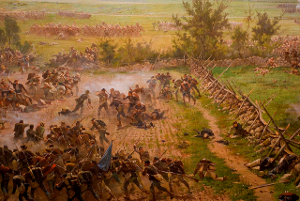
On July 3, 1863, at Gettysburg, Pennsylvania, as the sun rises behind the men of Colonel Dennis O’Kane’s Irish 69th Pennsylvania Volunteer Infantry on Cemetery Ridge, the most famous assault of the American Civil War is being prepared across the mile of open field in front of them. The 69th Pennsylvania will be at the very vortex of that assault, now known to posterity as Pickett’s Charge.

Pickett’s Charge is an infantry assault ordered by Confederate General Robert E. Lee against Major General George G. Meade‘s Union positions on the last day of the Battle of Gettysburg during the American Civil War. Its futility is predicted by the charge’s commander, Lt. General James Longstreet, and it is arguably an avoidable mistake from which the Southern war effort never fully recovers militarily or psychologically. The farthest point reached by the attack has been referred to as the high-water mark of the Confederacy.  The charge is named after Maj. General George Pickett, one of three Confederate generals who lead the assault under Longstreet.

Pickett’s charge is part of Lee’s “general plan” to take Cemetery Hill and the network of roads it commands. On the night of July 2, Meade correctly predicts at a council of war that Lee will attack the center of his lines the following morning.

At 1:00 PM on July 3, a massive artillery bombardment by the Confederate guns sails mostly over the heads of the 69th. The bombardment is meant to soften up the Union defense and silence its artillery but is largely ineffective. About 3:00 PM the barrage slackens, and the rebel infantrymen begin their assault. “And let your work this day be for victory or to the death,” Colonel Dennis O’Kane tells his men as the furious rebel onslaught approaches. Approximately 12,500 men in nine infantry brigades advance over open fields for three-quarters of a mile under heavy Union artillery and rifle fire.

Soon the 69th is forced to refuse both flanks as the Confederate tide rolls up to them and laps around both sides. While many around them run, the 69th stands fast. Although some Confederates are able to breach the low stone wall that shields many of the Union defenders, they cannot maintain their hold and are repulsed with over 50% casualties. The regiment’s tenacious stand in front of the famous copse of trees is a pivotal part of the crucial Union victory and a decisive defeat for the Confederacy that ends the three-day battle and Lee’s campaign into Pennsylvania.

Good to his word, Colonel O’Kane is killed and, lying dead near the 69th’s position, wearing gray lay Pvt. Willie Mitchel of the 1st Virginia Infantry, son of Irish patriot John Mitchel. At the most crucial battle of America’s Civil War, Irish are killing Irish on a foreign field once again.

Years later, when asked why his charge at Gettysburg failed, Pickett replies, “I’ve always thought the Yankees had something to do with it.”


Leave a comment

Birth of Writer John Boyle O’Reilly

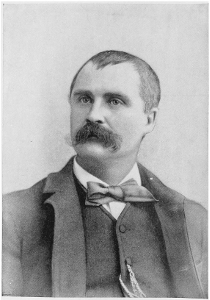
John Boyle O’Reilly, poet, journalist and fiction writer, is born in Dowth, County Meath on June 28, 1844.

O’Reilly is the third child of a headmaster and a schoolteacher. When he is fifteen, he moves to Lancashire and lives with his aunt and uncle. There he becomes a reporter with a local newspaper and joins the 11th Lancashire Rifle Volunteers in 1861. He returns to Ireland in 1863 and enlists with the 10th Royal Hussars in Dublin. However, after realising the way the British are treating his fellow people, he leaves the army and joins the Irish Republican Brotherhood around 1865.

In 1866 O’Reilly, along with many other members of the Brotherhood, are arrested and put on trial for treason. O’Reilly is found guilty and sentenced to death however, due to his young age, his sentence is reduced to 20 years penal servitude. He spends a year and a half in some English prisons before being transported to Western Australia in 1867, arriving in 1868.

A month after arriving O’Reilly is moved to the town of Bunbury where he starts receiving attention for protesting the chopping down of a tree. A year after arriving he decides to escape from the colony with the help of a local Catholic priest and some farmers from the nearby town of Dardanup. In February 1869 O’Reilly absconds from his convict camp and makes his way towards the Leschenault Peninsula where he waits for a ship to arrive. After approximately two weeks O’Reilly escapes on the Gazelle bound for the United States, arriving there in November 1869.

O’Reilly moves to Boston and becomes a well-known figure in the town where he becomes involved in civil rights, sports, and Irish American causes. He also becomes part owner of The Pilot newspaper. He publishes four books of poetry – Songs from the Southern Seas (1873), Songs, Legends and Ballads (1878), The Statues in the Block (1881) and In Bohemia (1886). He also publishes a novel Moondyne (1879) based on the convict of the same name and O’Reilly’s experiences in Western Australia. It becomes his most popular work. He also writes one last book of poems entitled Watchwords, which is released after his death.

John Boyle O’Reilly dies in Hull, Massachusetts on August 10, 1890, from heart failure after overdosing on his wife’s medication. His sudden death receives an outpouring of grief and tributes from the Boston community and also globally.

His funeral is held at St. Mary’s Church in Charlestown on August 13 and is attended by thousands. The streets near the church are lined with mourners. His wife does not attend the funeral due to grief and is unable to leave her bed. He is originally buried at Calvary Cemetery in Roxbury, but in November 1890 his remains are exhumed and moved to Holyhood Cemetery in Brookline.


Leave a comment

The Broad Street Riot

The Broad Street Riot, a massive brawl between Irish Americans and Yankee firefighters, occurs in Boston, Massachusetts, on June 11, 1837. At the time of this particular riot, nearly all of Boston’s firefighters are volunteers.

Boston is a major center for immigration in the 19th century due to its large seaport. Nativist and anti-Catholic sentiment is strong, especially among working-class men whose jobs and wages are threatened by an influx of poor Irish immigrants. On Broad Street, it is common for groups of nativist Yankees to vandalize Irish homes and attack lone Irishmen.

At about 3:00 PM on Sunday, June 11, 1837, Fire Engine Company 20 returns to their station on East Street from a fire at the Boston Neck. Some of the men go straight home from there, however most stop at a nearby pub for drinks. The pub is apparently operating illegally as it is a Sunday and, in Massachusetts, blue laws are then in effect.

The men have just emerged from the pub “in a more or less bellicose mood,” when they collide with a crowd of about a hundred Irishmen who are on their way to join a large funeral procession on Sea Street. Nearly all of the firefighters pass through the crowd without incident, however, when 19-year-old George Fay, who has reportedly had too much to drink, insults or shoves several of the Irishmen, and a fight breaks out. Fay’s friends rush to his aid, but the firemen are outnumbered and are badly beaten. Their foreman, W.W. Miller, orders them back into the firehouse.

By some accounts, the Irishmen then take over the firehouse. According to others, the crowd had begun to disperse, and the matter might have ended there had the foreman not “lost his head completely.” In any case, Miller orders his men to sound the emergency alarm. First, they roll their wagon into the street, ringing the fire alarm bell. Then Miller sends men to ring the church bells, summoning all the fire engines in Boston. According to the Boston Transcript, Miller then runs to another firehouse, shouting, “The Irish have risen upon us, and are going to kill us!”

Company 9, responding to what they think is a legitimate fire alarm, arrives just as the funeral procession is turning onto New Broad Street. Their horse-drawn wagon veers into the crowd, scattering and knocking down the mourners. The Irish assume the assault is deliberate, and another brawl erupts. As more fire companies arrive, and Irishmen pour out of nearby houses into the street to help their friends and relatives, the fight escalates into a full-blown riot. Before long, an estimated 800 men are doing battle with sticks, stones, bricks, and cudgels while at least 10,000 more urged them on. Protestant workmen come running to the aid of the firefighters, while underfoot, injured and unconscious men lay sprawled on the pavement.

Outnumbered, the Irish are defeated and driven back to their homes. That is when the home invasions begin. A “gang of stout boys and loafers” raid nearby houses, breaking doors and windows, and in some cases beating the occupants. Furniture and other possessions are destroyed and thrown into the street. Some Irish families lose their homes altogether.

After raging for about three hours, the riot is quelled when Mayor Samuel Atkins Eliot calls in the National Lancers, a newly formed cavalry company, and some 800 other members of the state militia with fixed bayonets. Among them are the Montgomery Guards, a short-lived Irish American infantry company which is forced to disband the following year due to the extreme nativist and anti-Catholic sentiment in Boston.

No immediate deaths result from the violence. Many people suffer serious wounds, however, and there is no nearby hospital to care for them. Given the lack of hospital and police records, the number of people who eventually die of their injuries cannot be determined. Thousands of dollars in damage are done to property belonging to some of the city’s poorest inhabitants.

The militia, being composed nearly entirely of Yankees, arrest 34 Irishmen and 4 Yankees. A grand jury indicts 14 of the Irishmen and all four of the Yankees. At the municipal court trial, a Yankee jury acquits the four Yankees and convicts four Irishmen, three of whom are sentenced to several months of hard labor.

Three months later, in September, Mayor Eliot establishes a professional, paid fire department, with all new hires requiring the approval of the mayor and aldermen. The Boston Police Department is established the following year.