seamus dubhghaill

Promoting Irish Culture and History from Little Rock, Arkansas, USA


Leave a comment

Birth of Anglo-Irish Poet Richard Murphy

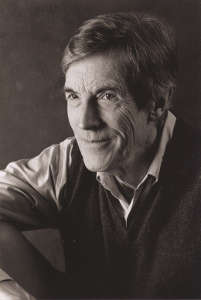
Richard Murphy, Anglo-Irish poet, is born on August 6, 1927, in County Mayo. He is a member of Aosdána and currently lives in Sri Lanka.

Murphy is born to an Anglo-Irish family at Milford House, near the Mayo-Galway border. His childhood in Ireland is documented in the film The Other Irish Travellers made by his niece, Fiona Murphy.

He spends much of his early childhood in Ceylon, now Sri Lanka, where his father, William Lindsay Murphy, serves in the Colonial Service and is active as mayor of Colombo and Governor-General of the Bahamas, in succession to the Duke of Windsor. He first receives his education at Canterbury School and Wellington College, Berkshire. He wins a scholarship to Magdalen College, Oxford, at 17, where he studies English under C.S. Lewis. He is later educated at the Sorbonne, and between 1953 and 1954, he runs a school in Crete. In his Archaeology of Love (1955), Murphy reflects on his experiences in England and the Continent.

In 1954, Murphy settles at Cleggan, a village on the coast of Galway where fishing has been abandoned after a famous sailing disaster. Several years later, in 1959, he purchases and renovates the Ave Maria, a traditional Galway hooker type boat, from Inishbofin fisherman, Michael Schofield, which he uses to ferry visitors to the island. Taking the first-hand accounts of survivors of the sailing disaster, he weaves the material into a long tour de force poem which closes his first collection Sailing to an Island, published in the early 1960s by Faber & Faber. In 1969, he purchases Ardoileán (High Island), a small island in the vicinity of Inishbofin.

Murphy enjoys commissions for his poems from the BBC which prompts him to start on his long book-length sequence The Battle of Aughrim. Ostensibly about the 18th century triumph of Dutch-led Protestant forces over the Irish and French Catholic forces, the poem deals obliquely not only with the brewing strife in Ulster of the 1960s, but also with the issues of the Vietnam War. Its episodic structure is highly influential on poetic sequences subsequently published by Montague and Heaney.

Since 1971 Murphy has been a poet-in-residence at nine American universities. He lives in Sri Lanka, having previously divided his time between Dublin and Durban, South Africa, where his daughter and her family reside. He is the maternal grandfather of YouTuber Caspar Lee. In 2002, a memoir of his life and times, The Kick, is published by Granta, constructed from detailed diaries kept over the course of five decades.


Leave a comment

Birth of William Henry Fortescue, 1st Earl of Clermont

William Henry Fortescue, 1st Earl of Clermont KP, Irish peer, politician and sportsman, is born on August 5, 1722. He is the eldest son of Thomas Fortescue (1683–1769), the Member of Parliament (MP) for Dundalk. His younger brother is James Fortescue, MP and Privy Counsellor.

Fortescue serves as High Sheriff of Louth in 1746. He represents Louth in the Irish House of Commons from 1745 to 1760 and subsequently Monaghan Borough from 1761 to 1770. He tries unsuccessfully in the 1760s to introduce a bill “to preserve partridges and hares and to take away the lives of above half the dogs in the nation.” In 1768 he briefly sits as Member of Parliament for Dundalk before opting to sit for Monaghan Borough, for which he has also been elected.

Fortescue is appointed Governor and Custos Rotulorum of County Monaghan for life in 1775, standing down just before his death on September 30, 1806. He is created Earl of Clermont in 1777 and a Knight Founder of the Order of St. Patrick on March 30, 1795.

He marries Frances Cairnes Murray, daughter and coheiress of Colonel John Murray, MP for County Monaghan. They have an only daughter, Louisa. On his death his Earldom of Clermont and 1770 Barony of Clermont become extinct whilst his Viscountcy and 1776 Barony of Clermont are inherited by a nephew, William Charles Fortescue, who had been MP for Louth (Parliament of Ireland constituency) and then Louth (UK Parliament constituency) since 1796.


Leave a comment

Death of Sportswriter Con Houlihan

Con Houlihan, Irish sportswriter, dies in Dublin on August 4, 2012. Despite only progressing to national journalism at the age of 46, he becomes “the greatest and the best-loved Irish sports journalist of all.”

Houlihan is born on December 6, 1925, in Castleisland, County Kerry. Over a lengthy career, Houlihan covers many Irish and international sporting events, from Gaelic football and hurling finals, to soccer and rugby World Cups, the Olympic Games and numberless race meetings inside and outside Ireland.

Houlihan is a journalist with the Irish Press group writing for The Irish Press, Evening Press and sometimes The Sunday Press, until the group’s demise in 1995. He writes the “Tributaries” column and Evening Press back sports page “Con Houlihan” column.

Houlihan dies on the morning of August 4, 2012 in St. James’s Hospital in Dublin. Often considered one of Ireland’s finest writers, he leaves behind a legacy of immense sports journalism that spans over 60 years. A minute’s silence is observed in his memory ahead of Kerry GAA‘s All-Ireland Senior Football Championship quarter-final defeat to Donegal GAA at Croke Park the following day. His last column, in which he wishes Irish Olympic boxer Katie Taylor well, is published the day after his death. His funeral takes place on August 8, 2012.

Ireland’s president, Michael D. Higgins, leads the tributes to Houlihan, describing him as a “most original writer, with a unique style based on his extensive knowledge of literature, politics, life and sport.” He adds, “He had that special quality and ability to identify with the passion, pain and celebration of Irish community life.”

A bronze bust of Houlihan is unveiled in his hometown of Castleisland in 2004. In 2011, another sculpture is erected outside The Palace bar in Dublin.


Leave a comment

Death of Charles G. Halpine, Journalist, Author & Soldier

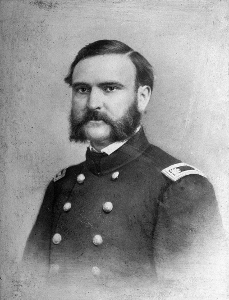
Charles Graham Halpine (Halpin), Irish journalist, author and soldier during the American Civil War, dies on August 3, 1868, in New York City.

Born at Oldcastle, County Meath, on November 20, 1829, Halpine is the son of the Rev. Nicholas John Halpin. He is educated at Trinity College, Dublin, until 1846, with original intentions for the medical profession, but ultimately prefers the law. In his leisure time he writes for the press. The sudden death of his father and his own early marriage compel him to adopt journalism as a profession.

In 1851 he emigrates to the United States, and takes up residence in Boston, where he becomes assistant editor of The Boston Post, and, with Benjamin Penhallow Shillaber, commences a humorous journal called The Carpet Bag, which is unsuccessful. Afterwards he resides in Washington, D.C., where he acts as the correspondent of The New York Times.

After moving back to New York, he secures employment with the New York Herald, and in a few months establishes relations with several periodicals. He undertakes a great variety of literary work, most of which is entirely ephemeral. He next becomes associate editor of The New York Times, for which he writes in 1855 and 1856 the Nicaragua correspondence at the time of William Walker‘s filibustering expedition. In 1857 he becomes principal editor and part proprietor of the New York Leader, which under his management rapidly increases in circulation.

At the beginning of the American Civil War in April 1861, he enlists in the 69th New York Infantry, in which he is soon elected a lieutenant, and serves during the three months for which he has volunteered. He is then transferred to the staff of General David Hunter as assistant-adjutant-general with the rank of major, and soon afterwards goes with him to Missouri to relieve General John Charles Frémont. He accompanies General Hunter to Hilton Head, and while there writes a series of burlesque poems in the assumed character of an Irish private. Several of them are contributed to the New York Herald in 1862 under the pseudonym of “Miles O’Reilly,” and with additional articles are issued in two volumes entitled Life and Adventures, Songs, Services, and Speeches of Private Miles O’Reilly, 47th Regiment New York Volunteers (1864), and Baked Meats of the Funeral, a Collection of Essays, Poems, Speeches, and Banquets, by Private Miles O’Reilly, late of the 47th Regiment New York Volunteer Infantry, 10th Army Corps. Collected, revised, and edited, with the requisite corrections of punctuation, spelling, and grammar, by an Ex-Colonel of the Adjutant-General’s Department, with whom the Private formerly served as Lance-Corporal of Orderlies (1866).

Halpine is subsequently assistant-adjutant-general on General Henry W. Halleck‘s staff with the rank of colonel in 1862 and accompanies General David Hunter as a staff-officer on his expedition up the Shenandoah Valley in the spring of 1864. On his return to New York, he resigns his commission in consequence of his bad eyesight, receiving the brevet of brigadier-general of volunteers.

He then makes New York his home and resumes his literary work. He becomes editor and, later, proprietor of the Citizen, a newspaper issued by the citizens’ association to advocate reforms in the civil administration of New York City. In 1867 he is elected registrar of the county of New York by a coalition of republicans and democrats. Incessant labour brings on insomnia. He has recourse to opiates, and his death in New York City on August 3, 1868, is caused by an undiluted dose of chloroform.


Leave a comment

The Battle of Rathmines

The Battle of Rathmines is fought in and around what is now the Dublin suburb of Rathmines on August 2, 1649, during the Irish Confederate Wars. It is fought between an English Parliamentarian army under Michael Jones which holds Dublin and an army composed of Irish Confederate and English Royalist troops under the command of the James Butler, 1st Duke of Ormond.

By 1649, Ireland has already been at war for eight years, since the outbreak of the Irish Rebellion of 1641. The English Parliament holds only two small enclaves, Dublin and Derry, in Ireland.

In July 1649, Ormond, marches his coalition forces of 11,000 men to the outskirts of Dublin with the intent of taking the city from its Parliamentary garrison, which had landed there in 1647. Ormond takes Rathfarnham Castle and camps at Palmerston Park in Rathgar, about 4 km south of the city. The area from Ormond’s camp to the city of Dublin is now a heavily urbanised area, but in 1649, it is open countryside. Ormond begins inching his forces closer to Dublin by taking the villages around its perimeter and to this end, sends a detachment of troops to occupy Baggotrath Castle, on the site of present-day Baggot Street bridge. For reasons which have never been clear, they take several hours to reach Baggotrath, a distance of about a mile, and they arrive to find that the Parliamentary troops have already occupied the castle.

However, Ormond is not expecting Michael Jones, the Parliamentary commander, to take the initiative and has not drawn up his troops for battle. Unfortunately for the Royalists, this is exactly what Jones does, launching a surprise attack on August 2 from the direction of Irishtown with 5,000 men and sending Ormond’s men at Baggotsrath reeling backwards towards their camp in confusion.

Too late, Ormond and his commanders realise what is going on and send units into action piecemeal to try to hold up the Parliamentarian advance, so that they can form their army into battle formation. However, Jones’ cavalry simply outflanks each force sent against them, sending them too fleeing back south through the townland of Rathmines. The battle becomes a rout as scores of fleeing Royalist and Confederate soldiers are cut down by the pursuing Roundheads. The fighting finally ends when the English Royalist troops under Murrough O’Brien, 1st Earl of Inchiquin, mounts a disciplined rearguard action, allowing the rest to get away. Ormond claims he has lost less than a thousand men. Jones claims to have killed around 4,000 Royalist or Confederate soldiers and taken 2,517 prisoners, while losing only a handful himself. Ormond certainly loses at least one leading officer, Christopher Plunkett, 2nd Earl of Fingall, who is fatally wounded and dies in Dublin Castle a few days later. Ormond also loses his entire artillery train and all his baggage and supplies.

In the aftermath of the battle, Ormond withdraws his remaining troops from around Dublin, allowing Oliver Cromwell to land in the city at Ringsend with 15,000 veteran troops on August 15. Cromwell calls the battle “an astonishing mercy,” taking it as a sign that God has approved of his conquest of Ireland. Over the next four years he completes the Cromwellian conquest of Ireland.

Without Jones’ victory at Rathmines, the New Model Army would have had no port to land at in Ireland and the Cromwellian conquest of Ireland would have been much more difficult. Ormond’s incompetent generalship at Rathmines disillusions many Irish Confederates with their alliance with the English Royalists and Ormond is ousted as commander of the Irish forces the following year.


Leave a comment

The Funeral of Jeremiah O’Donovan Rossa

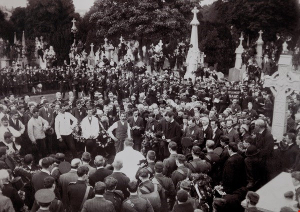
The funeral of Fenian Jeremiah O’Donovan Rossa is held before a huge crowd at Glasnevin Cemetery in Dublin on August 1, 1915.

Rossa’s body had been returned from New York City where he died June 29. He had been exiled by the British for his Fenian activities in 1871. While in exile, Rossa manages to alienate many of his former Fenian colleagues, including his good friend John Devoy, with his uncompromising advocacy of violence to end British rule in Ireland. Perhaps his attitude is due in part to the harsh treatment he receives in British prisons as well as scenes he witnesses while helping to distribute relief in his native County Cork during the Great Hunger.

In the late 1870s, he organizes the “Skirmishing Fund,” which finances the infamous Fenian dynamite campaign in England. When he dies in New York on June 29, 1915, he is estranged from most in the Irish republican movement.

Rossa’s funeral is one of the seminal events in the revival of the Irish republican movement in Ireland. During the three days when Rossa lays in the vestibule of the City Hall, encased in a coffin with a plate glass lid, thousands of citizens pass by to pay their final respects.

The coffin is conveyed from the City Hall in the four-horse bier in waiting at 2:25 PM and fifteen minutes later the cortège starts, headed by a guard of honour of the Irish Volunteers with rifles, a mounted guard being supplied by the same body. The coffin is thickly covered with wreaths and an open carriage behind is also filled with floral tokens, while many of the contingents carry wreaths to be placed on the grave.

The procession, in marching four deep at a slow pace, takes a little over fifty minutes to pass the corner of Dame Street into George’s Street. A conservative estimate of those who actually take part in the procession give the numbers as exceeding 6,000 and there must be at least ten times that number lining the streets.

The funeral comes into College Green at about 3:00 PM, headed by a body of Volunteers with the St. James’s Band. It is nearing 6:00 PM when the hearse passes through the main gates of Glasnevin Cemetery. The avenue leading to the mortuary chapel is lined by detachments of Volunteers. The prayers in the chapel are said by the Rev. D. Byrne, chaplain. Several priests then accompany the coffin to the grave, which is situated just beyond the eastern fringe of the O’Connell circle, close to the graves of two other prominent Fenians, John O’Leary and James Stephens.

Patrick Pearse gives an address at the graveside which has resounded with republicans down through the years. The final words of his oration provide them with one of their most enduring slogans, “Ireland unfree will never be at peace.”

A firing party then fires a volley, the Last Post is sounded, and wreaths are laid on the grave.


Leave a comment

Patrick Francis Healy Becomes President of Georgetown University

Patrick Francis Healy, Jesuit priest and educator, becomes the 29th President of Georgetown University on July 31, 1874. He is known for expanding the school following the American Civil War. Healy Hall is constructed during his tenure and is named after him. It is designated as a National Historic Landmark in the late 20th century.

Healy is born into slavery in 1834 in Macon, Georgia, the third son of Irish American plantation owner Michael Healy and his African American slave Mary Eliza, who is the multiracial daughter of a black slave and white slaveowner. The law establishes during colonial slavery in the United States that children are to take the legal status of the mother. By the principle of partus sequitur ventrum, Patrick and his siblings are legally considered slaves in Georgia, although their father is free, and they are three-quarters or more European in ancestry.

Discriminatory laws in Georgia prohibit the education of slaves and require legislative approval for each act of manumission, making these essentially impossible to gain. Michael Healy arranges for all his children to leave Georgia and move to the North to obtain their educations and have opportunities in their lives. They are raised as Irish Catholics. Patrick’s brothers and sisters are nearly all educated in Catholic schools and colleges. Many achieve notable firsts for Americans of mixed-race ancestry during the second half of the 19th century, and the Healy family of Georgia is remarkably successful.

Healy sends his older sons first to a Quaker school in Flushing, New York. Despite the Quakers’ emphasis on equality, Patrick encounters some discrimination during his grade school years, chiefly because his father is a slaveholder, which by the late antebellum years the Quakers consider unforgivable. Patrick also meets resistance in the school as an Irish Catholic. When Michael Healy hears of a new Jesuit college, the College of the Holy Cross in Worcester, Massachusetts, he sends his four oldest sons, including Patrick, to study there in 1844. They are joined at Holy Cross by their younger brother Michael in 1849.

Following Patrick’s graduation in 1850, he enters the Jesuit order, the first African American to do so, and continues his studies. The order sends him to Europe to study in 1858. His mixed-race ancestry has become an issue in the United States, where tensions are rising over slavery. He attends the Catholic University of Leuven in Belgium, earning his doctorate, becoming the first American of openly acknowledged part-African descent to do so. During this period, he is also ordained to the priesthood on September 3, 1864.

In 1866 Healy returns to the United States and teaches philosophy at Georgetown University in Washington, D.C. On July 31, 1874, he is selected as the school’s twenty-ninth president. He is the first college president in the United States of African American ancestry. At the time, he identifies as Irish Catholic and is accepted as such.

Patrick Healy’s influence on Georgetown is so far-reaching that he is often referred to as the school’s “second founder,” following Archbishop John Carroll. Healy helps transform the small nineteenth-century college into a major university for the twentieth century, likely influenced by his European education.

He modernizes the curriculum by requiring courses in the sciences, particularly chemistry and physics. He expands and upgrades the schools of law and medicine. The most visible result of Healy’s presidency is the construction of the university’s flagship building designed by Paul J. Pelz, begun in 1877 and first used in 1881. The building is named in his honor as Healy Hall.

Healy leaves the College in 1882 and travels extensively through the United States and Europe, often in the company of his brother James, a bishop in Maine. In 1908 he returns to the campus infirmary, where he dies on January 10, 1910. He is buried on the grounds of the university in the Jesuit cemetery.


Leave a comment

Birth of Novelist & Critic John Broderick

Irish novelist and critic John Broderick is born in Athlone, County Westmeath, on July 30, 1924.

Broderick is the only child of the proprietors of a thriving local business, Broderick’s Bakery. His father dies when he is just three years old. He begins his secondary education at the Marist Brothers’ School but, at the age of 12, on his mother’s remarriage to the bakery manager in 1936, he is sent to board at St. Joseph’s College, Garbally Ballinasloe. He leaves in 1941 without sitting the Leaving Certificate and is expected to take over the bakery business, but always intends to write.

From 1951 he lives for a time in Paris where he knows some of the French and expatriate literary community, among them Gore Vidal, Truman Capote, James Baldwin and most importantly Julien Green. Green is a French Academician and highly respected novelist and diarist, who becomes a mentor and personal friend. He visits Broderick in Athlone in 1974 and 1975.

The Irish Times accepts a travel article from Broderick in 1956. In the same year, the paper publishes the first of his book reviews. He continues to review widely and to write general articles for The Irish Times and Hibernia magazine, among others, until shortly before his death. As a critic he is frequently controversial being dismissive of a number of established writers including Heinrich Boll, Seamus Heaney and most notably Edna O’Brien while he is extremely generous and encouraging to a host of young Irish writers. His first novel, The Pilgrimage (1961) is banned by the Irish Censorship of Publications Board. Broderick is elected to membership of the Irish Academy of Letters in 1968, and in 1975 receives the Academy’s Annual Award for Literature.

Broderick lives most of his life in Athlone, with his mother until her death in 1974, and alone until he moves to Bath, England in 1981. He dies in Bath in 1989. The Westmeath County Library system has a collection of his papers, manuscripts and other materials.

Most of Broderick’s family are born and reared in Athlone, and many still live there today. John Broderick is third cousins to Shauna, Cliodhna and Aisling Golden, three sisters who perform together as a singing act called “The Golden Sisters” who are quarter finalists on the RTÉ prime time show “The All Ireland Talent Show.”


Leave a comment

Birth of Frank McGuinness, Playwright & Poet

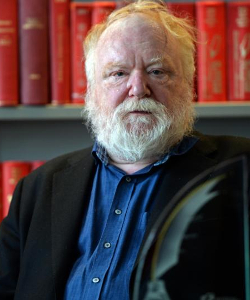
Frank McGuinness, award-winning Irish playwright and poet, is born in Buncrana, a town located on the Inishowen peninsula of County Donegal on July 29, 1953. As well as his own works, which include The Factory Girls, Observe the Sons of Ulster Marching Towards the Somme, Someone Who’ll Watch Over Me and Dolly West’s Kitchen, he is recognised for a “strong record of adapting literary classics, having translated the plays of Jean Racine, Sophocles, Henrik Ibsen, Federico García Lorca, and August Strindberg to critical acclaim.”

McGuinness is educated locally and at University College Dublin, where he studies Pure English and medieval studies to postgraduate level.

He first comes to prominence with his play The Factory Girls but establishes his reputation with his play about World War I, Observe the Sons of Ulster Marching Towards the Somme, which is staged in Dublin‘s Abbey Theatre and internationally. The play makes a name for him when it is performed at Hampstead Theatre, drawing comments about McGuinness’s Irish Catholic background. It wins numerous awards including the London Evening Standard Award for Most Promising Playwright for McGuinness and the Christopher Ewart-Biggs Memorial Prize. He has also written new versions of classic dramas, including works by Henrik Ibsen, Anton Chekhov, and Euripides, adapting the literal translations of others. In addition, he writes the screenplay for the film Dancing at Lughnasa, adapting the stage play by fellow Ulsterman Brian Friel.

McGuinness’s first poetry anthology, Booterstown, is published in 1994. Several of his poems have been recorded by Marianne Faithfull, including Electra, After the Ceasefire and The Wedding.

McGuinness previously lectured in Linguistics and Drama at the University of Ulster, Medieval Studies at University College, Dublin and English at the National University of Ireland, Maynooth. Then he is a writer-in-residence lecturing at University College Dublin before being appointed Professor of Creative Writing in the School of English, Drama and Film there in 2007.


Leave a comment

Birth of Charles Boyle, 4th Earl of Orrery

Charles Boyle, 4th Earl of Orrery, English nobleman, statesman and patron of the sciences, is born in Little Chelsea, London on July 28, 1674.

Boyle is the second son of Roger Boyle, 2nd Earl of Orrery, and his wife Lady Mary Sackville, daughter of Richard Sackville, 5th Earl of Dorset. He is educated at Christ Church, Oxford, and soon distinguishes himself by his learning and abilities. Like the first earl, he is an author, soldier and statesman. He translates Plutarch‘s life of Lysander, and publishes an edition of the epistles of Phalaris, which engages him in the famous controversy with Richard Bentley. He is a member of the Parliament of Ireland and sits for the Charleville constituency between 1695 and 1699. He is three times member for the town of Huntingdon and, upon the death of his brother, Lionel, 3rd earl, in 1703, he succeeds to the title.

Boyle enters the army, and in 1709 is raised to the rank of major-general and sworn one of Her Majesty’s Privy Council. He is appointed to the Order of the Thistle and appointed queen’s envoy to the states of Brabant and Flanders. Having discharged this trust with ability, he is created an English peer, as Baron Boyle of Marston, in Somerset. He inherits the estate in 1714.

Boyle becomes a Fellow of the Royal Society in 1706. In 1713, under the patronage of Boyle, clockmaker George Graham creates the first mechanical solar system model that can demonstrate proportional motion of the planets around the Sun. The device is named the orrery in the Earl’s honour.

Boyle receives several additional honours in the reign of George I but, having had the misfortune to fall under the suspicion of the government for playing a part in the Jacobite Atterbury Plot, he is committed to the Tower of London in 1722, where he remains six months, and is then admitted to bail. On a subsequent inquiry he is discharged.

Boyle writes a comedy, As you find it, printed in 1703 and later publishes together with the plays of the first earl. In 1728, he is listed as one of the subscribers to the Cyclopaedia of Ephraim Chambers.

Charles Boyle dies at his home in Westminster on August 28, 1731 and is buried in Westminster Abbey. He bequeaths his personal library and collection of scientific instruments to Christ Church Library. The instruments are now on display in the Museum of the History of Science, Oxford.

Boyle’s son John, the 5th Earl of Orrery, succeeds to the earldom of Cork on the failure of the elder branch of the Boyle family, as earl of Cork and Orrery.