Con Houlihan, Irish sportswriter, dies in Dublin on August 4, 2012. Despite only progressing to national journalism at the age of 46, he becomes “the greatest and the best-loved Irish sports journalist of all.”
Houlihan is born on December 6, 1925, in Castleisland, County Kerry. Over a lengthy career, Houlihan covers many Irish and international sporting events, from Gaelic football and hurling finals, to soccer and rugby World Cups, the Olympic Games and numberless race meetings inside and outside Ireland.
Houlihan is a journalist with the Irish Press group writing for The Irish Press, Evening Press and sometimes The Sunday Press, until the group’s demise in 1995. He writes the “Tributaries” column and Evening Press back sports page “Con Houlihan” column.
Houlihan dies on the morning of August 4, 2012 in St. James’s Hospital in Dublin. Often considered one of Ireland’s finest writers, he leaves behind a legacy of immense sports journalism that spans over 60 years. A minute’s silence is observed in his memory ahead of Kerry GAA‘s All-Ireland Senior Football Championship quarter-final defeat to Donegal GAA at Croke Park the following day. His last column, in which he wishes Irish Olympic boxer Katie Taylor well, is published the day after his death. His funeral takes place on August 8, 2012.
Ireland’s president, Michael D. Higgins, leads the tributes to Houlihan, describing him as a “most original writer, with a unique style based on his extensive knowledge of literature, politics, life and sport.” He adds, “He had that special quality and ability to identify with the passion, pain and celebration of Irish community life.”
A bronze bust of Houlihan is unveiled in his hometown of Castleisland in 2004. In 2011, another sculpture is erected outside The Palace bar in Dublin.
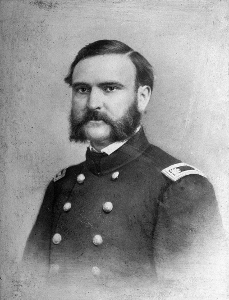
Born at Oldcastle, County Meath, on November 20, 1829, Halpine is the son of the Rev. Nicholas John Halpin. He is educated at Trinity College, Dublin, until 1846, with original intentions for the medical profession, but ultimately prefers the law. In his leisure time he writes for the press. The sudden death of his father and his own early marriage compel him to adopt journalism as a profession.
After moving back to New York, he secures employment with the New York Herald, and in a few months establishes relations with several periodicals. He undertakes a great variety of literary work, most of which is entirely ephemeral. He next becomes associate editor of The New York Times, for which he writes in 1855 and 1856 the Nicaragua correspondence at the time of William Walker‘s filibustering expedition. In 1857 he becomes principal editor and part proprietor of the New York Leader, which under his management rapidly increases in circulation.
At the beginning of the American Civil War in April 1861, he enlists in the 69th New York Infantry, in which he is soon elected a lieutenant, and serves during the three months for which he has volunteered. He is then transferred to the staff of General David Hunter as assistant-adjutant-general with the rank of major, and soon afterwards goes with him to Missouri to relieve General John Charles Frémont. He accompanies General Hunter to Hilton Head, and while there writes a series of burlesque poems in the assumed character of an Irish private. Several of them are contributed to the New York Herald in 1862 under the pseudonym of “Miles O’Reilly,” and with additional articles are issued in two volumes entitled Life and Adventures, Songs, Services, and Speeches of Private Miles O’Reilly, 47th Regiment New York Volunteers (1864), and Baked Meats of the Funeral, a Collection of Essays, Poems, Speeches, and Banquets, by Private Miles O’Reilly, late of the 47th Regiment New York Volunteer Infantry, 10th Army Corps. Collected, revised, and edited, with the requisite corrections of punctuation, spelling, and grammar, by an Ex-Colonel of the Adjutant-General’s Department, with whom the Private formerly served as Lance-Corporal of Orderlies (1866).
Halpine is subsequently assistant-adjutant-general on General Henry W. Halleck‘s staff with the rank of colonel in 1862 and accompanies General David Hunter as a staff-officer on his expedition up the Shenandoah Valley in the spring of 1864. On his return to New York, he resigns his commission in consequence of his bad eyesight, receiving the brevet of brigadier-general of volunteers.
He then makes New York his home and resumes his literary work. He becomes editor and, later, proprietor of the Citizen, a newspaper issued by the citizens’ association to advocate reforms in the civil administration of New York City. In 1867 he is elected registrar of the county of New York by a coalition of republicans and democrats. Incessant labour brings on insomnia. He has recourse to opiates, and his death in New York City on August 3, 1868, is caused by an undiluted dose of chloroform.
Broderick is the only child of the proprietors of a thriving local business, Broderick’s Bakery. His father dies when he is just three years old. He begins his secondary education at the Marist Brothers’ School but, at the age of 12, on his mother’s remarriage to the bakery manager in 1936, he is sent to board at St. Joseph’s College, GarballyBallinasloe. He leaves in 1941 without sitting the Leaving Certificate and is expected to take over the bakery business, but always intends to write.
From 1951 he lives for a time in Paris where he knows some of the French and expatriate literary community, among them Gore Vidal, Truman Capote, James Baldwin and most importantly Julien Green. Green is a French Academician and highly respected novelist and diarist, who becomes a mentor and personal friend. He visits Broderick in Athlone in 1974 and 1975.
The Irish Times accepts a travel article from Broderick in 1956. In the same year, the paper publishes the first of his book reviews. He continues to review widely and to write general articles for The Irish Times and Hibernia magazine, among others, until shortly before his death. As a critic he is frequently controversial being dismissive of a number of established writers including Heinrich Boll, Seamus Heaney and most notably Edna O’Brien while he is extremely generous and encouraging to a host of young Irish writers. His first novel, The Pilgrimage (1961) is banned by the Irish Censorship of Publications Board. Broderick is elected to membership of the Irish Academy of Letters in 1968, and in 1975 receives the Academy’s Annual Award for Literature.
Broderick lives most of his life in Athlone, with his mother until her death in 1974, and alone until he moves to Bath, England in 1981. He dies in Bath in 1989. The Westmeath County Library system has a collection of his papers, manuscripts and other materials.
Most of Broderick’s family are born and reared in Athlone, and many still live there today. John Broderick is third cousins to Shauna, Cliodhna and Aisling Golden, three sisters who perform together as a singing act called “The Golden Sisters” who are quarter finalists on the RTÉ prime time show “The All Ireland Talent Show.”
The Censorship of Publications Act is passed on July 16, 1929. The laws enacted by the Censorship of Publications Act, 1929 are introduced in an era of political isolationism and cultural and economic protectionism. Ireland’s culture is very moral and religious. Catholicism, the religion of 93% of the population, is the fundamental philosophy behind the censorship laws.
A main aim of the new legislation is to prevent the introduction of unwholesome foreign influences like materialism, consumerism and immorality from abroad. Specifically, this means works that are considered to be indecent or obscene, newspapers whose content relies too much on crime, and works that promote the “unnatural” prevention of conception or that advocate abortion. Irish writers who are found offensive are officially regarded as agents of decadence and social disintegration who are striking at the roots of family life and moral decency. For example, Father P.J. Gannon thinks that the Act is “but a simple measure of moral hygiene, forced upon the Irish public by a veritable spate of filth never surpassed.” He thinks that all literature must provide “noble ground for noble emotion.” PresidentÉamon de Valera feels that the arts in Ireland are to be encouraged when they observe the “holiest traditions,” but should be censored when they fail to live up to this ideal.
Although the new laws are typical of censorship laws in many other countries in the 1920s and 1930s, they are implemented with an eagerness which gradually alienates and embitters many Irish writers. It causes some writers to leave the country. The author Mervyn Wall explains that during the 1930s there is “a general intolerant attitude to writing, painting and sculpture. These were thought dangerous, likely to corrupt faith and morals…One encountered frequently among ordinary people bitter hostility to writers…Obscurantism had settled on the country like a fog, so of course anyone who had eyes to see and the heart to feel, was rebellious.”
The Academy of Letters established by William Butler Yeats attempts to fight censorship with solidarity among writers, but it achieves little in this field. The fight against literary censorship is fought mainly by isolated figures. Seán Ó Faoláin, perhaps the most vociferous critic of the censorship laws, writes, “Our Censorship…tries to keep the mind in a state of perpetual adolescence in the midst of all the influences that must, in spite of it, pour in from the adult world.”
Burke receives his early education at a Quaker school in Ballitore, County Kildare. In 1744, he enters Trinity College, Dublin, a Protestant establishment, which up until 1793, did not permit Catholics to take degrees. He graduates from Trinity in 1748. Burke’s father wants him to read Law, and with this in mind he goes to London in 1750, where he enters the Middle Temple, before soon giving up legal study to travel in Continental Europe. After eschewing the Law, he pursues a livelihood through writing.
Burke criticizes British treatment of the American colonies, including through its taxation policies. He also supports the American Revolution, believing both that it could not affect British or European stability and would be an innovative experiment in political development since the Americas are so far away from Europe and thus could have little impact on England.
Burke is remembered for his support for Catholic emancipation, the impeachment of Warren Hastings from the East India Company, and for his later opposition to the French Revolution. In his Reflections on the Revolution in France, he claims that the revolution is destroying the fabric of good society and condemned the persecution of the Catholic Church that results from it. This leads to his becoming the leading figure within the conservative faction of the Whig Party, which he dubs the “Old Whigs,” as opposed to the pro–French Revolution “New Whigs” led by Charles James Fox.
For more than a year prior to his death, Burke realizes that his “stomach” is “irrecoverably ruind.” Edmund Burke dies in Beaconsfield, Buckinghamshire, on July 9, 1797, and is buried there alongside his son and brother. His wife, Mary Jane Nugent, survives him by nearly fifteen years.
In the nineteenth century Burke is praised by both conservatives and liberals. Subsequently, in the twentieth century, he becomes widely regarded as the philosophical founder of modern conservatism.
After she graduates, her father employs her at his company but, following his death three years later, she changes professions and starts a public relations firm in 1983, which she runs for seven years. In 1983–84, she serves as secretary to the Fianna Fáil group at the New Ireland Forum. She serves as Charles Haughey‘s personal assistant, and becomes a family friend, taking holidays with his children. In 1987 she serves as election agent and party treasurer in Dublin North for Seán Haughey.
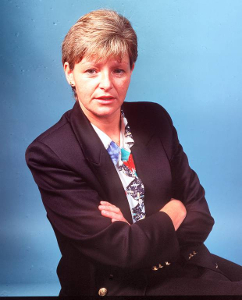
In 1990, she changes careers again, switching to journalism as a reporter with The Sunday Business Post and Sunday Tribune, working under editor Damien Kiberd. Craving first-hand information, she pursues a story directly to the source with little regard for her personal safety, to engage those she deems central to a story. This allows her to build close relationships with both the legitimate authorities, such as the Garda Síochána, and the criminals, with both sides respecting her diligence by providing highly detailed information. She also reports on Irish Republican Army activities in the Republic of Ireland.
From 1994 onwards, she begins to write about criminals for the Sunday Independent. Using her accountancy knowledge to trace the proceeds of illegal activity, she uses street names or pseudonyms for organized crime figures to avoid Irish libel laws.
When she begins to cover drug dealers, and gains information from convicted drugs criminal John Traynor, she receives numerous death threats. The first violence against her occurs in October 1994, when two shots are fired into her home after her story on murdered crime kingpin Martin Cahill is published. Guerin dismisses the “warning.” The day after writing an article on Gerry “The Monk” Hutch, on January 30, 1995, she answers her doorbell to a man pointing a revolver at her head. The gunman misses and shoots her in the leg. Regardless, she vows to continue her investigations.
On September 13, 1995, convicted criminal John Gilligan, Traynor’s boss, attacks her when she confronts him about his lavish lifestyle with no source of income. He later calls her at home and threatens to kidnap and rape her son and kill her if she writes anything about him.
On the evening of June 25, 1996, Gilligan drug gang members Charles Bowden, Brian Meehan, Kieran ‘Muscles’ Concannon, Peter Mitchell and Paul Ward meet at their distribution premises on the Greenmount Industrial Estate. The following day, while driving her red Opel Calibra, Guerin stops at a red traffic light on the Naas Dual Carriageway near Newlands Cross, on the outskirts of Dublin, unaware she is being followed. She is shot six times, fatally, by one of two men sitting on a motorcycle.
About an hour after Guerin is murdered, a meeting takes place in Moore Street, Dublin, between Bowden, Meehan, and Mitchell. Bowden later denies under oath in court that the purpose of the meeting is the disposal of the weapon but rather that it was an excuse to appear in a public setting to place them away from the incident.
At the time of her murder, Traynor is seeking a High Court order against Guerin to prevent her from publishing a book about his involvement in organised crime. Guerin is killed two days before she is due to speak at a Freedom Forum conference in London.
Guerin’s funeral is attended by Ireland’s TaoiseachJohn Bruton, and the head of the armed forces. It is covered live by Raidió Teilifís Éireann. On July 4, labour unions across Ireland call for a moment of silence in her memory, which is duly observed by people around the country. Guerin is buried in Dardistown Cemetery, County Dublin.
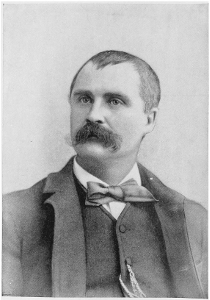
O’Reilly is the third child of a headmaster and a schoolteacher. When he is fifteen, he moves to Lancashire and lives with his aunt and uncle. There he becomes a reporter with a local newspaper and joins the 11th Lancashire Rifle Volunteers in 1861. He returns to Ireland in 1863 and enlists with the 10th Royal Hussars in Dublin. However, after realising the way the British are treating his fellow people, he leaves the army and joins the Irish Republican Brotherhood around 1865.
In 1866 O’Reilly, along with many other members of the Brotherhood, are arrested and put on trial for treason. O’Reilly is found guilty and sentenced to death however, due to his young age, his sentence is reduced to 20 years penal servitude. He spends a year and a half in some English prisons before being transported to Western Australia in 1867, arriving in 1868.
A month after arriving O’Reilly is moved to the town of Bunbury where he starts receiving attention for protesting the chopping down of a tree. A year after arriving he decides to escape from the colony with the help of a local Catholic priest and some farmers from the nearby town of Dardanup. In February 1869 O’Reilly absconds from his convict camp and makes his way towards the Leschenault Peninsula where he waits for a ship to arrive. After approximately two weeks O’Reilly escapes on the Gazelle bound for the United States, arriving there in November 1869.
O’Reilly moves to Boston and becomes a well-known figure in the town where he becomes involved in civil rights, sports, and Irish American causes. He also becomes part owner of The Pilot newspaper. He publishes four books of poetry – Songs from the Southern Seas (1873), Songs, Legends and Ballads (1878), The Statues in the Block (1881) and In Bohemia (1886). He also publishes a novel Moondyne (1879) based on the convict of the same name and O’Reilly’s experiences in Western Australia. It becomes his most popular work. He also writes one last book of poems entitled Watchwords, which is released after his death.
John Boyle O’Reilly dies in Hull, Massachusetts on August 10, 1890, from heart failure after overdosing on his wife’s medication. His sudden death receives an outpouring of grief and tributes from the Boston community and also globally.
His funeral is held at St. Mary’s Church in Charlestown on August 13 and is attended by thousands. The streets near the church are lined with mourners. His wife does not attend the funeral due to grief and is unable to leave her bed. He is originally buried at Calvary Cemetery in Roxbury, but in November 1890 his remains are exhumed and moved to Holyhood Cemetery in Brookline.
Young is born in Galgorm Castle, Ballymena, County Antrim, daughter and seventh of twelve children born to Grace Charlotte Savage, and John Young who is a prosperous unionist and high sheriff. Despite his position he is a believer in tenant rights. Her younger sister is the writer Ella Young and her brother Willie Young is secretary of the Ulster Unionist League.
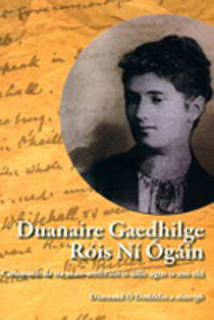
Young is educated by governesses until 1884 before completing training as a teacher through Cambridge University. Young also attends Gaelic League classes in 1903 in London while visiting her sister who is living in the city at the time. After visiting the Bodleian Library she becomes committed to the study of the Irish language.
In the early 1900s Young returns to Ireland and continues her study of the Irish language in Belfast at Seán Ó Catháin‘s Irish College and in County Donegal at Coláiste Uladh in Gort an Choirce. Young also stays in Dublin and becomes friends with members of the Gaelic League and meets Margaret Dobbs. Young works with Dobbs on the Feis na nGleann (The Glens Festival), a gathering dedicated to the Irish language.
Young is not involved in nationalism though she is strongly supportive of creating and maintaining a sense of “Irishness” through language and culture. She is also a friend and patron of Roger Casement. She also works with Ellen O’Brien and contributes to O’Brien’s book, The Gaelic Church. She keeps meticulous diaries and becomes interested in Rathlin Island and the Gaelic spoken there.
Rose Young is buried in the Presbyterian churchyard at Ahoghill, County Antrim.
O’Grady is born on March 22, 1846, at Castletown, County Cork, the son of Reverend Thomas O’Grady, the scholarly Church of Ireland minister of Castletown Berehaven, County Cork, and Susanna Doe. After a rather severe education at Tipperary Grammar School, O’Grady follows his father to Trinity College, Dublin, where he wins several prize medals and distinguishes himself in several sports.
O’Grady proves too unconventional of mind to settle into a career in the church and earns much of his living by writing for the Irish newspapers. Reading Sylvester O’Halloran‘s General history of Ireland sparks an interest in early Irish history. After an initial lukewarm response to his writing on the legendary past in History of Ireland: Heroic Period (1878–81) and Early Bardic Literature of Ireland (1879), he realizes that the public wants romance, and so follows the example of James Macpherson in recasting Irish legends in literary form, producing historical novels including Finn and his Companions (1891), The Coming of Cuculain (1894), The Chain of Gold (1895), Ulrick the Ready (1896) and The Flight of the Eagle (1897), and The Departure of Dermot (1913).
O’Grady also studies Irish history of the Elizabethan period, presenting in his edition of Sir Thomas Stafford‘s Pacata Hibernia (1896) the view that the Irish people have made the Tudors into kings of Ireland in order to overthrow their unpopular landlords, the Irish chieftains. His The Story of Ireland (1894) is not well received, as it sheds too positive a light on the rule of Oliver Cromwell for the taste of many Irish readers. He is also active in social and political campaigns in connection with such issues as unemployment and taxation.
Until 1898, he works as a journalist for the Daily Express of Dublin, but in that year, finding Dublin journalism in decline, he moves to Kilkenny to become editor of the Kilkenny Moderator. It is here he becomes involved with Ellen Cuffe, Countess of Desart and Captain Otway Cuffe. He engages in the revival of the local woolen and woodworking industries. In 1900 he founds the All-Ireland Review and returns to Dublin to manage it until it ceases publication in 1908. O’Grady contributes to James Larkin‘s The Irish Worker paper.
O’Grady’s works are an influence on William Butler Yeats and George Russell and this leads to him being known as the “Father of the Celtic Revival.” Being as much proud of his family’s Unionism and Protestantism as of his Gaelic Irish ancestry, identities that are increasingly seen as antithetical in the late 1800s, he is described by Augusta, Lady Gregory as a “fenian unionist.”
Advised to move away from Ireland for the sake of his health, O’Grady passes his later years living with his eldest son, a clergyman in England, and dies on the Isle of Wight on May 18, 1928.
O’Grady’s eldest son, Hugh Art O’Grady, is for a time editor of the Cork Free Press before he enlists in World War I early in 1915. He becomes better known as Dr. Hugh O’Grady, later Professor of the Transvaal University College, Pretoria, who writes the biography of his father in 1929.
Graham’s long time colleague and Hot Press editor Niall Stokes describes him, “In many ways, he was a founding father of modern Irish music. He inspired a whole generation of Irish fans and musicians to look at the world in a different and broader light. And he was good on more than music too. He felt a kinship with Northern Ireland and the people on both sides of the sectarian and political divide there that was unusual in those who were brought up within the narrow confines of the culture of Ireland in the ‘60s and ‘70s – and his political writing reflected this. And he was also ahead of the game in terms of his appreciation of the importance of the politics of food and the position of the developing world in the new era.”
Graham is instrumental in the formation of Irish rock band U2, having brought them to the attention of their manager Paul McGuinness. At an exhibition of early group photos, McGuinness remembers the role Bill Graham played by introducing him to the band. Despite being widely known as the man who “discovered” U2, it is a title he disavowed. He writes enthusiastically about the band, giving them their first exposure. Both guitarist The Edge and Bono have explained Graham’s role in the band’s development.
John Waters observes that “It is often said that Bill ‘discovered’ U2. This is untrue. Bill created U2, through his enthusiasm for them. He gave them a reflection of their own possibilities and they only looked back that once.” Graham has a deep knowledge of virtually every form of popular and roots music. Waters goes on to credit him as “the first Irish writer to write about the connection between Irish political culture and Irish rock’n’roll.”
A number of music critics/journalists have cited Graham as a primary influence, in some cases suggesting they got into the field as a direct result of his writing.





 seamus dubhghaill