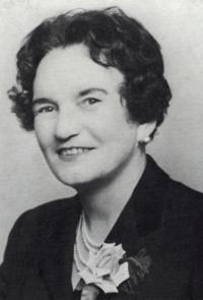
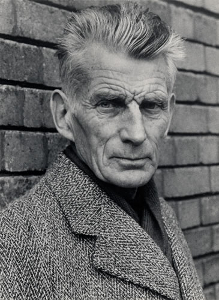
Máiréad Ní Ghráda, poet, playwright, and broadcaster, dies on June 13, 1971. She is a tireless promoter of the Irish language and writes many educational texts, some of which are still widely used today including Progress in Irish.
Máiréad is born and raised in Kilmaley, County Clare, a Breac Ghaeltacht, with Irish speaking parents. She wins a university scholarship while attending the local Convent of Mercy School and receives a BA in English, Irish, and French and an MA in Irish from University College Dublin (UCD).
Beginning in 1926 she spends nine years working for 2RN (now Radió Éireann). She is the first female announcer with 2RN, engaged as Woman’s Organiser with the national radio station for many years, a job which involves programming for women and children. She is the first female announcer in Ireland and Britain, and perhaps in Europe.
Máiréad writes her first play in 1931 while teaching Irish in a domestic science college in Kilmacud. An Uacht, a one act comedy based on Gianni Schicchi by Giacomo Puccini, is produced by Michéal Mac Liammóir at the Gate Theatre (1931). Her writing for theatre includes Mícheál, 1933 (adaptation of Michael, a story by Leo Tolstoy), An Grádh agus an Garda (1937), Giolla an tSoluis (1945), Hansel & Gretel (1951), Lá Buí Bealtaine (1953), Úll glas Oíche Shamhna (1955), Ríte (1955), Súgán Sneachta (1959), Mac Uí Rudaí (1961) and Stailc Ocrais (1962). An Triail (1964) and On Trial (1965) and Breithiúnas (1968), although critical of Irish society at the time, are her greatest successes.
Her enormous contribution to Irish language theatre includes eleven original plays, more than any other playwright in Irish.
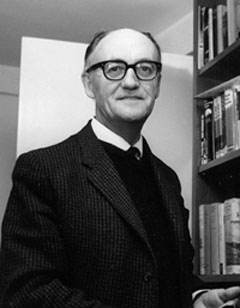
Brian Coffey, Irish poet and publisher, is born in Dún Laoghaire, County Dublin on June 8, 1905. His work is informed by his Catholicism and by his background in science and philosophy, and his connection to surrealism. For these reasons, he is seen as being closer to an intellectual European Catholic tradition than to mainstream Irish Catholic culture.
In the early 1930s, Coffey moves to Paris where he studies Physical Chemistry under Jean Baptiste Perrin, who won the Nobel Prize for Physics in 1926. He completes these studies in 1933, and his Three Poems is printed in Paris by Jeanette Monnier that same year. In 1934 he enters the Institut Catholique de Paris to work with the noted French philosopher Jacques Maritain, taking his licentiate examination in 1936. He then moves to London for a time and contributes reviews and a poem to T.S. Eliot‘s The Criterion magazine. He returns to Paris in 1937 as an exchange student to work on his doctoral thesis on the idea of order in the work of Thomas Aquinas. In 1938, Coffey’s second volume of poetry, Third Person, is published by George Reavey‘s Europa Press.
During the war, Coffey teaches in schools in London and Yorkshire, leaving his young family in Dublin. After the war, he returns to Paris and completes his doctoral thesis. The family then moves so that Coffey can take up a teaching post at the JesuitSaint Louis University.
By the early 1950s, Coffey becomes uncomfortable for a number of reasons, including the nature of his work, his distance from Ireland and the pressures that inevitably come to bear on an academic who has previously associated with well-known left-wing writers in Paris. For these reasons, he resigns in 1952.
In 1952, Coffey returns to live in London and, from 1973, Southampton. He begins again to publish his poetry and translations, mainly of French poetry. The first work in English to appear after this period of silence is Missouri Sequence, apparently begun in St. Louis but first appearing in the University Review, later known as the Irish University Review, in 1962.
Over the next decade or so, he publishes regularly in the University Review. He also sets up his own publishing enterprise, Advent Press, which publishes work by himself and by younger writers he wants to support.
Brian Coffey dies at the age of 89 on April 14, 1995, and is buried in Southampton, England.
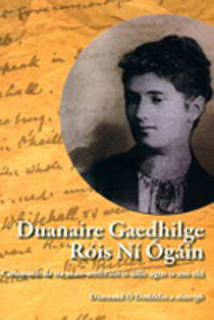
Young is born in Galgorm Castle, Ballymena, County Antrim, daughter and seventh of twelve children born to Grace Charlotte Savage, and John Young who is a prosperous unionist and high sheriff. Despite his position he is a believer in tenant rights. Her younger sister is the writer Ella Young and her brother Willie Young is secretary of the Ulster Unionist League.
Young is educated by governesses until 1884 before completing training as a teacher through Cambridge University. Young also attends Gaelic League classes in 1903 in London while visiting her sister who is living in the city at the time. After visiting the Bodleian Library she becomes committed to the study of the Irish language.
In the early 1900s Young returns to Ireland and continues her study of the Irish language in Belfast at Seán Ó Catháin‘s Irish College and in County Donegal at Coláiste Uladh in Gort an Choirce. Young also stays in Dublin and becomes friends with members of the Gaelic League and meets Margaret Dobbs. Young works with Dobbs on the Feis na nGleann (The Glens Festival), a gathering dedicated to the Irish language.
Young is not involved in nationalism though she is strongly supportive of creating and maintaining a sense of “Irishness” through language and culture. She is also a friend and patron of Roger Casement. She also works with Ellen O’Brien and contributes to O’Brien’s book, The Gaelic Church. She keeps meticulous diaries and becomes interested in Rathlin Island and the Gaelic spoken there.
Rose Young is buried in the Presbyterian churchyard at Ahoghill, County Antrim.
The work of Gore-Booth, alongside that of Esther Roper, the English woman who would become her lifelong companion, is responsible for the close link between the struggle for women’s rights in industry and the struggle for women’s right to vote. As a middle-class suffragist representing Manchester, the work of Gore-Booth is mainly recognized in the Lancashire cotton towns from 1899 to 1913. Her struggle begins when she becomes a member of the executive committee of the National Union of Women’s Suffrage Societies. Carrying out work at the Ancoats settlement, Eva becomes co-secretary of the Manchester and Salford Women’s Trade Union Council.
In 1902 Gore-Booth campaigns at the Clitheroe by-election on behalf of David Shackleton, a Labour candidate who promises her that he would show support for the women’s enfranchisement. Shackleton is elected but does not act upon his promise. This leads to the founding of the Lancashire and Cheshire Women Textile and Other Worker’s Representation Committee by Gore-Booth, Esther Roper and Sarah Reddish. When the Women’s Trade Union Council refuses to make women’s suffrage one of its aims, Gore-Booth resigns from the council.
In 1902 Gore-Booth campaigns at the Clitheroe by-election on behalf of David Shackleton, a Labour candidate who promises her that he would show support for the women’s enfranchisement. Shackleton is elected but does not act upon his promise. This leads to the founding of the Lancashire and Cheshire Women Textile and Other Worker’s Representation Committee by Gore-Booth, Esther Roper and Sarah Reddish. When the Women’s Trade Union Council refuses to make women’s suffrage one of its aims, Gore-Booth resigns from the council.
In 1907 Gore-Booth, reluctant to give up hope, contributes an essay “The Women’s Suffrage Movement Among Trade Unionists” to The Case for Women’s Suffrage. In this essay Eva gives a summary of reasons for the methods of the LCWTOW campaign to gain a vote for working women.
When Gore-Booth embarks on her writing career she is visited by William Butler Yeats who is very much taken with her work. Yeats hopes that she will take up his cause of writing Irish tales to enchant and amuse. Instead, Eva takes Irish folklore and put emphasis on the females in the story. Her widely discussed sexuality in later years is never declared but her poetry reflects it quite overtly. Gore-Booth is also one of a group of editors of the magazine Urania that publishes three issues per year from 1916 to 1940. It is a feminist magazine that reprints stories and poems from all over the world with editorial comment.
After years of playing a lead role in the Women’s Suffrage Movement and fighting for equality of women’s rights in the UK as well as staying true to her literary roots, Gore-Booth and Roper relocate to London from Manchester in 1913 due to Gore-Booth’s deteriorating respiratory health.
Just weeks after the 1916 Easter Rising, Gore-Booth travels to Dublin accompanied by Roper and is pivotal in the efforts to reprieve the death sentence of her sister Constance Markievicz awarded for her instrumental role in the rising, which is successfully converted to a life sentence. She further campaigns to abolish the death sentence overall and to reform prison standards. She attends the trial of Irish nationalist and fellow poet Roger Casement thus showing solidarity and support for the overturning of his death sentence.
During the remaining years of her life, which is claimed by cancer on June 30, 1926, Gore-Booth remains devoted to her poetry, dedicates time to her artistic talents as a painter, studies the Greek language and is known as a supporter of animal rights. She dies in her home in Hampstead, London, which she shares with Roper until her passing. She is buried alongside Roper in St. John’s churchyard, Hampstead.
O’Grady is born on March 22, 1846, at Castletown, County Cork, the son of Reverend Thomas O’Grady, the scholarly Church of Ireland minister of Castletown Berehaven, County Cork, and Susanna Doe. After a rather severe education at Tipperary Grammar School, O’Grady follows his father to Trinity College, Dublin, where he wins several prize medals and distinguishes himself in several sports.
O’Grady proves too unconventional of mind to settle into a career in the church and earns much of his living by writing for the Irish newspapers. Reading Sylvester O’Halloran‘s General history of Ireland sparks an interest in early Irish history. After an initial lukewarm response to his writing on the legendary past in History of Ireland: Heroic Period (1878–81) and Early Bardic Literature of Ireland (1879), he realizes that the public wants romance, and so follows the example of James Macpherson in recasting Irish legends in literary form, producing historical novels including Finn and his Companions (1891), The Coming of Cuculain (1894), The Chain of Gold (1895), Ulrick the Ready (1896) and The Flight of the Eagle (1897), and The Departure of Dermot (1913).
O’Grady also studies Irish history of the Elizabethan period, presenting in his edition of Sir Thomas Stafford‘s Pacata Hibernia (1896) the view that the Irish people have made the Tudors into kings of Ireland in order to overthrow their unpopular landlords, the Irish chieftains. His The Story of Ireland (1894) is not well received, as it sheds too positive a light on the rule of Oliver Cromwell for the taste of many Irish readers. He is also active in social and political campaigns in connection with such issues as unemployment and taxation.
Until 1898, he works as a journalist for the Daily Express of Dublin, but in that year, finding Dublin journalism in decline, he moves to Kilkenny to become editor of the Kilkenny Moderator. It is here he becomes involved with Ellen Cuffe, Countess of Desart and Captain Otway Cuffe. He engages in the revival of the local woolen and woodworking industries. In 1900 he founds the All-Ireland Review and returns to Dublin to manage it until it ceases publication in 1908. O’Grady contributes to James Larkin‘s The Irish Worker paper.
O’Grady’s works are an influence on William Butler Yeats and George Russell and this leads to him being known as the “Father of the Celtic Revival.” Being as much proud of his family’s Unionism and Protestantism as of his Gaelic Irish ancestry, identities that are increasingly seen as antithetical in the late 1800s, he is described by Augusta, Lady Gregory as a “fenian unionist.”
Advised to move away from Ireland for the sake of his health, O’Grady passes his later years living with his eldest son, a clergyman in England, and dies on the Isle of Wight on May 18, 1928.
O’Grady’s eldest son, Hugh Art O’Grady, is for a time editor of the Cork Free Press before he enlists in World War I early in 1915. He becomes better known as Dr. Hugh O’Grady, later Professor of the Transvaal University College, Pretoria, who writes the biography of his father in 1929.
Walter Macken, writer of short stories, novels and plays, is born at 18 St. Joseph’s Terrace in Galway, County Galway on May 3, 1915.
Macken’s father, Walter Macken, Sr., formerly a carpenter, joins the British Army in 1915 and is killed in March of the following year at St Eloi. The family therefore has to rely on lodgers and a small service pension to sustain them.
Macken attends the Presentation Convent for Infants from (1918-1921), St. Mary’s, a Diocesan College where they train people who want to become priests (1923-1924), and Patrician Brothers both Primary and Secondary (1921-1922 and 1924-1934), where he takes his Leaving Certificate. He is writing short stories, novels, and plays in exercise books from the age of eight and carries on these works well into his teens.
Macken is originally an actor, principally with the Taibhdhearc na Gaillimhe in Galway, where he meets his wife Peggy, and The Abbey Theatre in Dublin. He also plays lead roles on Broadway in M. J. Molloy‘s The King of Friday’s Men and his own play Home Is the Hero. The success of his third book, Rain on the Wind, winner of the Literary Guild award in the United States, enables him to focus his energies on writing.
His son Ultan Macken is a well-known journalist in the print and broadcast media of Ireland, and wrote a biography of his father, Walter Macken: Dreams on Paper.
Walter Macken dies of heart failure at the age of 51 in Menlo, County Galway, on April 22, 1967.
Edith Anna Œnone Somerville, Irish novelist who habitually signs herself as “E. Œ. Somerville,” is born on May 2, 1858, on the island of Corfu, then part of the United States of the Ionian Islands, a British protectorate where her father is stationed. She writes in collaboration with her cousin “Martin Ross” (Violet Martin) under the pseudonym “Somerville and Ross.” Together they publish a series of fourteen stories and novels, the most popular of which are The Real Charlotte, and The Experiences of an Irish R. M., published in 1899.
In January 1886 she meets her cousin Violet Martin, and their literary partnership begins the following year. Their first book, An Irish Cousin, appears in 1889, under the names Geilles Herring (from the maiden name of her ancestor, the wife of Sir Walter de Somerville of Linton and Carnwath) and Martin Ross, though the pen names are dropped after the first edition. In 1898, Somerville goes to paint at the Etaples art colony, accompanied by Violet. There they profit from their stay by conceiving together the stories later gathered in Some Experiences of an Irish R. M., completed the following year. By the time Violet dies in 1915, they have published fourteen books together. Her cousin’s death stuns Somerville, who continues to write as “Somerville and Ross,” claiming that they keep in contact through spiritualist séances.
Somerville is a devoted sportswoman who in 1903 becomes master of the Carbery West Foxhounds. She is also active in the suffrage movement, corresponding with Dame Ethel Smyth. She is in London still recovering from the shock of Violet’s death when the Easter Rising of 1916 breaks out. On May 9, 1916, she writes a letter to The Times, blaming the British government for the state of affairs in Ireland. After that she tends towards Nationalism, and as an adept musician at parties, she specializes in Irish tunes and Nationalist songs.
She has exhibitions of her pictures in Dublin and in London between 1920 and 1938 and is active as an illustrator of children’s picture books and sporting picture books.
Edith Somerville dies at Castletownshend on October 8, 1949, at the age of 91. She is buried alongside Violet Florence Martin at Saint Barrahane’s Church, Castletownsend, County Cork.
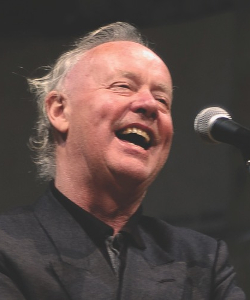
Brendan Kennelly, Irish poet and novelist, is born in Ballylongford, County Kerry, on April 17, 1936. Now retired from teaching, he serves as Professor of Modern Literature at Trinity College, Dublin until 2005. Since his retirement he has been titled “Professor Emeritus” by Trinity College.
Kennelly is educated at the inter-denominational St. Ita’s College, Tarbert, County Kerry, and at Trinity College, Dublin where he edits the student literary magazineIcarus. He graduates from Trinity and writes his PhD thesis there. He also studies at Leeds University. Brendan is married for 18 years to Margaret (Peggy) O’Brien, a colleague in the English Department at Trinity College. They live together in Sandymount, Dublin, with daughter Doodle for 12 years before separating. Brendan and Peggy remain friends and Peggy is now remarried. Peggy is a published poet and Professor of English at the University of Massachusetts Amherst.
Kennelly’s poetry can be scabrous, down-to-earth and colloquial. He avoids intellectual pretension and literary posturing, and his attitude to poetic language can be summed up in the title of one of his epic poems, “Poetry my Arse.” A 400-page long epic poem, “The Book of Judas”, published in 1991, tops the Irish best-seller list.
A prolific and fluent writer, he has more than twenty books of poetry to his credit, including My Dark Fathers(1964), Collection One: Getting Up Early (1966), Good Souls to Survive (1967), Dream of a Black Fox (1968), Love Cry(1972), The Voices (1973), Shelley in Dublin (1974), A Kind of Trust (1975), Islandman (1977), A Small Light (1979) and The House That Jack Didn’t Build (1982).
Kennelly has edited several other anthologies, including “Between Innocence and Peace: Favourite Poems of Ireland” (1993), “Ireland’s Women: Writings Past and Present, with Katie Donovan and A. Norman Jeffares” (1994), and “Dublines,” with Katie Donovan (1995).
Kennelly has also written two novels, “The Crooked Cross” (1963) and “The Florentines” (1967), and three plays in a Greek Trilogy, Antigone,Medea and The Trojan Women.
Kennelly is an Irish language speaker, and has translated Irish poems in “A Drinking Cup” (1970) and “Mary” (Dublin 1987). A selection of his collected translations is published as “Love of Ireland: Poems from the Irish” (1989).
Language is important in Kennelly’s work – in particular the vernacular of the small and isolated communities in North Kerry where he grew up, and of the Dublin streets and pubs where he becomes both roamer and raconteur for many years. Kennelly’s language is also grounded in the Irish-language poetic tradition, oral and written, which can be both satirical and salacious in its approach to human follies.
Regarding the oral tradition, Kennelly is a great reciter of verse with tremendous command and the rare ability to recall extended poems by memory, both his own work and others, and recite them on call verbatim.
Kennelly has commented on his own use of language: “Poetry is an attempt to cut through the effects of deadening familiarity and repeated, mechanical usage in order to unleash that profound vitality, to reveal that inner sparkle. In the beginning was the Word. In the end will be the Word…language is a human miracle always in danger of drowning in a sea of familiarity.”
John Millington Synge, a leading figure in the Irish Literary Revival, is born at Rathfarnham, near Dublin, on April 16, 1871. He is a poetic dramatist of great power who portrays the harsh rural conditions of the Aran Islands and the western Irish seaboard with sophisticated craftsmanship.
After studying at Trinity College and at the Royal Irish Academy of Music in Dublin, Synge pursues further studies from 1893 to 1897 in Germany, Italy, and France. In 1894 he abandons his plan to become a musician and instead concentrates on languages and literature. He meets William Butler Yeats while studying at the Sorbonne in Paris in 1896. Yeats inspires him with enthusiasm for the Irish renaissance and advises him to stop writing critical essays and instead to go to the Aran Islands and draw material from life. Already struggling against the progression of Hodgkin’s lymphoma which is untreatable at the time and eventually causes his death, Synge lives in the islands during part of each year between 1898 and 1902, observing the people and learning their language, recording his impressions in The Aran Islands (1907) and basing his one-act plays In the Shadow of the Glen and Riders to the Sea (1904) on islanders’ stories. In 1905 his first three-act play, The Well of the Saints, is produced.
Synge’s travels on the Irish west coast inspire his most famous play, The Playboy of the Western World (1907). This morbid comedy deals with the moment of glory of a peasant boy who becomes a hero in a strange village when he boasts of having just killed his father but who loses the villagers’ respect when his father turns up alive. In protest against the play’s unsentimental treatment of the Irishmen’s love for boasting and their tendency to glamorize ruffians, the audience riots at its opening at Dublin’s Abbey Theatre. Riots of Irish Americans accompany its opening in New York City in 1911, and there are further riots in Boston and Philadelphia. Synge remains associated with the Abbey Theatre, where his plays gradually win acceptance, until his death. His unfinished Deirdre of the Sorrows, a vigorous poetic dramatization of one of the great love stories of Celtic mythology, is performed there in 1910.
In the seven plays he writes during his comparatively short career as a dramatist, Synge records the colourful and outrageous sayings, flights of fancy, eloquent invective, bawdy witticisms, and earthy phrases of the peasantry from Kerry to Donegal. In the process he creates a new, musical dramatic idiom, spoken in English but vitalized by Irish syntax, ways of thought, and imagery.
Samuel Barclay Beckett, avant-garde novelist, playwright, theatre director, and poet, is born on Good Friday, April 13, 1906, in Foxrock, Dublin. His father, William Frank Beckett, works in the construction business and his mother, Maria Jones Roe, is a nurse. Beckett attends Earlsfort House School in Dublin and then, at age 14, he goes to Portora Royal School, the same school attended by Oscar Wilde. He receives his bachelor’s degree from Trinity College, Dublin in 1927. In his youth he periodically experiences severe depression keeping him in bed until mid-day. This experience later influences his writing.
In 1928, Beckett finds a welcome home in Paris where he meets and becomes a devoted student of James Joyce. In 1931, he embarks on a restless sojourn through Great Britain, France and Germany. He writes poems and stories and does odd jobs to support himself. On his journey, he comes across many individuals who inspire some of his most interesting characters.
In 1937, Beckett settles in Paris. Shortly thereafter, he is stabbed by a pimp after refusing his solicitations. While recovering in the hospital, he meets Suzanne Dechevaux-Dumesnuil, a piano student in Paris. The two become life-long companions and eventually marry. After meeting with his attacker, Beckett drops the charges, partly to avoid the publicity.
During World War II, Beckett’s Irish citizenship allows him to remain in Paris as a citizen of a neutral country. He fights in the resistance movement until 1942 when members of his group are arrested by the Gestapo. He and Suzanne flee to the unoccupied zone until the end of the war.
After the war, Beckett is awarded the Croix de Guerre for bravery during his time in the French resistance. He settles in Paris and begins his most prolific period as a writer. In five years, he writes Eleutheria, Waiting for Godot, Endgame, the novels Molloy, Malone Dies, The Unnamable, and Mercier et Camier, two books of short stories, and a book of criticism.
Beckett’s first publication, Molloy, enjoys modest sales, but more importantly praise from French critics. Soon, Waiting for Godot, achieves quick success at the small Theatre de Babylone putting Beckett in the international spotlight. The play runs for 400 performances and enjoys critical praise.
Beckett writes in both French and English, but his most well-known works, written between World War II and the 1960s, are written in French. Early on he realizes his writing has to be subjective and come from his own thoughts and experiences. His works are filled with allusions to other writers such as Dante Alighieri, René Descartes, and James Joyce. Beckett’s plays are not written along traditional lines with conventional plot and time and place references. Instead, he focuses on essential elements of the human condition in dark humorous ways. This style of writing has been called “Theater of the Absurd” by Martin Esslin, referring to poet Albert Camus’ concept of “the absurd.” The plays focus on human despair and the will to survive in a hopeless world that offers no help in understanding.
The 1960s are a period of change for Beckett. He finds great success with his plays across the world. Invitations come to attend rehearsals and performances which lead to a career as a theater director. In 1961, he secretly marries Suzanne Dechevaux-Dumesnuil who takes care of his business affairs. A commission from the BBC in 1956 leads to offers to write for radio and cinema through the 1960s.
Beckett continues to write throughout the 1970s and 1980s, mostly in a small house outside Paris. There he can give total dedication to his art evading publicity. In 1969, he is awarded the Nobel Prize in Literature, though he declines accepting it personally to avoid making a speech at the ceremonies. However, he should not be considered a recluse. He often times meets with other artists, scholars and admirers to talk about his work.
By the late 1980s, Beckett is in failing health and is moved to a small nursing home. His wife Suzanne dies in July 1989. His life is confined to a small room where he receives visitors and writes. He dies on December 22, 1989, in a hospital of respiratory problems just months after his wife.